www.wjpr.net Vol 4, Issue 09, 2015.
1396
EFFECT OF DIFFERENT SITTING POSTURES ON PULMONARY
FUNCTION IN YOUNG HELTHY INDIVIDUALS
Dr. Jumana J. Vanwala*, Dr. Sweety Shah, Dr. Neeta Vyas.
Gujarat, India.
ABSTRACT
Introduction- Spirometry is physiological test that measures how an individual inhale or exhales Volumes of air as a function of time. Neck
pain & back pain are very common condition in young individuals due
to their abnormal sitting postures like slumped sitting & slouched
sitting. So purpose of this study is to see whether these abnormal
sitting postures affect their pulmonary function or not. Aims and
objective- To determine the changes in pulmonary function in young
healthy individuals with variation in sitting postures. Method- Ethic’s
approval and written informed consent of the 90 subjects was taken prior to study. In this
study male & female between age group of 18 to 24 years with normal BMI (18.5 to
22.9kg/m2), good posture, nonsmokers & willing to participate were included. Subjects who
have BMI<18.5 or >22.9 kg/m2, poor posture, any orthopedic, cardiovascular or neurological
disease and doing gym training, yoga or pranayam were excluded. Each participant was given
three different sitting postures-Slumped, Upright, Slouched. 30 seconds rest period was
provided in between the postures. Outcome measures- FEV1(forced expiratory volume) %
of predicted, FVC (forced vital capacity) % of predicted, PEF (peak expiratory flow) % of
predicted, MVV (maximum voluntary ventilation) % of predicted RESULT- Statistical
analysis was done by SPSS version 16. One way- ANOVA test was applied to determine
difference of pulmonary function in three different postures. Pulmonary function was better
in upright posture but p value is not significant in any of the postures. CONCLUSION-
There is no effect on pulmonary function in upright, slumped and slouched sitting postures in
young healthy individuals’ in the age group of 18 to 24 years.
KEYWORDS: pulmonary function, slumped posture, slouched posture.
Volume 4, Issue 9, 1396-1409. Research Article ISSN 2277– 7105
Article Received on 30 June 2015,
Revised on 24 July 2015, Accepted on 18 Aug 2015
*Correspondence for
Author
Dr. Jumana J. Vanwala
Gujarat, India.
www.wjpr.net Vol 4, Issue 09, 2015.
1397 INTRODUCTION
Normal health is state of complete physical, mental and social well-being and not merely the
absence of disease or infirmity.[1] Young is considered as 15 to 24 year old male & female
according to standard provisional classification for age.[2] Postural changes can occur in
healthy populations due to habitual lifestyle factors, age or in association with pathology,
pain, or injury.[3] Habitual postures that overstretch extensor muscles and shorten flexor
muscles can lead to structural changes with potentially permanent negative impact on
physical functioning and quality of life.[4] Many respiratory conditions are noted because of
structural deformities which could have been prevented rather by correcting the abnormalities
in posture in early phase of development. One important fact of developing abnormal posture
in young healthy individuals is their faulty sitting positions most of the time. Young
individuals have to sit for long hours in lectures as well as on computers & during reading,[4]
writing & even when driving vehicles & they usually assumes different kinds of sitting
postures. Correct posture is the position in which minimum stress is applied to each joint.[5]
Faulty postureis any static position that increases the stress is applied to each joint.[5]
Slouch and slumped sitting positions are most commonly used by them. Slumped posture is
defined as relaxed sitting posture generally involves an abnormal degree of thoracic kyphosis
with abducted scapula and forward position of head.[6] Slouched sitting is defined as the LoG
is posterior to the spine and hips and body is being supported by the back of chair.[7] There
are chances of development of back and neck pain secondary to this abnormal sitting
postures.Furthermore, as respiratory muscles also have postural functions. Changes in
postural alignment affect position, range of motion and coupling patterns of the spinal and rib
articulations, which influence compliance via changing articular range of motion available for
respiration .Given the complex anterior and posterior articulations of the thoracic spine and
ribcage, it is reasonable to speculate that alignment changes in one plane will have the
potential to affect the three-dimensional shape and motion of the chest wall during breathing.
It is well documented that changes in body position (supine vs. standing vs. prone) alter
pulmonary function and the relative contribution to the rib cage and abdomen to ventilation.[3]
Since long, pulmonary function test is used mainly for the diagnostic purposes in respiratory
conditions.[8] Spirometry is a physiological test that measures how an individual inhales or
exhales volumes of air as a function of time. The primary signal measured in spirometry may
be volume or flow.[9] There are changes due to BMI on pulmonary function.[10] There is also
www.wjpr.net Vol 4, Issue 09, 2015.
1398
and lung ventilation are partially a result of thoracic mobility as well as excursion of the
diaphragm. The ability of the thorax to expand during inspiration and to return to resting
position during exhalation is dependent on the mobility of the thoracic spine and ribs. A
change in the position of the thoracic spine, that is, scoliosis, may alter the mechanics of the
chest wall, which may cause a uniform or asymmetrical change in the ability of the thorax to
expand. The seated leaning forward position is the optimum posture for the patients to
generate maximum inspiratory pressures and to obtain greatest subjective relief of
dyspnoea.[12] A previous study showed decreased activity of scalene and sternocleidomastoid
muscles in a forward leaning position.[13] In contrast another study indicated that a forward
leaning position with arm support allowed accessory muscles (i.e. pectoralis minor and
major) to contribute significantly to rib cage elevation, and arm and head support contribution
to inspiration in the forward leaning position.[14]
Although chronic obstructive pulmonary disease (COPD) is most closely associated with a
decrease in pulmonary function, it is also associated with secondary problems, such as weight
gain and a sedentary lifestyle. Such secondary problems further potentiate changes in
pulmonary function, stimulating a vicious cycle of worsening pulmonary function, increasing
weight and sedentariness. Commonly, those with COPD sit for long periods of time. Some
may be confined to wheelchair use. Moreover, those who sit for long periods often assume a
slumped posture, resulting in an increase in thoracic kyphosis. This slumped, kyphotic
posture has been postulated to be deleterious to some patients, especially those diagnosed
with COPD. It has also been shown to be associated with a decrease in both lung volume and
maximal inspiratory pressure in elderly persons. This is an important consideration for those
with COPD.[15] Pulmonary function tests that measure lung volume and capacities are
performed to evaluate the mechanical function of the lungs. Lung volume and capacities are
related to a person’s age, weight, sex and body positions and are altered by disease.[16]
Forced
expired volume (FEV1), forced vital capacity (FVC) and maximum voluntary ventilation
(MVV) and Peak expiratory flow (PEF) are considerable measures to see the lung function
the ventilatory effect by different sitting postures.The selected measurements used in this
study are considered as indicators for the integrity of respiratory system, elastic recoil of the
lung and airway resistance as well as strength and endurance of the respiratory muscles.[17]
More studies relating body posture and lung volume have been performed, but they focus
almost exclusively on comparisons between sitting, prone, and supine postures and significant
www.wjpr.net Vol 4, Issue 09, 2015.
1399
many studies till date has proved that poor sitting posture leads to back pain, neck pain etc
but nobody has focused on pulmonary function due to poor posture.A few investigations were
found to address the relationship between lung capacities in different sitting postures in
young healthy individuals. So, Aim of the study is to find the effect of different sitting
postures on pulmonary function in young healthy individuals.
AIMS AND OBJECTIVES
To determine the effect of different sitting postures on pulmonary function in young healthy
individuals.
NULL HYPOTHESIS: H0
There is no effect of different sitting postures on pulmonary function in young healthy
individual.
ALTERNATE HYPOTHESIS: H1
There is effect of different sitting postures on pulmonary function in young healthy
individuals.
METHODOLOGY Study Design
A cross-over study
Study Setting
S.B.B.college of physiotherapy,V.S.General hospital,Ahmedabad,Gujarat.
Study Duration
The total study duration was 6 months.
Sample Size
90 subjects
Sample size was obtained using following formula.[18]
n = (σ /∆) 2
(zα+zß) 2. So, minimal sample size needed for the study was 90 subjects.
Sampling Design
www.wjpr.net Vol 4, Issue 09, 2015.
1400 Inclusion Criteria
Male & Female between age group of 18 to 24 years
Normal BMI19 (18.5 to22.9 kg/m2)
Good posture
Non smokers
Willing to participate
Exclusion Criteria
BMI<18.5 or >22.9 kg/m2
Poor posture
Any orthopedic, cardiovascular or neurological disease /deformity
Doing gym training, yoga or pranayam.
MATERIALS
FIGURE 7- MATERIALS FIGURE 8- PFT INSTRUMENT
Outcome measures
FEV1(forced expiratory volume) % of predicted
FVC (forced vital capacity) % of predicted
PEFR (peak expiratory flow rate) % of predicted
MVV (maximum voluntary ventilation) % of predicted
Methodology
90 normal young healthy individuals were taken as per inclusion criteria and informed
written consent was taken. Ethical approval was obtained from the Institutional Review
board, V.S.Hospital,Ahmedabad. Whole procedure was explained to the participants.
Subjects were asked not to wear tight clothing and avoid eating a large meal within 2 hours
www.wjpr.net Vol 4, Issue 09, 2015.
1401
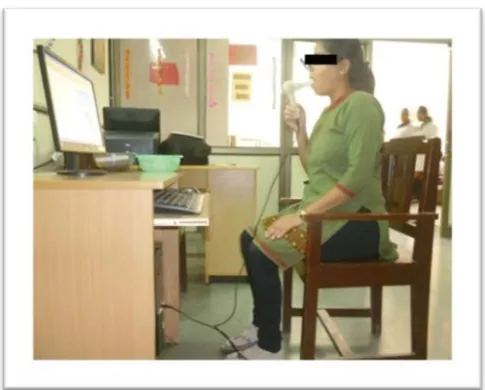
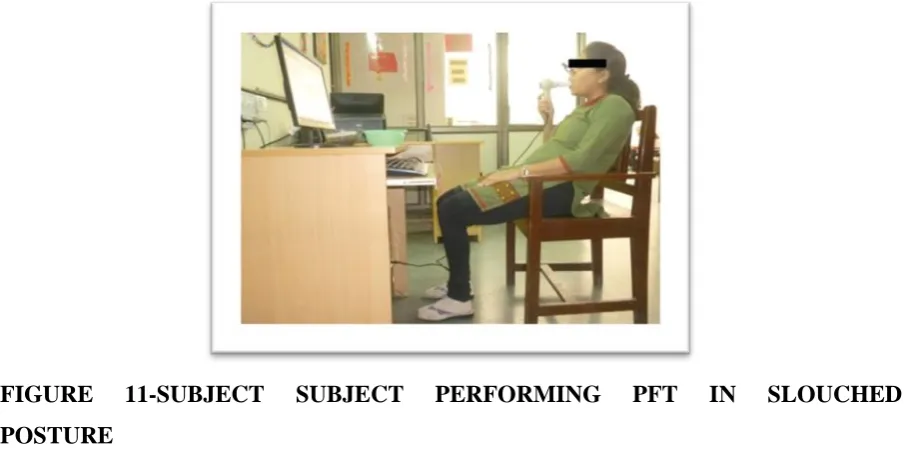
of each subject were performed. For PFT 3 sitting postures upright, slumped and slouched
sitting were given. These postures were given randomly to avoid bias. In all 3 postures
knees were flexed at 90° with feet fully supported. Pulmonary function test was done
[image:6.595.176.419.167.362.2]using Helios 401 RMS spirometer.
FIGURE 9- SUBJECT PERFORMING PFT IN UPRIGHT POSTURE
[image:6.595.165.430.409.609.2]www.wjpr.net Vol 4, Issue 09, 2015.
[image:7.595.72.527.73.303.2]1402 FIGURE 11-SUBJECT SUBJECT PERFORMING PFT IN SLOUCHED POSTURE
P F T w a s p e r f o r m e d f o r FVC, FEV1and PEF procedure, subjects were asked to
assume given posture. Then nose clip was attached and subjects were asked to inhale
completely and rapidly with a pause of, 1 s at TLC. Mouth piece was placed in the mouth and
asked to close lips around the mouthpiece. They were then asked to exhale maximally until
no more air can be expelled while maintaining posture. This was repeated minimum three
times and not more than eight times.[9]
MVV testing was done by asking the subject to have a nose clip and to maintain airtight seal
around the mouthpiece. They were asked to perform at least three resting tidal breaths,
followed by breathing as rapidly and deeply as possible.[9] These were carried out for each
subject in each posture and vigorous coaching was given throughout the maneuver. A brief
rest of 30 seconds between trials was used to minimize the fatigue effect on the
respiratory muscles.[20,21,22] PFT maneuvers of all the subject were taken in the afternoon
session from 3 to 5 pm.
RESULTS
Statistical analysis was done using SPSS version 16 and excel 2007. One-way ANOVA
(analysis of variance) was applied to see the difference of pulmonary function in upright,
slumped and slouched posture. Total 90 subjects participated in the study. Among them there
www.wjpr.net Vol 4, Issue 09, 2015.
1403 TABLE-1THE GENDER DISTRIBUTION
GENDER FEMALE MALE
IN PERCENTAGE 61% 39%
GRAPH 1- PIE CHART SHOWING THE GENDER DISTRIBUTION IN THE STUDY.
TABLE-2DEMOGRAPHIC DATA OF THE SUBJECTS IN THE STUDY.
TABLE-3 MEAN, SD AND P VALUE OF FEV1, FVC, PEFR AND MVV FOR THREE
DIFFERENT SITTING POSTURES.
Following bar graphs are showing the difference in each outcome measure in three different
sitting postures.
VARIABLE MEAN±SD
Age (years) 21.49±1.819
Height (cm) 165.94±9.081
Weight (kg) 57.07±8.240
BMI (kg/m2) 20.68±1.60
UPRIGHT Mean ± SD
SLUMPED Mean ± SD
SLOUCHED Mean ± SD
P
VALUE Interpretation
FEV1(%) 99.21±13.523 97.73±13.608 97.31±15.953 0.650 Not significant
FVC(%) 87.59±12.305 86.41±11.857 87.01±11.893 0.806 Not significant
PEFR(%) 79.89±17.611 76.83±18.300 78.84±16.980 0.499 Not significant
www.wjpr.net Vol 4, Issue 09, 2015.
1404 GRAPH 2-COMPARISON OF FEV1 IN THREE DIFFERENT SITTING POSTURES
GRAPH 3–COMPARISON OF FVC IN THREE DIFFERENT SITTING POSTURES
GRAPH 4– COMPARISON OF PEFR IN THREE DIFFERENT SITTING POSTURES
99.21
97.73 97.31
87.59
86.41 87.01
79.89
www.wjpr.net Vol 4, Issue 09, 2015.
1405 GRAPH 5 –COMPARISON OF MVV IN THREE DIFFERENT SITTING POSTURES
INTERPRETATION
From the graph we can say that pulmonary function is better in upright posture than slumped
or slouched posture, although there is no statistically significant difference of mean value in
any of the postures for pulmonary function and p value is >0.05. So, the null hypothesis is
accepted.
DISCUSSION
The present study was done to find out and compare the pulmonary function in slumped,
slouched and upright sitting posture. There were 90 young healthy individuals who
participated in the study. Pulmonary function of all the individuals was tested by means of
FEV1, FVC, PEFR and MVV. The p value for FEV1, FVC, PEFR and MVV was 0.650,
0.806, 0.499 and 0.399 respectively. According to statistical analysis upright sitting posture is
better than slumped sitting and slouched sitting posture but p value shows that there is no
statistically significant difference in pulmonary function among three different sitting
postures. Lee L et al, 20103 concluded in her study that thoracolumbar extension i.e. used in
slouched posture and slump postures had opposite effects on end expiratory diameters.
Diameters upper AP, axilla AP and axilla Lateral were greater in thoracolumbar extension
compared to slump. Conversely, lower lateral and abdominal AP diameters were less in
thoracolumbar extension than in slump posture. Motion changes during breathing were
opposite for upper AP, axilla AP, and lower lateral diameters; upper AP and axilla AP motion
were less in thoracolumbar extension and lower lateral motion was greater in thoracolumbar
extension. There were no differences of axilla lateral and abdominal AP diameters during
breathing between thoracolumbar extension and slump. So, from this it can be said that the
flexibility of the respiratory apparatus in people without respiratory disease or limitations in 77.62
75.46
www.wjpr.net Vol 4, Issue 09, 2015.
1406
chest wall mobility to adapt regional chest wall mobility to the changes in joint orientation
and muscle activation associated with subtle changes in posture in order to maintain constant
respiratory function.
Ogiwara S,2002.[23] suggested that strength of ventilatory muscle does not change with
change of posture. Both the inspiratory and expiratory muscle strength showed nochange
with alteration of body positions, hence support the null hypothesis. This finding suggest that
the ventilatory muscles of healthy individuals seems to work efficiently in any posture.
Specifically the length-tension relationship of these muscles seems to remain constant
regardless of any change in body position. According to Barnas GM et al.[24] slumped
position may actually serve to support the diaphragm with the help of the rigid abdominal
wall, as is seen in seated forward leaning postures, placing it at a mechanical
advantage along the length-tension curve to assist in maintaining pulmonary function.
A study by Landers M.[15], also found no difference between two sitting posture (slumped and
upright) in patients with COPD and they suggest that upright posture is not beneficial
because a s l u m p e d posture may have actually placed the characteristic flattened
diaphragm in a more advantageous biomechanical p o s i t i o n than would an upright
posture.
On the contrary, Crosbie WJ and Myles S[25]found that slumped posture show a general
decrease in pulmonary function as has been reported in the literature among
healthy subjects and they explained that in young healthy subjects with a normally
positioned diaphragm, the slumped sitting posture results in increased
intra-abdominal pressure by approximating the ribs to the pelvis, making it difficult for the
diaphragm to descend caudally during inspiration. Another study by Makhsous M et
al, 2004.[22] also suggest that slumped posture compress organs and impede diaphragm
movement. There are studies which suggest that there are changes in pulmonary
function in subjects with different body mass index. Hence, subjects who had normal
body mass index were only selected. Literature also says that there is diurnal variation
in pulmonary function. So, to avoid variation due to it, time is kept constant for
pulmonary function testing. To avoid the carry over effect or learning effect the postures
were given randomly to the subjects and wash out period was also given. Although no
clear differences emerged in pulmonary function, one should consider that there may
www.wjpr.net Vol 4, Issue 09, 2015.
1407
quality of life. A pro- longed slumped posture causes thoracic malformation, which may
lead to decreases in motor function and range of motion in the upper extremities. In
addition to potential motor function problems and musculo- skeletal pain, the
slumped position may also expose the anterior portion of the vertebrae in the
thoracic spine to sustained, abnormal compression, leading to possible wedge
fractures.[26]
In upright sitting, the vertical gravitational gradient is maximal, anteroposterior
diameter of chest wall is greatest and compression of heart and lung is minimal. The
shortened position of diaphragmatic fibres is countered by an increase in the neural
drive to breath in upright posture.[27] so, upright sitting posture should be preferred.
CONCLUSION
There is no effect on pulmonary function in upright, slumped and slouched sitting postures in
young healthy individuals’ in the age group of 18 to 24 years.
LIMITATION
3D digitization system[28] was not used during PFT maneuver, which is a biomedical model
that allow detailed, quantitative description of head, neck, lumber and pelvic postures during
different sitting postures. This model also enabled a distinction to be made between upper
and lower cervical motions.Male and female in the study were not equally distributed.
FUTURE STUDIES
Further study can be done in different pulmonary conditions. Study can be done by using 3D
digitization system, on different BMI and on different age group.
CLINICAL IMPLICATION
Although pulmonary function is not statistically significant in different sitting postures, mean
values are better in upright sitting posture. So, upright sitting posture should be preferred.
ACKNOWLEDGEMENT
I am thankful to my parents Ajabben and Joyabbhai vanwala, my husband Mohammad
Jinyawala, my guide, my friends Dr. Mansi Shingala, Dr. Rutvee Vinchhi, DR. Dipa
www.wjpr.net Vol 4, Issue 09, 2015.
1408 REFERENCES
1. World Health Organization 2006.Constitution of world health organization- Basic
documents, 45th edition, supplement, October 2006.
2. Provisional guidelines on standard international age classifications, series M, no.74, New
York, 1982.
3. Lee LJ, Chang A, Michel W, Hodges P Changes in sitting posture induce multiplanar
changes in chest wall shape and motion with breathing. Respiratory physiology &
neurobiology., 2010; 170: 236-245.
4. Shumway Cook A, Woollacott M, motor control, 4th edition, Philadelphia, Wolters
Kluwer, Lippicott Williams & Wilkins, 2012.
5. Magee D.J. Orthopedic physical assessment, 5th edition. Saunders , an imprint of Elsevier
,Canada, 2009.
6. Hawley G, The kinesiology of corrective exercise. Philadelphia, Lea and Febiger, 1937
7. Levangie P, Norkin C A comprehensive analysis of joint structure and function, Fourth
edition Philadelphia, Jaypee brothers medical publishers, 2011.
8. Miller MR et al, series ATS /ERS task force: standardization of lung function testing.
Eur Respire J., 2005; 26(1): 153-161.
9. Miller MR et al, series ATS /ERS task force: standardization of lung function testing. Eur
Respire J., 2005; 26(2): 320-335.
10.Jones R, Nzekwe M The effect of body massindex on lung volumes. Chest journal., 2006;
130: 827-833
11.Medarov B, Pavlov V, Rossoff L Diurnal variation in human pulmonary function,
International journal of clinical & experimental medicine.,. 2008; 3: 267-273.
12.Neill SO, Mccarthy DS postural relief of dyspnoea in severe chronic airflow limitation:
relationship to respiratory muscle strength. Journal of thorax., 1983; 38: 595-600
13.Sharp JT,Durtz WS, Moisan T, Machnach W, Postural relief of dyspnoea in severe
chronic obstructive pulmonary disease. AmRev Respir Dis., 1980; 122: 201-211.
14.Gosslink R: Breathing techniques in patients with chronic obstructive pulmonary disease
(COPD).chronic Respir Dis., 2004; 1: 163-172.
15.Landers MR, McWhorter JW, Filibeck D, Robinson C, Does Sitting Posture in Chronic
Obstructive Pulmonary Disease Really Matter? An analysis of 2 sitting postures and their
effect on pulmonary function, Journal of cardiopulmonary rehabilitation., 2006; 26:
www.wjpr.net Vol 4, Issue 09, 2015.
1409
16. Kisner C, Colby C Therapeutics exercise foundation and techniques, 5th edition.
Philadelphia, Jaypee Brother’s medical publishers 2007.
17.Talavera M, Kumar D and Casaburi R, The ABCs of PFTs (Pulmonary function test
provide key physiologic clues to disease processes, yet they remain underused in primary
care settings). The journal of respiratory care practitioners., 1998; 10(3): 31-37
18.Bolton S, Bon C, Pharmaceutical statistics: Practical and clinical application revised and
expanded, 4th edition, New York, 2004.
19.Annurad E, Shiwaku K, Nogi A, Kitajima K, Enkhmaa B, Shimono K, Yamane Y The
new BMI criteria for Asians by the regional office for western pacific region of WHO are
suitable for screening of overweight to prevent metabolic syndrome in elder Japanese
workers. Journal of occupation health, 2003; 45: 335-343
20.Hojat B, Mahdi E Effect of different sitting posture on pulmonary function on students,
journal of physiology and pathophysiology, 2011; 2(3): 29-33.
21.Lin F, Parasarthy S, Taylor S, Pucci D, Hendrix R, Makhsous M effect of Different
Sitting Postures on Lung Capacity Expiratory Flow(LC-EF), and Lumbar Lordosis.
Physical medicine and rehabilitation, 2006; 87: 54-509.
22.Makhsous M, Bankard J, Lin F, Taylor S, Pedersen J, Hilb J, Hendrix R, RESNA 27 th
International annual confence, Florida 2004.
23.Ogiwara S, Miyachi T, Effect of posture on ventilatory muscle strength. J Phys Ther Sci,
2001; 14:1-5.
24.Barnas GM, Green MD, Mackenzie CF et al, Effect of posture on lung and regional chest
wall mechanics. Anesthesiology. 1993; 78:251-259.
25.Crosbie WJ, Myles S. An investigation into the effect of postural modification on some
aspects of normal pulmonary function. Physiotherapy. 1985; 71:311-314.
26.Goh S, Price RI, Leedman PJ, Singer KP. The relative influence of vertebral body and
intervertebral disc shape on thoracic kyphosis. Clin Biomech (Bristol, Avon). 1999;
14:439-448.
27.Frownfelter D, Dean E Principals and practice of cardiopulmonary physical therapy,3rd
edition, United states of America,Don ledig,1996.
28.Black KM, McClure P, Polansky M The enfluence of different sitting postures on cervical