“A CLINICAL STUDY TO EVALUATE THE EFFICACY OF
VAITARANA BASTI
IN THE MANAGEMENT OF
GRIDHRASI
W.S.R.
TO SCIATICA”
Dr. Tiwari Bharti1*,Dr. Srivastava Alok2 and Dr. Shukla Durgesh Kumar3
1
M.D. (Scholar), Dept. of Panchkarma, Rishikul Govt. Ayurvedic College Haridwar, Uttarakhand, India.
2
Associate Professor, Dept. of Panchkarma, Rishikul Govt. Ayurvedic College Haridwar, Uttarakhand, India.
3
M.S. (Scholar), Dept. of Shalya Tantra, Rishikul Govt. Ayurvedic College Haridwar, Uttarakhand, India.
ABSTRACT
Gridhrasi is one of the Vatavyadhi caused by aggravated Vatadosha. This disease is characterized by radiating pain, tingling and pricking sensation & numbness at posterior aspect of leg, which makes the patient difficult to walk. Signs and symptoms of Gridhrasi shows close resemblance with sciatica. In this disease sciatic nerve is compressed, which are mainly caused by herniation or degenerative changes in lumber intervertebral disc. There is only conservative treatment giving short-term relief in pain or surgical intervention with side effect. In
Ayurved, Acharya Vangasen stated Vaitarana Basti in management of
Gridhrasi. Aims: To evaluate the efficacy of Vaitarana Basti in the management of Gridhrasi w.s.r. to sciatica. Materials and Methods: it is an open randomized clinical trial. A total of 20 patients suggesting
Gridhrasi on the basis of sign and symptom and clinical examination were selected from Panchkarma were treated with Vaitarana Basti (amount 380 ml was administered) for three consecutive sittings of 8 days along with interval of 8 days in between each sitting. Assessment was done after the completion of therapy on the basis of subjective criteria (pain, stiffness, tingling and pricking sensation, numbness and twiching and objective criteria (SLR, scoliosis, Walking Time). Results: Vaitarana Basti was found to be significantly effective in
Volume 4, Issue 8, 1728-1738. Research Article ISSN 2277– 7105
*Correspondence for Author
Dr.Bharti Tiwari M.D. (Scholar), Dept. of Panchkarma, Rishikul Govt. Ayurvedic College Haridwar, Uttarakhand, India.
Article Received on 06 June 2015,
reducing pain and other symptoms. Conclusion: Vaitarana Basti was found to be effective in management of Gridhrasi.
KEYWORDS: Gridhrasi, Sciatica, Vaitarana Basti.
INTRODUCTION
At present the human society is leading with mechanical life, frequent changing of lifestyle, environmental factors, climate etc. The critical busy schedule, restless, anxiety, stress & strain, running after comfortable life, comparing to higher group are curses different psychosomatic disorders. Improper sitting postures in office, jerking movements in travel, heavy labor work have led to low back pain and sciatica due to extra straining on spine. The prevalence of sciatica ranges from 11% -40%.[1] Among such disorders Ayurvedic classics have described a severe debilitating disease in the name of Gridhrasi. The name itself indicates the way of gait shown by the patient due to extreme pain just like a Ghridhra
(Vulture). In modern parlance the above condition is described in, as sciatica. Sciatica is a neuralgia along the course of sciatic nerve, most often with pain radiating into the Buttock and lower limb, most common due to herniation of lumber disc.[2]
Gridhrasi described in Charaka Samhita Samanyaja[3] and Nanatmaja Vatavyadhies.[4] It comes under 80 types of Nanatmaja Vatavyadhies. According to Acharya Charaka the cardinal signs and symptoms are pain in the Kati, Sphik, Uru, Janu, Jangha and Pada in order, stiffness, tingling & priking sensation, twitching[5] and according to Acharya Sushruta[6] and Vagbhatta[7] the condition where the Kandara of heel and Parsnee and
Angulees are affected by vitiated Vata causing Sakthikshepanigraha i.e. restricted lifting of the leg. Acharya Charaka has mentioned two types of Gridhrasi, Vataj and Vatkaphaj. In
Kaphanubandhi Gridhrasi, Tandra, Gaurava, Arochaka are present. As Acharya Charaka
mentioned various methods used in the treatment of Gridhrasi.[8]
Basti is specially indicated in the treatment of Vata that ultimately removes Srotodushti and
Vata-Vaigunya. Vaitarana Basti was indicated for Gridhrasi in Vangasen chapter
MATERIALS AND METHODS Composition of VaitaranaBasti
Saindhav lavana (Rock salt)-1 Karsha (12gm)
Amleeka (Tamarind)-1 pala
Guda (Jaggary)-1/2 pala
Til tail (Sesame oil)- 80 ml
Surabhi Payas (cow milk)-1 Kudav (192 ml)
METHOD OF PREPARATION
Mix jaggery in the required amount of water.
Prescribed quantity of Saindhava Lavana is added and churned thoroughly. After proper mixing of above constituents, the Moorchita Tila Taila should be added
slowly while churning in a slightly heated temperature.
Tamarind is mixed and squeezed well in hot water and to be used as Kalka. The above kalka is to be added into the vessel and continue the churning.
Finally boiled and cooled milk of prescribed amount is added very slowly while the churning process continues.
METHODS OF STUDY
On the basis of clinical examination and Prakruti described in Ayurvedic classics, patients of
Gridhrasi were selected from OPD and IPD of department of Panchkarma, Rishikul Campus, Uttarakhand Ayurveda University, Dehradun.
An open randomized clinical trial was conducted on these patients, where the patients was given Vaitarana Basti as described by Vangasen in chapter Bastikarmaadhikar to management of Gridhrasi with specific duration with 30 day follow up. Then the available data was assessed using suitable statistical analysis method i.e. paired test and unpaired t-test where ever required. Following subjective and objective parameters had taken for the assessment of result.
DIAGNOSTIC CRITERIA
INCLUSION CRITERIA
Patients with typical clinical findings suggestive of Gridhrasi were the trial subjects. Patients diagnosed of lumbago based upon investigation.
Age 20 - 60 years.
History of lumbosacral sprain / strain/ lumbago for more than six months. Degenarative Arthritis of lower spine.
EXCLUSION CRITERIA
Age group <20 years and >60 years.
Infection of spine especially Tuberculosis, Brucellosis and Pyogenic osteomyelitis etc. Referred low backache from pelvis, abdomen or thoracic diseases.
Neoplasm of spine.
CRITERIA FOR ASSESSMENT
The indoor patients were examined daily and outdoor patients weekly. Change was
observed in signs and symptoms by using appropriate clinical tools. The detail of score given to each sign and symptom and clinical test carried out is described below.
Pain locus: Distribution of pain for Gridhrasi. 6 sites where pain is present are
mentioned in Ayurvedic texts. They are Kati, Sphik, Uru, Janu, Jangha and Pada . The presence of pain at each site was given score as one and thus total score before treatment was noted. Similarly, after treatment, depending upon the presence of pain in number of sites, total score was calculated.
Pain locus- Kati, Sphik, Uru, Janu, Jangha and Pada - total 6 Severity of pain
0 - No pain 1- occasional pain
2 - Mild pain & no difficulty in walking
3 - Moderate pain & slight difficulty in walking
4 - Severe pain with severe difficulty in walking Stiffness
0 - No stiffness or stiffness lasting for 5 Min.
Tingling and pricking sensation-
0 - Not present 1 - Occasionally tingling and pricking sensation
2 - Mild tingling and pricking sensation 3 - Moderate tingling and pricking sensation 4 - Severe tingling and pricking sensation
Numbness 0 - not present 1 - present
Twitching 0 - no twitching
1- sometime for 5-10 min 2 - daily for 10-30 min 3 - daily for 30-60 min 4 - daily more than one hour
Associated Symptoms Aruchi
0- No Aruchi
1- Mild Aruchi
2- Moderate Aruchi
3- Severe Aruchi
Tandra 0- No Tandra
1- Mild Tandra
2- Moderate Tandra
3- Severe Tandra
Gaurava 0- No Gaurava
1- Mild Gaurava
2- Moderate Gaurava
Objective parameter SLR test
0 - More than 90o 1 - 71o – 90o 2 - 51o – 70o 3 - 30o – 50o 4 - Upto 30o
Scoliosis
0 - No scoliosis 1- Mild scoliosis 2 - Moderate scoliosis 3 - Severe scoliosis
Walking time 0 - upto 20 sec 1 - 21 sec to 40 sec 2 - 41 sec to 60 sec 3 - More than 60 sec
CRITERIA FOR ASSESSEMENT OF OVERALL EFFECT OF THERAPY
To assess the effect of therapy objectively, all the signs and symptoms were giving scoring depending upon their severity.
Complete relief : 100%
Maximum improvement : 76 % to 99% Moderate improvement : 51% to 75 % Mild improvement : 25 % to 50 % No improvement : 0% to >25 %
OBSERVATIONS
The important observations made in this study are summarized as follows.
Total 20 patients; Out of them maximum patients belonged to 41-50 years of age group
The maximum patients in this study were Vishamagni (72.5%), Krura Kostha (60%),
Katu Rasa dominant Ahara (83%) and having habit of Vishamashana (40%) and
Diwaswapna (75%). Maximum patients had Madhyama Vyayama Shakti (90%).
In maximum patients there was <6 months chronicity (72.5%), No history of trauma
(75%) with affected one leg (67.5%), and Vataja type of Gridhrasi (60%).
The symptoms of Gridhrasi observed among 40 patients of both groups were locus of
pain and severity of pain(100%), Stiffness (82.5%), Tingling & pricking sensation
(90%),numbness (45%), twitching (32.5%), positive SLR (100%). Most of the patients were taking Madhura Rasa dominant diet (33.3%).
Most of the patients were having Chinta and Shoka as Mansika Nidana (23.3% each). Most of the patients of the study were indulged in Samshana and Vishmashana (43.3%
and 36.6% respectively).
RESULTS
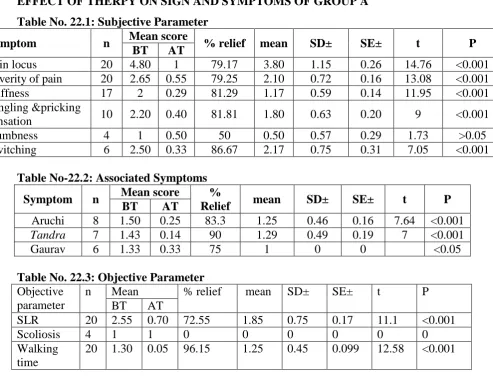
[image:7.595.55.549.361.739.2]EFFECT OF THERPY ON SIGN AND SYMPTOMS OF GROUP A Table No. 22.1: Subjective Parameter
Symptom n Mean score % relief mean SD± SE± t P
BT AT
Pain locus 20 4.80 1 79.17 3.80 1.15 0.26 14.76 <0.001 Severity of pain 20 2.65 0.55 79.25 2.10 0.72 0.16 13.08 <0.001 Stiffness 17 2 0.29 81.29 1.17 0.59 0.14 11.95 <0.001 Tingling &pricking
sensation 10 2.20 0.40 81.81 1.80 0.63 0.20 9 <0.001
Numbness 4 1 0.50 50 0.50 0.57 0.29 1.73 >0.05
Twitching 6 2.50 0.33 86.67 2.17 0.75 0.31 7.05 <0.001
Table No-22.2: Associated Symptoms
Symptom n Mean score %
Relief mean SD± SE± t P
BT AT
Aruchi 8 1.50 0.25 83.3 1.25 0.46 0.16 7.64 <0.001
Tandra 7 1.43 0.14 90 1.29 0.49 0.19 7 <0.001
Gaurav 6 1.33 0.33 75 1 0 0 <0.05
Table No. 22.3: Objective Parameter Objective
parameter
n Mean % relief mean SD± SE± t P
BT AT
SLR 20 2.55 0.70 72.55 1.85 0.75 0.17 11.1 <0.001
Scoliosis 4 1 1 0 0 0 0 0 0
Walking time
In Vaitarana Basti Group, highly significant results were seen in pain locus (79.17%),
severity of pain (79.25%), Stiffness (81.29%), tingling and pricking sensation (81.81%), twitching (86.67%), Aruchi (83.3%) and Tandra (90%), SLR (72.55%), walking time (96.15%), improvement in numbness (50%) and Gaurava (75%). Not any changes have been seen in Scoliosis after treatment.
Overall effect of therapy
RELIEF No. of pts. %
Complete relief (100%) 2 10%
Marked improvement (76% to 99%) 4 20% Moderate improvement (51% to 75%) 7 35% Mild improvement (25% to 50%) 5 25%
No improvement (<25%) 2 10%
Overall Vaitarana Basti group, 10% patients got complete relief in symptoms, 20%
marked improvement, 35% patients got moderate improvement, 25% patients got mild improvement and 10% got no improvement after completion of therapy.
DISCUSSION
Mode of action ofVaitarana Basti
The probable mode of action of any drug can be determined by the dominant pharmacodynamic factor in the particular drug which can be any one among Rasa, Guṇa,
Virya, Vipaka and Prabhava. The fundamentals of treatment in Ayurveda are mainly based on Dosha Chikitsa and Saṃprapti Vighatana (disintegration of pathogenesis) called Chikitsa. Therefore action of drug means that which dismantle the Samprapti Ghataka of the disease. As Gṛdhrasi is one of the Nanatmaja Vatavyadhis, the main involved Dosha is Vata. Among the five varieties of Vata Vyana Vayu, which is responsible for all motor activities[10] and
Apana Vayu, as its main site is Kati and Sakthi, is considered to be mainly vitiated in case of
of the drug. In the present study, the Vaitarana Basti contains ingredients which are mainly having Vatahara properties.
Sr.
No. Drug Rasa Guṇa Vīrya Vipāka Doṣaharatva
1. Saindhav
Lavana
Madhura
lavana Laghu, Snigdha, Sheeta Madhura Tridosahar
2. Chincha Madhura Amla
Sukshma Guru,
Ruksha Ushna Amla Vata-Kapha hara
3. Guḍa Madhura Snigdha Nati sita Madhura Vata hara
4. Tila taila Madhura
Tikshna,
Vyavāyi,Guru,Suks hma
Ushna Madhura Vata-Kapha hara
5.
Go-Dugdha Madhura
Snigdha
Guru,sara,Mrdu, Picchila Manda,
Shteeta Madhura Vata-Pitta hara
Tila Taila, which is the best Shamana Auṣadhi for Vata having Sūkṣma,Vyavāyi and Vikāśi Guṇas.[11]Tila taila is used as the base of the drug, as a result the active principles of the drug spreads very fast all over the body through the minute Srotas when administered as Basti. In the above table the properties and specific doṣa hara actions of the ingredients of Vaitarana Basti are shown, which indicate the predominant Vatahara action of the oil. firstly, Vaitarana Basti is constituted with Saindhava, Guda, Amleeka, Til taila and Go-dugdha. All of these are
Snigdha pharmacologically and do not create any Rookshata in the body, which is considered to be one of the complication of administering Nirooha alone.
From the diseases mentioned as the indications of Vaitarana Basti, AmaVata, chronic
Urusthamba, chronic Vishamajwara, it is understood that the Dravya has got its
Amadoshahara property. Shoola pradhanaVyadhis like Gridhrasi, Katishoola, prishta shoola
are indicated. The sotha conditions i.e. inflammatory conditions like Kati sotha, Uru sotha, prishta sotha; stiffness condition like janusankocha, where brimhana is needed, are indications for Vaitarana Basti. From these all indications, we can come into a conclusion that Vaitarana Basti possess an Amahara-shoolahara-sothahara sankochahara-brimhana
The Vaitarana Basti administered is retained for about 7-15 minutes. Though the Basti Dravya is not absorbed entirely, some of the minute elements are absorbed, which travels from Pakwasaya to the whole body. The chemical reaction sequence originated in
Pakwasaya passes from cell-to-cell, ultimately in the entire body.
The milk constitutes high quality proteins. In addition, the whey proteins have been demonstrated to increase the bone strength in experimental animals. The lactose that enters the colon favors calcium and possibly phosphorus absorption in human and is able to strengthen the nervous system. The anti-inflammatory action of Amleeka and the mucosa of the large intestine do not produce any enzyme. Any digestion that occur results due to the enzymes introduced from the small intestine or from bacterial action .These mucous secretion occurs as local stimuli, such as friction or exposure to harsh chemicals, trigger short reflexes involving local nerve plexuses. So, here we can assume that the administered Basti Dravya, slightly alkaline in nature, stimulates the bacterial action in colon and as a result vit. K, vit B12, thiamine, riboflavinetcare formed. They are essential for maintaining structural and functional integrity of nervous system understood as normal functions of Vata. The bacterial flora flourishes abundantly on administration of Nirooha Basti Dravya produces a favorable environment for their growth, thus helps in maintaining the body strength. The Vaitarana Basti has got the more lipid contents in it. The rectum has a rich blood and lymph supply and drugs can cross the rectal mucosa like other lipid membranes. The unionized and lipid soluble substances are rapidly absorbed from the rectum. In the rectum, in the upper portion, the absorption is via the upper rectal mucosa and is carried to the superior hemorrhoidal vein into portal circulation whereas that absorbed in the lower rectum enter directly into the systemic circulation via middle and inferior hemorrhoidal vein. So these observations suggest that this therapy not only produces symptomatic relief but also control the disease process and may cause long lasting effect.
CONCLUSION
A close perusal of the observation and inference that can be drawn leads to the following conclusions-
Gridhrasi can be well equated with sciatica in modern parvalance.
In this study none of the patients developed neither any adverse symptoms nor any
side effects during the course of treatment.
REFERENCES
1. Mumtaz Ali, VD Shukla, AR Dave, NN Bhatt, A clinical study of Nirgundi Ghana Vati
and Matra Basti in the management of Gridhrasi w.s.r. to sciatica, AYU, 2010; 31(4): 456- 460.
2. Tabor’s cyclopedic medical dictionary- 18th ed. jaypee brothers, New Delhi 26 ed. 3. Agnivesa, Charakasamhita vidhyotani teka edited by kasinath sastri & gorakhnath
chaturvedi Sutrasthana chapter 19 sloka 3. Varanasi: Chaukhambha Sanskrit Sansthan. 4. Agnivesa, Charakasamhita vidhyotani teka edited by kasinath sastri & gorakhnath
chaturvedi Sutrasthana chapter 20 sloka 10. Varanasi: Chaukhambha Sanskrit Sansthan. 5. Agnivesa, Charakasamhita vidhyotani teka edited by kasinath sastri & gorakhnath
chaturvedi Chikitsasthana chapter 28 sloka 101. Varanasi: Chaukhambha Sanskrit Sansthan.
6. Sushrutha, Sushruthasamhitha Ayurved Tatva Sandipika” commentary, edited by Dr. Ambikadatta Shashtri, nidanasthana chapter 1 sloka 74. Varanasi:Chaukhambha Sanskrit Sansthan.
7. Vagbhata, Ashthanga Hridaya hindi commentary, edited by Kaviraj Atridev Gupt, nidansthan chapter 15 sloka 54, Varanasi: Chaukhambha Sanskrit Sansthan.
8. Agnivesa, Charakasamhita vidhyotani teka edited by kasinath sastri & gorakhnath chaturvedi Chikitsasthana chapter 28 sloka 101. Varanasi: Chaukhambha Sanskrit Sansthan.
9. Vangasena, Vangasenasamhitha Bastikarmaadhikara/186-190. Jain Sankarlalji Vaidya, editor. Mumbai: Khemnath Srikrishnadas publishers.
10.Agnivesa, Charakasamhita vidhyotani teka edited by kasinath sastri & gorakhnath chaturvedi Chikitsasthana chapter 28 sloka 9. Varanasi: Chaukhambha Sanskrit Sansthan. 11.Sushrutha, Sushruthasamhitha Ayurved Tatva Sandipika” commentary, edited by Dr.