DEVELOPMENT AND VALIDATED STABILITY INDICATING
RP-HPLC METHOD FOR THE DETERMINATION OF PANTOPRAZOLE
IN PURE FORM AND ITS TABLET DOSAGE FORM
Puppala Sindhu*1, Dr. Gampa Vijayakumar1, Ramya Sri Sura2
1
CVM College of Pharmacy, Velichala, Karimnagar District, T.S. India.
2
SURA LABS, 4 th Floor, S.S Towers , Beside Chandana Brothers, Dilsukhnagar,
Hyderabad.
ABSTRACT
A rapid and precise reverse phase high performance liquid
chromatographic method has been developed for the validated of
Pantoprazole, in its pure form as well as in tablet dosage form.
Chromatography was carried out on a Phenomenex Gemini C18
(4.6×250mm) 5µ column using a mixture of Methanol: TEA Buffer pH
4.0 (70:30 v/v) as the mobile phase at a flow rate of 1.0ml/min, the
detection was carried out at 280nm. The retention time of the
Pantoprazole was 2.302 ±0.02min respectively. The drugs were
exposed to thermal, photolytic, acid, alkali, and oxidative stress and the
stressed samples were analyzed by use of the proposed method &
chromatograms from the stressed samples, obtained by use of the
photodiode-array detector. The method produce linear responses in the concentration range of
10-50mg/ml of Pantoprazole. The method precision for the determination of assay was below
2.0%RSD. The method is useful in the quality control of bulk and pharmaceutical
formulations.
KEYWORDS: Pantoprazole, RP-HPLC, validation.
INTRODUCTION
Pantoprazole,[13-17] or pantoprazol (also called Pantoprazolum) is a proton pump inhibitors, a
type of, Anti-Ulcer Agents used for the treatment of Gastric Ulcer.it is chemically
6-(difluoromethoxy)-2-{[(3,4-dimethoxypyridin-2-yl)methane]sulfinyl}-1H-1,3- benzodiazole.
Volume 4, Issue 8, 2315-2326. Research Article ISSN 2277– 7105
Article Received on 19 June 2015,
Revised on 10 July 2015, Accepted on 02 Aug 2015
*Correspondence
For Author
Puppala Sindhu
CVM College of
Pharmacy, Velichala,
Karimnagar District, T.S.
The author have developed a liquid chromatographic and validated, sensitive and
reproducible method for the determination of Pantoprazolein bulk and pharmaceutical dosage
forms.
Fig.No.Chemical structure of Pantoprazole
MATERIALS AND METHODS Chromatographic conditions
A prominence isocratic HPLC system (waters high performance liquid chromatography with
auto sampler and PDA detector) column Phenomenex Gemini C18 (4.6×150mm, 5µm). A
10µL Waters injection syringe was used for sample injection. HPLC grade methanol and
Triethylamine Buffer were used for the preparing the mobile phase. A freshly prepared
Methanol: Triethylamine Buffer (pH-4.0) (70:30 v/v) was used as the mobile phase. The
solvents was filtered through a 0.45µ membrane filter and sonicate before use. The flow rate
of the mobile phase was maintained at 1mL/min., column temperature was maintained at
35ºC temperature and the detection of the drug was carried out at 280nm.
Preparation of Triethylamine buffer (pH-4.0)
Take 6.0ml of Triethylamine in to 750ml of HPLC water in a 1000ml volumetric flask and
mix well. Make up the volume up to mark with water and adjust the pH to 4.0 by using
Orthophosphoric acid, filter and sonicate.
Preparation of mobile phase
Mix a mixture of above buffer 300mL (30%) and 700mL of Methanol HPLC (70%) and
degas in ultrasonic water bath for 5 minutes. Filter through 0.45µ filter under vacuum
Diluent preparation Mobile phase as diluent.
Standard solution preparation
Accurately weigh and transfer 10mg of Pantoprazole working standard in to 10mL
volumetric flask add about 10ml of diluent and sonicate to dissolve it completely and make
volume up to the mark with the same solvent. (Stock solution) further pipette 0.3ml of the
above stock solution in to a 10ml volumetric flask and dilute up to the mark with diluent. Mix
well and filter through 0.45 µm filter.
Sample solution preparation
Weigh 10 Pantoprazole tablets and calculate the average weight. Accurately weigh and
transfer the sample equivalent to 10mg of Pantoprazole into a 10ml volumetric flask. Add
about 10ml of diluent and sonicate to dissolve it completely and sonicate to dissolve it
completely and make volume up to the mark with diluent. Mix well and filter through
0.45µm filter. Further pipette 0.3ml of the above stock solution into a 10ml volumetric flask
and dilute up to the mark with diluent. Mix well and through 0.45µm filter.
Method validation Linearity
The linearity of the method was demonstrated over the concentration range of 10-50 µg/ml of
the target concentration. Aliquots of 10,20,30,40 and 50µg/ml were prepared from above
stock solution. Different concentrations of the pure drug were injected into the
chromatographic system. Calibration curve of Pantoprazole was constructed by plotting peak
area vs applied concentration of Pantoprazole.[1-10] A typical chromatogram is shown in Fig 1.
The obtained results shown an excellent correlation between peak area and concentration of
pure drug within the concentration range & it has shown in fig:2. The correlation coefficient
for the average area at each level versus concentration of analyte was calculated and is
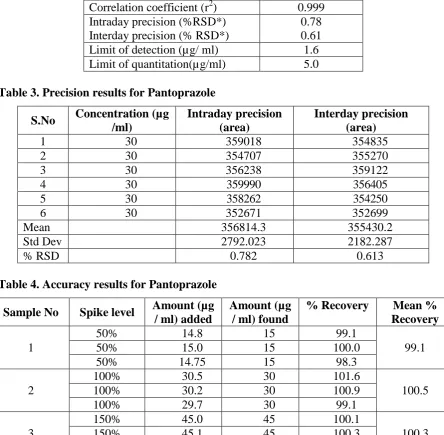
presented in Table:1 and their calibration parameters were shown in Table:2.
SAMPLE PREPARATIONS TO PERFORM FORCED DEGRADATION STUDIES Acid degradation
Take average weight of Tablet and crush in a mortar by using pestle and weight 10 mg
equivalent weight of Pantoprazole sample into a 10mL clean dry volumetric flask and add
neutralize the solution and make the volume up to mark by using Diluent and sonicate to
dissolve it completely and was analyzed as per the test method.
Alkaline degradation
Take average weight of Tablet and crush in a mortar by using pestle and weight 10 mg
equivalent weight of Pantoprazole sample into a 10mL clean dry volumetric flask and add
about 3mL of 5 N NaOH and kept a side for 3hours and add 3mL of 5 N Hcl solution to
neutralize the solution and make the volume up to mark by using Diluent and sonicate to
dissolve it completely and was analyzed as per the test method.
Peroxide degradation
Take average weight of Tablet and crush in a mortar by using pestle and weight 10 mg
equivalent weight of Pantoprazole sample into a 10mL clean dry volumetric flask and add
about 3mL of Hydrogen peroxide solution and kept a side for 3hours and make the volume up
to mark by using Diluent and sonicate to dissolve it completely and was analyzed as per the
test method.
Thermal degradation
Take average weight of Tablet and crush in a mortar by using pestle and weight 10 mg
equivalent weight of Pantoprazole sample into a 10mL clean dry volumetric flask and expose
to heat at 80-90ºc for 3hours and make the volume up to mark by using Diluent and sonicate
to dissolve it completely and was analyzed as per the test method.
Photolytic degradation
Take average weight of Tablet and crush in a mortar by using pestle and weight 10 mg
equivalent weight of Pantoprazole sample into a 10mL clean dry volumetric flask and expose
to sunlight for 3hours and make the volume up to mark by using Diluent and sonicate to
dissolve it completely and was analyzed as per the test method.
The results are shown in “Fig:4” to “Fig:8” and “Table:6”
Precision method
The precision of the method was demonstrated by inter-day and intra-day variation studies. In
the intra-day studies, six repeated injections of standard solution was made and the response
factor of drug peak and% RSD were calculated and present in Table 3. The chromatogram
solution were made for six consecutive days and response factor of drug peak and %RSD
were calculated shown in Table3. From the data obtained, the developed method was found
to be precise.
Accuracy
A study of recovery of Pantoprazole from spiked placebo was conducted at three different
spike levels i.e.50, 100 and 150 samples were prepared with Pantoprazole raw material
equivalent to about the target initial concentration of Pantoprazole. Sample solutions were
prepared in triplicate for each spike level and assayed as per proposed method. The %
recovery was given in Table4. The mean recoveries of Pantoprazole from spiked were found
to be in the range of 99.1-100.33%.
LOD and LOQ
The LOD and LOQ were separately determined based on the standard deviation of response
of the calibration curve. The residual standard deviation of the regression lines and slope of
the calibration curves were used to calculate the LOD and LOQ (Table no.2)
System suitability
System suitability tests are an integral part of method development and are used to ensure
adequate performance of the chromatographic system. Retention time (Rt), number of
theoretical plates (N) and tailing factor (T) were evaluated for six replicate injections of the
drug at a concentration of 100mcg/ml. The results given in Table5. Were within acceptable
limits.
Table 1. Linearity results for Pantoprazole
Conc. (µg / ml) 10 20 30 40 50
Avg. area 111022 232738 358996 476130 584909
Correlation 0.999
Table: 2 Characteristic parameters of Pantoprazole for the proposed RP-HPLC method
Parameters RP-HPLC
Calibration range (µg/ml) 10-50
Detection wavelength 280nm
Mobile phase (Methanol: Buffer) 70:30
Retention time 2.302±0.02
Regression equation(Y*) Y=11846x-2186
Slope (b) 11846
Correlation coefficient (r2) 0.999 Intraday precision (%RSD*)
Interday precision (% RSD*)
0.78 0.61
Limit of detection (µg/ ml) 1.6
[image:6.595.74.519.75.510.2]Limit of quantitation(µg/ml) 5.0
Table 3. Precision results for Pantoprazole S.No Concentration (µg
/ml)
Intraday precision (area)
Interday precision (area)
1 30 359018 354835
2 30 354707 355270
3 30 356238 359122
4 30 359990 356405
5 30 358262 354250
6 30 352671 352699
Mean 356814.3 355430.2
Std Dev 2792.023 2182.287
% RSD 0.782 0.613
Table 4. Accuracy results for Pantoprazole Sample No Spike level Amount (µg
/ ml) added
Amount (µg / ml) found
% Recovery Mean % Recovery 1
50% 14.8 15 99.1
99.1
50% 15.0 15 100.0
50% 14.75 15 98.3
2
100% 30.5 30 101.6
100.5
100% 30.2 30 100.9
100% 29.7 30 99.1
3
150% 45.0 45 100.1
100.3
150% 45.1 45 100.3
150% 45.2 45 100.5
Table:5 system suitability studies of Pantoprazole by RP-HPLC method
Property Values Required limits
Retention time (Rt) 2.301±0.02 RSD ≤ 2%
Theoretical plates (N) 5307 N > 2000
Tailing factor 1.7 T≤ 2
Table: 6 Data for forced degradation studies of Pantoprazole.
Parameter Area %label % Degradation
Acid 344532 97.5% 2.5
Alkali 354540 100.3% -
Peroxide 344518 97.5% 2.5
Thermal 349614 98.9% 1.1
Fig: 1. Chromatogram of Pantoprazole at 280nm
Fig:2. Calibration curve of Pantoprazole
FORCED DEGRADATION STUDIES
Fig: 4. ACID
Fig: 5. BASE
Fig: 7. THERMAL
Fig: 8. LIGHT
RESULTS AND DISCUSSION
In HPLC method, HPLC conditions were optimized to obtain, an adequate separation of
eluted compounds. The objective of this study was to develop a rapid and sensitive RP-HPLC
method for the analysis of Pantoprazole in bulk dug and pharmaceutical dosage form by
using the most commonly employed RP C-18 column with PDA-detection.
The run time was set at 5min and the retention time for Pantoprazole was 2.302±0.2 min.
Each sample was injected 5 times and the retention times were same. When the
concentrations of Pantoprazole and its respective peak areas were subjected to regression
analysis by least squares method, a good linear relationship (r2=0.999) was observed between
the concentration of Pantoprazole and the respective peak areas in the range 10-50µg/ ml.
formulations or in validation study (precision and accuracy). For the proposed RP-HPLC
method, characteristic parameters were shown in Table: 2.
To analyse tablet formulations, RP-HPLC method has been developed. Pantoprazole tablets
were analyzed as per the procedure described above. The low % RSD values (≤ 2) indicated
that the method was precise and accurate. The mean recoveries found in the range of
99.1-100.33%%. No interfering peaks were found in the chromatogram indicating that excipients
used in the tablet formulation did not interfere with the estimation of the drug by the
proposed RP-HPLC method.
CONCLUSION
The proposed RP-HPLC method was also validated for intra and inter-day variation. When
the solution containing 30µg/ml of Pantoprazole was repeatedly injected on the same day, the
% RSD in the peak area for six replicate injections was found to be 0.78%. Also the inter day
variation (6 days and six injections) was found to be 0.61%. The results are presented in
Table:3. The % RSD values were within 2 and the method was found to be precise. It can
concluded the proposed HPLC method is rapid, sensitive, precise and accurate for the
determination of Pantoprazole and can be reliably adopted for routine quality control
analysis of Pantoprazole in Bulk and its pharmaceutical formulations.
ACKNOWLWDGEMENT
I would like thank to my Guide and Principal Dr. Gampa Vijayakumar and Sura Labs,
Dilsukhnagar, Hyderabad, T.S for providing reference sample of Pantoprazole to facilitate
this work and also for providing facilities to carried my work.
REFERENCES Journal References
1. B. Siddartha and I. Sudheer Babu. Analytical method development and method validation
for the estimation of pantoprazole in tablet dosage form by RP-HPLC. Scholars Research
Library. Der Pharma Chemica., 2013; 5(4): 99-104.
2. Kareti Srinivasa Rao1, Nargesh Kumar Keshar1,Prasenjit Roy Choudhury and Ajay
Kumar Pattnaik. RP-HPLC Method for the Estimation of Pantoprazole
Sodium.International journal of pharma medicine and biological sciencs. Vol. 1, No. 1,
3. M. Rama Chandraiah and Y.V Rami Reddy. Method Development and Validation of
HPLC for the Determination and Quantification of Pantoprazole. Bulletin of
Environment, Pharmacology and Life Sciences., 2012; 1[8]: 39 – 42.
4. G. Manasa, n. Anusha development and validation of rp-hplc method for the
simultaneous estimation of pantoprazole and mosapride in capsule dosage form.
International Journal of Pharmacy and Pharmaceutical Sciences. Vol 4, Suppl 5, 2012
5. Prasanna Reddy.B, Mathsa.Jayaprakash, Kotta.Sivaji, G.T.Jyothesh Kuamr,
E.C.Surendranath Reddy4 and B.Ravindra Reddy. Determination Of Pantoprazole
Sodium And Lansoprazole In Individual Dosage Form Tablets By Rphplc Using Single
Mobile Phase. International Journal of Applied Biology and Pharmaceutical Technology,
Volume: I: Issue-2: Aug-Oct -2010.
6. Krishna R. Gupta, Rajesh B. Chawala, Sudhir G. Wadodkar. Stability indicating
RP-HPLC method for simultaneous determination of pantoprazole sodium and itopride
hydrochloride in bulk and capsule, Orbital - The Electronic Journal of Chemistry.Vol 2
No. 3 July-Seo 2010
7. G. Srinivasa Rao,A. B. N. Nagewara Rao, G. Rohini Reddy,MD. Abdul Shoeb, Ojeyemi
M. Olabamiwo1 and J. V. L. N. Seshagiri Rao. RP-HPLC method for simultaneous
estimation of domperidone and pantoprazole in capsule dosage form. Scholars Research
Library. Der Pharmacia Lettre., 2012; 4(6): 1712-1720.
8. Prasanna Reddy.Battu Simultaneous HPLC Estimation o Pantoprazole and Domperidone
from Tablets, International Journal of ChemTech Research. Vol.1, No.2, pp 275-277
9. Patel BH , Suhagia BN, Patel MM, Patel JR. Simultaneous estimation of pantoprazole
and domperidone in pure powder and a pharmaceutical formulation by high-perfomance
liquid chromatography and high-performance thin-layer chromatography methods.
Simultaneous estimation of pantoprazole and domperidone in pure pow... - PubMed –
NCBI, Jan-Feb; 90(1): 142-6.
10.Sivakumar Thanikachalam, Manavalan Rajappan, Valliappan Kannappan,
Stability-Indicating HPLC Method for Simultaneous Determination of Pantoprazole and
Domperidone from their Combination Drug Product, Chromatographia. Volume 67, Issue
1-2, pp 41-47
Books References
11.Government of India, Ministry of health and family welfare, Indian Pharmacopoeia, Vol-
12.The United States pharmacopoeia, USP 34 NF 29, Vol- III United States pharmacopoeia
convention, lnc, Rockville, 2011.
Websites
13.http://www.drugbank.ca/drugs/DB00213
14.https://en.wikipedia.org/wiki/Pantoprazole
15.http://www.medicinenet.com/pantoprazole/article.htm
16.http://www.rxlist.com/protonix-drug.htm