Fuzzing for Software
Security Testing and
Fuzzing for Software
Security Testing and
Quality Assurance
Ari Takanen
Jared DeMott
Charlie Miller
Library of Congress Cataloging-in-Publication Data
A catalog record for this book is available from the U.S. Library of Congress.
British Library Cataloguing in Publication Data
A catalogue record for this book is available from the British Library.
ISBN 13: 978-1-59693-214-2
Cover design by Igor Valdman
© 2008 ARTECH HOUSE, INC. 685 Canton Street
Norwood, MA 02062
All rights reserved. Printed and bound in the United States of America. No part of this book may be reproduced or utilized in any form or by any means, electronic or mechanical, including photocopying, recording, or by any information storage and retrieval system, without permission in writing from the publisher.
All terms mentioned in this book that are known to be trademarks or service marks have been appropriately capitalized. Artech House cannot attest to the accuracy of this information. Use of a term in this book should not be regarded as affecting the validity of any trademark or service mark.
This book is dedicated to our families and friends . . .
. . . and also to all quality assurance specialists and security experts who are willing to share their knowledge and expertise
Contents
Foreword xv
Preface xix
Acknowledgments xxi
CHAPTER 1
Introduction 1
1.1 Software Security 2
1.1.1 Security Incident 4
1.1.2 Disclosure Processes 5
1.1.3 Attack Surfaces and Attack Vectors 6
1.1.4 Reasons Behind Security Mistakes 9
1.1.5 Proactive Security 10
1.1.6 Security Requirements 12
1.2 Software Quality 13
1.2.1 Cost-Benefit of Quality 14
1.2.2 Target of Test 16
1.2.3 Testing Purposes 17
1.2.4 Structural Testing 19
1.2.5 Functional Testing 21
1.2.6 Code Auditing 21
1.3 Fuzzing 22
1.3.1 Brief History of Fuzzing 22
1.3.2 Fuzzing Overview 24
1.3.3 Vulnerabilities Found with Fuzzing 25
1.3.4 Fuzzer Types 26
1.3.5 Logical Structure of a Fuzzer 29
1.3.6 Fuzzing Process 30
1.3.7 Fuzzing Frameworks and Test Suites 31
1.3.8 Fuzzing and the Enterprise 32
1.4 Book Goals and Layout 33
CHAPTER 2
Software Vulnerability Analysis 35
2.1 Purpose of Vulnerability Analysis 36
2.1.1 Security and Vulnerability Scanners 36
2.2 People Conducting Vulnerability Analysis 38
2.2.1 Hackers 40
2.2.2 Vulnerability Analysts or Security Researchers 40
2.2.3 Penetration Testers 41
2.2.4 Software Security Testers 41
2.2.5 IT Security 41
2.3 Target Software 42
2.4 Basic Bug Categories 42
2.4.1 Memory Corruption Errors 42
2.4.2 Web Applications 50
2.4.3 Brute Force Login 52
2.4.4 Race Conditions 53
2.4.5 Denials of Service 53
2.4.6 Session Hijacking 54
2.4.7 Man in the Middle 54
2.4.8 Cryptographic Attacks 54
2.5 Bug Hunting Techniques 55
2.5.1 Reverse Engineering 55
2.5.2 Source Code Auditing 57
2.6 Fuzzing 59
2.6.1 Basic Terms 59
2.6.2 Hostile Data 60
2.6.3 Number of Tests 62
2.7 Defenses 63
2.7.1 Why Fuzzing Works 63
2.7.2 Defensive Coding 63
2.7.3 Input Verification 64
2.7.4 Hardware Overflow Protection 65
2.7.5 Software Overflow Protection 66
2.8 Summary 68
CHAPTER 3
Quality Assurance and Testing 71
3.1 Quality Assurance and Security 71
3.1.1 Security in Software Development 72
3.1.2 Security Defects 73
3.2 Measuring Quality 73
3.2.1 Quality Is About Validation of Features 73
3.2.2 Quality Is About Finding Defects 76
3.2.3 Quality Is a Feedback Loop to Development 76
3.2.4 Quality Brings Visibility to the Development Process 77
3.2.5 End Users’ Perspective 77
3.3 Testing for Quality 77
3.3.1 V-Model 78
3.3.2 Testing on the Developer’s Desktop 79
3.4 Main Categories of Testing 79
3.4.1 Validation Testing Versus Defect Testing 79
3.4.2 Structural Versus Functional Testing 80
3.5 White-Box Testing 80
3.5.1 Making the Code Readable 80
3.5.2 Inspections and Reviews 80
3.5.3 Code Auditing 81
3.6 Black-Box Testing 83
3.6.1 Software Interfaces 84
3.6.2 Test Targets 84
3.6.3 Fuzz Testing as a Profession 84
3.7 Purposes of Black-Box Testing 86
3.7.1 Conformance Testing 87
3.7.2 Interoperability Testing 87
3.7.3 Performance Testing 87
3.7.4 Robustness Testing 88
3.8 Testing Metrics 88
3.8.1 Specification Coverage 88
3.8.2 Input Space Coverage 89
3.8.3 Interface Coverage 89
3.8.4 Code Coverage 89
3.9 Black-Box Testing Techniques for Security 89
3.9.1 Load Testing 89
3.9.2 Stress Testing 90
3.9.3 Security Scanners 90
3.9.4 Unit Testing 90
3.9.5 Fault Injection 90
3.9.6 Syntax Testing 91
3.9.7 Negative Testing 94
3.9.8 Regression Testing 95
3.10 Summary 96
CHAPTER 4
Fuzzing Metrics 99
4.1 Threat Analysis and Risk-Based Testing 103
4.1.1 Threat Trees 104
4.1.2 Threat Databases 105
4.1.3 Ad-Hoc Threat Analysis 106
4.2 Transition to Proactive Security 107
4.2.1 Cost of Discovery 108
4.2.2 Cost of Remediation 115
4.2.3 Cost of Security Compromises 116
4.2.4 Cost of Patch Deployment 117
4.3 Defect Metrics and Security 120
4.3.1 Coverage of Previous Vulnerabilities 121
4.3.3 Vulnerability Risk Metrics 125
4.3.4 Interface Coverage Metrics 127
4.3.5 Input Space Coverage Metrics 127
4.3.6 Code Coverage Metrics 130
4.3.7 Process Metrics 133
4.4 Test Automation for Security 133
4.5 Summary 134
CHAPTER 5
Building and Classifying Fuzzers 137
5.1 Fuzzing Methods 137
5.1.1 Paradigm Split: Random or Deterministic Fuzzing 138
5.1.2 Source of Fuzz Data 140
5.1.3 Fuzzing Vectors 141
5.1.4 Intelligent Fuzzing 142
5.1.5 Intelligent Versus Dumb (Nonintelligent) Fuzzers 144
5.1.6 White-Box, Black-Box, and Gray-Box Fuzzing 144
5.2 Detailed View of Fuzzer Types 145
5.2.1 Single-Use Fuzzers 145
5.2.2 Fuzzing Libraries: Frameworks 146
5.2.3 Protocol-Specific Fuzzers 148
5.2.4 Generic Fuzzers 149
5.2.5 Capture-Replay 150
5.2.6 Next-Generation Fuzzing Frameworks: Sulley 159
5.2.7 In-Memory Fuzzing 161
5.3 Fuzzer Classification via Interface 162
5.3.1 Local Program 162
5.3.2 Network Interfaces 162
5.3.3 Files 163
5.3.4 APIs 164
5.3.5 Web Fuzzing 164
5.3.6 Client-Side Fuzzers 164
5.3.7 Layer 2 Through 7 Fuzzing 165
5.4 Summary 166
CHAPTER 6
Target Monitoring 167
6.1 What Can Go Wrong and What Does It Look Like? 167
6.1.1 Denial of Service (DoS) 167
6.1.2 File System–Related Problems 168
6.1.3 Metadata Injection Vulnerabilities 168
6.1.4 Memory-Related Vulnerabilities 169
6.2 Methods of Monitoring 170
6.2.1 Valid Case Instrumentation 170
6.2.3 Remote Monitoring 175
6.2.4 Commercial Fuzzer Monitoring Solutions 176
6.2.5 Application Monitoring 176
6.3 Advanced Methods 180
6.3.1 Library Interception 180
6.3.2 Binary Simulation 181
6.3.3 Source Code Transformation 183
6.3.4 Virtualization 183
6.4 Monitoring Overview 184
6.5 A Test Program 184
6.5.1 The Program 184
6.5.2 Test Cases 185
6.5.3 Guard Malloc 187
6.5.4 Valgrind 188
6.5.5 Insure++ 189
6.6 Case Study: PCRE 190
6.6.1 Guard Malloc 192
6.6.2 Valgrind 193
6.6.3 Insure++ 194
6.7 Summary 195
CHAPTER 7
Advanced Fuzzing 197
7.1 Automatic Protocol Discovery 197
7.2 Using Code Coverage Information 198
7.3 Symbolic Execution 199
7.4 Evolutionary Fuzzing 201
7.4.1 Evolutionary Testing 201
7.4.2 ET Fitness Function 201
7.4.3 ET Flat Landscape 202
7.4.4 ET Deceptive Landscape 202
7.4.5 ET Breeding 203
7.4.6 Motivation for an Evolutionary Fuzzing System 203
7.4.7 EFS: Novelty 204
7.4.8 EFS Overview 204
7.4.9 GPF + PaiMei + Jpgraph = EFS 206
7.4.10 EFS Data Structures 206
7.4.11 EFS Initialization 207
7.4.12 Session Crossover 207
7.4.13 Session Mutation 208
7.4.14 Pool Crossover 209
7.4.15 Pool Mutation 210
7.4.16 Running EFS 211
7.4.17 Benchmarking 215
7.4.19 Results 215
7.4.20 Conclusions and Future Work 219
7.5 Summary 219
CHAPTER 8
Fuzzer Comparison 221
8.1 Fuzzing Life Cycle 221
8.1.1 Identifying Interfaces 221
8.1.2 Input Generation 222
8.1.3 Sending Inputs to the Target 222
8.1.4 Target Monitoring 223
8.1.5 Exception Analysis 223
8.1.6 Reporting 223
8.2 Evaluating Fuzzers 224
8.2.1 Retrospective Testing 224
8.2.2 Simulated Vulnerability Discovery 225
8.2.3 Code Coverage 225
8.2.4 Caveats 226
8.3 Introducing the Fuzzers 226
8.3.1 GPF 226
8.3.2 Taof 227
8.3.3 ProxyFuzz 227
8.3.4 Mu-4000 228
8.3.5 Codenomicon 228
8.3.6 beSTORM 228
8.3.7 Application-Specific Fuzzers 229
8.3.8 What’s Missing 229
8.4 The Targets 229
8.5 The Bugs 230
8.5.1 FTP Bug 0 230
8.5.2 FTP Bugs 2, 16 230
8.6 Results 231
8.6.1 FTP 232
8.6.2 SNMP 233
8.6.3 DNS 233
8.7 A Closer Look at the Results 234
8.7.1 FTP 234
8.7.2 SNMP 237
8.7.3 DNS 240
8.8 General Conclusions 242
8.8.1 The More Fuzzers, the Better 242
8.8.2 Generational-Based Approach Is Superior 242
8.8.3 Initial Test Cases Matter 242
8.8.4 Protocol Knowledge 243
8.8.5 Real Bugs 244
8.8.7 How Long to Run Fuzzers with Random Elements 246
8.8.8 Random Fuzzers Find Easy Bugs First 247
8.9 Summary 247
CHAPTER 9
Fuzzing Case Studies 249
9.1 Enterprise Fuzzing 250
9.1.1 Firewall Fuzzing 251
9.1.2 VPN Fuzzing 253
9.2 Carrier and Service Provider Fuzzing 255
9.2.1 VoIP Fuzzing 256
9.2.2 WiFi Fuzzing 257
9.3 Application Developer Fuzzing 259
9.3.1 Command-Line Application Fuzzing 259
9.3.2 File Fuzzing 259
9.3.3 Web Application Fuzzing 261
9.3.4 Browser Fuzzing 262
9.4 Network Equipment Manufacturer Fuzzing 263
9.4.1 Network Switch Fuzzing 263
9.4.2 Mobile Phone Fuzzing 264
9.5 Industrial Automation Fuzzing 265
9.6 Black-Box Fuzzing for Security Researchers 267
9.6.1 Select Target 268
9.6.2 Enumerate Interfaces 268
9.6.3 Choose Fuzzer/Fuzzer Type 269
9.6.4 Choose a Monitoring Tool 270
9.6.5 Carry Out the Fuzzing 271
9.6.6 Post-Fuzzing Analysis 272
9.7 Summary 273
About the Authors 275
Bibliography 277
Foreword
It was a dark and stormy night. Really.
Sitting in my apartment in Madison in the Fall of 1988, there was a wild mid-west thunderstorm pouring rain and lighting up the late night sky. That night, I was logged on to the Unix systems in my office via a dial-up phone line over a 1200 baud modem. With the heavy rain, there was noise on the line and that noise was inter-fering with my ability to type sensible commands to the shell and programs that I was running. It was a race to type an input line before the noise overwhelmed the command.
This fighting with the noisy phone line was not surprising. What did surprise me was the fact that the noise seemed to be causing programs to crash. And more surprising to me was the programs that were crashing—common Unix utilities that we all use everyday.
The scientist in me said that we need to make a systematic investigation to try to understand the extent of the problem and the cause.
That semester, I was teaching the graduate Advanced Operating Systems course at the University of Wisconsin. Each semester in this course, we hand out a list of suggested topics for the students to explore for their course project. I added this testing project to the list.
In the process of writing the description, I needed to give this kind of testing a name. I wanted a name that would evoke the feeling of random, unstructured data. After trying out several ideas, I settled on the term “fuzz.”
Three groups attempted the fuzz project that semester and two failed to achieve any crash results. Lars Fredriksen and Bryan So formed the third group, and were more talented programmers and most careful experiments; they succeeded well beyond my expectations. As reported in the first fuzz paper [cite], they could crash or hang between 25–33% of the utility programs on the seven Unix variants that they tested.
However, the fuzz testing project was more than a quick way to find program failures. Finding the cause of each failure and categorizing these failures gave the results deeper meaning and more lasting impact. The source code for the tools and scripts, the raw test results, and the suggested bug fixes were all made public. Trust and repeatability were crucial underlying principles for this work.
In the following years, we repeated these tests on more and varied Unix sys-tems for a larger set of command-line utility programs and expanded our testing to GUI programs based on the then-new X-window system [cite fuzz 1995]. Windows followed several years later [cite fuzz 2000] and, most recently, MacOS [cite fuzz 2006]. In each case, over the span of the years, we found a lot of bugs and, in each case, we diagnosed those bugs and published all of our results.
In our more recent research, as we have expanded to more GUI-based applica-tion testing, we discovered that classic 1983 testing tool, “The Monkey” used on the earlier Macintosh computers [cite Hertzfeld book]. Clearly a group ahead of their time.
In the process of writing our early fuzz papers, we came across strong resist-ance from the testing and software engineering community. The lack of a formal model and methodology and undisciplined approach to testing often offended experienced practioners in the field. In fact, I still frequently come across hostile attitudes to this type of “stone axes and bear skins” (my apologies to Mr. Spock) approach to testing.
My response was always simple: “We’re just trying to find bugs.” As I have said many times, fuzz testing is not meant to supplant more systematic testing. It is just one more tool, albeit, and an extremely easy one to use, in the tester’s toolkit. As an aside, note that the fuzz testing has not ever been a funded research effort for me; it is a research advocation rather than a vocation. All the hard work has been done by a series of talented and motivated graduate students in our Computer Sci-ences Department. This is how we have fun.
Fuzz testing has grown into a major subfield of research and engineering, with new results taking it far beyond our simple and initial work. As reliability is the foundation of security, so has it become a crucial tool in security evaluation of soft-ware. Thus, the topic of this book is both timely and extremely important. Every practitioner who aspires to write safe and secure software needs to add these tech-niques to their bag of tricks.
Barton Miller Madison, Wisconsin April 2008
Operating System Utility Program Reliability—The Fuzz Generator
The goal of this project is to evaluate the robustness of various Unix utility pro-grams, given an unpredictable input stream. This project has two parts. First, you will build a “fuzz” generator. This is a program that will output a random charac-ter stream. Second, you will take the fuzz generator and use it to attack as many Unix utilities as possible, with the goal of trying to break them. For the utilities that break, you will try to determine what type of input caused the break.
The Program
–p only the printable ASCII characters
–a all ASCII characters
–0 include the null (0 byte) character
–l generate random length lines (\\ n terminated strings) –f name record characters in file “name’’
–d nnn delay nnn seconds following each character –r name replay characters in file “name’’ to output
The Testing
Preface
Still today, most software fails with negative testing, or fuzzing, as it is known by security people. I (Ari) have never seen a piece of software or a network device that passes all fuzz tests thrown at it. Still, things have hopefully improved a bit from 1996 when we started developing our first fuzzers, and at least from the 1970s when Dr. Boris Beizer and his team built their fuzzer-like test automation scripts. The key driver for the change is the adaptation of these tools and techniques, and availabil-ity of the technical details on how this type of testing can be conducted. Fortunately there has been enormous development in the fuzzer market, as can be seen from the wide range of available open source and commercial tools for this test purpose.
The idea for this book came up in 2001, around the same time when we com-pleted the PROTOS Classic project on our grammar-based fuzzers. Unfortunately we were distracted by other projects. Back then, as a result of the PROTOS project, we spawned a number of related security “spin-offs.” One of them was the com-mercial company Codenomicon, which took over all technical development from PROTOS Classic, and launched the first commercial fuzzers in early 2002 (those were for SIP, TLS, and GTP protocols if you are interested). Another was the PROTOS Genome project, which started looking at the next steps in fuzzing and automated protocol reverse-engineering, from a completely clean table (first publicly available tests were for various compression formats, released in March 2008). And the third was FRONTIER, which later spun-out a company doing next-gen network analysis tools and was called Clarified Networks. At the same time we kept our focus on fuzzer research and teaching on all areas of secure programming at the University of Oulu. And all this was in a small town of about two hundred thousand people, so you could say that one out of a thousand people were experts in fuzzing in this far-north loca-tion. But, unfortunately, the book just did not fit into our plans at that time.
The idea for the book re-emerged in 2005 when I reviewed a paper Jared DeMott wrote for the Blackhat conference. For the first time since all the published and some unpublished works at PROTOS, I saw something new and unique in that paper. I immediately wrote to Jared to propose that he would co-author this fuzzer book proj-ect with me, and later also flew in to discuss with him to get to know him better. We had completely opposite experiences and thoughts on fuzzing, and therefore it felt like a good fit, and so finally this book was started. Fortunately I had a dialog going on with Artech House for some time already, and we got to start the project almost immediately.
We wanted everything in the book to be product independent, and also technol-ogy independent. With our combined experiences, this seemed to be natural for the book. But something was still missing. As a last desperate action in our constant strug-gle to get this book completed by end of 2007, we reached out to Charlie Miller. The
main reason for contacting him was that we wanted to have a completely independ-ent comparison of various fuzzer technologies, and did not want to write that our-selves as both of us had strong opinions in various, conflicting, directions. I, for instance, have always been a strong believer in syntax testing-based negative testing (some call this model-based fuzzing), with no random component to the tests. Jared on the other hand was working on evolutionary fuzzers. Charlie accepted to write a chapter, but later actually got more deeply involved in the project and ended up writ-ing almost one third of the book (Charlie should definitely do more travelwrit-ing, as he claims he wrote all that in an airplane).
Our goal was to write something that would be used as a course book at uni-versities, but also as a useful reference for both quality assurance engineers and security specialists. And I think we succeeded quite well. The problem with other available books was that they were targeted to either security people, or to quality assurance, or on very rare occasions to the management level. But fuzzing is not only about security, as fuzzers are used in many closed environments where there are no security threats. It is also not only about software quality. Fuzzing is a con-vergence of security practices into quality assurance practices, or sometimes the other way around. In all 100+ global customers of Codenomicon fuzzing tools (in late 2007), from all possible industry verticals, the same logic is always apparent in deploying fuzzers: Fuzzing is a team effort between security people and quality assurance people.
There are many things that were left out of this edition of the book, but hopefully that will motivate you to buy enough books so that the publisher will give us an opportunity to improve. This book will never be complete. For example in 2007 and early 2008 there were a number of completely new techniques launched around fuzzing. One example is the recent release of the PROTOS Genome. Also, commer-cial companies constantly continue to develop their offerings, such as the rumors of the Wurldtech “Achilles Inside” (whatever that will be), and the launch of the “fifth generation” Codenomicon Defensics 3.0 fuzzing framework, both of which were not covered in this book. Academics and security experts have also released new frame-works and tools. One example that you definitely should check out is the FuzzGuru, available through OWASP. I am also expecting to see something completely different from the number of academics working with fuzzing, such as the techniques devel-oped by the Madynes team in France.
We promise to track those projects now and in the future, and update not only this book, but also our web site dedicated to fuzzing-related topics (www.fuzz-test .com.) For that, please contact us with your comments, whether they are positive or negative, and together we will make this a resource that will take software develop-ment a giant leap forward, into an era where software is reliable and dependable.
Acknowledgments
From Ari Takanen
There have been several people who have paved the way toward the writing of this book. First of all, I want to give big hugs and thanks to my home team. My family has been supportive in this project even if it has meant 24-hour workdays away from family activities. Combining a couple of book projects with running a security com-pany, traveling 50% of the year around the globe attending various conferences, and meeting with global customers can take a bit of time from the family. I keep making promises about dedicating more time for the family, but always fail those promises.
I am forever grateful to both Marko Laakso and Prof. Juha Röning from Univer-sity of Oulu for showing me how everything is broken in communication technolo-gies. Everything. And showing that there is no silver bullet to fix that. That was really eye-opening. To me, my years as a researcher in the OUSPG enabled me to learn everything there was to learn about communications security.
Enormous thanks to all my colleagues at Codenomicon, for taking the OUSPG work even further through commercializing the research results, and for making it possible for me to write this book although it took time from my CTO tasks. Special thanks to Heikki and Rauli. Thank you to everyone who has used either the Code-nomicon robustness testing tools, or the PROTOS test-suites, and especially to every-one who came back to us and told us of their experiences with our tools and performing security testing with them. Although you might not want to say it out loud, you certainly know how broken everything is. Special thanks to Sven Weizeneg-ger who provided valuable insight into how fuzzers are used and deployed in real-life penetration testing assignments.
I would like to thank everyone involved at Artech House, and all the other peo-ple who patiently helped with all the editing and reviewing, and impatiently reminded about all the missed deadlines during the process. Special thanks to Dr. Boris Beizer for the useful dialog on how syntax testing (and fuzzing) was done in the early 70s, and to Michael Howard for the review comments.
Finally, thanks Jared and Charlie for joining me in this project. Although it was slow and painful at times, it certainly was more fun than anything else.
From Jared DeMott
Jared would like to thank God and those he’s known. The Lord formed me from dust and my family, friends, co-workers, classmates, and students have shaped me from there. Special thanks to Ari, Charlie, and Artech for working hard to keep the book project on track. Thanks to my beautiful wife and two energetic boys for supporting
all of my career endeavors, and thanks to our parents for giving us much needed breaks and support.
Our goal is that readers of this book will receive a well-rounded view of comput-ing, security, software development, and of course an in-depth knowledge of the art and science of this evolving branch of dynamic software testing known as fuzzing.
From Charlie Miller
Introduction
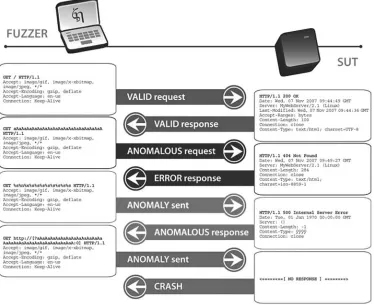
Welcome to the world of fuzzing! In a nutshell, the purpose of fuzzing is to send anomalous data to a system in order to crash it, therefore revealing reliability prob-lems. Fuzzing is widely used by both security and by quality assurance (QA) experts, although some people still suffer from misconceptions regarding its capa-bilities, effectiveness, and practical implementation. Fuzzing can be defined as
A highly automated testing technique that covers numerous boundary cases using invalid data (from files, network protocols, API calls, and other targets) as applica-tion input to better ensure the absence of exploitable vulnerabilities. The name comes from modem applications’ tendency to fail due to random input caused by line noise on “fuzzy” telephone lines.1
But before you explore fuzzing further, we ask you to try to understand why you are interested in fuzzing. If you are reading this, one thing is clear: You would like to find bugs in software, preferably bugs that have security implications. Why do you want to find those flaws? Generally, there are three different purposes for looking for these types of defects:
1. Quality Assurance (QA): Testing and securing your internally developed software.
2. System Administration (SA): Testing and securing software that you depend on in your own usage environment.
3. Vulnerability Assessment (VA): Testing and trying to break into someone else’s software or system.
We have seen a number of books about fuzzing that are written by security experts for security experts. There are also a handful of books that cover topics rel-evant to fuzzing, written by quality assurance engineers for other quality assurance engineers. Another set of books consists of “hacking cookbooks,” which teach you to use a set of tools without providing much original content about the topic at hand. In real life, testing practices are not that different from security assessment practices, or from hacking. All three require some theoretical knowledge, and some information on the available tools, as it is not efficient to continuously reinvent the wheel and develop our own tools for every task that arises.
1
In this book, we will look at fuzzing from all of these perspectives. No matter what your purpose and motivation for fuzzing, this is the book for you. We will view fuzzing from a developer’s perspective, as well as through the eyes of an enter-prise end user. We will also consider the requirements of a third-party assessment team, whether that is a testing consultant or a black-hat hacker. One goal of this book is to level the playing field between software companies (testers) and vulner-ability analysts (hackers). Software testers can learn from the talents of hackers, and vice versa. Also, as end users of software, we should all have access to the same bug-hunting knowledge and experience through easy-to-use tools.
Why did we choose fuzzing as the topic for this book? We think that fuzzing is the most powerful test automation tool for discovering security-critical problems in software. One could argue that code auditing tools find more flaws in code, but after comparing the findings from a test using intelligent fuzzing and a thorough code audit, the result is clear. Most findings from code auditing tools are false pos-itives, alerts that have no security implications. Fuzzing has no such problem. There are no false positives. A crash is a crash. A bug is a bug. And almost every bug found with fuzzing is exploitable at some level, at minimum resulting in denial of service. As fuzzing is generally black-box testing, every flaw is, by definition, remotely exploitable, depending, of course, on the interface you are fuzzing and to some extent on your definition of exploitation. Fuzzing is especially useful in ana-lyzing closed-source, off-the-shelf software and proprietary systems, because in most cases it does not require any access to source code. Doesn’t that sound almost too good to be true?
In this chapter we will present an overview of fuzzing and related technologies. We will look at why security mistakes happen and why current security measures fail to protect us from security compromises that exploit these mistakes. We will explore how fuzzing can help by introducing proactive tools that anyone can use to find and eliminate security holes. We will go on to look where fuzzing is currently used, and why. Finally, we will get a bit more technical and review the history of fuzzing, with focus on understanding how various techniques in fuzzing came into existence. Still, remember that the purpose of this chapter is only to provide an overview that will prepare you for what is coming later in the book. Subsequent chapters will provide more details on each of these topics.
1.1
Software Security
Very few people today know what software security really is, even if they are so-called “security experts.” Like the maps in ancient history used to warn, the dan-gerous area just outside the map is sometimes best left alone. The uncharted territory just read, “Here be dragons,” meaning that you should not venture there. It is too scary or too challenging. Fortunately for software security, the age of darkness is over because the first explorers risked their souls and delved into the mystic lands of hacking, trying to explain security to ordinary software developers. First, they were feared for their new skills, and later they were blamed for many of the dangerous findings they encountered. Even today they are thought to possess some secret arts that make them special. But what they found was not that complex after all.
Well, in our defense we have to say that we have explored the wilderness for more than ten years; so one could say that we are familiar with the things beyond the normal scope of software engineering and that we know the field well. We have looked at software security from an academic and commercial fuzzer developer per-spective, but also through the eyes of a security consultant, a contract hacker, and an independent analyst. Grab a book on secure programming, or one of the few good books on security, and you will be amazed how simple it is to improve software secu-rity through secure programming practices. Software secusecu-rity is a highly desirable topic to learn. The only thing you need is motivation and a will to learn. Young chil-dren could master those skills (and they continue to do so). Anyone can find a unique new vulnerability in almost any piece of commercial software and write an exploit for it. Anyone can even write worms or viruses with some focus on the topic. If you do not know what a vulnerability is, or what an exploit is, or even how to use one, you might be better off reading some other security-related book first. Don’t have patience for that? Well, we will do our best to explain along the way.
But first, let us look at what solutions are available out there. Software security can be introduced at various phases and places, starting from research and devel-opment (R&D), then entering the test-lab environment, and finally in the opera-tions phase (Figure 1.1).
In R&D, fuzzing can be used both in the early prototyping phase and in the implementation phase, where the majority of programming takes place. In fact, immediately when the first operational prototype is ready, it can be fuzzed. But a
more natural tool for software security in this phase is a source code auditing tool, which we will discuss later. One thing common in R&D environments is that devel-opers themselves use the tools at this stage.
Testing as an activity takes place throughout all phases of the software life cycle. Although most programmers conduct the first unit tests as part of R&D, a dedicated team typically performs most of the remaining testing efforts.2A test lab
environment can be quite different from an R&D environment. In a test lab, a sys-tem can be tested with any available tools, and the test results can be analyzed with all possible metrics selected for use. A test lab may contain expensive, dedicated tools for load and performance testing, as well as fuzzing. Indeed, some commer-cial fuzzers have been implemented as fixed test appliances for traditional test lab environments.
In operations, various post-deployment techniques are used to increase soft-ware security. Vulnerability scanners or security scanners such as Nessus3are most
commonly used in a live environment. An important criterion for test tools in an operational environment is that they should not disrupt the operation of critical services. Still, penetration testing services are often conducted against live systems, as they need to validate the real environment from real threats. This is because not all problems can be caught in the controlled confines of a test lab. Similarly, fuzzing should be carefully considered for operational environments. It may be able to find more flaws than when compared to a test lab, but it will most probably also disrupt critical services.
Never forget that there is no silver bullet solution for security: Not even fuzzing can guarantee that there are no flaws left in the software. The fast-paced world of technology is changing, growing, and constantly evolving, for better or worse. This is good news for testers: People will be writing new software for the foreseeable future. And new software inevitably brings new bugs with it. Your future careers are secured. Software is becoming more complex, and the number of bugs is thought to be directly proportional to lines of code. The security testing tools you have will also improve, and as you will see, fuzzing tools certainly have evolved during the past 20 years.
1.1.1 Security Incident
The main motivation for software security is to avoid security incidents: events where someone can compromise the security of a system through active attacks, but also events where data can be disclosed or destroyed through mistakes made by people, or due to natural disasters such as floods or tornadoes. Active compromises are the more significant factor for discussions related to fuzzing. “Accidental” inci-dents may arise when software is misconfigured or a single bit among massive
2The exact proportion of testing intermixed with actual development and testing performed by dedicated testers depends on the software development methodology used and the organizational structure of the development team.
amounts of data flips due to the infamous alpha-particles, cosmic rays, or other mysterious reasons and result in the crash of a critical service. Accidental incidents are still quite rare events, and probably only concernservice providers handling mas-sive amounts of data such as telecommunication. The related threat is minimal, as the probability of such an incident is insignificant. The threat related to active attacks is much more severe.
Software security boasts a mixture of terms related to security incidents. Threats are typically related to risks of loss for an asset (money, data, reputation). In a secu-rity compromise, this threat becomes realized. The means of conducting the com-promise is typically done through an attack, a script or malicious code that misuses the system, causing the failure, or potentially even resulting in the attacker’s taking control of the system. An attack is used to exploit a weakness in the system. These weaknesses are called software vulnerabilities, defects, or flaws in the system.
Example threats to assets include
• Availability of critical infrastructure components;
• Data theft using various technical means.
Example attacks are the actual exploitation tools or means:
• Viruses and worms that exploit zero-day flaws;
• Distributed Denial of Service (DDoS) attacks.
Vulnerabilities can be, for example,
• Openness of wireless networks;
• Processing of untrusted data received over the network;
• Mishandling of malicious content received over the network.
Even the casual security hackers are typically one step ahead of the system administrators who try to defend their critical networks. One reason for that is the easy availability of vulnerability details and attack tools. You do not need to keep track of all available hacking tools if you know where you can find them when you need them. However, now that computer crime has gone professional, all tools might not be available to the good guys anymore. Securing assets is becoming more challenging, as white-hat hacking is becoming more difficult.
1.1.2 Disclosure Processes
Three different models are commonly used in vulnerability disclosure processes:
1. No disclosure: No details of the vulnerability, nor even the existence of the vulnerability, are disclosed publicly. This is often the case when vulnerabil-ities are found internally, and they can be fixed with adequate time and prioritization. The same can also happen if the disclosing organization is a trusted customer or a security expert who is not interested in gaining fame for the findings. People who do not like the no-disclosure model often argue that it is difficult for the end users to prioritize the deployment of updates if they do not know whether they are security-related and that companies may not bother to fix even critical issues quickly unless there is direct pressure from customers to do so.
2. Partial disclosure: This is the most common means of disclosure in the industry. The vendor can disclose the nature of the correction and even a workaround when a proper correction is not yet available. The problem with partial disclosure is that hackers can reverse-engineer the corrections even when limited information is given. Most partial disclosures end up becoming fully known by those who are interested in the details and have the expertise to understand them.
3. Full disclosure: All details of the vulnerability, including possible exploita-tion techniques, are disclosed publicly. In this model, each reader with enough skill can analyze the problem and prioritize it accordingly. Some-times users decide to deploy the vendor-provided patches, but they can also build other means of protecting against attacks targeting the vulnerability, including deploying IDS/IPS systems or firewalls.
From an end-user perspective, there are several worrying questions: Will an update from the vendor appear on time, before attackers start exploiting a reported vulnerability? Can we deploy that update immediately when it becomes available? Will the update break some other functionality? What is the total cost of the repair process for our organization?
As a person conducting fuzzing, you may discover a lot of critical vulnerabili-ties that can affect both vendors and end users. You may want to consider the con-sequences before deciding what to do with the vulnerabilities you find. Before blowing the whistle, we suggest you familiarize yourself with the works done on vulnerability disclosure at Oulu University Secure Programming Group (OUSPG).4
1.1.3 Attack Surfaces and Attack Vectors
Now that we have explained how software vulnerabilities affect us and how they are announced, let’s take a close look at the nature of vulnerabilities in software. Vulnerabilities have many interesting aspects that could be studied, such as the level of exploitability and the mode of exploitability. But one categorization is the most important—the accessibility of the vulnerability. Software vulnerabilities have
rity implications only when they are accessible through external interfaces, as well as when triggers can be identified and are repeatable.
Fuzzing enables software testers, developers, and researchers to easily find vul-nerabilities that can be triggered by malformed or malicious inputs via standard interfaces. This means that fuzzing is able to cover the most exposed and critical attack surfaces in a system relatively well. Attack surface has several meanings, depending on what is analyzed. To some, attack surface means the source code fin-gerprint that can be accessed through externally accessible interfaces. This is where either remote or local users interact with applications, like loading a document into a word processor, or checking email from a remote mail server. From a system test-ing standpoint, the total attack surface of a system can comprise all of the individ-ual external interfaces it provides. It can consist of various network components, various operating systems and platforms running on those devices, and finally, all client applications and services.
Interfaces where privilege changes occur are of particular interest. For example, network data is unprivileged, but the code that parses the network traffic on a server always runs with some privilege on its host computer. If an attack is possible through that network-enabled interface—for example, due to a vulnerability in message pars-ing code—an unprivileged remote user could gain access to the computer dopars-ing the parsing. As a result, the attacker will elevate its privileges into those of the compro-mised process. Privilege elevation can also happen from lower privileges into higher privileges on the same host without involving any network interfaces.
An example of fuzzing remote network-enabled attack surfaces would be to send malformed web requests to a web server, or to create malformed video files for viewing in a media player application. Currently, dozens of commercial and free fuzz testing frameworks and fuzz-data generators of highly varying testing capabil-ity exist. Some are oriented toward testing only one or a few interfaces with a spe-cialized and predefined rule set, while some are open frameworks for creating fuzz tests for any structured data. The quality of tests can vary depending on the com-plexity of the interface and the fuzzing algorithms used. Simple tools can prove very good at testing simple interfaces, for which complex tools could be too time-consuming or expensive. On the other hand, a complex interface can only be tested thoroughly with a more capable fuzzing system.
The various routes into a system, whether they are remote or local, are called attack vectors. A local vector means that an attacker already has access to the sys-tem to be able to launch the attack. For instance, the attacker may possess a user-name and password, with which he or she can log into the system locally or remotely. Another option is to have access to the local user interface of the system. Note that some user interfaces are realized over the network, meaning that they are not local. The attacker can also have access to a physical device interface such as a USB port or floppy drive. As an example, a local attack vector can consist of any of the following:
5. Local network loops (RPC, Unix sockets or pipes, etc.); 6. Physical hardware access.
Much more interesting interfaces are those that are accessible remotely. Those are what fuzzing has traditionally focused on. Note that many local interfaces can also be accessed remotely through active content (ActiveX, JavaScript, Flash) and by fooling people into activating malicious content (media files, executables).
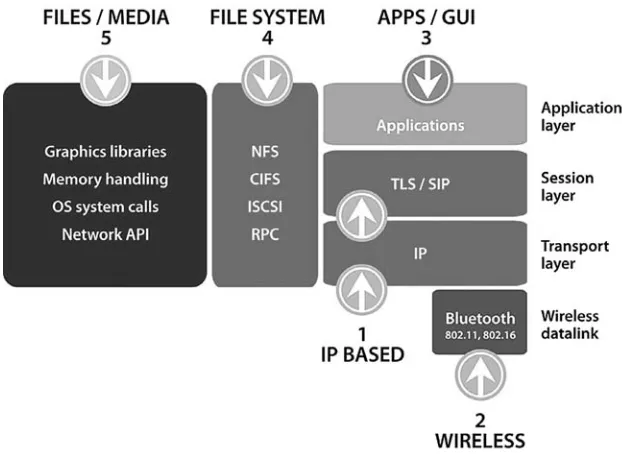
Most common categories of remote interfaces that fuzzers test are displayed in Figure 1.2.
1. Web applications: Web forms are still the most common attack vector. Almost 50% of all publicly reported vulnerabilities are related to various packaged or tailored web applications. Almost all of those vulnerabilities have been discovered using various forms of fuzzing.
2. Digital media: File formats are transferred as payloads over the network, e.g., downloaded over the web or sent via email. There are both open source and commercial fuzzers available for almost any imaginable file format. Many fuzzers include simple web servers or other tools to automatically send the malicious payloads over the network, whereas other file fuzzers are completely local. Interesting targets for file fuzzers are various media gateways that cache, proxy, and/or convert various media formats, anti-virus software that has to be able to separate valid file contents from mal-ware, and, of course, various widely used operating system components such as graphics libraries or metadata indexing services.
3. Network protocols: Standardization organizations such as IETF and 3GPP have specified hundreds of communication protocols that are used every-where in the world. A network protocol fuzzer can be made to test both client- and server-side implementations of the protocol. A simple router on the network can depend on dozens of publicly open protocol interfaces, all of which are extremely security critical due to the requirement of the router being available for any remote requests or responses.
tion of the device. For example, a flaw in an embedded device such as a Bluetooth-enabled phone can totally corrupt the memory of the device with no means of recovery.
Fuzzers are already available for well over one hundred different attack vectors, and more are emerging constantly. The hottest trends in fuzzing seem to be related to communication interfaces that have just recently been developed. One reason for that could be that those technologies are most immature, and therefore security flaws are easy to find in them. Some very interesting technologies for fuzzers include
• Next Generation Networks (Triple-Play) such as VoIP and IPTV;
• IPv6 and related protocols;
• Wireless technologies such as WiFi, WiMAX, Bluetooth, and RFID;
• Industrial networks (SCADA);
• Vehicle Area Networks such as CAN and MOST.
We will not list all the various protocols related to these technologies here, but if you are interested in finding out which protocols are the most critical ones for you, we recommend running a port scanner5against your systems, and using
net-work analyzers6to monitor the actual data being sent between various devices in
your network.
1.1.4 Reasons Behind Security Mistakes
Clearly, having security vulnerabilities in software is a “bad thing.” If we can define the attack surface and places where privilege can be elevated, why can’t we simply make the code secure? The core reason is that the fast evolution of com-munications technologies has made software overwhelmingly complex. Even the developers of the software may not understand all of the dependencies in the com-munication infrastructure. Integration into off-the-shelf platforms and operating systems brings along with it unnecessary network services that should be shut down or secured before deploying the products and services. Past experience has shown that all complex communication software is vulnerable to security inci-dents: The more complex a device is, the more vulnerable it usually proves in prac-tice. For example, some security solutions are brought in to increase security, but they may instead enable new vulnerabilities due to their complexity. If a thousand lines of code have on average between two to ten critical defects, a product with millions of lines of code can easily contain thousands of flaws just waiting to be found. For secure solutions, look for simple solutions over complex ones, and min-imize the feature sets instead of adding anything unnecessary. Everything that is not used by majority of the users can probably be removed completely or shut down by default. If you cannot do that or do not want to do that, you have to test (fuzz) that particular feature very thoroughly.
Standardization and harmonization of communications have their benefits, but there is also a downside to them. A standardized homogeneous infrastructure can be secure if all possible best practices are in place. But when security deployment is lacking in any way, such an environment can be disrupted with one single flaw in one single standard communication interface. Viruses and worms often target widely deployed homogeneous infrastructures. Examples of such environments include e-mail, web, and VoIP. A unified infrastructure is good from a security point of view only if it is deployed and maintained correctly. Most people never update the software in their mobile phones. Think about it! Some people do not even know if they can update the software on their VoIP phones. If you do not want to update all those devices every week, it might be beneficial to try to fuzz them, and maybe fix several flaws in one fell swoop.
Open, interconnected wireless networks pose new opportunities for vulnerabil-ities. In a wireless environment, anyone can attack anyone or anything. Wireless is by definition always open, no matter what authentication and encryption mecha-nisms are in place. For most flaws that are found with fuzzing in the wireless domain, authentication is only done after the attack has already succeeded. This is because in order to attempt authentication or encryption, input from an untrusted source must be processed. In most cases the first message being sent or received in wireless communications is completely anonymous and unauthenticated. If you do not need wireless, do not use it. If you need to have it open, review the real opera-tion of that wireless device and at minimum test the handling of pre-authenticaopera-tion messages using fuzzing.
Mobility will increase the probability of vulnerabilities, but also will make it eas-ier to attack those devices. Mobile devices with complex communication software are everywhere, and they often exist in an untrusted environment. Mobility will also enable anonymity of users and devices. Persons behind security attacks cannot be tracked reliably. If you have a critical service, it might be safer to ask everyone to authenticate himself or herself in a secure fashion. At minimum, anything that can be accessed anonymously has to be thoroughly tested for vulnerabilities.
1.1.5 Proactive Security
For an enterprise user, there are typically two different measures available for pro-tecting against security incidents: reactive and proactive. The main difference between reactive security measures and proactive security measures is who is in control of the process. In reactive measures, you react to external events and keep running around putting fires out. In proactive security measures, you take a step back and start looking at the system through the eyes of a hacker. Again, a hacker in this sense is not necessarily a criminal. A hacker is a person who, upon hearing about a new technology or a product, will start having doubts on the marketing terms and specifications and will automatically take a proactive mindset into ana-lyzing various technologies. Why? How? What if? These are just some of the ques-tions someone with this mindset will start to pose to the system.
XXX enables companies to preemptively mitigate unknown and published threats in products and services prior to release or deployment—before systems are exposed, outages occur, and zero-day attacks strike.
By using YYY, both product developers and end users can proactively verify secu-rity readiness before products are purchased, upgraded, and certainly before they are deployed into production environments.
In short, proactive, pre-deployment, or pre-emptive software security equals to catching vulnerabilities earlier in the software development life cycle (SDLC), and catching also those flaws that have not been disclosed publicly, which traditional reactive security measures cannot detect. Most traditional security solutions attempt to detect and block attacks, as opposed to discovering the underlying vul-nerabilities that these attacks target (Figure 1.3).
A post-deployment, reactive solution depends on other people to ask the ques-tions critical for security. An example of a reactive solution is a signature based anti-virus system. After a new virus emerges, researchers at the security vendor start poking at it, trying to figure out what makes it tick. After they have analyzed the new virus, they will make protective measures, trying to detect and eliminate the virus in the network or at a host computer. Another example of a reactive solution is an Intrusion Detection System (IDS) or an Intrusion Prevention System (IPS). These systems look for known exploits and block them. They do not attempt to identify which systems are vulnerable or what vulnerabilities exist in software. One could argue that even a firewall is reactive solution, although the pace of development is much slower. A firewall protects against known attacks by filtering communica-tion attempts at the perimeter. The common thread with most post-deployment security solutions is that they all target “attacks,” and not “vulnerabilities.” They are doomed to fail because of that significant difference. Every time there is a unique vulnerability discovered, there will be hundreds, if not thousands of attack variants trying to exploit that worm-sized hole. Each time a new attack emerges, the retroactive security vendors will rush to analyze it and deploy new fingerprints to their detection engines. But based on studies, unfortunately they only detect less than 70% of attacks, and are often between 30 and 60 days late.7
Figure 1.3 Reactive post-deployment versus proactive pre-deployment security measures.
One could argue that security scanners (or vulnerability scanners) are also proactive security tools. However, security scanners are still mostly based on known attacks and exhibit the same problems as other reactive security solutions. A security scanner cannot find a specific vulnerability unless the vulnerability is publicly known. And when a vulnerability becomes known, attacks usually already exist in the wild exploiting it. That does not sound very proactive, does it? You still depend on someone else making the decisions for you, and in their analyzing and protecting your assets. Security scanners also look for known issues in stan-dard operating systems and widely used hosts, as data on known vulnerabilities is only available for those platforms. Most tests in security scanners are based on passive probing and fingerprinting, although they can contain active hostile tests (real exploits) for selected known issues. Security scanners cannot find any un-known issues, and they need regular updating of threats. Security scanners also rarely support scanning anything but very popular operating systems and selected network equipment.
An additional recent problem that is becoming more and more challenging for reactive security solutions that depend on public disclosure is that they do not know the problems (vulnerabilities) anymore. This is because the “public disclosure movement” has finally died down. However, raising awareness about security mis-takes can only be a good thing. Public disclosure is fading because very few people actually benefit from it. Manufacturers and software developers do not want to pub-lish the details of vulnerabilities, and therefore today we may not know if they have fixed the problems or not. Hackers do not want to publish the details, as they can sell them for profit. Corporate enterprise customers definitely do not want to pub-lish any vulnerability details, as they are the ones who will get damaged by any attacks leading to compromises. The only ones who publish details are security companies trying to make you believe they actually have something valuable to offer. Usually, this is just bad and irresponsible marketing, because they are getting mostly second-hand, used vulnerabilities that have already been discovered by var-ious other parties and exploited in the wild.
A proactive solution will look for vulnerabilities and try to resolve them before anyone else learns of them and before any attacks take place. As we said, many enterprise security measures fail because they are focused on known attacks. A truly proactive approach should focus on fixing the actual flaws (unknown zero-day vul-nerabilities) that enable these attacks. An attack will not work if there is no under-lying vulnerability to exploit. Vulnerability databases indicate that programming errors cause 80% of vulnerabilities, so the main focus of security solutions should probably be in that category of flaws. Based on research conducted at the PROTOS project and also according to our experience at commercial fuzzing companies, 80% of software will crash when tested via fuzzing. That means we can find and eliminate many of those flaws with fuzzing, if we spend the effort in deploying fuzzing.
1.1.6 Security Requirements
based on the requirement set for the system. Unfortunately, traditional security requirements are feature-driven and do not really strike a chord with fuzzing.
Typical and perhaps the most common subset of security requirements or secu-rity goals consists of the following: confidentiality, integsecu-rity, and availability. Fuzzing directly focuses on only one of these, namely availability, although many vulnerabilities found using fuzzing can also compromise confidentiality and integrity by allowing an attacker to execute malicious code on the system. Furthermore, the tests used in fuzzing can result in corrupted databases, or even in parts of the mem-ory being sent back to the fuzzer, which also constitute attacks against confidential-ity and integrconfidential-ity.
Fuzzing is much closer to the practices seen in quality assurance than those related to traditional security requirements. This may have been one of the main reasons why fuzzing has not been widely adopted so far in software engineering processes: Security people have mostly driven its deployment. Without solid requirements to fulfill, you only end up with a new tool with no apparent need for it. The result is that your expensive fuzzer equipment ends up just collecting dust in some far-away test lab.
1.2
Software Quality
Thrill to the excitement of the chase! Stalk bugs with care, methodology, and rea-son. Build traps for them. . . . Testers! Break that software (as you must) and drive it to the ultimate—but don’t enjoy the programmer’s pain.
Boris Beizer8
People who are not familiar with testing processes might think that the purpose of testing is to find flaws. And the more flaws found, the better the testing process is. Maybe this was the case a long time ago, but today things are different. Modern testing is mostly focused on two things: verification and validation (V&V). Although both terms are used ambiguously, there is an intended difference.
Verificationattempts to answer the question: “Did we build the product right?” Verification is more focused on the methods (and in the existence of these methods), such as checklists, general process guidelines, industry best practices, and regula-tions. Techniques in verification ensure that the development, and especially the qual-ity assurance process, is correct and will result in reduction of common mistakes. Validation, on the other hand, asks: “Did we build the right product?” The focus is on ensuring and documenting the essential requirements for the product and in building the tests that will check those requirements. For any successful val-idation testing, one needs to proactively define and document clear pass/fail crite-ria for all functionality so that eventually when the tests are done, the test verdicts can be issued based on something that has been agreed upon beforehand.
Unfortunately, fuzzing does not fit well into this V&V model, as we will see here, and later in more detail in Chapter 3.
Testing is a time-consuming process that has been optimized over time at the same time that software has become more complex. With increasing complexity, devising a completely thorough set of tests has become practically impossible. Soft-ware development with a typical waterfall model and its variants—such as the iter-ative development process—proceed in phases from initial requirements through specification, design, and implementation, finally reaching the testing and post-deployment phases. These phases are rarely completely sequential in real-life devel-opment, but run in parallel and can revisit earlier steps. They can also run in cycles, such as in the spiral model. Due to this, the requirements that drive testing are drafted very early in the development process and change constantly. This is extremely true for various agile processes, where test requirements may be only rarely written down due to the fast change process.
If we look at fuzzing from a quality assurance perspective, fuzzing is a branch of testing; testing is a branch of quality control; quality control is a branch of qual-ity assurance. Fuzzing differs from other testing methods in that it
• Tends to focus on input validation errors;
• Tends to focus on actual applications and dynamic testing of a finished
product;
• Tends to ignore the responses, or valid behavior;
• Concentrates mostly on testing interfaces that have security implications.
In this section, we’ll look at different kinds of testing and auditing of software from a tester’s perspective. We will start with identifying how much you need to test (and fuzz) based on your needs. We will then define what a testing target is and fol-low that up with some descriptions of different kinds of testing as well as where fuzzing fits in with these definitions. Finally, we will contrast fuzzing with more traditional security measures in software development such as code auditing.
1.2.1 Cost-Benefit of Quality
From a quality assurance standpoint, it is vital to understand the benefits from defect elimination and test automation. One useful study was released in January 2001, when Boehm and Basili reviewed and updated their list of metrics on the ben-efits of proactive defect elimination. Their software defect reduction “Top 10” list includes the following items:9
1. Finding and fixing a software problem after delivery is often 100 times more expensive than finding and fixing it during the requirements and design phase.
2. Current software projects spend about 40% to 50% of their effort on avoidable rework.
3. About 80% of avoidable rework comes from 20% of the defects.
4. About 80% of the defects come from 20% of the modules, and about half of the modules are defect free.
5. About 90% of the downtime comes from, at most, 10% of the defects. 6. Peer reviews catch 60% of the defects.
7. Perspective-based reviews catch 35% more defects than nondirected reviews. 8. Disciplined personal practices can reduce defect introduction rates by up to
70%.
9. All other things being equal, it costs 50% more per source instruction to develop high-dependability software products than to develop low-dependability software products. However, the investment is more than worth it if the project involves significant operations and maintenance costs. 10. About 40% to 50% of users’ programs contain nontrivial defects.
Although this list was built from the perspective of code auditing and peer review (we all know that those are necessary), the same applies to security testing. If you review each point above from a security perspective, you can see that all of them apply to vulnerability analysis, and to some extent also to fuzzing. This is because every individual security vulnerability is also a critical quality issue, because any crash-level flaws that are known by people outside the development organiza-tion have to be fixed immediately. The defects found by fuzzers lurk in an area that current development methods such as peer reviews fail to find. These defects almost always are found only after the product is released and someone (a third party) con-ducts fuzz tests. Security is a subset of software quality and reliability, and the meth-odologies that can find flaws later in the software life-cycle should be integrated to earlier phases to reduce the total cost of software development.
The key questions to ask when considering the cost of fuzzing are the following.
1. What is the cost per defect with fuzzing?Some people argue that this met-ric is irrelevant, because the cost per defect is always less than the cost of a security compromise. These people recognize that there are always ben-efits in fuzzing. Still, standard business calculations such as ROI (return on investment) and TCO (total cost of ownership) are needed in most cases also to justify investing in fuzzing.
2. What is the test coverage?Somehow you have to be able to gauge how well your software is being tested and what proportion of all latent problems are being discovered by introducing fuzzing into testing or auditing proc-esses. Bad tests done with a bad fuzzer can be counterproductive, because they waste valuable testing time without yielding any useful results. At worst case, such tests will result in over-confidence in your product and arro-gance against techniques that would improve your product.10A solid fuzzer
with good recommendations and a publicly validated track record will likely prove to be a better investment coverage-wise.
3. How much should you invest in fuzzing?The motivation for discussing the price of fuzzing derives from the various options and solutions available in the market. How can you compare different tools based on their price, overall cost of usage, and testing efficiency? How can you compare the total cost of purchasing an off-the-shelf commercial fuzzer to that of adopting a free fuzzing framework and hiring people to design and imple-ment effective tests from the ground up? Our experience in the market has shown that the price of fuzzing tools is not usually the biggest issue in com-parisons. In commercial fuzzing, the cheapest tools usually prove to be the simplest ones—and also without exception the worst ones from a testing coverage, efficiency, and professional testing support standpoint. Commer-cial companies looking for fuzz testing typically want a fuzzer that (a) sup-ports the interfaces they need to test, (b) can find as many issues as possible in the systems they test, and (c) are able to provide good results within a reasonable timeframe.
There will always be a place for both internally built tools and commercial tools. A quick Python11script might be better suited to fuzz a single isolated custom
application. But if you are testing a complex communication protocol implementa-tion or a complete system with lots of different interfaces, you might be better off buying a fuzzing tool from a commercial test vendor to save yourself a lot of time and pain in implementation. Each option can also be used at different phases of an assessment. A sample practice to analyze fuzzing needs is to
1. Conduct a QA risk analysis, and as part of that, possibly conduct necessary ad-hoc tests;
2. Test your product thoroughly with a commercial testing tool;
3. Hire a professional security auditing firm to do a second check of the results and methods.
1.2.2 Target of Test
In some forms of testing, the target of testing can be any “black box.” All various types of functional tests can be directed at different kinds of test targets. The same applies for fuzzing. A fuzzer can test any applications, whether they are running on top of web, mobile, or VoIP infrastructure, or even when they are just standalone software applications. The target of a test can be one single network service, or it can be an entire network architecture. Common names used for test targets include
• SUT (system under test). An SUT can consist of several subsystems, or it can
represent an entire network architecture with various services running on top of it. An SUT can be anything from banking infrastructure to a complex telephony system. SUT is the most abstract definition of a test target, because it can encompass any number of individual destinations for the tests.
• DUT (device under test). A DUT is typically one single service or a piece of
equipment, possibly connected to a larger system. Device manufacturers mainly use the term DUT. Some examples of DUTs include routers, WLAN access points, VPN gateways, DSL modems, VoIP phones, web servers, or mobile handsets.
• IUT (implementation under test). An IUT is one specific software
implemen-tation, typically the binary representation of the software. It can be a process running on a standard operating system, or a web application or script run-ning on an application server.
In this book, we will most often refer to a test target as an SUT, because this term is applicable to all forms of test setups.
1.2.3 Testing Purposes
The main focus of fuzzing is on functional security assessment. As fuzzing is essen-tially functional testing, it can be conducted in various steps during the overall development and testing process. To a QA person, a test has to have a purpose, or otherwise it is meaningless.12Without a test purpose, it is difficult to assign a test
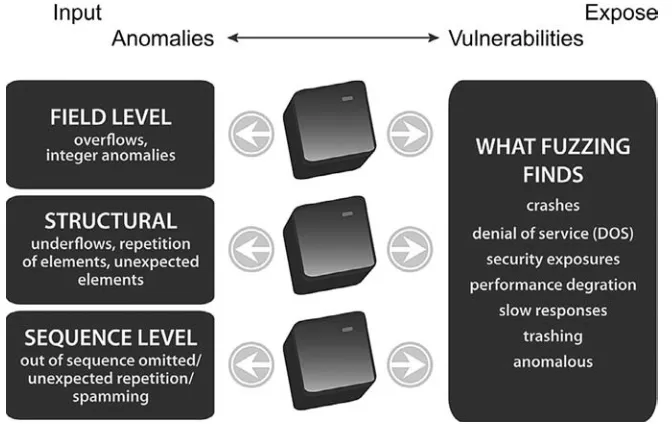
verdict—i.e., Did the test pass or fail? Various types of testing have different pur-poses. Black-box testing today can be generalized to focus on three different purposes (Figure 1.4). Positive testing can be divided into feature tests and perform-ance tests. Test requirements for feature testing consist of a set of valid use cases, which may consist of only few dozens or at most hundreds of tests. Performance testing repeats one of the use cases using various means of test automation such as record-and-playback. Negative testing tries to test the robustness of the system through exploring the infinite amount of possible anomalous inputs to find the tests that cause invalid behavior. An “anomaly” can be defined as any unexpected input Figure 1.4 Testing purposes: features, performance, and robustness.
that deviates from the expected norm, ranging from simple field-level modifications to completely broken message structures or alterations in message sequences. Let us explore these testing categories in more detail.
Feature testing, or conformance testing, verifies that the software functions according to predefined specifications. The features can have relevance to secu-rity—for example, implementing security mechanisms such as encryption and data verification. The test specification can be internal, or it can be based on industry standards such as protocol specifications. A pass criterion simply means that accord-ing to the test results, the software conforms to the specification. A fail criterion means that a specific functionality was missing or the software operated against the specification. Interoperability testing is a special type of feature test. In interoper-ability testing, various products are tested against one another to see how the fea-tures map to the generally accepted criteria. Interoperability testing is especially important if the industry standards are not detailed enough to provide adequate guidance for achieving interoperability. Most industry standards always leave some features open to interpretation. Interoperability testing can be conducted at special events sometimes termed plug-fests (or unplug-fests in the case of wireless protocols such as Bluetooth).
Performance testing tests the performance limitations of the system, typically consisting of positive testing only, meaning it will send large amounts of legal traf-fic to the SUT. Performance is not only related to network performance, but can also test local interfaces such as file systems or API calls. The security implications are obvious: A system can exhibit denial-of-service when subjected to peak loads. An example of this is distributed denial of