Knowledge in the making: Prototyping and human-centred
design practice.
WALTERS, Peter J.
Available from Sheffield Hallam University Research Archive (SHURA) at:
http://shura.shu.ac.uk/20492/
This document is the author deposited version. You are advised to consult the
publisher's version if you wish to cite from it.
Published version
WALTERS, Peter J. (2005). Knowledge in the making: Prototyping and
human-centred design practice. Doctoral, Sheffield Hallam University (United Kingdom)..
Copyright and re-use policy
See
http://shura.shu.ac.uk/information.html
Adsetts Centre City Campus Sheffield S1 1WB
1 0 1 8 2 6 2 1 0 5
<^r)/0cC<c r J O
2 *
Sheffield Haliam University
Author:
Title/Thesis Number:
no
W
maK
iNQ
- •
Degree:
-tP
Year: <£oo^
Copyright Declaration
Consultation for Research or Private study for Non Commercial
Purposes
I recognise that the copyright in this thesis belongs to the author.
I undertake not to publish either the whole or any part of it, or make a copy of the whole or any substantial part of it, without the consent of the author. I recognise that making quotations from unpublished works under 'fair dealing for criticism or review' is not permissible.
Consultation for Research or Private study for Commercial Purposes
I recognise that the copyright in this thesis belongs to the author.
I undertake not to publish either the whole or any part of it, or make a copy of the whole or any part of it, without the consent of the author.
I recognise that making quotations from unpublished works under 'fair dealing for criticism or review' is not permissible.
Readers consulting this thesis are required to complete the details below and sign to show they recognise the copyright declaration.
Date Name and Institution /Organisation
ProQuest Number: 10701139
All rights reserved
INFORMATION TO ALL USERS
The quality of this reproduction is dependent upon the quality of the copy submitted.
In the unlikely event that the author did not send a com plete manuscript and there are missing pages, these will be noted. Also, if material had to be removed,
a note will indicate the deletion.
uest
ProQuest 10701139
Published by ProQuest LLC(2017). Copyright of the Dissertation is held by the Author.
All rights reserved.
This work is protected against unauthorized copying under Title 17, United States C ode Microform Edition © ProQuest LLC.
ProQuest LLC.
789 East Eisenhower Parkway P.O. Box 1346
Knowledge in the making:
Prototyping and human-centred design practice
Peter James Walters
A thesis submitted in partial fulfilment of the requirements of
Sheffield Hallam University
for the degree of Doctor of Philosophy
6 * 0 'w -i
Contents
Acknowledgements
Abstract
1.0 Introduction, aims and objectives...5
Part One: Contextual Review 2.0 User-centred design literature: definitions and methods... 15
3.0 Human-centred design: Knowledge in the making...44
Part Two: Practical Examples 4.0 Practical examples: methodological overview...100
5.0 Well Connected: an interdisciplinary investigation into the benefits of tactile cues within safety critical product applications... 106
6.0 Bio-inspired actuators... 126
7.0 Summary, conclusions, future directions...228
8.0 Bibliography...248
9.0 Appendix 1 report on the visit to the MIT/Harvard Centre for Medical Simulation...265
Acknowledgements
I wish to express my gratitude to my supervisory team Professor Paul Chamberlain, Dr Tom Fisher, Professor Mike Press and Professor Anne Tomes who have
supported, encouraged and inspired.
I am thankful to Professor Chamberlain for providing me with the opportunity to contribute to his program of research in medical device design, and also to the other members o f the interdisciplinary project team: Dr Peter Gardner, Dr Rebecca Lawton and Dr Neil Carrigan (University of Leeds) and Dr Philip Bickford Smith (Bradford Royal Infirmary).
I would also like to thank Professor Sergio Pellegrino and Matthew Santer (University o f Cambridge), Dr Alaster Yoxall (University o f Sheffield), and Dr Muhammad Islam and Robert Glynn (Sheffield Hallam University) for taking an interest in my shape- changing structures and also for providing support and advice on computer modelling and simulation techniques in this area.
Thanks must also go to the skilled craftsmen and technicians in the design workshops of Sheffield Hallam University who have supported me in my making activities, especially Peter Downes, Howard Walker and John Walton, and also to Katie Davies for her assistance with photography.
Knowledge in the making:
Prototyping and human-centred design practice
Abstract
This thesis presents an enquiry into the natur e and role of prototyping within human- centred design practice, examining the capabilities and limitations of emerging prototyping technologies within this context.
A contextual review explores the significance of the human element in design. This leads to the proposal of a paradigm statement for human-centred design which informs the theoretical and practical research activity undertaken in the course o f this investigation.
A critical review o f literature aimed at the design and engineering professions
identifies a rhetoric celebrating the virtualisation of design processes. Here, advocates of emerging virtual prototyping technologies argue computer-based simulation techniques may reduce or replace physical prototype iterations, thereby greatly increasing the speed and efficiency of new product development processes. This thesis questions the extent to which virtual prototyping can replace physical human input in design.
A counter argument to the designer's total immersion in the virtual design world is that valuable creative opportunities may be revealed through discoveiy-oriented physical prototyping. Furthermore, it may not be possible to adequately describe all aspects of a design proposal using virtual methods alone. This is demonstrated in practical investigations in which designers sought to exploit tactile qualities as essential features in design, and also in cases involving complex structural behaviour.
VVIUVIIUM
1.0
Introduction, aims and objectives
'The feel fo r the physical world about us is being lost due to the intervention o f computerised equipment and work is becoming an abstraction from the real world. In my view profound problems face us in the coming years due to this process.'
Cooley (1980 p 4)
Like many others, I have always enjoyed making. The research described within this thesis arises from this personal enthusiasm and also a deeply held belief in the value of physical making and testing as a means of exploring practical design ideas. For me, a childhood fascination with all things mechanical led to a period of employment as an engineering draughtsperson. I was trained to work on the drawing board and also in CAD (Computer Aided Design) for the production o f engineering drawings for a variety of applications ranging from the fabrication o f large industrial structures to precision-machined engineering components. Here I benefited from the practical knowledge and experience of those who had worked "on the shop floor". However, I soon grew tired of life in the drawing office, and so I embarked upon studies in industrial design, undertaken in the hands-on "ait school" tradition o f studio and workshop-based leaning; a pragmatic approach which actively encouraged 'doing for the sake of knowing' (Dewey 1929 p 87, Gedenryd 1998 p 123).
Upon graduation, I entered employment in industrial design, where I gained professional experience in the use o f industry-standard computer aided design and engineering techniques and rapid prototyping technologies within a range of product design applications. I later pursued postgraduate study, where I was inspired by the work of researchers and academics engaged in practice-centred design research, based upon an approach of'experimental making' (eg Rust, Whiteley and Wilson 2000; Rust, Chamberlain and Roddis 2000; Rust 2004; Chamberlain, Roddis and Press 1999; Whiteley 2000).
Cooley, a senior development engineer at Lucas Aerospace in the 1970's, identified that the introduction of computer-aided design systems meant practical design tasks being taken out of the hands o f makers; the highly skilled engineering technicians who possessed a working tacit knowledge of physical materials and processes acquired through years of making things and seeing them break and rupture' (Cooley p 81). He fear ed the likely consequences of the loss o f physical human input into the design process when '...more and more, that knowledge has been abstracted away from the labour process and rarefied into mathematical functions' (Cooley p 5).
Cooley was an active h ade unionist, but he was not only concerned for the de-skilling of the labour' force, since it may be argued that without valuable practical knowledge and experience, designers and engineers may lose touch with the physical reality of design problems. Press (1996) describes how Cooley led trade unionists at Lucas in a unique response to increasing numbers of redundancies at the company. The Lucas Aerospace Worker’s Plan contained innovative ideas for socially responsible design and human-centred technologies, including a portable life support machine, a vehicle for children with Spina Bifida, energy conserving products, and wind-powered generators for use in developing countries.
Design ideas were developed by Lucas engineers in collaboration with universities and healthcare institutions, and manufacture of the designs would capitalise on the skills of the workforce. The Lucas Plan was never taken up by the company although, as Press reports, its underlying principles provided inspiration for other initiatives in the UK and abroad.
In literature aimed at the design and engineering professions, virtual and rapid prototyping techniques are often referred to as time compression technologies, since these processes promise shorter development times and a reduction in the number of physical prototype iterations required to get a product off the virtual drawing board and onto the production line. Here, advocates of virtual prototyping claim computer modelling and simulation technologies might reduce or replace physical prototype iterations in design.
A counter argument to the designer's total immersion in the virtual design world is that human knowledge and experiences may be elicited through hands-on interaction with physical prototype models. Chamberlain et al (1999, 2003), Rust et al (2000) and Rust (2004) identify how physical prototype artefacts may be instrumental in both eliciting and communicating knowledge within practice-centred design research. Here, physical prototypes provide a tangible 'bridge' between designers and other stakeholders within inter-disciplinary research (Rust et al 2000a). Valuable opportunities may therefore be lost through an over-reliance on hands-off virtual prototyping.
II I I I U U U V . I I U I I
The aims and objectives of the study were:
1 To review the literature within the discourses of design, human computer interaction and human factors engineering, to identify approaches to human- centred design adopted by practitioners within these fields.
2 To identify a paradigm statement for human-centred design - in this context, a statement o f ideas, values or beliefs to guide the theoretical and practical research activity described within this thesis1.
3 To review the literature from within product design and engineering discourse which describes the current state of the art in rapid and virtual prototyping.
4 To undertake practical design activities exploring approaches to prototyping within the context of human-centred design.
5 To communicate the findings and outcomes o f the practical design activities and to identify the implications and conclusions of the theoretical and practical research undertaken as part of this study.
1 In 'The Structure of Scientific Revolutions' Kuhn (1962 p 175) identifies that the term
paradigm can refer to the '...beliefs, values and techniques...' shared by a community
of practice.
In first half o f this thesis, I present a contextual review which explores the significance of the human element in design. Here Chapter 2 begins with Margolin's assertion that although '...the relationship between products and users has become a central theme of design discourse, users still remain little understood by designers' (Margolin 1997). Margolin's statement may seem somewhat controversial, since the benefits of user-centred design have been widely discussed within design, human computer interaction (HCI) and human factors engineering discourse.
Starting with Hemy Dreyfuss’ 'Designing for People' (1955), an extensive review of literature from within the fields of product design, HCI and human-factors engineering introduces a range o f definitions and methodological approaches to user-centred design. However the term user-centred design appeal s to have a utilitarian focus, in which people are defined merely as "users" and the emphasis is placed on product use, usability and the user experience (Buchanan 2001a, Bramwell-Davis 2002). Human- centred design implies a much broader concept, embracing the knowledge,
experiences and relationships between the designer, the end-users and the other stakeholders within the system of production and consumption. For example Papanek (1972) calls for the designer to take on the role o f advocate within a system of
production and consumption which is socially, ethically and ecologically responsible.
In seeking to affirm human needs and human values through practical intervention, human-centred might be considered to be a form of pragmatic humanism. A
discussion drawing on the writing of Buchanan, Manzini and Papanek further explores the humane dimensions of design. This leads me to propose the following as a
paradigm statement which serves as a guide to the theoretical and practical research described within this thesis:
Human-centred design is a creative exploration o f human needs, knowledge and experience which aims to extend human capabilities and improve quality o f life.
One may naturally assume that this creative approach conflicts with the 'scientistic' view of the world that is based on logic and rationality (Fisher 1997, Coyne and Snodgrass 1991). This conflict reflects a dualistic view of knowledge - Cartesian dualism - in which objectivity, logical deduction and theoretic reasoning are set apart from subjectivity, intuition and practical experience. Yet here the story of the scientists Newton and Hooke is presented; the intention is to illustrate how a coming together of theoretical and practical knowledge can lead to creative discoveries in science. Similarly it may be argued that creativity and invention in design come about through a combination of theoretical reasoning, intuition and practical experience.
At the Designing Design Research event held at London's Royal College o f Art in March 2004, John Chris Jones called on the design research community to 'end the dualism and create integration'. Through the synthesis of theory and practice, reason and intuition, human creativity may provide the key to reconciling the conflict of dualism. Perhaps this is the creative challenge that design must continually seek to address.
The schism of dualism appears again in a discussion exploring the Heideggian concepts of vorhanden and zuhanden (present-at-hand and ready-to-hand) and
Aicher's Analogous and Digital (1991). Parallels are identified between these concepts and changes in the nature of prototyping within human-centred design, specifically in the relationship between hands-on and hands-off approaches to prototyping.
Literature describing emerging virtual prototyping technologies aimed at the
engineering and design professions celebrates a progressive virtualisation of product development processes, thr ough which the requirement for physical prototype iterations might be reduced or even eliminated altogether (eg Connell 2004, Bocking 2003, Bussler 2003, Hollerbach et al 2000, Boswell 1998).
Three examples are presented - Cooley's account of the development o f a prototype aircraft engine (1980) and, more recently, the London Millennium Bridge and Thomas Heatherwick's sculpture 'The B of the Bang' in Manchester. These examples serve to illustrate the requirement for designers and engineers to confront the physical reality
of design problems, and the importance of physical human input in design.
However the potential benefits of accelerated product development timescales promised by advocates of virtual and rapid prototyping technologies cannot be ignored, nor can the creative opportunities which may be afforded by new forms of making. Therefore these examples point towards a requirement for reconciliation and integration of hands-off and hands-on prototyping processes within human-centred design practice.
In the second half of this thesis, I present practical examples investigating approaches to prototyping within human-centred design. The aim is to demonstrate ways in which a combination of hands-on and hands-off processes can together make a mutual contribution to human-centred design practice.
Chapter 4 provides an overview of the methodological approach adopted within the practical investigations. Since human-centred design practice is the field o f enquiry, a methodology based on practice clearly seems appropriate in this context. A practical approach to design research is introduced by Archer (1995). Here Archer describes an approach in which the researcher's own practice is the principal method of enquiry. This takes the form of action research, which Archer defines as:
'... Systematic enquiry conducted through the medium o f practical action, calculated to devise or test new, or newly imported, information, forms or procedures and to develop communicable knowledge ...
Action Research findings are extremely valuable. They produce insights which might otherwise never be obtained ...'
(Archer 1995)
Rust (1999, 2004) points to design as a tool for exploring the world, and suggests that insights gained through design enquiry might be different, and perhaps
l l l l l U U U Ut l U M
Through active engagement in creative practice, the researcher may gain unique insights which shed new light on the problem or process under investigation. An approach is therefore adopted in which the researcher's own creative practice forms an essential part of the research methodology.
Earlier it was identified that an aim o f human-centred design is to extend human capabilities and improve quality of life. One area in which design can make a practical contribution directed towards this aim is within the field of medical technology. Research described in chapter 5 relates to a pilot study forming part of an ongoing interdisciplinary investigation into the safety of medical devices led by the author's supervisor Professor Paul Chamberlain.
The project investigates the potential benefits of tactile cues within safety-critical product applications. Research focuses on the design and prototyping of a novel tactile identification system for connectors used in the administration of drugs to hospital patients; the aim is to help prevent potentially fatal misconnection errors since a number o f fatalities have occurred because patients have been connected up to the wrong drug delivery line.
I l l l l U U U b l l U I I
Rapid prototyping was used to produce a series o f physical prototype tactile components which were evaluated in identification tests conducted out by
Psychologists at the University of Leeds, involving participants who were healthcare specialist from the intensive care and anaesthetics departments of Bradford Royal Infirmary.
In addition to practical insights into the design, prototyping and testing o f the tactile identification system for medical connectors, findings from the research have been presented and published in international conference proceedings (Walters,
Chamberlain and Press 2003; Walters, Chamberlain, Press and Tomes 2004). The tactile identification system has been the subject of UK and international patent applications (Identification System for Compatible Components, inventors: Paul Chamberlain and Peter Walters, 2003, 2004).
Following on from research investigating the concept of tactile cues, chapter 6 introduces a biological analogy - the pufferfish is a creature which appears to exhibit both visual and tactile cues, expanding and projecting spikes to ward off predators in a dramatic display of self defence. This chapter describes practical research
investigating the design of bio-inspired indicators; devices which exhibit changes in shape and or surface texture in response to external stimuli. These devices
demonstrate design principles which may in future by applied in the development visual and tactile safety indicators for use in safety-critical product applications.
II 111 U U U U 1 IU II
Presentation of the physical prototypes to others revealed that the shape-changing indicators appeal' to exhibit gestural qualities that are surprisingly emotive. This unexpected practical outcome is discussed in the light of recent research into 'Design and Emotion' (eg McDonagh et al 2004, Norman 2004), highlighting a further dimension o f human-centred design. Furthermore, through consultation with
healthcare professionals and a leading packaging manufacturer, research identifies the potential for possible future developments in which shape-changing indicators may function as safety indicators within pharmaceutical packaging applications.
User-centred design literature, definitions and methods
2.0 User-centred design literature, definitions and methods
2.1
Introduction
'The relation of products to users has become a centr al theme of design discourse, though users still remain little understood by designers.'
Margolin (1997)
The benefits o f user-centred design have been widely discussed, within product design discourse, and also in the areas of human computer interaction (HCI), human factors engineering and ergonomics. In light of this, Margolin's assertion that users still remain little understood by designers may now seem somewhat controversial.
If the aim is to improve the usability of products, it is essential for designers to acquire knowledge of product use that is derived from first hand experience. In some cases, such as when designing familiar consumer products, designers can draw on their own “real-life” experience of using these products. However, it becomes more difficult when designing products that are used in unfamiliar contexts, or for people whose age and/or capabilities lie outside of the designer’s own experience. It is therefore necessary for designers to build close collaborative relationships with product users and, where possible, to take part in user activities themselves.
When it came to researching the requirements of end-users, the pioneering American industrial designer Hemy Dreyfuss led by example:
'I have washed clothes, cooked, driven a tractor, run a diesel locomotive, spread manure, vacuumed rugs, and ridden in an armoured tank. I have operated a sewing machine, a telephone switchboard, a com picker, a lift truck, a turret lathe, and a linotype machine... .We ride in submarines and jet planes. All this in the name o f research. ’
User-centred design literature, definitions and methods
Building upon the work of Dreyfuss and his contemporaries, practitioners from a range of disciplines have developed methods that aim to foster a greater
understanding of the design task, end-user requirements and the context for the design activity.
The aim of this chapter is to review the literature from the discourses o f design, human computer interaction, human factors engineering and ergonomics, in order to understand how practitioners within these fields apply user-centred design methods to support their work.
2.2
What is user-centred design?
Within product design discourse, McDonagh-Philp and Lebbon describe user-centred design as:
'...a design methodology that utilises users as a designing resource, to increase understanding of the user.'
(McDonagh-Philp and Lebbon 2000, McDonagh-Philp 1998)
And with Brusberg, in a more recent publication:
'User-centred design approaches aim to expand the designers' knowledge, understanding and empathy of users'
(Brusberg and McDonagh 2003)
User-centred design literature, definitions and methods
Tucker Viemeister, whose US-based consultancy Smart Design developed the award- winning Good Grips range o f kitchen utensils, describes his approach to user-centred design:
'We as designers are the advocate for the end user - that's social responsibility right there... We're the only people in the development process who are really concerned with what people are going to do with our stuff. The whole idea of design is changing. In the future designers are going to be more like psychiatrists: people who help others do what they want rather than tell them what to do.'
(Press 1995)
The Good Grips kitchen utensils feature chunky rubber handles to accommodate users with limited grip strength and dexterity. Both distinctive and affordable, these products exemplify the principles of'inclusive design' - designing with the needs of the widest possible range o f users in mind.
Within Human Computer Interaction discourse, Kantrovich (2004) cites ISO 13407 (1999), the international HCI usability standard listing the benefits of design which:
'....enhances effectiveness and efficiency, improves human working
conditions, and counteracts possible adverse effects of use on human health, safety and performance'
(Kantrovich 2004).
However, he acknowledges that the focus on efficiency, performance and safety - whilst being key elements of effective design - may give usability specialists the professional image of'... creativity police ...' (Kantrovich 2004) who prefer tried- and-tested solutions over more adventurous proposals.
User-centred design literature, definitions and methods
This approach may be illustrated in the design of a wearable computer for children by Philips Design (figure 2.1). The computer features a location-tracking device, to enable parents to check on their whereabouts of their children. This is perhaps a more socially acceptable application for so-called 'Big Brother' technologies.
Figure 2.1 Wearable computer for children
Image www.design.philips.com (accessed 20 September 2005)
The ergonomists Stanton and Young (1999) define user-centred design as
'designing systems on the basis o f a user-requirements specification, and an understanding of the capacities and limitations o f the end-user population, sometimes involving user trials'
(Stanton and Young 1999 p 122)
Ergonomics, in a literal translation, means 'the laws o f work'. Ergonomics and Human Factors professionals appear to place an emphasis on the role of the 'design specification', formulated on the basis of knowledge o f user requirements and human performance under task-specific conditions. The success or failure of a design proposal may be determined by comparing it with the specification, or by conducting user trails, where quantitative or qualitative data is recorded to assess the
User-centred design literature, definitions and methods
Figure 2.2 In ergonomics and human factors engineering, anthropometric data often forms the basis of the design specification
Image: Dreyfus, 1955
In 'Human-Centric Design', Morrissey (1998) describes the role o f user-centered research within mechanical and manufacturing engineering practice:
'The importance of investigating the human element, driven increasingly by contractual mandate, has pushed manufacturers to consider user issues much earlier in the design process’
(Morissey 1998)
User-centred design literature, definitions and methods
Engineers must therefore carry out a risk assessment to identify the various ways in which people are likely to use (or misuse) the new product or system. As part of this risk assessment, engineers will perform reliability calculations, and where
appropriate, build in 'factors o f safety', in order to minimise the likelihood of design failure, or injury that may result from the use or misuse of the product.
Figure 2.3 The responsibility for user-safety in the design of products such as heavy machinery usually rests with engineers
Images: www.JCB.com accessed 20 September 2005
User-centred design literature, definitions and methods
2.3 User-centred design methods
2.4 Design ethnography
Rothstein (2000) describes how have designers have adopted research techniques more commonly associated with ethnography and the social sciences. Ethnography, a sub-discipline of anthropology, refers to the study o f human societies - by
observing people's activities, and their interactions with one another. According to ethnographers Hammersley and Atkinson, ethnography literally means 'writing the culture' (Preece et al. 2002 p 288).
Practitioners of Human Computer Interaction first adopted ethnographic methods in the 1980s, to study how people interact within the workplace, observing people carrying out tasks, and their interactions with new technology (eg Suchman, 1987).
Rothstein describes how ethnographic observation - 'insights gained by watching and talking to people' - can provide an opportunity for greater interaction between designers and users, and encourage 'open-ended thinking', inspiring a greater level of innovation in product design (Rothstein 2000). He describes ethnography as a
'investigative, discovery-oriented process', and cites the creativity researchers Getzels and Cszikszentmihalyi (1976):
'The person who looks at problematic situations with an open mind,
ready to let the issues reveal themselves instead o f forcing themselves into a preconceived mould, increases his or her chances of discovering original responses.'
User-centred design literature, definitions and methods
Ward (2002b) describes a study on the use o f video ethnography in design, carried out at London's Royal College of Art. Video is used to record people in their home environments, doing everyday tasks such as loading the dishwasher or vacuuming the carpet. According to Ward, the knowledge that results from this observation can ’"provide context" for creating or improving products and services' (Ward 2002b). Using video techniques, data on product use can easily be recorded, reviewed and analysed by designers. She reports 'one frame o f video footage can show a multitude o f detail about context and usage' (Ward 2002b)
Ward cites managers at two leading UK design groups, PDD and Seymour Powell. Here video has proved to be an ideal medium for communicating the results of research to both design teams and clients.
Shaw (2003) provides a powerful example o f the application of ethnographic research methods, in a case study of the design o f a new thermal imaging camera for use by firefighters, carried out by UK design consultants Alloy Design (figure 2.4). Alloy Designer James Lamb took part in comprehensive firefighter training in smoke filled buildings. This gave the design team a unique insight and understanding o f the specific requirements associated with products intended for use in hostile, often life- threatening, situations.
Figure 2.4 Firefighting equipment by Alloy Design
User-centred design literature, definitions and methods
The designers at Alloy then worked closely with a team o f firefighters, who played an active role in the evaluation of new product prototypes. The prototype cameras were subject to rigorous testing in environments that simulated real fire-fighting situations, and were demonstrated to fire crews around the world. As a result of the end-user validation of the design, the camera received approval for full-scale development.
Preece et al present a number of case studies where ethnographic research methods have been used to inform the development of new software applications within the HCI field. One such method, called 'Contextual Design', has been used in the development of office-based software applications. This method requires the software developer to work as an apprentice to the end user. It is based on a 'partnership principle ... the developer and the user should collaborate in
understanding the work ... through discussion, observation and reconstruction of past events' (Preece et al 2002 pp 296 - 298)
Preece Rogers and Sharp also cite the ‘Presence Project’ (Gaver et al 1999) in which researchers adopted an innovative approach to data gathering. The project aimed to increase the presence of elderly people in their local community and research was carried out with groups in three European countries: one in Oslo, Norway, one near Amsterdam, the Netherlands, and one near Pisa, Italy.
User-centred design literature, definitions and methods
Preece et al. point out the aim of the cultural probes was not to identify specific needs or usability requirements. However the findings offered a rich source of contextual knowledge and experiences, from which the researchers could draw inspiration within their own field of practice.
The ergonomists Stanton and Young (1999) demonstrate a series of observational methods that have been applied in the analysis of the usability of existing products. As a case study, they describe techniques employed in a task analysis to evaluate the usability o f car radios. They describe in detail how this data can be analysed, in order to compare the usability of different competitor products. In some cases adopting such a detailed approach in the analysis and interpretation of observational or ethnographic data may appear highly structured and formulaic. These highly
"methodical" approaches may seem incompatible with the often "intuitive" processes evident within creative design practice.
Bruseberg and McDonagh-Philp concur
'design practice is extremely flexible and diverse - due to the nature of different kinds of projects and varying types of products, as well as the preferences of individual designers.... methods tend to be informal. User-centred design research methods should be adaptable to a range of design approaches, to take into account the intuitive nature of designing.’
(Bruseberg and McDonagh-Philp 2001)
User-centred design literature, definitions and methods
Here Graham Moore, a researcher for Design Consultants Seymour Powell points out: 'Lots of people argue that the last person you should send towards this kind of enquiry is a product designer ... because they're always seeking solutions' (Ward 2002b).
When observing user activities, designers naturally seek to elicit possible solutions. Lebbon asserts that this 'colours what they see when they observe someone'. Lebbon, a design researcher at the Helen Hamlyn Research Centre at the Royal College o f Art in London, considers that the 'best-case scenario ... is to have design researchers working alongside designers.' (Ward 2002b)
This may be one reason why design agencies such as IDEO or Sonic Rim in
America, Philips Design in The Netherlands, or Seymour Powell Foresight (SPF) in the UK, employ user research specialists to carry out research on behalf o f designers. These design researchers often come from disciplines outside of design, e.g.
psychology or the social sciences. They are experts in fieldwork, gathering both quantitative and qualitative data, which can then be presented to designers, to feed into the creative process of product development (Kelley 2001).
2.5
Scenario-based design and performance ethnography
Saks-Cohen (1997) describes how scenario-based design was used as part o f the DesignAge project at London’s Royal college o f Art. The project included user forums where students worked alongside members of the University of the Third Age
(U3A), a national educational organisation for active retired people. Student
designers imagined a story or scenario into which a design concept or idea might fit, then observed what users do in the real life situation.
User-centred design literature, definitions and methods
Saks-Cohen describes how the workshops helped to break down stereotypes the designers had fonned about older users, and the preconceptions they had about how they might use or interact with new products. Through the use of storytelling and imaginative scenario building, designers and potential users were able to gain a clearer picture of what or may not be practical or p o s s i b l e w h a t are the dreams and what are the nightmares'.
Saks-Cohen observed a difference in the way the student designers and the U3A members responded to new ideas, for example, electronic shopping over the internet, a concept which was relatively new at the time the paper was published. Younger people may be more open to home shopping because it saves time. The U3A members were less enthusiastic because they viewed the idea of going out shopping as a valuable opportunity for social interaction when they might meet up with friends. They suggested it would be better to see more cafes incorporated into retail environments to enhance the shopping experience.
This example highlights the differences in the needs and aspirations o f young and old that need to be accounted for in the development of new product ideas. The U3A members had enormous enthusiasm for the project: 'After years o f having bad design thrust upon them, our older friends felt like they could influence change. The user forums inspired a revolution of design awareness' (Saks Cohen 1997).
Brenda Laurel (2003) introduces performance ethnography; a novel approach to user-centred research that draws inspiration from the techniques of "method acting" in the theatre. She reports:
'...performance ethnography attempts to understand observed experience by memorising and performing it.'
User-centred design literature, definitions and methods
Following on from a phase of ethnographic observation, design researchers act-out scenarios as a way o f experiencing for themselves the experiences and feelings of the user. Laurel has named the process o f re-enactment 'informance' since it is intended to directly infoim the design activity.
Figure 2.6 The student used digital video to record the ice cream vendor operating a soft-serve machine. The student then re-enacted the physical actions of the ice cream vendor including the awkward posture required to operate the machine. Image: Laurel 2003
As a case study, she presents a student project investigating the design o f a soft-serve ice cream dispenser. Using digital video, the student designer first observed and recorded ice cream vendors operating a soft-serve machine. Then, back in the design studio, the student re-enacted step-by-step the physical actions o f the ice cream vendors.
User-centred design literature, definitions and methods
In the student's proposal, the dispenser machine is located overhead, and the ice cream is served at eye level so that the process is in the direct view o f the customer, including the selection from a variety of flavours and styles of cones. Laurel describes the new design as 'Soft serve ice cream as virtuoso performance!' (Laurel 2003).
Figure 2.7 The student acts out her proposal, the soft serve machine is
mounted overhead so that the whole process takes place in front of the customer, emphasising the performative nature of the task of serving ice cream. Image: Laurel 2003
2.6
Participatory approach
Preece, Rogers and Sharp (2002) describe the participatory approach to user-centred design:
'In contrast to Contextual Design (ethnomethodological approaches).... users are actively in involved in development. The intention is that they become an equal partner in the design team, and that they design the product in co-operation with the designers'
User-centred design literature, definitions and methods
They go on to explain how participatory design methods were developed in Scandinavia in the 1960's, as a response to the increase in the complexity o f information systems, and new labour laws that gave workers more control over the design of their own working environments.
One example often cited is the UTOPIA project (Bodker et al 1991, Ehn and Kyng 1991, both cited by Preece et al 2002). UTOPIA was a research project carried out between 1983 and 1994, involving collaboration between HCI specialists from the Royal Technical University in Stockholm, and the Nordic Graphic Workers' Union. A key aspect of the participatory methodology was the use of cardboard mock-ups to represent technology-based systems such as computer visual display units (VDUs), automated printing and soiling machines.
The mock-ups provided a quick and efficient way o f communicating the functions of unfamiliar systems, in a way that everyone could understand. End-users were then able to interact and modify the configuration of the system. For example, if the end users wanted to change the position of a mock-up o f sorting machine, they could simply pick it up and move it to a more move convenient position. If they wanted to change the way information was presented on a mock-up VDU, they could do so simply by drawing a new paper overlay with a marker pen (Rust, 2004).
En lokal fackktubb
forbereder slg for ny teknik:
— Rrtningama begriper vi inte
Vi gor attrapper och provar
Sort machine mock-up. The headline reads: “We did not understand the blueprints, so we made our own mock-ups."
User-centred design literature, definitions and methods
User research specialists Sonic Rim have developed their own participatory methods. Sanders (1999, 2000) describes a set of Make Tools that include materials for
creating 2D and 3D collages, drawings, images, photographs and maps, the aim of which is enable users to communicate their experiences, aspirations and hopes for the future:
'By accessing people's feelings, dreams and imaginations, we can
establish resonance with them. Special Tools are needed to access deeper levels o f user expression ... We have found that these tools are extremely effective in accessing people's unspoken feelings or emotional states'.
(Sanders 1999)
Sonic Rim's methods appear s to have a lot in common with ait therapy - Design Counselling perhaps?
Figure 2.9 Design Counselling?
User-centred design literature, definitions and methods
One criticism of this participatory approach is that end-users are not designers. Whilst end-users can inform the design process in a uniquely valuable w a y ..they do not necessarily know the best solution to the problem' (Bothwick 2003); 'the Skill of the designer is first to abstract consumer needs and aspirations, and then to give them material form' (Rees 1997). Designers are not in the business o f simply providing what end-users say they think they want; innovation requires designers to interpret user research in a creative and intelligent way.
In a recent study by Sener et al (2005), designers adopted a participatory or co-design
approach by engaging consumers in the development of beauty care products for Proctor and Gamble (UK). This research highlights some o f the limitations of participatory or co-designing as a methodology. The study found that whilst consumers could contribute much to the identification of problems with existing products, they appeared much less able to envisage possible features and functions of new products. According to Sener et al, this process requires 'design acumen' and involves innovative shifts in conceptual thinking. Sener et al. argue that as non designers, consumers lack both training and confidence in envisioning new possibilities which can limit the range and depth of design ideas proposed.
Sener et al also suggests that the vocabulary of consumers for articulating design ideas can be limited, as can their awareness of new technologies and how these might be applied in products. As Henry Ford1 once asserted: "If I'd have asked my
customers what they wanted, they’d have said faster horsesl" Furthermore, since it is said that a camel is a race-horse designed by committee, co-designing runs the risk of spawning a whole stable full of really fast camels2.
1 The author is grateful to his supervisor Professor Chamberlain for drawing attention to this anecdote from Henry Ford.
User-centred design literature, definitions and methods
2.7
Physical prototyping within user-centered design
Lebbon (in Ward 2002b) and Preece et al. (2002) questioned whether designers are the best people to carry out user-centred research in the ethnomethodological tradition. One reason given for this was that through their instinctive focus on problem-solving, the clarity of designers' observations may be distorted.
However, methods have been documented that demonstrate designers can work effectively with end-users, and that this can result in examples of highly innovative new products. The examples described below show how designers have capitalised on the early development and communication of design ideas to end-users, through the use of physical prototype models. Here, the involvement of users in the
evaluation of new design concepts and ideas can take place within iterative cycles of action and reflection (Torrens, 1998).
Whiteley (2000) describes the development of an artificial arm that demonstrates new design principles for robotics and prosthetics applications. Whiteley adopted a practice-centred approach to research that made extensive use of exploratory drawing and prototype model-making to develop and communicate ideas. He identified that previous robotic arms, typically developed using the engineering methods of mathematical modelling and analysis, might present "optimised" mechanical solutions (eg figure 2.10). However such devices may be unsuitable for use within prosthetics applications because they fail to meet a broader range of user needs, including both functional and cosmetic requirements. Whiteley observed that, in the development of “engineered” solutions, user evaluation often takes place after rather than during the development process (Whitely 2000 pp 2.2 - 2.7).
User-centred design literature, definitions and methods
Figure 2.10 The DLR robotic hand, developed by engineers at the German Aerospace Centre. Whilst being of a mechanically "optimised" form, this artificial hand may fail to serve as an adequate replacement for a real human limb. Image: Butterfass et al 1998.
Whiteley's ongoing process of modelling and user testing formed an integral part of the development of a new artificial arm. Whiteley describes an iterative process, where the production and subsequent evaluation of physical models leads to an 'increasingly refined' level of development (Whiteley 2000 pp 2.2-2.7)
Creative Reasoning
Prototype / Model Development
Evaluation
User-centred design literature, definitions and methods
Figure 2.12 Illustration of Whiteley's skeletal model of the human arm, wrist and hand; an accurate mechanical analogy of the human upper limb
Pering (2002) discusses the role of prototyping and user testing in the development of a new hand-held personal communication device, carried out by in-house HCI specialists at Handspring Inc., USA.
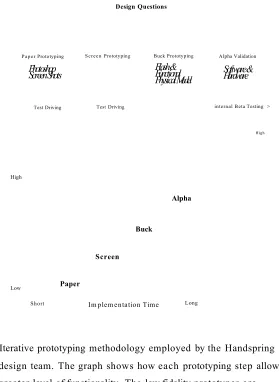
Handspring's sequential design methodology was based on a series of iterative loops, beginning with the construction of low fidelity prototypes of the product interface. These paper prototypes can quickly be mocked-up, tested by users, modified, and then re-tested. As the project progresses, and more knowledge is obtained on user requirements, the designers move on to create interactive, computer-based
User-centred design literature, definitions and methods
Further physical models are then constructed, in materials that simulate more closely the form and feel of a mass-produced item. These models, called Buck prototypes, contain working switches and controls that are linked to the computer-based simulation software that controls the on-screen graphics. Users can therefore test-drive both hardware and software elements of the product.
Following further feedback from users, the final phase of prototyping involves the production of an ’’Alpha" model, made from production-authentic materials, and containing all the working electronic elements, including the controls, software and graphical display. The Alpha prototypes are tested in user trials that last several weeks, to further validate the design, and to identify any "bugs" or "glitches" that can be ironed out prior to mass production.
iriv/. Q a o a a a a w a a
■<=
5K=5»«?<=»
Figure 2.13a "Paper prototype" of the Handspring communicator (Pering 2002)
Keyboard ftwl Flash Animation
laptop
Keyboard Chip
Buck Device
User-centred design literature, definitions and methods
Figure 2.13c
Figure 2.13d
Usability testing of the working "buck" prototype of the device (Pering 2002)
V]
Handspring Treo communicator product
User-centred design literature, definitions and methods
Design Questions
S creen Prototyping Buck Prototyping Alpha Validation P aper Prototyping
Flash & Functional Physical Model Photoshop
Screen Shots Software &Hardware
internal Beta Testing >
Test Driving Test Driving
High
High
Alpha
Buck
Screen
Paper
Low
Long
[image:41.612.180.459.79.461.2]Short Im plem entation Time
Figure 2.13e Iterative prototyping methodology employed by the Handspring design team. The graph shows how each prototyping step allows a greater level of functionality. The low fidelity prototypes are
relatively quick to implement, but give a low level of functionality, whereas the high fidelity "buck" prototypes take comparatively longer to implement but give a much more "realistic" level of functionality. Images Pering 2002
User-centred design literature, definitions and methods
Early on in the project, the designers were able to discuss ideas with therapists who had expertise in working with children with sensory impairments, and also with loudspeaker technologists and potential manufacturers. However, because of their disabilities, the end users (i.e. the children) could not actively participate in the research until the designers produced working physical prototypes with which they could interact. The prototypes allowed the children to control their own sensory experiences.
Figure 2.14 Tac-tile Sounds System (Chamberlain, 2003)
User-centred design literature, definitions and methods
Nornian, Heath and Pedgley (accessed 2005) describe the development o f a novel acoustic guitar with a plastic body. The development of the guitar formed a central part of Pedgley's PhD in Design at Loughborough University. An aim o f the investigation was to explore the acoustic properties of polymer materials as an alternative to wood, which has inherent material inconsistencies, in addition to ecological concerns over diminishing stocks o f trees harvested for prime tonewoods used in traditional guitar construction.
Design researchers Norman and Pedgley are themselves both active musicians. However, for the project they engaged the support of two "expert users" to assist them in the development and evaluation of the prototype polymer guitars in terms of construction, tone quality, playability and "feel". Here, they drew on the knowledge and experience of a world-renowned luthier (guitar maker) Rob Armstrong, and also a leading professional acoustic guitarist, Gordon Giltrap, who has endorsed the project and also composed, performed and recorded music on the prototype polymer guitars.
The relationship between musician and instrument is one o f intimate, multi-sensory physical engagement, involving extreme sensitivity to subtle differences in sound. In his evaluation of the prototype polymer guitar, Giltrap commented that the
instrument ‘...does not sound like plastic, whatever that's supposed to sound like, and anyone listening to it will hear a sound usually associated with a good quality
wooden acoustic guitar’ (Blincoe, 2002). Loughborough University has since filed a patent on the design of the innovative polymer guitar, and has established a
User-centred design literature, definitions and methods
Figure 2.15 Owain Pedgley with the prototype polymer-bodied guitar
Image: www.coolacoustics.com
In this section, user-centred design methods involving physical prototyping have been discussed. Here prototypes take on the role o f probe or provocative agent,
eliciting further knowledge o f the design task, and enabling both designers and end- users to experience the physical reality o f design ideas. The prototyping activity is discovery-oriented, and the knowledge and experiences that result from each stage form the basis for the next phase of development.
User-centred design literature, definitions and methods
(D 0) Q. £► CQ < iterative cycles
fl> VL X o
■O -o m" ®
Figure 2.16 Snowballing principle: Creative development is both iterative (cyclic) and progressive (moving forwards)
1.8
User-centred or human-centred design?
By adopting user-centred methods and techniques, the designer places end-user needs and aspirations at the centre of the design and innovation strategy.
User-centred design literature, definitions and methods
According to Buchanan, human-centred design emphasises the central place of human beings ' within the design activity. He warns '...w e often forget the full force and meaning of the phrase ... when we reduce our considerations o f human- centred design to matters of sheer usability and speak merely of "user-centred design'" (Buchanan 2001a).
Buchanan goes on to describe human-centred as:
'.... one of the practical disciplines of responsible action... fundamentally an affirmation of human dignity. It is an ongoing search for what can be done to support and strengthen the dignity of human beings as they act out their lives in varied social, economic, political and cultural circumstances.'
(Buchanan 2001a)
Through their creative actions, human beings may extend their capabilities and improve quality of life. In 'The Prometheus of the Everyday' Manzini emphasises the role of human creativity and invention. Prometheus, who in ancient Greek Myth furnished humankind with fire which he stole from the gods, stands to represent that which is creative, inventive and daring. Manzini goes on to identify how the purposeful actions o f the designer may '...contribute to the production of a habitable world, a world in which human-beings not merely survive but also expand their cultur al and spiritual possibilities' (Manzini 1995 p 220).
Human-centred design seeks to affirm and support human needs and human values through practical intervention. Here, human-centred design may be considered to be a form of pragmatic humanism. In light of this, the author offers the following description as a paradigm statement for human-centred design, to serve as a guide to the theoretical and practical research activity undertaken within this study:
User-centred design literature, definitions and methods
The following chapter introduces some key arguments surrounding this statement, in a discussion which explores interrelationships between human knowledge,
i ( u i i i a i r v / C i i u u u u c o i y 1 1 . r v i l u w i c u y c 111 u i c n i o r \ i u y
3.0 Human-centred design: Knowledge in the making
3.1 Introduction and overview
In the previous chapter, human-centred design was introduced as a creative
exploration of human needs, knowledge and experience. This chapter seeks to identify and explore some key theoretical arguments surrounding this statement. The
discussion draws upon ideas from the history and philosophy o f science, as well as writing from within ait, design and engineering discourse, the aim being to link the theoretical and methodological frameworks of human-centred design with the practical realities o f the design activity, in order to inform and support practice- centred research undertaken as part of this study.
The chapter begins by exploring some ideas about creativity and its role in the development o f human knowledge. In the familiar romantic stereotype, creativity is considered to be a mystical quality only possessed by truly gifted people. According to this view, the activities of creative practitioners are unpredictable and involve individualistic, highly subjective and non-rational mental process. These processes appear to conflict with an approach to human knowledge that is based on logic and rationality (Fisher 1997, Coyne and Snograss, 1991). The conflict reflects a dualistic view of human knowledge - Cartesian dualism - in which objectivity, logical
deduction and theoretical reasoning are set apart from subjectivity, intuitive judgement and practical experience.
In his 'Critique of Pure Reason' Immanuel Kant (1724-1804) sought to reconcile this dualism, asserting that human knowledge is only possible through the synthesis of reason and experience (Kant trans. Kemp-Smith ed. Caygill 2003; Scruton 2001). Similarly, it may be argued that creative discoveries come about through a
combination of theoretical reasoning, intuition and practical experience, and that these approaches appeal' to be complementary. A historic example is used to illustrate how a combination o f theoretical and practical approaches may lead to advances in scientific knowledge.
i l u i i i d 11 v v i i l l u v < u u o i v j i i . rvs l u v v i c u y c 111 m e i i i a r v i i i s j
(Magee, 1973 p 67). According to Popper, the evolution of scientific knowledge involves intuition, creative imagination and trial and error learning. The same is true for processes of creative discovery in design.
Broadbent (2003) provides a chronological review of attempts to integrate scientific methodology into design. This was first evident in modernist architecture and design of the 1920s, and later in the Design Methods movement, introduced by academics in the 1960s. Design Methods aimed to provide logical, rational, methodological frameworks to enable design to better respond to increasing social and technological complexity. However, Design Methods became a source of conflict; the movement was rejected by the design community as a whole, since its highly analytical approach failed to accommodate the intuitive nature of creative practice and lacked the '..vital human element' of design (Heskett 1980 p 208).
The 'hard systems' of Design Methods were followed by a 'soft systems' approach, drawing on methodological frameworks from the post-positivistic social sciences (Broadbent 2003). However soft systems too have met with notable criticisms. Buchanan points to the 'impossibility of design relying on any one o f the sciences (natural, social, or humanistic)' to provide adequate solutions to the highly complex problems encountered by humans within social and technological systems (Buchanan
1995). Whilst design may draw on scientific methods and ideas, science alone may prove insufficient as a basis for design.
Buchanan sees design as an integrative discipline; a 'new liberal ait o f technological culture'. Here, Buchanan uses Dewey's understanding of technology as an art o f experimental thinking to provides a common link between art, science and design. Through their creative actions, artists, scientists and designers may engage in an exchange of knowledge and ideas; human creativity may provide the key to reconciling the conflict of dualism.
Turning to technology, the chapter goes on to introduce arguments from Heidegger's essay 'The Question Concerning Technology' (1954). Here the philosopher points to the danger within technology that poses a threat to the future o f humanity and the planet, yet he also suggests that a saving power may be found. For Heidegger, the
i i u m a i r u u i i u c u u u o i v j i i . r v n u v v s c u y c 111 uiu imamii vj
However, the schism of dualism is further exposed in literature exploring the
relationship between technology and human knowledge. Aicher (1991) uses the terms
analogue and digital to describe a dualistic conflict which parallels that which is described above. For Aicher, digital represents abstraction, objective analysis, logical precision and quantitative results; analogue represents human sensuality, subjective judgement, qualitative responses and practical experience. He expresses concerns that
'digital technology is making man into an increasingly digital being'. (Aicher 1991 p 47)
The chapter goes on to discuss the relationship between analogue and digital
processes within design, focusing in particular on changes in the nature of prototyping within human-centred design practice. In this context analogue prototyping refers to
hands-on making and testing of physical prototype models; digital prototyping technologies include CAD-CAM, virtual and rapid prototyping. Examples are presented in which designers and engineers made extensive use of computer modelling and simulation techniques at the design stage. However in these cases - London's Millennium Bridge and 'The B of the Bang' sculpture in Manchester - the full extent of complex, real-world problems only came to light through the physical realisation of design proposals.
These examples point to a requirement for the reconciliation of digital and analogue processes within design practice. Benefits may be identified in digital prototyping in a number of areas. For example, in some large-scale engineering projects the time and cost involved in producing a full-size mock up may be prohibitive. In architecture, the first full-size physical prototype is likely to be the building itself. Here, virtual prototyping techniques have been shown to be beneficial (eg Connell, 2004). Also, in collaborative projects, digital prototyping enables design data to be shared between different members o f the development team. Within product design applications, rapid prototyping processes can enable the production of physical objects that would be difficult or impossible to create by another means; for example, when prototypes o f small or intricately detailed parts are required.
i i u i I icii i v c i i n v u V4w w i v j 1 1 ■ r \ i l u v v i c u y c 111 u i u 11 t o r x i i ivj
3.2 Do not look at my songs!
Do not look at my songs! I lower my eyes
as if 1 were caught in a crime. Even I do not dare
to watch them as they grow
-your curiosity is a betrayal
Bees, too, when they build their cells, let no-one watch,
nor do they watch themselves.
When they have carried the rich honeycombs to the light, o f day,
then you shall taste them first!
This poem by Friedrich Ruckert (1788-1866) was set to music by Gustav Mahler; a composer who, perhaps more than any other, might stand to represent the culmination of the late-romantic era in western classical music. The poem describes the familiar romantic stereotype o f the artist-genius whose creative processes are kept a closely guarded secret. The methods and processes of creativity are perhaps intangible, unknown even to the creative individuals themselves.
According to Epstein (1996), there are some common myths that surround human creativity. Traditionally, creativity has been viewed as a mystical quality only possessed by artists and other truly gifted people. A creative action was seen as an
‘individual act of genius, the radical breakthrough, the moment of inspiration’
(Jackson, 1995 p 37). Fisher (1997) identifies the stereotypical figure o f the romantic genius as a recurrent theme within design practice and design education. He
numcm-cerurea aesign: rvnowieage in tne making
Cartesian dualism refers to the rationalist philosophy o f Rene Descartes (1596-1650). Descartes was a mathematician who invented a branch of theoretical mathematics based on algebra and analytical geometry. Descartes believed that in the pursuit of certainty and absolute truth, mathematical logic and rationality could be applied to problems relating to non-mathematical knowledge. His well known statement "I think therefore I am" emphasises the primacy of rational thought over action and
experience. According to Descartes the human senses were to be mistrusted, and therefore knowledge must be the result of cognitive reasoning and not practical experience (Magee, 1998).
In contrast to this view, the empiricist philosopher Locke (1632-1704) believed that human knowledge is derived from experience, through a process of sensation and reflection. Locke's position is clearly captured in his statement 'no man's knowledge here can go beyond experience' (Magee, 1998 p 105). Empiricism provided a basis for scientific enquiry that sought to extend human knowledge and understanding through practical experimentation. Immanuel Kant (1724-1804) set out to reconcile the conflict between the rationalist and empiricist philosophies. In his 'Critique of Pure Reason', Kant argued that neither reason nor experience alone could provide
knowledge. It is only in the synthesis of reason and experience that human knowledge is possible (Kant trans. Kemp-Smith ed. Caygill 2003 pp 92-95 Scruton, 2001 pp 27, 35). In a similar way, it may be argued that the task of designing requires a creative synthesis of theoretical reasoning and practical experience.
Writers within the field of design have recognised problems posed by the dualistic view of knowledge which come about through the separation of reason and experience (eg Cooley 1980 and 1988, Jones 1991). Examples from the field of engineering design will be discussed later in this chapter. In 'Architect or Bee? The Human-Technology Relationship' Cooley (1980) emphasises the importance o f both theoretical and practical approaches and he also identifies the role creativity plays in extending human knowledge across diverse areas of practice:
num ciii-u eiiirea uesign: i\nowieage in tne maKing
Returning to Ruckert's image of the beehive, we can see that whilst the honeycomb takes on a logical, clearly defined structure, the creative fuel contained within its cells remains fluid, non-linear and is, in itself, unconstrained by physical form.
Rust (2004) discusses how discoveries and invention in both science and design can come about through the creative application of practical knowledge. Drawing on the work of Michael Polanyi, Rust considers the theoretical and practical processes that can lead to illumination; a discovery, invention, or the formulation o f a new theory or hypothesis.
One such illumination is present in the story of the tempestuous relationship between Sir Isaac Newton and the lesser-known scientist and inventor Robert Hooke. The story illustrates how a combination of theoretical and practical approaches led to advances in scientific knowledge. The different approaches of Newton and Hooke appear complementary, however their relationship eventually broke down completely. This conflict may reflect the dualistic view of human knowledge, which remains a subject for debate.
3.3 By Hooke or by Crooke?
nuiiictn-uenirea aesign: rvnowieage in tne making
William Blake’s famous portrait of Newton is shown in Figure 3.1. For Blake, a "true
romantic", Newton's classical physics represented the Age o f Reason, 'a soul shuddering vacuum... of abstractions and formulae, not o f experience ' (Raine, 1970 pp 76, 114). In the painting, Newton is depicted abandoning the creative imagination in favour of reason. Disconnected from human experience, he concentrates his vision solely on the geometric figur e inscribed by his compasses. For Blake, the compasses symbolise Newton's god-like status as architect of the universe, or the ‘divine geometer' (Hamlyn and Phillips 2000, p 212 also Blunt 1959).
Fig
ure 3.1
Newton. Painting by William Blake (1757 - 1827).numcm-utMiireu uesign: i\nowieage in me maKing
As a boy, Newton appeared small for his age, lonely, and somehow disconnected
from community life. He was, however, preoccupied with changes in the physical world around him, observing the position of the sun in the sky, and the projection of shadows. Gleick describes how the boy charted seasonal changes in the sun's position against fixed stars, tracing 'a slowly twisting figure eight, a figure invisible except to the minds eye' (Gleick, p 12). He found this movement, in his later study of the motion of planets, to be due to the earth's elliptical orbit and tilting axis.
The young Isaac was also an accomplished model maker 'building ingenious watermills and windmills'. Gleick recounts how, when the town of Grantham was building a new mill, Newton built a replica, 'internalising the whining and pounding of the machine and the principles that govern gears, levers, rollers and pulley wheels.' (Gleick, p 18)
On completion of his schooling in Grantham, Newton went on to study at Tr