
STABILITY-INDICATING DENSITOMETRIC, FLUORIMETRIC AND
DIFFERENCE ABSORBANCE (∆A) METHODS FOR THE
DETERMINATION OF SOTALOL – HCl
Sawsan A. Abdel Razeq, Khalid M. Abel Salam, Manal M. Fouad *and Tahany F. Mohamed.
Analytical Chemistry Department, Faculty of Pharmacy, Al-Azhar University, Cairo, Egypt.
ABSTRACT
Three simple, accurate and precise stability-indicating methods are presented for the quantitative estimation of sotalol-HCl in presence of its degradation products. The first is based on TLC separation of the drug from its degradates followed by densitometric measurement of the intact drug at 230 nm using a developing system composed of methanol- chloroform- conc. ammonia (7:3:0.05 by volume). The second method measures the fluorescence intensity of sotalol-HCl in ethanol at em 306 nm after its excitation at 238 nm, whilst the third
one depends on measurement of pH absorbance difference (A) of the drug solution between 0.1M HCl and 0.1 M NaOH at 249 nm. Regression analysis of Beer’s plots shows good correlations
(r = 0.9996 - 0.9997) over concentration ranges of 2 - 17.5 μg / spot, 1 - 15 μg mL-l and 2 – 20 μg mL-l of the drug for the three suggested methods, respectively. The three methods retain their accuracy in the presence of up to 80%, 70% or 60% degradant, respectively. The proposed methods are also successfully applied to analyze sotalol-HCl in its formulation; Betacor® tablets with mean recoveries ranging from 99.23 to 99.97 %. The results obtained are validated and statistically analysed and found to be in accordance with those given by a reported method.
KEY WORDS: stability-indicating, sotalol-HCl, densitometric, fluoremetry, pH absorbance difference (A).
7105 – 2277 ISSN Research Article . 13 -01 , 7 Volume 3, Issue
Article Received on 06 July 2014,
Revised on 30 July 2014, Accepted on 24 August 2014
*Correspondence for
Author
Dr. Manal M. Fouad
Analytical Chemistry
Department, Faculty of
Pharmacy, Al-Azhar
1. INTRODUCTION
Sotalol; (1-N-[4-[1-hydroxy-2-[(1-methyl ethyl) amino] ethyl] phenyl] methane sulfonamide) is a β- blocker, used in treatment of rhythm disturbances (cardiac arrhythmias), and is employed to treat hypertension in some individuals. It is an antagonist at both β1- and β2- adrenoceptors .This dual action leads to reduction in the automaticity of myocardial cells and in conduction through the atrioventricular node [1]. Numerous methods have been reported for the analysis of sotalol using several analytical techniques as liquid chromatography [2-12], voltammetry [13,14] and colourimetry [15].
2. Experimental 2.1. Instrumentation
- Camag TLC scanner 3, with WINCATS computer software (Switzerland). - Shimadzu, UV-Vis 1601 PC spectrophotometer (Tokyo, Japan).
- Jasco FP6200 spectrofluorometer (Japan).
- Precoated TLC plates, silica gel 60 GF254 (20 × 20 cm), (Fluka chemie, Switzerland). - Hamilton 100-µL microsyringe (Germany).
- UV lamp with short wavelength (254 nm) (Desega-Germany). - Chromatographic tank (25 × 25 × 9 cm).
- Jenco digital pH/temp meter with Jenway double function glass electrode (UK).
2.2. Materials and reagents
- Sotalol Hydrochloride; batch no.329-MC was kindly supplied by Amoun Pharmaceuticals Company, El-Obour City, Cairo, Egypt.
-Betacor tablet; batch no.121714, labeled to contain 80mg Sotalol – HCl per tablet, the product of Amoun Pharmaceuticals Company, El-Obour City, Cairo, Egypt.
- Chloroform, methanol and conc. ammonia (Sigma – Aldrich, USA). - Ethanol absolute (Riedell-detlean, Germany).
- Sodium hydroxide (El-Nasr Co., Egypt), 0.1N aqueous solution. - Gelatin (Adwic, Egypt).
- β-cyclodextrin and sodium dodecyl sulphate,( SDS) (Fluka, Switzerland).
2.3. Standard Solutions
Stock solution of the drug (0.5 mg mL-1) was prepared by dissolving 50 mg in 100 mL ethanol for densitometric method. The solution was further diluted with the same solvent to get a solution of 0.1mg mL-1 to be used for fluorimetric and A methods.
2.4. Preparation of degraded solution
50 mg of pure sotalol – HCl were refluxed with 100 mL 5N HCl for 6 hours. The solution was cooled, neutralized with 7N NaOH to pH about 7 and evaporated till dryness under vacuum. Residue was extracted three times, each with 25mL ethanol, then filtered into a 100- mL volumetric flask and diluted to volume with ethanol to obtain a degraded solution derived from 0.5 mg mL -1 sotalol – HCl.
2.5. Procedures 2.5.1. TLC method
Linearity – Aliquots of standard sotalol-HCl ethanolic solution (0.5 mg mL–1) equivalent to
(4-35 L) were performed on precoated 20 × 20 cm TLC aluminum silica gel 60 GF254 plates using Hamilton microsyringe (100- L). Plates were spotted 2 cm apart from each other and 2 cm apart from the bottom edge, placed in a chromatographic tank pre-saturated with the mobile phase for 20 min, then developed by ascending chromatography using methanol- chloroform- ammonia (7:3:0.05 by volume) as a mobile phase. The plates were air dried, detected under UV- lamp (254 nm) and scanned at 230 nm. Calibration curves were plotted representing the recorded area under the peak against corresponding drug concentration.
Mixtures of intact and degraded drug
Into a set of 10-mL volumetric flaks, different volumes (4.5-0.5 mL) of intact sotalol hydrochloride solution (0.5 mg mL–1) were transferred and mixed with (0.5-4.5 mL) of its
degradation product solution. Volumes were completed to the mark with ethanol then 50 L of each mixture were applied to a TLC plate following the above mentioned specific chromatographic conditions and scanned at 230 nm.
2.5.2. Spectrofluorimetric method Linearity
volume with ethanol. The fluorescence intensity was measured at em 306 nm against ethanol
as blank after being excited at 238 nm. Calibration curve relating the fluorescence intensity to drug concentration in g mL–1 was constructed and the regression equation was computed. Mixtures of intact and degraded drug
Aliquots of intact sotalol- HCl solution containing (0.09- 0.01 mg) were introduced into a
series of 10-mL volumetric flasks containing hydrolyzed solution equivalent to (0.01 - 0.09 mg) of the degraded sotalol- HCl, then diluted to the volume with ethanol and
fluorescence intensity was recorded at λem 306 nm using λ exc 283 nm.
2.5.3. A method Linearity
Aliquots of standard drug solution (0.1 mg mL–1) equivalent to 0.02-0.2 mg of sotalol hydrochloride were transferred into two sets of 10- mL volumetric flasks. The first one was diluted to volume with 0.1 M HCl and the other set with 0.1 M NaOH. ∆A of each solution
was measured at 249 nm by placing the acidic solution in the reference beam and the alkaline one in the sample beam. Calibration curve was constructed relating ∆A values to drug
concentrations.
Mixtures of intact and degraded drug
Different volumes (1.8-0.2 mL) of intact sotalol hydrochloride solution (0.1 mg mL-1) were introduced into two series of 10- mL volumetric flasks and mixed with (0.2-1.8 mL) of its degradate solution, then diluted to 10 mL with 0.1 M HCl in one set and 0.1 M NaOH in the second set. The absorbance of the alkaline solution was measured against the acidic one at 249 nm and the intact drug concentration was calculated from the corresponding regression equation.
Application to pharmaceutical formulation
Ten Betacor ® tablets were weighed, powdered and mixed well. An accurately weighed quantity of powdered tablets equivalent to 50 mg of sotalol Hydrochloride was extracted three times with 25 mL ethanol, filtered into100 mL volumetric flask then the volume was adjusted with the same solvent. The obtained solution labeled to contain (0.5 mg mL-1) of the drug was analysed by the densitometric method. Five fold dilution with ethanol was made to
RESULTS AND DISCUSSION
Three sensitive and selective stability-indicating methods were developed for the determination of sotalol - HCl in presence of its acidic degradates. The first method depended on the densitometric evaluation of thin layer chromatogram, the second based on measuring the fluorescence intensity of the drug at λex / λem =238 nm / 306 nm, whereas the third one
was pH-induced difference absorbance (∆A) spectrophotometry between 0.1 M NaOH and 0.1 M HCl drug solutions.
Forced degradation of sotalol –HCl
Stressed degradation was performed by refluxing the drug using different media; aqueous NaOH, HCl, H2O2 and UV light for different time intervals. Complete degradation was
attained upon refluxing the drug with 5M HCl for 6 hours, thus, the acidic degradate was subsequently used for the stability -indicating analysis of the drug.
The ethanolic solution containing the degradates was identified by TLC using precoated silica gel GF254 plate and methanol- chloroform-conc. ammonia (7:3:0.05 by volume) as
developing solvent. Complete degradation was confirmed by a single spot at Rf 0.91
corresponding to its acidic degradate, wrereas intact drug appears at Rf 0.52. Degradation was
further confirmed after evaporation of the ethanolic solution through its IR spectrum compared with the intact drug, The IR spectrum of the pure drug exhibits a sharp peak of SO2
group at 1608 cm-1 and two peaks at 3202 and 3371 cm-1 characteristic to the two -NH groups; The disappearance of SO2 group peak and the appearance of bifischered peaks at
3363 and3301 cm-1 for NH2 group in the IR spectrum of the degradate as shown in Fig.1 (a
and b), confirms the cleavage of CH3SO2 group after refluxing the drug with 5N HCl.
Additionally, IHNMR of intact sotalol showed a singlet peak at 2.9 ppm characteristic for the one hydrogen of CH3SO2 group, while , 1HNMR of the degradate showed the disappearance
Fig. (1): IR Spectra of: a) Intact sotalol - HCl on KBr disc. b) Sotalol – HCl acidic degradate on KBr disc.
Fig. (2): 1HMNR Spectra of: a) Intact sotalol – HCl , b) Sotalol - HCl acidic degradate.
(b)
(a)
[image:6.595.130.479.67.346.2] [image:6.595.134.485.399.708.2]This led to the suggestion of the following degradation pathway:
S
N
H
H
3
C
CH
3
H
N CH
3
O
O
OH
reflux 6hrs
with 5 N HCl
H
2
N
CH
3
H
N CH
3
OH
+ CH
3
SO
3
H
Sotalol- HCl acidic degradate
TLC method
A quantitative TLC densitometric method was developed for the determination of sotalol-HCl, depending mainly on the difference in Rf values of intact and degraded drugs. Different
developing systems were tried such as chloroform–methanol, acetonitrile – KH2PO4 buffer
(pH 3), methanol– KH2PO4 buffer (pH 7) and acetonitrile – H2O in different ratios. Best
separation with almost well defined spots was achieved using a mobile phase of methanol– chloroform– conc. ammonia (7:3:0.05 by volume). The plates were visualized under UV lamp at 254 nm, where spots appear at Rf 0.52 and 0.91 for sotalol hydrochloride and its
acidic degredate, respectively and measured densitometrically at 230 nm; Fig. (3).
Fig. (3): TLC densitogram of sotalol - HCl and its acidic degradate
Fluorimetric method
ethanol; the later gave maximum fluorescence; hence it was recommended throughout this work. The effect of surfactant was also studied by using different types of enhancers (1% aqueous gelatin, Β-cyclodextrin and sodium dodecyl sulfate) .No effect of sensitizers and
surfactants on fluorescence intensity was observed, thus none of them was used in this work.
Fig.(4): Excitation and emission spectra of sotalol-HCl (7µg mL- 1) in ethanol.
A method
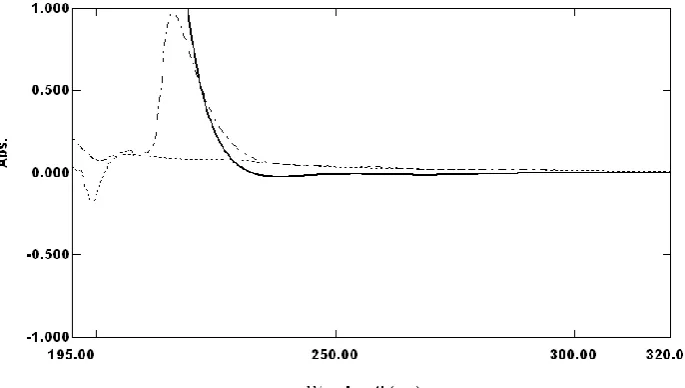
Sotalol hydrochloride was found to be pH sensitive, showing a bathochromic shift in its λmax from 227.5 nm in HCl to 248.5 nm in NaOH. Absorbance difference (∆A) measurements of both intact drug and its acidic degradate between their alkaline and acidic solutions at 249 nm indicated no interference from degradate, hence used for stability indication; Fig. 5 and 6.
[image:8.595.150.461.168.332.2][image:8.595.120.487.493.671.2]
Fig. 6: Absorption spectra of degraded Sotalol –HCl (10µg mL -1) in 0.1M HCl (...), in 0.1 M NaOH (- - - -) and ∆A spectrum (―) between NaOH and HCl solutions.
Method validation
The proposed methods were validated according to ICH guidelines [16].
Linearity
For the densitometric method, linear relationship was found to exist between peak areas of the separated spots and the corresponding drug concentration over the range of 2–17.5 µg/spot, while linearity between the absorbance and the drug concentration cover the range of 1-15 or 2-20 µg mL-1 using the spectrofluoremetric or ∆A methods, respectively. The obtained high correlation coefficient (0.9996-0.9997) indicates good obedience to Beer's law. Regression parameters were calculated and presented in Table (1).
Table (1):Regression parameters for the determination of sotalol -HCl by the proposed methods.
Parameter Densitometric method
Fluorimetric method
∆A method
λmax (nm) 230 λex 238, λem 306 249
Linearity range 2-17.5 µg/spot 1 - 15 µg mL–1 2 - 20µg mL–1
% 1
cm 1
A — — 511.5615
Regression parameters
Slope (b) 1937.1 43.4637 0.05021
Intercept (a) 3606.5 49.704 0.0062
[image:9.595.130.473.74.268.2]Accuracy and precision
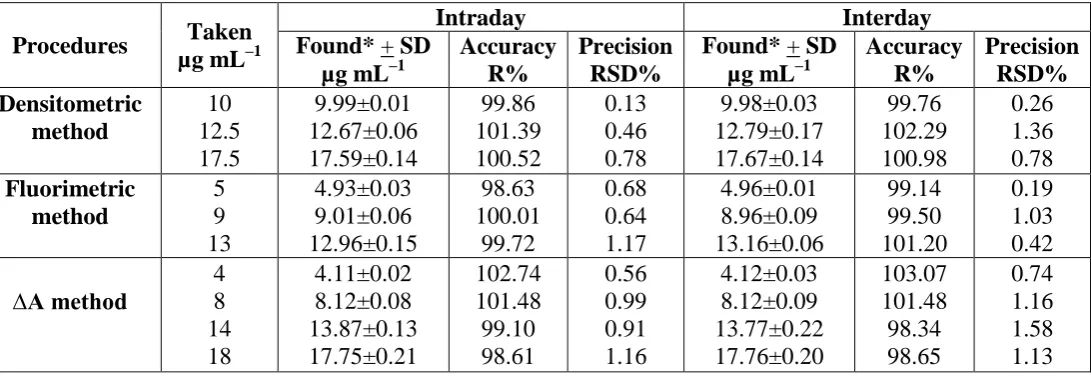
Densitometric method showed an intraday and interday accuracy (R %) calculated to be 99.76 - 102.29%, while precision (RSD %) ranged from 0.13 to 1.36%. Using the fluoremetric method, intraday and interday accuracy were found to be ranged from 98.63% to 101.20%, whereas, precision from 0.19% to 1.17%. ∆A method showed accuracy amounted to be 98.34% -103.07% and precision ranging from 0.56% -1.58% ; Table (2).
Table (2): Intraday and interday accuracy and precision for the determination of sotalol-HCl by the proposed methods.
* Average of three determinations.
Specificity
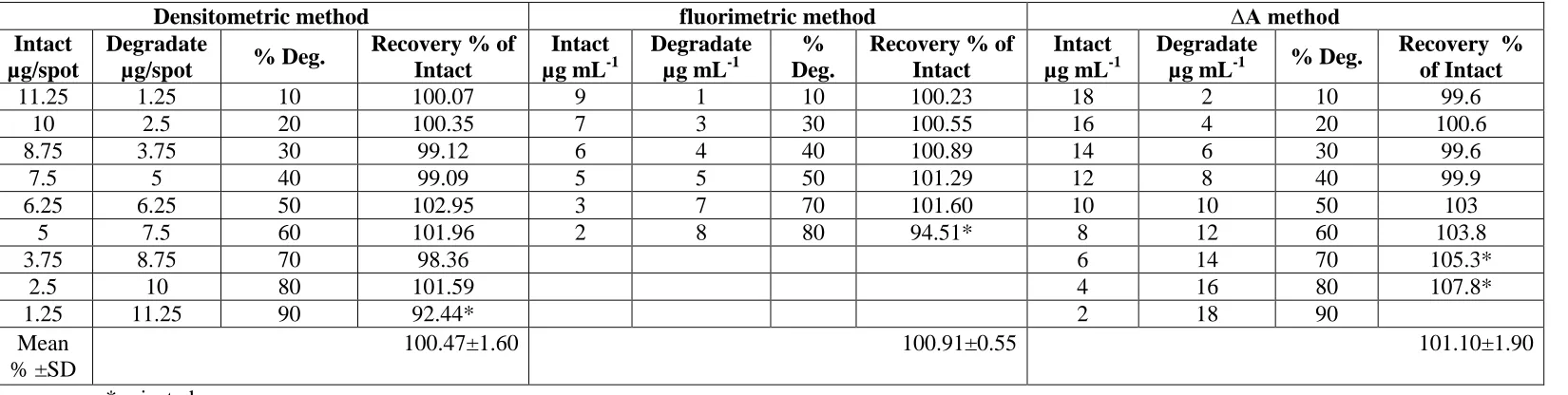
To assess the efficacy of the suggested methods as stability – indicating, acidic degradates of the drug was laboratory-prepared and mixed with the intact drug in different ratios and analyzed by the proposed methods (Table 3). It is clear that the efficacy of the suggested methods is not affected by the presence of up to 80% of the degradate for densitometric method, 70 % for the fluorimetric method while up to 60% for ∆A method. The selectivity of the proposed methods was further evaluated by application of the standard addition technique, recovery of standard added showing mean recoveries of added ± SD of 101.84% ± 0.54, 100.94% ± 0.85 and 98.92% ± 1.07 for the three methods, respectively.Statistical analysis of the results obtained by the three proposed methods compared with that of a reported method [15] revealed no significant differences between them within a probability of 95%; Table (4). However, the proposed methods were more sensitive and selective; determining the drug in presence of its aid-induced degradation products.
Procedures Taken µg mL–1
Intraday Interday
Found* + SD µg mL–1
Accuracy R%
Precision RSD%
Found* + SD µg mL–1
[image:10.595.30.576.252.445.2]Table (3): Determination of sotalol-HCl in mixtures with its acidic degradate by the proposed methods.
Densitometric method fluorimetric method ∆A method
Intact µg/spot
Degradate
µg/spot % Deg.
Recovery % of Intact
Intact µg mL-1
Degradate µg mL-1
% Deg.
Recovery % of Intact
Intact µg mL-1
Degradate
µg mL-1 % Deg.
Recovery % of Intact
11.25 1.25 10 100.07 9 1 10 100.23 18 2 10 99.6
10 2.5 20 100.35 7 3 30 100.55 16 4 20 100.6
8.75 3.75 30 99.12 6 4 40 100.89 14 6 30 99.6
7.5 5 40 99.09 5 5 50 101.29 12 8 40 99.9
6.25 6.25 50 102.95 3 7 70 101.60 10 10 50 103
5 7.5 60 101.96 2 8 80 94.51* 8 12 60 103.8
3.75 8.75 70 98.36 6 14 70 105.3*
2.5 10 80 101.59 4 16 80 107.8*
1.25 11.25 90 92.44* 2 18 90
Mean % ±SD
100.47±1.60 100.91±0.55 101.10±1.90
[image:11.842.17.842.106.314.2]Table (4): Results obtained by the proposed methods compared with a reference
method[15] for the determination of sotalol-HCl in its pharmaceutical preparations.
Figures in parenthesis are the theoretical t and F values at p = 0.05.
-Ref [15] involved colorimetric reaction of sotalol –HCl with Folin- Ciocaltus reagent at 725nm.
CONCLUSION
The suggested methods are sensitive, selective, and accurate that can determine sotalol-HCl in its pure form and pharmaceutical dosage forms. The three methods proved to be stability – indicating to determine the drug in presence of its acid - degradates. Moreover, all of the above proposed methods can be used for the routine analysis of sotalol-HCl in quality control and clinical laboratories.
REFERENCES
1. Udaykumar P.; Textbook of Medical Pharmacology, CBS publishers & Distributors LTD, New Delhi (India), 2010:129-134.
2. Bartek M.J., Vekshteyn M., Boarman M.P.and Gallo D.G.; Liquid-chromatographic determination of sotalol in plasma and urine employing solid-phase extraction and fluorescence detection; J. Chromatogr. 1987;421: 309-318.
3. Schlauch M., Fulde K. and Frahm A.W.; Enantioselective determination of (R)- and (S)-sotalol in human plasma by on-line coupling of a restricted-access material precolumn to a cellobiohydrolase I-based chiral stationary phase; J. Chromatogr. 2002; B 775: 197-207. 4. Mario Z. and Luciano Z.; Simple and fast chromatographic method for the determination
of sotalol in human serum; J. Chromatogr. 1998; B708: 335-336.
5. Badaloni E., Dacquarica I., Gasparrini F., Lalli S., Misiti D., Pazzucconi F. and Sirtori C.R.; Enantioselective liquid chromatographic-electrospray mass spectrometric assay of [beta]-adrenergic blockers: application to a pharmacokinetic study of sotalol in human plasma; J. Chromatogr. 2003; B 796: 45-54
Parameters Densitometric method
Fluorimetric
method ∆ A method
Refrence Method[15] Linearity range 2-17.5 µg/spot 1-15 µg mL-1 2-20 µg mL-1 25-150 µg mL-1
N 4 5 5 5
Mean % 99.23 99.97 99.53 98.98
SD 1.74 0.84 1.48 1.52
Variance 3.03 0.71 2.2 2.31
t – 0.23 (1.895) 1.27 (1.860) 0.58 (1.860) -
[image:12.595.68.539.104.246.2]6. S. Karkkainen; High-performance liquid-chromatographic determination of sotalol in biological fluids; J. Chromatogr. 1984; 336: 313-319.
7. Urech R., Chan L. and Duffy P.; High-performance liquid-chromatographic assay of sotalol [in plasma and serum]: improved procedure and investigation of peak broadening; J. Chromatogr. 1990; 534: 271-278.
8. Hoyer G.L.; Improved high-performance liquid-chromatographic method for the analysis of serum sotalol; J. Chromatogr. 1988; 427: 181-187.
9. Laeer S., Wauer I. and Scholz H.; Small blood volumes from children for quantitative sotalol determination using high-performance liquid chromatography; J. Chromatogr. 2001; B 753: 421-425.
10.Ranta V., Toropainen E., Talvitie A., Auriola S. and Urtti A.; Simultaneous determination of eight [beta]-blockers by gradient high-performance liquid chromatography with combined ultraviolet and fluorescence detection in corneal permeability studies in vitro; J. Chromatogr. 2002; B 772: 81-87.
11.Chiap P., Ceccato A., Miralles B., Boulanger B., Hubert P. and Crommen J.; Development and validation of an automated method for the liquid chromatographic determination of sotalol in plasma using dialysis and trace enrichment on a cation-exchange pre-column as online sample preparation; J. Pharm. Biomed. Anal. 2001; 24:801-814.
12.Zarghi A., Foroutan S.M., Shafaati A. and Khoddam A.; Development of an ion-pair liquid chromatographic method for determination of sotalol in plasma using a monolithic column; J. Pharm. Biomed. Anal. 2006; 41: 1433-1437.
13.Ali A. E., Ali R. A., Rezaei B. and Mohammadzadeh R.; Characterization of carbon nanotubes decorated with NiFe2O4 magnetic nanoparticles as a novel electrochemical sensor: Application for highly selective determination of sotalol using voltammetry; Materials Science and Engineering C 33 , 2013: 202–208.
14.Heli H., Jabbaric A., Zarghanc M. and Moosavi-Movahedi A.A.; Copper nanoparticles-carbon microparticles nanocomposite for electrooxidation and sensitive detection of sotalol; Sensors and Actuators B 140, 2009: 245–251.
15. Banerjee SK and Mashru R; A rapid colorimetric determination of sotalol-hydrochloride in bulk and dosage form; Indian J.Pharm.Sci.53, 1991: 243-244.


![Table (4): Results obtained by the proposed methods compared with a reference method[15] for the determination of sotalol-HCl in its pharmaceutical preparations](https://thumb-us.123doks.com/thumbv2/123dok_us/785966.585257/12.595.68.539.104.246/results-obtained-proposed-compared-reference-determination-pharmaceutical-preparations.webp)