Improving Video Classification Accuracy using
Cloud
Prabin Mandal
Department of Information Science Engineering, New Horizon College of Engineering Outer Ring Road, Marathalli, Bengaluru-
560 103
Abstract: The focus of this project is on the frame level features. One of the promising algorithms that can be used for this
purpose is Deep Bag of Frame pooling (DBoF). Deep bag of frame model is a convolutional neural network (CNN). The main
idea is to design two layers in the convolutional part. The approach enjoys the computational benefits of CNN, while at the same
time the weights on the up-projection layer can still provide a strong representation of input features on frame level. The
classification is performed at the final layer of the CNN. We will use the 8M dataset for experimentation. The
Youtube-8M dataset is the largest publicly available multi-label video classification dataset, with approximately 8 Million videos annotated
with 3862 classes of labels. The videos within the dataset averages 3.01 labels per video, where the number of labels per video
ranges from 1 to 23. As this dataset covers over 500,000 hours of video, 2.6 billion audio and visual features have been extracted
and pre-processed in advance by the Google Research Team as it would be infeasible for research teams to train hundreds of
Terabytes worth of video for their model.
Keywords: Video classification, convulational neural network, machine learning.
I.
INTRODUCTION
There is an English idiom: “a picture is worth a thousand words”. Such theory has been standing in human society for many years,
as this is the way our brain functions. With the development of neural network and deep learning, it can be applied to machine as
well. In other words, we human beings are able to teach or train computer to recognize objects from pictures and even describe them
in our natural language. Thanks, Google, for organizing this ‘Google Cloud & YouTube8M Video Understanding Challenge’, which
gives us a wonderful opportunity to test new ideas and implement them with the Google cloud platform. Google cloud recently
released the datasets and organized ‘Google Cloud &YouTube-8M Video Understanding Challenge’ on Kaggle. Competitors are
challenged to develop classification algorithms that assign video-level labels using the new and improved Youtube-8M V2 dataset.
Large-scale datasets have played a significant role in progress of neural network and deep learning areas. YouTube-8M is such a
benchmark dataset for general multilabel video classification. It was created from over 7 million YouTube videos (450,000 hours of
video) and includes video labels from a vocabulary of 4716 classes (3.4 labels/ video on average). It also comes with pre-extracted
audio & visual features from every second of video (3.2 billion feature vectors total).
ImageNet is one of the large Scale of datasets which have been key enablers of recent progress in image understanding.
[image:1.612.98.518.546.700.2]By supporting the learning process of deep networks with millions of parameters, such datasets have played a crucial role for the
rapid progress of image understanding to near-human level accuracy.
Video has become an indispensable form of media in the modern society. According to YouTube company statistics, every minute
there are 300 hours of video uploaded to YouTube and every day there are nearly 5 billion videos being watched. Not only the
number of videos we are dealing with is immense, but also the themes of the video has become extremely diverse. The types of
videos we encounter in daily life range from entertainment use such as music videos, movies and games, educational use of lectures
and experiments, to the many newly emerging technologies such as drones and autonomous cars. Under such background, an
efficient method to solve large-scale video classification is desired, which could in turn be applied to content discovery and filtering
Video classification is an inherently difficult task for various reasons. The dataset for video classification is usually limited to a
particular scene and separate for video and audio features. The most well studied video datasets, such as Sports-1M , Activity Net,
UCF-101 are all confined to a certain theme of videos. Thus, their models are more suitable in very specific classification task in
that theme than generic classification with a large number of classes. We provide several models of using both audio and visual
features to classify YouTube videos. We demonstrate that the additional audio information in the training process significantly
improves the model performance. The focus of this project is on the frame level features. One of the promising algorithms that can
be used for this purpose is Deep Bag of Frame pooling (DBoF). Deep bag of frame model is a convolutional neural network (CNN).
The main idea is to design two layers in the convolutional part. In the first layer, the up-projection layer, the weights are still applied
on frames, although all selected frames share the same parameter. The second layer is pooling the previous layer into video level.
The approach enjoys the computational benefits of CNN, while at the same time the weights on the up-projection layer can still
provide a strong representation of input features on frame level. The classification is performed at the final layer of the CNN. We
will use the Youtube-8M dataset for experimentation. The Youtube-8M dataset is the largest publicly available multi-label video
classification dataset, with approximately 8 Million videos annotated with 3862 classes of labels. The videos within the dataset
averages 3.01 labels per video, where the number of labels per video ranges from 1 to 23. As this dataset covers over 500,000 hours
of video, 2.6 billion audio and visual features have been extracted and pre-processed in advance by the Google Research Team as it
would be infeasible for research teams to train hundreds of Terabytes worth of video for their model.
II.
LITERATURE SURVEY
Sl No.
Title of the Paper
Authors
Month & Year
Observations
1
Cloud Based Video Analytics using
convolutional networks
Muhammad Usman
Yaseen,Ashiq Anjum,Mohsen
Farid,Nick Antonopoulos
August 2018
CNN,Learning Rate,SGD,stochastic
gradient descent
2
Efficient video Classification Using
Fewer Frames
Shweta Bharadwaj,Mukundhan
Sriniwasan,Mitesh M.Khapra
Feb 2019
-
3
Cloud Based Video Prepositions
With Classification Of Client In
Public systems
A.Arjuman Banu, A.K Reshmy
Cloud Storage,online social
networks,video recommendation,media
cloud andspammer detection
4
A Survey Of Research on Cloud
Robotics and Automation
Be3n kehoe, Pieter Abbeel
November
2014
Cloud Automation,Cloud Robotics,Big
Data,Cloudsourcing
5
A survey on Object detection and
Classification methods from Video
stream
Tasnia Bushra, Muhib Hassan
Khan
Object detection,
learning,training,
classification
6
A Survey On Video Classification
using action recognition
Caleb Andrew, Rex Fiona
2018
Multiple Instance learning,Conditional
Random Field
7
A Review of machine learning
techniques used for video
classification
Seetha Parameshwaran, Dr.
Shelbi Joseph
December 2017
Video classification techniques,video
based approach, Deep learning
8
Video classification with Recurrent
Neural Network
Bhagyashri P. Lokhande,
Sanjay s.Gharde
January 2016
Video Classification,
recurrent Neural Network, recurrent
Multilayer Perceptron,
9
Semi Supervised and Active
Learning in video Scene
Classificaion from Statistical
Features
Tomas Sabata, Petr Pulc, Martin
Holena
Video data,scene classification,semi-
supervised learning,colour
statistics,feedforward neural networks
analysis for sports
system,content based video
analysis,semantic analysis, sport video
analysis.
11
A survey of the techniques for the
identification and classification of
human actions from visual data
Shahela saif, Samabia
tehseen,Sumaira Kausar
November
2018
Computer vision, action recognition,deep
learning
12
Effective news video classification
based on audio content:A multiple
instance learning approach
Vivek P, Kumar
Rajamani,Lajish
Video classification,multiple instance
learning,feature
extraction,mi-Graph,mi-SVM
13
RGB-D-based human motion
recognition with deep learning
Pichao wang, wanqing
Li,Philip Ogunbona,Jun
Wan,Sergio Escalera
May 2018
Human motion recognition,RGB-D data,
Deep learning
14
Automatic Video Classification:A
Survey of the Literature
Darin Brezeale and Diane
J.cook
2017
Video classification, text based
approaches, audio based approaches
15
Video Classification
Pravina Baraiya, Disha
Sanghani
March 2018
Video classification, text based
approaches, audio based
approaches,visual based approach
16
Self Supervised Video
Representation Learning With
Odd-One-Out networks
Basura Fernando,Hakan Bilen,
Efsatratios Gavves,Stephen
Gould
2017
Odd-one-out learning,learning video
representation with O3N
17
A Survey Paper on :Video
Classification techniques
Nirav Bhatt,aspriha R. Das
2015
Audio based,T,video classification
Techniques,VisualBased
18
Large scale video classification with
Convolutional Neural Networks
Andrej Karpathy,George
Toderici, Sanketh
Shetty,Thomas Leung,Rahul
Sukthankar,Li Fei-Fei
CNN,
1)
Problem Statement:
The objective of the research is be able to develop video level and frame level features for analyzing video
contents and a framework for video classification by applying machine learning algorithm. This project focuses on widening
the horizon for video classification with use of Youtube8M data set as input, and using CNN for recognizing better features.
The ultimate goal is to ascertain the type of actions being performed and use video-level and frame level features to classify the
videos with promising accuracy.
III.
METHODOLOGY
A.
Feature Extractor
A deep model, namely an Inception network, trained on ImageNet was used to preprocess the videos and extract frame-level
features. An Inception Network is like a Convolutional Neural Network except it has been heavily modified to boost results and
performance. The following points are the procedures and specifications of the feature extraction process of this dataset:
1)
Each video was decoded at 1 frame-per-second up to the first 360 seconds (6 minutes). This cap was implemented for storage
and computation reasons.
2)
Decoded frames are fed into the Inception Network.
3)
The Rectified Linear Unit (ReLU) activation function of the last hidden layer before the classification layer is fetched.
4)
The feature vector is 2048-dimensional per second of video
5)
Principal Component Analysis (PCA) along with whitening was applied to scale down the feature dimensions to 1024, followed
by quantization (1 byte per coefficient)
6)
PCA and Quantization down samples the size of the data by the factor of 8
7)
The mean vector and covariance matrix for PCA was computed on all frames from the training partition
8)
Each 32-bit float was quantized into 256 distinct values (8 bits) using optimally computed (non-uniform) quantization bin
boundaries
9)
The dataset is then broken into 3844 shares each for the training, validation, and testing partitions
B.
Multilabel Classifier
This step involves selection of the most significant features for classification. We use Knowledge Graph entities to succinctly
describe the main themes of a video. Biking, not Dirt, Road, Person, Sky, and so on. Therefore, the aim of the dataset is not only to
understand what is present in each frame of the video, but also to identify the few key topics that best describe what the video is
about. Note that this is different than typical event or scene recognition tasks, where each item belongs to a single event or scene.
This would produce thousands of labels on each video but without answering what the video is really about. The goal of this
benchmark is to understand what is in the video and to summarize that into a few key topics. In the following subsections, we
describe our vocabulary and video selection scheme, followed by a brief summary of dataset statistics. We followed two main tenets
when designing the vocabulary for the dataset; namely 1) every label in the dataset should be distinguishable using visual
information alone, and 2) each label should have sufficient number of videos for training models and for computing reliable metrics
on the test set.
C.
Code & Implementation
import os
import sys
import tarfile
import numpy
from six.moves import urllib
import tensorflow as tf
INC_TF_GRAPH = 'http://download.tensorflow.org/models/image/imagenet/inception-2015-12-05.tgz'
PCA_MAT = 'http://data.yt8m.org/yt8m_pca.tgz'
MOD_DIR = 'yt8m'
class FeatureExtractor(object):
# Extracts YouTube8M features for RGB frames.
def __init__(self, mod_dir=MOD_DIR):
# Create model directory if not created.
self._mod_dir = mod_dir
if not os.path.exists(mod_dir):
os.makedirs(mod_dir)
# Load PCA Matrix.
dw_path = self._download(PCA_MAT)
pca_mean = os.path.join(self._mod_dir, 'mean.npy')
if not os.path.exists(pca_mean):
tarfile.open(dw_path, 'r:gz').extractall(mod_dir)
self._load_pca()
# Load Inception Network
dw_path = self._download(INC_TF_GRAPH)
inc_proto_file = os.path.join(
self._mod_dir, 'classify_image_graph_def.pb')
if not os.path.exists(inc_proto_file):
tarfile.open(dw_path, 'r:gz').extractall(mod_dir)
self._load_mod(inc_proto_file)
def extract_rgb_frame_features(self, frame_rgb, apply_pca=True):
# Applies feature extraction on an RGB frame.
with self._inc_graph.as_default():
frame_features = self.session.run('pca_final_feature:0', feed_dict={'DecodeJpeg:0': frame_rgb})
return frame_features
def apply_pca(self, frame_features):
feats = frame_features - self.pca_mean
# Multiply by eigenvectors.
feats = feats.reshape((1, 2048)).dot(self.pca_eigenvecs).reshape((1024,))
# Whiten
feats /= numpy.sqrt(self.pca_eigenvals + 1e-4)
return feats
def _download(self, url):
"""Downloads `url` if not in `_mod_dir`."""
filename = os.path.basename(url)
dw_path = os.path.join(self._mod_dir, filename)
if os.path.exists(dw_path):
return dw_path
def _load_mod(self, proto_file):
graph_def = tf.GraphDef.FromString(open(proto_file, 'rb').read())
self._inc_graph = tf.Graph()
with self._inc_graph.as_default():
_ = tf.import_graph_def(graph_def, name='')
self.session = tf.Session()
Frame_Features = self.session.graph.get_tensor_by_name('pool_3/_reshape:0')
Pca_Mean = tf.constant(value=self.pca_mean, dtype=tf.float32)
Pca_Eigenvecs = tf.constant(value=self.pca_eigenvecs, dtype=tf.float32)
Pca_Eigenvals = tf.constant(value=self.pca_eigenvals, dtype=tf.float32)
Feats = Frame_Features[0] - Pca_Mean
Feats = tf.reshape(tf.matmul(tf.reshape(Feats, [1, 2048]), Pca_Eigenvecs), [1024, ])
tf.divide(Feats, tf.sqrt(Pca_Eigenvals + 1e-4), name='pca_final_feature')
def _load_pca(self):
self.pca_mean = numpy.load(os.path.join(self._mod_dir, 'mean.npy'))[:, 0]
self.pca_eigenvals = numpy.load(os.path.join(self._mod_dir, 'eigenvals.npy'))[:1024, 0]
self.pca_eigenvecs = numpy.load(os.path.join(self._mod_dir, 'eigenvecs.npy')).T[:, :1024]
[image:5.612.83.539.498.695.2]D.
Structure and Data Flow Diagram
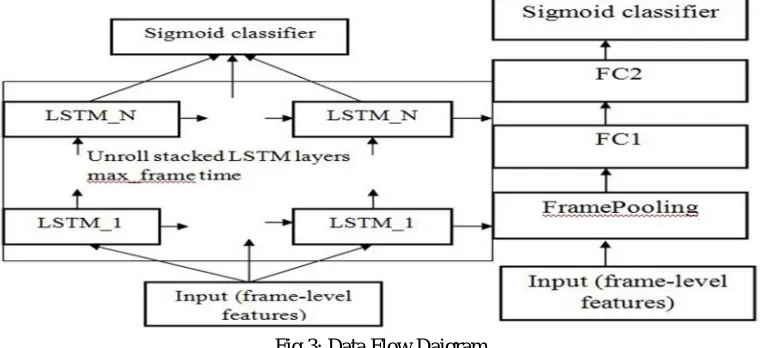
Fig 3: Data Flow Daigram
The above diagram shows us the flow of the program. The data is first collected from youtube8M data set and then the raw data is
filtered and then it is segmented and then data is sent for feature extraction where the process of extraction begins. After that the
Regression algorithms like LSTM, DboF and logistic regression is being applied and the classification is done with the help of
machine learning algorithms.
IV.
RESULT AND CONCLUSION
V.
CONCLUSIONS
REFRENCES
[1] Dr. Mohan Kumar S & Dr. Balakrishnan, Classification Of Breast Mass Classification – CAD System And Performance Evaluation Using SSNE, IJISET – International Journal of Innovative Science, Engineering & Technology, Vol. 2, Issue 9, 417-425, ISSN 2348 – 7968
[2] Dr. Mohan Kumar S, Dr. Balakrishnan, Classification Of Breast Mass Classification – CAD System With Performance Evaluation, International Journal of Engineering And Computer Science, Volume 4, Issue 09, 14187-14193, ISSN 2319-7242, September, 2015
[3] Dr. Mohan Kumar S, Dr. Balakrishnan, Classification Of Breast Microcalcification- CAD System And Performance Evaluation Using SSNE, International Journal of Advanced Research in Computer Science and S
[4] oftware Engineering, Volume 5 , Issue 9, 824-830, ISSN: 2277 128X, Sep- 2015
[5] Dr. Mohan Kumar S, Karthikayini, Essential Best Practices And Processes In Higher Educational Technical Institutions, International Journal Of Engineering Research And General Science, Volume 3, Issue 6, 231-236, ISSN 2091-2730 231, December, 2015
[6] Dr. Mohan Kumar S, Karthikayini, LNW-A System Model For A High Quality Effective E-Learning Using Cloud Environs, International Journal of Current Research and Review, Volume 7, Issue 23, 21-25, ISSN: 0975-5241, December, 2015
[7] Dr. Mohan Kumar S, Ayurveda Medicine Roles In Healthcare Medicine, And Ayurveda Towards Ayurinformatics, International Journal of Computer Science and Mobile Computing, Volume 4, Issue 12, 35-43, ISSN 2320-088X, December, 2015
[8] Dr. Mohan Kumar S, Muralidhara, Importance Of Accreditation And Autonomous Status In HEI – An Assessment With Special Orientation To Karnataka State, International Journal of Engineering Sciences & Research Technology, Volume 5, , Issue 1, 472-479, ISSN : 2277-9655, January, 2016
[9] Dr. Mohan Kumar S , Interrelated Research Works And Importance Of Object Oriented Analysis And Modeling, International Journal of Engineering Sciences & Research Technology, Volume 5, Issue 1, Page Numbers:59-62, ISSN : 2277-9655, January, 2016
[10] Dr.S Mohan Kumar, R.Jaya, A Survey On Medical Data Mining – Health Care Related Research And Challenges, International Journal of Current Research, Volume 8, Issue 01, Page Numbers; 25170-25173, ISSN:0975-833X, January, 2016
[11] R.Jaya, Dr S Mohan Kumar, A Study On Data Mining Techniques, Methods, Tools And Applications In Various Industries, International Journal of Current Research & Review, Volume 8, Issue 04, Page Numbers:35-43, ISSN:0975-5241, January, 2016
[12] Clara K, Dr S Mohan Kumar, Cyber Crime Varient Activities And Network Forensic Investigation, International Journal of Emerging Technology and Advanced Engineering, Volume 6, Issue 04, Page Numbers: April 2016, ISSN:2250-2459, March, 2016,
[13] Clara.K, Dr S Mohan Kumar,Exploratory Study Of Cyber Crimes, Digital Forensics And Its Tools, International Journal of Emerging Technology and Advanced Engineering, Volume 6, Issue 04, Page Numbers: April 2016, ISSN:2250-2459, March, 2016
[14] Revathi Y, Dr S Mohan Kumar, Efficient Implementation Using RM Method For Detecting Sensitive Data Leakage In Public Network International Journal of Modern Trends in Engineering and Research, Volume 3, Issue 04, Page Numbers: 515-518, ISSN (Online):2349–9745 ISSN (Print):2393-8161 , April, 2016
[15] Revathi Y , Dr S Mohan Kumar, Review On Importance And Advancement In Detecting Sensitive Data Leakage In Public Network, International Journal Of Engineering Research And General Science, Volume 4, Issue 02, Page Numbers:263-265, ISSN:2091-2730, April, 2016
[16] Revathi Y, Dr S Mohan Kumar, A Survey On Detecting The Leakage Of Sensitive Data In Public Network International Journal of Emerging Technology and Advanced Engineering, Volume 6, Issue 03, Page Numbers:234-236, January, 2016
[17] Vandana CP, "Security improvement in IoT based on Software Defined Networking (SDN)",International Journal of Science, Engineering and Technology Research (IJSETR)
[18] Volume 5, Issue 1 ,Pages 291-295
[19] Vandana cp,"Internet of Things and Security",International Journal of Computer Science and Mobile Computing ,Volume 5 ,Issue 1 [20] Pages 133-139 ,IJCSMC, Vol. 5, Issue. 1, January 2016
[21] Vandana cp,Study of Resource Discovery trends in Internet of Things (IoT) ,Journal Int. J. Advanced Networking and Applications ,Volume 8,Issue 3 [22] Pages 3084-3089
[23] Vandana cp,IOT future in edge computing ,Journal International Journal of Advanced Engineering Research and Science [24] Volume 3 ,Issue 12 , AI Publications
[25] Sujithra ks,Baswaraju Swathi, sonia singh,Inclusive analysis of incomplete data sets using IkNN search, International Journal of Innovative Research in Computer and Communication Engineering,
[26] Subathra Muthuraman, Mrs Swathi Baswaraju, Mrs B Mounica, LARGE SCALE IMAGE RETRIEVAL USING DESCRIPTORS AND DISTANCE MEASURE, International Journal of Computer Science and Mobile Computing, Vol.4 Issue.5
[27] Swathi Baswaraju, Balani Somesh, Shrestha Niza Barun-SURVEY ON HOME SECURITY SURVEILLANCE SYSTEM BASED ON WI-FI CONNECTIVITY USING RASPBERRY PI AND IOT MODULE, International Journal of Advanced Research in Computer Science . Mar/Apr2018, Vol. 9 Issue 2.
[28] Mr.Dilish Babu.J, Dr.S Mohan Kumar, A Survey On Secure Communication In Public Network During Disaster , IJESRT -International Journal Of Engineering Sciences & Research Technology, Volume 5, Issue 3, Page Numbers:430-434, ISSN: 2277-9655, March 2016
[29] Mr.Dilish Babu.J, Dr.S Mohan Kumar, Survey On Routing Algorithms During Emergency Crisis Based On MANET, IJETAE, International Journal of Emerging Technology and Advanced Engineering, Volume 6, Issue 3, Page Numbers: 278-281, ISSN: 2250–2459, Mar-16
[30] Mr.Dilish Babu.J, Dr.S Mohan Kumar, Emergency Communication Sysytem For Natural Disaster Using MANET, IJRDO, International Journal of Research and Development Organization, Volume 2, Issue 5, Page Numbers:01 to 10, ISSN:2456-1843, May, 2016
[31] Ms.Sulochana Panigrahi, Dr S Mohan Kumar, Social Data Analysis Using Big-Data Analytic Technologies- Apache Flume, HDFS, HIVE, IJRDO, International Journal of Research and Development Organization, Volume 2, Issue 5, Page Numbers:16 to 21, ISSN:2456-1843, May, 2016
[32] Ms.Sulochana Panigrahi, Dr S Mohan Kumar, Social Media Analysis Using Apache Flume, Hdfs, Hive, International Journal of Current Trends in Engineering & Technology, Volume 2, , Issue 2, Page Numbers:282 to 285, ISSN:2395-3152, March, 2016
[34] Naga Raju Hari Manikyam and Dr. S .Mohan Kumar, Methods And Techniques To Deal With Big Data Analytics And Challenges In Cloud Computing Environment, International Journal of Civil Engineering & Technology (IJCIET), ISSN 0976-6308 and 0976-6316(Print&Online), Volume 8, Issue 4, 04-17, [35] V Karthik, Dr.S . Mohan Kumar and Ms. Karthikayini, A Novel Survey On Location Based Node Detection And Identifying The Malicious Activity Of
Nodes In Sensor Networks International Journal of Civil Engineering & Technology, (IJCIET), ISSN 0976-6367 and 0976-6375(Print & Online), Volume 8, [36] Karthik V, Ms.Karthikayini, Dr S Mohan Kumar, Ms Gayathri T, Geocentric Based Node Detection And Revoking Malicious Node In WSN, International
Journal for Science and Advance Research in Technology (IJSART), ISSN 2395-1052 (Print&Online), Volume 3, Issue 4, 04-17
[37] Dr.S. Mohan Kumar and Dr G. Balakrishnan, Wavelet And Symmetric Stochastic Neighbor Embedding Based Computer Aided Analysis For Breast Cancer, Indian Journal of Science and Technology ISSN 0974-6846 and 0974-5645(Print&Online), Volume 9, Issue 47, 12-16
[38] Sruthi Hiremath, Sheba Pari N and Dr.S. Mohan Kumar, Booster in High Dimensional Data Classification, (DOI: 10.15680/IJIRCCE.2017. 0503349), International Journal of Innovative Research in Computer and Communication Engineering, Vol. 5, Issue 3, March 2017, 5984-5989.
[39] Dr S. Mohan Kumar & Dr.T.Kumanan, Skin Lesion Classification System and Dermoscopic Feature Analysis for Melanoma Recognition and Prevention, IJETAE, International Journal of Emerging Technology and Advanced Engineering, ISSN: 2250–2459 and Volume 7, Issue 7, July 2017,
[40] Dr S. Mohan Kumar & DrJitendranathMungara, J. Karthikayini, Design and implementation of CNN for detecting Melanoma through image processing, International Journal for Research in Applied Science and Engineering Technology, ISSN : 2321 – 9653, Volume 6, Issue - 3, March – 2018 in (DOI : 10.22214) pp. No.: 2249-2253
[41] Dr S. Mohan Kumar & J. Karthikayini, Surveys on Detection of Melanoma through image processing Techniques, International Journal for Research in applied science and Engineering Technology (IJRASET), ISSN : 2321 – 9653, volume 6, Issue III, March 2018 in IJRASET, DOI: 10.22214, pp. no.: 1699-1704
[42] Dr S. Mohan Kumar, Automated Segmentation of retinal images, International Journal of Engineering and Technology, UAE, July 2018, International Journal of Engineering and Technology, UAE
[43] Dr. S. Mohan Kumar & Anisha Rebinth, Automated detection of Retinal Defects using image mining, A review, European Journal of Biomedical and Pharmatical Sciences, European ISSN : 2349 – 8870, Volume 5 , Issue : 01 year : 2018, pp No.: 189 – 194
[44] Dr. S. Mohan Kumar& Dr.T.Kumanan, Analysis on skin Lesion classification systems and Dermoscopic Feature Analysis for Melanoma International Journal for Research in Applied Science and Engineering Technology (IJRASET), ISSN : 2321 – 9653, Volume 6, Issue - 3, March – 2018 in (DOI : 10.22214), pp. no.:1971-78
[45] Dr. S. Mohan Kumar & Dr.T.Kumanan, Study on skin Lesion Classifications system and Dermoscopic Feature Analysis for Melanoma, International journal of Creative Research Thoughts (IJCRT), IJCRT1802680, ISSN : 2320 – 2882, Volume 6, issue-1, March 2018, Page No . 1863 – 1873
[46] Dr. S. Mohan Kumar & Dr.T.Kumanan, Classification System and Dermoscopic Features Analysis for Melanoma recognition and Prevention, International journal of Creative Research Thoughts (IJCRT), IJCRT1802680, ISSN : 2250 – 2459 , Volume 7 , Issue 8, August 2017 , pp no: 351 – 357
[47] Dr. S. Mohan Kumar& Darpan Majumder, Healthcare Solution based on Machine Learning Applications in IOT and Edge Computing, International Journal of Pure and Applied Mathematics, ISSN: 1311-8080 (printed version) ISSN: 1314-3395 (on-line version) Jul 2018 issue.
[48] Dr. S. Mohan Kumar, Ashika.A, A Survey on Big Data Analysis, Approaches and its Applications in the real World, Journal of Emerging Technologies and Innovative Research, ISSN: 2349-5162, May 2018 , Volume 5, Issue 5, pp. no.: 93-100
[49] Shreya R, Sri Lakshmi Chandru, Vivek Kumar, Shwetha M, Dr. S. Mohan Kumar, Classification of Skin Cancer through image processing and implementating CAD System International journal of Creative Research Thoughts (IJCRT)IJCRT1802680m, ISSN : 2320 – 2882, Volume 6, issue-2 , April 2018 Page No . 1863 – 1873
[50] S Mohan Kumar & Dr. Balakrishnan, Statistical Features Based Classification of Micro calcification in Digital Mammogram using Stocastic Neighbour Embedding, International Journal of Advanced Information Science and Technology, 2012, ISSN:2319-2682 Volume 07, Issue 07 , November 2012, Page Numbers: 20-26
[51] S Mohan Kumar & Dr. Balakrishnan ,Breast Cancer Diagnostic system based on Discrete Wavelet Transformation and stochastic neighbour Embedding, European Journal of Scientific Research, 2012, ISSN:1450-216X ,Volume 87, Issue 03 , October 2012, Page Numbers: 301-310
[52] S Mohan Kumar & Dr. Balakrishnan, Classification of Microclacification in digital mammogram using SNE and KNN classifier, International Journal of Computer Applications - Conference Proceedings published in IJCA, 2013 ISBN: 973-93-80872-00-6, ICETT proceedings with IJCA on January 03,2013, Page Numbers: 05-09
[53] S Mohan Kumar & Dr. Balakrishnan, Mutiresolution analysis for mass classification in Digital Mammogram using SNE, IEEE international Conference- ICCSP-13 organized by Athiparasakthi Engineering College, Chennai , 2013, ISBN:978-1-4673-4864-5, Page Numbers: 2041-2045.
[54] S Mohan Kumar & Dr. Balakrishnan, Categorization of Benign And Malignant Digital Mammograms Using Mass Classification – SNE and DWT, Karpagam Journal of Computer Science, 2013, ISSN No: 0973-2926, Volume-07, Issue-04, June-July-2013, Numbers: 237-243.
[55] S Mohan Kumar & Dr. Balakrishnan, Classification of Micro Calcification And Categorization Of Breast Abnormalities - Benign and Malignant In Digital Mammograms Using SNE And DWT, Karpagam Journal of Computer Science 2013, ISSN No: 0973-2926, Volume-07, Issue-05, July-Aug, 2013. Page Numbers: 253 to 259
[56] S Mohan Kumar & Dr. Balakrishnan, The Performance Evaluation of the Breast Mass classification CAD System Based on DWT, SNE AND SVM , International Journal of Emerging Technology and Advanced Engineering, 2013, ISSN 2250–2459, Volume 3, Issue 10, October 2013, Page Numbers: 581-587