S q u i b s and D i s c u s s i o n s
Co-occurrence Patterns among Collocations:
A Tool for Corpus-Based Lexical Knowledge
Acquisition
D o u g l a s B i b e r •
Northern Arizona University
1. Introduction
One of the main problems for applied natural language processing is gaps in the lexicon, including missing words and word senses, and inadequate descriptions of word use in context. Traditional lexicography has similar concerns. The availability of large, on-line text corpora provides a straightforward tool for enlarging the stock of words included in a lexicon. The identification of additional word senses and uses is more problematic, however.
Much recent lexicographic work employs concordances generated from text cor- pora for these purposes. While this approach provides a more solid empirical basis than traditional lexicographic approaches (which depend on the manual collection and sorting of citation index cards), concordances can actually provide too much data. For example, a concordance for the word
certain
produced on an 11.6 million-word sub- sample of the Longman/Lancaster Corpus generated 3,424 entries; a concordance for the wordright
from the same subcorpus generated 7,619 entries. Simply determining the number of different senses in a database of this size is a daunting task; to accu- rately group different uses or rank them in order of importance is not really feasible without the use of additional tools.One such tool is to simply sort concordance lines according to their different collocational patterns. Entries can be sorted according to their collocates on both the left and the right. Many of these collocational pairs show a strong relation to a particular word sense (e.g., contrast
right ear
andright away),
and thus analysis of collocational relations has become an important tool for lexical knowledge acquisition (see Sinclair 1991; Smadja 1991; Zernik 1991).In addition, there are statistical tools that can help determine the relative strength of collocational relations. For example, Church and Hanks (1990) describe the use of the mutual information index for this purpose (cf. Calzolari and Bindi 1990). Church et al. (1991) further describe the use of t-scores to assess the extent of the differences between the collocational patterns of nearly synonymous words. These tools are important in that the strongest collocational associations often represent different word senses, and thus 'they provide a powerful set of suggestions to the lexicographer for what needs to be accounted for in choosing a set of semantic tags' (Church and Hanks 1990, p. 28). However, such tools do not directly characterize word senses or even provide any direct indication of the number of different senses that a word has. 1 Further, these
* Dept. of English, Northern Arizona University, P.O. Box 6032, Flagstaff, AZ 86011-6032; [email protected].
tools are not designed to assess the relations
among
various collocations, addressing the question of which clusters of collocations reflect similar underlying senses. 2The present paper discusses the use of factor analysis (a multivariate statistical technique) as a tool for such research questions. In particular, this technique con- tributes three types of information not provided by other complementary techniques: 1) an indication of the number of major senses a n d / o r uses associated with a word; 2) an indication of the w a y that various collocational patterns relate to one another in marking word senses and uses; and 3) a fuller analysis of the senses themselves, based on interpretation of the shared bases underlying the groupings of collocations.
2. Methodology
The use of multivariate statistical techniques for lexical knowledge acquisition was first proposed by Bindi et al. (1991). In particular, that study illustrates the use of Multidimensional Scaling (MDS) to identify the relations among semantically related word types (e.g.,
piccolo, corto, breve)
and their collocates (or 'word mates'). The input data for this approach are mutual information indexes computed over the domain of an entire corpus. Separate association indexes are computed for each pair of target word types (e.g.,piccolo
andcorto)
and for all of the word types in relation to various 'word-mates' (e.g.,piccolo
withbambino).
This entire matrix is then analyzed by MDS to cluster word types and word-mates along a few underlying dimensions, providing a geometric representation of the semantic domain in question (in this case, 'smallness'). Word types are clustered together to the extent that they are associated with the same word-mates. The geometric distance between a word-mate and its word type reflects the strength of the relevant association index, and word-mates are clustered together to the extent that they are associated with the same word types (see Bindi et al. 1991). Factor analysis differs from MDS in that the input data are computed over the domain of individual texts, rather than over the domain of the entire corpus. Fur- ther, the application of factor analysis here is to identify basic word senses and uses associated with a single word rather than the relations among a set of semantically related words. This statistical technique identifies the groupings of collocations that tend to co-occur frequently in texts. If we assume that texts are topically coherent, it follows that groupings of collocations that co-occur frequently in texts will often reflect different underlying word senses.This approach is illustrated here through analyses of two
words--certain
andright--in
an 11.66 million-word subsample of the Longman/Lancaster corpus. This corpus is designed to represent a wide range of text varieties (see Summers 1991), including ten major topical categories (e.g., natural science, social science, fiction), three mediums (books, periodicals, and ephemera), and three levels (technical/literary, lay/middle, and popular).The first step in the analysis is to identify the major collocational patterns for the target word. In the present analysis, this was done simply by computing the frequency of all collocational pairs over the entire corpus; collocations that occurred more than 30 times were considered to be important word associations and thus included in the subsequent analyses. 3 For
certain,
20 left collocates and 14 right collocates met this2 Church et al. (1991, pp. 150-155) show how word association measures computed over the domain of discourse units (rather than bigrams or SVO triples) can be used to identify topical domains for information retrieval purposes.
Douglas Biber Co-occurrence Patterns
c r i t e r i o n ; for right, t h e r e w e r e 24 left c o l l o c a t e s a n d 53 r i g h t c o l l o c a t e s m e e t i n g t h e c r i t e r i o n .
T h e n e x t s t e p w a s to c o u n t t h e f r e q u e n c y o f e a c h c o l l o c a t i o n p a i r i n e a c h t e x t o f t h e c o r p u s . O n l y t e x t s l o n g e r t h a n 20,000 w o r d s w e r e i n c l u d e d a t t h i s s t a g e , to i n s u r e a d e q u a t e r e p r e s e n t a t i o n o f t h e r e l e v a n t c o - o c c u r r i n g c o l l o c a t i o n s . T w o h u n d r e d f o r t y - s i x t e x t s f r o m t h e s u b c o r p u s m e t t h i s c o n d i t i o n .
F a c t o r a n a l y s i s w a s t h e n u s e d to i d e n t i f y t h e g r o u p i n g s o f c o l l o c a t i o n a l p a i r s t h a t t e n d e d to c o - o c c u r in texts. F a c t o r a n a l y s i s b u i l d s u p o n p a i r w i s e c o r r e l a t i o n s a m o n g t h e v a r i a b l e s to i d e n t i f y a r e d u c e d set o f u n d e r l y i n g c o n s t r u c t s , o r ' f a c t o r s ' . 4 E a c h v a r i a b l e h a s s o m e c o r r e l a t i o n , o r ' l o a d i n g , ' w i t h e a c h factor, b u t o n l y t h e l a r g e r l o a d i n g s a r e i m p o r t a n t in i n t e r p r e t i n g t h e u n d e r l y i n g c o n s t r u c t s .
I n t h e p r e s e n t case, t h e v a r i a b l e s a r e t h e f r e q u e n c y c o u n t s f o r e a c h c o l l o c a t i o n a l pair. T h e f a c t o r s t h u s r e p r e s e n t t h e c o l l o c a t i o n a l p a i r s t h a t t e n d to c o - o c c u r f r e q u e n t l y in texts. G i v e n t h e f o l l o w i n g a s s u m p t i o n s , it w a s h y p o t h e s i z e d t h a t t h e f a c t o r g r o u p - i n g s o f c o l l o c a t i o n a l p a i r s w o u l d r e p r e s e n t d i f f e r e n t u n d e r l y i n g w o r d s e n s e s ; t h e re- q u i r e d a s s u m p t i o n s are: 1) t h a t e a c h c o l l o c a t i o n a l p a i r t e n d s to h a v e a s t r o n g r e l a t i o n to a s i n g l e w o r d s e n s e , a n d 2) t h a t t e x t s a r e t o p i c a l l y c o h e r e n t , a n d t h a t w o r d s w i l l t h e r e f o r e t e n d to b e u s e d i n a s i n g l e s e n s e t h r o u g h o u t t h e d o m a i n o f a text. To t h e e x t e n t t h a t t h e s e a s s u m p t i o n s a r e a c c u r a t e , c o l l o c a t i o n a l p a i r s s h o u l d c o - o c c u r in t e x t s a s r e f l e c t i o n s o f t h e s a m e u n d e r l y i n g w o r d s e n s e . T h e p i l o t a n a l y s e s p r e s e n t e d i n t h e f o l l o w i n g s e c t i o n i n d i c a t e t h a t t h e s e a s s u m p t i o n s d o c o m m o n l y h o l d in n a t u r a l d i s c o u r s e .
3. C o - o c c u r r e n c e Patterns a m o n g C o l l o c a t i o n s for
certain
a n dright
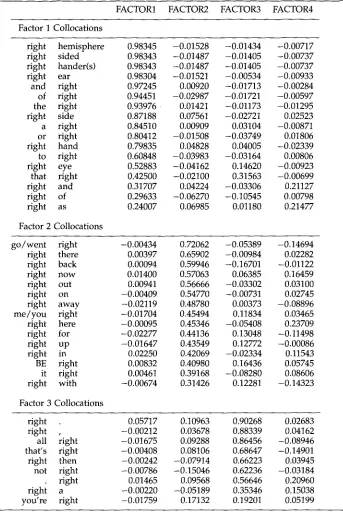
T h e f a c t o r a n a l y s e s f o r t h e c o l l o c a t e s o f certain a n d right a r e s u m m a r i z e d i n T a b l e s 1 a n d 2 r e s p e c t i v e l y . 5 T h e t a b l e s p r e s e n t t h e f a c t o r l o a d i n g s for e a c h c o l l o c a t i o n a l p a i r o n e a c h factor. L o a d i n g s c a n r a n g e f r o m 0.0 to p l u s o r m i n u s 1.0. A l o a d i n g o f 0.0
that are not necessarily frequent in their overall occurrence. In addition, word associations at a distance should be included.
4 See Biber (1988) for a fuller discussion of factor analysis and its application to the computational analysis of linguistic variation. There are three main corpus design considerations required by this use of factor analysis. First, the analysis requires long, connected texts, to provide ample opportunity for the (co-)occurrence of a range of collocational pairs; the analysis here excludes all texts shorter than 20,000 words. Shorter texts would often contain few tokens of a few collocational pairs and would thus not adequately represent the correlations among collocations. Composite texts are not acceptable because they violate the assumption of topical coherence. Second, the analysis requires a large number of texts. A general rule of thumb for factor analysis is that there should be five times as many texts as variables (Gorsuch 1983). Thus, there should be a minimum of 240 texts included for the final factor analysis of right, which is based on 48 collocational pairs. (The final factor analysis of certain is based on 25 collocational pairs and would thus require only 150 texts.) The sub-corpus used here, with 246 coherent texts longer than 20,000 words, meets these criteria. Finally, the corpus used for analysis must represent the full range of variability with respect to the collocational patterns. Corpora that are restricted topically or restricted to a few registers are not adequate for analyses of this type, because the reduced variability results in reduced correlations, which in turn result in a skewed and unreliable factorial structure (cf. Biber 1990).
5 I used a common factor analysis with a Promax rotation. Scree plots of the eigenvalues and
consideration of the two-, three-, and four-factor solutions indicated that the three-factor solution was the most adequate for the analysis of certain, while the four-factor solution was the most adequate for the analysis of right. Variables that had communalities K .10 were dropped from the final analysis; 25 collocational pairs were included in the final analysis of certain, and 48 pairs in the analysis of right.
Table 1
Factorial structure of the collocates of certain.
FACTOR1 FACTOR2
Major Factor 1 Collocation
FACTOR3
in certain 0.74077 0 . 0 7 1 1 0 -0.05468
certain other 0.68352 -0.09431 -0.05035
of certain 0.61015 0.32266 -0.05660
and certain 0.58373 -0.12996 -0.11671
certain of 0.56773 -0.10960 0.22018
certain 0.49718 0 . 0 9 2 3 1 -0.12760
certain 0.46448 0.10248 0.05560
!
there BE certain 0.32284 -0.03747 0.07349
certain type(s) 0.31556 0 . 0 6 1 9 1 -0.10855
on certain 0.29994 0.27142 -0.01401
with certain 0.29908 0 . 2 4 9 8 1 -0.07999
that certain 0.27814 0.18763 0.01827
Major Factor 2 Collocations
certain extent -0.21295 0 . 9 1 0 6 5 0.01578
certain aspect(s) -0.08321 0.90127 0.01704
to certain 0.15364 0.71625 0.00352
under certain 0.02432 0 . 4 4 9 7 9 -0.02374
for certain 0.40779 0.44289 0.05722
a certain 0.01796 0.35752 0.01724
by certain 0.22450 0 . 3 3 3 5 1 0.02019
Major Factor 3 Collocations
certain that 0.13828 0.00372 0.87341
certain -0.11735 0.03704 0.46955
it BE certain -0.04318 0.00884 0.42112
m a k e / m a d e certain 0.02137 0.00068 0.32323
I / w e BE certain -0.08456 -0.06629 0.29203
quite certain -0.08470 0.04002 0.23607
s h o w s that the v a r i a b l e h a s no relation to the p o o l of s h a r e d v a r i a n c e a c c o u n t e d for b y the factor, w h i l e a l o a d i n g of 1.0 r e p r e s e n t s a perfect correlation.
Each factor c o m p r i s e s a n u m b e r of collocational pairs w i t h relatively large load- ings, while the r e m a i n i n g collocations h a v e small or negligible associations. Tables 1 a n d 2 are o r g a n i z e d so that the collocations h a v i n g large l o a d i n g s on each of the factors are g r o u p e d together.
C o n s i d e r first the factorial structure for certain, p r e s e n t e d in Table 1. T h e first 12 collocations listed on the table h a v e large l o a d i n g s on Factor 1, w i t h g e n e r a l l y small loadings on the other t w o factors (e.g., in certain has a l o a d i n g of .74 on Factor 1, b u t l o a d i n g s n e a r 0.0 on Factors 2 a n d 3). T h e second g r o u p of 7 collocations h a v e the largest loadings on Factor 2; while the last g r o u p of 6 collocations h a v e large l o a d i n g s on Factor 3. 6
For the p u r p o s e s of interpretation, each factor can be c o n s i d e r e d as c o m p r i s i n g
[image:4.468.89.432.88.444.2]Douglas Biber Co-occurrence Patterns
Table 2
Factorial structure of the collocates of
right.
FACTOR1 FACTOR2 FACTOR3 FACTOR4 Factor 1 Collocations
right hemisphere 0.98345 -0.01528 -0.01434 -0.00717 right sided 0.98343 -0.01487 -0.01405 -0.00737 right hander(s) 0.98343 -0.01487 -0.01405 -0.00737 right ear 0.98304 -0.01521 -0.00534 -0.00933 and right 0.97245 0.00920 -0.01713 -0.00284 of right 0.94451 -0.02987 -0.01721 -0.00597 the right 0.93976 0.01421 -0.01173 -0.01295 right side 0.87188 0.07561 -0.02721 0.02523 a right 0.84510 0.00909 0.03104 -0.00871 or right 0.80412 -0.01508 -0.03749 0.01806 right hand 0.79835 0.04828 0.04005 -0.02339 to right 0.60848 -0.03983 -0.03164 0.00806 right eye 0.52883 -0.04162 0.14620 -0.00923 that right 0.42500 -0.02100 0.31563 -0.00699 right and 0.31707 0.04224 -0.03306 0.21127 right of 0.29633 -0.06270 -0.10545 0.00798 right as 0.24007 0.06985 0.01180 0.21477 Factor 2 Collocations
g o / w e n t right -0.00434 0.72062 -0.05389 -0.14694 right there 0.00397 0.65902 -0.00984 0.02282 right back 0.00094 0.59946 -0.16701 -0.01122 right now 0.01400 0.57063 0.06385 0.16459 right out 0.00941 0.56666 -0.03302 0.03100 right on -0.00409 0.54770 -0.00731 0.02745 right away -0.02119 0.48780 0.00373 -0.08896 m e / y o u right -0.01704 0.45494 0.11834 0.03465 right here -0.00095 0.45346 -0.05408 0.23709 right for -0.02277 0.44136 0.13048 -0.11498 right up -0.01647 0.43549 0.12772 -0.00086 right in 0.02250 0.42069 -0.02334 0.11543 BE right 0.00832 0.40980 0.16436 0.05745 it right 0.00461 0.39168 -0.08280 0.08606 right with -0.00674 0.31426 0.12281 -0.14323 Factor 3 Collocations
[image:5.468.58.401.120.632.2]Table 2
Continued.
FACTOR1 FACTOR2 FACTOR3 FACTOR4 Factor 4 Collocations
• right 0.03424 0 . 0 2 4 0 8 -0.12703 0.99315
right you -0.00214 -0.06841 0 . 1 0 1 6 2 0.86214
right so 0.02173 -0.05118 0 . 0 8 4 6 7 0.77789
right she/he/they -0.00184 -0.07307 0 . 0 9 3 0 1 0.59287
right I/we -0.00618 0 . 0 8 1 9 9 0 . 0 5 7 8 1 0.57046
right it 0.01641 0 . 1 1 6 9 1 -0.09122 0.37539
right from -0.01475 -0.00082 -0.03191 0.34669
only those features with large loadings, so that each factor represents a separate group- ing of collocations that tend to co-occur frequently in texts. Factor 3 is the easiest to interpret: all six of the collocational pairs grouped on this factor represent contexts where
certain
functions to m a r k certainty. In all of these cases,certain
is a predicative adjective, often taking athat
c o m p l e m e n t clause (e.g.,I am quite certain that... ).
In contrast,
certain
does not have the sense of certainty in a n y of the collocational pairs grouped on Factors 1 a n d 2; rather the collocations grouped on these factors function to identify an unspecified (and perhaps u n k n o w n ) subset of some larger group (e.g.,in certain cases, a certain person). 7
The difference b e t w e e n Factors 1 a n d 2 is less obvious. An examination of the concordance listings for the associated collocations, however, shows that there is an important, systematic difference between the two factors: the collocations on Factor 1 tend to m o d i f y concrete, physical or tangible referents, while the collocations on Factor 2 tend to m o d i f y abstract referents. Thus, consider the examples from both factors listed in Table 3.Factor I collocations tend to be more concrete, often characterizing physical objects (e.g.,
towns, adults, trees, raw vegetables).
In contrast, Factor 2 collocations m o d i f y more abstract referents, such asbasic truths, general values,
a n dassumptions.
The collocationfor certain
has a loading of about .40 on both Factor 1 a n d Factor 2, a n d it shows both kinds of pattern; for example, it modifiesusers
a n dspeakers,
similar to other Factor 1 collocations, a n d it modifiesresponsibilities, symptoms,
a n ddeficiencies,
similar to other Factor 2 collocations.The factorial structure for
right,
presented in Table 2, similarly shows a highly sys- tematic patterning a m o n g collocations. Factor I represents the positional or directional use ofright;
in fact, m a n y of these collocations refer to b o d y parts on theright
side.Factor 2 is equally transparent b u t represents a w o r d sense that does not receive m u c h attention in most dictionaries:
right
marking 'immediately,' 'directly,' or 'exactly.' There are a large n u m b e r of collocational pairs having this sense (e.g.,right there, right
back, right now),
and Factor 2 shows that there is a strong t e n d e n c y for these collocations to co-occur in texts. On first consideration, the collocationgo~went right
seems to be an exception to the general pattern u n d e r l y i n g Factor 2 (representing the Factor 1 sense of 'to the right' instead). Examination of the concordance listings for this collocation shows, however, that it almost always occurs w i t h the Factor 2 sense• as ingo right
through, go right up, he went right away.
[image:6.468.51.431.79.208.2]Douglas Biber Co-occurrence Patterns
Table 3
Example contexts for major collocations on Factors 1 and 2 in the analysis of certain.
Factor 1 collocations
in certain: ways, cases, instances, towns, districts, directions, areas, cultures, companies certain other: external parasites, parts of the body, adults, statements, mediterranean cultures, crisp greens
of certain: monkeys, infants, theologians, particles, sovereigns, people, details, trees, individuals and certain: kinds of cats, kinds of laughing, spices, bits of information, compositions, broiler growers, raw vegetables
for certain: users, kinds of addressees, speakers, materials
Factor 2 collocations
(to) a certain extent (for) certain aspects
to certain: deficiencies, stimuli, nonmaterial aspects, very strong drives, basic truths, defects, general values, simplifying principles
under certain: assumptions, (economic) conditions for certain: responsibilities, symptoms, deficiencies, types
Factor 3 represents a grouping of collocations having the general sense of 'ok' or 'correct.' All right is commonly used to mark agreement or to mark a discourse juncture. Right can occur by itself with these same functions (hence the collocations
of right with preceding and following punctuation). The collocation that's right also
typically marks agreement to a previous assertion. Right then appears to represent a use of the Factor 2 pattern meaning 'immediately,' but this collocation also frequently occurs as a response in the context all right then. The collocation not right indicates a lack of correctness or normalcy, as in all was not right with the mirror and something was not right close-up.
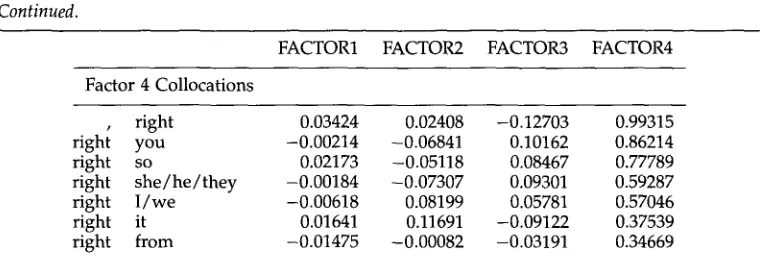
Finally, Factor 4 seems to represent a stylistically marked use of right at the end of a clause, with no intervening punctuation before the following clause. Collocations of this type commonly have all right, right, or that's right preceding a clause, as in all right you found the..., all right I pushed . . . . that's right I think, right away they walk toward... The underpinnings of this factor need further investigation.
4. C o n c l u s i o n
grammatical tagger, making the collocations sensitive to grammatical category. Finally, lexical associations at a distance should be included in the analysis. In this regard, the analyses here have been restricted: they consider only collocations of adjacent words, with no regard for grammatical category, a n d with the input data identified simply on the basis of absolute frequency. However, even w i t h these restrictions, factor analysis appears to be a powerful tool for identifying u n d e r l y i n g patterns a m o n g collocations, reflecting some of the major senses a n d uses of a word.
References
Biber, Douglas (1988). Variation across Speech and Writing. Cambridge University Press. Biber, Douglas (1990). "Methodological
issues regarding corpus-based analyses of linguistic variation." Literary and Linguistic Computing, 5, 257-269.
Bindi, Remo; Calzolari, Nicoletta; Monachini, Monica; and Pirrelli, Vito (1991). "Lexical knowledge acquisition from textual corpora: A multivariate statistic approach as an integration to traditional methodologies." In Proceedings, Seventh Annual Conference of the U W Centre for the New OED and Text Research. Oxford, U.K.
Calzolari, Nicoletta, and Bindi, Remo (1990). "Acquisition of lexical information from a large textual Italian corpus." In
Proceedings, 13th International Conference on Computational Linguistics. 54-59.
Church, Kenneth Ward, and Hanks, Patrick (1990). "Word association norms, mutual information, and lexicography."
Computational Linguistics, 16, 22-29.
Church, Kenneth; Gale, William; Hanks, Patrick; and Hindle, Donald (1991). "Using statistics in lexical analysis." In Lexical Acquisition: Exploiting On-Line Resources to Build a Lexicon, edited by Uri Zernik, 115-164. Lawrence Erlbaum Associates.
Gorsuch, Richard L. (1983). Factor analysis. Lawrence Erlbaum Associates.
Sinclair, John (1991). Corpus, Concordance, Collocation. Oxford University Press. Smadja, Frank (1991). "Macrocoding the
lexicon with co-occurrence knowledge." In Lexical Acquisition: Exploiting On-Line Resources to Build a Lexicon, edited by Uri Zernik, 165-189. Lawrence Erlbaum Associates.
Summers, Della (1991).
"Longman/Lancaster English language corpus: Criteria and design." Technical Report, Longman.