American
Journal
of
Computational Linguistics
Microfiche 33 : 45C o m p u t e r S c i e n c e D e p a r t m e n t I n d i a n a U n i v e r s i t y
B l o o n l i n g t o n 4 7 4 0 1
ABSTRACT
Generation of English s u r f a c e s t r i n g s from a s e m a n t i c n e t w o r k
is viewed a s t h e c r e a t i o n o f a l i n e a r surface s t r i n g t h a t d e s c r i b e s
a node o f t h e s e m a n t i c network. The form o f t h e s u r f a c e s t r i n g i s
c o n t r o l l e d by a r e c u r s i v e augmented t r a n s i t i o n network grammar,
which i s c a p a b l e of e x a m i n i n g t h e form a n d c o n t e n t o f t h e s e m a n t i c
n e t w o r k c o n n e c t e d to t h e s e m a n t i c node b e i n g d e s c r i b e d . A s i n g l e
node o f the grammar network may r e s u l t i n d i f f e r e n t f o r m s o f sur-
f a c e strings depending on t h e s e m a n t i c node i t i s g i v e n , and a
single semantic node may be d e s c r i b e d by d i f f e r e n t s u r f a c e s t r i n g s
d e p e n d i n g on t h e grammar node i t is g i v e n t o . S i n c e g e n e r a t i o n
from a semantPc n e t w o r k r a t h e r t h a n from d i s c o n n e c t e d p h r a s e m a r k e r s , ,
t h e s u r f a c e s t r i n g may b e g e n e r a t e d d i r e c t l y , l e f t t o r i g h t . I n t r o d u c t i o n
I n t h i s p a p e r , w e d i s c u s s t h e a p p r o a c h b e i n g taken i n t h e E n g l l s h
g e n e r a t i o n s u b s y s t e m o f a n a t u r a l language understanding s y s t e m
presently u n d e r development
a t
I n d i a n a U n i v e r s i t y . The c o r e o ft h e u n d e r s t a n d e r i s a s e m a n t i c n e t w o r k p r o c e s s i n g s y s t e m , SNePS
( S h a p i r o ,
1975),
which i s a d e s c e n d a n t o f t h eMENTAL
s e m a n t i o sub-system ( S h a p i r o , 1971a, 1971b) o f t h e M I N D s y s t e m (Kay, 1973).
The r o l e of t h e g e n e r a t o r 1 3 t o describe, i n E n g l i s h , any oP t h e
n o d e s i n the sernantjc network, a l l o f which r e p r e s e n t concepts o f
4 6
and other computations are ~ e q u i r e d in t h e p r o c e s s of p a s t i n g t h e s e
t r e e s t o g t h e r i n a p p r o p r i a t e p l a c e s u n t i l a ' s i n g l e phrase marker
I s a t t a i n e d w h i c h w i l l l e a d t o t h e s u r f a c e string. S i n c e we are
g e n e r a t i n g from a s e m a n t i c network, aL1 t h e p a s t i n g t o g e t h e r i s
a l r e a d y done. G r a b b i n g t h e n e t w o r k by t h e node of i n t e r e s t and
l e t t i n g t h e n e t w o r k dangl-e from i t gives a s t r u c t u r e m i c h may b e
searched a p p p o g r i a t e l y i n o r d e r t o g e n e r a t e t h e s u r f a c e s t r f n g
directly i n l e f t
t o
r i g h t f a s h i o n .Our system b e a r s a s u p e r f i c i a l r e s e m b l a n c e t o that d e s c r i b e d
fn Simmons a n d Slocum, 1972 a n d i n Simmons, 1973. T h a t s y s t e m ,
h o w e v e r , s t o r e s s u r f a c e i n f o r m a t i o n s u c h as t e n s e and v o i c e i n its
s e m a n t i c rietwork a n d its ATN t a k e s as i n p u t a l i n e a r list c o n t a i n -
ing t h e semantic node and a generation p a t t e r n consisting o f a
" s e r i e s of c o n s t r a i n t s on t h e m o c l a l l t y f l (Simmons e t a l . , 1973, p . 9 2
The g e n e r a t o r d . e s c r i b e d i n Schank e t a l . , 1973, t r a n s l a t e s from
a " c o n c e p t u a l s t r u c t u r e f 1 i n t o a network o f t h e f o r m o f Simmons
'
network w h i c h is t h e n g i v e n t o a v e r s i o n o f Simmons g e n e r a t i o nprogram. The two s t a g e s use d i f f e r e n t mechanisms. Our system
amounts t o a u n i f i c a t i o o f these two s t a g e s .
The g e n e r a t o r , as d e s c r i b e d i n this p a g e r , as w e l l a s SNePS,
a parser and an i n f e r e n c e mechanism h a v e been written i n LISP 1 . 6 and a r e r u n n i n g I n t e r a c t i v e l y on a DEC system-10 on t h e I n d i a n a
University Computing Network.
Representation i n t h e S e m a n t i c _ N e t w o r k
Conceptual i n f o r m a t i o n derived from p a r s e d s e n t e n c e s o r d e d u c e d from other i n f o r m a t i o n ( o r i n p u t d i r e c t l y v i a t h e SNePS user's l a n -
guage) i s stored i n a s e m a n t i c n e t w o r k . The n o d e s i n the n e t w o r k represent c o n c e p t s which may b e d i s c u s s e d and reasoned abaat. The edges represent semantic b u t n o n - c o n c e p t u a l b i n a r x relations
between nodes. T h e r e are a l s o a u x i l i a r y n o d e s w h i c h SNePS can
use or which the user c a n use as SNePS v a r i a b l e s . (For a more
The semantic network r e p r e s e n t a t i o n b e i n g used does n o t i n - 4 7
olude information considered .t.6 be f e a t u r e s of' t h e s u r f a c e s t r i n g
such as t e n s e , v o i c e o r main v s . r e l a t i v e c l a u s e . I h s t e a d of t e n s e ,
t e m p o r a l i n f o r m a t i o n i s s t o r e d P e I a t i v e t o a growing t i m e l i n e
i n a manner s i m i l a r t o t h a t of B r u c e , 1 9 7 2 . From t h i s i n f o r m a t i o n a t e n s e can b e g e n e r a t e d f o r a n o u t p u t s e n t e n c e , b u t i t may be a
d i f f e r e n t t e n s e t h a n that of t h e o r i g i n a l i n p u t s e n t e n c e i f t i m e has p r o g r e s s e d i r i %he 5 n t e r i m . The v o i c e o f a g e n e r a t e d s e n t e n c e
i s u s u a l l y d e t e r m i n e d by t h e top l e v e l c a l l t o the g e n e r a t o r f u n c - t i o n . However, sometimes i t i s d e t e r m i n e d b y t h e g e n e r a t o r gram-
m a r . F o r example, when g e n e r a t i n g a r e l a t i v e c l a u s e , v o i c e i s
d e t e r m i n e d b y w h e t h e r t h e nodn b e i n g m o d i f i e d - i s t h e a g e n t o r ob-
j e c t o f t h e a c t i o n d e s c r i b e d by t h e r e l a t i v e clause. The Main
c l a w e of a g e n e r a t e d s e n t e n c e depends on which s e m a n t i c node i s
g i v e n t o t h e g e n e r a t o r in t h e t o p l e v e l c a l l . O t h e r n o d e s con-
n e c t e d t o it may r e s u l t i n r e l a t i v e c l a u s e s b e i n g g e n e r a t e d . These
r o l e s may b e r e v e r s e d i n o t h e r t o p l e v e l c a l l s t o t h e g e n e r a t o r .
The g e n e r a t o r i s d r i v e n b y two s e t s of d a t a : t h e s e m a n t i c n e t -
work and a grammar i n t h e form of a r e c u r s i v e augmented t r a n s i t i o n n e t w o r k (ATN) similar t o t h a t o f Woods, 1973. The e d g e s on
o u r ATN a r e somewhat d i f f e r e n t from t h o s e of Woods s i n c e o u r view
i s t h a t t h e g e n e r a t o r i s a t r a n d u c e r f r o m a n e t w o r k i n t o a l i n e a r s t r i n g , whereas a p a r s e r I s a t r a n s d u c e r f r o m a l i n e a r string i n t o a t r e e o r n e t w o r k . The changes t h i s e n t a i l s a r e d i s c u s s e d below.
D u r i n g any p o i n t i n g e n e r a t i o n , t h e g e n e r a t o r i s working on some
p a r t i c u l a r s e m a n t i c n o d e . F u n c t i o n s on t h e e d g e s o f t h e A T N can
examine the network c o n n e c t e b t o t h i s node a n d fail o r s u c c e e d
a c c o r d i n g l y . I n t h i s way, n o d e s o f t h e ATN can " d e c i d e " what sur- face form i s most a p p r o p r i a t e f o r d e s c r i b i n g a s e m a n t i c n o d e , w h i l e d i f f e r e n t ATN n o d e s may g e n e r a t e different s u r f a c e foI?ms t o des-
cribe t h e same semantic node.
A common a s s u m p t i o n among l i n g u i s t s i s that g e n e r a t i o n b e g i n 3
LEX
Fizure 1: Semantic Network R e p r e s e n t a t L o n for " C h a r l i e believes
that a dog kissed sweet young Lucy," "Charlie i s a person," and "Lucy i s a p e r s o n .
,.Af=rmation considered t o be features o f surface strings are n o t
s t o r e d in the semantic network, but a r e u s e d by the p a r s e r in con- s t r u c t i n g t h e network rrom t h e i n p u t s e n t e n c e and b y t h e g e n e r a t o r
f o r generating
a
s u r f a c e s t r i n g from t h e network. F o r e x a m p l e ,t e n s e i s mapped into and from t e m p o r a l r e l a t i o n s between a node
r e p r e s e n t i n g that some a c t i o n has, i s , or will occur and a growing
t i m e l i n e . Restrictive relative clauses are used by t h e p a r s e r
to Identify a node being d i s c u s s e d , while n o n - r e s t r i c t i v e r e l a t i v e
clauses may result i n new i n f o r m a t i o n b e i n g added t o t h e network.
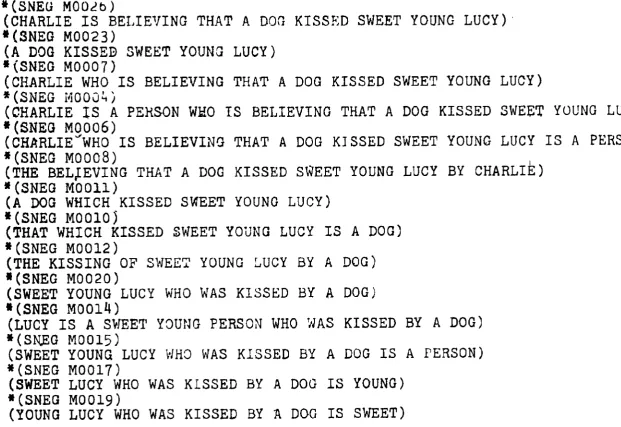
The example used i n t h i s p a p e r i s designed t o i l l u s t r a t e t h e generation i s s u e s being discussed. Although i t also i l l u s t r a t e s
*(SNEG M O O L b )
(CHARLIE IS
BELIEVING
THAT A DOG KISSED SWEET Y O U N G L U C Y ) ,*
(SNEG
M0023)( A DOG KISSED SWEET YOUNG LUCY) *(SNEG M0007)
(CHARLIE
WHO IS BELIEVING THAT A DOG KISSED SWEET YOUNGLUCY)
"(SNEG i4OOd;j
(CHARLIE
IS
A PERSON WXO ISBELIEVING THAT
A DOG KISSED SWEET Y O U N G L U C Y )*
(SNEG M0006)( C H R R L I E ~ W H O IS BELIEVING
THAT
A DOG KISSEDSWEET
YOUNG L U C Y I S A PERSON)(SNEG M0008)
(THE
BELJEVING THAT A DOG KISSED SWEET Y O U N G LUCY BY CHARLIE)*
(SNEG M0011)( A DOG WHICH KISSED SWEET Y O U N G L U C Y )
*(SNEG ~ 0 O l O j
(THAT
WHICH
KISSED SWEET YOYNG LUCY IS A DOG)*
(SNEG M0012)(THE
KISSING OF SWEET Y O U N G LUCYBY
k DOG)@(SNEG M0020)
(SWEET
YOUNG LUCY WHO WAS KISSEDBY
A D O G )*(SNEG
M0014)(LUCY
IS A SWEET Y O U N G PERSON WHO NAS KISSED BY A DOG)*(SWG M0015)
(SWEET Y O U N G LUCY HH3 WAS KISSED BY A DOG IS A PERSON)
*(SNEG M0017)
(SWEET LUCY WHO W A S KLSSED BY A DOG IS Y O U N G )
*(SNEG M0019)
(YOUNG LUCY WHO WAS KISSED
BY
A DOG IS SWEET)F i g u r e 2 : R e s u l t s o f calls t o t h e g e n e r a t o r with nodes f r o m F i g u r e
I*
User i n p u t i s on l i n e s beginning with*.
c e r t a i n l y change as work p r o g r e s s e s . F i g u r e 1 shows t h e s e m a n t i c
network r e p r e s e n t a t i o n for the i n f o r m a t i o n i n the sefitencesb, "Charlie
b e l i e v e s that a dog k i s s e d sweet young L u c y , " " C h a r l i e is a p e r s o n , "
and "Lucy i s a p e r s o n . " Converse edges a r e n o t shown, b u t
i n a l l c a s e s t h e label o f a c o n v e r s e edge i s t h e l a b e l o f t h e f o r - ward edge with
' * '
appended e x o e p t f o r BEFORE, whose c o n v e r s e e d g eis l a b e l l e d AFTER. LEX p o i n t e r s p o i n t t o n o d e s c o n t a i n i n g ; l e x i c a l
e n t r i e s . STIME p o i n t s t o the s t a r t i n g t i m e o f a n a c t i o n and ETIME
t o i t s e n d i n g t i m e . Nodes r e p r e s e n t i n g i n s t a n t s of t i m e a r e re-
l a t e d t o each o t h e r by t h e BEFORE/AFTER e d g e s . The auxiliary node
NOW has a :VAL p o i n t e r t o t h e c u r r e n t i n s t a n t o f t i m e .
F i g u r e 2 shows t h e g e n e r a t o r ' s o u t p u t f o r many o f t h e n a d c s o f
[image:5.791.69.691.101.528.2](BELIEVE((CTGY.V)(I~BELIEVE)
(PRES.BELIEVES)(PAST.BELIEVED)(PASTP.BELIEVED)(PRESP.BELIE~JING)))
(CHARLIE
( (CTGY.
NPR) (PI
.
CHARLIE)
1')
(DO~'((CTQY.N)(SING.DOG)(PLUR.DOGS))) (K~SS((CTGY
.v)
CINF.KISS)~PRES.KISSES)~PP.ST.KISSED~~PASTP.KISSED)(PRESP.KISSING~~)
(LUCY-((CTGY.NPR)(PI.LUCY)))(PERSON((CTGY.N!(sING.PERSON)(PLUR.PEOPLE)~~
(SWEET(~CTGY.ADJ)(PI.SUEET) 1 )(YO~NG((CTGY.ADJ)(PI.YOUNG)))
Figure
3:
The l e x i c o n used i n t h e example o f Figures 1 and 2.Generation as P a r s i n g
Normal p a ~ s i n g i n v o l v e s t a k i n g i n p u t from a linear s t r i n g and
p r o d u c i n g a tree o r network structure as o u t p u t . V i e w i n g this
in terns of an ATN grammar as described i n Woods, 1973, t h e r e i s a
w e l l - d e f i n e d n e x t input f u n c t i o n which simply p l a c e s s u c c e s s i v e
word6 into t h e * * r e g i s t e r . The o u t p u t f u n c t i o n , however, i s more
complicated, uslng BUILDQ t o build p i e c e s o f t r e e s , o r , as i n o u r
p a r s e r , a BUILD function t o build p i e c e s o f network.
If we now consider g e n e r a t i n g i n t h e s e t e r m s , we s e e t h a t t h e r e
i s no simple n e x t i n p u t f u n c t i o n . The g e n e r a t o r will focus on
some s e m a n t i c node f o r a w h i l e , r e c u r s i v e l y s h i f t i n g its a t t e n t i o n
to adjacent nodes and back. S i n c e there are s e v e r a l a d j a c e n t n o d e s ,
connected by variously l a b e l l e d e d g e s , t h e grammar a u t h o r must
specify which edge t o f o l l o w when t h e g e n e r a t o r i s to move t o a n o t h e r
semantic node. F o r t h e s e r e a s o n s , t h e same focal semantic node
is used when traversing edges of the grammar n e t w o r k and a new se-
mantic node is- specified by g l , v i n g a p a t h from t h e c u r r e n t s e m a n t i c
node when pushing t o a new grammar node. The r e g i s t e r SNODE is
u s e d t o hold t h e current semantic node.
The output f u n c t i o n of g e n e r a t i o n i s s t r a i g h t f o r w a r d , s i m p l y
being concatenation o n t o a growing s t r i n g . Since t h e o u t p u t s t r i n g
garc : := (TEST test [action]* (TO gnode) )
(JUMP [action]*(TO g n o d e ) )
(mM
wform (wqrd*) test [action]*(TO g n o d e ) ) (NOTMEM wform (word#) test [ a c t i o n ] * ( T ~ g n o d e ) )(TRANSR ([regname] regname regname) test [ a c t i o n ] * (TO gnode) )
( G E N gnode sform [action]*regnarne [action]*(TO g n o d e ) )
sform
::=
w f o r mSNODE
wform : := (CONCAT f ~ form*) ~ m
(GETF sarc [ a f o r m ] )
( GETR re gname )
(LEXLOOK l f e a t [ sf orm] )
s e x p form -: := w f o r m sform
a c t ion : := (SETR regname f o m
(ADDTO regname form* )
(ADDON regname f o m * )
sexp
test : : (MEMS form f o r m )
(PAT23 s f o r m sarc* s f o r m ) form
sexp
gnode : := <any LISP atom which r e p r e s e n t s a grammar node> word : := <any LISP atom>
regname ::= <any non-numeric LISP atom used as a r e g i s t e r name> sarc ::= <any LISP atom used as a s e m a n t i c a r c l a b e l >
l f e a t : := <any LISP atom used as a l e x i c a l feature> sexp : := <any LISP s-expression>
Figure 4: Syntax o f edged of g e n e r a t o r ATN grammars
i s t e r
*.
When a pop o c c u r s , i t i s always t h e c u r r e n t v a l u e of*
t h a t is r e t u ~ n e d .
Figure 4 shows the s y n t a x of t h e g e n e r a t o r ATN grammar. O b j e c t
language s y m b o l s are )
,
( , and elements i n c a p i t a l l e t t e r s . Meta- language symbols are i n lower c a s e , Square b r a c k e t s e n c l o s e op-t i o n a l elements. Elements followed b y
*
may b e repeated one o r moret j m e s . Angle b r a c k e t s e n c l o s e i n f o r m a l E n g l i s h d e s c r ~ p t i o n s .
Semantics of Eage Functions
In this section, t h e semantics of t h e grammar arcs, forms and
t e s t s a p e p r e a e h t e d and compared t o those o f Woods1 ATNs.?
The
---
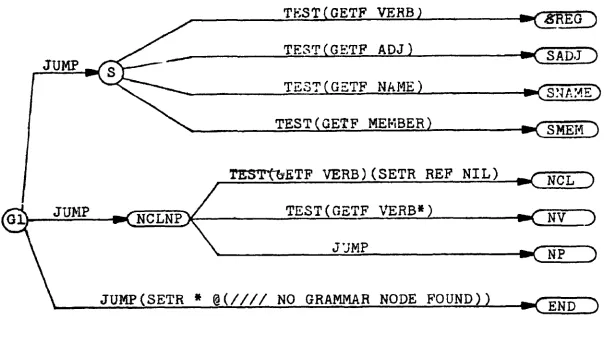
NCL
')
[image:8.795.71.677.100.437.2]JUMP(SETR
*
@ ( / / / / NO GRAMMAR NODE F O U N D ) ) M E N D )Figure 5 : The d e f a u l t e n t r y i n t o the grammar n e t w o ~ k .
essential differences are those required by the differences between
generating and p a r s f n g as discussed in the p r e v i o u s s e c t i o n .
(TEST t e s t [action]*(TO gnode))
If the test i s successful ( e v a l u a t e s t o non-NIL), t h e a c t i o n s
are performed and g e n e r a t i o n c o n t i n u e s a t gnode. I f t h e test
f a i l s , this edge i s n o t t a k e n . TEST- is t h e same as W o o d s T TST,
w h i l e TEST(GETF s a r c ) i s analogous t o Woods' C A T .
(JUMP action]*(^^ gnode))
Equivalent to (TEST T [actlon]*(TO gnode)). J U M P is simllar In use to Woods JUMP, b u t the d i f f e r e n c e from TEST T disappears
s i n c e no edge r'consumesl' a n y t h i n g .
(MEM wform (word*) t e s t [action]* (TO gnode) )
If t h e value of wform has a n o n - n u l l intersection w i t h t h e
list of words, the test is performed. If t h e test is also success-
f u l the a c t i o n s are performed and g e n e r a t i o n continues a t gnode.
MEM(GETR VC)(PASS)T G-EN N C L N P ( ~ E T F OBJECT)
(ADDTO DONE SNODEI*
(
SREG PRED)OEN NCLNP(GETF AGENT)(ADDTO DONE SNODE)*
Figure
6:
Generation of subject of sub ject-verb-ob ject sentence.is not taken. This is similar in form to W o o d s 1 MEM, but m a i n l y used for testing r e g i s t e r s .
(NOTMEM wform (word*) test [action]*(TO g n o d e ) )
This is e x a c t l y l i k e MEM except the intersection must be n u l l .
(TRANSR ([regnamel] regname2 regname3) t e s t [ a c t i o n ] * gnode) )
If regnamel i s present, t h e c o n t e n t s o f regname2 are added
on the end of regnamelo If regname is empty, t h e edge is n o t
3
taken. Otherwise, t h e f i r s t e l e m e n t i n regname 3 is removed and
p l a c e d in regname2 arid t h e t e s t i s performed. If t h e t e s t f a i l s , t h e edge i s n o t taken, b u t if i t s u c c e e d s , the a c t i o n s are performed
and g e n e r a t i o n continues at gnode. TRANSR i s used t o iterate t h r o u g h
several nodes all in t h e same semantic r e l a t i o n w i t h t h e main se-
m a n t i c node.
(GEN gnodel s f o r m [action]*regname [ a c t i o n ] * ( T O g n o d e * ) )
The f i r s t s e t of a c t i o n s a r e p e r f o r m e d and t h e generation i s
c a l l e d recursively w i t h the semantic node that is the v a l u e of sform
and a t t h e grammar node gnodel. If this g e n e r a t i o n is successful
( r e t u r n s non-NIL), the result i s placed i n t h e r e g i s t e r regname,
t h e second s e t o f a c t i o n s are performed and g e n e r a t i o n c o n t i n u e s
at gnode*. If the generation fails, the edge i s not t a k e n . This I s the same as W o o d s 1 PUSH but requires a semantic node t o be n p e c i -
(ADDON
*
@WILL @HAVE)(ADDON
*
QWQULD)UI@(ADDON
*
@ ( / / / C A N N O T COMPUTE TENSE))TEST( MENS (GETR REF) ( * @NOW) ) (ADDON PIS') \ a
MEM(GETR VC) (PASS)T(ADDON
*
@BEEN)CVPF
MEM(GETR VC)(PASS)T(ADDON
*
@BE)( t p ~
JUMP
@ F A S T ~ J U M P ( A D D 0 N
*
(LExLOOK PASTP(GETF VERB)))JuMP(ADDON
*
(LEXLOOK INF(GETF V E R B ) ) ) [image:10.791.73.722.97.680.2]CTIINF
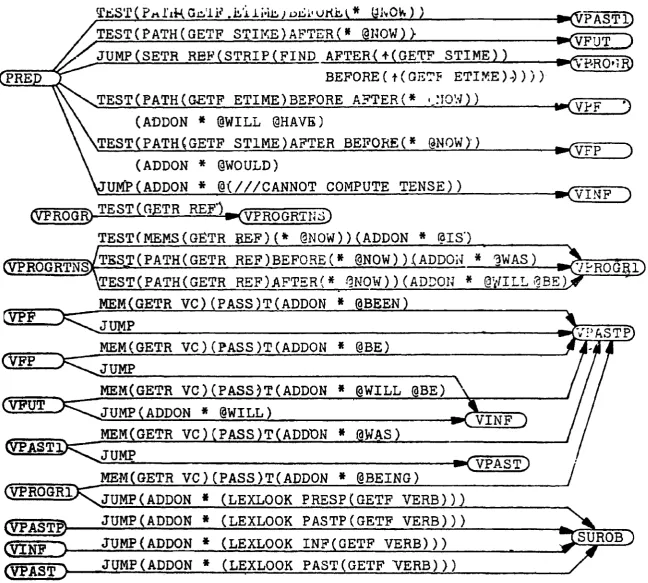
) -Figure 7: Tense g e n e r a t i o n network.
transfer is made to the node END. A t t h a t point, the c o n t e n t s o f the register named
*
are r e t u r n e d .(CONCAT form form*)
The forms are evaluated and c o n c a t e n a t e d i n the order g i v e n .
Performs a r o l e a n a l o g o u s to t h a t of W o o d s t BUILDQ.
(GETF sarc [sform])
Returns a list of a l l semantic nodes at the end of the seman-
Figure
8:
The tenses of "breakn which t h e network o f F i g u r e 7can generate.
o f sfomn. I f s f o r m i s missing, SNODE is assumed. Returns N I L i f
I
t h e r e a r e no s u c h s e m a n t i c nodes. It is similar in the semantic
Tense
past f u t i l ~ e
present prog~essive p a s t progressive
future progr6ssive
past
In
futurefuture
fq p a s tA c t i v e Passive
domain t o Woods' GETF i n t h e l e x i c a l domatn. broke
will break
is break-lng was b r e a k i n g
w i l l be b r e a k i n g '
w i l l
have b r o k e n would b r e a k(GETR regname)
Returns the contents o f register regname. I t i s essentially
t h e same as Woodst GETR.
was b r o k e n
w i l l be broken i s being broken
was being broken
will b e being broken w i l l have been broken
,
wquld b e broken.
(LEXLOOK l f e a t [sform])
Returns the value o f the lexical feature, l f e a t , o f the l e x i c a l
e n t r y a s s o c i a t e d w i t h the semantic node which i s t h e value o f sform.
If s f o r m is missing, SNODE i s assumed. If no lexical entry i s a s s o -
c i a t e d with t h e semantic node, NIL i s r e t u r n e d . LEXLOOK i s sirnilar
t o W o o d s 1 GETR and as a l s o i n the l e x i c a l domain.
(SETR regnarne f o r m )
The v a l u e of form is p l a c e d in t h e r e g i s t e r regname. It is the same as W o o d s 1 SETR.
(ADDTO Pegname form*)
E q u i v a l e n t t o (SETR regname ( C O N C A T (GETR regname) form*)).
Equivalent to (SETR regname (CONCAT form* (GETR regname))).
(MEW f o r m form)
Returns
TIf
t h e values of the t w o forms havea
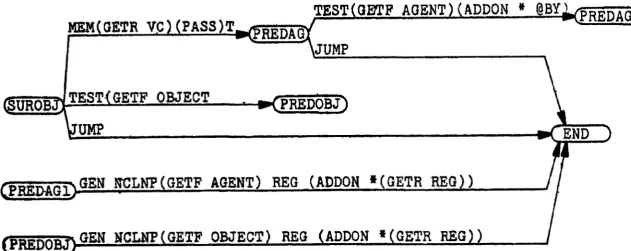
non-null intersec-TEST( GETF OBJECT ~ P R E D O B J )
UMP
cpmDAm
GEN
KLNP (GETF AGENT) REG (ADDON*
(GETR 'REG) ) [image:12.791.68.700.70.321.2]CpRGDOB3
GEN NCLNP (GETF OBJECT) REG (ADDON*
(GETR
REG ) )I
Figure
9:
Generating t h e s u r f a c e o b j e c t .(PATH s f o m l
sarc*
sformp)R e t u r n s T i f a p a t h descr3bedl By t h e sequence o f s e m a n t i c a r c s
e x i s t s between t h e v a l u e o f sfoml and s f o r m p . If %he s e q u e n c e
i s sarcl s a r c 2
...
sarc,, the p a t h d e s c r i b e d i s t h e same as t h a ti n d i c a t e d by s a r c l * sarc2*
...
sarcni. If
no such p a t h exists,NIL
i s r e t u r n e d . (Remember,*
means r e p e a t one o r more t i m e s . )Discussion o f
an
Example Orammar Network,The t o p level g e n e r a t o r f u n c t i o n , SNEG, Ls g i v e n
as
argumentsa semantic node and, o p t i o n a l l y , a grammar node. If t h e grammar
node i s n o t g i v e n , g e n e r a t i o n b e g i n s a t t h e node G 1 which should
be
a
small d i s c c i r n i n a t i o n n e t t o choose t h e p r e f e r r e d d e s c r i p t i o nfor t h e given s e m a n t i c node, T h i s p a r t of t h e example grammar is
shown i n Figure
5.
J n it w e see t h a t t h e preferred d e s c r i p t i o n f o r any s e m a n t i c node i sa
s e n t e n c e . If no s e n t e n c e can b e formeda noun phrase w i l l be t r i e d . Those a r e t h e only p r e s e n t l y avail-
able options.
Semadtic
nodes
w i t h a n o u t g o i n g VERB edge can be d e s c r i b e d bya
normal SUBJECT-VERB-OBJECT s e n t e n c e . ( F o r this example, weF i g u r e 1 0 : Generating t h e t h r e e " n o n - r e g u l a r " s e n t e n c e s .
which depends on w h e t h e r t h e s e n t e n c e i s t o b e i n a c t i v e o r p a s s i v e
v o i c e . A l t e r n a t i v e l y , t h e c h o i c e c o u l d be e x p r e s s e d i n terms o f
whether t h e a g e n t o r o b j e c t is t o be t h e t o p i c as s u g g e s t e d by Kay,
1975. Figure
6
shows Lhe network that generates t h e s u b j e c t . Ther e g i s t e r DONE h a l d s s e m a n t i c noaes f o r which s e n t e n c e s are b e i n g
g e n e r a t e d for l a t e r checking too p r e v e n t i n f i n i t e r e c u r s i o n . WPthout i t , node MOO23 o f F i g u r e I would be d e s c r i b e d a s , "A dog which k i s s e d
young sweet Lucy who was k i s s e d b y a dog w h i c h k i s s e d .
. . "
The i n i t l a 1 p a r t of t h e PRED network i s concerned with g e n e r a t - ing t h e tense. T h i s depends on t h e BEFORE/AFTER p a t h between t h e
s t a r t i n g and/or endinb time of t h e a c t i o n and t h e c u r r e n t v a l u e o f NOW, w h i c h , i s given by t h e form ( # @ N O W ) . Figure 7 shows t h e t e n s e
g e n e r a t i o n network. Figure 8 shows t h e t e n s e s t h i s n e t w o r k i s a b l e t o generate.
A f t e r the verb group is g e n e r a t e d , the surface o b j e c t i s gener-
a t e d b y d e s c r i b i n g e i t h e r t h e s e m m t i c a g e n t o r object. F i g u r e 9
skuws this part o f t h e network
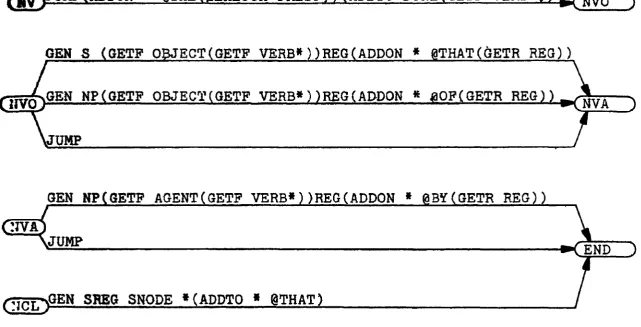
The o t h e r t h r e e kinds of s e n t e n c e s a r e lor d e s c r i b i n g nodes
r e p r e s e n t i n g : (1) t h a t something h a s a p a r t i c u l a r adjective a t t r i b u - able t o it, ( 2 ) that something has a name, ( 3 ) that something i s a
member of some c l a s s . The n e t w o r k s f o r t h e s e a r e shpwn i n F i g u r e
1 0 . Again, t h e DONE r e g i s t e r i s used t o p r e v e n t s u c h s e n t e n c e s as
GEN 3 (GETF OBJECT(GETF VERB*))REG(ADDON
*
@THAT(GETR R E G ) ) [image:14.791.73.715.107.434.2]cICL>GEN SREG SNODE *(ADDTO
*
@THAT)Figure 11: Generating norninalized verbs and sentences.
Pugure
5
showed three b a s i c kinds of noun phrases t h a t can b egenerated: the noun clause or nominalized sentence, s u c h as " t h a t a d o f ~ kissed sweet young Lucyt'; the nominalized verb, such as "the
kisslng of sweet young Lucy by a dogn; the r e g u l a r noun phrase.
The first two of these are generated by the network shown in Figure
11. Bere DONE is ased t o prevent, f o r example, " t h e kissing o f sweet
young Lucy who was kiesed by a dog by a dog."
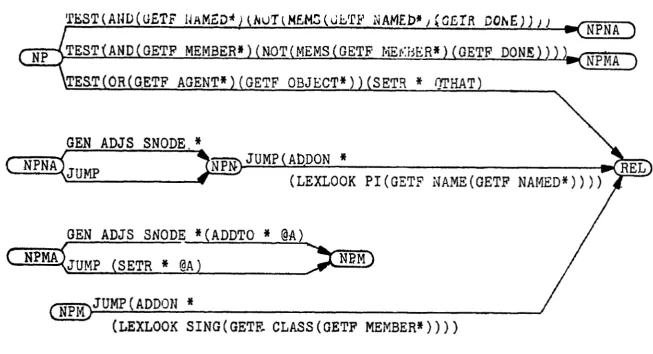
The regular noun phrase network begins w l t h a n o t h e r descrimina- t i o n net which has the following p r i o r i t i e s : use a name of t h e o b j e c t ;
use a class the o b J e c t belongs to; use something e l s e known about
*he obJect. A lower p r i o r i t y description will be used i f all h i g h e r p r i o r i t y descriptions
are
a l r e a d y in DONE. F i g u r e 12 shows t h e be-glnnlrrg
of the noun phrase network. A d j e c t i v e s are added before t h eGEN ADJS SNODE *(ADDTO
*
@A)
Cm&uMp (sETR
*
B A ) N E M ~ [image:15.791.65.719.84.438.2](LEXLOOK SING(GETE CLASS(GETF MEMBER*))))
Figure 12: The beginning o f the noun phrase network.
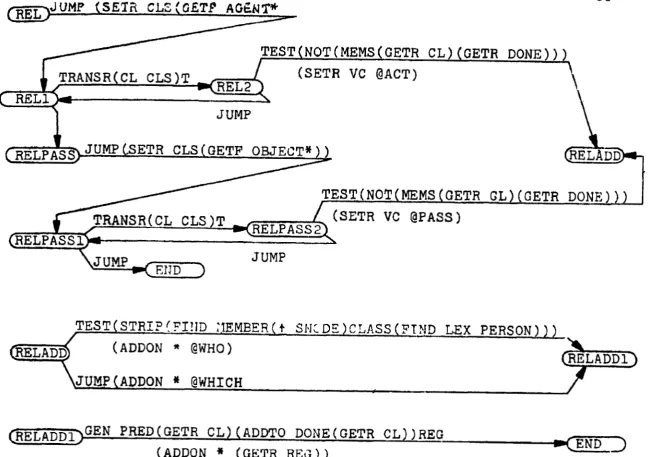
F i g u r e 13 shows the a d j e c t i v e s t r i n g g e n e r a t o r and F i g u r e 1 4 shows
t h e r e l a t i v e c l a u s e g e n e r a t o r . N o t i c e t h e u s e o f t h e TRANSR edges
f o r i t e r a t i n g . A t t h i s time, we have no t h e o r y f o r d e t e r m i n i n g t h e
number o r which a d j e c t i v e s and r e l a t i v e c l a u s e s t o g e n e r a t e , s o
a r b i t r a r i l y we generate a l l a d j e c t i v e s n o t a l r e a d y on DONE but o n l y
one relative c l a u s e . We have n o t y e t implemented any o r d e r i n g o f
a d j e c t i v e s . It i s merely f o r t u i t o u s t h a t "sweet young L u c y t is
eenerated rather than "young sweet Lucyft. The network i s w r i t t e n
s o t h a t a r e l a t i v e clause f o r which t h e noun i s t h e deep a g e n t is
preferred o v e r one i n which t h e noun i s t h e d e e p o b j e c t . Notice
t h a t t h i s choice determines t h e v o i c e of t h e embedded c l a u s e . The
fomn (STRIP(FIND MEMBER (1. SNODE) CLASS (FIND LEX P E R S O N ) ) ) is a
call t o a SNePS f u n c t i o n t h a t d e t e r m i n e s i f t h e o b j e c t i s known t o
be a person, i n ~ h i c h c a s e "WHO" i s used r a t h e r t h a n "'WHICHft. This
determination i s made by r e f e r r i n g t o t h e s e m a n t i c network r a t h e r
t h a n by i n c l u d i n g
a
HUMAN
f e a t u r e on t h e l e x i c a l e n t r i e s f o r LUCYnDJs7JUMP(SETR
ADJS(GETF
W E I C H * ) )Figure 13,: The network f o r g e n e r a t i n g a s t r i n g o f a d j e c t i v e s .
Notice that any i n f o r m a t i o n a b o u t t h e object b e i n g described
by a noun phrase may be used t o construct a relatfve clause even
i f that Lnfomnation derived from some main clause. A l s o , while
the g e n e r a t o r i s examining a s e m a n t i c node all t h e i n f o r m a t i o n a b o u t
that node i s reachable from i t and may be used d i r e c t l y . There
i s no need t o examine disjoint deep phrase markers t o d i s c o v e r w h e r e
they can b e attached t o each o t h e r s o that a complex sentence can be derived.
Future Work
Additional work needs ts be done i n d e v e l o p i n g t h e s t y l e of g e n e r a t i o n d e s c r i b e d i n this p a p e r . Experience with larger and
richer networks will lead to the f o l l o w i n g i s s u e s : d e s c r i b i n g a node
by a pronoun when that node has b e e n d e s c r i b e d e a r l i e r i n the string;
r e g u l a t i n g v e r b o s i t y and complexity, p o s s i b l y b y the u s e of r e s o u r c e
bound8 simulating the limitations of s h o r t t e r m memory* keeping
,
sub-ordinate clauses and descriptions to t h e point o f t h e c o n v e r s a t i o n
p o s s l b l y by the use of a TO-DO register h o l d i n g t h e n o d e s t h a t are
t o b e included in t h e string.
In t h l a paper, only i n d e f i n i t e descriptions were g e n e r a t e d . We
are working on a routine t h a t w l l l I d e n t i f y t h e p r o p e r subnet o f t h e
semantic network t o j u s t i f y a d e f i n i t e d e s c r i p t i o n . T h i s must b e
(SETR VC @ A C T )
JUMP
\JUMP F JUMP
[image:17.791.71.724.86.543.2]TEST(STRI? !*I!JD :.lEMEEFl(f SI\l; D E ) C L A S S (YT?ID E X PERSON) ) )
Figure 14: T h e r e l a t i v e clause g e n e r a t o r .
Acknowledgements
The a u t h o r i s indebted t o J o h n Lowrance, who lfiplemnted t h e
generator, Stan Kwasny, who implemented the p a r s e r , Bob Bechtel,
who worked b u t t h e t e m p o r a l r e p r e s e n t a t i o n , N i c h V i t u l l i and N i c k
Eastridge, who implemented versions of SNePS, and Jim McKew for general software ? u p p o r t . Computer service was p r o v i d e d by t h e
I U P U I Computing F a c i l i t i e s . T y p i n g and graphics were d ~ n s b y
Bruce, B.C. 2 9 7 2 , A m o d e l f o r temporal r e f e r e n c e s a n d its a p p l i - c a t i o n in a question answering program, A r t i f i c i a l Intelli-
gence
3 ,
1, 1-25.R a y ,
M.
1973.
The MIND system. N a t u r a l hanguage, Probesstng, R e R u s t i n (EB. ),
AlgorithmScs Press, Mew Y s r k , 155-188. 'Kay, M.
1975.
Syntactic processing and functional s e n t e n c e p e r -s p e c t i v e . Theoretical Issues in N a t u r a l Language Processfng
R, Sch& and B,L, maah-Webber ( E d s , ) , B o l t Beranek,& Newman, f n c . , Ombrfdge, Massachusetts.
S c h a n ~ , R.C.; @oldman, ; Rteger, C
,
111; a n d R i e s b e c k , C .1973.
NARGlE: memory, a n a l y s i s , responae g e n e r a t i o n , and i n f e r e n c e on English, Proc, T h i r d xntematf onal, J o i n t C o n f e r e n c e on A r t i . f i c i q l , ,Intelligence, S t a n f o r d University, August 20-23, 255-26T.
Shapiro, S , C . 1971a. The W I N 3 system: a data s t r u c t u r e f o r seman- tic Infornation p r o c e s s l r i g . R-837-PR. The Rand Corp
.
,
S a n t a Monica, C a l % f o r n l a .Shapirs. S.C. l g r l b . A n e t structure f o r semantic i n f o r m a t i o n
- storage, deduetlon and r e t r i e v a l . 2nd International J o i n t - Con- - .
-Shapiro, S . C.
1975
* bAn 2 ntroduction t o SNePS.
Technical R e p o r tNo. 31, CumpuLer Science Department, I n d i a n a U n i v e r s i t y , Bloom- f ngt on,
SS@@ons, R , F . 1973, Semantic networks: their cornputatSon and u s e
for understanding English s e n t e n c e s . c o m p u t e r Models of Thohght
R.C* Schank and K.M. Colby (Eds.), W.B. Freeman
Francisco, 63-113.
Sirnone,
R.B.,
and Slocurn, 3 . 1972. G e n e r a t i n g English discoursefrom
rralnantic net6 +Corn,.
ACM 15, 10, 891-905.Woods, W.A+
1973.
A n exgerlmental p a r s i n g s y s t e m for transitionne