Smart Greenhouse using Embedded System
Ambrish Patil1, Sunil Jagannath2
1
PG Student, VLSI & ES, Sharnbasva University, Kalaburagi, Karnataka
2
Asst. Professor, ECE, Sharnbasva University, Kalaburagi, Karnataka
Abstract: Greenhouses are controlled area environment to grow plants. In order to achieve maximum plant growth, the continuous monitoring and controlling of environmental parameters such as temperature, humidity, soil moisture, light intensity, soil pH etc. are necessary for a greenhouse system. The main aim of this project is to design a simple, low cost, Arduino based system to monitor the values of environmental parameters and that are continuously updated and controlled in order to achieve optimum plant growth and yield. 4 in 1 sensor module is designed which consist of temperature sensor, humidity sensor, light intensity sensor and pH sensor to measure respective parameters. All environmental parameters are sent to user mobile via internet (IOT). A mobile app is designed to get plant data from any distance around the worlds. An alert message is displayed on the mobile app (LCD display as well) user when the sensor value exceeds a defined level. All farmers can control their greenhouses from any place by knowing the status of their greenhouse parameters at any time and they can control actuators (cooling fan, exhaust fan, water pump) to adjust environmental parameters. In addition colour sensors are used to get the RGB values of soil. With RGB values it is possible to predict the health of soil, i.e. we can analyze the nutrients present in the soil. If it is observed that the RGB values of soil are mismatching with the standard values, suitable mixtures can be added to compensate for the same. Ardiuno Mega controller is used as a controller device is programmed in such a way that it continuously monitors the data from the sensors, displays data parameters on LCD display, and transfers data to mobile app via IOT module. And also whenever the controller observes that the parameters are getting exceed of threshold values, it sends signal to the controlled devices (e.g. Fan) to turn it ON, at the same time alert message will be displayed on LCD display and mobile app.
Keywords: Smart greenhouse, agriculture, environmental parameters, automation.
I. INTRODUCTION
A greenhouse is a structure with walls and roof made chiefly of transparent material, such as glass, in which plants requiring regulated climatic conditions grown. These structures range in size from small sheds to industrial-sized buildings. The greenhouse industry is the fastest growing sector worldwide. The growth of crop in greenhouse depends on temperature, gas, light intensity and other parameters in greenhouse. So it is important to real-timely and properly measure and adjust the temperature, gas, light intensity and other parameters in the greenhouse. With the continued expansion of production scale, the disadvantages of traditional wire monitoring system are more and more prominent, such as complicated arrangement, difficult maintenance and so on. Then the monitoring system is developed, which based on wireless communication technology, does not need cables, adds or reduces configuration at random, possess simple system construction. Moreover, it is characterized by its low power consumption. Therefore, it proves to be simple and of practical significance.
Using IOT it is possible to control and monitor systems from a long Distance. The primary aim of this paper is to propose the concept of Development of a Low-Cost IOT Based monitoring and Control system for Greenhouse using the combination of an ARM Controller. Greenhouse environment parameters monitoring system based on wireless communication technology has been developed to control remotely, which realizes the measurement and control of temperature, gas, light intensity and the other parameters.
II. FUNCTIONAL BLOCK DIAGRAM AND DECRIPTION
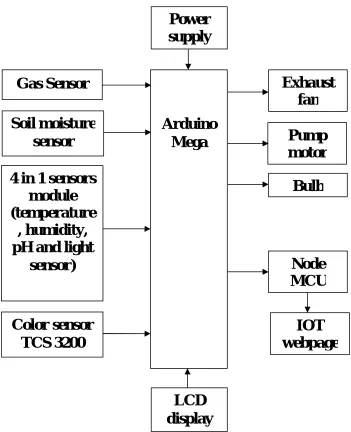
The Functional Block diagram of the entire system is as shown in the Figure 1. The project consists of arduino microcontroller, 4 in 1 sensor module (temperature, humidity, light intensity and pH), gas sensor, moisture sensor and color sensors. All these sensors are connected to arduino which is main processing unit of the system. The sensors sense different conditions and provide data to microcontroller for processing. IOT is established to transfer those data to user over distance. It also uses a LCD display to display the data obtained from the sensors. System architecture is composed of ARM based system board.
Fig 1: Functional block diagram
A. Arduino Microcontroller
The Arduino Mega 2560 is a microcontroller board based on the ATmega2560. It has 54 digital input/output pins (of which 15 can
be used as PWM outputs), 16 analog inputs, 4 UARTs (hardware serial ports), a 16 MHz crystal oscillator, a USB connection, a power jack, an ICSP header, and a reset button. It contains everything needed to support the microcontroller; simply connect it to a computer with a USB cable or power it with a AC-to-DC adapter or battery to get started. The Mega 2560 board is compatible with most shields designed for the Uno and the former boards Duemilanove or Diecimila.
B. Moisture Sensor
Finally, your plants can speak to you! Just don’t be upset when it’s only to let you know when they need something. With this module, you can tell when your plants need watering by how moist the soil is in your pot, garden, or yard. The two probes on the sensor act as variable resistors. Water is conductive, so the more water in the soil, the better the conductivity and the lower the resistance with a higher SIG out.
Use it in a home automated watering system, hook it up to IoT, or just use it to find out when your plant needs a little love. Installing this sensor and its PCB will have you on your way to growing a green thumb!
Arduino
Mega
Gas Sensor
Power
supply
LCD
display
Exhaust
fan
Soil moisture
sensor
4 in 1 sensors
module
(temperature
, humidity,
pH and light
sensor)
Pump
motor
Bulb
Node
MCU
IOT
webpage
Color sensor
C. Gas Sensor
MQ135 gas sensor module for air quality having digital as well as analog output. Sensitive material of MQ135 gas sensor is SnO2, which with lower conductivity in clean air. When the target combustible gas exist, the sensors conductivity is more higher along with the gas concentration rising. MQ135 gas sensor has high sensitivity to Ammonia, Sulphide and Benze steam, also sensitive to smoke and other harmful gases. It is with low cost and suitable for different application.
Used for family, Surrounding environment noxious gas detection device, Apply to ammonia, aromatics, sulfur, benzene vapor, and other harmful gases/smoke, gas detection, tested concentration range: 10 to 1000 ppm.
D. 4 in 1 Sensor Module
A 4 in 1 sensor module that consist of four sensors i.e. temperature, humidity, light intensity and pH sensors, that can measure temperature, humidity, light intensity of environment and pH of soil. As it consists of 4 sensors in single module it helps in reducing the hardware size and complexity. Reading accuracy is also improved.
Acidity or alkalinity in a plant’s soil is measured by pH. The pH scale goes from 1 to 14 -- a pH of 1 is highly acidic and a pH of 14 is highly alkaline. The soil's pH varies depending on geographical location. Many plants, including common garden and houseplants, prefer a neutral pH level of around 7.
E. Colour Sensors
The TCS230 senses colour light with the help of an 8 x 8 array of photodiodes. Then using a Current-to-Frequency Converter the readings from the photodiodes are converted into a square wave with a frequency directly proportional to the light intensity. Finally, using the Arduino Board we can read the square wave output and get the results for the colour.
In the design the colour sensors are utilized to obtain RGB values of soil. An RGB value of soil indicates the nutrients present in the soil. Based upon the RGB values received we can decide whether to add the missing nutrients to soil.
F. ESP8266 WIFI Module
ESP8266 WiFi Module is a node MCU that acts as a medium between arduino and mobile app. It employs a 32-bit RISC CPU based on the Tensilica Xtensa L106 running at 80 MHz (or over clocked to 160 MHz). It has a 64 KB boot ROM, 64 KB instruction RAM and 96 KB data RAM. External flash memory can be accessed through SPI.
[image:3.612.133.490.454.712.2]ESP8266 module is low cost standalone wireless transceiver that can be used for end-point IoT developments. To communicate with the ESP8266 module, microcontroller needs to use set of AT commands. Microcontroller communicates with ESP8266-01 module using UART having specified Baud rate.
III.SOFTWARE IMPLEMENTATION
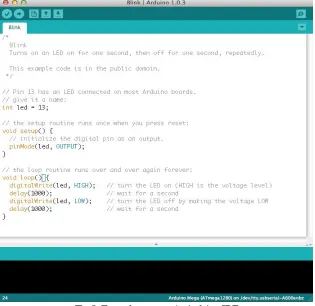
Arduino is an open-source platform used for building electronics projects. Arduino consists of both a physical programmable circuit board (often referred to as a microcontroller) and a piece of software, or IDE (Integrated Development Environment) that runs on your computer, used to write and upload computer code to the physical board.
[image:4.612.155.470.198.504.2]The Arduino platform has become quite popular with people just starting out with electronics, and for good reason. Unlike most previous programmable circuit boards, the Arduino does not need a separate piece of hardware (called a programmer) in order to load new code onto the board – you can simply use a USB cable. Additionally, the Arduino IDE uses a simplified version of C++, making it easier to learn to program. Finally, Arduino provides a standard form factor that breaks out the functions of the micro-controller into a more accessible package.
Fig 3: Example program in Arduino IDE
IV.RESULTS
The architecture is implemented with arduino programming using embedded C. In this paper we allow the users to set the conditions appropriate to the crop is growing. This will be done via IOT module. The more accurate a sensor is, better it will perform. The unit will monitor the conditions of various parameter considerations and take appropriate action.
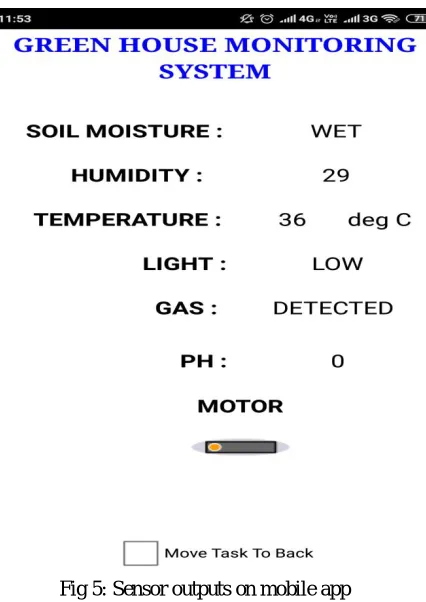
[image:4.612.119.506.579.710.2]Fig 5: Sensor outputs on mobile app
The sensor outputs are monitored by the monitoring unit and are displayed in the LCD display and mobile app, which are shown in the Figure 4 & 5 respectively. Mobile app is developed using PHP language. Sensor data are sent to mobile app over internet. For example if light intensity is detected low, bulb is turned on. And at the same time data will be updated on mobile app. In the design motor button is created in app, so that when ever moisture is not found in soil, motor can be turned on by pressing button in mobile app.
V. COCNCLUSION AND FUTURE WORK
The monitoring and control system for environment parameters in greenhouse based on global system for mobile communications technology is developed and initially experimented. The experimental results indicate that the system has some features as follows:
A. It can be used in agriculture vegetable greenhouse to monitor and control the environmental parameters to overcome the disadvantage of traditional measuring and controlling.
B. It can be kept long distance, real time monitoring for parameter of greenhouse and the information can be obtained of greenhouse at any time.
C. It has the advantages of IOT technology , not needing cables, low power consumption, cheap cost, good robustness, flexible extension, convenient installing over the traditional measurement and control system.
Future enhancement is part of all products life cycle. This lists out some missing things in the current product. It also indicates adding more features to the existing product. Following are the future enhancements which could be implemented.
1) Colors sensors can also be used to monitor leaves health.
2) It is challenging but possible to combine several sensors & build with only one pair of probes, by doing which reading accuracy can be further improved, fluctuations reduced.
VI.ACKNOWLEDGMENT
I am thankful to all the faculties of ECE department, Sharnbasva University, Kalaburagi, for their encouragement and support throughout the work.
REFERENCES
[1] Jian Song, “Greenhouse Monitoring and Control System Based on Zigbee Wireless Senor Network" ICECE '10 Proceedings of the 2010 International Conference on Electrical and Control Engineering IEEE Computer Society Washington, DC, pp.2785-2788 USA ©2010.
[2] Nagesh Kumar D.N, JIT Bangalore, “ARM Based Remote Monitoring and Control System for Environmental Parameters in Greenhouse “©2015 IEEE. [3] Mr Pravin D Auti, ME, Amrutvahini college of Engineering, “Green House Remote Monitoring System Using Embedded Controlled Sensor Network”
International Journal of Emerging Trends in Science and Technology - 2016
[4] Ms.P.Lavanya , M.Tech, Bharat Engineering college, Andra Pradesh, “ARM7 Based Monitoring and Control System for Environmental Parameters in Greenhouse” International Journal of Advanced Research in Electronics and Communication Engineering – 2017
[5] Vimal P V, PG Student, NMAMIT, Nitte Karnataka, India, “IOT Based Greenhouse Environment Monitoring and Controlling System using Arduino Platform” 2017 International Conference on Intelligent Computing,Instrumentation and Control Technologies (ICICICT), ©2017 IEEE
[6] Muhammad Ali Mazidi and Janice Gillespie Mazidi and Rollin D. McKinlay, 'The 8051 Microcontroller and Embedded Systems - using Assembly and C", Pearson, 2006.
[7] Raj Kamal, "Embedded Systems Architecture, Programming and Design", TMH Publication, 8'" Edition, 2006.
[8] Kittas, C. T Boulard and G. Papadakis, Natural ventilation of a greenhouse with ridge and side openings: sensitivity to temperature and wind effects. Transactions of ASAE, 40(2): 415-425, 1997.
[9] Dr. K.V.K.K Prasad, "Embedded Real Time Systems", Dreamtech Press Publication, 2nd Edition, 2005.
[10] Daniel W Lewis, "Fundamentals of Embedded Software where C and Assembly meet", Publisher Prentice Hall Inc, ISBN 0-13-061589-7, 2002.
[11] Wei. Q, Jin. N, Lou X, Ma. R, Xu. J, “Software design for water environment remote monitoring system based on mobile devices”, Applied Mechanics and Materials, pp. 2027-2032, 201.