Functional Centering
Grounding Referential Coherence
in Information Structure
M i c h a e l S t r u b e *
University of Pennsylvania
U d o H a h n t Freiburg University
Considering empirical evidence from a free-word-order language (German) we propose a revi- sion of the principles guiding the ordering of discourse entities in the forward-looking center list within the centering model. We claim that grammatical role criteria should be replaced by criteria that reflect the functional information structure of the utterances. These new criteria are based on the distinction between hearer-old and hearer-new discourse entities. We demonstrate that such a functional model of centering can be successfully applied to the analysis of several forms of referential text phenomena, viz. pronominal, nominal, and functional anaphora. Our method- ological and empirical claims are substantiated by two evaluation studies. In the first one, we compare success rates for the resolution of pronominal anaphora that result from a grammatical- role-driven centering algorithm and from a functional centering algorithm. The second study deals with a new cost-based evaluation methodology for the assessment of centering data, one which can be directly derived from and justified by the cognitive load premises of the centering model.
1. Introduction
The problem of establishing referential coherence in discourse can be rephrased as the problem of determining the proper antecedent of a given anaphoric expression in the current or the preceding utterance(s) and the rendering of both as referentially iden- tical (coreferential). This task can be approached in a very principled w a y by stating general constraints on the grammatical compatibility of the expressions involved (e.g., Haddock 1987; Alshawi 1992). Linguists have devoted a lot of effort to identifying conclusive syntactic and semantic criteria to reach this goal, e.g., for intrasentential anaphora within the binding theory part of the theory of Government and Binding (Chomsky 1981), or for intersentential anaphora within the context of the Discourse Representation Theory (Kamp and Reyle 1993).
Unfortunately, these frameworks fail to uniquely determine anaphoric antecedents in a variety of cases. As a consequence, referentially ambiguous interpretations have to be dealt with in those cases in which several alternatives fulfill all the required syntactic and semantic constraints. It seems that syntactic and semantic criteria con- stitute only necessary but by no means sufficient conditions for identifying the valid antecedent among several possible candidates. Hence, one is left with a preferential choice problem that falls outside of the scope of those strict grammaticality constraints relating to the level of syntax or semantics only. Its solution requires considering pat-
• Institute for Research in Cognitive Science, 3401 Walnut Street, Suite 400A, Philadelphia, PA 19104, USA t Computational Linguistics Group, Text Understanding Lab, Werthmannplatz 1, 79085 Freiburg,
Computational Linguistics Volume 25, Number 3
terns of language use and, thus, introduces the level of discourse context and further pragmatic factors as a complementary description level.
Computational linguists have recognized the need to account for referential ambi- guities in discourse and have developed various theories centered around the notion of discourse focus (Grosz 1977; Sidner 1983). In a seminal paper, Grosz and Sidner (1986) wrapped up the results of their research and formulated a model in which three levels of discourse coherence are distinguished--attention, intention, and discourse segment structure. While this paper gives a comprehensive picture of a complex, yet not ex- plicitly spelled-out theory of discourse coherence, the centering model (Grosz, Joshi, and Weinstein, 1983, 1995) marked a major step in clarifying the relationship between attentional states and (local) discourse segment structure. More precisely, the centering model accounts for the interactions between local coherence and preferential choices of referring expressions. It relates differences in coherence (in part) to varying demands on inferences as required by different types of referring expressions, given a particular attentional state of the hearer in a discourse setting (Grosz, Joshi, and Weinstein 1995, 204-205). The claim is made then that the lower the inference load put on the hearer, the more coherent the underlying discourse appears.
The centering model as formulated by Grosz, Joshi, and Weinstein (1995) refines the structure of "centers" of discourse, which are conceived as the representational device for the attentional state at the local level of discourse. They distinguish two basic types of centers, which can be assigned to each utterance
Ui--a
single backward- looking center,Cb(Ui),
and a partially ordered set of discourse entities, the forward- looking centers,Cf(Ui).
The ordering onCf
is relevant for determining the Cb. It can be viewed as a salience ranking that reflects the assumption that the higher the ranking of a discourse entity inCf,
the more likely it will be mentioned again in the immediately following utterance. Thus, given an adequate ordering of the discourse entities inCf,
the costs of computations necessary to establish local coherence are minimized.Given that the ordering on the
Cf
list is crucial for determining theCb,
it is no surprise that there has been much discussion among researchers about the ranking criteria appropriate for different languages. In fact, Walker, Iida, and Cote (1994) hy- pothesize that theCf
ranking criteria are the only language-dependent factors within the centering model. Though evidence for m a n y additional criteria for theCf
ranking have been brought forward in the literature, to some extent consensus has emerged that grammatical roles play a major role in making ranking decisions (e.g., whether the referential expression appears as the grammatical subject, direct object, or indirect object of an utterance). Our own work on the centering model 1 (Strube and H a h n 1996; Hahn and Strube 1996) brings in evidence from German, a free-word-order language in which grammatical role information is far less predictive of the organization of centers than for fixed-word-order languages such as English. In establishing proper referential relations, we found the functional information structure of the utterances to be much more relevant. By this we mean indicators of whether or not a discourse entity in the current utterance refers to another discourse entity already introduced by previous utterances in the discourse. Borrowing terminology from Prince (1981, 1992), an entity that does refer to another discourse entity already introduced is called discourse-old or hearer-old, while an entity that does not refer to another discourse entity is called discourse-new or hearer-new.Strube and Hahn Functional Centering
Based on evidence from empirical studies in which we considered German as well as English texts from different domains and genres, we make three contributions to the centering approach. The first, the introduction of functional notions of information structure into the centering model, is purely methodological in nature and concerns the centering approach as a theory of local coherence. The second deals with an empirical issue, in that we demonstrate how a functional model of centering can be success- fully applied to the analysis of different forms of anaphoric text phenomena, namely pronominal, nominal, and functional anaphora. Finally, we propose a new evaluation methodology for centering data in terms of a cost-based evaluation approach that can be directly derived from and justified by the cognitive load premises of the centering model.
At the methodological level, we develop arguments that (at least for some free- word-order languages) grammatical role criteria should be replaced by functional role criteria, since they seem to more adequately account for the ordering of discourse entities in the Cf list. In Section 4, we elaborate on particular information structure criteria underlying such a functional center ordering. We also make a second, more general methodological claim for which we have gathered some preliminary, though still not conclusive evidence. Based on a reevaluation of centering analyses of some challenging language data that can be found in the literature on centering, we will argue that exchanging grammatical for functional criteria might also be a reason- able strategy for fixed-word-order languages. What makes this proposal so attractive is the obvious gain in the generality of the model--given a functional framework, fixed- and free-word-order languages might be accounted for by the same ordering principles.
The second major contribution of this paper is related to the unified treatment of different text coherence phenomena. It consists of an equally balanced treatment of intersentential (pro)nominal anaphora and inferables (also called functional, bridging, or partial anaphora). The latter phenomenon (cf. the examples in the next section and the in-depth treatment in Hahn, Markert, and Strube [1996]) is usually only sketchily dealt with in the centering literature, e.g., by asserting that the entity in question "is re- alized but not directly realized" (Grosz, Joshi, and Weinstein 1995, 217). Furthermore, the distinction between these two kinds of realization is not part of the centering mechanisms but delegated to the underlying semantic theory. We will develop argu- ments for how to discern inferable discourse entities and relate them properly to their antecedent at the center level. The ordering constraints we supply account for all of the types of anaphora mentioned above, including (pro)nominal anaphora (Strube and Hahn 1995; Hahn and Strube 1996). This claim will be validated by a substantial b o d y of empirical data in Section 5.
Our third contribution relates to the w a y the results of centering-based anaphora resolution are usually evaluated. Basically, we argue that rather than counting reso- lution rates for anaphora or comparing isolated transition types holding among head positions in the center lists--preferred transition types stand for a high degree of local coherence, while less preferred ones signal that the underlying discourse might lack coherence--one should consider adjacent transition pairs and annotate such pairs with the processing costs they incur. This way, we define a dual theory-internal metric of inference load b y distinguishing between "cheap" and "expensive" transition types. Based on this distinction, some transition types receiving bad marks in isolation are ranked "cheap" when they occur in the appropriate context, and vice versa.
Computational Linguistics Volume 25, Number 3
troduction into what we call the "grammatical" centering model (actually, a recap of Grosz, Joshi, and Weinstein [1995]) in Section 3, we turn in Section 4 to our approach, the functional model of centering. In Section 5, we present the methodological frame- work and the empirical data from two evaluation studies we carried out. In Section 6, we relate our work to alternative approaches dealing with local text coherence. In Section 7, we discuss some remaining unsolved problems.
2. Types of Anaphoric Expressions
In this paper, we consider anaphora as a textual phenomenon only, and deal with anaphoric relations that hold between adjacent utterances (intersentential anaphora). 2 Text phenomena are a challenging issue for the design of a text parser for any text- understanding system, since recognition facilities that are imperfect or altogether lack- ing result in referentially incomplete, invalid, or incohesive text knowledge represen- tation structures (Hahn, Romacker, and Schulz 1999). Incomplete knowledge structures emerge when references to already established discourse entities are simply not rec- ognized, as in the case of conceptually neutral pronominal anaphora (e.g., er, 'it,' in example (ld) co-specifying with 316LT, a particular notebook introduced in exam- ple (la)). Invalid knowledge structures emerge when each entity that has a different denotation at the text surface is also treated as a formally distinct item at the level of text knowledge representation, although they all refer literally to the same entity. These false referential descriptions result from unresolved nominal anaphora (e.g., Rechner, 'computer' in example (lc) co-specifies with 316LT in (la)). Finally, incohesive or artificially fragmented knowledge structures emerge when entities that are linked by various conceptual relations at the knowledge level occur in a text such that an implicit reference to these relations can be made without the need for explicit signal- ing at the text surface level. Corresponding referential relations cannot be established at the text representation level, since these inferables remain unsolved (such as the relation between Akkus, 'rechargeable battery cell', and 316LT in examples (lb) and (la), respectively. 3 The linking conceptual relation between these two discourse ele- ments has to be inferred in order to make it explicit at the level of text knowledge representation structures (for an early statement of this idea in terms of "bridging" inferences, see Clark [1975]).
Note an interesting asymmetric relationship between these three types of anaphora. Pronominal anaphora are constrained by morphosyntactic and grammatical agreement criteria between the pronoun and the antecedent, 4 and no conceptual constraints ap- ply. Nominal anaphora are only constrained by number compatibility between the anaphoric expression and the antecedent, while at the conceptual level the anaphoric expression is related to its antecedent in terms of a conceptual generalization relation. Finally, no grammatical constraints apply to inferables, while conceptual constraints typically require a nongeneralization relation (e.g., part-whole) to hold between the inferable and its antecedent. Of course, contextual conceptual constraints are intro- duced for both nominal and pronominal anaphora by sortal requirements set up, e.g., by the case roles of the main verb.
2 We have also considered the role of anaphora within sentences. The d-binding criterion we have developed for resolving intrasentential anaphora is based on dependency grammar notions described in more detail in Strube and Hahn (1995).
3 Note that Reserve-Batteriepack in Example (la) and Akkus in (lb) denote conceptually different discourse entities that cannot be coindexed.
Strube and Hahn Functional Centering
Let us illustrate these different types of p h e n o m e n a b y considering the following text fragment:
Example 1
a. Ein Reserve-Batteriepack versorgt d e n 316LT ca. 2 M i n u t e n mit Strom. [A reserve battery pack]nom - supplies - the [316LT]acc - for
approximately 2 minutes - w i t h power.
The 3 1 6 L T is supplied w i t h p o w e r b y a reserve battery pack for approximately 2 minutes.
b. Der Status des A k k u s w i r d d e m A n w e n d e r angezeigt.
[The status - [of the rechargeable battery cell]gen]nom -- is -- [to the user]aat - signalled.
The status of the rechargeable battery cell is signalled to the user.
c. Ca. 30 M i n u t e n vor der Entleerung beginnt der Rechner 5 Sekunden z u piepen.
Approximately 30 minutes - before discharge - starts - [the computer]nmam c - for 5 seconds - to beep.
Approximately 30 minutes before discharge the computer beeps for 5 seconds.
d. 5 M i n u t e n bevor er sich ausschaltet, f/ingt die Low-Battery-LED an zu blinken.
5 minutes - before - [it]n m~sc - itself - turns off - begins - [the l o w - b a t t e r y - L E D ] , o m - to flash.
5 minutes before it turns off, the low-battery-LED begins to flash.
C o m m o n to all the varieties of anaphora we discuss is the search for the proper antecedent in previous utterances, the correct determination of which is considered to be the task of the centering mechanism. The kinds of anaphora we treat can be distin- guished, however, in terms of the criteria being evaluated for referentiality. In the case of inferables, the missing conceptual link m u s t be inferred in order to establish local coherence between the utterances involved. In the surface form of utterance (lb) the in- formation that A k k u s , 'rechargeable battery cell', links u p w i t h 3 1 6 L T is missing, while, d u e to obvious conceptual constraints, it cannot link up w i t h Reserve-Batteriepack, for example. The u n d e r l y i n g relation can only be m a d e explicit if conceptual k n o w l e d g e about the domain, viz. the relation PART-OF between the concepts RECHARGEBAT- TERYCELL a n d 316LT, is available (see Hahn, Markert, a n d Strube [1996] for a detailed treatment of the resolution of inferables). In the case of nominal anaphors, a conceptual specialization relation has to be determined between the specific antecedent a n d the more general anaphoric expression, for example, between 3 1 6 L T a n d Rechner, 'com- puter', in (la) a n d (lc), respectively. Finally, the resolution of p r o n o m i n a l anaphors need not take conceptual constraints into account at all, b u t is restricted to gram- matical constraints, as illustrated b y the masculine gender of Rechner, 'computermasc', (co-specifying w i t h 316LTmasc) a n d er 'it'masc, in (lc) a n d (ld), respectively.
Computational Linguistics Volume 25, Number 3
Table 1
Cf
ranking by grammatical roles.subject > object(s) > other(s)
Table 2
Transition types.
Cb(U~) = Cb(U~_ 0
Cb(Ui) # Cb(U~_ 0
Cb(Ui) = Cp(Ui) C O N T I N U E
Cb(U~) :/: Cp(Ui)
R E T A I NS H I F T
3. The Centering M o d e l
The centering model (Grosz, Joshi, and Weinstein 1983, 1995) is intended to describe the relationship between local coherence and the use of referring expressions. The model requires two constructs, a single backward-looking center and a list of forward- looking centers, as well as a few rules and constraints that govern the interpretation of centers. It is assumed that discourses are composed of constituent segments (Grosz and Sidner 1986), each of which consists of a sequence of utterances. Each utterance
Ui
in a given discourse segment
DS
is assigned a list of forward-looking centers,Cf(DS,
Ui),
and a unique backward-looking center,Cb(DS, Ui). The
forward-looking centersof
Ui
depend only on the discourse entities that constitute the ith utterance; previous utterances provide no constraints onCf(DS, Ui).
A ranking imposed on the elements of theCf
reflects the assumption that the most highly ranked element ofCf(DS, Ui),
the preferred center
Cp(DS, Ui),
will most likely be theCb(DS, Ui+l).
The most highly ranked element ofCf(DS, Ui)
that is finally realized inUi+l
(i.e., is associated with an expression that has a valid interpretation in the underlying semantic representation) is the actualCb(DS, Ui+I).
Since in this paper we will not discuss the topics of global coherence and discourse macro segmentation (for recent treatments of these issues, see Hahn and Strube [1997] and Walker [1998]), we assume a priori that any centering data structure is assigned an utterance in a given discourse segment and simplify the notation of centers toCb(Ui)
andCf(Ui).
Grosz, Joshi, and Weinstein (1995) state that the items in the
Cf
list have to be ranked according to a number of factors including grammatical role, text position, and lexical semantics. As far as their discussion of concrete English discourse phenomena is concerned, they nevertheless restrict their ranking criteria to those solely based on grammatical roles, which we repeat in Table 1.The centering model, in addition, defines transition relations across pairs of adja- cent utterances (Table 2). These transitions differ from each other according to whether backward-looking centers of successive utterances are identical or not, and, if they are identical, whether they match the most highly ranked element of the current forward- looking center list, the
Cp(Ui),
or not.Strube and Hahn Functional Centering
clauses
tensed
embedded same-level
inaccessible accessible, less salient
I
I
direct speech non-report complements
[image:7.468.40.375.60.179.2]reported speech relative clauses
Figure 1
Kameyama's intrasentential centering categorization.
untensed
Rule 1
If any element of
CJ:(Ui)
is realized by a p r o n o u n inUi+l,
then theCb(Ui+l)
m u s t be realized by a p r o n o u n also.Rule 2
Sequences of continuation are to be preferred over sequences of retaining; and se- quences of retaining are to be preferred over sequences of shifting.
Rule 1 states that no element in an utterance can be realized by a p r o n o u n unless the backward-looking center is realized by a pronoun, too. This rule is intended to capture one function of the use of pronominal a n a p h o r s - - a p r o n o u n in the
Cb
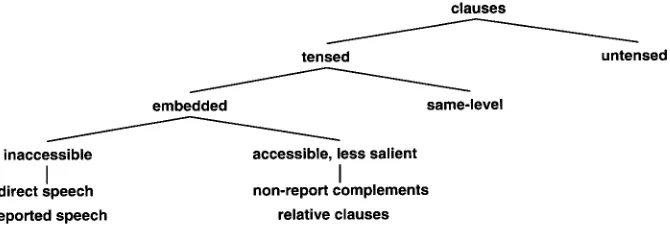
signals to the hearer that the speaker is continuing to refer to the same discourse. Rule 2 should reflect the intuition that a pair of utterances that have the same theme is more coherent than another pair of utterances with more than one theme. The theory claims, above all, that to the extent that a discourse adheres to these rules and constraints, its local coherence will increase and the inference load placed u p o n the hearer will decrease.The basic unit for which the centering data structures are generated is the utter- ance U. Since Grosz, Joshi, and Weinstein (1995) and Brennan, Friedman, and Pollard (1987) do not give a reasonable definition of utterance, we follow Kameyama's (1998) method for dividing a sentence into several center-updating units (Figure 1). Her in- trasentential centering mechanisms operate at the clause level. While tensed clauses are defined as utterances on their own, untensed clauses are processed with the main clause so that the
Cf
list of the main clause contains the elements of the untensed e m b e d d e d clause. Kameyama further distinguishes, for tensed clauses, between se- quential and hierarchical centering. Except for direct and reported speech (embed- ded and inaccessible to the superordinate level), nonreport complements, and relative clauses (both embedded but accessible to the superordinate level; less salient than the higher levels), all other types of tensed clauses build a chain of utterances at the same level.3.1 A Centering Algorithm for Anaphora Resolution
Though the centering model was not originally intended to be used as a blueprint for anaphora resolution, 5 several applications tackling this problem have made use of
Computational Linguistics Volume 25, Number 3
Table 3
Basic centering algorithm.
1. If a pronoun in Ui is encountered, test the elements of the Cf(Ui-1) in the given order until an element under scrutiny satisfies all the required morphosyntactic, binding, and sortal criteria. This element is chosen as the antecedent of the pronoun.
2. When utterance Ui is completely read, compute Cb(Ui) and generate Cf(Ui); rank the elements according to agreed-upon preference criteria (such as the ones from Table 1).
the model, nevertheless. One interpretation is d u e to Brennan, Friedman, a n d Pollard (1987) w h o utilize Rule 2 for c o m p u t i n g preferences for a n t e c e d e n t s of p r o n o u n s (see Section 3.2). In this section, w e will specify a simple algorithm that uses the Cf list directly for p r o v i d i n g preferences for the a n t e c e d e n t s of p r o n o u n s .
The algorithm (which w e will refer to as the basic algorithm; Table 3) consists of t w o steps, w h i c h are triggered independently.
We m a y illustrate this a l g o r i t h m b y referring to the text f r a g m e n t in e x a m p l e (2): 6
Example 2
a. The sentry was not dead.
b. He was, in fact, s h o w i n g signs of reviving . . . c. He was partially u n i f o r m e d in a cavalry tunic. d. Mike stripped this f r o m him a n d d o n n e d it. e. He tied and g a g g e d the man . . . .
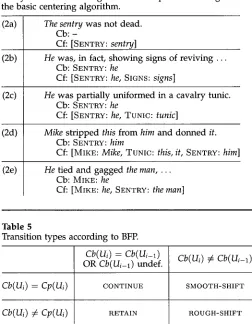
Table 4 gives the centering analysis for this text f r a g m e n t using the a l g o r i t h m f r o m Table 3. 7 Since (2a) is the first sentence in this fragment, it has n o Cb. In (2b) ~ a n d in (2c) the discourse entity SENTRY is referred to b y the p e r s o n a l p r o n o u n he. Since w e a s s u m e a Cf r a n k i n g b y grammatical roles in this example, SENTRY is r a n k e d highest in these sentences (the p r o n o u n always a p p e a r s in subject position). In (2d), the discourse entity MIKE is i n t r o d u c e d b y a p r o p e r n a m e in subject position. The p r o n o u n him is resolved to the m o s t h i g h l y r a n k e d e l e m e n t of Cf(2c), n a m e l y SENTRY. Since Mike occupies the subject position, it is r a n k e d h i g h e r in the Cf(2d) t h a n SENTRY. Therefore the p r o n o u n he in (2e) can be resolved correctly to MIKE.
This e x a m p l e not o n l y illustrates a n a p h o r a resolution using the basic a l g o r i t h m f r o m Table 3 b u t also incorporates the application of Rule 1 of the centering model. (2d) contains the p r o n o u n him, w h i c h is the Cb of this utterance. In (2e), the Cb is also realized as a p r o n o u n while SENTRY is realized b y the definite n o u n p h r a s e the man, w h i c h is allowed b y Rule 1.
3.2 The BFP Algorithm
The centering algorithm described b y Brennan, Friedman, a n d Pollard (1987, hence- forth BFP algorithm) interprets the centering m o d e l in a certain w a y a n d applies it to the resolution of p r o n o u n s . The m o s t o b v i o u s difference b e t w e e n Grosz, Joshi, a n d
6 With slight simplifications taken from the Brown Corpus cn03.
Strube and Hahn Functional Centering
Table 4
Analysis for the text fragment in Example 2 according to the basic centering algorithm.
(2a) The sentry was not dead. Cb: -
Cf: [SENTRY: sentry]
(2b) He was, in fact, showing signs of reviving ... Cb: SENTRY: he
Cf: [SENTRY: he, SIGNS: signs]
(2c) He was partially uniformed in a cavalry tunic.
Cb: SENTRY: he
Cf: [SENTRY: he, TUNIC: tunic]
(2d) Mike stripped this from him and donned it. Cb: SENTRY: him
Cf: [MIKE: Mike, TUNIC: this, it, SENTRY: him] (2e) He tied and gagged the man . . . .
Cb: MIKE: he
Cf: [MIKE: he, SENTRY: the man]
Table 5
Transition types according to BFP.
Cb(Ui) = Cb(Ui_l) Cb(Ui) # Cb(Ui-1)
O R Cb(Ui-1) undef.
Cb(Ui) = Cp(Ui) C O N T I N U E SMOOTH-SHIFT
Cb(Ui) ~ Cp(Ui) R E T A I N ROUGH-SHIFT
Weinstein (1983, 1995) a n d Brennan, Friedman, a n d Pollard (1987) is that the latter use two SHIFT transitions instead of only one: SMOOTH-SHIFT 8 requires the Cb(Ui) to equal Cp(Ui), while ROUGH-SHIFT requires inequality (Table 5). Brennan, Friedman, a n d Pollard (1987) also allow the Cb(Ui_I) to remain undefined.
Brennan, Friedman, a n d Pollard (1987) extend the ordering constraints in Cf in the following way: "We rank the items in Cf b y obliqueness of grammatical relations of the subcategorized functions of the m a i n verb: that is, first the subject, object, a n d object2, followed b y other subcategorized functions, a n d finally, adjuncts." (p. 156). In order to apply the centering model to p r o n o u n resolution, they use Rule 2 in m a k i n g predictions for pronominal reference a n d redefine the rules as follows (quoting Walker, Iida, a n d Cote [1994]):
R u l e 1'
If some element of Cf(Ui-1) is realized as a p r o n o u n in Ui, then so is Cb(Ui).
[image:9.468.36.288.88.421.2]Computational Linguistics Volume 25, Number 3
Table 6
BFP-algorithm.
1. Generate possible
Cb-Cf
combinations. In this step, all (plausible and implausible) assignments of pronouns to elements of the previous Cf are computed.2. Filter by constraints, e.g., contra-indexing, sortal predicates, centering rules and constraints. This way, possible antecedents are filtered out because of morphosyntactic, binding, and semantic criteria. Also the realization of noun phrases in the current utterance (e.g., realization as a pronoun vs. realization as a definite noun phrase or proper name) comes into play.
3. Rank by transition orderings. This is the step, where the pragmatic constraints of centering apply. Basically, CONTINUE transitions are preferred, i.e., the antecedent of a pronoun is more likely to turn up as the Cb of the previous utterance than any other element of the Cf. In certain configurations, the algorithm includes a preference for parallelism in linguistic constructions.
Rule 2 ~
Transition states are ordered. CONTINUE is p r e f e r r e d to RETAIN is p r e f e r r e d to SMOOTH- SHIFT is p r e f e r r e d to ROUGH-SHIFT.
Their algorithm (Table 6) consists of three basic steps (as described b y Walker, Iida, a n d Cote [1994]). 9
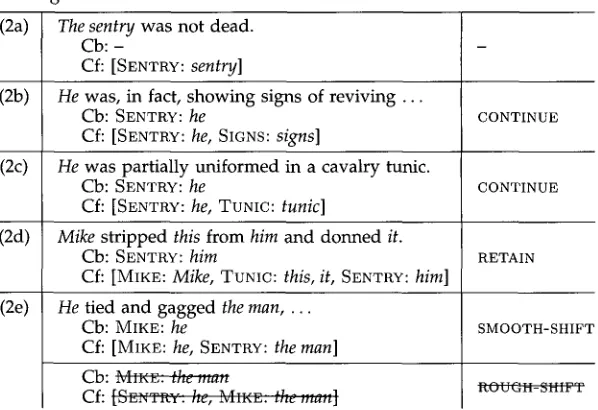
In o r d e r to illustrate this algorithm, w e use e x a m p l e (2) f r o m a b o v e a n d s u p p l y the c o r r e s p o n d i n g Cb/Cf data in Table 7. Let us focus o n the interpretation of utterance (2e) w h e r e the centering data diverges w h e n one c o m p a r e s the basic a n d the BFP algorithms. After step 2 (filtering), the algorithm has p r o d u c e d t w o readings, w h i c h are r a t e d b y the c o r r e s p o n d i n g transitions in step 3. Since SMOOTH-SHIFT is p r e f e r r e d o v e r ROUGH-SHIFT, the p r o n o u n he is resolved to
MIKE,
the h i g h e s t - r a n k e d e l e m e n t of Cf(2d). Also, Rule 1 w o u l d be violated in the rejected reading.4. Principles of Functional Centering
The crucial p o i n t u n d e r l y i n g functional centering is to relate the r a n k i n g of the f o r w a r d - looking centers a n d the i n f o r m a t i o n structure of the c o r r e s p o n d i n g utterances. Hence, a p r o p e r c o r r e s p o n d e n c e relation b e t w e e n the basic centering data structures a n d the relevant functional notions has to be established a n d formally r e p h r a s e d in t e r m s of the centering model. In this section, w e first discuss t w o studies in w h i c h the i n f o r m a t i o n structure of utterances is a l r e a d y integrated into the centering m o d e l ( R a m b o w 1993; H o f f m a n 1996, 1998). Using these p r o p o s a l s as a p o i n t of d e p a r - ture, w e shall d e v e l o p o u r o w n p r o p o s a l - - f u n c t i o n a l centering (Strube a n d H a h n 1996).
4.1 Integrating Information Structure and Centering
As far as the centering m o d e l is concerned, the first account involving i n f o r m a t i o n structure criteria was g i v e n b y K a m e y a m a (1986) a n d f u r t h e r refined b y Walker, Iida, a n d Cote (1994) in their s t u d y o n the use of zero p r o n o u n s a n d topic m a r k -
Strube and Hahn Functional Centering
T a b l e 7
Centering analysis for the text fragment in example (2) according to the BFP algorithm.
(2a) The sentry was not dead. Cb: -
Cf: [SENTRY: sentry]
(2b) He was, in fact, showing signs of reviving ...
Cb: SENTRY: he CONTINUE
Cf:
[SENTRY:
he, SIGNS: signs](2c) He was partially uniformed in a cavalry tunic.
Cb: SENTRY: h e CONTINUE
Cf:
[SENTRY:
he, TUNIC: tunic](2d) Mike stripped this from him and donned it.
Cb: SENTRY: him RETAIN
Cf: [MIKE: Mike, TUNIC: this, it, SENTRY: him] (2e) He tied and gagged the man . . . .
Cb: MIKE: he SMOOTH-SHIFT
Cf: [MIKE: he, SENTRY: the man] Cb: . . . ±vJ.Jr,.r~. th6 iii~iz
KGUGH-SHIFT
LOm,~N J - l ~ t , l . It¢~ l & V l l h f J . ~ll.G l l t l , ¢ l l , ]
ers in Japanese. This led them to augment the grammatical ranking conditions for the forward-looking centers by additional functional notions.
A deeper consideration of information structure principles and their relation to the centering model has been proposed in two studies concerned with the analysis of German and Turkish discourse. Rambow (1993) was the first to apply the centering methodology to German, aiming at the description of information structure aspects underlying scrambling and topicalization. As a side effect, he used centering to define the utterance's theme and rheme in the sense of the functional sentence perspective (FSP) (Firbas 1974). Viewed from this perspective, the theme/rheme-hierarchy of utter- ance Ui is determined by the Cf(Ui_l). Elements of Ui that are contained in Cf(Ui-1) are less rhematic than those not contained in Cf(Ui-1). He then concludes that the Cb(Ui) must be the theme of the current utterance. Rambow does not exploit the information structure of utterances to determine the Cf ranking but formulates it on the basis of linear textual precedence among the relevant discourse entities.
[image:11.468.35.334.98.303.2]Computational Linguistics Volume 25, Number 3
Cf list. In her approach, this r a n k i n g is achieved b y thematic roles (see also Turan
[1998]).Both R a m b o w (1983) as well as H o f f m a n (1996, 1998) a r g u e for a correlation be- t w e e n the i n f o r m a t i o n structure of utterances a n d centering. Both of t h e m find a cor- r e s p o n d e n c e b e t w e e n the
Cb a n d the t h e m e or the topic of an utterance. T h e y refrain,
however, f r o m establishing a strong link b e t w e e n the i n f o r m a t i o n structure a n d center- ing as w e suggest in o u r m o d e l , one that mirrors the influence of i n f o r m a t i o n structure in the w a y the f o r w a r d - l o o k i n g centers are actually ranked.4.2 Functional Centering
Grosz, Joshi, a n d Weinstein (1995) a d m i t that several factors m a y h a v e an influence on the r a n k i n g of the
Cf b u t limit their exposition to the exploitation of grammatical
roles only. We d i v e r g e f r o m this p r o p o s a l a n d claim that, at least for languages w i t h relatively free w o r d o r d e r (such as German), the functional i n f o r m a t i o n structure of the utterance is crucial for the r a n k i n g of discourse entities in theCf
list. Originally, in Strube a n d H a h n (1996), w e d e f i n e d theCf
r a n k i n g criteria in terms of context- boundedness. In this paper, w e redefine the functionalCf
r a n k i n g criteria b y m a k i n g reference to Prince's w o r k on the a s s u m e d familiarity of discourse entities (Prince 1981) a n d i n f o r m a t i o n status (Prince 1992). The t e r m c o n t e x t - b o u n d in Strube a n d H a h n (1996) c o r r e s p o n d s to the t e r m e v o k e d u s e d b y Prince. I°We briefly list the major claims of o u r a p p r o a c h to centering. In the following sections, w e elaborate on these claims, in particular the r a n k i n g of the f o r w a r d - l o o k i n g centers.
• The elements of the
Cf list are o r d e r e d according to their i n f o r m a t i o n
status. H e a r e r - o l d discourse entities are r a n k e d h i g h e r t h a n h e a r e r - n e w discourse entities. The o r d e r of the elements of theCf list for
Ui
p r o v i d e s the preference for the interpretation of a n a p h o r i c expressions inUi+l.
• The first e l e m e n t of theCf(Ui),
the p r e f e r r e d center,Cp(Ui),
is thediscourse entity the utterance
Ui is " a b o u t . " In other w o r d s , the
Cp is the
center of attention.In contrast to the BFP algorithm, the m o d e l of functional centering requires neither a b a c k w a r d - l o o k i n g center, n o r transitions, n o r transition r a n k i n g criteria for a n a p h o r a resolution. For text interpretation, at least, functional centering also m a k e s n o com- m i t m e n t s to f u r t h e r constraints a n d rules.
4.3
Cf
Ranking Criteria in Functional CenteringIn this section, w e i n t r o d u c e the functional Cf r a n k i n g criteria. We first describe a basic version, w h i c h is valid for a w i d e r a n g e of text genres in w h i c h p r o n o m i n a l reference is the p r e d o m i n a n t text p h e n o m e n o n . This is the t y p e of discourse to w h i c h centering was m a i n l y a p p l i e d in p r e v i o u s a p p r o a c h e s (see, for example, Walker's [1989] or Di Eugenio's [1998] test sets). We then describe the e x t e n d e d version of the functional
Cf
r a n k i n g constraints. The two versions differ w i t h respect to the i n c o r p o r a t i o n of (a subset of) inferables in the second version and, hence, w i t h respect to the r e q u i r e m e n t sStrube and Hahn Functional Centering
[image:13.468.35.264.57.124.2]--< N E W
Figure 2
Information status and familiarity (basic version).
relating to the availability of w o r l d k n o w l e d g e , w h i c h is n e e d e d to p r o p e r l y account for inferables. The e x t e n d e d version assumes a detailed treatment of a particular sub- set of inferables, so-called functional a n a p h o r a (in H a h n , Markert, a n d Strube [1996], functional a n a p h o r a are referred to as textual ellipses). We claim that the e x t e n d e d version of ranking constraints is necessary to analyze texts f r o m certain genres, e.g., texts from technical or medical domains. In these areas, p r o n o u n s are u s e d rather in- frequently, while functional a n a p h o r s are the major text p h e n o m e n a to achieve local coherence.
4.3.1 Basic
Cf
R a n k i n g . Usually, theCf
r a n k i n g is r e p r e s e n t e d b y an o r d e r i n g relation on a single set of elements, e.g., grammatical relations (as in Table 1). We use a layered representation for o u r criteria. For the basicCf
ranking criteria, w e distinguish b e t w e e n two different sets of expressions, hearer-old discourse entities inUi
(OLD) a n d hearer- n e w discourse entities inUi
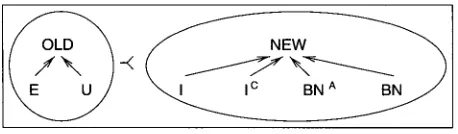
(NEW). These sets can be f u r t h e r split into the elements of Prince's (1981, 245) familiarity scale. The set of hearer-old discourse entities (OLD) consists of e v o k e d (E) a n d u n u s e d (U) discourse entities, while the set of h e a r e r - n e w discourse entities (NEW) consists of b r a n d - n e w (BN) discourse entities. For the basicCf
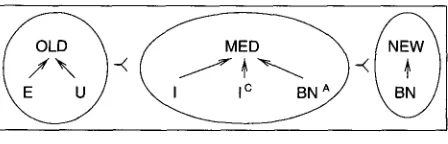
ranking criteria, it is sufficient to assign i n f e r a b l e (I), containing inferable (IC), a n d a n c h o r e d b r a n d - n e w (BN A) discourse entities to the set of h e a r e r - n e w discourse entities (NEW). n See Figure 2 for an illustration of Prince's familiarity scale a n d its relation to the two sets. N o t e that the elements of each set are indistinguishable w i t h respect to their i n f o r m a t i o n status. E v o k e d a n d u n u s e d discourse entities, for example, h a v e the same i n f o r m a t i o n status because they b e l o n g to the set of hearer-old discourse entities. So the basicCf
r a n k i n g in Figure 2 boils d o w n to the preference of OLD discourse entities over N E W ones.For an operationalization of Prince's terms, w e state that e v o k e d discourse en- tities are simply cospecifying (resolved anaphoric) expressions, i.e., p r o n o m i n a l a n d n o m i n a l anaphora, relative p r o n o u n s , p r e v i o u s l y m e n t i o n e d p r o p e r names, etc. Un- u s e d discourse entities are p r o p e r n a m e s a n d titles. In texts, b r a n d - n e w p r o p e r n a m e s are usually a c c o m p a n i e d b y a relative clause or an appositive that relates t h e m to the h e a r e r ' s knowledge. The c o r r e s p o n d i n g discourse entity is e v o k e d o n l y after this elaboration. W h e n e v e r these linguistic devices are missing, w e treat p r o p e r n a m e s as u n u s e d . 12 In the following, w e give some examples of e v o k e d , u n u s e d , a n d b r a n d - n e w
11 Quoting Prince (1992, 305): "Inferrables are like Hearer-new (and, therefore, Discourse-new) entities in that the hearer is not expected to already have in his/her head the entity in question."
Computational Linguistics Volume 25, Number 3
discourse entities, t h o u g h in naturally occurring texts these p h e n o m e n a rarely s h o w u p u n a d u l t e r a t e d . 13 The remaining categories will be explained subsequently.
Example 3
a. H e lived his final nine years in one of [two rent-subsidized
buildings]BN
constructed especially for elderly survivors.
b. W h e n the
[buildings]E
o p e n e d - one in 1964, one in 1970 - there w e r e waiting lists.c. Once,
[they]E
held 333 survivors.In e x a m p l e (3a),
buildings
is i n t r o d u c e d as a discourse-new discourse entity, w h i c h is b r a n d - n e w (BN). In (3b), the definite N Pthe buildings
cospecifies the discourse entity f r o m (3a). Hence,buildings in
(3b) is e v o k e d (E), just as isthey in
(3c).Certain p r o p e r n a m e s are a s s u m e d to be k n o w n b y a n y hearer. Therefore, these p r o p e r n a m e s n e e d no f u r t h e r explanation.
Winnie Madikizela Mandela in
e x a m p l e (4) is u n u s e d (U), i.e., it is d i s c o u r s e - n e w b u t hearer-old. O t h e r p r o p e r n a m e s h a v e to be i n t r o d u c e d because they are d i s c o u r s e - n e w a n d hearer-new. In e x a m p l e (5),Marianne
Kador
is i n t r o d u c e d b y m e a n s of a l e n g t h y appositive that relates the b r a n d - n e w p r o p e rn a m e to the k n o w l e d g e of the hearer. In particular, the n o u n p h r a s e
the apartment
buildings
is discourse-old (see e x a m p l e (3)).Example 4
[A defiant Winnie Madikizela Mandela]u
testified for m o r e t h a n 10 h o u r stoday, dismissing all evidence that . . .
Example 5
" H e was an u n d e r v a l u e d p e r s o n all his life," said
Marianne Kador, a
social w o r k e r for Selfhelp C o m m u n i t y Services, w h i c h operates the a p a r t m e n t buildings in Queens.
In Table 8, w e define various sets, w h i c h are u s e d for the specification of the
Cf
r a n k i n g criteria in Table 9. We distinguish b e t w e e n t w o different sets of discourse entities, hearer-old discourse entities (OLD) a n d h e a r e r - n e w discourse entities (NEW).
For a n y two discourse entities
(x, posx)
a n d(y, posy),
w i t h x a n d y d e n o t i n g the linguistic surface expression of those entities as t h e y occur in the discourse, a n dpOSx
a n d
posy
indicating their respective text position,pOSx ~ posy,
in Table 9 w e define the basic o r d e r i n g constraints on elements in the f o r w a r d - l o o k i n g centersCf(Ui).
For a n y utteranceUi,
the o r d e r i n g of discourse entities in theCf(Ui)
that can be d e r i v e d f r o m the a b o v e definitions a n d the o r d e r i n g constraints (1) to (3) are d e n o t e d b y the relationII ..~ H.
O r d e r i n g constraint (1) characterizes the basic relation for the overall r a n k i n g of the elements in the
Cf.
Accordingly, a n y hearer-old expression in utteranceUi
is g i v e n the highest preference as a potential a n t e c e d e n t for an a n a p h o r i c expression inUi+l. Any
Strube and Hahn Functional Centering
Table 8
Sets of discourse entities for the basic Cf ranking.
DE : the set of discourse entities in Ui E : the set of evoked discourse entities in Ui U : the set of unused discourse entities in Ui
OLD := E U U
NEW := DE - OLD
Table 9
Basic functional ranking constraints on the Cf list.
1. If x E OLD and y E NEW, then x-~ y.
2. If x, y E OLD or x, y E NEW, then x -~ y, if posx < posy
3. If (1) or (2) do not apply, then x and y are unordered with respect to the Cf-ranking.
h e a r e r - n e w expression is r a n k e d b e l o w h e a r e r - o l d expressions. O r d e r i n g constraint (2) c a p t u r e s the o r d e r i n g for the sets O L D or N E W w h e n t h e y contain e l e m e n t s of the s a m e type. In this case, the e l e m e n t s of e a c h set are r a n k e d a c c o r d i n g to their text position.
4.3.2 E x t e n d e d Cf R a n k i n g . While the basic Cf r a n k i n g criteria are sufficient for texts w i t h a h i g h p r o p o r t i o n of p r o n o u n s a n d n o m i n a l a n a p h o r a (e.g., literary texts, n e w s - p a p e r articles a b o u t persons), it is n e c e s s a r y to refine the r a n k i n g criteria in order to deal w i t h e x p o s i t o r y texts, e.g., test reports, discharge s u m m a r i e s . These texts u s u a l l y contain f e w p r o n o u n s a n d are c h a r a c t e r i z e d b y a large n u m b e r of inferrables, w h i c h are often the m a j o r glue in a c h i e v i n g local coherence. In o r d e r to a c c o m m o d a t e the centering m o d e l to texts f r o m these genres, w e distinguish a third set of expressions;
m e d i a t e d d i s c o u r s e entities in Ui (MED). O n Prince's (1981) familiarity scale, the set of hearer-old discourse entities (OLD) r e m a i n s the s a m e as before, i.e., it consists of e v o k e d (E) a n d u n u s e d (U) discourse entities, while the set of h e a r e r - n e w discourse entities (NEW) n o w consists only of b r a n d - n e w (BN) discourse entities. Inferable (I), containing inferable (IC), a n d a n c h o r e d b r a n d - n e w (BN A) discourse entities, w h i c h m a k e u p the set of m e d i a t e d discourse entities, h a v e a status b e t w e e n h e a r e r - o l d a n d h e a r e r - n e w discourse entities. 14 See Figure 3 for Prince's familiarity scale a n d its rela- tion to the three sets. Again, the e l e m e n t s of this set are i n d i s t i n g u i s h a b l e w i t h respect to their i n f o r m a t i o n s t a t u s - - f o r instance, inferable a n d a n c h o r e d b r a n d - n e w discourse entities h a v e the s a m e i n f o r m a t i o n status b e c a u s e t h e y b e l o n g to the set of m e d i a t e d discourse entities. Hence, the e x t e n d e d Cf ranking, d e p i c t e d in Figure 3, will prefer O L D discourse entities o v e r M E D i a t e d ones, a n d M E D i a t e d ones will b e p r e f e r r e d o v e r N E W ones.
We a s s u m e that the difference b e t w e e n containing inferables a n d a n c h o r e d b r a n d - n e w discourse entities is negligible. (It w a s not well d e f i n e d in Prince [1981] a n d in
Computational Linguistics
Figure 3
Information status and familiarity (refined version).
Volume 25, Number 3
Prince [1992] she abandoned the second term.) Therefore, we conflate them into the category of anchored brand-new discourse entities. These discourse entities require that the anchor modifies a brand-new head and that the anchor is either an evoked or an unused discourse entity. In the following, we give examples of inferrables and anchored brand-new discourse entities.
Example 6
a. By his teen-age years, the distorted mentality of anti-Semitism was in full warp.
b. [Thefamily]i was expelled to Hungary in 1939 . . .
In example 6 the relation between the definite NP the family and the context has to be inferred, therefore the family belongs to the category inferable (I). It is marked by definiteness but it is not anaphoric since there is no anaphoric antecedent. Though inferables are often marked by definiteness, it is possible that they are indefinite, like an uncle in example (7b).
Example 7
a. He shared this bounty with his father
b. but [a sickly uncle]1 was left to remain hungry.
Anchored brand-new (BN A) discourse entities as in example (8) are heads of phrases whose modifiers relate (anchor) them to the context.
Example 8
a. He had already lost too m a n y companions.
b. [[HiS]E fianc~e]BNA had died in a car wreck.
Strube and Hahn Functional Centering
Table 10
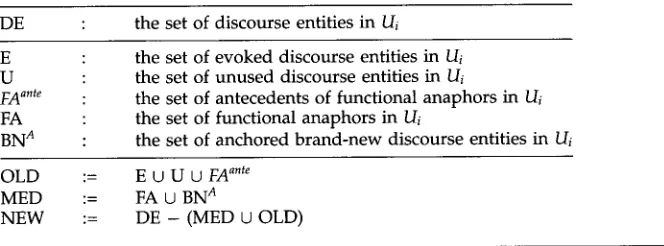
Sets of discourse entities for the extended Cf ranking. DE : the set of discourse entities in Ui
E U
F A ante
FA
BN A :
the set of evoked discourse entities in Ui the set of unused discourse entities in Ui
the set of antecedents of functional anaphors in Ui the set of functional anaphors in Ui
the set of anchored brand-new discourse entities in Ui OLD := E U U U FA ante
MED := FA U BN A
NEW := DE - (MED U OLD)
Table 11
Extended functional ranking constraints on the Cf list.
1. If x E OLD and y E MED, then x-< y. If x C OLD and y C NEW, then x -< y. If x E MED and y E NEW, then x -4 y.
2. If x, y C OLD, or x, y C MED, or x, y C NEW, then x -< y, if pOSx < posy
3. If (1) or (2) do not apply, then x and y are unordered with respect to the Cf-ranking.
For a n y t w o discourse entities (x, pOSx) a n d (y, po@), w i t h x a n d y d e n o t i n g the linguistic surface e x p r e s s i o n of those entities as t h e y occur in the discourse, a n d pOSx a n d posy indicating their respective text position, pOSx =fi posy, in Table 11 w e define the e x t e n d e d functional o r d e r i n g constraints o n e l e m e n t s in the f o r w a r d - l o o k i n g centers Cf(Ui). In the following, for a n y u t t e r a n c e Ui, the o r d e r i n g of discourse entities in the Cf(Ui) that c a n b e d e r i v e d f r o m the a b o v e definitions a n d the o r d e r i n g constraints (1) to (3) are d e n o t e d b y the relation "-<".
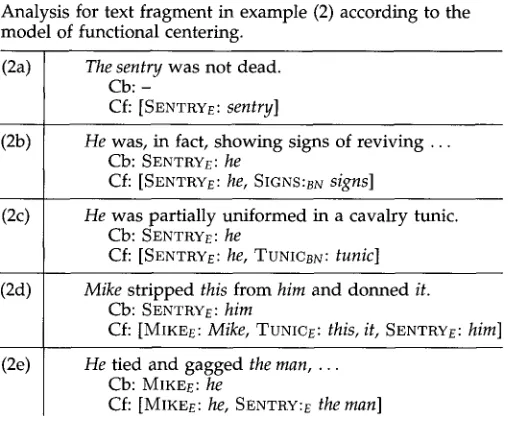
O r d e r i n g constraint (1) characterizes the basic relation for the overall r a n k i n g of the e l e m e n t s in the Cf. Accordingly, a n y h e a r e r - o l d e x p r e s s i o n in u t t e r a n c e Ui is g i v e n the h i g h e s t preference as a p o t e n t i a l a n t e c e d e n t for an a n a p h o r i c or functional a n a p h o r i c expression in Ui+l. A n y m e d i a t e d e x p r e s s i o n is r a n k e d just b e l o w hearer- old expressions. A n y h e a r e r - n e w e x p r e s s i o n is r a n k e d lowest. O r d e r i n g constraint (2) fixes the o r d e r i n g w h e n the sets OLD, MED, or N E W contain e l e m e n t s of the s a m e type. In these cases, the e l e m e n t s of each set are r a n k e d a c c o r d i n g to their text position. In Table 12 w e s h o w the analysis of text f r a g m e n t (2) u s i n g the basic a l g o r i t h m see Table 3) w i t h the basic functional Cf r a n k i n g constraints (see Table 9). The f r a g m e n t starts w i t h the e v o k e d discourse entity SENTRY in (2a) (the definiteness of the N P indicates that it w a s a l r e a d y m e n t i o n e d earlier in the text). The p r o n o u n s he in (2b) a n d (2c) are e v o k e d , w h i l e signs a n d tunic are b r a n d - n e w . We a s s u m e Mike in (2d) to be e v o k e d , too
(MIKE
is the m a i n character of that story). MIKE is the l e f t m o s t e v o k e d discourse entity in (2d), hence r a n k e d highest in the Cf(2d) a n d the m o s t p r e f e r r e d a n t e c e d e n t for the p r o n o u n he in (2e).5. E v a l u a t i o n
[image:17.468.36.368.91.214.2]Computational Linguistics Volume 25, Number 3
Table 12
Analysis for text fragment in example (2) according to the model of functional centering.
(2a)
(2b)
(2c)
(2d)
(2e)
The sentry was not dead. Cb: -
Cf: [SENTtWE: sentry]
He was, in fact, showing signs of reviving ... Cb: SENTRYE: he
Cf: [SENTRYE: he, SIGNS:BN signs]
He was partially uniformed in a cavalry tunic. Cb: SENTRYE: he
Cf: [SENTRYE: he, TUNICBN: tunic] Mike stripped this from him and donned it.
Cb: SENTRYE: him
Cf: [MIKEE: Mike, TUNICE: this, it, SENTRYE: him] He tied and gagged the m a n , . . .
Cb: MIKEE: he
Cf: [MIKEE: he, SENTRY:E the man]
We t h e n i n t r o d u c e a n e w c o s t - b a s e d e v a l u a t i o n m e t h o d , w h i c h w e u s e for c o m p a r i n g t h e e x t e n d e d C f r a n k i n g c o n s t r a i n t s f r o m Table 11 w i t h s e v e r a l o t h e r a p p r o a c h e s .
5.1 S u c c e s s R a t e E v a l u a t i o n
5.1.1 D a t a . I n o r d e r to c o m p a r e t h e f u n c t i o n a l c e n t e r i n g a l g o r i t h m (i.e., the basic al- g o r i t h m f r o m Table 3 o p e r a t i n g w i t h t h e basic f u n c t i o n a l C f r a n k i n g c o n s t r a i n t s f r o m Table 9) w i t h t h e BFP a l g o r i t h m , w e a n a l y z e d a s a m p l e of E n g l i s h a n d G e r m a n texts. T h e test set (Table 13) c o n s i s t e d of t h e b e g i n n i n g s of t h r e e s h o r t stories b y E r n e s t H e m i n g w a y , 15 three articles f r o m t h e N e w York Times ( N Y T ) , 16 the first three c h a p t e r s of a n o v e l b y U w e J o h n s o n S t h e first t w o c h a p t e r s of a s h o r t s t o r y b y H e i n e r Mfiller, TM a n d s e v e n articles f r o m t h e Frankfurter Allgemeine Z e i t u n g (FAZ). 19
15 Hemingway, Ernest. 1987. The Complete Short Stories of Ernest Hemingway. Scribner, New York. ("An African story," pages 545-554; "Soldier's home," pages 111-116; "Up in Michigan," pages 59~62.) 16 (i) New York Times, Dec. 7, 1997. ("Shot in head, suspect goes free, then to college," by Jane Fritsch,
pages A45-48.) (ii) New York Times, Dec. 1, 1997. ("Winnie Mandela is defiant, calling accusations 'lunacy'," by Suzanne Daley, pages A1-12.) (iii) New York Times, Dec. 11, 1997. ("Remembering one who remembered. Eugen Zuckermann, survivor, kept the ghosts of the holocaust alive," by Barry Bearak, pages B1-8.)
17 Johnson, Uwe. 1965. Zwei Ansichten. Suhrkamp Verlag, Frankfurt am Main.
18 Miiller, Heiner. 1974. Geschichten aus der Produktion 2. Rotbuch Verlag, Berlin. ("Liebesgeschichte," pages 57-62.)
19 FAZ, Aug. 28, 1997. ("Die gute Nachricht ist: Wir k6nnen gewirmen. New Yorks frthherer
[image:18.468.48.305.79.293.2]Strube and Hahn Functional Centering
Table 13
Test set for success rate evaluation.
Hemingway NYT English Writers FAZ German
3rd pers. & poss. pron. 274 302 576
sentences 153 233 386
words 2785 4546 7331
299 320 619
186 394 580
3195 8005 11200
5.1.2 Method. The evaluation was carried out manually by the authors, supported by a small-scale discourse annotation tool. We used the following guidelines for our evaluation: We did not assume any world knowledge as part of the anaphora resolu- tion process. Only agreement criteria and sortal constraints were applied. We did not account for false positives and error chains, but marked the latter (see Walker 1989).
We use Kameyama's (1998) specifications for dealing with complex sentences (for a description, see Section 3). Following Walker (1989), a discourse segment is defined as a paragraph unless its first sentence has a pronoun in subject position or a pronoun whose syntactic features do not match the syntactic features of any of the preceding sentence-internal noun phrases. Also, at the beginning of a segment, anaphora resolu- tion is preferentially performed within the same utterance. According to the preference for intersentential candidates in the original centering model, we defined the following anaphora resolution strategy (which is not the best solution for the anaphora resolution problem either, but sufficient for the purposes of the evaluation):
1.
.
3.
Test elements of Cf(Ui_l)--according to the BFP algorithm, or the functional centering (henceforth abbreviated as FunC) algorithm.
Test elements of
Ui,
which precede the pronoun, left-to-right.Test elements of Cf(Ui_2) , Cf(Ui_3) . . . . i n the given order.
Since clauses are short in general, step 2 of the algorithm only rarely applies.
Computational Linguistics Volume 25, Number 3
Table 14
Evaluation results for success rates.
Hemingway NYT English Writers FAZ German
3rd pers. & poss. pron. 274 302 576 299 320 619
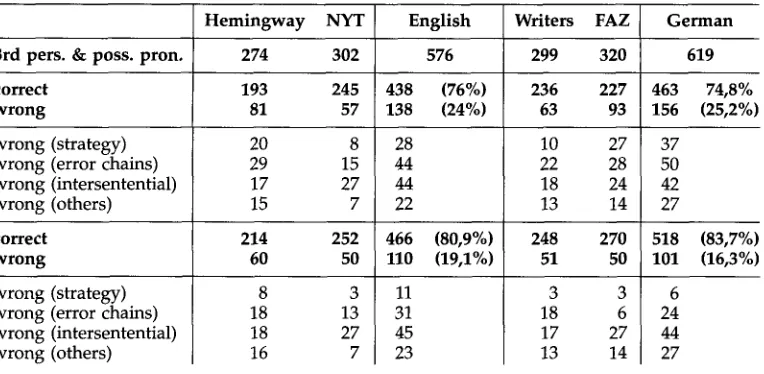
:orrect 193 245 438 (76%) 236 227 463 74,8%
wrong 81 57 138 (24%) 63 93 156 (25,2%)
wrong (strategy) 20 8 28 10 27 37
wrong (error chains) 29 15 44 22 28 50
wrong (intersentential) 17 27 44 18 24 42
wrong (others) 15 7 22 13 14 27
:orrect 214 252 466 (80,9%) 248 270 518 (83,7%)
wrong 60 50 110 (19,1%) 51 50 101 (16,3%)
wrong (strategy) wrong (error chains) wrong (intersentential) wrong (others)
8 3
18 13
18 27
16 7
11 31 45 23
3 3
18 6
17 27
13 14
6 24 44 27
5.1.4 I n t e r p r e t a t i o n . While the rate of errors caused b y the specifications for c o m p l e x
sentences a n d b y o t h e r reasons is almost identical (the small difference can be ex- p l a i n e d b y false positives), there is a r e m a r k a b l e difference b e t w e e n the algorithms w i t h respect to strategic errors a n d error chains. Strategic errors occur w h e n e v e r the preference g i v e n b y the algorithm u n d e r consideration leads to an error. Most of the strategic errors i m p l i e d b y the FunC a l g o r i t h m also s h o w u p as errors for the BFP algorithm. We interpret this finding as an indication that these errors are c a u s e d b y a lack of semantic or w o r l d k n o w l e d g e . The r e m a i n i n g errors of the BFP a l g o r i t h m are c a u s e d b y the strictly local definition of its criteria a n d because the BFP a l g o r i t h m c a n n o t deal w i t h some particular configurations leading to ambiguities. The FunC al- g o r i t h m has f e w e r error chains n o t only because it yields f e w e r strategic errors, b u t also because it is m o r e robust w i t h respect to real texts. An utterance
Ui,
for instance, w h i c h intervenes b e t w e e nUi-1
a n dUi+l
w i t h o u t a n y relation toUi-1
does n o t affect the preference decisions inUi+2
for FunC, a l t h o u g h it does affect t h e m for the BFP algorithm, since the latter c a n n o t assign theCb(Ui+l).
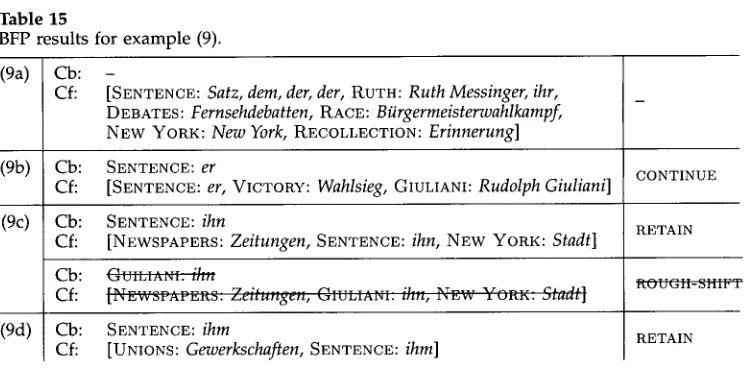
Also, error chains are s o m e t i m e s shorter in the FunC analyses.E x a m p l e (9) illustrates h o w the local restrictions as d e f i n e d b y the original cen- tering m o d e l a n d the BFP algorithm result in errors a n d lead to r a t h e r l e n g t h y error chains (see Table 15 for the c o r r e s p o n d i n g centering analysis). The discourse entity
SENTENCE,
w h i c h is cospecified b y the p r o n o u ner,
'it'masc, in (9b), is theCb(9b).
There- fore, it is the m o s t p r e f e r r e d a n t e c e d e n t for the p r o n o u nihn
in (9c), w h i c h causes a strategic error. This error, in turn, is the r e a s o n for a c o n s e q u e n t error in (9d), because there are n o semantic cues that enforce the correct interpretation, i.e., the coreferen- tiality b e t w e e nihn
a n dGiuliani.
The possible i n t e r r u p t i o n of the error chain, indicated b y the alternative interpretation in (9c), is r u l e d out, h o w e v e r , b y the p r e f e r e n c e for RETAIN o v e r ROUGH-SHIFT transitions (cf. Rule 2').E x a m p l e 9
[image:20.468.56.438.91.278.2]Strube and Hahn Functional Centering
Table 15
BFP results for example (9).
(9a) Cb: -
Cf: [SENTENCE: Satz, dem, der, der, RUTH: Ruth Messinger, ihr, DEBATES: Fernsehdebatten, RACE: Biirgermeisterwahlkampf, NEW YORK: New York, RECOLLECTION: Erinnerung]
(9b) Cb: SENTENCE: er CONTINUE
Cf: [SENTENCE: er, VICTORY: Wahlsieg, GIULIANI: Rudolph Giuliani]
(9c) Cb: SENTENCE: ihn RETAIN
Cf: [NEWSPAPERS: Zeitungen, SENTENCE: ihn, NEW YORK: Stadt]
Cb : . . . ~ u t ~ . ~,~,~ ~ O U G H - S H / F T Cf r ~ T . . . - 7 _ : ~ . . . ,-~ . . . :1.._ ~,T . . . . ~ r . . . . O , - JL1
(9d) Cb: RETAIN
Cf:
S E N T E N C E : ihm
[UNIONS:
Gewerkschaften,
S E N T E N C E :ihm]
[The sentence]smuabSjCect, w i t h w h i c h R u t h M e s s i n g e r - o n e of the TV d e b a t e s - o p e n e d , - will - the o n l y one - be, - w h i c h - of her - in m e m o r y - remains.
The sentence, w i t h w h i c h R u t h M e s s i n g e r o p e n e d one of the TV debates, will be the o n l y one, w h i c h will b e recollected of her.
b. A m n a h e z u sicheren Wahlsieg des A m t s i n h a b e r s R u d o l p h Giuliani a m D i e n s t a g w i r d er nichts ~indern.
[Of the a l m o s t certain - v i c t o r y in the election - of [the officeholder R u d o l p h Giuliani]masc]a'd~SCct - on T u e s d a y - will - [it]smu~Cct - n o t h i n g - alter.
Of the officeholder R u d o l p h Giuliani's a l m o s t certain v i c t o r y in the election on Tuesday, it will alter nothing.
c. Alle Z e i t u n g e n d e r Stadt unterstiitzen ihn.
[All - n e w s p a p e r s of the city]subject - s u p p o r t - [him]dmiraeScCt_object . He is s u p p o r t e d b y all n e w s p a p e r s of the city.
d. Die G e w e r k s c h a f t e n stehen hinter ihm.
[ T h e unions]subject - s t a n d b e h i n d - [him]imnadSiCrect_object . He is b a c k e d u p b y the unions.
The nonlocal definition of h e a r e r - o l d discourse entities enables the F u n C algo- r i t h m to c o m p u t e the correct a n t e c e d e n t for the p r o n o u n ihn in (9c) p r e v e n t i n g it f r o m r u n n i n g into a n error chain (see Table 16 for the functional centering data). GIULIANI, w h o w a s m e n t i o n e d earlier in the text, is the l e f t m o s t e v o k e d discourse entity in (9b) a n d therefore the m o s t p r e f e r r e d a n t e c e d e n t for the p r o n o u n in (9c), t h o u g h there is a p r o n o u n of the s a m e g e n d e r in (9b).
We e n c o u n t e r e d p r o b l e m s w i t h K a m e y a m a ' s (1998) specifications for c o m p l e x sen- tences. The differences b e t w e e n clauses that are accessible f r o m a h i g h e r syntactic level a n d clauses that are n o t could n o t be verified b y o u r analyses. Also, her a p p r o a c h is s o m e t i m e s too c o a r s e - g r a i n e d (i.e., there are still a n t e c e d e n t s w i t h i n o n e utterance), a n d s o m e t i m e s too fine-grained. 2°
[image:21.468.33.405.68.256.2]