Example-Based Machine Translation
System Using the World Wide Web
Andy Way
∗Nano Gough
†Dublin City University Dublin City University
We have developed an example-based machine translation (EBMT) system that uses the World Wide Web for two different purposes: First, we populate the system’s memory with translations gathered from rule-based MT systems located on the Web. The source strings input to these systems were extracted automatically from an extremely small subset of the rule types in the Penn-II Treebank. In subsequent stages, thesource, targettranslation pairs obtained are automatically transformed into a series of resources that render the translation process more successful. Despite the fact that the output from on-line MT systems is often faulty, we demonstrate in a number of experiments that when used to seed the memories of an EBMT system, they can in fact prove useful in generating translations of high quality in a robust fashion. In addition, we demonstrate the relative gain of EBMT in comparison to on-line systems. Second, despite the perception that the documents available on the Web are of questionable quality, we demonstrate in contrast that such resources are extremely useful in automatically postediting translation candidates proposed by our system.
1. Introduction
In quite a short space of time, translation memory (TM) systems have become a very
useful tool in the translator’s armory. TM systems store a set ofsource, target
trans-lation pairs in their databases. If a new input string cannot be found exactly in the translation database, a search is conducted for close (or “fuzzy”) matches of the input string, and these are retrieved together with their translations for the translator to manipulate into the final, output translation. From this description, it should be clear
that TM systems do nottranslate: Indeed, some researchers consider them to be little
more than a search-and-replace engine, albeit a rather sophisticated one (Macklovitch and Russell 2000).
We can illustrate this with respect to the TM entries in (1), taken from the Canadian Hansards:
(1) a. While most were critical, some contributions were thoughtful and
constructive=⇒La plupart ont formul ´e des critiques, mais certains ont
fait des observations r ´efl´echies et constructives.
b. Others were plain meanspirited and some contained errors of fact=⇒
D’autres discours comportaient des propos mesquins et m ˆeme des erreurs de fait.
Consider the new source string in (2):
(2) While most were critical, some contributions were plain meanspirited.
Despite the fact that this new input in (2) is extremely close to the source strings in the TM entries in (1), no TM system containing just these translation pairs in its database would be able to translate (2); the best they could do would be to identify one or both of the two source sentences in the TM in (1) as fuzzy matches and display these, together with their French translations. The translator would then manipulate the target strings in the TM into the final translation (3):
(3) La plupart ont formul´e des critiques, mais certains ont fait des
observations mesquines.
An alternative translation that might be derived from the TM entries in (1) is that in (4):
(4) La plupart ont formul´e des critiques, mais certains comportaient des
observations mesquines.
At all stages in the translation process, therefore, the translators themselves are the integral figures: They are free to accept or reject any suggested matches, they construct the translations, and they may or may not use any translations proposed by the TM system to formulate the translations in the target document. Finally, they are free to insert the translations produced into the TM itself as they see fit: that is, either (3) or (4) could be inserted into the TM with the source string (2), or some other translation, if that were preferred.
A prerequisite for TM (and example-based machine translation [EBMT]) applica-tions is a parallel corpus aligned at sentential level. Such a corpus may be presented
to translators en bloc, or translators may help construct it themselves. Here too the
translator maintains a large degree of autonomy: Using a tool such asTrados WinAlign,
for example, he or she may manually overwrite some of the aligner’s decisions by
linkingsource, targetsentence pairs using the graphical interface provided.
Nevertheless, TM systems are currently falling far short of their potential, given
the limitation that the smallest accessible translation units aresource, targetstrings
aligned only at sentential level. Consider the fuzzy matching operation, for instance: Translators are able to set a fuzzy match threshold below which no translation pairs are proposed by the TM system. If this threshold is set too low, then potentially useful translation pairs will be presented along with a lot of noise, thereby risking that this useful translation information will be obscured (high recall, low precision); if it is set too low, then good matches will be presented, but potentially useful matches will not be (low recall, high precision). We noted above that faced with the new input in (2), a TM system might be able to present the translator with the fuzzy matches in (1). However, if a translator were to set the level of fuzzy matching at 80% (a not unreasonable level), then neither of the translation pairs in (1) would be deemed to be a suitably good fuzzy match, as only 7/9 (77%) of the words in (1a) match those in (2) exactly, and only 3/9 (33%) of the words in (1b) match those in (2) exactly. Indeed, setting an appropriate fuzzy match level is such a difficult problem that some translators switch off this option and use the TM only to find exact matches.
sententially aligned TM examples in (1) so that subsentential chunks were displayed to the user, then the chance of finding exact matches or good fuzzy matches would increase considerably. This is currently beyond the scope of TM systems.
In contrast, EBMT systems have overcome this constraint by storing subsentential translational correspondences in addition to the sententially aligned pairs from which they are derived. As a consequence, where a TM system can only propose a number of close-scoring matches in its database for the translator to adapt into the final trans-lation, an EBMT system can produce translations itself by automatically combining chunks from different translation examples stored in its memories.
In Section 2, we describe how we automatically obtain a hierarchy of lexical
re-sources that are used sequentially by our EBMT system, wEBMT, to translate new
input. The primary resource gathered is a “phrasal lexicon,” constructed by extracting over 200,000 phrases from the Penn Treebank and having them translated into French by three Web-based machine translation (MT) systems.
Each set of translations is stored separately, and for each set the “marker hypoth-esis” (Green 1979) is used to segment the phrasal lexicon into a “marker lexicon.” The marker hypothesis is a universal psycholinguistic constraint which states that natural languages are ”marked” for complex syntactic structure at surface form by a closed set of specific lexemes and morphemes. That is, a basic phrase-level segmentation of an input sentence can be achieved by exploiting a closed list of known marker words to signal the start and end of each segment.
Consider the following example, selected at random from the Wall Street Journal
section of the Penn-II Treebank:
(5) The Dearborn, Mich., energy company stopped paying a dividend in the
third quarter of 1984 because of troubles at its Midland nuclear plant.
Here we see that three noun phrases start with determiners and one with a possessive pronoun. The sets of determiners and possessive pronouns are both very small. Fur-thermore, there are four prepositional phrases, and the set of prepositions is similarly
small. A further assumption that could be made is that all words that end with-edare
verbs, such as stoppedin (5). The marker hypothesis is arguably universal in
presum-ing that concepts and structures like these have similar morphological or structural marking in all languages.
The marker hypothesis has been used for a number of different language-related tasks, including
• language learning (Green 1979; Mori and Moeser 1983; Morgan, Meier,
and Newport 1989)
• monolingual grammar induction (Juola 1998)
• grammar optimization (Juola 1994)
• insights into universal grammar (Juola 1998)
• machine translation (Juola 1994, 1997; Veale and Way 1997; Gough, Way,
and Hearne 2002)
research of Mori and Moeser (1983) showed a similar effect due to case marking on pseudowords in such artificial languages, and Morgan, Meier, and Newport (1989) demonstrated that languages that do not permit pronouns as substitutes for phrases also provide evidence in favor of the marker hypothesis. Juola’s (1994, 1998) work on grammar optimization and induction shows that context-free grammars can be converted to ”marker-normal form.” However, marker-normal form grammars cannot capture the sorts of regularities demonstrated for languages that do not have a one-to-one mapping between a terminal symbol and a word. Nevertheless, Juola (1998, page 23) observes that “a slightly more general mapping, where two adjacent termi-nal symbols can be merged into a single lexical item (for example, a word and its case-marking), can capture this sort of result quite handily.” Work using the marker hypothesis for MT adapts this monolingual mapping for pairs of languages: It is rea-sonably straightforward to map an English determiner-noun sequence onto a Japanese noun–case marker segment, once one has identified the sets of marker tags in the lan-guages to be translated.
Following construction of the marker lexicon, thesource, targetchunks are
gen-eralized further using a methodology based on Block (2000) to permit a limited form of insertion in the translation process. As a byproduct of the chosen methodology, we also derive a standard ”word-level” translation lexicon. These various resources render the set of original translation pairs far more useful in deriving translations of previously unseen input.
In Section 3, we describe in detail the segmentation process, together with the procedure whereby target chunks are combined to produce candidate translations. In Section 4, we report initially on two experiments in which we test different versions of our EBMT system against test sets of NPs and sentences. We then conduct a set of further experiments which show that using the resources developed from more than one on-line MT system may improve both translation coverage and quality. Further-more, seeding the system databases with more fragments improves translation quality. In addition, we calculate the net gain of our EBMT system by comparing translation quality against that of the three on-line MT systems. Finally, we comment on the relative strengths and weaknesses of the three on-line MT systems used.
Like most EBMT systems, our approach suffers from the problem of “boundary friction”: where chunks from different translation examples are recombined, the quality of the resulting translations may be compromised. Assume that the aligned examples in (6) are located in the system database:
(6) a. You can attach a phone to the connector=⇒Vous pouvez r ´elier un
t ´el ´ephone au connecteur.
b. Connect only the keyboard and a mouse=⇒Connectez uniquement
le clavier et une souris.
Let us now confront the EBMT system with the new input string in (7):
(7) You can attach a mouse to the connector.
This could be correctly translated by the EBMT system by isolating the useful trans-lation fragments in (8):
(8) a. You can attach=⇒Vous pouvez r ´elier (from (6a))
b. a mouse=⇒une souris (from (6b))
Recombining the French chunks gives us the correct translation in (9):
(9) Vous pouvez r´elier une souris au connecteur.
However, a number of mistranslations could also ensue, including those in (10):
(10) a. *Vous pouvez r´elier un souris au connecteur.
b. *Vous pouvez r´elier un souris au le connecteur.
The mistranslation (10a) could be formed via the set of inferences in (11):
(11) You can attach a=⇒Vous pouvez r ´elier un (from (6a))
mouse=⇒souris (from (6b))
to the connector=⇒au connecteur (from (6a))
The mistranslation (10b) could be formed via the set of inferences in (12):
(12) You can attach a=⇒Vous pouvez r ´elier un (from (6a))
mouse=⇒souris (from (6b))
to=⇒au (from (6a))
the=⇒le (from (6b))
connector=⇒connecteur (from (6a))
It is clear, therefore, that unless the process by which the originalsource, target
sentence pairs are fragmented is well defined and strictly controlled, chunks may be combined from different contexts that result in agreement errors such as those in
(10).1 Depending on the input string, our wEBMT system may generate thousands
of candidate translations, including many mistranslations like those in (10). A major advantage of MT systems based on probabilities is that output translations can be ranked (and pruned, if required): One would hope that such systems would rank good translations such as that in (9) more highly than poor ones such as those in (10). We demonstrate that in almost all experiments, our EBMT system consistently ranks the “best” translation in the top 10 output translations, and always in the top 1% of the translations generated.
In order to minimize errors of boundary friction, in Section 5 we develop a novel, post hoc procedure via the World Wide Web to validate and, if necessary, correct
translations prior to their being output to the user.2 Finally we conclude and point to
areas of future research.
1 Note also that with respect to the translations given in (3) and (4), the translator interacting with the TM has used his or her translation knowledge to avoid a problem of boundary friction: Given the TM entries in (1), the translation ofplain meanspiritedwould appear to bemesquins. This is correct in this context, as it co-occurs with a masculine plural nounpropos. In translating (2), however,observationsis a feminine plural noun, so the adjectivemesquinesis inserted to maintain agreement throughout the NP. If the translation pairplain meanspirited, mesquineswere not found in the system’s memories, then only the mistranslationobservations mesquinscould be produced by an EBMT system.
2. Deriving Translation Resources from Web-Based MT Systems
All EBMT systems, from the initial proposal by Nagao (1984) to the recent collection of Carl and Way (2003), are premised on the availability of subsentential alignments derived from the input bitext. There is a wealth of literature on trying to establish
sub-sentential translations from a bilingual corpus.3 Kay and R ¨oscheisen (1993) attempt to
extract a bilingual dictionary using a hybrid method of sentence and word alignment
on the assumption that the source, target words have a similar distribution. Fung
and McKeown (1997) attempt to translate technical terms using word relation matrices, although the resource from which such relations are derived is a pair of nonparallel corpora. Somers (1998) replicates the work of Fung and McKeown with different lan-guage pairs using the simpler metric of Levenshtein distance. Boutsis and Piperidis (1998) use a tagged parallel corpus to extract translationally equivalent English-Greek clauses on the basis of word occurrence and co-occurrence probabilities. The respec-tive lengths of the putarespec-tive alignments in terms of characters is also an important factor. Ahrenberg, Andersson, and Merkel (2002) observe that for less widely spoken languages, the relative lack of linguistic tools and resources has forced developers of word alignment tools for such languages to use shallow processing and basic statis-tical approaches to word linking. Accordingly, they generate lexical correspondences by means of co-occurrence measures and string similarity metrics.
More specifically, the notion of the phrasal lexicon (used first by Becker 1975) has been used successfully in a number of areas:
• Learnability (Zernik and Dyer 1987)
• Text generation (Hovy 1988; Milosavljevic, Tulloch, and Dale 1996)
• Speech generation (Rayner and Carter 1997)
• Localization (Sch¨aler 1996)
More recently, Simard and Langlais (2001) have proposed the exploitation of TMs at a subsentential level, while Carl, Way, and Sch¨aler (2002) and Sch¨aler, Way, and Carl (2003, pages 108–109) describe how phrasal lexicons might come to occupy a central place in a future hybrid integrated translation environment. This, they suggest, may result in a paradigm shift from TM to EBMT via the phrasal lexicon: Translators are on the whole wary of MT technology, but once subsentential alignment is enabled,
translators will become aware of the benefits to be gained fromsource, targetphrasal
segments, and from there they suggest that “it is a reasonably short step to enabling an automated solution via the recombination element of EBMT systems such as those described in [Carl and Way 2003].”
In this section, we describe how the memory of our EBMT system is seeded with a set of translations obtained from Web-based MT systems. From this initial resource, we subsequently derive a number of different databases that together allow many new input sentences to be translated that it would not be possible to translate in other systems. First, the phrasal lexicon is segmented using the marker hypothesis to produce a marker lexicon. This is then generalized, following a methodology based on Block (2000), to generate the “generalized marker lexicon.” Finally, as a result of the
methodology chosen, we automatically derive a fourth resource, namely, a “word-level lexicon.”
2.1 The Phrasal Lexicon
Our phrasal lexicon was built by selecting a set of 218,697 English noun phrases and verb phrases from the Penn Treebank. We identified all rule types occurring 1,000 or more times and eliminated those that were not relevant (e.g., rules dealing only with numbers). Where rules contained just a single nonterminal on their right-hand side, only those rules whose left-hand side was VP were retained in order to ensure that we could handle intransitive verbs. In total, 59 rule types out of a total of over 29,000 (i.e., just 0.002% of the rules in Penn-II) were used in creating the various lexical resources. For each of these 59 rule types, the tokens corresponding to the rule right-hand sides were extracted. These extracted English phrases were then translated using three on-line MT systems:
• SDL International’sEnterprise Translation Server4 (system A)
• Reversoby Softissimo5 (system B)
• Logomedia6 (system C)
Translating the NPs via these MT systems was reasonably straightforward. We report in Section 4 on the quality of the French NPs produced, and in Section 5 we discuss experiments designed to discover whether our EBMT system could improve on any mistranslations obtained. Translating the VPs involved a little more thought: In the main, on-line MT systems such as these work far better when they translate sentences. In order to obtain finite verb forms rather than the default infinitival forms, we provided dummy subjects. Initially these were third-person plural pronouns, which caused similar verb forms to be created. This obviously biases the EBMT system more in favor of third-person plural sentences. Nevertheless, using the WWW-based post hoc evaluation methodology proposed in Section 5, we were still able to obtain reasonable translations for non-third-person-plural sentences too. In a subsequent experiment,
we seed the databases ofwEBMTwith third-person singular verb forms by providing
third-person singular pronouns as the dummy subjects, and in a final experiment we combine all third-person fragments (both singular and plural) into the system’s memories and compare results on the same test set.
The on-line MT systems were selected purely because they enable batch translation of large quantities of text. In our experience, the most efficient way to translate large amounts of data via on-line MT systems is to send each document as an HTML page with the phrases to be translated encoded as an ordered list. We automatically tagged the English phrases with HTML codes and input them into each translation system
using the Unixwgetfunction, which takes a URL as input and writes the corresponding
HTML document to a file. If the URL takes the form of a query, then the document retrieved is the result of the query, namely, the translated Web page. Once this is obtained, it is a simple process to retrieve the French translations and associate them with their English source equivalents.
4 http://www.freetranslation.com 5 http://trans.voila.fr
2.2 The Marker Lexicons
Given that the marker hypothesis is arguably universal, it is clear that benefits may
accrue by using it to facilitate subsentential alignment ofsource, targetchunks. Juola
(1994, 1997) conducts some small experiments using his METLA system to show the
viability of this approach for English−→French and English−→Urdu. For the English
−→ French language pair, Juola gives results of 61% correct translation when the
system is tested on the training corpus, and 36% accuracy when it is evaluated with
test data. For English−→Urdu, Juola (1997, page 213) notes that “the system learned
the original training corpus. . .perfectly and could reproduce it without errors”; that
is, it scored 100% accuracy when tested against the training corpus. On novel test
sentences, he gives results of 72% correct translation. In theirGaijinsystem, Veale and
Way (1997) give a result of 63% accurate translations obtained for English−→German
on a test set of 791 sentences from CorelDRAWmanuals.
As inMETLAandGaijin, we exploit lists of known marker words for each language
to indicate the start and end of segments. For English, our source language, we use the sets of marker words in (13):
(13)
<DET> {the, a, an, those, these, . . .}
<PREP> {in, on, out, with, from, to, under,. . .}
<QUANT> {all, some, few, many,. . .}
<CONJ> {and, or,. . .}
<POSS> {my, your, our,. . .}
<PRON> {I, you, he, she, it,. . .}
A similar set (14) was produced for French, the target language in ourwEBMTsystem:
(14)
<DET> {le, la, l’, les, ce, ces, ceux, cet,. . .}
<PREP> {dans, sur, avec, de, `a, sous, . . .}
<QUANT> {tous, tout, toutes, certain, quelques, beaucoup,. . .}
<CONJ> {et, ou,. . .}
<POSS> {mon, ma, mes, ton, ta, tes, notre, nos, . . .}
<PRON> {je, j’, tu, il, elle,. . .}
In a preprocessing stage, the alignedsource, targetpairs in the phrasal lexicon are
traversed word by word, and whenever any such marker word is encountered, a new
chunk is begun, with the first word labeled with its marker category (<DET>,<PREP>,
etc.). The example in (15) illustrates the results of running the marker hypothesis over
the source phraseall uses of asbestos:
(15) <QUANT> all uses <PREP> of asbestos
In addition, we impose a further constraint that each chunk must also contain at least
one non–marker word, so that the phraseout in the coldwill be viewed as one segment
(labeled with<PREP>), rather than split into still smaller chunks.
For eachEnglish,FrenchXpair, where Xis one of the sets of translations derived
us a total of 656,091 source, targettranslation pairs (including many repetitions, of course). Given that English and French have essentially the same word order, these marker lexicons are predicated on the na¨ıve yet effective assumption that
marker-headed chunks in the sourceS map sequentially to their target equivalentsT; that is,
chunkS1 −→ chunkT1, chunkS2 −→ chunkT2,. . .chunkSn −→ chunkTn, subject to their
marker categories matching, where possible. Using the previous example ofall uses of
asbestos, this gives us the marker chunks in (16):
(16) <QUANT> all uses : tous usages <PREP> of asbestos : d’ asbeste
Sometimes the number of marker chunks in the two languages differs, with respect to both the marker categories and the number of chunks obtained. Consider the example in (17):
(17) The man looks at the woman=⇒L’homme regarde la femme.
Once the marker hypothesis is applied to (17), it would be marked up as in (18):
(18) <DET>The man looks<PREP>at<DET>the woman=⇒ <DET>L’ homme regarde<DET>la femme.
That is, the English verb subcategorizes for a PP complement which in this case
con-tains two marker words, whereas the French verbregarder is a straightforward
tran-sitive verb. It may appear, therefore, that there are three chunks in the English string and only two on the French side, but this is not the case: The restriction that each segment must contain at least one non–marker word ensures that we have just two marker chunks for the English string in (18). However, it remains the case that the chunks are tagged differently; we obtain the marker chunks in (19):
(19) English:
<DET>The man looks <PREP>at<DET> the woman
French:
<DET>L’ homme regarde <DET>la femme
Our alignment method would therefore align the first English chunk with the first French chunk, as their marker categories match. Note, of course, that this contains a
translation error:regardetranslates not aslooksbut rather aslooks at. Errors such as this
will adversely affect translation quality, but as we report in Section 4, good-quality translations are obtainable on the whole. The second pair in (19), however, cannot be mapped straightforwardly onto one another, as the marker categories differ.
Nev-ertheless, our algorithm would align “<DET> the woman” with “<DET>la femme,” as
their marker categories match. This ensures that as many potentially useful translation fragments are generated as possible.
still further, the mapping function needs to be improved to account for examples such as (20):
(20) The man likes the woman=⇒La femme plaˆıt `a l’homme.
The like =⇒ plaire case is an argument-switching (or relation-changing) example, in that the subject in English becomes the indirect object in French, and the English object translates as the French subject. If we were to apply the marker hypothesis to (20), we would derive (21):
(21) <DET>The man likes<DET>the woman=⇒ <DET>La femme plaˆıt<PREP> `a<DET>l’ homme.
That is, without recourse to a lexicon or information about the relative distribution of words and their translations, we would derive the marker chunks in (22):
(22) a.<DET>The man likes=⇒<DET> La femme plaˆıt b.<DET>the woman=⇒<DET>l’ homme
Of course, both alignments are wrong. However, our alignment method correctly aligns
source, targetsegments in approximately 80% of cases. We calculate this as an
ap-proximation by testing all translations of marker chunks to see whether these French
chunks appear anywhereon the Web: If so, we assume that the translations obtained
by the online MT systems are correct. For 39,895 such translations, 75.2% of those produced by system A appear on the Web, with 81.7% of those generated by system B and 81.5% of those produced by system C also appearing on the Web. Note that this gives us only an approximation of the correctness of our alignments, as we are testing whether the French translations are “good French” rather than whether the alignments in which they appear are actually correct.
Correcting misalignments such as those in (22) is a topic for further research. Adding a bilingual lexicon (our word-level lexicon, for example) and incorporating the constraints contained therein into the marker-based alignment process would prevent chunks such as those in (22) from being generated, and we conjecture that translation quality would improve accordingly.
Given marker chunks such as those in (16), we are able to extract automatically a further bilingual dictionary, the word-level lexicon. We take advantage of the assump-tion that where a chunk contains just one non–marker word in both source and target, these words are translations of each other. Where a marker-headed pair contains just two words, as in (16), for instance, we can extract the word-level translations in (23):
(23)
<QUANT> all : tous <PREP> of : d’ <LEX> uses : usages <LEX> asbestos : asbeste
Juola (1994, 1997) assumes that words ending in -ed are verbs. However, given that verbs are not a closed class, in our approach we do not mark chunks beginning with a verb with any marker category. Instead, we take advantage of the fact that the initial phrasal chunks correspond to rule right-hand sides. That is, for a rule in the
Penn Treebank VP−→VBG, NP, PP, we are certain (if the annotators have done their
job correctly) that the first word in each of the strings corresponding to this right-hand side is a VBG, that is, a present participle. Given this information, in such cases we tag
such words with the<LEX>tag. Takingexpanding the board to 14 members−→augmente
le conseil `a 14 membresas an example, we extract the chunks in (24):
(24)
<DET> the board : le conseil <DET> the : le
<PREP> to<QUANT>14 members : `a 14 membres <QUANT> 14 members : 14 membres <LEX> expanding : augmente <LEX> board : conseil <PREP> to : `a
<LEX> members : membres
We ignore here the trivially true lexical chunk “<QUANT>14 : 14.”
In a final processing stage, we generalize over the marker lexicon following a process found in Block (2000). In Block’s approach, word alignments are assigned probabilities by means of a statistical word alignment tool. In a subsequent stage, chunk pairs are extracted, which are then generalized to produce a set of translation
templates for each source, targetsegment.
Block distinguishes chunks from “patterns,” as we do: His chunks are similar to our marker chunks, and his patterns are similar to our generalized marker chunks.
Once chunks are derived fromsource, targetalignments, patterns are computed from
the derived chunks by means of the following algorithm: “for each pair of chunk pairs
CS1,CT1,CS2,CT2, ifCS1 is a substring inCS2 and CT1 is a substring inCT2, then
PS,PT is a pattern pair wherePS equalsCS2 with CS1 replaced by a variable V and
PT equalsCT2 with CT1 replaced byV” (Block 2000, pages 414–415). Block then gives
an example that shows how patterns are derived. Assume the chunk pairs in (25):
(25) [das], [which]
[ist], [is]
[was], [what]
[Sie], [you]
[wollten], [wanted]
[das ist], [which is]
[das ist was], [which is what]
[das ist was Sie], [which is what you]
Using the algorithm described above, the patterns in (26) are derived from the chunks in (25):
(26) [Vist], [V is]
[dasV], [whichV]
[dasVwas], [whichVwhat]
.. .
[Vist was Sie], [Vis what you]
.. .
[das ist wasV wollten], [which is whatV wanted]
.. .
Of course, many other researchers also try to extract generalized templates. Kaji, Kida, and Morimoto (1992) identify translationally equivalent phrasal segments and replace such equivalents with variables to generate a set of translation patterns. Watan-abe (1993) combines lexical and dependency mappings to form his generalizations. Other similar approaches include those of Cicekli and G ¨uvenir (1996), McTait and Trujillo (1999), Carl (1999), and Brown (2000), inter alia.
In our system, in some cases the smallest chunk obtainable via the marker-based segmentation process may be something like (27):
(27) <DET>the good man : le bon homme
In such cases, if our system were confronted with a good man, it would not be able
to translate such a phrase, assuming this to be missing from the marker lexicon. Ac-cordingly, we convert examples such as (27) into their generalized equivalents, as in (28):
(28) <DET>good man : bon homme
That is, where Block (2000) substitutes variables for various words in his templates, we replace certain lexical items with their marker tag. Given that examples such as
’‘<DET> a : un” are likely to exist in the word-level lexicon, they may be inserted at
the point indicated by the marker tag to form the correct translationun bon homme. We
thus cluster on marker words to improve the coverage of our system (see Section 5 for results that show exactly how clustering on marker words helps); others (notably Brown [2000, 2003]) use clustering techniques to determine equivalence classes of individual words that can occur in the same context, and in so doing derive translation templates from individual translation examples.
2.3 Summary
In sum, we automatically create four knowledge sources:
• the originalsource,targetphrasal translation pairs
• the marker lexicon (cf. (16))
• the generalized marker lexicon (cf. (28))
When matching the input to the corpus, we search for chunks in the order given here, that is, from specific examples (those containing more context) to generic (those containing less context). We give in (29) an example of how a particular sentence from our test set is translated via these different knowledge sources:
(29) Input:
A major concern for the parent company is what advertisers are paying per page.
Chunks found in marker lexicon:
for the parent company : pour la soci´et´e m`ere
what advertisers are paying per page : quels annonceurs paient per page
Chunk found in generalized marker lexicon: <DET>major concern : inqui´etude majeure
Words found in word-level lexicon: <DET>a : une
<LEX>is : est
Given the fragments shown in (29), a translation can now be derived. First, the
word pair “<DET> a : une” is inserted into the generalized template “<DET> major
concern: inqui´etude majeure” to begin the translation process; the next chunk, “for the parent company : pour la soci´et´e m`ere,” is retrieved from the marker lexicon; the
missing word pair “<LEX>is : est” is retrieved from the word-level lexicon; and finally,
the marker chunk “what advertisers are paying per page : quels annonceurs paient per page” is appended to produce the translation in (30):
(30) Une inqui´etude majeure pour la soci´et´e m`ere est quels annonceurs
paient per page.
Of course, this “translation” is not without problems: There is a poor (in this instance)
translation of whatasquels, and a nontranslation of per. There is little our system can
do about errors such as these made by the on-line MT systems. Nevertheless, (29) illustrates how the various knowledge sources play a part in determining the final translation in our system.
Note that none of these aligned resources would be possible in a TM system. The problem of segmentation is not an inconsiderable one in all EBMT systems, but we (and others) have found that using the marker hypothesis can greatly facilitate such a process. We shall show in subsequent sections that because such knowledge sources are derived automatically from the original translations obtained via Web-based MT systems, the translations obtained in our EBMT process are largely of high quality, are ranked highly in the set of output translation candidates, and may be generated in almost all cases—all this despite the fact that the original translations obtained via the Web contain many errors, and that the source phrases to be translated were selected from a mere fraction of the rule types in the Penn-II Treebank.
3. Retrieving Chunks and Producing Translations
a set of sentences. Although we are primarily interested in translating sentences, we translate NPs for two reasons: (1) to assure ourselves that we are in fact translating nominal chunks correctly, and (2) to see whether our methodology can actually correct any NPs mistranslated by the three on-line MT systems. In this section, we describe the processes involved in retrieving appropriate chunks and forming translations for NPs only (these being fewer in number than for sentences, of course).
3.1 Segmentation of the Input
In many cases, a 100% match for a given NP cannot be found in the phrasal lexicon. In order to try and process the NP in a compositional manner, it is segmented into smaller chunks, and the system then attempts to locate these chunks individually and to retrieve their relevant translation(s) from the various lexicons described above. We
use ann-gram-based segmentation method. Initially, we located all possible bigrams,
trigrams and so on within the input string and then searched for these within the relevant knowledge sources.
However, many of thesen-grams cannot be found by our system, given that new
chunks are placed in the marker lexicon when a marker word is found in a sentence.
Taking the NP the total at risk a year as an example, chunks such as the total at risk a
or at risk acannot be located, as new chunks would be formed at each marker word (assuming the adjacent word is a non–marker word), so the best that could be expected here might be to find the chunks in (31):
(31) <DET>the total,<PREP>at risk,<DET> a year
The respective translations of these chunks would then be recombined to form the
target string. In a recent addition to our work, we have eliminated certain n-grams
(such as those that end in a marker word, for instance) from the search process, as these would never be found given our chosen method of segmentation.
3.2 Retrieving Translation Chunks
We use translations retrieved from the three different on-line MT systems specified above (see Section 2.1). These translations are further broken down using the marker
hypothesis to provide us with an additional three knowledge sources A, B, and
C, a marker lexicon, generalized marker lexicon and word-level lexicon derived from
chunks produced by each system. These knowledge sources can be combined in several different ways. We have produced translations using
• information from a single source: A/A, B/B, or C/C, that is, a phrasal
lexicon and set of marker lexicons derived from translations produced by each on-line system
• information from pairs of sources: A/A and B/B, A/A and C/C or
B/B and C/C, that is, phrasal and marker lexicons derived from
translations produced by two different on-line systems
• information from all available knowledge sources: A/A and B/B and
C/C, that is, phrasal and marker lexicons derived from translations
produced by all three on-line systems
not translated in exactly the same manner by the three on-line MT systems means that more knowledge sources could be combined in attempting to translate the new input contained in the test sets of noun phrases and sentences. Results from experiments conducted using multiple knowledge sources are given in Section 4.2.
3.3 Calculation of Weights
Each time a source language (SL) chunk is submitted for translation, the appropriate target language (TL) chunks are retrieved and returned with a weight attached. We use a maximum of six knowledge sources:
• Stage 1: Three sets of translations (A, B, and C) are retrieved using each
of the three on-line MT systems.
• Stage 2: Three sets of translations (A, B, and C) acquired by breaking
down the translations retrieved in Stage 1 using the marker hypothesis to form the marker lexicon, the generalized marker lexicon, and the word-level lexicon.
Within each knowledge source, each translation is weighted according to the formula in (32):
(32) weight = total number of translations produced for SL phrasenumber of occurrences of the proposed translation
For the SL phrase the house, assuming that la maison is found eight times and le
domicile is found twice, thenP(la maison | the house) = 8/10 andP(le domicile |the house) = 2/10. Note that since each SL phrase will only have one proposed translation within each of the knowledge sources acquired at Stage 1, these translations will always have a weight of 1.
If we wish to consider only those translations produced using a single MT system
(e.g., A and A), we add the weights of translations found in both knowledge sources
and divide the weights of all proposed translations by two. For the SL phrase the
house, assuming P(la maison | the house) = 5/10 in knowledge source A and P(la
maison | the house) = 8/10 in A, then P(la maison | the house) = 13/20 over both
knowledge sources. Similarly, if we wish to consider translations produced by all three MT systems, then we add the weights of common translations and divide the weights of all proposed translations by six.
When translated phrases have been retrieved for each chunk of the input string, they must then be combined to produce an output string. In order to calculate a ranking for each TL sentence produced, we multiply the weights of each chunk used in its construction. Note that this ensures that greater importance is attributed to longer chunks, as is usual in most EBMT systems (cf. Sato and Nagao 1990; Veale and Way
1997; Carl 1999).7
As an example, consider the translation into French ofthe house collapsed. Assume
the conditional probabilities in (33):
(33) a. P(la maison|the house) = 8/10
b. P(le domicile|the house) = 2/10
c. P(s’´ecroula|collapsed) = 1/7
d. P(s’effondra|collapsed) = 6/7
Given the weights in (33), the four translations in (34) can be produced, each with an associated probability:
(34) a. P(la maison s’´ecroula|the house collapsed) = 8
10.17 = 708
b. P(le domicile s’´ecroula|the house collapsed) = 2
10.17 = 702
c. P(la maison s’effondra|the house collapsed) = 8
10.67 = 4870
d. P(le domicile s’effondra|the house collapsed) = 2
10.67 = 1270
Where different derivations result in the same TL string, their weights are summed and the duplicate strings are removed.
The examples in (33) and (34) are reasonably straightforward if we assume, as here, that the chunks in (35) exist in the system databases shown:
(35) Marker lexicon:
<DET>the house : la maison <DET>the house : le domicile
Word-level lexicon:
<LEX>collapsed : s’´ecroula <LEX>collapsed : s’effondra
If the input string were insteada house collapsed, and the NPa housewere absent from
the marker lexicon, then a translation could be formed via the chunks in (36):
(36) Generalized marker lexicon: <DET>house : maison <DET>house : domicile
Word-level lexicon:
<LEX>collapsed : s’´ecroula <LEX>collapsed : s’effondra <DET>a : un
<DET>a : une
Given the aligned segments in (36), the correct translations (37) would be built:
(37) a. Une maison s’´ecroula.
b. Une maison s’effondra. c. Un domicile s’´ecroula. d. Un domicile s’effondra.
However, in addition, the mistranslations in (38) would be constructed:
b. *Un maison s’effondra. c. *Une domicile s’´ecroula. d. *Une domicile s’effondra.
These mistranslations are all caused by boundary friction.
Each of the translations in (37) and (38) would be output with an associated weight and ranked by the system. We would like to incorporate into our model a procedure whereby translation chunks extracted from the phrasal and marker lexicons are more highly regarded than those constructed by inserting words from the word-level lexicon into generalized marker chunks. That is, we want to allocate a larger portion of the probability space to the phrasal and marker lexicons than to the generalized or word-level lexicons. We have yet to import such a constraint into our model, but we plan to do so in the near future using the weighted majority algorithm (Littlestone and Warmuth 1992).
4. Experiments and System Evaluation
We report here on a number of experiments using test sets of 200 sentences and 500 noun phrases. Some typical examples from the two test sets are given in (39):
(39) Noun phrases:
•the heavy use of management fees last year
•an increase through issues of new shares and convertible bonds
•a space-based defense shield for official acts by the congressman
Sentences:
•The bright red one interferes with the genes that are responsible for
collecting pollen.
•A more recent novel permitted the new basket product.
•The area with the museums and the charities is under something of a
cloud.
•Reducing the supply of goods as commissions to middlemen permitted
a chaotic sex life.
The test sets were created automatically from words contained in at least one of the systems’ knowledge bases, with the proviso that the strings corresponding to the 59 rule types we extracted from the Penn Treebank reflected the frequency bias of these rule types, as far as possible. That is, we wanted to ensure that strings corresponding to a rule type that was (approximately) twice as frequent as some other rule type occurred (approximately) twice as often in the test sets. Finally, we ensured that strings corresponding to all 59 rule types were present in the sentence test set.
The experiments were designed to evaluate the coverage and translation quality of different versions of our EBMT system. We contrast the results obtained when the memories of our system are seeded with source strings and their translations derived from
• each of the three individual on-line MT systems (A, B, and C)
• each pair of on-line MT systems (AB, AC, and BC)
We also compare and contrast the results obtained when the memories of our sys-tem are seeded with source strings and their translations derived using third-person singular, third-person plural, and both third-person singular and third-person plural dummy subjects.
Both sets of experiments are designed to test whether coverage and translation
quality improve when more source, target fragments are taken into account. With
respect to quality, the translations output (for sentences, using chunks derived with third-person plural dummy subjects) were scored according to the following scale by two native speakers of French with excellent English:
• 1: Contains major syntactic errors and is unintelligible
• 2: Contains minor syntactic errors and is intelligible
• 3: Contains no syntactic errors and is intelligible
This scale is used to measure the impact on translation quality, both for sentences and NPs, of using multiple knowledge sources. Although we are primarily interested in the translation of sentences, we use the NP test set to see whether we are in fact translating nominal chunks correctly, and also to investigate whether our methodology can actually correct any NPs mistranslated by the three on-line MT systems. We discuss this further in Section 5.
We also measure the ability of our system to rank the “best” translation (as deter-mined by our human experts) highly in the set of output translations. Statistical MT
systems such aswEBMTmay derive many different translations for a particular input,
each of which is output with a confidence weighting. We are keen to ensure that if our system is able to produce high-quality translations, these are ranked as highly as possible: We do not consider it feasible for a human to have to sift through many hundreds or thousands of translations in order to determine the “correct” one.
In a further experiment, we translate the test set of sentences via the three
on-line MT systems and test to see whether our system wEBMT can improve on these
translations. In so doing we calculate the “net gain” of performing example-based MT compared to using on-line MT systems.
Finally, we offer some thoughts on the relative merits of the three on-line MT systems used in our research. Although this was not the primary focus of our research, it turned out that we were able, as a direct consequence of our methodology, to evaluate the on-line MT systems chosen.
4.1 Experiments Using Single Knowledge Sources
Here we report on experiments in which the two test sets are tackled by our system when its memory is seeded with translations obtained by the individual on-line MT systems specified in Section 2.1. A parameter that is altered in the experiment on the sentential test set is the nature of the dummy subjects used to gather the initial translation fragments: third-person singular, third-person plural, and both third-person singular and third-person plural.
4.1.1 Sentences. The test set comprised 200 sentences, with an average sentence length of 8.5 words (minimum 3 words, maximum 18). The input strings were segmented by
Experiment 1: Third-Person Plural Subjects
As far as coverage is concerned, our systemwEBMT translated 184 (92%) of the
sen-tences using chunks derived from Systems A and C, and using chunks from system B, our system managed to translate 180 sentences (90%). The same 16 sentences were not translated by any of the systems owing to their failure to locate one or more words in the sentence within the word-level lexicon. Recall that despite the fact that all words in the test set were seen by the system in the training phase, only those content (i.e., non-marker) words that occur in bigram marker chunks are inserted into the word-level lexicon (cf. (23)). In cases such as these, in which one or more words cannot be translated by our system, partial translations such as those in (40) are output:
(40) A little girl misplaced a full page=⇒Une petite fillemisplacedune
pleine page.
That is, althoughmisplacedwas present in the system’s database, it was not present in
the correct context. That is, it appeared in the phrasal lexicon, as shown in (41):
(41) were misplaced=⇒ont ´et ´e ´egar ´es
The form required in (40) is a simple past-tense verb, butmisplacedappears in (41) only
as a passive participle. The wordwere in (41) is not a marker word, so this fragment
cannot be broken down any further by our segmentation method.8 In such cases we
output the partial translation with source equivalents for any untranslated words, as shown in (40).
Ninety-six (48%) of the sentences were translated by combining fragments con-tained in the original phrasal lexicon or the marker lexicon, 56 (28%) of the translations were obtained by locating single content (i.e., non-marker) words in the word-level lexicon and inserting these into the translation at the appropriate position, and 32 (16%) were produced by inserting marker words into generalized templates.
Table 1 shows the results obtained from our human evaluators’ ratings of the translations produced by our system when it was populated with fragments derived from one of the individual on-line MT systems. Evaluators rated more than one-third of translations as intelligible and without syntactic errors (score 3), with over 85% of translations deemed intelligible (scores 2 and 3) for all systems. Unintelligble
transla-tions (score 1) ranged from 14% for chunks derived from SDLto just 4.4% for
trans-lations formed from knowledge sources created from Logomedia. These initial results
provide some evidence in favor of the hypothesis that Logomedia might be the best
system. Although such evaluation is not a primary focus of our work at the outset, our methodology provides as a spin-off an evaluation of the three MT systems. We discuss this further in Section 4.5.
When the system cannot produce a translation for a particular input, the main reason is an absent word in the word-level lexicon. Adding more lexical entries would improve translation coverage and would also affect translation quality (possibly ad-versely, in some cases). We plan to measure the impact of a larger lexicon in future work. Low-quality translations are almost invariably caused by inappropriate verb forms in the word-level dictionary: For the experiments carried out in which all verbs
Table 1
Translation quality for sentences: Chunks derived from individual on-line MT systems, third-person plural dummy subjects.
System Score 1 Score 2 Score 3
A 14.2% 51.2% 34.6% B 8.9% 54.7% 36.4% C 4.4% 59.1% 36.5%
were third-person plural, any NP with a third-person singular subject in the test set would be accompanied by a third-person plural verb in the translation. A similar effect
is seen where the databases ofwEBMTwere seeded with third-person singular verbs,
of course. However, we should expect an improvement in translation quality when both sets of verb forms are included in the memories of the system (see Experiment 2).
Table 2 shows where the “best” translation, as defined by a human expert, was ranked among the of translations output by our system. In over 65% of cases, the system itself had ranked the “best” translation first, and the “best” translation was never located outside the top five ranked translations. This is remarkable given that over 2,000 translations are output for certain source sentences.
Experiment 2: Seeding the Databases with More Examples
The results for the previous experiment were obtained when the databases were seeded with third-person plural dummy subjects. We ran two variations on this experiment: (1) we tested the system by seeding its memories with third-person singular dummy subjects, and (2) We tested the system by seeding its memories with both third-person singular and third-person plural dummy subjects.
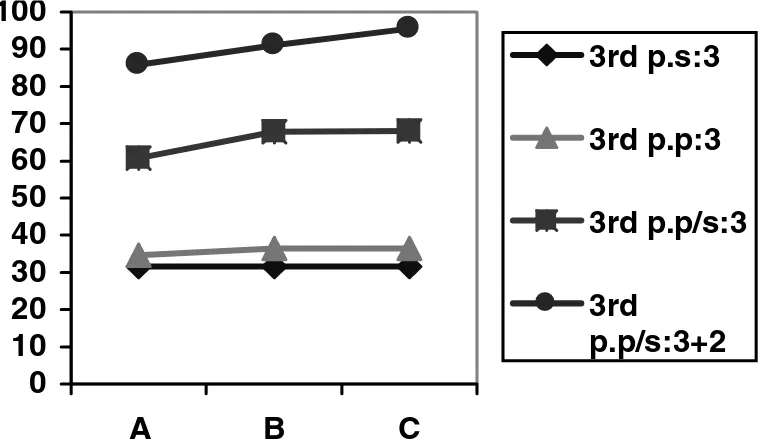
Figure 1 shows that translation quality improves when the system databases are seeded with more translation pairs. We can see that the system does slightly better when it uses third-person plural chunks compared to when it uses their singular coun-terparts. When third-person singular dummy subjects are inserted in order to derive the initial translation fragments inserted into our system’s memories, the number of translations rated 3 for quality deteriorates by about 5% for systems B and C and by about 3% for system A. Given a larger number of third-person plural NP subjects in our test set, this was to be expected.
[image:20.612.103.287.646.700.2]However, a considerable improvement in quality can be seen when fragments from
Table 2
Ranking of “best” translation for sentences: Chunks derived from individual on-line MT systems, third-person plural dummy subjects.
System Ranked 1 Ranked 2–5
0
10
20
30
40
50
60
70
80
90
100
A
B
C
3rd p.s:3
3rd p.p:3
3rd p.p/s:3
3rd
[image:21.612.107.488.91.312.2]p.p/s:3+2
Figure 1
Translation quality improves when system databases are seeded with more translation pairs: Measuring % translation quality using fragments derived from single on-line MT systems.
Table 3
Ranking of “best” translation for sentences: Chunks derived from individual on-line MT systems, third-person singular and third-person plural dummy subjects.
System Ranked 1 Ranked 2–5 Ranked 6–10 Ranked 10–20
A 65.2% 30.5% 0.0% 4.3% B 60.8% 34.9% 0.0% 4.3% C 64.1% 31.6% 0.0% 4.3%
both singular and plural forms are inserted into the system’s memories. Translations produced from chunks derived from system A are rated 3 in 66.1% of cases, and this rises to 67.9% for system B and 68% for system C. Regarding intelligibility (scores 2 and 3 for quality), system A scores 85.8%, system B scores 91.1%, and system C scores 95.6%. We consider these to be very reasonable results.
Table 3 summarizes the relative ranking of the “best” translation when more trans-lation pairs are used to seed the system’s memories. Now that both third-person sin-gular and third-person plural dummy subjects are provided, we see that the number of “best” translations ranked first deteriorates, by about 6% for systems A and C and by 4.5% for system B. In Table 2, we saw that the “best” translation was in no case ranked lower than fifth, but now that many more translations are output per test set sentence, we sometimes have to search as low as 20th in order to find the “best” translation.
4.1.2 Experiment 3: Noun Phrases. The test set comprised 500 noun phrases, with an average NP length of 6.14 words (minimum 3 words, maximum 12). The noun phrases
[image:21.612.104.393.411.465.2]it is highly probable that they do not existen blocin the phrasal lexicon and therefore need to be analyzed using smaller fragments in the system’s databases.
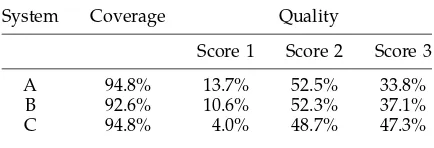
We give results for coverage and translation quality in Table 4. These results are for NPs translated via chunks derived from the three individual on-line MT systems. As with the sentence test set, fragments derived from systems A and C achieve the broadest coverage, producing translations for 474 out of the 500 NPs; those obtained from system B enable 463 of the 500 NPs to be translated.
As for quality, wEBMT clearly performs best when using translation fragments
derived from system C: 47.3% of these translations were awarded a quality score of 3, more than 10% better than for chunks derived from system B. For system C, a total of 452 (96%) of the generated translations were deemed intelligible (scores 2 and 3), that is, 31 (6.6%) more translations than with system B.
On average, about 54% of translations are formed by combining chunks from the phrasal lexicon with those from the marker lexicon, about 9% are produced by inserting marker words into the generalized templates, and about 37% are generated by inserting single non–marker words from the word-level lexicon at the appropriate locations in phrasal chunks. The major reason that translations fail to be produced in 6% of cases is the absence of a relevant generalized template. For example, the unseen
inputher negative TV adsis generalized to (42):
(42) <POSS>negative TV ads
However, the nearest relevant generalized template found in the system’s memory is (43):
(43) <DET>negative TV ads
That is, the template in (43) allows the insertion of any determiner, but no other marker word. Deriving translation fragments from more examples would lead to an improvement in coverage. Alternatively, for marker words that appear in the same relative position, such as determiners and possessive pronouns, we could “back off” to a more general marker tag to allow mutual substitution of such words in a subse-quent operation to enable translation of examples like these. This remains an area of investigation in future work.
[image:22.612.104.321.628.702.2]The results in Table 4 further substantiate our findings on the sentence test set, namely, that system C may be the best of the three on-line MT systems used to populate the memories of our EBMT system. We comment further on this in Section 4.5. In addition, these figures provide strong evidence that our system can indeed translate most noun phrases with which it is confronted and with more than reasonable quality.
Table 4
Translation coverage and quality for NPs: Chunks derived from individual on-line MT systems.
System Coverage Quality
Score 1 Score 2 Score 3
Table 5
Ranking of “best” translation for NPs: Chunks derived from individual on-line MT systems.
System Ranked 1 Ranked 2 Ranked 3–5 Ranked 6–10
[image:23.612.104.283.243.336.2]A 64.6% 9.1% 23.6% 2.7% B 57.7% 15.6% 24.8% 1.9% C 60.0% 7.6% 29.3% 3.1%
Table 6
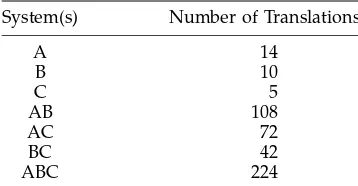
Number of translations produced for the NPa plan for reducing debt over 20 years.
System(s) Number of Translations
A 14
B 10
C 5
AB 108
AC 72
BC 42
ABC 224
The results obtained regarding the ranking of the “best” translation appear in Table 5. Our system ranks the “best” translation first over 57% of the time, and in over 96% of cases, it ranks it in the top five, and at worst in the top ten.
4.2 Experiments Using Multiple Knowledge Sources
If the three on-line MT systems translate the phrases extracted from the Penn-II Tree-bank in different ways, then combining systems to obtain results for AB, AC, BC, and ABC always involves an increase in the number of translations produced, both for sentences and noun phrases. That is, if an input string receives a translation via chunks derived from the individual on-line systems, when chunks are combined from different systems, more translations will be output for that input string.
As an example, the number of translations produced by each system for the NP
a plan for reducing debt over 20 years is shown in Table 6. Whereas the greatest num-ber of translations for this NP produced from chunks from any individual on-line system is 14, when translation fragments from all three systems are merged (ABC), 224 translations are produced. Combining systems in this way means that all possible combinations of chunks from the systems are produced: That is, the number of trans-lations generated via AB is much larger than those derived from either A or B, as now chunks from A and B may be combined to produce new translations that could not be generated from the individual knowledge sources. As a further example, consider
the translation of the NPthe total at risk a year. When fragments from systems A and
B are combined, the “best” translation is comprised of the chunk combination AAB, that is, the three-chunk combination in (44), with the first two chunks obtained from system A, and the last from system B:
(44) [Athe total], [Aat risk], [Ba year]
0
20
40
60
80
100
AB
BC
AC
ABC
3rd p.s:3
3rd p.p:3
3rd p.s/p:3
3rd
[image:24.612.109.484.92.323.2]p.s/p:3+2
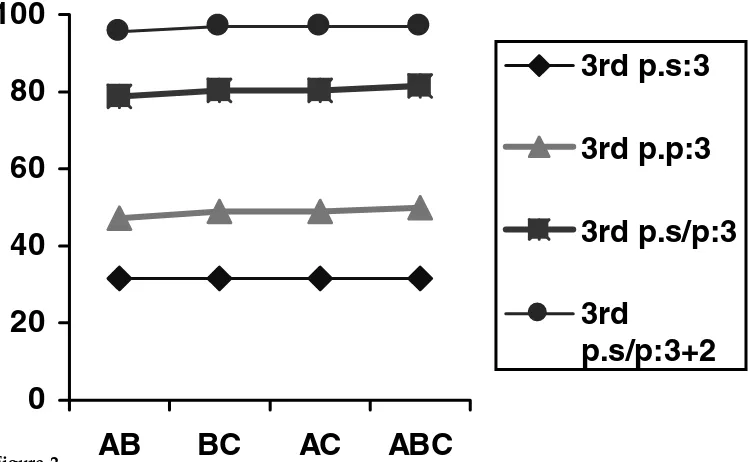
Figure 2
Translation quality improves when system databases are seeded with more translation pairs and when more knowledge sources are used: Measuring % translation quality using fragments derived from combinations of on-line MT systems.
evaluated: Of course, if we consider (say) three-chunk combinations from either system A or B, the only possibilities are AAA or BBB, respectively.
However, the number of translations produced by the system is less significant than their quality. The ranking process outlined in Section 3 classifies the translations produced with regard to their position as the “best” translation. In the sections below, we also discuss the issue of quality and show that it improves when more translation fragments are taken into account. Furthermore, we show below that despite generating
more translations per input string,wEBMTstill ranks the “best” translation in the top
1% of all output translation candidates.
4.2.1 Experiment 4: Translating Sentences by Combining Fragments from Different Systems. We saw in Experiment 1 that 16 strings in the test set were left untranslated by systems A, B, and C individually. When knowledge sources are combined, these 16 strings remain untranslated. However, as Figure 2 shows, the translation quality im-proves significantly. The best individual system performance was 36.5% scoring 3. This rises to a best performance of 48.9% among pairs of systems combined and improves still further to 50% when chunks from all three knowledge sources are combined.
Table 7
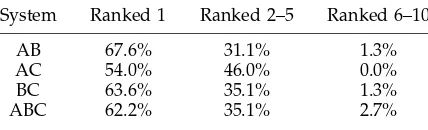
Ranking of “best” translation for sentences: Chunks derived from combinations of on-line MT systems, third-person plural dummy subjects.
System Ranked 1 Ranked 2–5 Ranked 6–10
AB 67.6% 31.1% 1.3% AC 54.0% 46.0% 0.0% BC 63.6% 35.1% 1.3% ABC 62.2% 35.1% 2.7%
4.2.2 Experiment 5: Combining Fragments from Different Systems and Seeding the Databases with More Examples. Figure 2 demonstrates that considerable
improve-ments in translation quality are achieved when the memory ofwEBMTis seeded with
both third-person singular and third-person plural fragments. For the pairwise com-binations, 78.7% of the translations derived from AB are rated 3 for quality, compared to 80.4% of those derived from AC and BC. The results for ABC improve again, to 81.5%. Regarding intelligibility (scores 2 and 3 for quality), we can see from Figure 2 that near perfect results are obtained: AB scores 95.6%, and all other combinations score 96.7%.
Table 8 shows the ranking of the “best” translation when multiple knowledge sources are employed and both third-person singular and third-person plural dummy subjects are used to populate the system’s memories. The number of instances in which
the “best” translation is ranked first bywEBMTdeteriorates: by 24% for AB, by 15% for
[image:25.612.103.442.637.702.2]AC, by 20% for BC, and by 27% for ABC. For all system combinations, Table 7 shows that the “best” translation was ranked no lower than 10th; for the system combinations in Table 8, sometimes the “correct” translation is ranked as low as 36th. As expected, the worst ranking results are for system combination ABC, in which all system chunks are combined for both third-person singular and third-person plural dummy subjects. However, even here the “best” translation is ranked in the top five in over 63% of cases, and 72.6% of the time it is located among the top 10 ranked translations. For this system configuration, the lowest we have to look to find the “best” translation is 36th. For that particular sentence (i.e., the one for which the “best” translation is ranked 36), over 4,000 possible translations are generated, so even here the “best” translation remains in the top 1% of translation candidates.
Table 8
Ranking of “best” translation for sentences: Chunks derived from combinations of on-line MT systems, third-person singular and third-person plural dummy subjects.
System Ranked 1 Ranked 2–5 Ranked 6–10 Ranked 10–20 Ranked 20–40
Table 9
NPs: Coverage and quality improve when fragments from different sources are included.
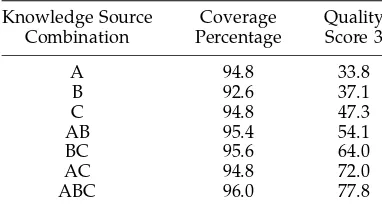
Knowledge Source Coverage Quality Combination Percentage Score 3
A 94.8 33.8
B 92.6 37.1
C 94.8 47.3
AB 95.4 54.1 BC 95.6 64.0 AC 94.8 72.0 ABC 96.0 77.8
4.2.3 Experiment 6: Translating Noun Phrases by Combining Fragments from Dif-ferent Systems.
As we did with sentences, we seeded our EBMT system with fragments derived from the three different on-line MT systems and confronted it with the NP test set. Table 9 clearly shows that as more knowledge sources are added, translation quality improves considerably. The worst-performing individual system scores 3 for quality in just over a third of cases, but when all system chunks are combined, this rises to 77.8%. Note also that, unlike with sentences, we see an increase in coverage when more knowledge sources are used, from a low of 92.6% for system B to a high of 96% when all chunks are combined. Many more improvements are seen when our post hoc validation and correction methodology, described in Section 5, is used, but the merging of fragments derived from different on-line systems also leads to an improvement in translation quality. Consider the examples in (45):
(45) Input: an old story in common
System B: une vieille histoire dans commun
System Combination BC: une vieille histoire en commun
That is, the optional PPin commonwas mistranslated by system B asdans commun, but
when knowledge from system C is added to that of system B, the improved translation
en commun is generated.
[image:26.612.104.368.636.701.2]We saw in Section 4.1.2 that when translating the NP test set, the “best” transla-tion, as adjudged by our human evaluators, was to be found no lower than tenth of all translations output by our system. When knowledge sources are combined, it is
Table 10
Ranking of “best” translation for NPs: Chunks derived from more that one on-line MT system.
System Ranked 1 Ranked 2 Ranked 3–5 Ranked 6–10