Exploring Camera
Angle Effects on
the Evaluation of
Faces and Objects
Rasmus
Wienemann
Faculty of
Behavioral Sciences
Department of
Exploring Camera Angle Effects on the Evaluation of Faces and Objects
Rasmus Wienemann
University of Twente, Enschede, The Netherlands Faculty of Behavioral Sciences
Department of Psychology
1
stExaminer
Dr. Ard Heuvelman
University of Twente Faculty of Behavioral Sciences
Department of Psychology
2
ndExaminer
Dr. Somaya ben Allouch
University of Twente Faculty of Behavioral Sciences
Imagery becomes am increasingly important way of communication in the steadily internationalizing culture of the 21st century. Marketers (Meyers-Levy, J & Peracchio, L.A. 1992; Scott & Vargas, 2007) and designers are especially interested in the possibilities to communicate to their end users with a telling photograph or form of the product. In television or film, the portrayal of actors is constructed with great care to support the story line or create a certain effect. Inevitable in literature over film making a great deal of attention is focused on the presentation of the actors (e.g. Lievaart, R.B. & Hoetink, H., 2007).
Scott & Vargas (2007) argue that pictures in contemporary marketing are starting to function analogous to writing systems. This view of pictorial stimuli as analogous to writing implies that the interpretation of pictures is dependent on cognition as well as learning. A similar assumption of media as an analog to writing systems is opted by Meyrowitz (1998) as one type of media literacy. In his essay, Meyrowitz compares different types of media with different languages with each media type having its own set of grammar in forms of different aesthetic properties that influence the content elements. This grammar is specifically used by media creators to compensate shortcomings of a certain medium. Bold lettering can be used to emphasize the virtue with which an argument is made. Punctuation can help the readability of print media, but can even change the meaning of sentences completely. Film also makes great use of manipulating certain variables in order to create a desired effect. Directors and editors use a variety of techniques like length of shots, point of view, and cuts. Some of the films media grammar can also be applied to still photography, in such instances as point of view and the camera angle argues Meyrowitz.
The angle from which a scene is portrayed greatly influences the viewer’s perception of the actor/actress, scene, individual or object. That said much speculation and applied folk psychology has dominated the subject. Cameramen, movie directors, photographers, marketers and many other professionals have manipulated the camera angle and have hypothesized about the created effect. (e.g. Kepplinger, 1987; Meyers-Levy, 1992) Many effects are argued from a point of common sense. Politicians photographed from a low angle looking up at them seem dominant and powerful. Looking down on the scene let the actor be perceived inferior and small. One explanation states that one‘s experience with looking up at parents whilst growing up and looking down on younger - inferior - siblings effects the perception of individuals and faces.
and Meyers-Levy & Peracchio (1992) While Kraft only found that the perceived size of boxes was influenced in photographic depiction of serial events Meyer-Levy & Peracchio found that the camera angle alone was enough to change the subjects evaluation of a fake advertisement and the depicted product. Furthermore, the researchers found that the level as to which the subject was motivated to analyze the depicted advertisement was of great influence to the size of the camera angle effect. The researchers primed the subjects to different levels of motivation to analyze the advertisement. Additionally the subject‘s Need for Cognition, “[…] an individual‘s tendency to engage in and enjoy effortful cognitive endeavors“ (Cacioppo, J.T., Petty, R.E. & Kao, C.F., 1984, p.306), was measured. The two measures were combined as a motivation to process factors that were found to affect the size of the camera angle effect. A high motivation to process caused the camera angle effect to disappear that was found in lower levels of motivation. The authors argue that the reason for this effect lies in the heuristic processing hypothesis. This hypothesis states that one relates what he or she sees in a picture to themselves by placing themselves in the camera. Therefore a high camera angle depicting someone from above interpreted as looking down on someone. In that way the hypothesis is similar to an evolutionary approach as it also is based on previous experience of the viewer influencing the perception of the present stimulus. The role of motivation to process and Need for Cognition on the heuristic processing hypothesis is that when motivation is at moderate or low levels one falls back on heuristics to analyze pictures and therefore become receptive for the effect of the camera angle. The in depth analysis of the stimulus should not be affected by such an effect, however.
Based on the different, and sometimes contradicting, findings of earlier research (Kepplinger, 1987; Kraft, 1987) the present study aimed to shed more light on the specifics of where camera angle effects occur; namely the present study aimed to investigate the fundamentals of camera angle effects when applied to faces and objects. The first mater that was investigated in this study was if a camera angle on the ratings of the scales occurs on faces and objects identically. Thus exploring the degree to which such an effect is dependent of the stimulus. The following null hypothesis was tested.
H1: An effect of the camera angle is indiscriminate to the nature of the stimulus (i.e. face or object).
The influence of the subjects‘ need for cognition as found by Meyer-Levy & Peracchio (1992) will also be examined in the proposed research. Unlike that study the present study does not present the stimuli in context. As the influence of the ‘Need for Cognition’ might also have influenced the subjects’ perception of the context the present study aimed to reproduce the effect of the ‘Need for Cognition’ in a study without context. The following hypothesis to be tested was formulated.
H2: The subject‘s need for cognition interacts with the camera angle effect.
differentials are expected to measure different aesthetic and emotional properties of each item. The scales used in the study had to suffice a number of criteria. As mentioned they had to be applicable to faces as well as objects. Osgood et al. have determined three main factors in their studies of the semantic differential: Evaluation, Potency and Activation. These factors were found in all of the studies conducted by Osgood and his colleges. All scales used in the present study were scales used in one of those studies and all except maturity were found to load on one of the three main factors. These main factors offer a reliable set of scales to examine the difference in camera effect between faces and objects as they were found across a number of different concepts not limited to humanoid or lifeless stimuli. Osgood et al.(1957) sorted the tested concepts in five concept groups: “person concept“ (me), “physical objects“ (knife), “abstract concepts“ (modern art), “event concepts“ (birth) and “institutions“ (united nations) with each providing one example of the concept used given in parenthesis (p.49). According to the findings of Kepplinger (1987) and Mignualt & Chaudhuri (2003) the scales from the factor Potency as dominance, bravery and strength can be influenced by the camera angle in research of faces. Kraft (1987) has also found evidence for a camera angle effect on the perception of the evaluation scale “good - bad“ evidently that such an effect is not solely limited to potency scales.
All scales had been used in earlier research to rate objects or faces with reliable effect between items or are expected to be applicable for faces as well as objects. Table 1 presents an overview of the scales that were used and the factors they were expected to load on based on the findings of Osgood et al.. The scales for beauty, size and roundness were expected to be applicable for faces and objects without validation from previous research. Maturity, although loading on one of the less describing factors in the research by Osgood et al., will be used due to the insight in the role of the heuristic processing hypothesis as an explanation of the camera effect. Implying that looking up would make an object seem more mature (i.e. grown up) and looking down childish.
Osgood‘s factors were further used to investigate a possible interaction of the factors and the sort of the item (i.e. face or object). An interaction could indicate that the item‘s evaluation is dependent on the kind of scale and underling factor and not simple features of a certain camera angle. This would support the findings of Kepplinger (1987) and Meyer-Levy & Peracchio (1992) in that such a camera effect is not universal and dependent on other factors as the attribute that is measured. The investigation of an interaction can be summarized in the following research question:
Table 1.
Semantic differentials with underlying measure per item and respective factor from Osgood et al.
Scale Measure Factor
good - bad goodnessa b i evaluation
pleasant - unpleasant pleasantnessc a evaluation
beautiful - ugly beauty evaluation
sad - happy moodd evaluation
soft - hard hardnesse f potency
unemotional - emotional emotionalityf potency
tall - short heighti potency
big - small size potency
feminine - masculine masculinityb potency
active - passive activeness/efficacyg activity
round - sharp roundness tautness/activity
interesting - boring interestg receptivness/activity
childish - mature maturityf novelty
Method
Subjects
Subjects were approached via different means to participate in the study. Most subjects were approached via internet and some via personal communication. Via the internet subjects were approached via emails, personal messages in social networks, guest books and mood messages in social networks and the researcher‘s chat application. Subjects were also encouraged to forward the link to the survey further throughout their friends. Three general subject populations that were approached can be defined as fellow students at the University of Twente and, from the background of the researcher subjects from the area of Hanover, Germany and Ottawa, Canada.
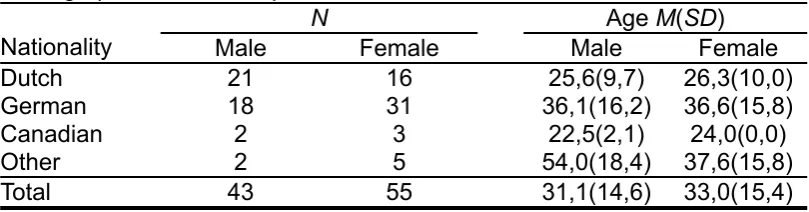
[image:8.595.110.515.459.565.2]Every subject participated at free will and was not rewarded financially or in the form of credits for their participation. The survey was conducted in English as an in-browser online survey all subjects were asked to wear correctional lenses if they usually wore them. screen captures of the survey can be found in Appendix A) The subjects were identified by their IP address and time of participation, 98 completely answered surveys were accumulated within one week, six incomplete data sets had to be eliminated. Of the 98 subjects 43 were male and 55 were female. The mean age was 32,2 years with a standard deviation of 14,5 years. (minimum 17, maximum 72). Of the sample 49 subjects were German, 37 Dutch, 5 Canadian and 7 had another nationality. The demographics of the sample are summarized in Table 2.
Tabel 2.
Demographics of the sample
N Age M(SD)
Nationality Male Female Male Female
Dutch 21 16 25,6(9,7) 26,3(10,0)
German 18 31 36,1(16,2) 36,6(15,8)
Canadian 2 3 22,5(2,1) 24,0(0,0)
Other 2 5 54,0(18,4) 37,6(15,8)
Total 43 55 31,1(14,6) 33,0(15,4)
Stimuli
Figure 1. Female face 1 and kettle from high camera angle.
The objects were free ware files from internet portals in “3ds“ format. The objects were chosen to be similar to faces in size, positive height to width ratio (i.e. higher than wide), number of features, three-dimensionality, availability (common vs. rare) and not cultural specific. Due to the limited extend of the present research it was not possible to match stimuli or pretest different objects, therefore a careful selection was critical. Although to test the hypotheses no direct comparison between stimuli is necessary. it was assumed that such a selection would provide more valid results. Although the faces were presented from a frontal point of view to minimize interference with potential lateral angle effects, the objects were presented in an informative point of view to counteract ambiguity of object recognition but were not rotated between renderings. This was also achieved by using more common objects as opposed to rare objects subjects might not recognize or know. To assure intercultural recognition of the objects no highly cultural specific objects were used. It should be noted that the results are expected to only be applicable to a western culture. The main function of the criteria “number of features“, “positive height to width ratio“ and “three-dimensionality“ was to choose objects whose representation does change by altering the camera tilt. A volleyball, for example, will not differ much depending on camera angle. The same is assumed of mainly “flat“ single feature objects as simple vases for example. Object in the study shall therefore be selected on the basis of these criteria and the assumption of therefore yielding valid results.
Apparatus
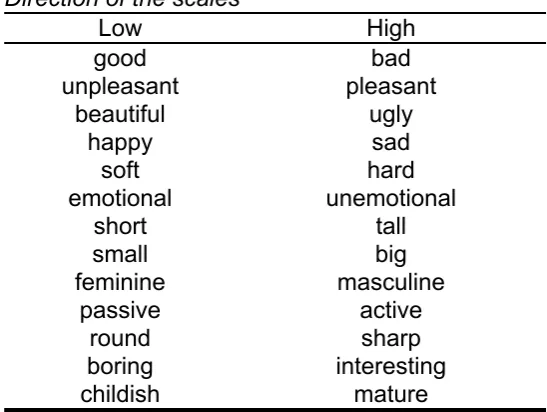
For the evaluation of the stimuli seven point Likert scales with an opposing term at either end of the scale. The survey was conducted via a website and could be filled in within the subject‘s browser window. To prevent a priming or answer pattern effect to occur each subject was presented with stimuli with different camera angles as opposed to making a survey only with stimuli with the same angle in each version. For the sake of the study‘s reliability the only alteration between each page of the survey was the camera angle of the stimulus. To further prevent answer patterns several measures were taken. The scale‘s orientations within one page of the survey were altered between scales, i.e. the left end of the scale scoring high as opposed to the right end. Between stimuli the order of the scales was differed. Four different configurations were produced. This was done in such a manner that each scale was located in every quarter of the list once within the four versions and so that the underlining factors were spread out. The four configurations were then assigned to stimuli in such a manner that each configuration appeared once in every third of the pages. Between versions of the survey the angle per stimulus differed. This was also done so that every angle appeared four times during the survey. Per angle one stimulus was a female face, one a male face and two were objects. Finally these three versions‘ ordered was inverted from back to front to form a total of six different versions. This was done in order to counteract learning or boredom effects. (The exact order of stimuli and scales can be found in Appendix C)
Randomization across the six versions was achieved by an adaptive link on the welcome page. The link sent the first subject to click on the START link to version one, the second to version two and so forth upon having sent a subject to version six it would automatically send the subject to the first version once again and start the cycle anew. This achieved a decent amount of randomization and a similar amount of versions filled in (n1=38, n2=29, n3=31, versions that differ
in camera angle).
Tabel 3.
Direction of the scales
Low High good bad unpleasant pleasant beautiful ugly happy sad soft hard emotional unemotional short tall small big feminine masculine passive active round sharp boring interesting childish mature Procedure
Upon following the link to the Survey the subjects were shown a welcome screen which stated that the study was conducted as part of a bachelor thesis at the University of Twente, the semantic differentials were explained and they were asked to wear glasses or contact lenses if they needed to. Nothing was mentioned about the goal of the study as to achieve reliable results.
After clicking start the first stimulus appeared centered at the top of the window with the semantic differentials underneath. Beneath the scales was a button labeled Reset, which reset all scales, and a button labeled Next, which send the information to the server and redirected the subject to the next stimulus. Upon opening none of the scales were filled in to prevent subjects clicking through the survey. All scales had to be filled in in order to proceed or an error massage would show upon clicking Next.
Following the twelve stimuli the subjects were asked to fill out the condensed ‘Need for Cognition’ scale by Cacioppo et al. (1984). In order to keep the survey consistent the answer possibilities were limited to a seven point Likert scale instead of the nine point scale used by Cacioppo et al. (1984) (for an example of the questionnaire see Appendix E)
Results
Need for Cognition
The ‘Need for Cognition’ (NfC) questionnaire‘s reliability was tested by computing Cronbach‘s Alpha. The reliability coefficient was +0.78 that allows the assumption that the questionnaire did indeed measure one underlying factor. The mean scores of the ‘Need for Cognition’ (NfC) scales were computed for each subject as a variable meannfc. The mean score of this variable of the sample was 4,9 (SD= 0,7) on a scale from 1 through 7. In fact only nine subjects had a meannfc of four or lower. To categorize the sample in low and high NfC two groups were formed using the same method as was used as in the study of Meyer-Levy and Peracchio(1992). The sum of all NfC items‘ scores was computed and the sample‘s median of 90 determined. Subjects were then categorized to either low or high NfC according to their score in relation to the median. The
meannfc of the low-nfc(n=51, M=4,41, SD=0,47) and high-nfc (n=47, M=5,51, SD=0,38) group differed significantly, t(96)=12,35, p < 0,001 (two-tailed).
Hypotheses
To test the hypotheses three (camera angle, i.e. high, eye-level, low) by two (NfC, i.e. high, low) Multivariate Analyses of variance (MANOVA) were performed per stimulus. Dependent variables were the scores on the scales of that stimulus and the independent variables the camera angle and the subject’s NfC category. The results are presented in Tabel 4.
In order to test the first hypothesis that the camera angle effect was indiscriminate to the nature of the stimulus, i.e. face or object, the main effect of the camera angle was examined. On all face stimuli a significant main effect of the camera angle effect was found on the objects, however, only the blender showed a significant effect. To test this difference Analyses of Variance (ANOVA) were performed per scale per stimulus with the camera angle as independent factor. The complete recollections of these ANOVAs can be found in Appendix D. The scale maturity was the only scale that produced no significant effects of the camera angle on any stimulus and was excluded from further analyses. The results were aggregated in a table in such a way that per stimulus per scale could be indicated if the respective ANOVA was significant. This table was then analyzed by means of a nonparametric test. A χ2 square test was performed to test for an interaction between the nature of the stimuli (face or object) and the significance of the ANOVA on a the scales. The test supported that more scales were significant when the stimulus was a face (34 of 72) rather than an object (10 of 72), χ2(1,N = 144) = 18,85, p < 0,001.
Research Question
[image:13.595.138.455.91.634.2]To answer the research question first the reliability of the scales was measured. Cronbach‘s Alpa was +0,81 for the scales of the evaluation factor, +0,69 for the scales of the activity factor and +0,53 for the potency scales. For the factor potency reliability could not be lifted higher than +0,63 by deleting items and the scales were not further analyzed. The maturity scale was not used here
Table 4.
MANOVAs of camera angle and NfC category per stimulus
Source
Source Fa p
female face 1 female face 1
angle 2,68*** 0,00
angle*NfC category 0,65 0,90
female face 2 female face 2
angle 2,50*** 0,00
angle*NfC category 1,40 0,11
female face 3 female face 3
angle 4,70*** 0,00
angle*NfC category 0,76 0,79
male face 1 male face 1
angle 1,76* 0,02
angle*NfC category 0,43 0,99
male face 2 male face 2
angle 2,86*** 0,00
angle*NfC category 0,92 0,59
male face 3 male face 3
angle 2,26** 0,00
angle*NfC category 0,90 0,61
kettle kettle
angle 1,46 0,08
angle*NfC category 2,07** 0,00
blender blender
angle 1,95** 0,01
angle*NfC category 0,72 0,84
microscope microscope
angle 0,77 0,79
angle*NfC category 0,79 0,75
coffee maker coffee maker
angle 1,26 0,19
angle*NfC category 0,53 0,97
hourglass hourglass
angle 1,32 0,16
angle*NfC category 0,67 0,89
hammer hammer
angle 1,02 0,45
angle*NfC category 0,77 0,78
Note.adf=(26,160).
Discussion and Limitations
Discussion
The first Hypothesis can be discarded as the results of the MANOVAs in Table 4 show that the camera angle has an effect on all faces but only on one object. The additional χ2 square test further supports this conclusion. This indicates that there is in fact a difference in camera angle effect between faces and objects in this study. The reason for this difference cannot be completely be clarified by this study neither was it the intention of the research to do so. The scales used might more commonly be used by laity to describe faces rather than objects, although they had been used for both in previous studies as discussed above. Also, from personal communication to the researcher from subjects after they had filled in the survey a little confusion was created by the uni-color objects. This of course is necessary to eliminate uni-color effects but might have caused some evaluation bias that might be stronger with objects that are more often multi-colored rather than generally uni-colored faces.
These results support the heuristic processing hypothesis in that it is much more common that the subjects see faces from different angles with a certain meaning intended than objects. As argued by Mignault and Chaudhuri (2003) the face is often used by humans, but also other life forms to communicate basic emotions and dominance with their environment. Objects, on the other hand, are more commonly seen in only one position as for example on the counter, thus from above, for most kitchen appliances.
In photography and film the camera angle is often used in the same way to produce similar effect. Powerful politicians and royalty are often depicted from a low angle; this might be the result of the way leaders are often positioned on a stage when they talk to a group. The fact the one is used to seeing leaders or powerful individuals on stages and the pictures of those events from a low angle might cause one to develop a heuristic when evaluating low angle shots. If this is true the heuristic processing hypothesis is likely to be a self-fulfilling prophecy in that people are used to a certain depiction and this depiction will than be used by cameramen and photographers to communicate that which in turn further strengthens the heuristic.
The second hypothesis can only be accepted for one stimulus, namely the blender. For all other stimuli no interaction between the camera angle and the level of the NfC could be found. It can be assumed that the subject‘s level of NfC does not interact with the camera angle in the sort of depiction of the stimuli chosen for this study. Te stimuli were presented without context as opposed to the study of Meyers-Levy and Peracchio(1992) where an advertisement with text and picture was used. It might be that in their study the high NfC category simply studied the text more thoroughly, which was identical in both advertisements.
sample. The study of Meyers-Levy and Peracchio also had an above average mean score in their sample but it was still lower that in the present study. The mean of their study was at 60% of the highest possible score where as in this study the mean was at 70% of the highest score. This minimizes the validity of the analysis and therefore makes a definite conclusion over the influence of the NfC for this study impossible. The reasons for the high mean of the sample are believed to be manifold. For one in the researchers environment most people are taking part in a higher educational program or have a university or collage degree. As indicated by earlier research the level of NfC does correlate with educational success (Elias, S.M. & Loomis, R.J., 2002). Also the way the subject was approached, online and semi personally relies on a certain level of curiosity of the potential subject to help by filling in the survey. A person‘s curiosity has been found to positively correlate to that individual‘s NfC. (Olson, K., Camp, C. & Fuller, D.,1984).
The research question could only be tested between two factors as the potency factor was not measured reliably. Also the reliability of the activity factor was rather low but allowed for a general exploration of an effect the underlying factor has on the occurrence of a camera angle effect. The analysis showed that the scales of the evaluation factor were more often significantly influenced by the camera angle than the ones from the activity factor. The factors do differ in amount of times a camera angle effect occurs. The reason for this cannot be determined definitely by the present study. One explanation might be that the evaluation factor correlates to one‘s emotional response to the stimulus that is virtually immediate and that for other factors a longer evaluation period is needed. But to thoroughly study and be able to formulate conclusions over the specifics of such an interaction further research is needed with scales with a higher Cronbach‘s Alpha that measure all three basic factors reliably.
Limitations
In order to allow the present study a more in depth analysis of the effects of the camera angle some alternations would have to be done. A big problem was produced by the nature of the survey concerning the analysis of the gathered data when the decision was made to vary camera angles within versions. This was done to counteract priming and or fatigue effects but caused great difficulties in analyzing the effects of the camera angle. The alternation that each version was equal to one angle would have made an analysis of the camera angle per scale across stimuli possible and therefore a much more detailed and valid testing of the differences between objects and faces. The problem was not foreseen by the researcher.
control the subject‘s experimental setting. Also the size of the subjects screen might influence the effect in that the size of the stimulus is not completely controllable within internet browsers. The size of an image has been positively correlated to perceived arousal by earlier studies (Detenber, B. H.& Reeves, B.A., 1996). This might have an influence and if so it cannot be controlled in the present setup, although the stimulus size was constant in pixels limiting such an effect. Also Exposure times of the stimuli cannot be controlled within this setup.
The present study aimed to isolate the camera angle effect from context. This decision could possibly have biased the result towards the more commonly utilized effect of the camera angle on the evaluation of faces compared to objects. Namely that faces can be portrayed without much context whereas objects are bound to have a context in form of their environ meant that they rest on. The effect of the context on an angle effect is something that should be analyzed in future studies. All studies that generated angle effect with depictions of objects did so with context. in the study of Kraft (1987) the stimulus was part of a story and in the study of Meyers-Levy and Peracchio (1992) of an advertisement.
Future Research
For a more in depth study of the camera effects without context the present study could be repeated with thorough pre-testing of the stimuli to ensure comparability. The survey should further be conducted in such a manner that allows comparison between stimuli across scales as discussed above. The effect of the factors found by Osgood et al. (1987) could also be tested in a study with extensive pre-testing of the stimuli and scales. The role of context should be studied with identical stimuli and a differing context a simple title of each stimulus might suffice to influence the evaluation of the same stimulus on the same scale. Kepplinger (1987) proposed that the camera angle interacts with each scale of evaluation but it could be that the context of a stimulus might interact with a scale as well. A low angle shot of a face with either “The Hero“ or “The Villain“ as a title might invert the camera effect on a scale as good - bad whilst the size of the effect stays constant. Thus the size of the effect is influenced by the angle and the direction by the context and or the scale.
References
Blender (version 2.48a) [Computer software]. (2008). Amsterdam: Stichting Blender Foundation. Bloch, P. H. (1995). Seeking the ideal form: Product design and consumer response. Journal of
Marketing, 59(3), 16-29.
Cacioppo, J. T., Petty, R.E. & Kao, C.F. (1984). The Efficient Assessment of Need for Cognition.
Journal of Personality Assessment, 48(3), 306-307.
Desmet, P. (2003). Measuring Emotion: Development and Application of an Instrument to measure emotional responses to Products. In M. A. Blythe, A. F. Monk, K. Overbeeke & P. C. Wright (Eds.), Funology: From Usability to Enjoyment (pp. 111-123). Norwell, MA: Kluwer
Academic Publishers.
Detenber, B. H. & Reeves, B. A. (1996). Bio-informational Theory of Emotion: Motion and Image Size Effects on Viewers. Journal of Communication, 46(3), 66-84.
Elias, S. M. &Loomis, R. J. (2002). Utilizing Need for Cognition and Perceived Self-Efficacy to Predict Academic Performance. Journal of Applied Social Psychology, 32(8), 1687-1702. Hsu, S. H., Chuang, M. C. & Chang, C. C. (2000). A semantic differential study of designers' and
users‘ product form perception. International Journal of Industrial Ergonomics, 25, 375-391. Kepplinger, H. M. (1987). Darstellungseffekte: Experimentelle Untersuchungen zur Wirkung von
Pressefotos und Fernsehfilmen [Depiction effects: Experimental Studies of the Effect of Press Photos and Television Movies]. Freiburg(im Breisgau): Karl Alber
Kraft, R. N. (1987). The influence of camera angle on comprehension and retention of pictorial events. Memory & Cognition, 15(4), 291-307.
Lievaart, R. B. & Hoetink, H. (2007). Films Maken: alles over film maken op video - een handboek van scenario tot montage (6th ed.). Amsterdam: QQleQ Dramaprodukties
McCain, T. A., Chilberg, J. & Wakshlag, J. (1977). The Effect of Camera Angle to Communicator Credibility. Journal of Broadcasting, 21(1), 35-46.
Meyers-Levy, J. & Peracchio, L. A. (1992). Getting an Angle on Advertising: The Effect of Camera Angle on Product Evaluations. Journal of Marketing Research, 39, 454-461.
Meyrowitz, J. (1998). Multiple Media Literacies. Journal of Communication, 48(1), 96-108.
Mignault, A. & Chaudhuri, A. (2003). The Many Faces of a Neutral Face: Head Tilt and Perception of Dominance and emotion. Journal of Nonverbal Behavior, 27(2), 111-132.
Olson, K., Camp, C. & Fuller, D. (1984). Curiosity And Need For Cognition. Psychological Reports,54(1), 71-74.
Osgood, C. E., Suci, G. J., Tannenbaum, P. H. (1957). The Measurement of Meaning. Urbana, Chicago and London: University of Illinois Press
Table A1
Configurations of scales
configuration 1 configuration 2 configuration 3 configuration 4
hardness interest height goodness
beauty mood pleasantness maturety
activeness emotionality masculiniy size
height hardness roundness interest
pleasantness beauty goodness mood
masculiniy activeness maturety emotionality
roundness goodness size height
interest maturety hardness pleasantness
mood size beauty masculiniy
emotionality height activeness roundness
goodness pleasantness interest hardness
maturety masculiniy mood beauty
[image:29.595.58.542.456.697.2]size roundness emotionality activeness
Table A2
Order Stimuli with respective configuration of scales
item order configuration order inverted configuration
female face1 female face1 3 hammer 3
female face2 kettle 1 male face3 1
female face3 male face1 4 hourglass 4
male face1 blender 2 female face3 2
male face2 microscope 4 male face2 1
male face3 female face2 3 coffee maker 2
Kettle coffee maker 2 face2 3
Blender male face2 1 microscope 4
Microscope female face3 2 blender 2
Coffee Maker hourglass 4 male face1 4
Hourglass male face3 1 kettle 1
M(SD) ANOVA of angle stimulus
stimulus low eye-level high df F-score
female face 1 female face 1
active 3,55(1,408) 3(1,317) 3,31(1,628) 2,95 1,241
beauty 3,66(1,192) 3,71(1,189) 3,48(1,617) 2,95 0,24
emotion 4,32(1,646) 3,39(1,022) 4,17(1,649) 2,95 3,718*
gender 4,05(1,676) 3,26(1,505) 2,79(1,424) 2,95 5,696**
good 3,26(1,223) 3,23(0,717) 3,55(1,242) 2,95 0,803
hard 3,76(1,55) 2,87(0,991) 3,59(1,783) 2,95 3,347*
height 4,42(1,718) 5,13(1,024) 4,97(1,18) 2,95 2,538
interest 4,39(1,285) 4,29(0,902) 4,28(1,556) 2,95 0,09
maturity 4,42(1,734) 5,29(1,16) 4,9(1,472) 2,95 2,919
mood 3,76(1,101) 3,23(1,055) 4,28(1,222) 2,95 6,543**
pleasant 3,39(1,424) 3,58(1,205) 3,97(1,658) 2,95 1,321
round 3,66(1,381) 3,35(1,082) 4,07(1,602) 2,95 2,056
size 4,08(1,363) 4,16(1,416) 3,79(1,449) 2,95 0,568
female face 2 female face 2
active 3,38(1,449) 3,82(1,642) 3,71(1,395) 2,95 0,718
beauty 3,76(1,215) 2,89(1,247) 3,19(1,078) 2,95 4,402*
emotion 3,86(1,529) 3,29(1,45) 3(1,065) 2,95 3,085
gender 4,1(1,448) 3,16(1,669) 2,19(1,046) 2,95 13,352**
good 3,76(1,154) 2,68(1,297) 2,94(0,964) 2,95 7,441**
hard 3,52(1,573) 2,63(1,149) 3(1,238) 2,95 3,736*
height 4,38(1,237) 4,66(1,341) 4,61(1,145) 2,95 0,446
interest 4,24(1,55) 4,47(1,33) 4,68(1,194) 2,95 0,771
maturity 4,72(1,667) 4,74(1,571) 4,68(1,351) 2,95 0,014
mood 3,79(1,177) 2,89(1,429) 3,19(1,302) 2,95 3,867*
pleasant 4,07(1,387) 2,66(1,341) 3,26(1,154) 2,95 9,702**
round 3,17(1,227) 2,66(1,236) 2,81(1,223) 2,95 1,48
size 4,45(1,429) 3,97(1,241) 3,74(0,999) 2,95 2,557
female face 3 female face 3
active 3,61(1,476) 3,97(1,295) 3,95(1,374) 2,95 0,649
beauty 4,42(1,119) 3,31(1,168) 3,39(1,285) 2,95 8,325**
emotion 3,61(1,334) 2,55(0,985) 3,24(1,618) 2,95 4,635*
gender 4,58(1,587) 2,45(1,27) 1,76(0,852) 2,95 45,833**
good 4,06(1,153) 3,14(0,875) 3,03(1,15) 2,95 9,032**
hard 4,26(1,365) 2,76(1,185) 2,84(1,285) 2,95 13,616**
height 4,77(1,23) 4,83(1,002) 4,55(1,589) 2,95 0,417
male face 1 male face 1
active 3,81(1,558) 4,16(1,685) 4,1(1,589) 2,95 0,445
beauty 5,39(0,989) 5,37(1,076) 4,86(1,093) 2,95 2,435
emotion 3,19(1,327) 3,18(1,658) 3,66(1,542) 2,95 0,956
gender 6,39(0,882) 6,63(0,589) 6,31(0,806) 2,95 1,688
good 4,9(1,165) 4,92(1,124) 4,97(1,239) 2,95 0,022
hard 4,23(1,23) 4,84(1,386) 4,72(1,162) 2,95 2,155
height 5,16(1,214) 4,89(1,673) 5(1,195) 2,95 0,308
interest 3,9(1,35) 4,39(1,346) 4,72(1,131) 2,95 3,107*
maturity 5,81(1,25) 5,74(1,446) 6,31(0,604) 2,95 2,151
mood 5,03(1,016) 5(0,838) 5,03(1,149) 2,95 0,013
pleasant 5,32(0,979) 4,95(1,374) 5,03(1,21) 2,95 0,864
round 2,94(1,365) 3,13(1,563) 4,21(1,497) 2,95 6,431**
size 5,68(1,137) 5,76(0,998) 4,76(1,38) 2,95 7,065**
male face 2 male face 2
active 3,87(1,51) 3,03(1,401) 2,81(1,108) 2,95 5,893**
beauty 5,68(1,042) 5(1,195) 4,26(1,264) 2,95 12,885**
emotion 3,89(1,624) 4,41(1,476) 3,84(1,463) 2,95 1,301
gender 6,37(0,852) 5,79(1,207) 5,68(1,166) 2,95 4,201*
good 4,71(1,113) 3,9(1,012) 3,97(1,08) 2,95 6,13**
hard 4,92(1,73) 3,79(1,634) 4,42(1,361) 2,95 4,124*
height 4,97(1,404) 4(1,389) 4,03(1,426) 2,95 5,389**
interest 4,08(1,217) 3,72(1,306) 3,77(1,543) 2,95 0,698
maturity 5,61(1,264) 5,38(1,208) 5,42(1,285) 2,95 0,319
mood 5,16(1,079) 4,59(1,119) 5,03(1,048) 2,95 2,434
pleasant 5,29(1,011) 4,48(1,353) 4,42(1,148) 2,95 6,078**
round 3,21(1,545) 2,79(1,346) 3,23(1,407) 2,95 0,881
size 5,71(1,206) 5,28(1,131) 4,48(1,092) 2,95 9,839**
male face 3 male face 3
active 3,14(1,706) 2,68(1,222) 3,37(1,422) 2,95 1,957
beauty 5,52(1,379) 4,45(1,261) 4,16(1,305) 2,95 9,337**
emotion 3,72(1,83) 4,03(1,354) 4,08(1,634) 2,95 0,444
gender 6,07(0,923) 5,97(0,912) 5,58(1,177) 2,95 2,188
good 4,52(1,243) 3,74(1,182) 3,37(1,149) 2,95 7,809**
hard 4,07(1,944) 4,06(1,209) 4,05(1,77) 2,95 0,001
height 4,76(1,405) 4,71(1,101) 4,37(1,46) 2,95 0,873
interest 3,83(1,284) 3,77(1,454) 4,58(1,308) 2,95 3,892*
maturity 5,55(1,152) 5,68(1,045) 5,42(1,056) 2,95 0,481
mood 5,21(0,978) 4,1(0,978) 4,53(1,428) 2,95 6,795**
pleasant 5,21(1,346) 4,19(1,327) 4,13(1,51) 2,95 5,679**
round 2,72(1,222) 3,03(1,329) 2,89(1,41) 2,95 0,402
stimulus
stimulus low eye-level high df F-score
object 1 object 1
active 3,26(1,653) 2,79(1,373) 3(1,375) 2,95 0,758
beauty 4,26(1,064) 4,31(1,137) 3,58(1,5) 2,95 3,587*
emotion 4,61(1,202) 5,31(1,775) 4,53(1,672) 2,95 2,317
gender 3,45(1,06) 3,41(1,24) 2,95(1,207) 2,95 2,006
good 3,58(0,958) 3,31(1,312) 2,79(1,166) 2,95 4,237*
hard 5,06(1,569) 5,38(1,59) 4,32(2,028) 2,95 3,258*
height 4,19(1,515) 3,79(1,398) 3,37(1,567) 2,95 2,588
interest 3,48(1,546) 3,38(1,449) 3,97(1,442) 2,95 1,592
maturity 4,81(1,046) 4,55(1,055) 4,79(1,143) 2,95 0,522
mood 3,9(0,746) 3,69(0,93) 3,71(0,984) 2,95 0,538
pleasant 3,87(1,284) 3,66(1,344) 2,89(1,034) 2,95 6,255**
round 2,9(1,274) 2,79(0,902) 2,53(1,502) 2,95 0,803
size 4,87(1,31) 4,41(1,427) 3,97(1,365) 2,95 3,686*
object 2 object 2
active 3,31(1,892) 4,37(1,731) 4,19(1,682) 2,95 3,229*
beauty 4,48(1,326) 4,95(1,451) 4,42(1,025) 2,95 1,741
emotion 5,72(1,162) 5(1,507) 4,84(1,393) 2,95 3,537*
gender 4,83(1,071) 4,63(1,46) 4,13(0,922) 2,95 2,765
good 3,9(0,9) 3,61(1,22) 3,39(1,116) 2,95 1,612
hard 6,03(0,981) 5,45(1,537) 5,16(1,344) 2,95 3,341*
height 4,62(1,347) 4,66(1,097) 4,32(1,107) 2,95 0,784
interest 4,52(1,703) 3,58(1,671) 3,71(1,575) 2,95 2,952
maturity 5,17(1,071) 4,76(1,125) 4,74(1,032) 2,95 1,537
mood 4,03(1,117) 3,76(0,82) 3,9(1,136) 2,95 0,589
pleasant 4,17(1,227) 3,79(1,298) 3,65(1,17) 2,95 1,452
round 4,97(1,322) 5,08(1,65) 4,87(1,36) 2,95 0,173
size 4,38(1,522) 4,26(1,288) 4,29(1,039) 2,95 0,07
object 3 object 3
active 4,26(1,537) 4,07(1,387) 3,65(1,664) 2,95 1,411
beauty 3,79(0,991) 3,9(0,9) 3,97(1,169) 2,95 0,265
emotion 5,03(1,533) 5,52(1,353) 4,77(1,334) 2,95 2,117
gender 4,45(1,058) 4,21(0,94) 4,26(1,094) 2,95 0,514
good 2,92(1,302) 3,45(1,088) 3,26(1,341) 2,95 1,529
hard 5,18(1,373) 4,76(1,596) 5,03(1,472) 2,95 0,692
height 3,71(1,113) 3,52(1,379) 3,71(1,189) 2,95 0,255
interest 5,37(1,239) 4,9(1,423) 5,1(1,399) 2,95 1,037
object 4 object 4
active 4,14(1,807) 4,13(1,668) 3,79(1,891) 2,95 0,425
beauty 3,79(0,94) 3,81(1,014) 4,11(1,226) 2,95 0,927
emotion 5,34(1,565) 4,84(1,44) 4,5(1,607) 2,95 2,468
gender 4,07(1,193) 3,87(1,056) 4,03(1,284) 2,95 0,237
good 3,03(1,017) 3,35(0,915) 3,05(1,374) 2,95 0,783
hard 4,9(1,566) 3,87(1,284) 4,16(1,717) 2,95 3,506*
height 4,1(1,012) 3,68(1,107) 3,68(0,904) 2,95 1,808
interest 3,45(1,804) 3,87(1,648) 3,61(1,764) 2,95 0,456
maturity 5(0,964) 4,97(1,08) 4,95(1,251) 2,95 0,018
mood 3,76(0,786) 3,65(1,142) 3,79(1,069) 2,95 0,182
pleasant 3,45(1,213) 3,16(1,157) 3,21(1,359) 2,95 0,451
round 3,41(1,15) 3,13(1,335) 2,89(1,247) 2,95 1,422
size 4,21(0,978) 3,97(1,048) 3,66(1,192) 2,95 2,144
object 5 object 5
active 4,18(1,753) 4,45(1,609) 3,66(1,587) 2,95 1,782
beauty 3,66(1,341) 3,23(1,087) 3,93(1,252) 2,95 2,49
emotion 4,95(1,469) 4,9(1,3) 5,72(1,533) 2,95 3,142*
gender 4,08(1,124) 3,65(1,082) 3,97(1,18) 2,95 1,316
good 3,34(1,258) 3,26(0,815) 3,55(1,152) 2,95 0,563
hard 4,53(1,606) 4,06(1,632) 3,9(1,423) 2,95 1,491
height 4,18(1,574) 4,13(1,384) 4,24(1,354) 2,95 0,045
interest 4,21(1,417) 4,39(1,476) 3,48(1,639) 2,95 3,057
maturity 5(1,162) 5,16(1,098) 4,69(1,168) 2,95 1,312
mood 4,26(1,131) 4(0,73) 3,79(0,902) 2,95 2,046
pleasant 3,74(1,501) 3,61(1,022) 4,1(1,205) 2,95 1,193
round 2,53(1,084) 2,94(1,289) 2,69(1,039) 2,95 1,102
size 4,16(1,763) 4,32(1,376) 4,17(1,49) 2,95 0,109
object 6 object 6
active 4,71(1,716) 5,16(1,534) 4,72(1,98) 2,95 0,755
beauty 4,68(1,166) 4,29(1,037) 4,14(1,432) 2,95 1,63
emotion 5,23(1,257) 4,58(1,654) 5,21(1,521) 2,95 2,107
gender 5,74(1,39) 5,66(1,146) 5,66(1,173) 2,95 0,05
good 4,03(1,11) 3,34(1,564) 3,55(1,454) 2,95 2,121
hard 6,39(0,919) 6,21(1,212) 6,55(0,632) 2,95 1,01
height 4,26(1,612) 4,39(1,669) 4,24(1,48) 2,95 0,096
interest 3,48(1,313) 4,18(1,411) 4(1,581) 2,95 2,119
maturity 5,42(1,089) 5,24(1,324) 5,48(1,09) 2,95 0,397
mood 4,13(0,718) 4,26(0,76) 3,93(0,842) 2,95 1,521
pleasant 4,84(1,319) 4,29(1,412) 4,34(1,542) 2,95 1,455
round 4,94(1,413) 5,18(1,54) 5,69(1,168) 2,95 2,259
Dr. Heuvelman Dr. ben Allouch
Mr. Jonker Graeme
Loes Bart