FLIGHT RECORDERS. A TECHNIQUE FOR THE
STUDY OF BIRD NAVIGATION
BY D. H. WILKINSON
From the Cavendish Laboratory, University of Cambridge
(Received 15 December 1949)
(With Three Text-figures)
Experiments on the homing ability of birds usually take the form of displacing a bird from its home, releasing it at a known time, observing its behaviour until out of sight and then noting the time when it returns, if at all, to its home. If the interval between release and return is that appropriate to direct flight from release point to home the interpretation is obvious; the bird has flown more-or-less straight home. If, as is more usual, the interval is considerably greater than the direct flight time the question arises as to whether the bird has been flying all the time or whether some substantial fraction of the time has been spent in other ways such as resting and feeding. It is of importance to be able to answer this question: a theory of bird homing based on methodical or random search would demand a considerable time spent actually on the wing, while a theory which postulates some genuine naviga-tional ability on the part of the bird would admit of considerable resting periods and a time actually in the air no bigger than the direct flight time. The time spent in flying is, then, a vital datum which is lacking in conventional homing experiments.
One solution lies in the following of the bird by light aeroplane or helicopter, and some work in this direction has already been reported by Griffin & Hock (1949). This method does not permit of following the bird for more than a few hours so that only the first one or two hundred miles of the course can be mapped, and the tracking of a bird which spends several days over the journey is obviously impossible. The method can only be applied to fairly large and conspicuous birds, is always open to the suspicion that the bird's flight is influenced by the proximity of the aeroplane, and is slow in gathering data. It is, nevertheless, a most powerful technique, and has already yielded invaluable information.
during a flight would have lead to an error of a factor two in the estimated flying time.
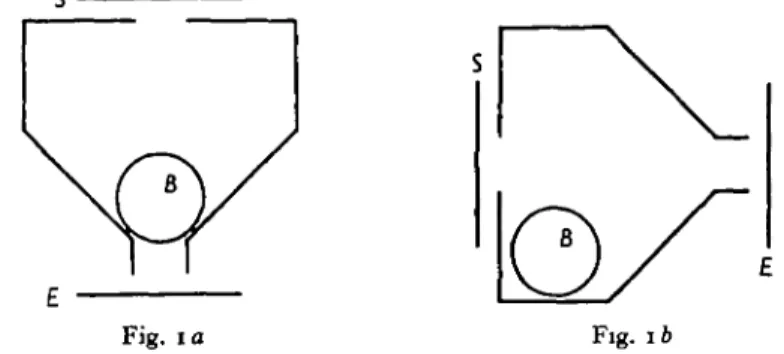
Essentially what is required is some form of clock which only operates when the bird to which it is fixed is on the wing and whose time-keeping is unaffected by such variables as the bird's air-speed and the ambient temperature. The clock should be very light so as not to interfere with normal flight, and, because of the large numbers required and the high probability of total loss, should be easy and cheap to make. Such clocks or flight recorders may easily be constructed, the mechanism being the recording, on a piece of photographic emulsion, of the a-particles emitted from a radioactive source. The rate of such emission is entirely unaffected by external circumstances while the recording is completely quantitative, examination of the processed emulsion through a high-power microscope showing very clearly the tracks of individual a-particles, enabling the total number received to be directly counted. (A popular account of the photographic plate technique for the studying of nuclear radiations such as the a-particle has been given by Powell & Occhialini (1947).) It is then merely necessary to combine such a radioactive source and photo-graphic emulsion (both of negligible weight) with some sort of shutter which is interposed between the two except when the bird is in flight: the penetration of the a-particle into solid matter is only a few tens of microns so this shutter need not be very substantial. One possibility which immediately presents itself is to fix the recorder on to the bird in such a way that it is differently oriented when the bird is in flight or on the ground, and use gravity to open and close the shutter. The device which has been developed is illustrated schematically in Fig. 1 a, b. The orientation when the bird is not in flight is shown in Fig. 1 a. 5 is the a-particle source and E
Fig. 1 a Fig. 16
194
s
wings are a natural second choice: it is easy to find places where the recorder may be fixed so that its orientation while the bird is on the ground is always within 45 ° of that of Fig. 1 a except in exceptional circumstances of violent motion, display and so on, while in flight the orientation of Fig. ib is approximated to. Thus in the domestic pigeon the recorder is fixed on the undersurface of the quill and inner web of the second primary just about where this feather disappears beneath the under wing coverts. At this point in normal carriage the quill is roughly horizontal, so the recorder is fixed at right angles to it. In flight the axis of the recorder is roughly horizontal and, in any case, the centrifugal force tends to hold the ball B against the side of the recorder rather than in the bottom of the cone.
The recorder is calibrated by laying it on its side as in Fig. 1 b for a known time. Tests with birds in the loft and in flight have shown that the device works accurately in both orientations. It has a fairly wide range of sensitivity. Thus in the model about to be described the area of emulsion exposed to the a-particle source is about 0-2 sq. mm.: within this area one can count quantitatively up to about 20,000 a-particle tracks (the tracks are formed at right angles to the plane of the emulsion so have the least tendency to overlap in the field of view). Now the counting of 1000 tracks gives a probable error, owing to statistical
fluctuations, of about 2 % in the estimate of the flying time, so a factor of 20 or so is permitted between the longest and shortest flight times if all are to be known to 2 % or better, and if the accuracy aimed at were only 10% this factor would rise to 500. Anytime scale from minutes to weeks may be catered for by changing the strength of the radioactive source, and even if 10,000 tracks are desired in a 10 min. flight the source strength demanded is less than a micro-curie. The recorder may, of course, be stored all ready for use for long periods in the position of Fig. 1 a without any a-particle leakage on to the emulsion from the strongest source. The emulsion may be processed and examined at leisure.
An 'exploded' view of the working design of the recorder is shown in Fig. 2. S, E and B have the same significance as before. S is a polonium a-particle source deposited on a piece of thin silver foil from a solution in nitric acid. Polonium has the advantage of cheapness and of being a practically pure a-particle emitter—a source whose a-particles are accompanied by strong /S or y-radiation is undesirable because these radiations, more penetrating than the a-particles, may fog the emulsion if the device remains long before use and make counting of the a-particle tracks
means that there is no radiation hazard for the bird. A disadvantage of polonium is that it decays relatively quickly: unless all the flights and calibration exposures are over in a time much less than the half-life of 140 days the decay must be allowed for, but this may be done easily and accurately.* £ is a disk of Ilford C 2 stripped emulsion of diameter 4 mm. and of thickness 50 fi. After exposure it may be affixed to a specially prepared glass slide supplied by Messrs Ilford, and then processed in the usual way. B, the steel ball, has a diameter of 1 mm., and serves as a scale for the figure. The rest of the device is made on the lathe, and is of duralumin. This metal is chosen for its lightness and because it does not have so deleterious an effect on the emulsion as many metals (anodized aluminium would be still better in this respect). The plug F is a push fit into the body D, and is short enough to allow a little play to the emulsion. F and D are recessed above and below the emulsion to avoid contact between the metal and the important central region of E where the a-particles strike. C may be cemented on to D; A may simply be coated on the sides with soft wax and pressed into C to retain the source S. The recorder, ready for use, weighs about 250 mg. It may either be fixed directly to the feather as described above, or, better, a light bucket made of duralumin may be fixed in its place some days before the flight and loaded with a mass equal to that of the recorder. The bird may then accustom itself to the attachment, and may be given practice flights with it in place. For use the recorder is slipped into the bucket and secured by a thread passing through a hole in the base of the bucket and in a slot filed along the diameter of A and C. A rubber solution, such as Bostik, has been found very satisfactory for sticking the device to the feather. Domestic pigeons accustom themselves within a few minutes to the attachment, and there is no evidence that their flight is affected in any way. A balance weight may be symmetrically fixed on the other wing. This device has been successfully used in the summer of 1949 in large-scale experiments on the homing of domestic pigeons performed in collaboration with Mr G. V. T. Matthews: these experiments form part of an extensive investigation into the homing and navigational ability of birds in progress at the Department of Zoology, Cambridge.
No attempt has been made to reduce the device to its smallest form. The size is
• The correction is made as follows. Suppose the bird spends a time TX between release and return, the calibration exposure begins a time T, after the release of the bird, and then it lasts a time T3; then the apparent flight tune as deduced from the recorder should be multiplied by
If now AT!, AT,, AT3<<I this expression reduces to i — A (JT, + T, — J-rj), A is the decay constant of the active body used: for polonium it is equal to o 00495 day"1, the T'S being measured in days.
This correction may, of course, be circumvented by using an active body of long half life (which is equal to 0693/A). Use of such a body would also get over the assumption, implicit in the correction stated above, that the flying time is roughly uniformly distributed throughout the time TJ. Many such bodies of long half life are available, though none is so convenient as polonium.
limited only by the availability of small steel balls or the equivalent, and by the inconvenience of handling small fragments of emulsion. An overall reduction in scale by a factor two should be realizable, and, with economy of metal, a mass of 20 mg. should be attainable. This would enable the technique to be applied to quite small birds.
It would be an advantage, for the study of gliding and soaring birds such as gulls and gannets, to have a device which distinguished between gliding or soaring and flapping flight. Such a composite device has not been made, but one which responds only to flapping flight is illustrated schematically in Fig. 3. A steel weight W of
Fig 3
length 4 mm., bearing on its free end an a-particle source is held axially within the cylindrical body B of the device by a thin tungsten wire T. When the device is not subject to sideways acceleration a-particles may pass down the narrow hole and register on the emulsion E. If accelerated, however, as when fixed to a flapping wing, the weight W moves from side to side relative to B, and the a-particles may only fall on the emulsion for a fraction of the time, while the free end of W is passing the hole. The recorder may be 'shut off' for storing by placing the pole of a magnet alongside, drawing Wto the inner wall of B. A device of the proportions of Fig. 3 and with a wire of diameter 40 p. has been made and tested on domestic pigeons. When fixed in the same place as described for the other device (but parallel to the quill), it recorded about one-fifth as many tracks when flying as when not. This fraction will vary with the species studied, and must be determined in test flights. If this can be done, an examination of the records of the two types of device carried by the same bird will reveal the time spent flapping, that spent gliding and that spent other-wise than in flight. This device has not yet been used in any large-scale experiments. Refinements of the devices and applications of the method suggest themselves in numbers. Thus the combination of a compass card of emulsion and a shutter would yield the time spent flying in various directions. An air-speed indicator could be constructed by mounting the source on a light spring and vane. A device for measuring the time spent by a bird on water could be made by opposing a source to a piece of emulsion covered by a thin light and water-proof layer so that water came between the two when the bird was on, say, the sea. But such devices would demand much more technical skill in construction than those described here.
Department of Radiochemistry, Cambridge, for his help with the polonium sources; to Mr D. D. Stewart, of the Cavendish Laboratory, for his patience and skill in machining the many prototypes of these devices, and, finally, to Mr G. V. T. Matthews, of the Zoological Laboratory, Cambridge, for much help with the tests.
REFERENCES
EXNER, S. (1905). S.B. Akad. Witt. Wien, 114, 763.
GRIFFIN, D . R. & HOCK, R. J. (1949). Ecology, 30, 176.