The Processing of R e f e r r i n g Expressions d i t h i n \ a Semantic Network
John R. Anderson Yale U n i v e r s i t y
Frege (1892) i s c r e d i t e d w i t h emphasizing t h e d d s t i n c t i o n between s e n s e and r e f e r e n c e . H i s fa- mous example involved t h e mornige star and t h e evening s t a r . D e s p i t e t h e f a c t t h a t t h e y both re-
f e r t o t h e same o b j e c t ( i . e . , Venus), t h e y have d i f f e r e n t s e n s e s a s witnessed by t h e f a c t t h a t s e n t e n c e (1) is n o t synonymous w i t h s e n t e n c e ( 2 ) :
(1) The morning s t a r i s t h e morning s t a r . ( 2 ) The morning s t a r i s t h e evening s t a r . This p h i l o s o p h i c a l i s s u e h a s s i m i l a r i t i e s t o an
i s s u e t h a t i s of importance t o understanding n a t - u r a l language processing: How do s u b j e c t s process r e f e r r i n g e x p t e s s i o n s t o e x t r a c t i n t e r n a l repre- s e n t a t i o n s (a) of t h e i h meaning and (b) of t h e i r r e f e r e n t s An t h e e x t e r n a l world. The exanple sen- t e n c e t h a t we w i l l b e r e t u r n i n g t o i n t h i s paper i s :
(3) The f i r s t p r e s i d e n t of t h e United S t a t e s was a bad husband.
It is c l e a r t h a t i n understanding t h i s s e n t e n c e we both process t h e s u b j e c t a s a d e s c r i p t i o n , and i d e n t i f y t h i s a s r e f e r r i n g t o George Wash- ington. This paper w i l l t r y t o e x p l a i n how t h i s comes about. A s I b e l i h e t h a t a l l i n t e r e s t i n g q u e s t i o n s about r e p r e s e n t a t i o n come down t o
q u e s t i o n s about memory, I w i l l approach t h i s ques- t i o n from a human memory perspective.
Some " s e l f -evident1' t r u t h s about human memoty
.
To set up a framework f o r further d i s -cussions, I would l i k e t o l i s t some of t h e f a c t s that I t h i n k we know +bout human memory
--
e i t h e r because of a s o p h i s t i c a t e d common s e n s e and s e l f - observation o r because of a mass of e x p e r i m e n t a l d a t a :(1) Human memory can be conceived of as a neswork of associations,among concepts.
(2) Some nodes i n t h i s network refer t o i n - d i v i d u a l s i n t h e e x t e r n a l world.
(3) Once i n f o r m a t i o n i s d e p o s i t e d i n memory i t cannot be erased.
While t h e r e are a number of memory t h e o r i e s t h a t embody t h e s e assumptions, I w i l l be using t h e
ACT
model (Anderson, 1976) t o p r e s e n t t h e t h e o r y and d i s c u s e t h e data i n t h i s paper. With t h i s b r i e f statement of the p r e - t h e o r e t i c a l b i a s e s , I would l i k e t o t u r n t o a n experimental paradigm which c a p t u r e s , i n expanded t i m e s c a l e , t h e p r o c e s s e s thatI
t h i n k a r e going on when we comprehend re- f e r r i n g expressions.A Mock-up of t h e Morning
Star-even in^
S t a r Exaplple One of t h e experiments i n t h i s s e r i e s ( s e e Anderson, 1977; Anderson & Hastie, 1974 for athorough r e p o r t ) had s u b j e c t s study a s e t ~f f a c t s
such a s (4)
-
(8) :(4)
The smart Russian ie t h e t a l llawyer,
(5) The smart Russian cdrsed t h e s a l e s g i r l . (6) The smart Russian rescued t h e k i t t e n ' . (7) The t a l l lawyer adopted t h e c h i l d . (8) The
t a l l
lawyer caused t h e a c c i d e n t . The c r i t i c a l manipulation was whether the i d e n t i - [image:1.860.438.783.341.951.2]f i c a t i o n s e n t e n c e
(44
was l e a r n e d some time be- f o r e o r some time a f t e r s e n t e n c e s (5) -(8).
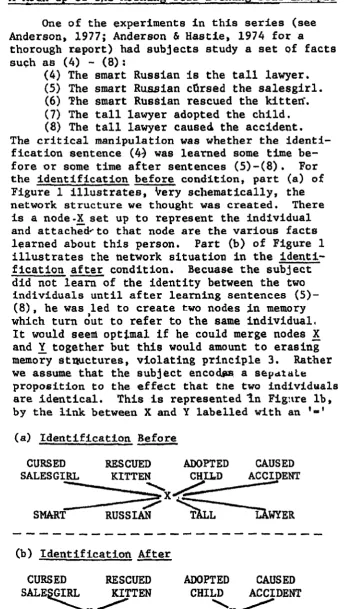
For t h e i d e n t i f i c a t i o n befoxe c o n d i t i o n , p a r t (a) o f Figure 1 i l l u s t r a t e s , bery scbernatically, t h e network s t r u c t u r e w e thought was c r e a t e d . Therei s a node-X set up t o r e p r e s e n t t h e i n d i v i d u a l and attach;& t o t h a t node a r e t h e v a r i o u s f a c t s l e a r n e d about t h i s person. P a r t (b) of Figure 1 i l l u s t r a t e s t h e network s i t u a t i o n
i n
t h e i d e n t i - f i c a t i o n a f t e r c o n d i t i o n . Becuase the s u b j e c t d i d not l e a r n of t h e i d e n t i t y between t h e two i n d i v i d u a l s u n t i l a f t e r l e a r n i n g s e n t e n c e s ( 5 ) -( 8 ) . he was l e d t o c r e a t e two nodes i n memory which t u r n Gut: t o r e f e r t o t h e same i a d i v i d u a l ,
It would seeui o p t t m a l i f he could merge nodes X and t o g e t h e r b u t t h i s would amount t o erasin; memory a t q u c t u r e s , v i o l a t i n g p r i n c i p l e 3. Rather w e assume t h a t t h e s u b j e c t e n c o b a s e r a t a b p r o p o s i t i o n t o t h e e f f e c t t h a t t n e two i n d i v i d u a l s a r e i d e n t i c a l . T h i s i s r e p r e s e n t e d I n Fig:tre l b , by t h e l i n k between X and Y l a b e l l e d w i t h an ' = I
( a ) I d e n t i f i c a t i o n Before
CURSED RESCUED ADOPTED CAUSED
SALESGIRL KITTEN CHILD ACCIDENT
(b) I d e n t i f i c a t i o n A f t e r
CURSED RESCUED ADOPTED
CAUSED
S & E y x Y E N CH1Lty<DENT
/ \
SMART RUSS
IAN
TALL/
LAWYJIRThe memory r e p r e s e n t a t i o n s i n P a r t s (a) v8.m
(b) make d i f f e r e n t p r e d i c t i o n s about time t o v e r i f y statements
(9)
vs. (LO):(9) The amart Russian cursed t h e s a l e s g i r l . (10) The smart Ruasian caused t h e a c c i d e n t . Statement (9) i s r e f e r r e d t o a8 a d i r e c t statement because it i s i d e n t i c a l t o a study statement, while statement (10) i d r e f e r r e d t o as an i n f e r - ence ae i t can be I n f e r r e d from s t a t e m e n t s (4) and (8) ,
Table 1 d i s p l a y s s u b j e c t s ' r e a c t i o n times t o v e r i f y d i r e c t s t a t e m e n t s and inferences i n t h e i d e n t i f i c a t i o n b e f o r e and i d e n t i f i c a t i o n , a f t e r condition. W would expect a u b j e c t s e tn ehow very l i t t l e advantage f o r d i r e c t statement over i n f e r - ence i n a r e p r e s e n t a t i o n l i k e Figure l a s i n c e t h e r e is no a p e c i a l c o n n e c ~ i o n preserved between t h e p r e d i c a t e s and t h e r e f e r r i n g e x p r e s s i o n s they
Table 1
Reaction T i m e s ( i n msec) t o v e r i f y Statements l i k e 9 and 10 I d e n t i f i c a t i o n Provided
Before A f t e r
D i r e c t Statement
Inference
were s t u d i e d with. I n f a c t t h e v e r i f i c a t i o n times a r e almost i d e n t i c a l i n t h e two conditions. I n c o n t r a s t t h e a f t e r condition i n P a r t b of Figure 1 each r e f e r r f n g expression l a only d i r e c t l y con- nected t o t h e b r e d i c a t e s i t was s t u d i e d with. To verify an i n f e r e n c e r e q u i r e s an e x t r a step of ac-
t i v a t i n g t h e path encoding t h e e q u a l i t y of X and
Y,
Correapondipgly, w e f i n d an advantage f o r d i -r e c t statements over inference. F i n a l l y , n o t e t h a t t h e r e are many more l i n k b a t t a c h e d t o node
X i n p a r t (a) than t o e i t h e r
3
o rq
i n p a r t (b).-
This means t h e r e ire more frreflevant p a t h s t h a t
fl
can i n t e r f e r e with f i n d i n g t h e desired connectlon. Correspondingly, we f i n d s u b j e c t s f a s t e r t o d i r e c t statement t r u e s in t h e a f t e r condition.
The
d a t a reported i n Table 1 come from t h e first block of r e a c t i o n time t e s t t r i a l s . Therewere foup such blocks of t r i a l s . The r e a c t i o n time data f o r
a l l
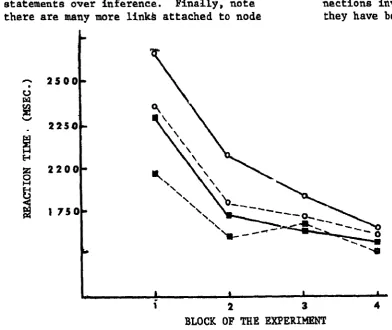
f o u r blocks a r e displayed i nFigure 2 . Besides i l l u s t r a t i n g a g e n e r a l speed-up over the course o f t h e expertlnent, t h e f i g u r e il- l u s t r a t e s t h e d i f f e r e n c e s among t h e conditions gradually dioappear over t h e couree of t h e experi- ment. S p e c i f i c a l l y , t h e d i f f e r e n c e s between i n -
f e r e n c e and d i r e c t statements i n t h e after condi- t i o n d i s a p p e a r s and t h e d i f f e r e n c e s between iden- tif&,c@tion before and i d e n t i f i c a t i o n a f t e r condi- dlsappear
.
To account f o r t h i s across-block t r e n d
we
propose t h a t t h e s u b j e c t begins a process of copylng t h e p r e d i c a t e s from one of t h e nodes
i n
Figure l b t o t h e o t h e r node. Thet i s , one node i s chosen t o be abandoned and t h e o t h e r t o receive a l l information. Therefore, supposing t h e s u b j e c t choses t o copy from node Y t o X, everytime h e en- counters a f a c t a t t a c h e d t o X he w i l l attempt t o
[image:2.860.106.499.687.1017.2]copy i t t o Y . Figure 3 i l l u s t r a t e s w r b e l i e f a- bout t h e memory r e p r e s e n t a t i o n by t h e end o f t h e experiment. Note t h a t
the
node X has been a t t a c h - Figure 3: Memory r e p r e s e n t a t i o n i n t h e i d e n t i f i - c a t i o n-
a f t e r c o n d i t i o n a f t e r much practice a t ver- f ying inference quest ions.CURSED RESCUED ADOPTED CAUSED ACCIgENT
SMART
RUSSIAN
ed t o
a l l
t h e f a c t s learned of Y. ALSO t h e con- nectiond involving Y a r e d o t t e d t o i n d i c a t e thatthey have become weak through d i s u s e . The a f t e r
M After I n f e r e n c e
o-
-o Before In£ erenceBefore D i r e c t Statement c-4 After D i r e c t Statement
Figure 2: V e r i f i c a t i o n times f o r v a r i o u s kinds
of
probes as afunction of p t a c t i c e .
r e p r e s e n t a t ion i n Figure 3 has become f u n c t i o n a l l y almost e q u i v a l e n t t o t h e b e f o r e r e p r e s e n t a t i o n i n Figure la. Thus t h e r e i s l i t t l e d i f f e r e n c e between i n f e r e n e e and d i r e c t s t a t e m e n t o r between t h e a f - ter and b e f o r e condition.
One might wonder why t h e subject d i d not pet- form t h i s copying when h e learned about t h e iden- t i t y between t h e two r e f e r r i n g e x p r e s s i o n s r a t h e r than l a t e r i n t h e v e r i f i c a t i o n phase of t h e e x p e r i - ment. I n t h e ACT memory model such copying opera- t i o n s cannot be performed u n l e s s t h e d a t a
t o
b e copied i s a c t i v e i n working memory. A t t h e time of s t u d y i n g t h e i d e n t i f i c a t i o n s t a t e m e n t (4) t h e p r e d i d t e s needed f o r copying would not be a c t i v e i n memory. It is only when i n f e r e n t i a l statements l i k e (10) a r e encountered i n t h e test t h a t t h e aop- ying can t a k e place. The r e f e r r i n g e x p r e s s i o n could be copied while l e a r n i n g t h e i d e n t i f i c a t i o n s t a t e m e n t , So t h e e x p r e e s i o n t a l l lawyer might be immediately a t t o r h e d t o X. Thus, F i g u r e l b might be an o v e r s i m p l i f i c a t i o n of t h e s t a t e of memory i n t h e i d e n t i f i c a t i o n , a f t e r .condition. Buti n
any c a s e , t h e i n f e r e n c e e f f e c t w i l l n o t go aw5y u n t i l t h e p r e d i c a t e s a r e copied and t h i s w i l k n o t occur u n t i l t h e r e a c t i o n t i m e t e s t phase.Why should we believe t h i s copying explana- t i o n r a t h e r than any of t h e m u l t i t u d e of a l t e r n a - t i v e mechanisms t h a t might, be o f f e r e d t h e e x p l a i n t h e d a t a i n Figure 2. F i r s t , i t s a t i s f i e s t h e c o n s t r a i n t t h a t t h e s u b j e c t n o t be a b l e t o e r a s e i n f o r m a t i o n from memory and many of the mechanisms would not be. Second, u n l i k e many of t h e o t h e r mechanisms, i t assumes a n a s y a e t r y i n t h e f a t e of t h e two i n d i v i d u a l nodes i n F i g u r e - l b , One node is f a t e d t o r e c e i v e a l l t h e information and the o t h e r node i s - t o be abandqned. It seema reason- a b l e t h a t a s u b j e c t would choose t o p r e s e r v e t h a t node which had t b e more i a f o r m a t i o n a t t a c h e d and/ o t had t h i s i n f o m a t L o n a t t a c h e d more s t r o n g l y . W e have been a b l e t o demonstrate t h a t s u b j e c t s do abandon the "weaker" node.
The evtdence f o r t h i s asymetry comes from experiments t h a t use .a proper name rather t h a n one of t h e d e f i n i t e descriptions. That i s , t h e m a t e r i a l is t h e same as i n t h e example except
t h a t wherever t a l l
Lawyer
appears a p r o p e r name l i k e James B a r t l e t t would be used. There i s evi- dence (Anderson,l.377)
t h a t s u b j e c t s l e a r n mater- i a l less w e l l i n v o l v i n g t h e proper name t h a n t h e d e f i n i t e d e s c r i p t i o n . ~ o r r e s p o h d i n g l y , w e would expect s u b j e c t s t o choose t o abandon t h e proper name node and rnajlntain t h e d e f i n i t e d e e c r f p t i o n node. Evidence f o r this comes from t h e follow- i n g a n a l y s i s : W would propose t h a t , e ia the indt i a l d r i l l i n g on t h e s e n t e n c e James Battlett
&
t h e Russian, i n t h e i d e n t i t i c a t i o n a f t e r cofidi--
-
t i o n s u b j e c t s copy t h e James Bartlett name tn
t h e Russian node. F i g u r e 4 i l l u s t r a t e s t h e mem- o r y r e p r e s e n t a t i o n w i t h t h i s asymetry. Note t h a t ,
CURSED RESCIfED ADOPTED CAUSED
SALESGIRL KITTEN CHILD ACCIDENT
1 X N
1 1
'-4
I-
B ARTLETT
Fi
.
4 : V e r i f i c a t i o n t h e e i n t h e i d e n t i f i c a t i o nbe&rc and Ldentif i c a t i o n a f t e r con-
-
i n an. experiment t h a t used b o t h proper names and d e f i n -i t e d e s c r i p t i o n s as r e f e r r i n g expreaeions.
a c c o r d i n g t o t h i s * re p r e s e n t a t i o n , subj ecte should be as f a s t when v e t i f y i n g an i n f e r e n c e p r e d i c a t e of
James
B'artlett as a d i r e c t s t a t e m e n t p r e d i c a t e . T h i s i s because t h e p r o p e r name is d i r e c t l y a t t a c h & edt o
both. I n c o n t r a s t , s u b j e c t s should b e much slower f o r an i n f e r e n c e p r e d i c a t e t o w d e f i n i t e d e s c r i p t i o n because t h o s e p r e d i c a t e s have not y e t d i r e c t l y been a t t a c h e d t o node5
t o
which t h e des- c r i p t i o n is attached. To v e r i f y t h e s e q u e s t i o n s i n v o l v e s t h e e x t r a r e t r i e v ~ l of the p r q p o a i t i o n t h a t node X e q u a l s node Y. Figure 5 p r e s e n t s t h e d a t a from one of t h e experiments (Anderson & Has-t i e , 1974) c o n t r a s t i n g definite d e s c r i p t i o n s
and
p r o p e r namef3, A s predicted t h e r e i e a l a r g e fn-f e r e n c e e f f e c t only f o r d e f i n i t e d e s c r i p t i o n s i n t h e a f t e r c o n d i t i o n ,
BEFORE
PROPER
DWINI;TE
DESCRIPTION DESCRIPTION
I
1 I I I I1
DIRECT INFERENCE DIRECT INFERENCE
STATEMENT STATEMENT
F i g u r e 5.
A p p l i c a t i o n t o Recognition of R e f e r r i n g Expressfon
The advaritage o f t h e para-m j u s t reviewed
is that the sequence of s t a t e s o f memory i s s u f -
f i c i e n t l y s p r e a d o u t o v e r t i m e t h a t it i s p o s s i b l e t o map out t h e changes i n memory. I w i l l be pro- posing that t h e t e is a similar sequence of memory s t a t e s when s u b j e c t s p r a c e s s r e f e r r i n g e x p r e s s i o n s as i n (3) :
(3) The f i r s t p r e s i d e n t of t h e United S t a t e s was a bad husband.
However, t h e p r o c e s s i n g happens s o r a p i d l y i t
i s
n o t a s e a s y t o v e r i f y each s t a t e i n the sequence. F i g u r e 6 i l l u s t r a t e s two p o s s i b l e sequences
CHOPPED
CHE~RRY
REVOLUTIONARY LED\
i / A m/'
GEORGE\
1st PRESIDENTWASHINGTON OF USA
1s t PRESIDENT
OF USA
CHOPPED LED
CHERRY REVOLUTIONARY
CHOPPED, LED BAD
I
CHERRY REVOLUTIONARY HUSBAND TREEY
I
l b t PRESCHOPPED LED BAD
1
CHOPPED LED BADTREE
\
,
7
Y/'
GEORGE .* 1st
I
PRES.WASHINGTON OF USA OF USA
CHERRY REVOLUTIONARY HUSBAND
1
WASHINGTON OF USA OF ..USA
GEORGE 1st PRES. 1st PRES.
CHERRY REVOLUTIONARY HUSBAND
/--
\
-GEORGE Is t PRES
.
Is tI
PRTS.
WASHINGTON OF USA OF USA
I
WASHINGTON OF USA OF USA Figure 6. Possible s t a r e s of memory representlation during t h e procearring of s e n t e n c e (3).t h e d e f i n i t e d e s c r i p t i o n . A node Y h a s been crea- t e d t o which there h a s been atrached the " f i r s t p r e s i d e n t of USA" d e s o r i p t i o n . A s e p a r a t e node,
5,
i n memory encodes permanent information about George Washington. P a r t (a) of Figure 6 i l l u s - t r a t e s a s i t u a t i o n analagous t o t h e i d e n t i f i c a - t i o n a f t e r condition,, p r i o r t o t h e i d e n t i f i c a ---
t i o n statement. There a r e two d i s t i n c t nodes, un- connected, t h a t r e f e r t o t h e same i n d i v i d u a l . In- t r o s p e c t i v e l y , it seems c l e a r t h a t a t l e a s t some- times I comprehend d e f i n i t e d e s c r i p t i o n s b e f o r e recognizing t h e i r r e f e r e n t s . For i n s t a n c e , f un- d e r s t a n d t h e d e s c r i p t i o n
--
The p r e s i d e n t of Francei n 1970 l o ~ & b e f o r e I decide t h a t t h i s
is
George--
Pompidou. The s t r u c t u r e surrounding
Y
i n P a r t ?a) n o t o n l y provides a n embodiment of t h i s pre-icfen-t i f i c a t i o n comprehension, it serves, a s an encod- i n g of t h e information t h a t i s t o guide t h e s e a r c h f o r a r e f e r e n t . The
ACT
theory would use t h i s re- presentation t o b u i l d a p a t t e r n t h a t ,could b e,
matched t o memory t o r e t r i e v e kke r e f e r e n t . I n t h e case of a d e s c r i p t i o n l i k e-
f i r s t g r e s i d e n t of the USA a d i r e c t p a t t e r n match should s u f f i c e t o r e-
t r i e v e t h e referent. I n my case for t h e Presid'enr of France i n 1970 d e s c r i p t i o n , a more complex prob-
4
l e m s o l v i n g s t r a t e g y had
rn
be evolked.Once t h e d e s c r i p t i o n of s e n t e n c e (3) has
been comprehended two t h i n g s can happen: The sub- j e c t can proceed t o recognize t h e r e f e r e n t of t h e d e f i n i t e d e s c r i p t i o n and he can go on to compre- hend the "was bad husband" predicate. D e ~ e n d i n g
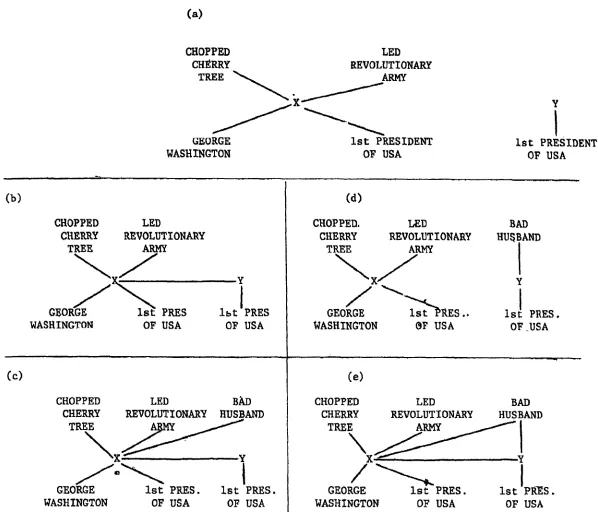
on t h e o r d e r of t h e s e two e v e n t s w e w i l l wind up w i t h s l i g h t l y d i f f e r e n t r e p r e s e n t a t i o n s i n memory. P a r r (b) of F i g u r e 5 i l l u s t r a t e s t h e s t a t e of mem- o r y a f t e r r e c o g n i t i o n of t h e d e s c r i p t i o n and be- f o r e comprehensian of the p r e d i c a t e . A s i n t h e a f t e r condition ( P a r t b o f Figure 1) a 12nk i s i n t r o d u c e d encoding the i d e n t i t y o f X and Y. When the p r e d i c a t e i s comprehended a r e p r e s e n t a t i o n of i t s meaning can be a t t a c h e d d i r e c t l y t o X, g i v i n g t h e r e p r e s e n t a t i o n i n P a r t (c) of F i g u r e 6.
[image:4.866.123.721.99.611.2]P a r t ( d ) i l l u s t r a t e s t h e s t a t e of memory when the p r e d i c a t e has been comprehended but t h e d e f i n i t e d e s c r i p t i o n has n o t been i d e n t i f i e d . I n this c a s e t h e meaning r e p r e s e n t a t i o n of t h e pred- i c a t e has been a t t a c h e d t o node,
1.
Part (e) of Figure 6 i l l u s t r a t e s t h e s t a t e of memory when t h e d e f i n f t e descri.ptlop is subsequently~recognized. Again a l i n k i s i n t r b d u c e d i n d i c a t i n g t h e i d e n t i t y between andY.
The-
bad husband p r e d i c a t e , whichr e c o g n i z e - d e s c r i p t i o n sequepce ( p a r t e) is t h a t i n t h e l a t t e r e a s e t h e p r e d i c a t e i s a t t a c h e d t o both nodes. This l a t t e r s i t u a t i o n i s l i k e t h e s i t u a t i o n
i n t h e a f t e r c o n d i t i o n of t h e previous memory ex- periments,
What determines which o c c u r s f i r s t
--
re- c o g n i t i o n of d e s c r i p t i o n o r oomprehension of pred- i c a t e ? I n t h eACT
model both processes can go on independently. It would simply be a r a c e between two independent p r o c e s s e s . F a c t o r s such a s how q u i c k l y t h e p r e d i c a t e i s p r e s e n t e d ( i f spoken) o r how quickly t h e s u b j e c t t u r n s t o t h e p r e d i c a t e ( i fp r i n t e d ) w i l l determine t h e speed of t h e comprehen- s i o n s u c c e s s . The speed of recognizing t h e des- c r i p t i o n w i l l vary w i t h t h e d i f f i c u l t y of f i n d i n g its r e f e r e n t . I t i s c l e a r t h a t n e i t h e r process w a i t s on t h e o t h e r a s witnessed by t h e s e n t e n c e s :
(11) The f i r s t prime m i n i s t e r o f Canada was a bad husbaad
.
(12) The f i r s t p r e s l d e n t of t h e United Skates p i l a c k e d g i b s .
I n (11) we comprehend t h e p r e d i c a t e although we never f i n d a r e f e r e n t f o r the s u b j e c t . I n ( 1 2 ) we f i n d a r e f e r e n t f o r t h e s u b j e c t although we never Comprehend t h e p r e d i c a t e .
Evidence on t h e Recognition of R e f e r r i n g Exprea- s i o n s
.
-
Right now t h e c o n t e n t i o u s r e a d e r might be t h i n k i n g "Yes, t h a t is a p o s s i b l e model f o r t h e p r o c e s s i n g of r e f e r r i n g expressions. Yes, i t i s t o n s i s t e n t w i t h t h e model f o r your e a r l i e r memory experiments. Yes, you presented evidence f o r t h a t model. But, i s t h e r e any independent experimental evidenoe for this model when a p p l i e d to the real- t 5 m e r e c o g n i t i o n of d e f i n i t e d e s c r i p t i o n s ? " Be- cause of i t s rapid real-time c h a r a c t e r i s t i c s i t is h a r d to provide p a r t i c u l a r l y d i r e c t evidence f o r this process. But-there are some c o n s i s t e n t ex- perimental result,^ :
A r e l e v a n t f e a t u r e t o n N e about Figure 6c i s t h a t i t p r e s e r v e s no r e c o r d t h a t t h e
bad
husband p r e d i c a t e was a s s e r t e d v i a the f i r e r p r e a -i d e n t of USA d e s c r i p t i o n . I n c o n t r a s t F i g u r e 6e
---
does p r e s e r v e tttis information. Both r e p r e s e n t a - t i o n s a r e p o s s i b l e depending on t h e e x a c t timing of d e s c r i p t i o n r e c o g n i t i o n v e r s u s p r e d i c a t e .com- prehension. To t h e e x t e n t t h a t t h e r e is a mix- t u r e of t h e s e r e p r e s e n t a t i o n s we p r e d i c t both a tendency t o make confusions about what r e f e r r i n g e x p r e s s i o n was used ( r e p r e g e n t a t i o n 6 4 and t h a t s u b j e c t s w i l l have Some r e s i d u a l a b i l i t y t o make t h i s d i s c r i m i n a t i o n ( r e p r e s e n t a t i o n 6e). An ex- periment reported by Anderson and Bower (1973) s u p p o r t s t h i s d u a l p r e d i c t i o n . They had s u b j e c t s s t u d y s e n t e n c e s l i k e :
(11) The f i r s t p r e s i d e n t of t h e United S t a t e s was a bad husband.
(12) Abraham Lincoln was a good husband.
A f t e r studying such s e n t e n c e s s u b j e c t s were asked t o chose among a l t e r n a t i v e s such a s the following: (13) The f i r s t p r e s i d e n t of t h e United S t a t e s
was a bad husband.
(14) George Washington was a bad husband. (15) The f i r s t p r e s i d e n t of t h e United S t a t e s
was a good husband.
(16) George Washington was a good husband.
These
a l t e r n a t i v e s were p r e s e n t e d t o t h e e u b j e c t5l
randomly ordered but
1
p r e s e n tthem
here systemat- i c a l l y . S u b j e c t swere
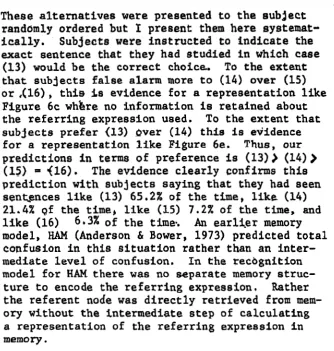
i n s t r u c t e d t o i n d i c a t e t h e e x a c t s e n t e n c e t h a t t h e y had s t u d i e d i n which c a s e(13) would be t h e correct choice. To t h e extent t h a t s u b j e c t s f a l s e a l a r m more t o (14) o v e r (15) o r ,(16), t h i s i s evidence f o r a r e p r e s e n t a t i o n l i k e F i g u r e 6c whbre no i n f o r m a t i o n is r e t a i n e d about t h e r e f e r r i n g e x p r e s s i o n used. To t h e e x t e n t t h a t s u b j e c t s p r e f e r (13) Qver (14) t h i s i s evidence f o r a r e p r e s e n t a t i o n like Figure 6e. Thus, o u r p r e d i c t i o n s
i n
terms of p r e f e r e n c e i s (13)>
(14) )(15) = (16). The evidence c l e a r l y confirms t h i s p r e d i c t i o n w i t h s u b j e c t s s a y i n g t h a t they had s e e n
s e n t e n c e s l i k e (13) 65.2% of t h e t i m e , l i k e (14) 21.4% q f t h e t i m e , l i k e (15) 7.2% of t h e t i m e , and l i k e (16) 683% of t h e time..
An
earlier
memory model,HAM
(Anderson 6 Bower, 1973) p r e d i c t e d t o t a l confusion i n t h i s s i t u a t i o n r a t h e r thanan
i n t e r - m e d i a t e l e v e l of confusion. I n t h e r e c b g n i t i o n model f o r HAbt t h e r e was no s e p a r a t e memory s t r u c -t u r e t o encode t h e r e f e r r i n g e x p r e s s i o n . Rather t h e r e f e r e n t node was d i r e c t l y r e t r i e v e d from mem- o r y w i t h o u t t h e i n t e r m e d i a t e s t e p of c a l c u l a t i n g a r e p r e s e n t a t i o n of t h e r e f e r r i n g e x p r e s s i o n I n memory.
Recently Ortony and Anderson (1977) reporc
a s t u d y which r e p l i c a t e d and extended t h i s reb,ult, They noted t h a t some p r e d i c a t e s seemed more appro- p r i a t e to a proper name and o t h e r p r e d i c a t e s seemed more a p p r o p r i a t e t o a d e f i n i t e d e s c r i p t i o n . Con-
s i d e r t h e i r examples:
(17) The f i r s t man on the moon became a n a t i o n - a l hero.
(18) Neil Armstrong h a s s e v e r a l children. (19) The f i r s t man on t h e moon h a s s e v e r a l
c h i l d r e n .
(20) N e i l Armstrong became a n a t i o n a l hero. Ortony and Anderson p o i n t our t h a t t h e uses i n
(17) and (18) a r e somewhat more n a t u r a l than @he uses i n
(191
and (20).
Correspondingly, theyfound s u b j e c t s made fewer e r r o r s i . n remembering what t h e r e f e r r i n g e x p r e s s i o n had been f o r senten-
c e s l i k e (17) and (18) t h a n f o r s e n t e n c e s l i k e (19) and (20)
.
The e r r o r rates were 19.6% Versus 30.7%. Note, however, t h a t i n both c a s e s s u b j e c t s i d e n t i f i e d t h e o r i g i n a l referring expression b e t t e r t h a n chance (50%).The Ortony and Anderson r e s u l t wou-ld b e expected under t h e c u r r e n t theory. To t h e e x t e n t t h a t - t h e p r e d i c a t e f i t s t h e r e f e r r i n g e x p r e s s i o n s u b j e c t s might . a t t a c h i t t o t h e new node Ce.g., node Y i n Figure 5) which has t h e r e f e r r i n g ex- p r e s s i o n atcached t o i t . A s Ortony and Anderson noted, t h e
HAM
t h e o r y had no way t o e x p l a i n t h i s a f f i n i t y between c e r t a i n r e f e r r i n g e x p r e s s i o n s and c e r t a i n p r e d i c a t e s . To e x p l a i n t h e Ortony and An: d e r s o n r e s u l t s i n t h e HAM framework we had t o a t t r i b u t e them r o a response b i a s . [image:5.868.434.768.86.437.2]Opaque and .Transparent Refexences
This a n a l y s i s ,of refemnce has a n a t u r a l ex- t e n s i o n t o a n a l y z i n g t h e d i f f e r s n c e between opaque and t r a n s p a r e n t r e f e r e n c e . For m t a n c e , c o n t r a s t :
(21) I am looking f o r t h e b e s t lawyer i n town.
(22) 1 a m l o o k i n g f o r my l i t t l e o l d mother. While b o t h (21) and (22) might b e conszdered am- biguous, t h e more a p p a r e n t i n t e r p r e t a t i o n of (21)
i d t h a t I am l o o k i n g f o r someone who f i t s t h e des- c r i p t i o n "the b e s t lawyer i n town" and t h a t I do n o t have a p a r t i c u l a r person i n plind. I n c o n t r a s t , t h e more a p p a r e n t i n t e r p r e t a t i o n of (22) is t h a t I do have a p a r t i c u l a r person i n mind, The former i s an i n s t a n c e of opaque r e f e r e n c e and t h e l a t t e r
is
an f n s t a n e e of t r a n s p a r e n t r e f e r e n c e . Our d i s c u s - s i o n has s o f o r focused on t r a n s p a r e n t r e f e r e n c e . To c o r r e c t l y remember an instance of opaque r e f e r - ence i t i s c r i t i c a l t h a t i t n o t b e t r e a t e d i n t h e same manner a s t r a n s p a r e n t r e f e r e n c e . That i s , even i f t h e l i s t e n e r knows t h e r e f e r e n c e of " t h e b e s t lawyer i n town", h e s h o u l d n o t u s e t h e node f o r t h i s r e f e r e n c e i n r e p r e s e n t i n g t h e meaning o f (21). Rather h e should c r e a t e a new node, a t t a c h t h e d e s c r i p t i o n t o i t , and put t h i s node i n t h e r e p r e s e n t a t i o n of (21). F i g u r e s 7a and 7b i l l u s - t r a t e t h e d i f f e r e n t r e p r e s e n t a t i o n s a p p r o p r i a t e f o r (21) and (22). In P a r t (a) t h e r e are two d i s -OTHER PRIOR ( a ) JOHN
FACTS LOOKS
1
/
FORX Y
I
BEST LAWYER BEST CAWYER
1
I N TOWN I N TOWN
( by OTHER PRIOR
FACTS
JOHN
x
-
LOOKSI
FORJOHN
'
S LITTLE OLD MOTHERF i g u r e 7:. Memory r e p r e s e n t a t i o n d o r any i v s f a n c e of opaque r e f e r e n c e (a) and t r a n s p a r e n t r e f e r e n c e (b)
.
t i n c t nodes preserved t o r e p r e s e n t t h e b e s t lawyer i n town. One node
(3
has t h e p r i o r f a c t s known about t h e person w h i l e t h e second node-(x)
s t o r e s information about t h e opaque r e f e r e n c e i n s e n t e n c e [image:6.860.71.412.149.955.2] [image:6.860.76.398.362.724.2]( 2 1 ) . There
i a
no s u c h - d i s t i n c t i o n i n P a r t (b) of Figure 7 f o r t h e t r a n s p a r e n t c a s e i n ( 2 2 ) . A l l information i s a t t a c h e d t o t h e a r i g i n a l node2.
So, t h e d i f f e r e n c e between t r a n s p a r e n t and opaque r e f e r e n c e i s whether tbe new i n f o r m a t i o n i s copied t o &n e x i s t i n g node.Conclusions
d i s t i n c t i o n between s e n s e and r e f e r e n c e . The f i r s t h a l f of this paper r e p o r t e d experiments where we b a s i c a l l y r e c r e a t e d F r e g e ' s example and d i s c o v e r e d t h a t s u b j e c t s d e a l t with t h a t dilemna by t h e pro- c e s s of cbpying from one r e f e r r i n g node t o a n o t h e r . The argument i n t h e second h a l f o f t h e paper was t h a t Frege' s examples a r e n o t i s o l a t e d t o d4scov- eries of s c i e n c e o r t o b i z a r r e p s y c h o l o g i c a l ex- periments. R a t h e r , e v e r y tlme we r e c o g n i z e a t r a n s p a r e n t r e f e r r i n g e x p r e s s i o n w e go through a d i s c o v e r y l i k e t h a t of the i d e n t i t y between the mbrning s t a r and evening s t a r . We c r e a t e a node t o r e p r e s e n t t h e r e f e r e n t of t h e r e f e r r i n g expres- s i o n and o n l y t h e n discover, w i t h v a r y i n g d i f f i - c u l t y , t h a t t h i s node h a s t h e same r e f e r e n c e as an e s t a b l i s h e d node I n memory.
Acknowledgments: P r e p a r a t i o n of t h i s manuscript and t h e r e s e a r c h r e p o r t e d was s u p p o r t e d by Grant BNS 76-00959 from t h e N a t i o n a l S c i e n c e Foundation.
E
would l i k e t o thank Paul K l i n e f o r h i s comments on t h i s manuscript.References
Anderson, J . R, Language, memory and thought. H i l l s d a l e , N . J . : Lawrence Erlbaum Asso- c i a t e s , 1976.
Anderson, J. R. Memory f o r i n f o r m a t i o n about i n d i - v i d u a l s . Memory4&
-
Cognition, 1977,2,
430-442Anderson, J. R. & Bower, G. H. Human a s s o c i a t i v e
memory. Washington, DC: Hemisphere
P r e s s , 1973.
Anderson, J. R. & H a s t i e , R. IndFviduation and r g f e r e n c e i n memory: P r o p e r names and d e f i n i t e d e s c r i p t i o n s . C o g n i t i v e P ~ y c h o - l o g y , 1974,
6,
495-514.Ftege, G. ~ b e r S i n n und Bedetung. Z e i t s c h r i f t
fiir P h i l o s o p h i e p h i l o s o p h i c h e K r a t i k ,
-
1892, 100 ( a l l )
.
( T r a n s l a t i o n a v a i l a b l e i n P. Geach and M. Black (Eds.), T r a n s l a - t i o n s from t h e p h i l o s o p h i c a l w r i t i n g sof
---
G o t t l o b Frege. Oxford: B a s i l Blackwell,1960, 56-78).
Ortony, A. & Anderson, R. C. D e f i n i t e d e s c r i p t i o n s and semantic memory. C o g n i t i v e S c i e n t e , 1977,