A Proposal of Cooking Model and Cooking Step
Scheduling Algorithm for Multiple Dishes
Yukiko Matsushima, Nobuo Funabiki, Toru Nakanishi
Abstract—Cooking everyday is very hard for busy people such as workers, students, and child-rearing families because the time is not enough for this activity. At the same time, it is important to have a lifestyle that does not rely too heavily on eating-out and instant foods. One solution to this situation is to cook dishes for the whole week at the weekend, and then eat them during the week. The way of cooking with a good schedule of cooking steps among multiple dishes under constraints of a cooking time is very important. In this paper, we propose a cooking step scheduling algorithm for multiple dishes within a limited cooking time. Furthermore, we present a cooking model to estimate cooking time accurately under various conditions such as different kitchen layouts and number of cooks. Using experiments, we verify the accuracy of the model where a cooking time difference between the model and the real cooking is about two minutes.
Index Terms—home cooking support, cooking model, cooking step scheduling, algorithm
I. INTRODUCTION
Cooking everyday is very hard for busy people such as workers, students, and child-rearing families because the time is not enough for this activity. Therefore, a lot of people are eating at restaurants or buying lunch boxes at convenience stores, and failing to follow a balanced nutritional diet as recommended in the government’s Food Balance Guide [1]. On the other hand, there is a great deal of public fears about metabolic syndrome [2]. Furthermore, more and more people have desired to have a healthy and cost-effective diet by cooking at home.
One method to solve this problem is to cook several dishes at a weekend, and to eat them at the following weekdays by keeping them in refrigerators. However, the task of efficiently cooking various dishes at the same time is often difficult because of the limited availability of pots, stoves, and microwave ovens in conventional kitchens. If people cook these dishes without a proper schedule, it may consume an inhibitory long time to complete cooking of all the dishes. Besides, if they want to eat them at a dinner, some dishes completed first may become too cold when others are completed. Thus, the weekend cooking of multiple dishes becomes a hard one for them.
In this paper, we propose a cooking step scheduling algorithm for multiple dishes to help conventional persons to cook multiple dishes without difficulty. For this purpose, we present a cooking model to estimate the cooking time accurately under various conditions such as different kitchen layouts and number of cooks. In the cooking model, first, we give the kitchen layout that is composed of cooks,
Dept. of Communication Network Engineering, Okayama University, 3-1-1 Tsushimanaka, Okayama, 700-8530, Japan
Email:[email protected] Email:[email protected] Email:[email protected]
pans and pots, cutting boards, stoves, microwave ovens, and a sink. This model becomes flexible in terms of the number of kitchen utensils and cooks. Then, we define six cooking steps, namely, Cut step, Mix step, Fry step, Boil step, Nuke step and Wash step. Lastly, we define state transition diagrams of the items in the kitchen layout to determine the constraints of applying the cooking steps.
For a given cooking order of multiple dishes, the cooking model calculates the minimum cooking time by executing their cooking steps as early as possible such that the con-straints are satisfied. For example, Boil step and Nuke step can be executed with other steps simultaneously, because they do not need a cook. Besides, two types of cooks are considered in the model, namely a main-cook and a sub-cook. The main-cook can execute any cooking step, and the sub-cook may execute a part of the cooking steps. Thus, the sub-cook is regarded as a helper for the main-cook, and can be a partner or a child. Actually, the projects by the Japanese government such as“Equal employment and work and family harmonization” [3] and ”Ikumen (child-rearing men) project” [4] have expected to increase the opportunity of cooking together with family members.
Our cooking step scheduling algorithm optimizes the cooking step schedule for multiple dishes based on the he simulated annealing (SA) [5]. It repeats the random update of the dish order and the calculation of the cooking time using the cooking model.
The rest of this paper is organized as follows: Section II presents a cooking model. Section III presents a cooking step scheduling problem for multiple dishes. Section IV shows their evaluations. Section V concludes this paper with some possible ideas for developing this research.
II. COOKINGMODEL
In this section, we present the cooking model to optimize the arrangement of the cooking steps for multiple dishes and estimate the cooking time accurately.
A. Kitchen Layout
Fig. 1. Kitchen layout.
that for any ingredient, the cleaning and the division into each dish are finished beforehand, and that there is enough space to put ingredients in the kitchen between cooking steps. We regard the cooking process for any dish as a sequence of cooking steps. We define six different cooking steps depending on the nature of the procedure, namely, Cut step, Mix step, Fry step, Boil step, Nuke step, and Wash step. The following four steps always require the load of a cook. In Cut step, a cook processes ingredients by peeling, cutting, and slicing them on a cutting board. In Mix step, a cook mixes ingredients by blending, kneading, and wrapping them. In Fry step, a cook heats ingredients by frying, deep-frying, or grilling them using a pan on a stove where a cook is always engaged to avoid scorching. In Wash step, a cook cleans pans and pots in the sink. The following two steps do not require the load of a cook. In Boil step, a cook can heat ingredients using a stove without a load by boiling, stewing, and steaming them. In Nuke step, a cook can nuke ingredients using a microwave oven without a load.
We note that Cut step, Mix step, Fry step, and Wash step require the load of a cook. Thus, these steps can be executed only when a cook is not engaged in any step requiring the load. On the other hand, Boil step and Nuke step do not require the cook load. Thus, they can be executed in parallel with the above-mentioned four steps.
B. State Transition Diagram for Ingredient
Figure 2 illustrates the state transition diagram for an in-gredient. Preparation represents the state that the ingredient is ready to cook. Pause does the state that the ingredient is waiting for the transition to another step. Completion does the state where all the cooking steps have finished for a dish. Cut step, Mix step, Fry step, Boil step and Nuke step represent the states where the corresponding steps are executed. Fry step, Boil step and Nuke step can transit to the same state to deal with the recipe like“first boiling, then stewing”. Hence, the following five conditions must be satisfied at the transitions of (1) to (5) in Fig. 2:
1) A cook and a cutting board must be available for the transition to Cut step.
2) A cook must be available for the transition to Mix step. 3) A cook, a stove, and a pan (a pot) must be available
for the transition to Fry step.
Fig. 2. State transition diagram for ingredient.
4) A stove and a pan (a pot) must be available for the transition to Boil step.
5) A microwave oven must be available for the transition to Nuke step.
C. State Transition Diagram for Cook
Fig. 3. State transition diagram for cook.
Figure 3 illustrates the state transition diagram for a cook. Available represents the state where the cook can execute a cooking step requiring the load of a cook such as Cut step, Mix step, Fry step, and Wash step. Busy represents the state where a cook is executing a step and cannot perform another one. The cooking model can change the number of cooks and the roles of the main-cook and the sub-cook.
[image:2.595.311.539.572.670.2]D. State Transition Diagram for Pot
Fig. 4. State transition diagram for pot.
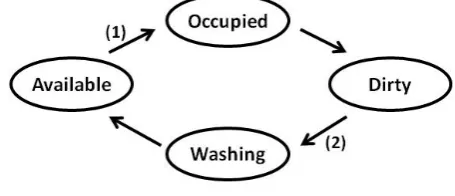
a cook stops the current cooking step to wash the dirty pot in the sink, because the number of pots is limited. Hence, the following two conditions must be satisfied at the transitions of (1) and (2) in Fig. 4:
1) Fry step or Boil step must be selected as the next step at the transition to Occupied.
2) A cook and a sink must be available at the transition to Wash step.
E. State Transition Diagram for Cutting Board, Stove, and Microwave Oven
Fig. 5. State transition diagram for cutting board, stove, and microwave oven
Figure 5 illustrates the state transition diagram for a cutting board, a stove, and a microwave oven. Available represents the state where the corresponding item can be used for cooking. Occupied represents the state where it is currently used for cooking.
F. State Transition Diagram for Sink
Fig. 6. State Transition Diagram for Sink.
Figure 6 illustrates the state transition diagram for a sink. Available represents the state where a sink can be used for washing pots. Occupied represents the state where the sink is currently used for washing.
G. Cooking Process Simulation
The cooking model estimates the completion time of each dish by simulating the cooking processes of the multiple dishes for a given cooking starting order of the dishes. This cooking starting order of the dishes is called the dish order in this paper. Actually, at every minuteT, the following steps are executed until all the dishes are completed. :
1) T is updated byT++. Note thatT is initialized by 0. 2) The completion time of a dish is recorded when the state of the corresponding ingredients becomes Com-pletion.
3) The starting time of washing a pot is recorded when the state of the pot becomes Dirty.
4) The next cooking step for a cook is selected and the starting time is recorded when the state of a cook becomes Available.
5) The next cooking step for a stove or a microwave oven is selected and the starting time is recorded when the state of the corresponding one becomes Available.
In the following subsections, we give the details in steps 3), 4), and 5).
1) Washing Step: As soon as the state of a pot becomes Dirty and the states of a sink is Available, a cook washes the pot, assuming the pot washing has the first priority to other cooking steps. Even if a cook is executing a different step, the cook interrupts it and starts washing the pot. Note that when the remaining number of cooking steps using pots does not exceed the number of available pots, a cook does not execute Wash step. Besides, a sub-cook is selected preferentially when both cooks becomes Available.
2) Next Cooking Step Selection for Cook: The cooking model selects the next cooking step of a dish for an available cook by the following steps.
1) The first dish in the dish order that satisfies the following conditions is found:
• The state is Preparation or Pause.
• The next step of the dish is neither Boil step nor Nuke step because they do not need a cook. 2) When the next cooking step of the found dish is Cut
step, the state of a cutting board is checked:
a) When the state of the cutting board is Available, the next cooking step of the dish is selected for the cook, and the state of the cutting board is changed to Occupied.
b) Otherwise, this dish is given up, and 1) is repeated to check the next dish candidate.
3) When the next cooking step of the dish is Mix step, this step is selected for the cook.
4) When the next cooking step of the dish is Fry step, the state of a stove is checked:
a) When the state of the stove is Available, the next cooking step of the dish is selected for the cook, and the state of the stove is changed to Occupied. b) Otherwise, this dish is given up, and 1) is repeated
to check the next dish candidate.
3) Next Cooking Step Selection for Stove and Microwave Oven: The cooking model selects the next cooking step of a dish for an available stove and a microwave oven by the following steps.
1) The first dish in the dish order that satisfies the following conditions is found:
• The state is Preparation or Pause.
• The next step of the dish is not Cut step, Mix step, or Fry step because they need a cook.
2) When the next cooking step of the found dish is Boil step, the state of a stove is changed to Occupied. 3) When the next cooking step of the found dish is Nuke
step, the state of a microwave oven is changed to Occupied.
III. COOKINGSTEPSCHEDULINGPROBLEM FOR MULTIPLEDISHES
In this section, we formulate a cooking step scheduling problem for multiple dishes and propose its algorithm using the proposed cooking model.
A. Cooking Step Scheduling Problem
1) Input: The inputs of this problem are as follows:
• the number of pots, cutting boards, stoves, and mi-crowave ovens
• the role of a sub-cook
• the washing time of a pot (min.) • the list of ndishes:V ={1, ..., n}
– the name of a dish i(i∈V)
– the cooking step of dish i at stepj: Cut step, Mix step, Fry step, Boil step, and Nuke step
– the cooking time of dishi at stepj (min.) 2) Output: The output of the problem is the cooking step schedule for all the dishes.
3) Constraint: The cooking step schedule satisfies the constraints defined in the cooking model in Section II.
4) Objective: Two objective functions are defined in this problem. The first one represents the maximum cooking time to complete all the dishes in Eq. (1). The second one represents the difference between the time when the first dish is completed and the time when the last dish is completed in Eq. (2).Cirepresents the completion cooking time (min.)
of dishi.
f1(σ) = max
i {Ci}. (1)
f2(σ) = max
i {Ci} −mini {Ci}. (2)
B. Algorithm
A heuristic algorithm for the cooking step scheduling problem is presented based on the simulated annealing (SA). The objective function is minimized by repeating random changes of the dish order and the cooking time calculation using the cooking model.
1) Preprocessing Stage: In the preprocessing stage, the cooking time of each dish at each cooking step is calculated according to the number of servingsm. The duration of Cut step is usually proportional to the quantity of the ingredients. Thus, the time is given by the product of the time for one person and m. The duration of Fry step, Boil step, Mix step and Nuke step is not proportional to the quantity, although the rise of temperature is slightly delayed due to the increase of ingredients. Thus, the time is given by product of the time for one person and(1 + 0.1·m). Finally, the number of cooking steps using pots in Boil step or Fry step is calculated to judge the necessity of Wash step.
2) Generating Dish Order Stage: For a given set of dishes, this algorithm optimizes the dish orderσto minimize the objective function, where the cooking model generates the cooking step schedule from the dish order and calculates the cooking completion time. The initial value of σ is randomly generated. Then, the algorithm improves σ by swapping randomly selected two adjacent dishes.
3) Cooking Model Simulation Stage: By applying σ to the cooking model, the cooking step schedule is generated and the completion time of each dish is calculated. Then, the objective functions are calculated.
4) Dish Order Update Stage: The adoption of the gener-ated dish orderσis judged based on SA. Whenσolddenotes
the previous solution and∆ denotes the difference between two objective function values (=f(σ)−f(σold)), thenσis
adopted with the probability of1for∆≤0. Otherwise,σis
adopted with the probabilitye−∆t wheretis the temperature
of SA. This algorithm terminates if σ is not updated at one temperature. Table I shows the parameter set for this algorithm.
TABLE I PARAMETERS OFSA
Parameter Value
Initial temp. 100.0 Temp. change Current temp.×0.9
# of temp. changes 100 # of iterations at each temp. # of dishes×100
IV. EVALUATION
We implemented the proposed cooking model and the cooking step scheduling algorithm as Java applications to evaluate them.
A. Example for Evaluation
As an instance to evaluate the accuracy of the estimated cooking time by our model, we adopt the six dishes in Table II. The number of cooks is set two, where the main-cook can execute any main-cooking step and the sub-main-cook can execute Mix step, Fry step, and Wash step. The number of pots, cutting boards, stoves, and microwaves ovens are set three, one, two, and one, respectively. The number of servings m is four. The washing time for a pot is fixed as three minutes.
TABLE II
DISHES AND COOKING TIME FOR ONE MEAL IN SAMPLE INSTANCE.
i Dish Proc. j= 1 2 3 4
type cut mix boil 1 Stuffed sweet pepper min. 2 5 15
type cut fry boil
2 Fried clams min. 2 4 3
type boil nuke cut fry 3 Fried rice & salmon min. 10 2 3 5
type cut boil
4 Miso soup min. 1 10
type cut nuke cut
5 Eggplant salad min. 1 3 1
type cut mix 6 Cabbage pickles min. 2 2
B. Result of Algorithm Execution
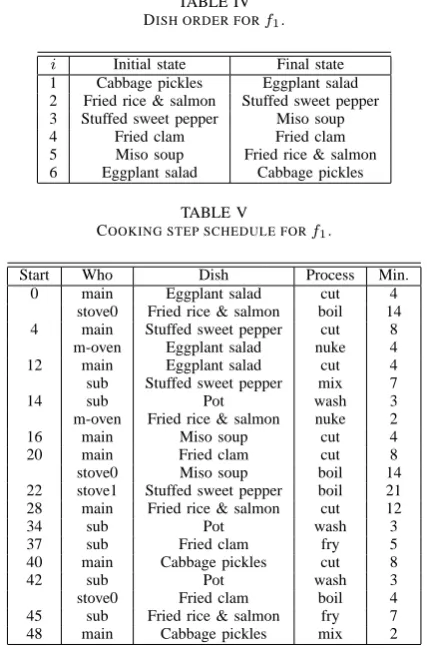
Table III shows the best values for the two objective functions among 20 executions. Table IV shows an initial solution to the dish orderσand a best solution for f1 using
this example. Table V shows the cooking step schedule using the best solution forf1.
TABLE III
OBJECTIVE FUNCTION VALUES.
f1(min.) f2(min.) Initial state 68 55
TABLE IV DISH ORDER FORf1.
[image:5.595.307.552.105.279.2]i Initial state Final state 1 Cabbage pickles Eggplant salad 2 Fried rice & salmon Stuffed sweet pepper 3 Stuffed sweet pepper Miso soup 4 Fried clam Fried clam 5 Miso soup Fried rice & salmon 6 Eggplant salad Cabbage pickles
TABLE V
COOKING STEP SCHEDULE FORf1.
Start Who Dish Process Min.
0 main Eggplant salad cut 4 stove0 Fried rice & salmon boil 14 4 main Stuffed sweet pepper cut 8
m-oven Eggplant salad nuke 4 12 main Eggplant salad cut 4 sub Stuffed sweet pepper mix 7
14 sub Pot wash 3
m-oven Fried rice & salmon nuke 2
16 main Miso soup cut 4
20 main Fried clam cut 8
stove0 Miso soup boil 14 22 stove1 Stuffed sweet pepper boil 21 28 main Fried rice & salmon cut 12
34 sub Pot wash 3
37 sub Fried clam fry 5
40 main Cabbage pickles cut 8
42 sub Pot wash 3
stove0 Fried clam boil 4 45 sub Fried rice & salmon fry 7 48 main Cabbage pickles mix 2
C. Evaluation of Estimated Cooking Time
[image:5.595.50.288.511.662.2]We actually cooked the six dishes in the same environment by following the cooking step schedule in Table V to evaluate the difference between the estimated cooking time by the model and the actual cooking time by real cooking. Then, the difference becomes only two minutes where the estimated time is 52 minutes and the actual time is 54 minutes. Fig. 7 shows the dishes by real cooking.
Fig. 7. Cooked dishes in real cooking byf1schedule.
D. Cooking Time Change by Sub-cook Role Change
Figure 8 shows the changes in f1 brought about by
changing the role of the sub-cook, where C, M, F and W represent Cut step, Mix step, Fry step, and Wash step that can be executed by the sub-cook respectively. As the number of roles increases for a sub-cook, the cooking time decreases.
When a sub-cook can execute all of the cooking steps, the cooking time becomes about the half of the time by a single cook.
0 50 100 150 200 250 300 350 400 450
2 4 6 8 10 12 14 16 18 20
Time(min.)
Number of dishes none
W F,W M,F,W C,M,F,W
Fig. 8. Change off1 by role changes of sub-cook.
V. CONCLUSION
This paper presented a cooking model and a cooking step scheduling algorithm for multiple dishes. We verified the accuracy of the estimated cooking time by the model and the effectiveness of our algorithm through the simulation using six dishes. In addition, we confirmed that the increase of roles by a sub-cook can reduce the cooking time. Our future works may include the construction of a cooking step database and the development of a total cooking support system using a Web application.
REFERENCES
[1] Ministry of Health, Labour and Welfare, Ministry of Health, Labour and Welfare, “Food balance guide”. http://www.j-balanceguide.com/. [2] Ministry of Health, Labour and Welfare, “Preventive metabolic
syn-drome”. http://www.mhlw.go.jp/bunya/kenkou/metabo02/.
[3] Ministry of Health, Labour and Welfare, “Equal employment, work and family harmonization and part-time work information”. http://www.mhlw.go.jp/bunya/koyoukintou/index.html.
[4] Ministry of Health, Labour, and Welfare, “Ikumen (child-rearing men) project”. http://www.ikumen-project.jp/index.html.
[5] M. Yagiura, T. Ibaraki, Combinatorial Optimization, Asakura (Japanese), 2001.
[6] R. Hamada, I. Ide, S. Sakai, and S. Sakai, “HappyCooking: multimedia cooking navigation software,” Digital Content Symposium (Japanese), June 2006.
[7] R. Hamada, I. Ide, S. Sakai, and H. Tanaka, “Structural analysis of cooking preparation steps,” Proc. Int. Workshop. Inform. Retrieval with Asian Lang. (Japanese), pp.157-164, 2000.