Abstract—Performance measurement systems (PMSs) in a manufacturing company are very complex and comprehensive including with many tangible and intangible factors. In order to achieve competitive advantage in nowadays’ global environment manufacturers have to implement PMSs which have to be suitable for enterprises’ strategic targets. Initially, a firm operating in industry has to assess it’s own weak and strong points very seriously in different dimensions. Evaluating manufacturing performance includes many individual judments of the managers who have different assessment of each other. The purpose of the paper is to evaluate manufacturing performance of a Turkish textile company via multiple criteria decision making (MCDM) in fuzzy environment. We propose a model to help the manufacturers for the manufacturing performance evaluation and for assessing weak and strong points of their firms based on fuzzy Choquet integral.
Index Terms— Performance evaluation, manufacturing performance, multi-criteria, fuzzy set, Choquet integral.
I. INTRODUCTION
Nowadays, textile and apparel sector is one of the most important and valuable sectors by providing many employments in Turkey [12]. According to rapid technological changes and globalization, firms have been facing with increasingly intense competition [7]. On the other hand globalization and technological developments provide many opportunities such as new markets, new machinery, reduced cost, equipment and installations. In order to survive in this competitive and global circumstance, performance measurement in different dimensions is unavoidable for manufacturing firms [9]. Also evaluating manufacturing performance is necessary for management in order to correct manufacturing deficiencies and to decide proper conduct for achieving competitive advantage.
Manufacturing performance evaluation is very complex and comprehensive related to many tangible and intangible factors [1]. In addition, manufacturers usually have different strategies and management approaches such as total quality management (TQM), just-in-time (JIT),
Manuscript received March 05, 2012; revised April 4, 2012.
Tufan Demirel is with the Yildiz Technical University, Department of Industrial Engineering, Besiktas, 34349 Istanbul, Turkey (phone: +90 212 383 2867; fax: +90 212 258 59 28; e-mail: [email protected]).
Engin Taskan is with the Turkish Air Force Academy, Industrial Engineering Department of ASTIN, Yesilyurt, 34149 Istanbul, Turkey (phone: +90 212 663 2490; fax: +90 212 662 8551; e-mail: [email protected]).
computer-integrated manufacturing (CIM), optimise production realization (OPR) to accomplish their goals and targets [6]. It is very common that there is no single generic and superior strategy to please the need for all firms. The situation of each company entails different management strategies and performance measures for its sustainable competitiveness. Briefly to be survival in today’s World, manufacturing firms must identify and design their performance criteria which have to be appropriate for firms’ strategic aims and goals. Moreover, performance criteria must be measurable, logical, valid, dependable and multidimensional including with tangible and intangible aspects.
Several performance evaluation systems have been proposed ranging from balance scorecard to AHP-fuzzy models. However in the literature there are few fuzzy logic methods with Choquet integral focusing on evaluating manufacturing performance by multidimensions. Furthermore, in many studies manufacturing performance in a plant has been compared with other plants, but in our study we compare manufacturing performance by means of shift and overtime in a medium size enterprise operating in Turkish apparel industry. The main purpose of this research is to guide manufacturers evaluating their own plants in fuzzy multi-criteria environment by the ways of working such as single shift, binary shift, triple shift and overtime.
The paper is organised as follows: Section 2 reviews the literature pertaining to manufacturing performance evaluation. Section 3 presents how we decide the criteria and adapt them in our study. Section 4 illustrates Choquet integral and the steps of the methodology. The next section of the paper displays our emprical results and a brief discussion for assessing them. Finally, conclusion and the future direction of the work are described in Section 6.
II. REVIEW
The continuous growth and development of industry force firms to be globalized due to survival in today’s competitive environment. In order to achieve this goal, manufacturing enterprises have been implementing manufacturing measurement systems since production functions existed. Also performance measures have been evolving related to time and era. In this way enterprises and manufacturing measures keep up with the times. Hon reviews performance measurement and manufacturing systems in every aspects. The evaluation of performance measures are specified such as in 60’s cost, in 70’s productivity, in 80’s quality, in 90’s and so far
Multi-Criteria Evaluation of Shifts and
Overtime Strategies using Choquet Integral
multidimentional [1].
Folan and Browne narrate the evoluation performance measurement (PM) which begins with a recommendation (an advice related to the PM discipline) and particular sets of recommendations constitude frameworks which can be divided in two sections such as structural and procedural frameworks. Then PMSs and inter-organizational PM, which is dichotomised into supply chain and extended enterprise PM, are examined towards performance management [2]. PM is an activity that managers execute to reach the enterprise’s strategic goals. Performance indicators (PI) are defined and incorporated due to measuring performance in a company. There are several kinds of performance indicators related to firms’ strategy and processes [3]. Peformance measures, consisted with proliferation of PIs, are aggregation of a wide range of disciplines ranging from operation management to marketing. Therefore, many kinds of disciplines have rolled in the devolopment of performance measures [4]. PMSs are affected performance outcomes of enterprises. Hence, managers provide information for feedback and feed-forward uses by incorporating multiple financial and non-financial PIs in regard to sustainable competitive advantage [5].
Cost-accounting PMSs are not adequate to evaluate nowadays’ manufacturing firms performance. Therefore a wide range of integrated systems have been designed to remedy the deficiencies of the traditional PMSs [6]. There are many empirical studies related to manufacturing performance with Analytical Hierarchy Process (AHP) and fuzzy-AHP. Kaya, Çalışkan and Gözlü try to evaluate manufacturing performance using AHP by determinig suitable performance criteria [7]. Göleç and Taşkın propose a fuzzy methodology for evaluating manufacturing system performance in the existence of normal AHP, Approximate Reasoning (AR) (based on experts’ knowledge ) and System-With-Feedback (SWF). After comparing these methods, the best result was taken from fuzzy-AHP [8]. Sun evaluates four notebook companies via the relative performance by multidimensions utilizing a fuzzy-AHP and fuzzy TOPSIS model [9]. El-Baz presents a fuzzy desicion making approach to cope with the performance measurement in supply chain systems [10]. Yüksel and Dağdeviren propose an integrated Balanced Scorecard (BSC) approach with fuzzy analytic network process (ANP) in order to determine the performance level of business [11]. Han and Jun Ji evaluate the performance of employees based on fuzzy AHP in regard to job performance, work ability, work attitude and moral though in a company [13]. Kaplanoğlu and Özok propose a fuzzy AHP model for assessing academic performance of three academicians using three main criteria and their sub-criteria [14]. Ballı, Uğur and Korukoğlu develop and apply a fuzzy expert system for evaluating performance of employees in a company [15]. Seçme, Bayrakdaroğlu and Kahraman assess the performance of banks utilizing a fuzzy multi-criteria decision model by evaluating many financial and non-financial indicators [16]. Şen and Cenkçi present an
integrated approach for performance measurement of the production planning process. First, the production performance planning criteria are determined and then these criteria are evaluated through a fuzzy AHP model [17]. Ertuğrul and Karakaşoğlu propose a fuzzy model to measure Turkish cement firms performance by means of financial ratios [18]. Yalçın, Bayrakdaroğlu and Kahraman develop a new financial performance evoluation approach for ranking 94 companies of seven distinct sector in fuzzy environment [19].
In addition to the previous performance evaluation methods and models, there are some studies based on fuzzy Choquet integral. Lee evaluates and ranks the energy performance of 47 office buildings in Taiwan by means of fuzzy measure and fuzzy integral [20]. Büyüközkan and Ruan present a model for software development experts and managers to assess software development risks via two-additive Choquet integral [21]. Ayyıldız and Çetin Demirel express a fuzzy Choquet integral approach for multi-criteria supplier evaluation problem in order to obtain more effective results [22]. Cliville, Mauris and Berrah present how to deal with an industrial quantified performance aggregation process in a company based on a Choquet fuzzy integral [23]. Büyüközkan, Fevzioğlu and Ersoy propose using a Choquet integral for assessing and deciding fourth party logistics (4PL) operating models [24]. Berrah, Mauris and Montmain present a quantitative model due to monitoring the overall performance of an enterprise based on a Choquet integral aggregation operator and the model is applied to a company [25].
III. DETERMINIG CRITERIA FOR EVALUATING MANUFACTURING PERFORMANCE
Up to now, performance evaluation and especially manufacturing performance evaluation are discussed in general perspective by means of many studies mentioned before. Evaluating real life manufacturing in a company requires understanding of all the factors affecting the performance [10]. The selection of a range of performance measures includes various factors determined by the subjective judgments of people [6]–[13]. Moreover performance criteria have to be appropriate to the company’s strategic intentions and aims in order to sustain competitive advantage. Therefore, to decide suitable, valid, logical and measurable criteria for evaluating manufacturing performance, five managers of the company are interviewed from different departments such as management, human resources, finance, production and quality departments. Among many criteria mentioned in the studies, six main criteria (mc) and their sub-criteria (sc) are determined to evaluate manufacturing performance of the chosen textile firm [1]-[7]-[8]-[9]-[13]. Under the light of the managers’ thought and past studies we generate manufacturing performance measures and explain below.
3.1. Production Measures:
Production measures are important elements for manufacturing firms to improve their performance and to achieve their goals. Production performance measures can
also be used to compare the performance of different organizations, plants, departments, individuals or machines. When considering the importance of production measures in evaluating manufacturing performance, the production measures have to be designed comprehending all the conditions and the importances for the manufacturing firms [7]. In this study the production measures include 4 sub-criteria, such as production cycle time, schedule compliance ratio, satisfying demand on time, and complete and on time products.
3.2. Supply Chain Measures:
Supply chain is a continuous process, from raw materials to finished goods. Hence, supply chain management, analysis, and improvement become increasingly important. Managers want to measure the performance of the supply chain and the results of improvement efforts across supplier, company, and custumer operations [9]. Supply chain measures are becoming very crutial for organizations, mainly because they are related to cost of products, trading partners, manufacturing, suppliers, and shareholders. Supplier capabilities to rapid changes, communication capabilities (shared data), and supply cost are sub-criteria which are defined to exposure supply chain performance and improvement in different working aspects.
3.3. Innovation Measures:
Innovation is defined as a key success factor in today’s competitive and global economy [26]. It is well known that industrial enlivenment must continually cope with extremely rapid changes, which demand on innovative technological and managerial response [9]. Innovation is a vital requirement, due to the adoptation to external and internal environment and to ensure the firms’ survival by increasing their competitiveness. Among many types of criteria under innovation measures three of them are chosen for analysis in the study. One of them is adaptation to external or internal environment. The second one is how respond to rapid changes and the last one is knowledge sharing.
3.4. Cost Measures:
It is well known that cost measures deals with how support the companies strategic objectives. The majority of emprical studies have found that firms’ cash flow as a measure of internal financial capability is associated with higher level of performance [9]. Cost measures look back rather than ahead because they capture the results of the past performance. As all cost measures use the same currency, they could be rolled up from working level of the organization to the top and cascaded down from top to the working level [1]. The criteria under cost measures are the ones that affect the cost of manufacturing [7]. One of them is total product cost, which is related to the overall cost of manufacturing per a unit or quantity of product. Inventory cost is the cost of holding goods in stock. Asset turnover is a financial ratio that measures the efficiency of a company’s use of its assets in generating sales revenue or sales income to the company [9].
3.5. Human Resource Measures:
Human resource measures include the criteria related to
the human. Effectively managing human resource is very significant for the firms’ sustainable competitiveness. Managing techniques, such as recruit, train, apply, apprise, and maintain combine organizational strategies and human resources plan that can effectively carry out human resources development [27]. Valued human resource development not only improves professionals skills and capabilities, but also solves the problem of measuring the effects of human resources on an organization [9]. The human resource measures include three main aspects in this study. One of them is job performance, the other one is skills and capabilities, and the last one is job satisfaction.
Fig. 1. The hierarchical framework of the evaluating manufacturing performance modified from [1]-[7].-[8]-[9]-[13]; and from thought of managers.
3.6. Quality Measures:
[image:3.595.311.549.209.722.2]ever since production functions exist. Quality is generally defined as a measure of excellence. In some circumstances, quality is confined to minimizing defect rates or conforming to design specifications[8]. However, nowadays many companies approach quality as an opportunity to satisfy the customer, besides avoiding problems and deficiencies. In the study quality measures are determined for analysis such as customer satisfaction, perceived relative quality, value of returned merchandise, and defect ratio.
IV. CHOQUET INTEGRAL AND STEPS OF METHODOLOGY
Choquet Integral have been introduced as Capacities in 1953 by Choquet [28]. In 1974, Sugeno [29] introduced the concept of fuzzy integral. In the following, some basic definitions are given to explain the basics of Choquet Integral [31]: Let be the set of attributes (or any set in a general setting). A set function is called a fuzzy measure if it satisfies the three following axioms: (1) : an empty set has no importance, (2) : the maximal set has a maximal importance,
(3) : a new
added criterion cannot make the importance of a coalition (a set of criteria) diminish.
The methodology is composed of eight steps [30]-[33]: Step 1. Given criterion i, respondents’ linguistic preferences for the degree of importance, perceived performance levels of alternative working in shifts and overtime, and tolerance zone are surveyed.
Step 2. In view of the compatibility between perceived performance levels and the tolerance zone, trapezoidal fuzzy numbers are used to quantify all linguistic terms in this study. Given respondent t and criteria i, linguistic terms for the degree of importance is parameterized by
t
i t i t i t i t
i
a
a
a
a
A
1,
2,
3,
4~
, perceived performance levels by
t
i t i t i t i t
i
p
p
p
p
p
1,
2,
3,
4~
, and the tolerance zone by
t
U i t U i t L i t L i t
i
e
e
e
e
e
1,
2,
3,
4~
. In this case study, t=1,2,3,4,5,i=1,2,…,nj, j=1,2,3,4, n1=3, n2=2, n3=4, n4=3; where nj represents the number of criteria in dimension j.
Step 3. Average Ait
~
, ~pitand t i
e~ into Ai
~
, ~pi, and e~i, respectively using Eq. ( 1 ).
k a , k a , k a , k a k A~ A ~ k t t i k t t i k t t i k t t i k t t i i 1 4 1 3 1 2 1 1 1 (1) Step 4. Normalize the manufacturing performance of each criterion using Eq. (2). 01 01[ ]
, i, i,
i ,
i f f ,f
f ~
(2) where fiF(S)is a fuzzy-valued function. F~(S)is the
set of all fuzzy-valued functions
i i i , i , ii ,p
e p f , f f , f 2 [1,1]
and ei are
-level cuts of p~iand e~ifor all
[0,1].Step 5. Find the manufacturing performance of dimension j using Eq.(3).
C f dg , C f dg , g
~ d f ~
C
) ( ) ( ) ( [0,1] (3) where ], [ ) ( ) (
: i i i
i P S I R ,g g ,g
g gi [gi,,gi,],
), (
:SI R
fi and [ ]
i i i f ,f
f for i=1, 2, 3, ..., nj.
To be able to calculate this manufacturing performance, a λ value and the fuzzy measures g(A(i)), i=1,2,...,n, are needed.
These are obtained from the following Eqs. (4), (5), and (6) [29]-[32]:
An g
s n gng
(4)
A g g
A gg
A , i ng i i i1 i i1 where 1
(5)
n i i n i i A g A g S g 1 1 0 if 0 if 1 1 1 1
(6) where, Ai Aj
for all i, j = 1,2,3,…,n and ij , and
1,
.Let µ be a fuzzy measure on (I,P(I)) and an application f : I →
. The Choquet integral of f with respect to µ is defined by:
n i i IA
i
f
i
f
fd
C
11
(7) where
is a permutation of the indices in order to have
1 ...f
n ,A
i,...,
n
and f
0 0f i ,
by convention.
It is easy to see that the Choquet integral is a Lebesgue integral up to a reordering of the indices. Actually, if the fuzzy measure µ is additive, then the Choquet integral reduces to a Lebesgue integral.
It is shown in Modave and Grabisch (1998) [31] that under rather general assumptions over the set of alternatives X, and over the weak orders
i there exists a unique fuzzy measure µ over I such that:
x
u
y
u
y
x
X
y
x
,
,
(8)where
n
i
i
A
i
x
i
u
i
x
i
u
x
u
1
1
1
(9) which is simply the aggregation of the monodimensional utility functions using the Choquet integral with respect to
.Step 6. Aggregate all dimensional performance levels of the working in shifts and overtime into overall performance levels, using a hierarchical process applying the two-stage aggregation process of the generalized Choquet integral. This is represented in Eq. (10). The overall performance levels yields a fuzzy number,
V
~
.
maincriterion dg V fdg C criterion main fdg C criterion main m
C 1 (10) Step 7. Assume that the membership ofV
~
is
x
V
~
;defuzzify the fuzzy number
V
~
into a crisp value v using Eq. (11) and make a comparison of the overall performance levels of working in shifts and overtime.4
4
3
2
1
~
a
a
a
a
A
F
(11) Step 8. Compare weak and advantageous criteria among working in shifts and overtime using Eq. (1).
V. NUMERICAL EXAMPLE
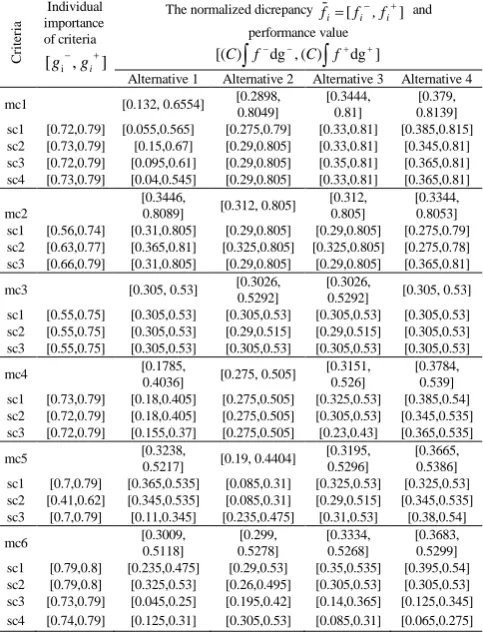
This study aims to evaluate manufacturing performance of a Turkish textile company. For this aim, fuzzy Choquet integral is used for assessing manufacturing performance. For the application, five managers of the company from different departments and the authors of the study establish a team in order to decide multidimensional criteria of this paper. After discussion among the criteria, six main categories are determined for analysis of the elected firm. They are production, supply chain, innovation, cost, human resource and quality measures. The hierarchical structure in Fig.1 demonstrates the general form of the manufacturing performance evaluation.
These five managers confirmed the criteria and sub-criteria and decided on using the evaluation scale in Table I [34].
Table I. The relationship between trapezoidal fuzzy numbers and degrees of linguistic importances in a nine-linguistic-term scale (Delgado et al., 1998).
Low/High Levels The degrees of
importance
Trapezoidal fuzzy numbers
Label Linguistic
terms
Label Linguistic
terms
EL Extra Low EU Extra Unimportant
(0,0,0,0)
VL Very Low VU Very Unimportant
(0,0.01,0.02,0.07)
L Low U Unimportant (0.04,0.1,0.18,0.23) SL Slightly
Low
SU Slightly Unimportant
(0.17,0.22,0.36,0.42)
M Middle M Middle (0.32,0.41,0.58,0.65) SH Slightly
High
SI Slightly Important
(0.58,0.63,0.8,0.86)
H High HI High Important
(0.72,0.78,0.92,0.97)
VH Very High VI Very Important
(0.93,0.98,0.98,1.0)
EH Extra High
EI Extra Important
(1,1,1,1)
[image:5.595.307.549.110.428.2]Table II and table III give the evaluation results by the generalized choquet integral for =0 and =1 . For the sub-criteria, eq.(2) is used while eq.(3) is for the main criteria.
Table II. Evaluation results by the generalized Choquet Integral for =0
C rit er ia Individual importance of criteria ] , [ i i g g
The normalized dicrepancy [ ]
i i i f ,f
f and
performance value ] dg ) ( , dg )
[(C
f C
f Alternative 1 Alternative 2 Alternative 3 Alternative 4
mc1 [0.132, 0.6554] [0.2898,
0.8049]
[0.3444, 0.81]
[0.379, 0.8139]
sc1 [0.72,0.79] [0.055,0.565] [0.275,0.79] [0.33,0.81] [0.385,0.815]
sc2 [0.73,0.79] [0.15,0.67] [0.29,0.805] [0.33,0.81] [0.345,0.81]
sc3 [0.72,0.79] [0.095,0.61] [0.29,0.805] [0.35,0.81] [0.365,0.81]
sc4 [0.73,0.79] [0.04,0.545] [0.29,0.805] [0.33,0.81] [0.365,0.81]
mc2
[0.3446,
0.8089] [0.312, 0.805]
[0.312, 0.805]
[0.3344, 0.8053]
sc1 [0.56,0.74] [0.31,0.805] [0.29,0.805] [0.29,0.805] [0.275,0.79]
sc2 [0.63,0.77] [0.365,0.81] [0.325,0.805] [0.325,0.805] [0.275,0.78]
sc3 [0.66,0.79] [0.31,0.805] [0.29,0.805] [0.29,0.805] [0.365,0.81]
mc3 [0.305, 0.53] [0.3026,
0.5292]
[0.3026,
0.5292] [0.305, 0.53]
sc1 [0.55,0.75] [0.305,0.53] [0.305,0.53] [0.305,0.53] [0.305,0.53]
sc2 [0.55,0.75] [0.305,0.53] [0.29,0.515] [0.29,0.515] [0.305,0.53]
sc3 [0.55,0.75] [0.305,0.53] [0.305,0.53] [0.305,0.53] [0.305,0.53]
mc4 [0.1785,
0.4036] [0.275, 0.505]
[0.3151, 0.526]
[0.3784, 0.539]
sc1 [0.73,0.79] [0.18,0.405] [0.275,0.505] [0.325,0.53] [0.385,0.54]
sc2 [0.72,0.79] [0.18,0.405] [0.275,0.505] [0.305,0.53] [0.345,0.535]
sc3 [0.72,0.79] [0.155,0.37] [0.275,0.505] [0.23,0.43] [0.365,0.535]
mc5 [0.3238,
0.5217] [0.19, 0.4404]
[0.3195, 0.5296]
[0.3665, 0.5386]
sc1 [0.7,0.79] [0.365,0.535] [0.085,0.31] [0.325,0.53] [0.325,0.53]
sc2 [0.41,0.62] [0.345,0.535] [0.085,0.31] [0.29,0.515] [0.345,0.535]
sc3 [0.7,0.79] [0.11,0.345] [0.235,0.475] [0.31,0.53] [0.38,0.54]
mc6 [0.3009,
0.5118] [0.299, 0.5278] [0.3334, 0.5268] [0.3683, 0.5299]
sc1 [0.79,0.8] [0.235,0.475] [0.29,0.53] [0.35,0.535] [0.395,0.54]
sc2 [0.79,0.8] [0.325,0.53] [0.26,0.495] [0.305,0.53] [0.305,0.53]
sc3 [0.73,0.79] [0.045,0.25] [0.195,0.42] [0.14,0.365] [0.125,0.345]
sc4 [0.74,0.79] [0.125,0.31] [0.305,0.53] [0.085,0.31] [0.065,0.275]
Table III. Evaluation results by the generalized Choquet Integral for =1
C rit er ia Individual importance of criteria ] , [ i i g g
The normalized dicrepancy [ ]
i i i f ,f
f and
performance value ] dg ) ( , dg )
[(C
f C
f Alternative1 Alternative 2 Alternative 3 Alternative 4
mc1 [0.1543,
0.6044] [0.31, 0.7598]
[0.3669, 0.7739]
[0.3973, 0.7839]
sc1 [0.75,0.78] [0.085,0.515] [0.305,0.745] [0.36,0.77] [0.405,0.785]
sc2 [0.75,0.78] [0.17,0.62] [0.31,0.76] [0.35,0.77] [0.355,0.775]
sc3 [0.75,0.78] [0.115,0.56] [0.31,0.76] [0.37,0.775] [0.375,0.78]
sc4 [0.75,0.78] [0.065,0.5] [0.31,0.76] [0.35,0.77] [0.375,0.78]
mc2 [0.3836,
0.7724] [0.3502, 0.7637] [0.3502, 0.7637] [0.3568, 0.771]
sc1 [0.6,0.7] [0.33,0.765] [0.31,0.76] [0.31,0.76] [0.295,0.745]
sc2 [0.67,0.74] [0.41,0.775] [0.37,0.765] [0.37,0.765] [0.32,0.735]
sc3 [0.7,0.76] [0.33,0.765] [0.31,0.76] [0.31,0.76] [0.375,0.78]
mc3 [0.35, 0.48] [0.348, 0.479] [0.348, 0.479] [0.35, 0.48]
sc1 [0.59,0.71] [0.35,0.48] [0.35,0.48] [0.35,0.48] [0.35,0.48]
sc2 [0.59,0.71] [0.35,0.48] [0.335,0.465] [0.335,0.465] [0.35,0.48]
sc3 [0.59,0.71] [0.35,0.48] [0.35,0.48] [0.35,0.48] [0.35,0.48]
mc4 [0.2238,
0.3536] [0.32, 0.455]
[0.3612, 0.4801]
[0.424, 0.4987]
sc1 [0.75,0.78] [0.225,0.355] [0.32,0.455] [0.37,0.485] [0.43,0.5]
sc2 [0.75,0.78] [0.225,0.355] [0.32,0.455] [0.35,0.48] [0.39,0.49]
sc3 [0.75,0.78] [0.2,0.32] [0.32,0.455] [0.275,0.385] [0.41,0.495]
mc5 [0.3723,
0.4778] [0.2299, 0.382] [0.362, 0.4842] [0.3985, 0.5012]
sc1 [0.74,0.77] [0.41,0.495] [0.13,0.255] [0.37,0.485] [0.37,0.485]
sc2 [0.45,0.58] [0.39,0.49] [0.13,0.255] [0.335,0.465] [0.39,0.49]
sc3 [0.74,0.77] [0.14,0.29] [0.265,0.42] [0.34,0.485] [0.405,0.505]
mc6 [0.3444,
0.4652] [0.3414, 0.4776] [0.3668, 0.4846] [0.3901, 0.4957]
sc1 [0.8,0.8] [0.265,0.42] [0.32,0.48] [0.38,0.495] [0.41,0.51]
sc2 [0.8,0.8] [0.37,0.485] [0.305,0.44] [0.35,0.48] [0.35,0.48]
sc3 [0.75,0.78] [0.09,0.2] [0.24,0.365] [0.185,0.31] [0.17,0.29]
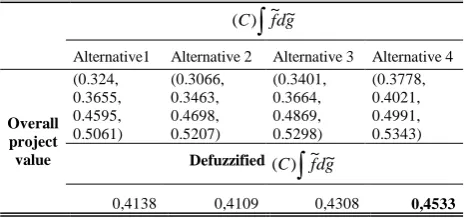
[image:5.595.61.489.581.783.2]Table IV. Defuzzified overall values of alternatives.
g ~ d f ~ C) (
Alternative1 Alternative 2 Alternative 3 Alternative 4
Overall project value
(0.324, 0.3655, 0.4595, 0.5061)
(0.3066, 0.3463, 0.4698, 0.5207)
(0.3401, 0.3664, 0.4869, 0.5298)
(0.3778, 0.4021, 0.4991, 0.5343)
Defuzzified (C)
~fdg~0,4138 0,4109 0,4308 0,4533
From table IV, the defuzzified overall values of alternative shifts and overtime using generalized Chouqet Integral are obtained as 0.4138, 0.4109, 0.4308, and 0.4533.
According to the analysis results among the four alternatives, overtime has the best result (0,4533) and triple shift has the second result (0,4308). On the other hand, it must be pointed out that there are not big differences between single shift (0,4138) and binary shift (0,4109).
In the study to examine manufacturing performance in the chosen textile firm using the multi-criteria desicion model, 6 critical factors and 20 associated sub-criteria are analyzed for 4 alternatives (single shift, binary shift, triple shift and overtime) (Fig.1).
VI. CONCLUSION
In today’s dynamic environment, manufacturing firms need to implement PMSs that should evolve with and adapt to the changing internal and external environment in order to remain competitive. The proposed model in this study will let managers to evaluate manufacturing performance of their firms not only for the textile sector but also for other sectors. In the future these results can be compared with other fuzzy AHP methods such as VIKOR in order to make clear the validity of the study.
REFERENCES
[1] K.K.B. Hon, Performance and Evaluation of Manufacturing Systems, CIRP Annals - Manufacturing Technology, Volume 54, Issue 2, 2005, Pages 139-154.
[2] P. Folan, J. Browne, A review of performance measurement: Towards performance management, Computers in Industry, Volume 56, Issue 7, September 2005, Pages 663-680.
[3] C. Lohman, L. Fortuin, M. Wouters, Designing a performance measurement system: A case study, European Journal of Operational Research, Volume 156, Issue 2, 16 July 2004, Pages 267-286. [4] R. H. Chenhall, K. L.-Smith, Multiple Perspectives of Performance
Measures, European Management Journal, Volume 25, Issue 4, August 2007, Pages 266-282.
[5] J. Grafton, A. M. Lillis, S. K. Widener, The role of performance measurement and evaluation in building organizational capabilities and performance, Accounting, Organizations and Society, Volume 35, Issue 7, October 2010, Pages 689-706.
[6] C.-C. Chen, An objective-oriented and product-line-based manufacturing performance measurement, International Journal of Production Economics, Volume 112, Issue 1, March 2008, Pages 380-390.
[7] Kaya, E.; Caliskan, F.D.; Gozlu, S.; , "Manufacturing Performance Criteria: An AHP Application in a Textile Company," Management of Engineering and Technology, Portland International Center for , vol., no., pp.1186-1194, 5-9 Aug. 2007.
[8] A. Göleç, H. Taşkın, Novel methodologies and a comparative study for manufacturing systems performance evaluations, Information Sciences, Volume 177, Issue 23, 1 December 2007, Pages 5253-5274.
[9] C.-C. Sun, A performance evaluation model by integrating fuzzy AHP and fuzzy TOPSIS methods, Expert Systems with Applications, Volume 37, Issue 12, December 2010, Pages 7745-7754.
[10] M. A. El-Baz, Fuzzy performance measurement of a supply chain in manufacturing companies, Expert Systems with Applications, Volume 38, Issue 6, June 2011, Pages 6681-6688.
[11] İ. Yüksel, M. Dağdeviren, Using the fuzzy analytic network process (ANP) for Balanced Scorecard (BSC): A case study for a manufacturing firm, Expert Systems with Applications, Volume 37, Issue 2, March 2010, Pages 1270-1278.
[12] Aluftekin, N; Tas, A; Yuksel, O; Cakar, G.E; Bayraktar, F, “Assessment of cluster potential and decision making criterion in the textile and apparel sector using the Analytic Hierarchy Process (AHP)” African Journal of Business Management Vol. 5(22), pp. 9125-9136, 30 September, 2011.
[13] N. Han; X.-Jun Ji; , "The study on performance evaluation based on AHP-fuzzy," Machine Learning and Cybernetics, 2009 International Conference on , vol.5, no., pp.2750-2753, 12-15 July 2009.
[14] D. Kaptanoğlu, A. F. Özok, A fuzzy model for academic performance evaluation, itüdergisi/d, Cilt:5, Sayı:1, Kısım:2, 193-204, Şubat 2006. [15] S. Ballı, A. Uğur, S. Korukoğlu, Implementation of a fuzzy expert
system for performance evaluation in human resource management, Ege Academic Review, 9 (2) 2009: 837-849.
[16] N. Y. Seçme, A. Bayrakdaroğlu, C. Kahraman, Fuzzy performance evaluation in Turkish Banking Sector using Analytic Hierarchy Process and TOPSIS, Expert Systems with Applications, Volume 36, Issue 9, November 2009, Pages 11699-11709.
[17] C. G. Şen, D. Cenkçi, An integrated approach to determination and evaluation of production planning performance criterıa, Journal of Engineering and Natural Sciences, Sigma 27, 1-17, 2009.
[18] İ. Ertuğrul, N. Karakaşoğlu, Performance evaluation of Turkish cement firms with fuzzy analytic hierarchy process and TOPSIS methods, Expert Systems with Applications, Volume 36, Issue 1, January 2009, Pages 702-715.
[19] N. Yalcin, A. Bayrakdaroglu, C. Kahraman, Application of fuzzy multi-criteria decision making methods for financial performance evaluation of Turkish manufacturing industries, Expert Systems with Applications, Volume 39, Issue 1, January 2012, Pages 350-364.
[20] W.-S. Lee, Evaluating and ranking energy performance of office buildings using fuzzy measure and fuzzy integral, Energy Conversion and Management, Volume 51, Issue 1, January 2010, Pages 197-203. [21] G. Büyüközkan, D. Ruan, Choquet integral based aggregation approach
to software development risk assessment, Information Sciences, Volume 180, Issue 3, 1 February 2010, Pages 441-451.
[22] G. Ayyıldız, N. Çetin Demirel, Fuzzy choquet integral approach for multi criteria supplier evaluation problem, Sigma 28, 214-223, 2010. [23] Cliville, V.; Mauris, G.; Berrah, L.; , "A Quantified Industrial
Performance Measurement System Based on a Choquet Fuzzy Integral," Fuzzy Systems, 2006 IEEE International Conference on , vol., no., pp.1057-1064, 0-0 0.
[24] G. Büyüközkan, O. Feyzioğlu, M. Ş. Ersoy, Evaluation of 4PL operating models: A decision making approach based on 2-additive Choquet integral, International Journal of Production Economics, Volume 121, Issue 1, September 2009, Pages 112-120.
[25] L. Berrah, G. Mauris, J. Montmain, Monitoring the improvement of an overall industrial performance based on a Choquet integral aggregation, Omega, Volume 36, Issue 3, June 2008, Pages 340-351.
[26] G. Akman, C. Yılmaz, Innovative capability, innovation strategy and market orientation: An empirical analysis in Turkish software industry, International Journal of Innovation Management, Vol. 12, No. 1 (March 2008) pp. 69–111.
[27] Tai, D.-W.-S., & Wang, R. (2006). A framework for human resources development in Taiwan’s high tech industry. World Transactions on Engineering and Technology Education, 5(1), 221–224.
[28] G. Choquet, "Theory of capacities," Annales de I'nstitut Fourier, pp. 5:131-295, 1953.
[29] M. Sugeno, Theory of fuzzy integrals and its applications, PhD thesis. Tokyo: Tokyo Institute Of Technology, 1974.
[30] H.-H. Tsai and I.-Y. Lu, "The evaluation of service quality using generalized Choquet Integral," Information Sciences, vol. 176, no. 6, pp. 640-663, 2006.
[31] F. Modave and M. Grabisch, "Preference representation by the Choquet Integral: The commensurability hypothesis ," In proceedings 7th international conference on information processing and management of uncertainty in knowledge-based systems (IPMU), 1998.
[32] K. Ishii and M. Sugeno, "A model of human evaluation process using fuzzy integral," International Journal of Man-Machine Studies, vol. 22, no. 1, pp. 19-38, 1985.
[33] T.Demirel, N. Çetin Demirel, and C.Kahraman, “Multi-Criteria Warehouse Location Selection Using Choquet Integral”, Expert Systems with Applications, Vol.37, No 5, 3943-3952, 2010.
[34] Delgado, M., Herrera, F., Herrera-Viedma, E., Martnez, L. Combining numerical and linguistic information in group decision making. Information Sciences 107, 1998, 177–194.
![Fig. 1. The hierarchical framework of the evaluating manufacturing performance modified from [1]-[7].-[8]-[9]-[13]; and from thought of managers](https://thumb-us.123doks.com/thumbv2/123dok_us/1280843.656573/3.595.311.549.209.722/hierarchical-framework-evaluating-manufacturing-performance-modied-thought-managers.webp)