BIM-BASED SOFTWARE FOR CONSTRUCTION
WASTE ANALYTICS USING ARTIFICIAL
INTELLIGENCE HYBRID MODELS
By
OLUGBENGA OLAWALE AKINADE
A thesis submitted in partial fulfilment of the requirements of the
University of the West of England, Bristol
ii
DECLARATION
I declare that this thesis represents my own work carried out by me, except where due acknowledgement has been made in the text, and that it has not been submitted either in part or full for any other award than the degree of Doctor of Philosophy of the University of the West of England. Materials from other sources have been duly acknowledged and referenced in line with ethical standards, and the list of publications made from the thesis has been provided.
Signed: OLUGBENGA OLAWALE AKINADE
Signature ………
iii
ABSTRACT
The Construction industry generates about 30% of the total waste in the UK. Current high landfill cost and severe environmental impact of waste reveal the need to reduce waste generated from construction activities. Although literature shows that the best approach to Construction Waste (CW) management is minimization at the design stage, current tools are not robust enough to support architects and design engineers. Review of extant literature reveals that the key limitations of existing CW management tools are that they are not integrated with the design process and that they lack Building Information Modelling (BIM) compliance. This is because the tools are external to design BIM tools used by architects and design engineers. This study, therefore, investigates BIM-based strategies for CW management and develops Artificial Intelligence (AI) hybrid models to predict CW at the design stage. The model was then integrated into Autodesk Revit as an add-in (BIMWaste) to provide CW analytics.
Based on a critical realism paradigm, the study adopts exploratory sequential mixed methods, which combines both qualitative and quantitative methods into a single study. The study starts with the review of extant literature and Focus Group Interviews (FGIs) with industry practitioners. The transcripts of the FGIs were subjected to thematic analysis to identify prevalent themes from the quotations. The factors from the literature review and FGIs were then combined and put together in a questionnaire survey and distributed to industry practitioners. The questionnaire responses were subjected to a rigorous statistical process to identify key strategies for BIM-based approach to waste efficient design coordination.
Results of factor analysis revealed five groups of BIM strategies for CW management, which are: (i) BIM-based collaboration for waste management, (ii) waste-driven design process and solutions, (iii) lifecycle waste analytics, (iv) innovative technologies for waste intelligence and analytics, and (v) improved documentation for waste management. The results improve the understanding of BIM functionalities and how they could improve the effectiveness of existing CW management tools. After that, the key strategies were developed into a holistic BIM framework for CW management. This was done to incorporate industrial and technological requirements for BIM enabled waste management into an integrated system.
iv
DEDICATION
, ,
,
, ,,
v
ACKNOWLEDGEMENT
My profound gratitude to God Almighty, the giver of life for the grace to complete this research.
My sincere appreciation goes to my mentor and director of studies, Professor Lukumon Oyedele for his tremendous supervision, exemplary leadership, guidance, and encouragement throughout the PhD research journey. Your incredible patience and support were invaluable to the success of the study. I will also like to appreciate the contributions and support of my second supervisor, Dr. Kamran Munir.
I am grateful for the financial support provided by Innovate UK and Balfour Beatty Construction Services (CSUK). I would like to thank Jonathan Law (Technical Manager at CSUK) and Peter Trebilcock (Director of BIM at CSUK) for facilitating part of the data collection process.
I acknowledge the supports from other staff members at the University of the West of England, Bristol. I am indeed grateful to Dr Svetlana Cicmil, Dr. Ximing Ruan, Dr Vikas Kumar, Dr. Charles Booth, Prof. Lamine Mahdjoubi, Dr Ismail Adelopo, Dr Akin Ojolo, Dr Bolanle Karimu, Dr Anu Ajayi, Dr Lukman Akanbi, and Dr Juan Manuel Davila Delgado. I must express my sincere gratitude to FBL Graduate School, particularly Dr Helen Frisby, Samantha Watts, and Dr Paul Spencer who diligently provided the required support and for stimulating a vibrant research environment.
Many thanks to Pastor and Deaconess Olujimmy Apata for their spiritual support. A big thank you to my friends and colleagues, Saheed Ajayi, Muhammad Bilal, Hafiz Alaka Hakeem Owolabi, and Udonna Okeke.
vi
I am eternally grateful to my wife and heartbeat, Omolola for her sincere love, prayers, and encouragement. To my little princess, Jemima for the smile that brightens me up after a long day.
vii
LIST OF PUBLICATIONS
1) Olugbenga O. Akinade, Lukumon O. Oyedele, Kamil Omoteso, Saheed O. Ajayi, Muhammad Bilal, Hakeem A. Owolabi, Hafiz A. Alaka, Lara Ayris, John Henry Looney, BIM-based deconstruction tool: Towards essential functionalities, International Journal of Sustainable Built Environment, Available online 29 January 2017
2) Akinade, O.O., Oyedele, L.O., Ajayi, S.O., Bilal, M., Alaka, H.A., Owolabi, H.A., Bello, S.A., Jaiyeoba, B.E. and Kadiri, K.O., 2016. Design for Deconstruction (DfD): Critical success factors for diverting end-of-life waste from landfills. Waste Management.
3) Akinade, O.O., Oyedele, L.O., Munir, K., Bilal, M., Ajayi, S.O., Owolabi, H.A., Alaka, H.A. and Bello, S.A., 2016. Evaluation criteria for construction waste management tools: towards a holistic BIM framework. International Journal of Sustainable Building Technology and Urban Development, pp. 1-19.
4) Akinade, O.O., Oyedele, L.O., Bilal, M., Ajayi, S.O., Owolabi, H.A., Alaka, H.A. and Bello, S.A., 2015. Waste minimisation through deconstruction: A BIM based Deconstructability Assessment Score (BIM-DAS). Resources, Conservation and Recycling, 105, pp. 167-176.
5) Bilal, M., Oyedele, L.O., Munir, K., Ajayi, S.O., Akinade, O.O., Owolabi, H.A. and Alaka, H.A., 2017. The application of web of data technologies in building materials information modelling for construction waste analytics. Sustainable Materials and Technologies.
6) Bilal, M., Oyedele, L.O., Qadir, J., Munir, K., Ajayi, S.O., Akinade, O.O., Owolabi, H.A., Alaka, H.A. and Pasha, M., 2016. Big Data in the construction industry: A review of present status, opportunities, and future trends. Advanced Engineering Informatics, 30(3), pp. 500-521.
7) Bilal, M., Oyedele, L.O., Akinade, O.O., Ajayi, S.O., Alaka, H.A., Owolabi, H.A., Qadir, J., Pasha, M. and Bello, S.A., 2016. Big data architecture for construction waste analytics (CWA): A conceptual framework. Journal of Building Engineering, 6, pp. 144-156.
viii
Journal of Sustainable Building Technology and Urban Development, 6(4), pp. 211-228.
9) Ajayi, S.O., Oyedele, L.O., Akinade, O.O., Bilal, M., Alaka, H.A. and Owolabi, H.A., 2017. Optimising material procurement for construction waste minimization: An exploration of success factors. Sustainable Materials and Technologies.
10) Ajayi, S.O., Oyedele, L.O., Bilal, M., Akinade, O.O., Alaka, H.A. and Owolabi, H.A., 2017. Critical management practices influencing on-site waste minimization in construction projects. Waste management, 59, pp.330-339.
11) Ajayi, S.O., Oyedele, L.O., Akinade, O.O., Bilal, M., Alaka, H.A., Owolabi, H.A. and Kadiri, K.O., 2017. Attributes of design for construction waste minimization: A case study of waste-to-energy project. Renewable and Sustainable Energy Reviews, 73, pp.1333-1341.
12) Ajayi, S.O., Oyedele, L.O., Akinade, O.O., Bilal, M., Owolabi, H.A., Alaka, H.A. and Kadiri, K.O., 2016. Reducing waste to landfill: A need for cultural change in the UK construction industry. Journal of Building Engineering, 5, pp. 185-193.
13) Ajayi, S.O., Oyedele, L.O., Kadiri, K.O., Akinade, O.O., Bilal, M., Owolabi, H.A. and Alaka, H.A., 2016. Competency-based measures for designing out construction waste: task and contextual attributes. Engineering, Construction and Architectural Management, 23(4).
ix TABLE OF CONTENTS
DECLARATION ... ii
ABSTRACT ... iii
DEDICATION ... iv
ACKNOWLEDGEMENT ... v
LIST OF PUBLICATIONS ... vii
LIST OF FIGURES ... xv
LIST OF TABLES ... xviii
LIST OF ACRONYMS ... xx
1 INTRODUCTION ... 1
1.1 Background of study ... 1
1.2 BIM for Construction Waste Management ... 2
1.3 Hybrid Models for Construction Waste Analytics ... 4
1.4 Problem statement ... 5
1.5 Gap in Knowledge and Research Justification ... 6
1.6 Research Questions ... 7
1.7 Aim and Objectives ... 7
1.8 Research methodology ... 8
1.8.1 Methodology for Objective 1 ... 8
1.8.2 Methodology for Objective 2 ... 10
1.8.3 Methodology for Objective 3 ... 11
1.8.4 Methodology for Objective 4 ... 12
1.9 Unit of Analysis ... 12
1.10 Thesis contribution ... 13
1.11 Scope of Research ... 14
1.12 Layout of thesis ... 15
2 CONSTRUCTION WASTE MANAGEMENT STRATEGIES AND TOOLS ... 18
2.1 Overview ... 18
2.2 Definition and Sources of Construction Waste ... 18
2.3 Design for Construction Waste Prediction ... 20
2.4 Design for Construction Waste Minimisation ... 21
2.4.1 Design for Material Optimisation ... 22
x
2.4.3 Design for Material Recovery and Reuse ... 24
2.4.4 Design for Offsite Construction ... 26
2.4.5 Design for Deconstruction and Flexibility ... 26
2.5 Construction Waste Management Tools ... 27
2.5.1 Waste Management Plan Templates and Guides ... 28
2.5.2 Waste Data Collection and Audit Tools ... 30
2.5.3 Waste Prediction Tools ... 30
2.5.4 Waste Quantification Models ... 31
2.5.5 GIS Tools ... 31
2.6 Limitations of existing construction waste management tools ... 32
2.6.1 Existing CW management Tools are Completely Detached from the Design Process 34 2.6.2 Existing CW Management Tools Lack Interoperability Capabilities ... 35
2.6.3 Construction Waste Data are not Sufficient ... 36
2.6.4 Waste management responsibilities are not clear ... 37
2.6.5 Lifecycle Analysis (LCA) of CW Performance is not available ... 37
2.7 Summary ... 38
3 BUILDING INFORMATION MODELLING (BIM) AND ARTIFICIAL INTELLIGENCE (AI) SYSTEMS ... 40
3.1 Overview ... 40
3.2 Building Information Modelling: Concepts and Benefits ... 41
3.3 BIM in the Changing UK Construction Industry ... 43
3.3.1 UK BIM Level 2 Programme ... 44
3.4 Building Information Modelling Platforms ... 47
3.5 BIM for Designing out Construction Waste ... 48
3.5.1 Team Communication and Integration ... 50
3.5.2 Parametric Modelling and Visualisation ... 50
3.5.3 Building Performance Analysis and Simulation ... 51
3.5.4 Automatic Documentation Generation ... 52
3.5.5 Improved Building Lifecycle Management ... 53
3.5.6 Interoperability with Other Applications ... 53
3.6 BIM Development Tools ... 54
xi
3.6.2 BIM Application Programming Interfaces ... 56
3.7 Artificial Intelligence System Development ... 58
3.7.1 Review of Relevant Theories in Artificial Intelligence and Associated Areas . 59 3.7.2 Implications of the Theories for the Study ... 65
3.7.3 Types of Artificial Intelligence Systems ... 66
3.8 Summary ... 77
4 RESEARCH METHODOLOGY... 79
4.1 Overview ... 79
4.2 Research Paradigms ... 81
4.2.1 Ontological and Epistemological Requirements of the Study ... 81
4.2.2 Available Research Paradigms ... 82
4.2.3 Adopted Research Paradigm for the Study ... 87
4.3 Research Strategy and Methods ... 89
4.3.1 Qualitative Research ... 90
4.3.2 Quantitative Research ... 91
4.3.3 Mixed Methods Research ... 92
4.4 Exploratory Sequential Mixed Methods Design ... 93
4.5 Ethical Considerations ... 96
4.6 Software Development Methodologies ... 96
4.6.1 Waterfall Model ... 97
4.6.2 Incremental Development ... 97
4.6.3 Spiral Development ... 98
4.6.4 Agile Programming ... 98
4.6.5 Rapid Application Development ... 99
4.7 Summary ... 100
5 HOLISTIC BIM FRAMEWORK FOR CONSTRUCTION WASTE MANAGEMENT 102 5.1 Overview ... 102
5.2 Sampling Techniques ... 102
5.3 Qualitative Data Collection ... 104
5.4 Qualitative Data Analysis ... 105
5.5 Evaluative Criteria for Construction Waste Tools ... 108
xii
5.6.1 Questionnaire Design ... 108
5.7 Quantitative Data Analyses ... 112
5.7.1 Reliability analysis and Descriptive Statistics ... 113
5.7.2 Exploratory Factor Analysis ... 115
5.8 Data Validity and Reliability ... 116
5.9 BIM Framework for Construction Waste Management ... 117
5.10 Summary ... 119
6 AI HYBRID MODEL DEVELOPMENT FOR CONSTRUCTION WASTE PREDICTION ... 122
6.1 Overview ... 122
6.2 Model Development Process and Experimental Setup ... 122
6.3 Construction Waste Data Collection and Exploration ... 123
6.4 Data Preparation for ANFIS Model Development ... 134
6.5 Adaptive Neuro-Fuzzy Inference System (ANFIS) ... 135
6.6 ANFIS Model Development and Training ... 139
6.6.1 Input selection for ANFIS Models ... 139
6.6.2 ANFIS Structure and Training ... 142
6.6.3 ANFIS Model Evaluation ... 146
6.6.4 Computing Waste by Material Types and Management Routes ... 149
6.7 Mathematical Model for Dimensional Coordination ... 151
6.7.1 Computing Required Bricks ... 152
6.8 Summary ... 159
7 BIM-BASED SYSTEM FOR CONSTRUCTION WASTE PREDICTION AND MINIMISATION (BIMWASTE) ... 160
7.1 Overview ... 160
7.2 Software Development Environment ... 160
7.2.1 C# Programming Environment ... 160
7.2.2 Revit 2017 Application Programming Interface (API) ... 162
7.2.3 User Interface (UI) and Presentation Frameworks ... 166
7.3 System Design for BIMWASTE ... 167
7.4 BIM-based software for Construction Waste Prediction ... 167
7.4.1 User Interface Module ... 168
xiii
7.4.3 Material Database for BIMWaste ... 178
7.4.4 Material Take-Off Calculation Module ... 179
7.4.5 Report Generation Module ... 180
7.5 BIM-Based Design Advisor for Material Optimisation ... 185
7.6 System Testing for BIMWaste ... 192
7.6.1 Results for Test Case 1 ... 195
7.6.2 Results for Test Case 2 ... 197
7.7 Summary ... 198
8 DISCUSSION OF RESULTS ... 200
8.1 Overview ... 200
8.2 Evaluative Criteria for Construction Waste Tools ... 200
8.2.1 Waste Prediction Criteria ... 200
8.2.2 Waste Data Criteria ... 202
8.2.3 BIM Criteria ... 203
8.2.4 Commercial and Procurement Criteria ... 204
8.2.5 Design Criteria ... 206
8.2.6 Technological Criteria ... 207
8.3 BIM Strategies for Design-based Construction Waste Management ... 208
8.3.1 BIM-based Collaboration for Waste Management ... 208
8.3.2 Waste-Driven Design Process and Solutions ... 210
8.3.3 Lifecycle Waste Analytics ... 212
8.3.4 Innovative Technologies for Waste Intelligence and Analytics ... 213
8.3.5 Improved Documentation for Waste Management ... 215
8.4 Holistic BIM Framework for Construction Waste Management ... 216
8.4.1 Infrastructure Layer ... 216
8.4.2 Data Layer ... 217
8.4.3 Presentation Layer ... 218
8.4.4 BIM Business Domain Layer ... 218
8.4.5 Service Domain Layer ... 219
8.4.6 Application Layer ... 220
8.5 BIM-Based Construction Waste Prediction using Hybrid Models ... 220
8.6 Summary ... 223
xiv
9.1 Overview ... 225
9.2 Summary of the Study ... 225
9.3 Main Findings of the Study ... 227
9.3.1 Strategies for BIM-Based Construction Waste Management ... 228
9.3.2 Development of AI Hybrid Models for CW Prediction ... 231
9.3.3 Development and Testing of BIM-Based Tool for CW Management ... 232
9.4 Implications of the Study ... 233
9.4.1 Implications for practice ... 233
9.4.2 Theoretical Implications ... 236
9.5 Limitations of the Study ... 237
9.6 Areas of Future Research ... 238
REFERENCES ... 240
APPENDIX A: FOCUS GROUP INTERVIEW SCHEDULE ... 277
xv
LIST OF FIGURES
Figure 1.1: Layout of Thesis ... 16
Figure 2.1: Strategies for Construction Material Recovery ... 25
Figure 2.2: Current Waste Management Tools ... 29
Figure 3.1: Concepts of Building Information Modelling ... 42
Figure 3.2: BIM Collaborative Platform ... 43
Figure 3.3: Reform Movements and Important Milestones within the UK Construction Industry ... 45
Figure 3.4: BIM Maturity Model by Bew and Richards (2008) ... 46
Figure 3.5: BIM Functionalities Framework for Construction Waste Management ... 51
Figure 3.6: Theoretical Underpinning of Study ... 60
Figure 3.7: Balance Theory for Recycling of Construction and Demolition Wastes ... 63
Figure 3.8: Architecture of a Knowledge Based System ... 71
Figure 3.9: Processes in Knowledge Based System Development ... 72
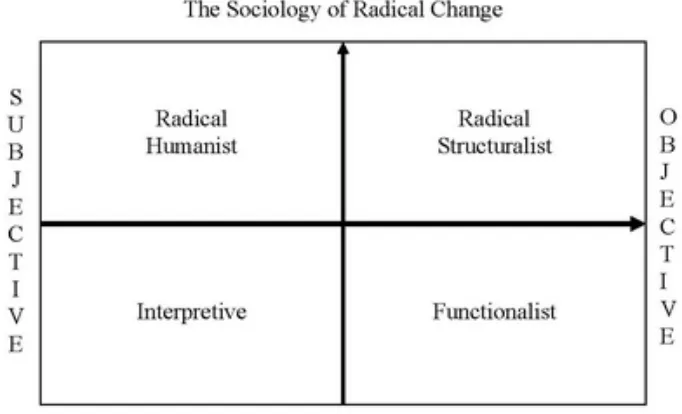
Figure 4.1: Paradigms Framework Proposed by Burrell and Morgan (1979) ... 83
Figure 4.2: An Overview of the Sequential Exploratory Mixed Method Design Process ... 93
Figure 5.1: Methodological flowchart ... 103
Figure 5.2: A Framework of Criteria for Evaluating the Performances of Waste Management Tools ... 109
Figure 5.3: Framework for a BIM-Based Construction Waste Management System ... 120
Figure 6.1: Process of Model Development ... 123
Figure 6.2: Distribution of Waste Data Record by Waste Type ... 127
Figure 6.3: Distribution of Total Waste Output by Construction Type ... 128
Figure 6.4: Waste Management Routes of Waste Types ... 131
Figure 6.5: Waste Management Routes of Construction Type ... 132
Figure 6.6: Distribution of GFA according to Construction Type ... 132
Figure 6.7 Distribution of Cost according to Construction Type ... 133
Figure 6.8: Distribution of Total Waste Output according to Construction Type ... 133
Figure 6.9: Block Diagram of Proposed ANFIS Model ... 134
Figure 6.10: ANFIS Model Development Flowchart ... 135
Figure 6.11: A Two Inputs and one Output ANFIS System ... 137
Figure 6.12: RMSE for two-input ANFIS Model for CW Prediction ... 142
xvi
Figure 6.14: Network Structure of ANFIS Model with Grid Partitioning ... 144
Figure 6.15: Fuzzy Rules for the ANFIS Model ... 146
Figure 6.16: Rule Viewer for the ANFIS Model ... 147
Figure 6.17: Gaussian Membership Function for Variable “Gross Floor Area” ... 148
Figure 6.18: Gaussian Membership Function for Variable “Gross Floor Area” ... 148
Figure 6.19: Comparison of Actual and Predicted Values ... 149
Figure 6.20: Standard Cavity Wall Fully Filled with Insulation ... 152
Figure 6.21: Stretcher Bond using 215x102.5x65 Brick ... 154
Figure 6.22: Graph of Wall Length against br+ ... 156
Figure 7.1: Visual Studio Community Integrated Development Environment ... 161
Figure 7.2: Debugging Revit Plugin in Visual Studio ... 162
Figure 7.3: Enabling Managed Compatibility Mode in Visual Studio ... 162
Figure 7.4: The Two DLL References (RevitAPI.dll and RevitAPIUI.dll) Needed for Add-in Development ... 163
Figure 7.5: Autodesk Revit API Framework ... 163
Figure 7.6: Code Structure for External Command Class ... 164
Figure 7.7: Code Structure for External Application Class ... 165
Figure 7.8: Structure of a .addin manifest file for External Application ... 165
Figure 7.9: Process flow for BIMWaste ... 169
Figure 7.10: Class Implementation for BIMWaste Ribbon Panel ... 170
Figure 7.11: BIMWaste Ribbon Panel ... 170
Figure 7.12: Welcome Page for BIMWaste ... 171
Figure 7.13: BIMWaste About Dialog ... 171
Figure 7.14: BIMWaste Preferences Dialog ... 172
Figure 7.15: BIMWaste Application Settings Page ... 172
Figure 7.16: Create CWA Model Dialog ... 173
Figure 7.17: BIMWaste Reports Window ... 175
Figure 7.18: Sample Dashboard of a CWA Report ... 175
Figure 7.19: Sample Waste Distribution by Levels Stacked Chart ... 176
Figure 7.20: Sample Waste Distribution by Element and Material Types ... 176
Figure 7.21: Sample of Exported Bill of Quantity in Excel Format ... 177
Figure 7.22: Project Parameters for CWA ... 177
xvii
Figure 7.24: Material Database Class ... 179
Figure 7.25: Functions for Collecting All Element and Materials ... 181
Figure 7.26: Functions for Getting all Level and Their Elevation ... 181
Figure 7.27: Function for Getting Elements According to Level ... 182
Figure 7.28: Function for Calculating Gross Floor Area ... 182
Figure 7.29: HTML Code for Report Head Tag ... 182
Figure 7.30: HTML Code for Element-Material Waste Distribution Panel ... 183
Figure 7.31: JavaScript Code for Stacked Bar Chart ... 183
Figure 7.32: Sample Element-Material Waste Distribution Stacked Chart ... 184
Figure 7.33: Menu Bar to Access Panels of the Reports ... 184
Figure 7.34: Design Advisor Button on BIMWaste Ribbon ... 185
Figure 7.35: Material Optimisation Design Advisor Dialog ... 187
Figure 7.36: Selecting Single and All Elements in Document Preview ... 188
Figure 7.37: Updating Element Details Table and Chart. The selected element is shown in the preview panel ... 189
Figure 7.38: Selecting all Elements of Type CL_W1 ... 190
Figure 7.39: Possible Replacement Elements for Basic Wall CL_W1 ... 191
Figure 7.40: Save Chart as PNG image ... 192
Figure 7.41: CWA Dashboard for Test Case 1 ... 195
Figure 7.42:Waste Output by Element Type for Test Case 1 ... 196
Figure 7.43: Waste Distribution by Building Levels for Test Case 1 ... 196
Figure 7.44: CWA Dashboard for Test Case 2 ... 197
Figure 7.45: Waste Output by Element Type for Test Case 2 ... 198
xviii
LIST OF TABLES
Table 1.1: Research Road Map, Methodologies, and Outputs ... 9
Table 2.1: Design-based Causes of Construction Waste ... 19
Table 2.2: Existing Tools for Construction Waste Management and their Limitation ... 33
Table 3.1: A Comparison of API of top BIM Software ... 49
Table 3.2: IFC Development Tools ... 57
Table 3.3: Comparison of Artificial Intelligence Techniques ... 67
Table 3.4: Artificial Intelligence Techniques in Construction Studies ... 68
Table 3.5: Comparison of Different AI Techniques ... 75
Table 3.6: Classification of Hybrid Systems ... 76
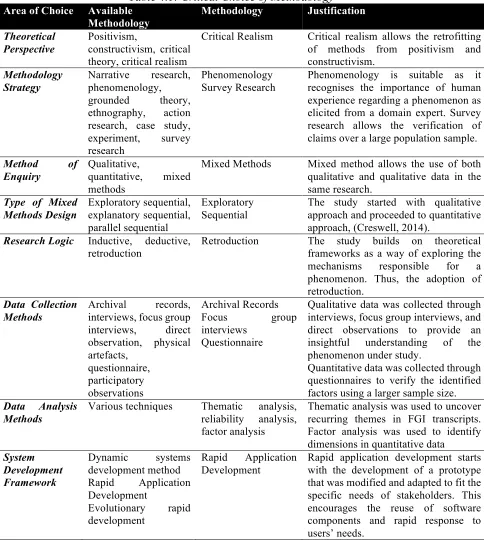
Table 4.1: Critical Choice of Methodology ... 80
Table 4.2: Comparison of Alternative Inquiry Paradigms ... 84
Table 4.3 Comparison of Qualitative and Quantitative Research ... 89
Table 5.1: Overview of the focus group discussions and the participants ... 105
Table 5.2: Descriptive interpretive analysis process ... 106
Table 5.3: Example of classification based on the coding scheme ... 107
Table 5.4: Evaluative Criteria for Existing Waste Management Tools (a) ... 110
Table 5.5: Evaluative Criteria for Existing Waste Management Tools (b) ... 111
Table 5.6: Demographics of survey respondents ... 113
Table 5.7: Reliability analysis and ranking of critical factors for designing out waste ... 114
Table 5.8: Component labelling and corresponding criteria from exploratory factor analysis ... 116
Table 6.1: Cost Classification Range ... 124
Table 6.2: Gross Floor Classification Range ... 124
Table 6.3: Sample Construction Waste Data Record ... 125
Table 6.4: Total Waste Output by Waste Type ... 126
Table 6.5: Total Waste Output by Construction Type ... 127
Table 6.6: Total Waste Output by Project Usage ... 128
Table 6.7: GFA Classification of Waste Data Record ... 129
Table 6.8: Cost Classification of Waste Data Record ... 129
Table 6.9: Waste Data Distribution with respect to Construction Type, Project Use Type and Waste Type ... 130
xix
Table 6.11: Input and Output Variables for ANFIS ... 139
Table 6.12: Sample of Waste Data ... 140
Table 6.13: Details of Hybrid Learning Algorithm ... 140
Table 6.14: Results of Input Selection for ANFIS Model ... 141
Table 6.15: Input Membership Functions for ANFIS ... 145
Table 6.16: Performance of ANFIS Using Different Membership Functions ... 147
Table 6.17: Construction Waste Output Distribution by Construction Types and Waste Types ... 150
Table 6.18: Distribution of Waste Management Route ... 151
Table 6.19: Composition of Standard Cavity Wall ... 152
Table 6.20: Metrics for Dimensional Coordination of Cavity Wall ... 153
Table 6.21: Bricks Requirement and Potential Waste (height, lh = 3000mm) ... 157
Table 7.1: Test Plan for BIMWaste ... 193
Table 7.2: Test Cases for BIMWaste ... 194
xx
LIST OF ACRONYMS
3D Three Dimensional
ACO Ant Colony Optimisation
AEC Architectural, Engineering and Construction AI Artificial Intelligence
ANFIS Adaptive Neuro-Fuzzy Inference System ANN Artificial Neural Network
API Application Programming Interface BIM Building Information Modelling BQ Bill of Quantity
BRE Building Research Establishment
BREEAM Building Research Establishment Environmental Assessment Method BWAS Building Waste Assessment Score
CAD Computer Aided Design CW Construction Waste
CDW Construction and demolition waste CO2 Carbon dioxide
COBie Construction Operations Building Information Exchange CW Construction Waste
DEFRA Department for Environment, Food, and Rural Affairs DfD Design for Deconstruction
DoW Design out Waste
DoWT-B Designing Out Waste Tool for Buildings DRWE Demolition and Renovation Waste Estimator FGI Focus Group Interview
FS Fuzzy System
FST Fuzzy Set Theory
gbXML Green Building Extensible Markup Language GFA Gross Floor Area
GIS Geographic Information System GPS Global Positioning System ICE Institution of Civil Engineers
xxi IES Integrated Environmental Solutions IFC Industry Foundation Classes
IPD Integrated Product Delivery KBS Knowledge Based System n-D N-Dimensional
NBS National Building Specification
NRM 2 New Rules of Measurement for detailed measurement of building works NWT Net Waste Tool
RAD Rapid Application Development RIBA Royal Institute of British Architects RMSE Root Mean Square Error
SDK Software Development Kit
SMARTWaste Site Methodology to Audit, Reduce and Target Waste SMM Standard Method of Measurement for building works SPSS Statistical Package for the Social Sciences
SWMP Site Waste Management Plan
UI User Interface
UK United Kingdom
UML Unified Modelling Language USA United States of America
USEPA United States Environmental Protection Agency WDR Waste Data Records
WPM Waste Prediction Models
1
1
INTRODUCTION
1.1
Background of study
The rapid urbanisation across the globe has led to the inevitably large volume of Construction Waste (CW). From 2004 to 2012, CW contributed the largest percentage (about 30%) of the total waste sent to landfill in the UK (DEFRA, 2011, 2012). According to Osmani (2012b), this percentage of waste requires a payment close to £200 million as annual landfill tax. Apart from the high landfill cost, the disposal of waste has resulted into severe ecological damage (Lu et al., 2011; Nagapan et al., 2012b; Oyedele et al., 2013), shortage of land (Gavilan and Bernold, 1994), and increased transportation and project costs (Yuan, 2012). The constant increase in landfill charges instituted by most countries to discourage waste disposal to landfills has not reduced the amount of CW sent to landfills (Matsueda and Nagase, 2012). Still, the volume of waste sent to landfill sites is a major concern owing to the cost of waste disposal and its adverse environmental impacts. To avoid the undesirable impacts of waste disposal, there is need for an overall change in strategy towards preservation of the finite natural resources, reduction in demand for landfill, and reduction in the total project cost (Oyedele et al. 2013). According to Ajayi et al. (2016), a number of construction waste management strategies have been encouraged to ensure a tighter loop of material and building components.
2
The opportunities in designing out waste have motivated various stakeholders to develop initiatives such as “designing out waste” by Waste and Resources Action Programme (WRAP) and SMARTWaste by Building Research Establishment (BRE) (BRE, 2008b; Langdon, 2011). The UK government also commissioned waste minimisation and sustainability initiatives, which include “halving waste to landfill by 2012 relative to 2008” (Oyedele et al., 2013), “Zero waste to landfill by 2020” (Phillips et al., 2011), and Site Waste Management Plan (SWMP) Regulation (WRAP, 2008). Likewise, the United States Environmental Protection Agency (USEPA) has also set targets to characterise and understand CW material stream as well as promoting research on best practices for CW reduction and recovery (USEPA, 2003). All of these suggest an operational shift from on-site CW management to design based CW management (Osmani, 2013). However, a review of existing CW management tools reveals key underlying problems to design-based CW management. This is because the tools either are too late at the design stage or are not embedded within the design process (Akinade et al., 2016). This makes the tools difficult to be used by architects and design engineers. To overcome these problems, evidence shows that techniques in Building Information Modelling (BIM) could be adopted by design teams for the purpose of waste minimisation (Liu et al., 2011). The BIM-based approach allows CW process to be tightly integrated into the design process and into existing software used by architects and design engineers.
This study therefore assists in accomplishing set targets for the adoption of BIM and the implementation of favourable design strategies for CW minimisation. Thus, the study contributes significant economic, social, and environmental gains by reducing demand for landfills, reducing CO2 emission, conserving embodied energy, preserving natural
environment, and reducing project cost.
1.2
BIM for Construction Waste Management
3
activities to sustain their competitive advantage. A recent survey of about 1,000 UK construction professionals by National BIM Survey (RIBA, 2016) reveals an uptake in the adoption of BIM from 48% in 2015 to 54% in 2016. The survey also reveals that 95% of people expect to adopt BIM on their project within three years. This means that the UK now ranks alongside USA, Finland, Singapore, New Zealand, Hong Kong. with regards to BIM adoption. The increasing adoption of BIM in the construction industry (Azhar, 2011) has improved system interoperability (Steel, Drogemuller and Toth, 2012), information sharing, visualisation of n-D models and decision making processes (Eastman et al., 2011). BIM also provides a platform for seamless collaboration among stakeholders from different disciplines (Grilo and Jardim-Goncalves, 2010). Accordingly, BIM knowledge taps into various fields, which include project management, construction, engineering, information technology, policy and regulation. Accordingly, the expectations of BIM cut across these fields (Singh, Gu and Wang, 2011). Considering the numerous benefits of BIM, there is a need to systematically structure such diverse knowledge in an efficient way to enhance the understanding and efficient development of BIM for CW management. However, none of the existing BIM software offers CW management functionality.
4
1.3
Hybrid Models for Construction Waste Analytics
Advancement in Information and Communication Technologies (ICT) and BIM technologies reveals that any promising innovation within the Architectural, Engineering, and Construction (AEC) industry requires BIM compliance (Liu et al., 2011) and that computer support is indispensable in construction related tasks to achieve the required flexibility, reliability, and efficiency (Eastman et al., 2009). It is based on the foregoing that this study explores an intersection of research frontier in Artificial Intelligence (AI), BIM, sustainability and building construction studies to understand how CW management could be integrated into existing BIM platforms. This study therefore lays on this premise to formalise CW prediction and minimisation strategies into a hybrid AI computational system. This is with the aim of integrating the computational system with existing BIM framework to support architects during the early design stages.
Hybrid systems is a promising research field that integrate multiple AI techniques to find synergetic solution to specific problems. As such, hybrid systems overcome specific limitations of individual techniques and they combine their strengths (Son, Kim and Kim, 2012; Kim, 2013). For example, Fuzzy Inference System (FIS) may be suited to domain knowledge representation and uncertainty handling but it lacks good learning ability (Munakata, Jani and Engineering, 1994). However, machine learning techniques such as NN that possess good learning capability are not uncertainty nor imprecision tolerant. Therefore, the hybridization of complementary AI techniques could produce powerful intelligent systems that could solve practical computing problems (Mohanty, Ravi and Patra, 2013).
5
To achieve CW prediction and minimisation capabilities for the proposed BIM system, AI hybrid models were adopted. The study uses Adaptive Neuro-Fuzzy Inference System (ANFIS) method that integrates the strengths of Artificial Neural Networks (ANN) and Fuzzy Systems (FS) into a single hybrid system (Jang, 1993). The proposed hybrid systems provide exceptional capability by synergising human-like reasoning of FS with connectionist learning based structure of ANN. Adequate CW record data were therefore collected for the purpose of model development, training and testing.
1.4
Problem statement
Evidence from literature suggests that an operational shift from on-site waste management to design based waste management is needed for effective CW management (Faniran and Caban, 1998; Mcdonald and Smithers, 1998; Poon, Yu and Jaillon, 2004; Liu et al., 2011; Osmani, 2012b, 2013). This requires dealing with the problem at source, which is usually at the design stage by designing out CW before it occurs. Tackling this problem calls for a strategic approach to planning for CW reduction using appropriate design tools. However, a review of existing CW management tools reveals key underlying problems to design-based CW management. First, despite the general knowledge that taking the right decisions during design could minimise CW, none of the existing tools has been fully integrated into building design process. This makes the tools too late at the design stage and therefore makes their usage by architects and design engineers difficult. Second, none of the existing waste management tools is BIM compliant (Cheng and Ma, 2011). This is because the tools are external to BIM software used by designers, thereby limiting their usability. Third, despite the current effort to achieve full software interoperability in the AEC industry, existing CW management tools lack interoperability capabilities with other software. Overcoming these problems require tight integration of BIM-based approach to CW management into design process and software used by architects and design engineers.
6
management tools would favour automatic capture of design parameters for CW analytics. It would also help to mitigate errors from manual entry of parameters as done in existing CW management tools. Pointedly, integrating CW management with BIM increases the usability of CW management tools to make appropriate waste minimisation decisions within BIM software. Such system would leverage BIM modelling platforms and their material database to understand and visualise the effects of design decisions on CW generation. The integration also offers a powerful synergy for simulating performances of buildings with respect to CW. In addition, BIM would provide a powerful collaboration platform for all stakeholders towards an effective CW management, seamless information sharing, and software interoperability. This would enable all stakeholders to participate actively in CW decision-making.
1.5
Gap in Knowledge and Research Justification
Despite the benefits accruable from the use of BIM and the steep rise its adoption, the use of BIM for CW management is often neglected (Akinade et al., 2015). Although there are several studies that have stimulated the consciousness of BIM for CW management (Liu et al., 2011; Won, Cheng and Lee, 2016), none of the studies has provided clear instructions on how BIM could be used for this purpose. Besides, this lack of provision for clear instructions raises serious concerns on how CW management could be incorporated into BIM. The set of studies only provides conceptual frameworks by identifying factors that must be considered during design (Liu et al., 2011; Osmani, Glass and Price, 2008; Won, Cheng and Lee, 2016). Thus, the studies fail to provide a methodological mechanism needed to understand how to implement the design principles for CW management. Another challenge is that none of the studies provides an objective measure of performance for DoW principles. These limitations therefore reveal the need to take a holistic approach to investigating CW management principles empirically and to develop a framework for integrating the principles into BIM.
7
leveraged on the BIM technology through the Autodesk Revit API. However, the system only estimates waste generation from demolition and renovation of existing buildings. This clearly shows that the development of a BIM-enabled tool for simulating the different aspects of waste reduction is timely. Considering the foregoing reveals that the use of BIM for CW management would be an effort channelled in the right direction. This is because literature reveals that design decisions have high impact on CW generation (Faniran and Caban, 1998; Osmani et al., 2008). Based on the identified gap in knowledge, this study seeks to identify key BIM functionalities that could provide effective decision-making mechanisms for CW prediction and minimisation at the design stages. At the end, this study develops a BIM-based CW management tool that is code named BIMWaste.
1.6
Research Questions
Based on the research aim and objectives, this study would answer the following research questions:
a) What are the underlying strategies for BIM-based CW prediction and minimisation at the design stage?
b) What are the critical features of BIM for CW prediction and minimisation? c) How can the strategies for CW prediction and minimisation be formalised into
a computational system?
d) How can the computational system for CW prediction and minimisation be integrated into existing BIM platforms?
1.7
Aim and Objectives
8
a) To investigate strategies for enabling BIM-based CW management at the design stage
b) To formalise strategies for CW prediction and minimisation into computational systems using Artificial Intelligence (AI) hybrid models
c) To integrate the computational systems for CW management into existing BIM platform
d) To test the performance of the BIM-based CW management tool
1.8
Research methodology
This mixed methods study adopts several techniques to achieve the specific objectives. The techniques include systematic literature review, focus group discussions, questionnaire survey, thematic analysis of qualitative data, statistical analysis of quantitative data, hybrid AI techniques, Rapid Application Development (RAD) framework, and software testing techniques. Table 1.1 presents the tasks required to accomplish the research objectives and the corresponding expected outputs. The following subsections briefly describe the methodological approaches adopted for the each of the research objectives.
1.8.1 Methodology for Objective 1
Objective: To investigate strategies for enabling BIM-based construction waste management at the design stage.
To achieve this objective, strategies for enabling BIM-based CW management were identified using a mixed methods strategy. Second, a holistic BIM framework for CW management was then developed.
9
Table 1.1: Research Road Map, Methodologies, and Outputs
PROJECT AIM: “To investigate how design-based CW management capabilities could be incorporated into existing BIM platforms.”
OBJECTIVES TASKS MTD OUTPUTS
1) To investigate strategies for enabling CW prediction and minimisation at the design stage.
1) Review of existing CW management tools and identify their limitations.
LR FGI TA QS SA
§ Evaluation criteria for existing CW tools
§ BIM features for CW management
§ Expectations of stakeholders on BIM for CW management. § Holistic BIM framework for
CW management 2) Conduct FGI to identify BIM strategies for CW
management.
3) Conduct a detailed survey research to undertake a wider verification of factors identified during FGIs. 4) Develop a holistic BIM framework for CW management.
2) To formalise strategies for CW prediction and minimisation into computational systems.
5) Collect Waste Record Data. Carry out CW data preparation and set-up database.
GA ANFIS MM
§ CW database
§ AI Hybrid models for CW prediction and minimisation 6) Select features that best predict CW
7) Develop Hybrid AI models for CW prediction
3) To integrate the computational systems for CW management into BIM platforms
8) Setup software development environment RAD C# Revit
§ Full BIMWaste software § Autodesk Revit Plugin for
BIMWaste 9) Design and implement prototypes for BIMWaste
10) Integrate BIMWaste into existing BIM software 11) Prepare operation guide for BIMWaste
4) To test the BIM-based CW management tool in terms of its CW prediction and minimisation
capabilities.
12) Develop BIM designs as test cases FT NFT AT
§ Fully tested BIMWaste software
§ Test results 13) Test BIMWaste in terms of their performance and
acceptance
KEY: MTD – Methods; LR - Literature Review; FGI – Focus Group Interview; QS – Questionnaire Survey; RAD – Rapid Application Development; TA – Thematic Analysis; SA – Statistical Analysis; ANFIS – Adaptive Neuro-Fuzzy Inference System; FT - Functional Testing;
10
The limitations of existing CW management tools were also identified. A comprehensive review of the concept of BIM, BIM development tools,
BIM features for designing out waste, and Artificial Intelligence Hybrid models was carried out.
b) Focus Group Interviews (FGIs) were conducted with architects, design managers, M&E engineers, construction project managers, civil engineers, structural engineers, and BIM specialists. The FGI was conducted to establish a baseline for the expectations of UK construction stakeholders in terms of BIM for CW management. The transcripts of the FGIs were then subjected to thematic analysis to identify the themes across the discussions. The results were used to identify a list of evaluative criteria for CW tools and strategies for BIM-based CW management.
c) The factors identified from the qualitative data analysis were developed into a questionnaire survey to verify the factors using a larger population sample. Respondents for the questionnaire survey were chosen from the UK construction industry. The questionnaire survey was adequately pilot-tested and administered. The completed questionnaires were then subjected to exploratory factor analysis to identify the underlying structure of the factors.
d) Based on the foregoing, a holistic BIM framework for CW management was developed using an architecture-based layered approach. This approach allows related components to be grouped into layers and to ensure hierarchical categorisation of components.
1.8.2 Methodology for Objective 2
To formalise strategies for construction waste prediction and minimisation into computational systems.
11
a) Historical Waste Data Records (WDR) was collected from reputable waste contractors and put in a database.
b) The data was subjected to exploratory data analysis to understand the distribution and structure of the data.
c) A hybrid model based on Adaptive Neuro-Fuzzy Inference System (ANFIS) was developed to predict CW from a set of features.
d) A Dimensional Coordination Model (DCM) was then developed for CW minimisation using mathematical modelling.
1.8.3 Methodology for Objective 3
To integrate the computational systems for construction waste management with BIM platforms
First, requirement gathering for the proposed BIM plugin was carried out. Autodesk Revit was chosen as the BIM platform for the plugin development because it is widely used and it provides a rich Application Programme Interface (API) and Software Development Toolkit (SDK). In addition, Revit provides a powerful BIM parametric modelling platform and a robust material database. The following methods were used to achieve the development and integration of the Revit plugin:
a) The development of the full system is based on Rapid Application Development (RAD) framework. RAD employs a sequence of activities that encourages rapid response to users’ needs.
12
c) System design was done using Unified Modelling Language (UML) in StarUML environment.
d) The modules of the full BIM-based software for CW prediction and minimisation (BIMWaste) were developed in C# and integrated into Autodesk Revit as a Plugin.
1.8.4 Methodology for Objective 4
To test the performance of the BIM-based CW management tool
The full system was eventually tested for CW prediction accuracy, usability, and acceptability. Accordingly, the following activities were carried out to achieve the objective:
a) A plan for functional and non-functional testing of BIMWaste was developed. The test plan contains a list of activities that was carried out during the test and the objectives.
b) Test cases of BIM designs were then developed in Autodesk Revit.
c) The full software was then tested based on the plan and test cases.
1.9
Unit of Analysis
According to Trochim (2006), it is important to identify the unit of analysis for a study to ensure that results are correctly interpreted. Unit of analysis is the major entity that would be studied and analysed in a research. This entails the identification of “who” or “what” is analysed to draw conclusions. The unit of analysis of a study could be individuals, groups, organisations, partnership, communities, projects, artefacts, or geographical units. The choice among these options is dependent on the problem a study tries to address.
13
study also seeks to understand stakeholders’ expectations on the use of BIM for CW management, this study also includes individuals as less significant unit of analysis. However, the focus of identifying stakeholders’ expectations is to develop a holistic BIM framework for CW management, which guides the development of the full BIM system for CW prediction and minimisation. Based on the foregoing, the results, conclusions, and recommendations from this study must be interpreted and used within the context of building designs.
1.10
Thesis contribution
It is generally accepted in the literature that the best approach to CW management is minimisation through design (Faniran and Caban, 1998; Osmani, Glass and Price, 2008; Zhang, Wu and Shen, 2012). This is because design based philosophy offers flexible and cost-effective approach to CW management before it occurs. This places huge responsibilities on architects and design engineers to ensure that waste is given high priority in addition to project time and cost during design. Despite the willingness of architects and design engineers to carry out these duties, existing waste management tools cannot support them effectively. Besides, none of the existing CW management tools is BIM compatible despite the benefits of BIM in improving building process performances. Therefore, this study contributes to knowledge in two major ways: Academic knowledge and industrial practices.
This research made significant academic contribution to CW management at the design stages in several ways. The study identified the limitations of existing CW management tools. The two key limitations are: (i) the tools are completely detached from the design process, and (ii) existing tools lack interoperability capability. Accordingly, the study employed BIM to address the key limitations identified. This study therefore improves the understanding of how CW prediction and minimisation strategies could be captured and represented using AI artefacts. Particularly, the study contributed significantly to BIM studies by developing a system to streamline the estimation and minimisation of CW in BIM environment. The study also helps to understand expectations of industry stakeholders on the use of BIM for CW management.
14
during design. BIMWaste predicts the potential CW output of a building design and it provides suggestion on how CW could be minimised through dimensional coordination and material optimisation. BIMWaste also provides a basis for comparative analysis of building designs and for selecting the one with the least CW potential among options without affecting building forms or function. In addition, BIMWaste could provide a guideline or benchmark for monitoring building CW in the AEC industry.
1.11
Scope of Research
This study explores a multi-disciplinary intersection of research frontier in AI, BIM, and construction sustainability, which are all individually vast areas of study. As such, it is important to define the scope of the study with respect to definition of waste, types of projects considered, building lifecycle stages, and implementation scope. Although, LEAN include non-material waste such as waste associated with transportation, time loss, under-utilisation, inadequate training, and waiting (Koskela, 2004), material waste has the highest environmental impact (Faniran and Caban, 1998; Osmani et al. 2008; Oyedele et al. 2013). As such, waste considered in this study is limited to building material waste and the definition of waste used in the study does not cover non-material waste. Material waste could be explored in three sustainability dimensions depending on the scope of assessment (BS EN 15643-1, 2010), which are economic, environmental, and social. However, this study only considers environmental dimension of sustainability.
15
1.12
Layout of thesis
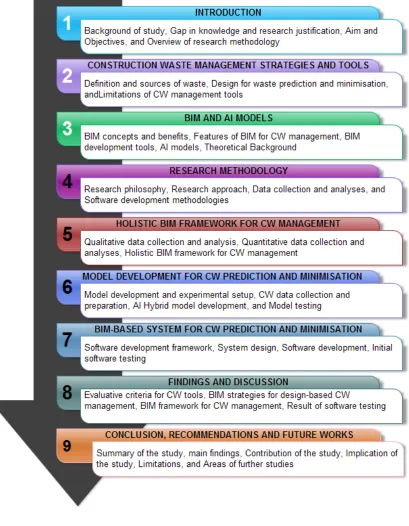
This thesis consists of ten chapters as shown in Figure 1.1. The summaries of other chapters and their place in the research process are summarised as follows:
Chapter 2 contains a review of extant literature on CW management. The chapter defines the concept of CW and it identifies key causes of waste. The chapter discusses CW prediction and the role of design in CW minimisation. The chapter also contains a discussion of existing strategies and tools for CW management. The chapter ends with the discussion of the limitations of existing CW management tools.
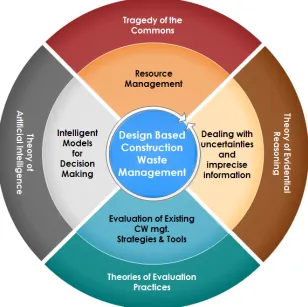
Chapter 3 details the significance of BIM in the changing construction ecosystem and how BIM could be leveraged for CW management. The chapter discusses the current BIM implementation strategy and presents a review of existing BIM software. The state of the art in BIM development is also discussed to identify how BIM capacities could be employed for CW management. The chapter ends with the review of Artificial Intelligence techniques and the theoretical underpinnings of the thesis. The chapter reviews relevant theories and it discusses their place in the study. The theories are tragedy of the commons, graph theory, theories of evidential reasoning, and theory of building layers.
Chapter 4 contains the methodological approach of the study. The chapter covers the research philosophy, strategies, and approaches that were adopted for this study. Details of the data collection and analyses techniques adopted for the study are presented. After the discussion of software development frameworks, the chapter ends with the presentation of the adopted framework for software development.
16
Figure 1.1: Layout of Thesis
17
Chapter 7 contains the integration of the developed models for CW prediction and minimisation into BIM software. As such, a BIM system for CW prediction and minimisation (BIMWaste) was developed. The chapter discusses the development environment needed for BIM development, system design for BIMWaste, and the development process for BIMWaste. At the end, BIMWaste was tested with some test cases to verify its operations and accuracy.
Chapter 8 contains the discussion of the findings of the study. It presents a set of evaluative criteria for CW tools and it discusses the features of BIM that are relevant to CW management. After this, the chapter discusses a holistic BIM framework for CW management, which presents functional systems of a robust CW management tool. The chapter ends with the discussion of findings from CW data record exploratory analysis and software testing.
18
2
CONSTRUCTION WASTE MANAGEMENT STRATEGIES
AND TOOLS
2.1
Overview
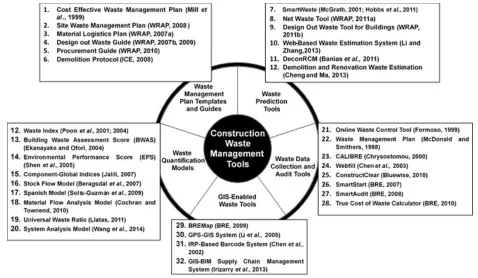
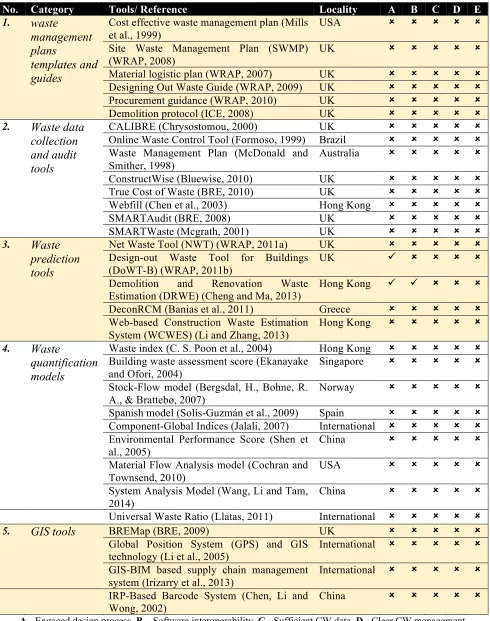
This chapter contains the discussion on the concept, definition, and causes of Construction Waste (CW). The chapter presents a thorough review of extant literature on CW management to understand existing research stream in design for CW prediction and minimisation. Five design principles for CW minimisation are discussed, which are design for material optimisation, design for waste efficient procurement, design for material recovery and reuse, design for off-site construction, and design for deconstruction and flexibility. Thereafter, existing CW management tools are reviewed to identify their limitations. A list of 32 tools was identified in five categories, which include waste data collection and audit, waste prediction, waste quantification models, waste management plan templates and guide, and location-enabled services. The limitations of these tools were identified after a thorough review. Key limitations of existing CW tools are: (i) existing CW tools are completely detached from the design process, (ii) existing CW management tools lack interoperability capabilities, (iii) CW data are not sufficient, (iv) CW management responsibilities are not clear, and (v) lifecycle analysis of CW performance is not available.
2.2
Definition and Sources of Construction Waste
19
tar and tar; (v) metallic waste including cable; (vi) soil, contaminated soil, stones and dredging soil; (vii) gypsum (viii) cement; (ix) paint and vanishes; and (x) adhesives and sealants.
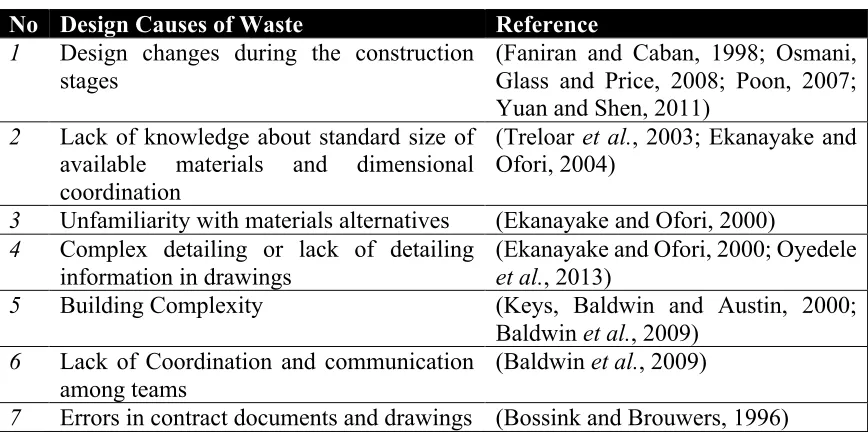
[image:40.595.82.516.308.527.2]Studies on sources of CW waste (Skoyles, 1976; Craven, Okraglik and Eilenberg, 1994; Gavilan and Bernold, 1994; Faniran and Caban, 1998; Ekanayake and Ofori, 2000; Serpell and Labra, 2003) classified the key contributors into six groups, which are design, materials procurement, materials handling, operations, residual related and others. However, there is consensus that the planning and design (pre-construction) stages are responsible for the largest percentage of CW. Some causes of design waste as identified in the literature are shown in Table 2.1.
Table 2.1: Design-based Causes of Construction Waste
No Design Causes of Waste Reference
1 Design changes during the construction stages
(Faniran and Caban, 1998; Osmani, Glass and Price, 2008; Poon, 2007; Yuan and Shen, 2011)
2 Lack of knowledge about standard size of available materials and dimensional coordination
(Treloar et al., 2003; Ekanayake and Ofori, 2004)
3 Unfamiliarity with materials alternatives (Ekanayake and Ofori, 2000) 4 Complex detailing or lack of detailing
information in drawings (Ekanayake and Ofori, 2000; Oyedele et al., 2013) 5 Building Complexity (Keys, Baldwin and Austin, 2000;
Baldwin et al., 2009) 6 Lack of Coordination and communication
among teams
(Baldwin et al., 2009)
7 Errors in contract documents and drawings (Bossink and Brouwers, 1996)
20
Despite the literature that abounds for causes and management of CW, few studies have been carried out to develop tools for design-based waste management. Besides, most of these few studies focus on CW management frameworks (Jun, Qiuzhen and Qingguo, 2011; Liu et al., 2011; Osmani, 2012b), disposal cost estimation (Chen et al., 2006; Yuan et al., 2011; Cheng and Ma, 2011) and demolition waste quantification (Cochran et al., 2007a; Wu et al., 2014; Rosmani and Hassan, 2012). This therefore reveals a huge gap in knowledge because no design tool exists to assist architects and design engineers to estimate the CW output potential of a building design and to proffer ways of reducing the CW. Laying on a solid premise of the importance of reducing the amount of CW to landfills, this study therefore seeks to integrate favourable design strategies for construction waste prediction and management into BIM. This is to ensure that the tool is practicable for use at the design stages.
2.3
Design for Construction Waste Prediction
In achieving effective CW management, robust Waste Prediction Models (WPMs) are needed to estimate the waste potentials of building models accurately before construction. This is because an increase in CW disposal costs will affect the project cost considerably. The review of extant literature reveals four broad categories of WPMs, which are: (i) waste generation rate based models (Poon, Yu and Jaillon, 2004; Masudi et al., 2011; Li et al., 2013); (ii) construction activities based models (Fatta et al., 2003; Ekanayake and Ofori, 2004; Wang et al., 2004); (iii) building elements and materials based models (Shen et al., 2005; Jalali, 2007; Bergsdal, Bohne and Brattebø, 2007; Cochran et al., 2007b; Solís-Guzmán et al., 2009); and (iv) simulation based models (Wu, Fan and Liu, 2013; Salem et al., 2008; Zaman and Lehmann, 2013). These models have set the foundation for CW quantification, however, their reliability is not guaranteed. This is because the peculiarity of building properties and activities affecting CW generation are quite diverse. As such, treating every building the same way could be misleading.
21
can be used to predict CW during design stages. The expectation of a robust WPM therefore taps into the perceived degree of accuracy from relationship among specific variables, which goes beyond waste generation rates, construction activities, building materials, and historical waste data. There are certain factors, such as soil type, construction methodology, design quality, and competency of site workers that are associated with waste output potentials of building models. This calls for a rethink of the development of a robust and holistic quantification model for an accurate estimation of CW at the design stage. This thus sets the stage for the full integration of WPMs into existing design tools.
2.4
Design for Construction Waste Minimisation
Over the decades, building construction activities have generated the largest volume of waste across the globe (Faniran and Caban, 1998; USEPA, 2003; Osmani, 2013). This waste is attributed to the constant uptake of construction, demolition and renovation activities during which villages are built into towns, towns into cities and cities into mega cities (Jaillon and Poon, 2014a). In fact, this uptake of building activities results in about 30% of the total annual waste generation worldwide (Jun, Qiuzhen and Qingguo, 2011). This thus puts immense pressure on the depleting landfill sites and affects the environment adversely. To ensure the conservation of natural resources and to reduce the cost and impacts of waste disposal, effective waste management practices must be put in place. This will ensure that flow of construction materials in a closed loop to minimise waste generation, preserve natural resources and reduce demand for landfills. To achieve this, effective management strategies such as waste reduction, component reuse, and material recycling are needed to divert CW from landfills (Oyedele et al., 2013).
22
(2009) produced a design guideline to assist the design team with opportunities for designing out waste based on five principles, which are:
i) Design for materials optimisation, ii) Design for waste efficient procurement, iii) Design for material recovery and reuse, iv) Design for off-site construction, and v) Design for deconstruction and flexibility.
2.4.1 Design for Material Optimisation
Material optimisation approach to CW minimisation focuses on lean design towards material resources efficiency without compromising the design functions and aesthetics. Lean design applies lean production principles to eliminate waste and to improve engineering processes. The lean design principle considers design process in five areas of improvement (Freire and Alarcón, 2002). The five areas are client, administration, project, resource, and information. However, in terms of CW, material optimisation is key to waste elimination. This is because evidence across extant literature reveals that the construction industry consumes about 50% of the natural resources and contributes a large proportion of waste (about 30%) to landfills. These percentages have raised concerns among stakeholders about the environmental sustainability of the construction industry because material depletion is inevitable if the current rate of natural resources extraction and waste generation continues. Likewise, this will affect the environment negatively by increasing the likelihood of greenhouse effect and CO2 emission.
23
addition, dimensional coordination of design will potentially encourage reuse of offcuts and formworks.
Therefore, architects and design engineers must be equipped with the knowledge of material specifications and standards to understand the constituent of materials, their performance, design code of practice, and materials that favour the design intentions. In this regard, the materials’ fitness for use and quality could be assesses by a list of parameters, which include function, composition, waste potential, strength, reliability, durability among others. Green Guide (Anderson and Shiers, 2009), which is a specification guide for the relative environmental performance of over 250 materials and components, could be employed to achieve effective building material substitution at the design stage,. The Green guide was developed to provide material standardisation and to provide a wide range of alternatives for different material and components types. The foregoing reveals that it is important to tackle the challenge of material specification optimisation from three perspectives: (a) material fit for purpose, (b) material composition of components, and (c) material performance for assurance of quality control.
2.4.2 Design for Waste Efficient Procurement
Evidence shows that inefficiencies in the coordination of procurement activities could lead to CW (Greenwood, 2003; Dainty and Brooke, 2004; Wang, Kang and Tam, 2008; Khanh and Kim, 2014). Considering that cost of building materials could take up to 50% of the project cost, appropriate strategies must be employed to ensure that accurate materials are purchased and that materials are delivered efficiently (Faniran and Caban, 1998; Oyedele et al., 2013). Waste efficient procurement could be achieved through just-in-time delivery (Dainty and Brooke, 2004; Al-Hajj and Hamani, 2011), efficient delivery schedule (Khanh and Kim, 2014), procurement of preassembled components (Formoso et al., 2002), and provision for take back scheme for unused materials (Al-Hajj and Hamani, 2011; Nagapan et al., 2012a).
24
freezing design process before starting procurement process. This is to avoid possible reworks and variation of orders. In additions, architects and design engineers needs to ensure the use of preassembled components (Formoso et al., 2002), modular building design, use of standardised materials to reduce off-cuts (McKechnie and Brown, 2007), specification of materials with less packaging (Yuan, 2013). During material specification, accurate material take-off must be ensured to avoid excessive order. Appropriate communication must also be ensured between the project team and suppliers in terms of preferred methods of waste reduction.
2.4.3 Design for Material Recovery and Reuse
25
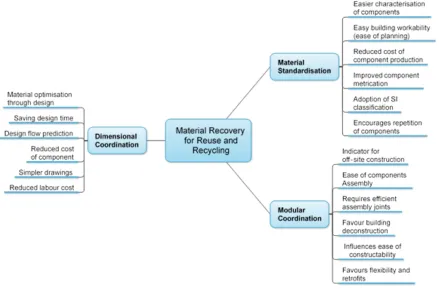
Figure 2.1: Strategies for Construction Material Recovery
26 2.4.4 Design for Offsite Construction
Offsite construction is a process where components are prefabricated and preassembled offsite within a controlled environment and transported to site (Jaillon and Poon, 2014b). The most common offsite construction practices include formworks, scaffolding, rebar works, concrete placements, welding, masonry works, façade, bathroom pods, stairs, roof structures, windows and doors. (Jaillon, Poon and Chiang, 2009; Baldwin et al., 2009; Kozlovská and Spišáková, 2013). A key indicator for offsite construction is modular coordination (Addis, 2008; Tam et al., 2007). Advantages of adopting offsite construction practices include improved environmental performance through waste reduction, reduced construction cost and shortened construction time, and early standardisation and freezing of design layout. Even, Tam et al. (2007) argues that offsite construction could reduce waste generation by 100% and cost of waste management by 84.7%.
Despite the well documented benefits of offsite construction, it has not been fully adopted by contractors (Tam et al., 2007; Jaillon and Poon, 2014b; Begum, Satari and Pereira, 2010; Jaillon, Poon and Chiang, 2009). Major constraints to the adoption of offsite construction include lack of research information and expert advice at early design stage, transportation and vertical movement of components, time required for the initial design development, lack of offsite construction experience, limited space for holding offsite components, and lack of hoist equipment capacity. Besides, the decision to employ off-site construction is mostly based on familiarity and personal preferences but not on rigorous data analysis and research information (Pasquire and Gibb, 2002).
2.4.5 Design for Deconstruction and Flexibility
27
reducing site disturbance (Lassandro, 2003), minimising harmful emission, reducing health hazard (Chini and Acquaye, 2001) and preserving embodied energy (Thormark, 2001) through material reuse; (b) social andeconomic benefits: by providing business opportunities through material recovery, reuse and recycling; and providing employment to support deconstruction infrastructure.
To enable a well-planned deconstruction, conscious efforts must be taken by architects and engineers right from the design stages (Kibert, 2008). As such, the eventual purpose of deconstruction must be identified to guarantee the success of Design for Deconstruction (DfD). This will enhance understanding of relevant design strategies and tools required for deconstruction. Several studies have discussed existing perspectives on DfD principles and how interplay among them could ensure successful building deconstruction. These studies provide a solid foundation for contemporary DfD process and are majorly driven by efficient building elements selection to facilitate easy disassembly (Addis, 2008). The highlight of building elements selection process include: (i) the specification of durable materials (Tingley, 2012); (ii) using materials with no secondary finishes (Guy and Ciarimboli, 2008); (iii) using bolt/nuts joints instead of gluing (Chini and Balachandran, 2002