Bristol
Social
Marketing
Centre
Co-creating with communities
to understand and help solve
the problems that lead to
alcohol harm
Katie Collins &
Lindsay Manning
“From my years in living in inner city Liverpool, as a single parent on a low income who faced and witnessed some of the situations in your presentation, I was moved by the way you undertook such a sensitive project so respectfully and with such care. Thank you for such an interesting and honest approach, I both personally and professionally thoroughly appreciated it.”
Health Promotion Practitioner
Foreword
By Claire Procter, Social Marketing Manager, NHS Gloucestershire
In spring 2011, the Public Health Directorate at NHS Gloucestershire commissioned the Bristol Social Marketing Centre to work with them on a project aimed at reducing risky
drinking in Gloucester, the district with the highest rate of alcohol related hospital admissions in the county.
The objectives were threefold:
1. To better understand the drivers of drinking at the individual and community level; 2. To develop our understanding of what works in reducing risky drinking; and
3. To involve the community throughout the project (using the principle of co-creation) to encourage local ownership and sustainability
The project focused on people living in the wards of Podsmead and Matson. The target audience was increasing and high-risk drinkers, with a particular focus on those aged 35-55 (the age group with the highest rate of alcohol related hospital admissions).
While the starting point was alcohol, there was an appreciation that any exploration of drinking behaviour would need to consider the other aspects of an individual’s life which impact on health and wellbeing (such as access to employment and emotional wellbeing). Similarly the project team were mindful that meaningful collaboration with the community would require a more flexible project plan to allow residents to shape the project’s direction and outcome.
This report prepared by the Bristol Social Marketing Centre provides an overview of the project process, research findings and evaluation and makes recommendations to inform future work in this area. It also reflects on some of the challenges involved both in co-creation and seeking to address specific health behaviours within the context of ‘whole’ community development.
“I feel the idea of the project was pitched well; rather than waiting for people to come to you/us we went out to meet them. This is an approach that we use in detached youth work and feel this a way to break down barriers for people that struggle to know where to find things out that effect their lives or them personally, whatever it may be. This approach gives a voice to those people who in formal settings are unrepresented. But if people feel that the info went nowhere then they will quickly become sceptical about the purpose and will be even less willing to take part next time; reinforcing their negative conception of community / political involvement”
Acknowledgements
There are many who have helped us with this project and we would like to thank all the people who got involved: everyone in Matson and Podsmead who was willing to speak to us in confidence; Amy and Luke at the Redwell Centre; Anne Catchpole and Jo Cadogan from the Independence Trust; Ann Donnelly; Bob Purcell from Gloucester Athletics Club; Carmel Webb; Carrie-Anne Panting; Catherine Hewer of Dreamscheme; Colin Levine from the Nelson Trust; Dani Kilkenny and Family Workers Caroline, Coralie and Kirsty from The Link Children’s Centre; David and Vanda Fews; Dawn Fox; Dr. Jeni Parsons and Curate Keith Hebden of St Katherine’s Church; Erin Baker from Get up and Grow; Garry Slatter; Gerry Hartin; Gill Ragon at Gloucester City Council; Hugo and Lucille of the Phoenix Centre; Isabel Romero and the Community Health Trainers; Jackie, Tanya, Claire and Christine; Janet Champion and Carol Lee of the Saintbridge Townswomen’s Guild; Jason Dunsford from GFirst; Jennie Dallimore; Julie Dowling; Lawrence, Shelley, Reyaz and Ashraf from Fair Shares; Liam Kelch from the Tenants’ and Residents’ Association; Lisa Wilkes; Louise Major; Lorna Robinson from Gloucester City Council; Mark Gale from the Gateway Trust; members of the Katherine Wheel Club; Nurse Anna Gibbins; Pat Dabbs; PC Fraser Mackie and PCSOs Sylvia Lane and Charlotte Simmons; Penny Ridler; Peter Steel from the Independence Trust; Rebecca from UnLtd; Rev. Kevin Durrant at the Baptist Church, Russell Bridge from Halford House; Sam Harness of
Gloucester Youth; Sarah and Roy of St Hilda’s Hall; Sergeant Liz Lovell; Sue and Samantha Cole; Sue Baldwin of the Art Group; Sue Cochrane from NHS
Gloucestershire; Sue Cunningham, Penny Liddicott, Gary Mills and Paul Stepney of GL Communities; Terry Elcock, Lorenzo Divattimo, Neil Duffy, Jo Flood and Amanda
Highlights: Understanding
Co-creating the research evolved naturally into an ethnographic style of data collection; between January and June 2012, researchers spent time with local people in community spaces, their homes and on the street across both communities.
Over 48,000 words of notes based on conversations with 23 males and 41 females in Matson, and 19 males and 39 females in Podsmead were collected.
The research questions for this phase were: Why do people drink, why do they feel they can’t stop and how does this affect them and those around them?
It was found that there was good evidence to support our theory that drinking was often a consequence of other factors, though once people started drinking to excess, this exacerbated other issues.
Alcohol is readily available and cheap to buy. Even if it weren’t, people would make cutbacks in other areas.
There’s a feeling that ‘outsiders’ don’t understand what it’s like to live in Matson and Podsmead and so shouldn’t think they know automatically what should change.
Seven broad themes emerged from our study, which were named family, trapped, worry, powerless, alone, ashamed and confused:
Family Family can be a trigger (e.g. childhood experiences) and be part of the
consequences of risky drinking. Family could also help spot problems early, help people cut down and cope with less alcohol.
Trapped People feel trapped in many ways: by their responsibilities, because they can’t move away, by their financial situation and by what’s available locally.
Worry People worry about the practical and the social consequences of seeking help: losing children to Social Services, losing friends or benefits and the humiliation of other people knowing their problems.
Powerless People feel stuck in a rut, they may be suffering mental health or mood problems or simply be bored, de-motivated and feel they have no reason to get up in the morning.
Alone People feel physically, emotionally and socially isolated: others are at work and they are stuck at home, no one else understands.
Ashamed Men feel shame about admitting weakness and harming their masculine self-image, women feel ashamed about not fulfilling caring duties. Consequently, everyone hides their problems.
Highlights: Solutions
Co-design is a community centred methodology that designers use to enable people to
participate in the design process. In partnership with agency Uscreates (www.uscreates.com) we ran co-design events in Matson and Podsmead.
A range of different ideas emerged from both communities. Solutions were founded on the insight (reinforced by the community co-creators) that reducing isolation and boredom and increasing wellbeing should result in less reliance on drinking.
Matson
In Matson, a vision of a Community Hub emerged that would host a range of services for all ages as well as being a venue for ‘positive’ (i.e. not stigmatising) reasons to visit.
For reasons of time and resources the Hub idea could not be developed in full, so it was decided to develop the Hub concept as a network of people.
Options for training, support and rewards were investigated with potential volunteers and stakeholders. Stakeholders were keen to collaborate and sustain the scheme long term; our involvement in developing the volunteer scheme in Matson ended with a detailed hand over to Hannah Williams of the Asset Based Community Development1 (ABCD) team at Barnwood. Podsmead
In Podsmead, we connected ideas from community co-creators with the feedback we had received in the research about the lack of services (particularly a GP and Pharmacist) and facilities like cafés and shops to create the idea of mobile engagement.
Stakeholders suggested the name Podsmobile and recommended that each day of the pilot should be themed so that people would know what to expect.
The design of the Podsmobile was inspired by two ideas from co-creators:
• Use a map of Podsmead landmarks, a way of making it feel like it belonged and was not
shared with neighbouring communities.
• Co-design the vehicle as part of the pilot, hence the ‘blackboard’ style decals and chalk pens
provided.
The Gloucestershire Youth Services vehicle became the Podsmobile for four days. We
procured a gazebo and picnic tables for a daily street café as well as appropriate permissions and insurance.
The pilot included an engagement day, careers and money day, a young people and families day and a mental and physical health day. All equipment sourced for the pilot was donated to the Podsmead Community Association and the Athletics Club for use in future events in Podsmead. The Podsmobile branding and artwork was given to the Big Local team for use in future community engagement activity.
1 ABCD looks upon local assets as the foundation of community development. Building on the skills of local
Highlights: Evaluation
The sample of 300 pre and 301 post interviews was selected by dividing the combined
population of people aged 35-55 in Matson and Podsmead into sub-groups based on age (35-39, 40-44, 45-49 or 50-54 years) gender (male or female) and lower layer super output areas. The survey was conducted face-to-face in November 2011 and again by the same method in August 2012.
Recollection and opinion of the work
Recollection of any new health or alcohol schemes was low (this isn’t unexpected as we didn’t actually launch such a scheme), as was recollection of an “alcohol research project” in the community.
However, recollection of the Podsmobile was high (36.8%) and the idea was very popular; 69.1% thought it was a very good idea and 86.1% thought it should go ahead, though some people felt that affordable, local public transport would be more empowering.
Community Strength and Wellbeing
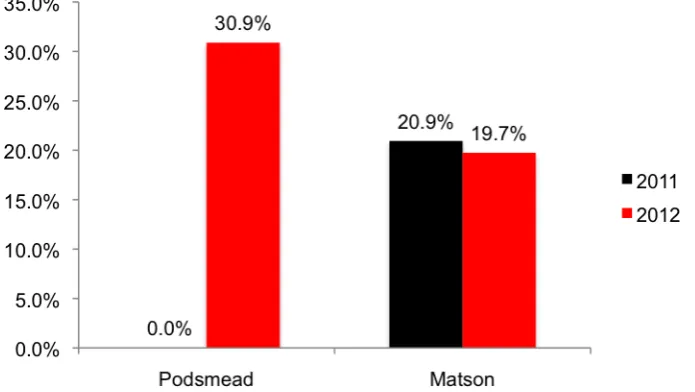
There has been a significant increase in the numbers of people in Podsmead attending community events, volunteering and joining community organisations. In Matson, the percentages are not significantly different between 2011 and 2012.
It is very encouraging that the Podsmobile pilot appears to have engaged with 16 people (23.5% of the 68 surveyed there) who otherwise would not be taking an active part in community events.
Due to the emergence of a very prominent theme of wellbeing, the 7-item Short Warwick-Edinburgh Mental Wellbeing Scale was used in 2012. There was no significant difference in wellbeing between Matson and Podsmead in 2012.
Combining the communities, we found that the mean wellbeing score for younger people (35-39) year olds is significantly higher than for means for other groups.
Drinking and help-seeking
The distribution of Alcohol Use Disorder Identification Test (AUDIT) scores in Matson was not significantly different between 2011 and 2012, suggesting that claimed drinking has not changed.
However, in Podsmead the distribution of the ADUIT scores was significantly different in 2012, showing that drinking appears to have decreased. Caution should be applied here, the sample size is relatively small and it is possible that this is a ‘false positive’ result.
The majority of respondents were in the ‘pre-contemplation’ category of the Stages of Change model in relation to their drinking behaviour. However, the pre-contemplators mainly scored as low or medium risk on the AUDIT.
Highlights: Recommendations
Listening to people is good; showing them that you have listened is better
Results suggest that people in Podsmead have responded well to evidence that their views have been heard and that service providers are prepared to act upon them.
So, people need to know (particularly in Matson where nothing tangible has happened so far) what is happening next.
Good data has been gathered and we suspect that people would feel as though their opinions haven’t been treated with respect if others were to arrive armed with a list of similar questions. Engaging people has raised expectations; this promise needs to be kept
There were a number of people in Matson keen to help develop the Hub idea; time has passed and they are wondering whether anything is going to happen.
We would suggest working with Fair Shares, the Community Health Trainers and Gloucester City Homes on the Matson Hub.
The emerging spirit in Podsmead is a great opportunity for anyone that would like to see positive changes there; the work that has been happening needs continued support.
Rather than tackling shame and stigma head on, show that ‘outsiders’ can be trusted Particularly worrying for people was unwanted involvement of Social Services in family life, loss of benefits and personal information “getting out” if they sought help.
Shame and stigma are embedded socio-cultural phenomena and consequently it takes a great deal of time and investment to change the way that individuals feel.
Myths and misunderstandings can be tackled sympathetically, backed up by information (that isn’t perceived as being unrealistic) about how services can help and what can be achieved. Primarily, we found that people responded to the field researcher’s respectful and empathetic approach and the way that this enabled relationships and trust to develop over time.
If people can feel better, then they can cope better
Our work seems to provide good evidence of the link between people’s emotional wellbeing, social connectedness and the need to use alcohol as a “palliative” way of coping with stress and unhappiness. Finding ways to reduce isolation seems to be a vital first step.
Our learning is quite specific, what can be applied more widely?
This is one of the big challenges of any sort of asset based or collaborative working; the Asset Based Community Development project is well placed to assist with this methodology.
We can offer some specific suggestions to anyone wishing to embark upon a similar journey to ours: Begin by getting to know the community but acknowledge that it takes time to build trust. Recognise the value of community ‘gatekeepers’ but remain receptive to local power relations and politics, which can be complex and difficult to uncover.
Once trust has been built it is very damaging to break it, so it is vital to seek a commitment from stakeholders that they will make long-term plans for the future of initiatives.
Using case studies and storyboards worked well for getting people to think of solutions. These worked as ‘workshop materials’ and more ad hoc activities.
By its nature, this type of collaborative working is continually evolving and plans will change regularly. We have found that a regular ‘pause and prioritise’ meeting offers an invaluable chance to reflect on what has been learnt and agree next steps.
Finally, we would recommend that one person should take on the role of ‘engagement lead’ (thought they can be supported by others as needed) with responsibility for building
Table of Contents
1. Methodology ... 10
1.1. Process... 10
1.2. Stakeholder workshop ... 11
1.3. Exploratory engagement... 11
1.4. Co-creating the research methods ... 12
1.5. Data Collection: An ethnographic approach ... 12
2. Research findings ... 13
2.1. Research questions ... 13
2.2. Qualitative themes ... 13
2.3. Case Study 1: Young mum... 15
2.4. Case Study 2: Carer ... 17
2.5. Case Study 3: Younger man... 19
2.6. Case Study 4: Older man ... 21
3. Co-creation in Matson ... 23
3.1. Co-design ... 23
3.2. Matson Hub Concept ... 23
3.3. Volunteering Scheme ... 24
3.4. Sustainability: Fair Shares and ABCD ... 25
4. Co-creation in Podsmead ... 27
4.1. Co-design ... 27
4.2. Mobile Engagement Concept ... 27
4.3. Podsmobile Pilot ... 28
4.4. Big Local Consultation ... 29
5. Evaluation ... 30
5.1. Study design and sampling... 30
5.2. Do people recall any new schemes or events? ... 30
5.3. Recollection and opinion of the Podsmobile... 32
5.4. Community strength... 34
5.5. Wellbeing ... 37
5.6. Drinking behaviour... 39
5.7. Where to go for help with drinking ... 41
6. Conclusions and reflections ... 42
6.1. Risky drinking is bound up with many factors... 42
6.2. Community strength may be linked to drinking... 42
6.3. Something exciting is happening in Podsmead ... 42
6.4. It’s a challenge to integrate co-creation in commissioning frameworks... 43
6.5. The challenges of scaling up co-created solutions ... 43
7. Recommendations ... 44
7.1. Listening to people is good; showing them that you’ve listened is better ... 44
7.2. Engaging people has raised expectations; this promise should be kept ... 44
7.3. To challenge shame and stigma, show that ‘outsiders’ can be trusted ... 45
7.4. If people can feel better, then they can cope better without alcohol... 46
Figures
Figure 1: Lauren's story (used in co-design) ... 16
Figure 2: Jane's story (used in co-design)... 18
Figure 3: Alex's story (used in co-design) ... 20
Figure 4: Bill's story (used in co-design)... 22
Figure 5: Matson Hub vision... 24
Figure 6: Strengths of Fair Shares and Community Health Trainers as partners in the Matson scheme 26 Figure 7: Podsmobile schedule ... 28
Figure 8: Images from the Podsmobile engagement... 29
Figure 9: Recall of new health schemes or events... 31
Figure 10: Recall of new alcohol schemes or events ... 31
Figure 11: Opinion of the Podsmobile ... 32
Figure 12: Suggestions for the Podsmobile... 33
Figure 13: Have you attended a community event in the last 12 months?... 34
Figure 14: Have you been a member of an organised group in the community in the last 12 months?... 34
Figure 15: Have you volunteered in the last 12 months? ... 35
Figure 16: Emotional and practical support, given and received (2012 only)... 36
Figure 17: Stages of Change distribution across AUDIT categories ... 40
Figure 18: Sources of help for drinking... 41
Tables Table 1: Podsmobile recall and community event cross-tabulation... 32
Table 2: volunteering and organised community group cross-tabulation in Podsmead (2012 only) ... 35
Table 3: Community Strength Scores... 36
Table 4: I feel like I belong to a community (2012 only) ... 37
Table 5 Mean Wellbeing Scores (2012 only)... 38
Table 6: Descriptive statistics for Alcohol Use Disorders Identification Test ... 39
Table 7: Distribution of AUDIT scores ... 39
Table 8: Stages of Change in Matson and Podsmead ... 40
1. Methodology
The two communities selected for this intervention were chosen by NHS Gloucestershire (NHSG) because of higher than average related hospital admissions and alcohol-related crime and disorder (LAPE) and because the target wards contain high numbers of risky drinking households, according to a geo-demographic alcohol segmentation analysis
undertaken by NHSG. The target wards also rank in the most deprived quintile nationally as assessed by the 2007 Indices of Multiple Deprivation.
At the start of the project, the team agreed upon a working hypothesis that providing information about safe drinking levels or attempting to educate people about the dangers of heavy drinking would probably be ineffective. Instead, it was supposed that many factors in the social,
economic and physical environment influence drinking levels and that any intervention needs to acknowledge these issues. Consequently, we began the project with no prior assumptions about what we might discover or what solutions might be appropriate.
UWE proposed a Participatory Action Research methodology. This is founded in the research paradigm known as critical research, i.e. rather than describing situations as they are or seeking out general rules and principles, researchers following this tradition seek to improve human welfare using methods of reflection and action (Murray & Ozanne 1991).
Participatory Action Researchers prioritise learning with and for disenfranchised or marginalised people (in the case of this project, people from deprived areas who may lack social and
economic power to change their circumstances). People participate in the inquiry at all stages, including design, data collection, analysis, application and dissemination of research findings (Ozanne & Saatcioglu, 2008; Fields et al., 2008).
1.1. Process
The project began in November 2011 with a survey to 300 people aged 35 – 55 in Matson and
Podsmead. Next was the Qualitative Research, led by field researcher Lindsay starting with trying to understand the reasons why people in Matson and Podsmead might consume too much alcohol. Following the analysis of qualitative data, various activities were undertaken to present the findings back to the communities and work with them to co-create solutions.
After a brief pilot of the most promising co-created ideas, the team handed over our insights and contacts to NHS Gloucestershire’s Asset Based Community Development Lead, who are working with the Barnwood Trust to develop Matson and Podsmead as learning sites.
1.2. Stakeholder workshop
To launch the project, a second workshop was held for stakeholders (the first had been held by NHSG, prior to our involvement in the project). 10 stakeholders from the police, council,
community organisations and charities were able to attend.
“Stakeholders felt that
improving self-esteem and
self-competence and
increasing engagement in
the community needed to
come before objectives
related specifically to
drinking.”
Stakeholders were asked to identify and prioritise what they thought the goals of the project should be. Overwhelmingly,
stakeholders felt that improving self-esteem and feelings of competence and increasing involvement and engagement in the
community needed to come before objectives related specifically to drinking. Other important goals were: to motivate people to reduce the amount they’re drinking; to give people tools that will help them reduce their drinking levels (at home or on the streets) and to encourage people to take more ‘interest’ in their health generally and to take action to improve things. Stakeholders were asked how they thought people should be spoken to. They suggested an approach that was flexible in the times we were out an about to accommodate working people and that people should be spoken to informally, everyone, not just drinkers. To go to people where they are, to become involved in existing activities as much as possible rather than expecting people to join our agenda and finally to be aware that the environment in which the conversation takes place is important.
1.3. Exploratory engagement
The first piece of engagement was at the community fun day at Matson Rugby Club. This event was regarded as an opportunity to explore the community’s reaction to the project, in particular whether they experienced a negative reaction to being asked about their drinking. We saw this first event as an opportunity to learn about Matson and start making contacts there, but primarily to help us to find an appropriate course between the need to prioritise outcomes related to alcohol on the one hand, and our whole community philosophy on the other.
We spent over 2 hours talking to people about the project, asking them about their community and their drinking. We found 11 people who were willing to give us their contact details and expressed an interest in finding out more.
We were surprised that people didn’t seem to mind being asked about drinking, provided that specific details about consumption were not requested (open questions and vague categories like ‘medium, heavy’ were preferred). Conversely, speaking generally about the community made it difficult to turn the conversation around to alcohol. People wanted to talk about issues like youth services and healthy eating on a budget, and once they’d had an idea they were difficult to divert.
We spoke to several people who identified themselves as ‘heavy drinkers’ but didn’t feel that this was a problem they needed to address. Several males appeared proud of their heavy drinking, and wanted to joke about it, pointing out the “alcoholics” in the group. One male did wish to reduce his drinking, but felt that this was something he needed to manage in private. Apart from this gentleman, there didn’t seem to be much stigma attached to drinking, though the majority of the people we spoke thought of themselves as ‘social drinkers’.
We got the sense that the community cared about their young people, and this could be a route to engage older people as well. Existing organisations like the Rugby Club and Redwell were well regarded, and word-of-mouth seems to be very important.
1.4. Co-creating the research methods
Further engagement took place at an Ideas Workshop held at the Redwell Centre in Matson, designed to explore a range of research methods with residents and use their knowledge of their community to identify the most effective way of approaching data collection. Despite the use of existing community networks and ‘pamper’ incentives to attract the women and mothers who frequently attend the centre, there was a poor turnout. However, there were some very valuable insights from the Centre Manager and youth workers who took part.
Co-creating the research design began via ‘methods stations’, which encouraged people to experiment with different ways of expressing themselves about risky drinking in context, such as visual methods, playing simple games and more traditional qualitative techniques like semi-structured interviews.
People were willing to verbalise their (personal and in some cases harrowing) stories with us in these informal situations. However it was found that literacy problems were common, with the result that many people felt anxious about engaging with any method that required them to read or write, particularly if doing so would expose spelling mistakes or misunderstandings publically. Conversely, we discovered that once people
had overcome their initial ‘stage fright’ at being asked to create something visual, they found the collage method enjoyable and thought this would work well for their community. This method had two advantages: it gave people something to do whilst they spoke thus avoiding direct eye contact and it inspired new directions in the conversation.
Many people were concerned that they would ‘lose control’ of their stories. Several asked who would be told about revelations made; there seemed to be a distrust of authority and outsiders and whilst this had been mitigated somewhat by spending so much time in the community, this ‘trust capital’ didn’t extend beyond the researcher.
“The traditional qualitative
approach of depth
interviews or focus groups
was likely to unsuccessful
in uncovering the range of
issues because only the
confident, literate people
with nothing to ‘hide’ or no
difficult stories would come
forward”
For these reasons, we concluded that the traditional formative qualitative approach of depth interviews or focus groups was likely to unsuccessful in uncovering the range of issues in Matson and Podsmead because only the confident, literate people with nothing to ‘hide’ or no difficult stories would come forward. In some cases we found that the informality of the ad hoc discussions in public, familiar surroundings gave people a feeling of security that would
disappear in the unfamiliar, private and formal setting of traditional health research.
1.5. Data Collection: An ethnographic approach
Ethnography is an observational method designed to get at the meanings underlying peoples' behaviours by focusing on everyday life as events unfold naturally. Its goal is to understand behaviour from the point of view of those who are being studied (Galanti, 1999). Ethnographic research produces ‘situated knowledge’ and captures the details of social life through detailed description and “slice of life” accounts (Taylor, 2002).
collection. Between January and June 2012, Lindsay spent time in multiple venues across both communities and collected field notes based on conversations with 23 males and 41 females in Matson and 19 males and 39 females in Podsmead.
2. Research findings
2.1. Research questions
• Why do people drink?
• Why do they feel they can’t stop?
• How does this affect them and those around them?
Complex stories about why people started to drink were told; what keeps people drinking, why they might not ask for help and how it affects those around them.
This section summarises the key themes from our analysis of the field notes and presents four typical ‘case studies’ of the types of drinkers we encountered. Please note that whilst the case studies are based upon real stories some details have been changed so that individuals cannot be identified.
2.2. Qualitative themes
Can be a trigger: for example experiences in childhood or partner losing job can turn moderate drinking into risky.
Can be part of consequences: family has to pick up pieces with little formal support, drinking can lead to domestic violence (which leads to more drinking) and loss of family. Can be helpful: harder to hide problems from family so they can catch them early, they can make it easier to cope without alcohol, not wanting children to copy can encourage change.
By their responsibilities: to mind young
children and to keep things going when times are tough.
Because they can’t move away: can’t escape anti-social behaviour or bullying, can’t offend neighbours because they’re stuck with them. By peer pressure: on men to be “manly” and drink and women to do what their friends are doing.
By circumstances: struggling to get by on low income and cope with debt, unemployment and benefit problems.
People worry about the practical
consequences of seeking help: losing their children, benefits or home.
People worry about the social consequences of seeking help: that their friends will be hostile or they will be humiliated when people hear about their problem.
Community co-creators changed our word apathy to ‘powerless’.
Nothing to do: if people are not working (unemployed or caring for children) they feel they have nothing productive to occupy themselves with.
Nothing to look forward to: people feel low, de-motivated and depressed. They get up late and start drinking at lunchtime.
No reason to bother: people don’t see why they should change; they think there are bigger problems than health.
People feel physically isolated: their friends are at work; the traditional pub with games and caring landlord has gone.
People feel emotionally isolated: no one understands what they’re going through; everyone else is coping OK.
People feel socially isolated: they have no one to turn to, they might have asked for help in the past and been let down.
Men feel ashamed about: admitting weakness, letting down their mates and family, losing face and not being able to hold their drink.
Women feel ashamed about: people thinking they aren’t a good mum because they drink. The consequences of shame are people want to hide their problems and are afraid to ask for help in case others find out.
People are confused about what to believe: how many units is healthy, how many units in a drink. The advice changes and the media try to shock.
People are confused about where to go: who they can trust and what will happen if they admit a problem and ask for support. Where is the best place to go for help?
People are confused about what’s normal: many people see risky drinking as normal; family, friends and neighbours all do it.
2.3. Case Study 1: Young mum
Isolated and unhappy since she gave birth as she has can’t go out with her group of friends anymore, so drinks to combat feelings of boredom and depression
Lauren is 21 years old and lives in a two-bed flat. She has a little girl who is 10 months old. She split up with her ex 6 weeks after her baby was born, because he couldn’t cope with the stress, sleepless nights and changes that a baby brought to their home. He still sees his daughter every week and tries to help out financially occasionally, but he has moved out of Gloucester to find work.
Lauren had her first drink when she was 12, along with her mates. They always used to go out together as a group; they would have a few bottles of wine at each other’s house before they headed into town, to get drunk on less money. They didn’t cause much trouble, they had a laugh and were just doing what everyone their age did. Ever since she had the baby, Lauren has stopped going out regularly with these friends. She can’t even go round to have a drink with them before they go out, like she used to do when she was pregnant, because she can’t leave her daughter. In fact she can’t go out at all in the evening, and stays in alone with nothing to do but watch TV.
anyone who goes to the toddler group, and is worried that it will be a bunch of older mums who will criticise her for being young and single. It is also at the other end of Matson and she feels more nervous going up there. Lauren feels let down by her friends, who seem to have dumped her since she had her baby. She used to feel like she had a lot of fun and friends, and that she had a lot to look forward to, but now feels like she will be trapped as a lonely mum for years, with no chance to get a proper job or get out to see her friends.
She knows some other mums where she lives and she sometimes gets invited to their flats, where they get all the kids playing together then spend the afternoon over a few bottles of wine. She knows this isn’t a good thing to do but she likes being with them most of the time because she isn’t lonely then, and she can’t be there and refuse a drink because they’d think she was criticising their drinking.
“She likes being with them
most of the time because she
isn’t lonely, and she can’t be
there and refuse a drink
because they would think she
was criticising their drinking.”
They are really critical and bitchy about other mums in the area, and she doesn’t want them to find out what a bad mum she thinks she is, so any time she thinks she has done something stupid or wrong it turns into a big deal for her. She wants to get on with them because she knows they could really cause trouble for her if they wanted to.
Lauren does worry about the amount she is drinking and that she is a bad mum; she is
[image:16.595.48.554.457.785.2]frightened to ask for help or even tell the Health Visitor how much she is really drinking because she is worried they might take her daughter away. She sometimes resents her daughter and this makes her feel worse, especially in the evening when there is nothing else to do but sit alone and watch TV. So she started having a drink when she puts her daughter to bed and now she finds she is drinking for at least 4 hours a night. She picks up cheap deals with her weekly shopping, so she feels better that she is not going to the off-license every morning because someone would notice.
2.4. Case Study 2: Carer
A wife who is trying to live with and support someone who is drinking too much. They have difficulty in getting support for the person who needs help and also feel a lack of support themselves
Jane is 46 years old. She is married to Bill, and they have a son aged 17 and a daughter aged 13. Bill had an accident at work three years ago, and he has very little mobility in his left leg now. He had to give up work and although he was given a good settlement, nearly all that money has gone now and he is finding it hard to get another job. He can’t move very far, can’t sit for long and is often in pain.
As a result, Jane has had to increase the hours she works at a café in town, but money is really tight. Bill feels like he can’t look after his family and that he is failing them, and is getting
increasingly depressed. He used to have a few good friends that he went to play skittles at the pub with a couple of times a week, but now his leg prevents him from going so they have replaced him on their team. He doesn’t really see anyone outside of the immediate family; instead he watches a lot of TV and gambles on the Internet.
Bill helps a bit with going to the shops around the corner, but can’t manage any of the housework or gardening, so Jane and the children divide these between them. Jane is exhausted a lot of the time as she has to work nearly full time, and then comes home to manage the house as well.
She feels that Bill resents her for managing to juggle a job, the family and the home as well, but she doesn’t do it to make him feel bad - she does it because if she didn’t then it wouldn’t get done. She would like a bit of gratitude and recognition of the hard work she puts in; she
struggles to cope with Bill’s depression, as he often gets angry and frustrated, and takes it out on her and the kids.
“If something could be
done about Bill’s pain and
mobility then he wouldn’t
feel the need to drink so
much, but at the moment
he needs help with his
depression.
He usually just shouts, but has recently started throwing things and has smacked her across the face twice. She is also worried about Bill’s drinking as this has steadily increased since his accident, partly to manage the pain and help him sleep but also partly because he is bored and depressed so he has a drink whenever he wants to forget the way his life has changed. She is now sure that he starts drinking at lunchtime as she is measuring the amount of empties.
She tries to restrict it by limiting the amount of money he has around the house, but the old man across the road is also a heavy drinker and has started coming over regularly to keep Bill
company in the afternoons so he is also contributing to the problem. Their son is also drinking more of the alcohol lying round the house, and when she challenged him he said ‘if it’s alright for dad then it’s alright for me’.
Jane feels certain that if something could be done about Bill’s pain and mobility then he wouldn’t feel the need to drink so much, but at the moment he needs help with his depression. She
doesn’t know of any services that could help her or offer advice, and she doesn’t know anyone else who has gone through anything similar.
Although she has her family around her, she feels really alone and that she is trying to keep her family together on her own, and that it will reflect badly on her as a wife and a mother if she can’t keep it up. She is also worried about the GP passing it on to social services who might interfere with her kids; she doesn’t trust health professionals.
2.5. Case Study 3: Younger man
He experiences social pressure to keep drinking and pressure to keep things fun and not to seek help. He feels he has the right to drink; he earns his money and can decide for himself how to spend it. If mistakes have been made while drunk, these are still framed as fun (e.g. injuries or crimes committed)
Alex is 34 years old. He has a big group of friends that he has grown up with in Matson, and they all go out together. They started drinking when they were about 12 or 13, the same time they started smoking. They go out Friday and Saturday night into town, and sometimes mid-week as well, although this is sometimes more local like the rugby club. Before he goes out Alex will drink a few shots or beers, depending on whether he plans on having a heavy night, because it will make the evening cheaper if he is already tanked up before he leaves. So he regularly stocks up at the supermarket when he does his shopping as the cheap deals are much better than the local shop. He works full time for a local construction company, and has a 2 bed house and his own car. He doesn’t really get involved in the community as he usually goes outside Matson for entertainment and just looks on it as a cheap area to live. Drinking is part of Alex’s identity – he thinks about himself as part of that group of friends, and drinking is what they do together: they keep in contact during the week via texts and Facebook and plan what they are going to do that weekend.
The alcohol just makes it possible for them to act the way they want to have a laugh and a good time, even if he had a bad day or week at work he can forget it and have a good weekend. He has no real stress or worries in his life, drinking is just for
pleasure and he feels that it is his right to drink as much as he likes because he has earned it through hard graft during the week. He resents anyone telling him what he should do with his own money, especially when no-one else is involved. He is aware that his lifestyle is not very healthy, but he doesn’t want to think about that now, no more than he wants to think about getting married or having kids – he can think about that later.
“If someone gets hurt or
something gets
damaged then it’s all just
part of the fun, you
make a joke out of it
because you never
know how the night is
going to turn out.”
Alex doesn’t think that he has a problem with drinking, or that it is risky – apart from if someone got seriously hurt which would be unlikely because they don’t usually drink and drive. He thinks people who do have a problem with alcohol are old and often homeless street-drinkers, who buy cheap booze every morning from the off-license and start drinking before lunch.
2.6. Case Study 4: Older man
He has been drinking too much for a while and now lost things that are important, such as job, wife and children. He has reached the ‘bottom’ and it is now more acceptable to seek help Michael is 56 years old. He used to live with his wife and two children in a 3-bed house, where he ran his own business as a cab driver. He grew up in Matson, with his brother and parents. His dad was a heavy drinker and used to regularly beat him and his brother from a young age. He was constantly nervous because he didn’t know when his dad would strike out at him. He fell out with his dad when he was 17, and didn’t speak to him again. His dad died 15 years ago from liver cancer. Michael started drinking at home when he was young – he used to steal some of his dad’s booze. When he left home aged 17 he was already drinking every day, and he used it to help him relax and sleep at night.
He didn’t used to see drinking as a problem. He would go out with his friends for a few pints two or three times a week, when they would play darts or skittles. He’d have a few glasses of whisky when he got home too. But then the pubs changed and stopped offering the games, so they just spent all their time drinking instead. The work dried up as well, and he had more time on his hands so he started drinking in front of the TV in the afternoon. His wife moaned at him to get out the house, so he used to go to the pub instead, for some peace and quiet. The pub was the only place he could think of going - he didn’t know of anywhere where men his age could go and do something other than drink. This extra time drinking meant that he couldn’t take up the odd bit of work that did come through, because he’d had too much to drive. So his business gradually folded, and his wife kept blaming him because they couldn’t afford the things that they used to be able to buy. He felt like a failure because he had built his business up, and so he went to the pub more often to get away from the house and everything that reminded him. He found that he was drinking there on his own more and more, especially after a couple of his close friends died.
“He didn’t feel able to
go to the GP because
it would be admitting
to another weakness
or failure on top of
losing his business
and putting his family
in debt.”
Michael didn’t think he had a problem with alcohol, but he knew that he was depressed. But he didn’t feel able to go to the GP or speak to his wife, because it would be admitting to another weakness or failure on top of losing his business and putting his family in debt. He knew that his friends would also tell him to keep it
together for his family, and that he was no use to them if the doctor sent him away for treatment. He thought it was a private family matter and he didn’t want any outside person interfering. It was up to her to tell him when she wasn’t prepared to put up with it anymore, and then he could do something about it. But she didn’t, she just decided to take the kids and leave. This was four years ago - his wife then remarried and his children who are now 15 and 12 years old have taken on their new step-dad’s surname. Michael had to move out, and now lives in a room in his friend’s house. He doesn’t sleep well and he doesn’t get up until lunchtime because he doesn’t need to go to work. He finds it difficult to get up because there’s nothing pushing him to and he often feels depressed about the day ahead so then it’s easier to skip breakfast and go straight into lunch and a beer. His friend is also a fairly heavy drinker, and they share the cost of rent and food between them and then spend the rest on alcohol. On a good day Michael feel like he wants to do something to cut down his drinking, because he knows how much he has lost as a result of it. But on a bad day he feels really low and worthless, because he has lost his business and family and his children don’t even want to share his name
When he does think about wanting to get help and cut down drinking, Michael doesn’t know what he would do with his time. The men he knows are all drinkers, though some of them now encourage him to get help because they can see how much he has lost through drinking. He wouldn’t think to get involved with any community activities because he thinks these are for women and children, not divorced middle-aged men. So the only places he can think to go to get him out of the house would all be places where he could drink, and all the people he now sees regularly have a drink in their hands.
3. Co-creation in Matson
The Design Council defines co-design as a community centred methodology that designers use to enable people who will be served by a designed outcome to participate in devising solutions to their problems.
3.1. Co-design
In partnership with social change agency Uscreates, we ran a co-design workshop, held at the Baptist Church on Matson Avenue. Five residents attended for the whole workshop, two from local churches along with stakeholders from the Independence Trust, The Link, and Gloucester City Homes.
More than 40 ideas emerged from the workshop; some quite specific to a particular age and life-stage (e.g. extreme sports could help divert groups of young men from organising all their social activity around alcohol) but with general principles that apply to all (e.g. provide activities that don’t revolve around drinking). Ideas were both preventative and geared to help people already struggling with their drinking. To end the workshop, two groups were asked to visualise the idea that they felt was the most likely to make a difference. Independently, both groups created a ‘Community Hub’, located in the centre of Matson (to remove the territorial issues of people from one end of Matson feeling unwelcome at the other end).
3.2. Matson Hub Concept
The Matson Hub would host a range of services for all ages as well as being a venue for
‘positive’ (i.e. not stigmatising) reasons to visit such as a café, evening social club and venue for short courses. Having somewhere ‘positive’ to go with activities for all ages as well as
somewhere to socialise would reduce isolation (the community is felt to have no social spaces for adults at the moment, not even a café) and help mitigate the stigma associated with
accessing help.
It was thought that this would reduce alcohol harm in several ways: by making services easier and less embarrassing to access and also by giving people reasons to leave their homes (where they drink because they are isolated, lonely and bored) by giving them things to do that do not revolve around drinking.
However, our experience and research to date in Matson suggested that if the Hub was simply created, without work to engage residents in the process of designing it, it risks becoming a great provision of many facilities and services that the community just doesn’t use. A
programme of engagement needs to happen that builds upon the work we have started, so that when and if a Hub is launched, people will use it.
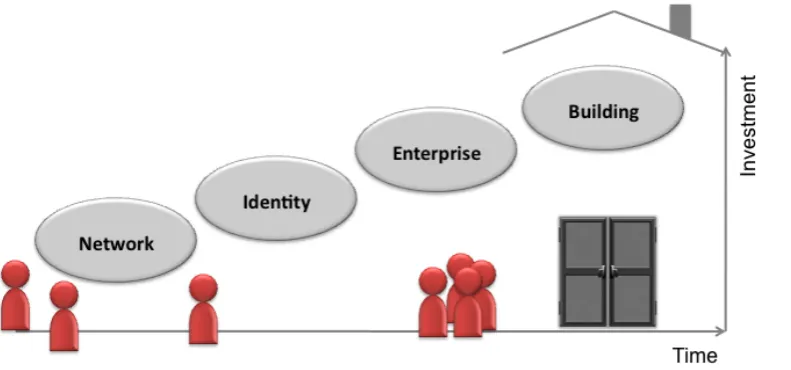
For reasons of time and resources the Hub idea could not be developed in full with this project. So, a decision was made to develop the Hub concept as a network of people working together to befriend and mentor, along with providing clear information and busting some of the myths that scare people away from accessing help. This vision came from the Matson volunteers, and was something that could be achieved within the budget and time available.
[image:24.595.45.441.138.323.2]3.3. Volunteering Scheme
Figure 5: Matson Hub vision
Volunteers and stakeholders agreed that a first step of creating a ‘network’ of volunteers was a sensible way to begin. Several offers of support were made from stakeholders, including
expertise on setting up, help with promoting the scheme and assistance in recruiting more
volunteers. It was agreed that the scheme would be launched at the Community Health Day that was planned for 21st June 2012 (unless the organisers refused permission, in which case staff at the Children’s Centre offered to launch our scheme at their community fete, also in June 2012).
Anne Catchpole from the Independence Trust shared her knowledge about creating a
befriending and signposting volunteer scheme. Following her input, it seemed sensible set up the scheme with the principles of the Mentoring and Befriending Foundation in mind (they define the process as “a voluntary, mutually beneficial and purposeful relationship in which an
individual gives time to support another to enable them to make changes in their life.”), with the ultimate objective of qualifying for Approved Provider status. This would mean that our scheme would be based upon safe, effective practice with outcomes that can be monitored. It was felt also that this would make the scheme more attractive to potential volunteers and increase public confidence.
Training
We instigated some background research into suitable training options, for instance, the Independence Trust offer training in Identification and Brief Advice and Motivational Interviewing.
We also intended to find ways to link up the training programme with other local courses to help
volunteers progress towards a qualification if possible. Staff from the Gloucestershire Gateway Trust, a local charity that works to enable sustainable regeneration in Matson, White City, Podsmead, Tuffley and Stonehouse, were supportive of the idea and felt that helping volunteers towards a recognised qualification would be beneficial to the individuals involved a strong incentive to take part.
“Helping volunteers
towards a recognised
qualification would be
beneficial to individuals
and a strong incentive
to take part.”
One option under consideration was the Royal Society of Public Health’s Level 2 award in understanding health improvement. We discovered that the Community Health Trainers at the Independence Trust were also qualified to deliver this training. Holders of this Level 2
qualification will gain the knowledge and understanding needed to help people in need of support and encouragement to make positive changes in their lives. The award covers: inequalities in health; how effective communication can support health messages; the importance of promoting improvements in health and wellbeing and the impact of behaviour change on health and wellbeing.
Finally, we began to compile a list of what services are available locally and how they can be accessed, with the intention of working with volunteers to co-create suitable materials to help them communicate with those in need of help. Volunteers had suggested leaflets, but also more innovative ways of breaking down barriers to services and dispelling myths such as a video created by the team showing people where they would go, who they would meet and what to expect from the service. This, they felt, could be shared on smart phones and Facebook. Recruitment and Rewards
Finally, volunteers were asked about what incentives the scheme could include. As explained above, the training was thought to be a powerful incentive in itself, but volunteers also thought that themselves and others they knew would value ‘points’ or vouchers for short breaks and days out. One of the things that can make life difficult in this community is never being able to escape.
3.4. Sustainability: Fair Shares and ABCD
One of the most important goals of this project was to co-create something that would be sustainable. As such, several potential partners in the scheme were involved in discussions from the start.
It was learnt that the Community Health Trainers were also intending to set up a ‘Community Health Champions’ scheme with similar remit and objectives. It was also discovered that
Gloucester City Homes ran a network of volunteers to assist their fellow residents with housing related issues. GCH were keen to collaborate, as were the Health Trainers. Similar schemes in other communities in Gloucester were the Health Inequalities Project and Fair Shares.
Fair Shares (www.fairshares.org) are a registered charity set up in Gloucestershire to pioneer Community Time Banks throughout the county. Time Banking is a community-based scheme that promotes two-way volunteering using time as its currency. Time Banks bring the community together and reward people for the help they provide to others in their neighbourhood.
with others. The Fair Shares team believes passionately that everyone has something to offer, and everyone’s time is valued equally.
Fair Shares Community Health Trainers
Are experienced in community engagement and ABCD approach;
Volunteer recruitment and management ingrained into practice, and their local Time Brokers offer regular contact and supervision; A reward system via time-banked hours is in place
Builds community engagement via the reciprocal exchange of skills and time
Has at its heart a focus on mental health and the benefits of social and community engagement
Have ongoing processes to ensure provision of adequate insurance, safeguarding, dealing with confidential issues and reporting where necessary Have health expertise and access to regularly updated knowledge of services and sign-posting
Experienced and trained to identify needs and refer to the right place for further help Access to ongoing training and
development options
Figure 6: Strengths of Fair Shares and Community Health Trainers as partners in the Matson scheme
Our involvement in developing the volunteer scheme in Matson ended with a detailed hand over to Hannah Williams, NHSG Lead for Asset Based Community Development. We have been assured that our findings will be integrated with the Matson ABCD learning site and are happy to support this process beyond the scope of this project.
If we had be asked to continue developing the Matson Hub Network as a volunteering scheme, we would have chosen to work in a way that is more akin to the approach pioneered by Fair Shares. So, rather than taking a very direct “health messages” approach (we do not believe people would feel comfortable speaking to their friends and neighbours about their drinking), volunteers would be “befrienders” who would build relationships and trust over time, increasing social connections and wellbeing.
In itself, this process of reducing isolation and building self-esteem and social networks may well have had a positive impact on individual and community health in Matson in the longer term. If relationships between volunteers and their communities are strong, people may feel much more comfortable approaching volunteers for advice on how and where they can get help for alcohol problems.
4. Co-creation in Podsmead
Co-creation in Podsmead was undertaken with a similar philosophy and process to the Matson work. Part way through the process, the community was awarded a £1 million grant from the Big Local Lottery fund, and a £100,000 grant from the British Heart Foundation (BHF). Councillor Jennie Dailmore was a key collaborator in Podsmead and was vital in securing in both these grants for the community. Through Jennie’s open and collaborative approach, we were
welcomed into the team and contributed to the early stages of engaging the community in these projects.
4.1. Co-design
Because we knew that people would be very unlikely to attend a workshop, we attended two community events with social change agency Uscreates to try and engage people in mini co-design activities.
We spoke to 33 people about our research findings and what ideas they had to make things better. Like Matson, a variety of suggestions were made but many fell under the broad themes of combating isolation (giving people the opportunity to make friends, join groups, even just talk to someone for a few minutes) and breaking down barriers (between age groups and between people who feel trapped and isolated). Specific suggestions included befriending or mentoring schemes and a community bus.
Our experience with trying to engage people in Podsmead suggests that they don’t take part in anything that requires them to leave their own territory (which may be as limiting as their home or street). They feel that they’ve been let down and forgotten, and trust needs to be rebuilt. So, rather than expecting them to engage with an intervention on our terms, we connected ideas from the co-design with the feedback we had received in the research about the lack of services and facilities in Podsmead to create the idea of mobile engagement that would work hard to involve people street-by-street.
The advantage of this approach is that once established, the vehicle can be used to deliver any intervention, service or enterprise (such as fruit and vegetable delivery, a mobile GP, Internet café and careers advice, dental checks, youth services etc). In essence, we were proposing collaboration between local enterprise and service providers. At its most basic level, we were attempting to get people out of their houses and talking to one another, even just for a few minutes.
4.2. Mobile Engagement Concept
Podsmead stakeholders were keen to get involved with something that had momentum and energy. There was interest in volunteering each day to talk to people, serve tea and cake etc. Some would be happy to engage proactively, others would rather speak to people who
approached the team.
People suggested that the mobile engagement be given a permanent name; and while
Podsmobile was felt to be a bit ‘cheesy’ most people liked it. Stakeholders also really liked the idea of reusable images and branding that could be used for future engagement and Big Local events. To achieve this, the branding would have to be something identifiable as Podsmead and related to improving the community in general.
It was suggested that each day was given a theme so that people would know what to expect, and information about ‘What’s On’ each day could be updated easily using a menu type
blackboard, which would also fit with the daily street café that would form part of the engagement.
vehicle as part of the pilot. We were slightly concerned (based on past experience) about the possibility of graffiti, so a blackboard format with some space for volunteers and stakeholders to decorate together was felt to be the most effective compromise.
4.3. Podsmobile Pilot
The Gloucestershire Youth Services vehicle became the Podsmobile for four days. We
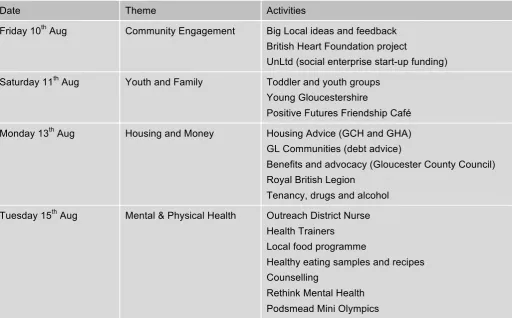
procured a gazebo and picnic tables, as well as a café style blackboard and a supply of chalk markers. Appropriate permissions were gained from the council to provide a street café, and supplies of beverages and snacks were arranged. Volunteer drivers (with the correct licences and training) were recruited and insurance organised via the Youth Services team. Each of the four days of the pilot was themed around a particular topic:
Date Theme Activities
Friday 10th Aug Community Engagement Big Local ideas and feedback British Heart Foundation project
UnLtd (social enterprise start-up funding) Saturday 11th Aug Youth and Family Toddler and youth groups
Young Gloucestershire
Positive Futures Friendship Café Monday 13th Aug Housing and Money Housing Advice (GCH and GHA)
GL Communities (debt advice)
Benefits and advocacy (Gloucester County Council) Royal British Legion
Tenancy, drugs and alcohol Tuesday 15th Aug Mental & Physical Health Outreach District Nurse
Health Trainers Local food programme
Healthy eating samples and recipes Counselling
[image:28.595.43.556.200.518.2]Rethink Mental Health Podsmead Mini Olympics
Figure 8: Images from the Podsmobile engagement
All equipment was donated to the Podsmead Community Association and the Athletics Club for use in future events in Podsmead.
4.4. Big Local Consultation
The Big Local team used the Podsmobile as part of their consultation process with local people. They received 140 completed questionnaires, and found overwhelmingly that the people of Podsmead have identified a need for better health facilities and activities for young people. Further work will be needed to identify what this youth work will look like. This is supported by what people want the YPOD to be; with 30% suggesting the YPOD should be used for youth actives.
5. Evaluation
Evaluation provides a powerful tool for assessing the impact of interventions, offers a useful means of informing future planning and allows us to understand more about what works, what does not work and why (Mistral et al, 2008).
The difficulty of evaluating health impacts from a community intervention has been highlighted (Kegler et al, 2000). In order to detect outcomes resulting directly from our project, a mixed methodology approach combining quantitative and qualitative data collection methods was considered, based primarily upon a quasi-experimental design of a pre/post survey and analysis of alcohol specific and alcohol related hospital admissions data. However, it proved to be
impossible to access hospital admissions data to post-code level (which would be necessary in order to isolate Matson and Podsmead patients from other areas).
Consequently, the quantitative evaluation rests upon three waves of survey data: the first conducted in November 2011, before engagement with the community began. The second wave data was collected in August 2012, and the third wave will be collected in August 2013.
5.1. Study design and sampling
The sample of 300 pre and 301 post interviews was selected by dividing the target population into sub-groups based on age (35-39, 40-44, 45-49, 50-54 years) gender (male/female) and lower layer super output areas. Quotas for each sub-group were calculated for Podsmead, Matson & Robinswood based on the population numbers from the Office for National Statistics population estimates for Mid-2010. Respondents who claim to consume alcohol less than once per week were screened out of the sample.
The tendency for people to present themselves in a more favourable way in response to
research questions (Gordon and Langmaid, 1988) can be a problem for researchers. Further, it has been found that self-reported alcohol consumption can be under reported by between 20-33% and risky drinking by up to 50% (Davis et al, 2010). To mitigate this, we:
• Assured respondents that the survey was completely anonymous and were encouraged to
answer the questions truthfully.
• Asked respondents to self-complete sections of the survey which were deemed more
sensitive and therefore more susceptible to socially desirable responding.
• Included a short version of the Marlowe Crowne (M-C) social desirability scale to detect and
negate where individuals had been influenced by this bias.
The order or sequence of questions on structured questionnaires has been found to influence respondent bias Hair et al (2006), regardless of whether the survey is self-completion or
interview administered. One method of eliminating order bias in such cases is to rotate the order or sequence of questions.
Accordingly, the order of questioning was rotated in sections including scale based questions or multiple answer options. For the self-completion section, two versions of the questions were produced (a) original version and (b) one reversed version and distributed to the two halves of the sample.
5.2. Do people recall any new schemes or events?
Q: Can you remember any new health schemes or events for local people?
Figure 9: Recall of new health schemes or events
Q: Can you remember any new schemes or events for local people related to alcohol?
Figure 10: Recall of new alcohol schemes or events
In fact, recall of new schemes or events specifically related to alcohol has decreased between November 2011 and August 2012. Statistical analysis using Pearson’s Chi Square test
suggests that this decrease is statistically significant (p=.003).
Q: Are you aware of (and have you taken part in) a research project that’s been happening locally?
Over 96% of local people did not know that a research project about drinking and health had been happening. Of the 301 people surveyed, 2 were aware of the project and 3 had taken part themselves.
Q: Are you aware of a scheme called Fair Shares?
This question was included for Matson residents only, because at the time the questionnaire was finalised we believed that Fair Shares were going to be commissioned to run the
[image:31.595.56.510.334.535.2]Interpretation of what people remembered
• There is no difference in the percentage of people who recalled a new health scheme and
significantly fewer people remembered a new scheme about alcohol in 2012.
• A small proportion of people knew about the research project; more (14.6%) had heard of
Fair Shares
5.3. Recollection and opinion of the Podsmobile
Q: Have you seen the Podsmobile?
25 (36.8%) of the 68 Podsmead residents surveyed in 2012 remembered seeing the Podsmobile. This is a very good level of recall for a 4-day pilot scheme.
Statistically, there was found to be a very weak correlation (using Pearson’s test) with the 21 Podsmead residents (30.9%) who claimed to have attended a community event in 2012 (see also Figure 13).
Perhaps this is because the Podsmobile did not appear to fit the description of ‘community event’ in some people’s minds, but it is very encouraging that the pilot appears to have engaged with 16 people (23.5% of the 68 surveyed) who otherwise would not be taking an active part in the community.
Have you attended a community event in the last 12 months? Have you seen the Podsmobile?
Yes No Total
Yes 9 16 25
No 12 31 43
[image:32.595.37.560.355.443.2]Total 21 47 68
Table 1: Podsmobile recall and community event cross-tabulation
Residents were asked: (as you may know) this is a new scheme that is in its trial stage. The idea is that this bus tours around Podsmead delivering services, facilities and things that are not otherwise available in the area. On a scale of 1 to 5 where 5 means a ‘very good idea’ and 1 means ‘a very bad idea’, what do you think of this as an idea?
Q: What do you think of the Podsmobile idea?
Figure 11: Opinion of the Podsmobile
[image:32.595.50.362.552.725.2]Additional topics to cover Groups to cater for Other comments About road safety
Information on fitness
Advice/keep people motivated if looking for jobs
Information on local things, services
Anything to with health issues or anti social behaviour (e.g. dog poo)
Forms and things elderly people have difficulty with (shopping, grass cutting, Internet, benefits)
Awareness of crime - PSO activity and crime prevention Help with benefits and money management
Support for giving up alcohol, info about drink and drugs
Something for families and kids
Advice on what is available for old people.
Help generally with all things as I'm Polish.
NEETS. More awareness of activities for 14+
Something for teenagers and any related issues like alcohol, contraception
More things for the disabled - more things going on that they could go to
Come around in the evenings and weekends so people at work can benefit
Taking people to shops. Helping people with shopping. Taking them to the doctors. Anything for people who cannot do things on their own, can't get around
Just general transport for people who can't get to the shops because of mobility problems
Figure 12: Suggestions for the Podsmobile
Q: Would you like to see the scheme go ahead?
86.8% of the 68 Podsmead residents surveyed would like to see the Podsmobile go ahead. 5 residents (7.4%) did not want to see the scheme go ahead, and 4 (5.9%) did not know or did not answer the question.
Interpretation of the Podsmobile Pilot
• We were pleased with the proportion of people who remembered the Podsmobile.
• There wasn’t a significant overlap between people who remembered the Podsmobile and
those who had attended a different community event, which suggests the Podsmobile reached people who would otherwise not have engaged.
• Very high percentages o