Stronger Security Notions for Decentralized Traceable Attribute-Based
Signatures and More Efficient Constructions
Essam Ghadafi
University of Bristol, United Kingdom
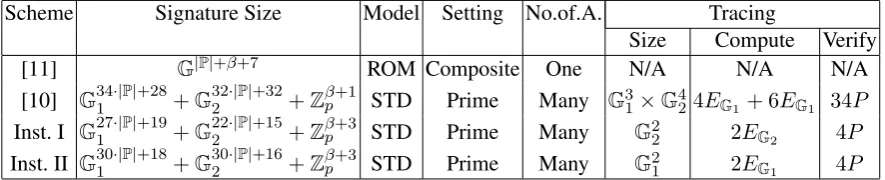
Abstract. In this work, we revisit the notion of Decentralized Traceable Attribute-Based Signatures (DTABS) introduced by El Kaafarani et al. (CT-RSA 2014) and improve the state-of-the-art in three dimensions: Firstly, we provide a new stronger security model which circumvents some shortcomings in existing models. Our model minimizes the trust placed in attribute authorities and hence provides, among other things, a stronger definition for non-frameability. In addition, unlike previous models, our model captures the notion of tracing soundness which is important for many applications of the primitive, and which ensures that even if all parties in the system are fully corrupt, no one but the actual signer can claim authorship of the signature. Secondly, we provide a generic construction that is secure w.r.t. our strong security model and show two example instantia-tions in the standard model which are more efficient than existing construcinstantia-tions (secure under weaker security definitions). Finally, unlike existing constructions, we dispense with the need for the expensive zero-knowledge proofs required for proving tracing correctness by the tracing authority. As a result, tracing a signature in our constructions is significantly more efficient than existing constructions, both in terms of the size of the tracing proof and the computational cost required to generate and verify it. For instance, verifying tracing correctness in our constructions requires only 4 pairings compared to 34 pairings in the most efficient existing construction.
Keywords. Attribute-based signatures, security definitions, traceability, standard model.
1 Introduction
Attribute-based cryptography provides a versatile solution for designing role-based cryptosystems. In attribute-based cryptosystems, the private operation, e.g. decryption/signing, is performed w.r.t. a secu-rity policy. Only users possessing attributes satisfying the policy can perform the operation. Goyal et al. [18], inspired by the work of Sahai and Waters [32], put forward the first attribute-based cryptosystems. In Attribute-Based Signatures (ABS) [27, 28], messages are signed w.r.t. signing policies expressed as predicates. A signature convinces the verifier that it it was produced by a user with attributes sat-isfying the associated signing policy revealing neither the identity of the user nor the attributes used. Attribute-based signatures have many applications, including trust negotiation, e.g. [12], attribute-based messaging, e.g. [9], and leaking secrets. For more details refer to [28, 31].
The security of attribute-based signatures [27] requires user’s privacy and unforgeability. Informally, user’s privacy (i.e. anonymity), requires that signatures reveal neither the user’s identity nor the attributes used in the signing. On the other hand, unforgeability requires that a user cannot forge a signature w.r.t. a signing predicate that her attributes do not satisfy, even if she colludes with other users.
Traceable Attribute-Based Signatures (TABS) [11] extend standard attribute-based signatures by adding an anonymity revocation mechanism which allows a tracing authority to recover the identity of the signer. Such a feature is important for enforcing accountability and deterring abuse.
Related Work. Various constructions of attribute-based signatures exist in the literature [26, 34, 25, 28, 30, 31, 20, 13]. Those constructions vary in terms of the expressiveness of the policies they support and whether they offer selective or adaptive security. Adaptively secure schemes supporting more expressive policies are preferable since they cover a larger scale of potential applications.
Supporting multiple attribute authorities was first considered by [27, 30]. However, the multi–authority setting still had the problem of requiring a central trusted authority. Furthermore, in some cases, the se-curity of the entire system is compromised if the central authority is corrupted. Okamoto and Takashima [31] proposed the first fully decentralized construction.
Escala et al. [11] added the traceability feature to standard ABS schemes and proposed a model for the single attribute authority setting. More recently, El Kaafarani et al. [10] proposed a security model and two generic constructions for decentralized traceable attribute-based signatures. They also provided instantiations without random oracles [5]. Besides correctness, the recent model of [10] defines three security requirements: anonymity, full unforgeability and traceability. Informally, anonymity requires that a signature reveals neither the identity of the signer nor the set of attributes used in the signing; full unforgeability requires that users cannot forge signatures w.r.t. signing policies their individual attributes do not satisfy even if they collude, which also captures non-frameability; and traceability requires that the tracing authority is always able to establish the identity of the signer and prove such a claim.
We end by noting that there exist other weaker variants of traceable attribute-based signatures suiting specific applications. For instance, [22] proposed the notion of attribute-based group signatures which attaches public attributes to standard group signatures. Also, [23] proposed a traceable attribute-based signature scheme where the signing policy is determined beforehand by the verifier and hence requiring interaction in the signing protocol.
Shortcomings in Existing Models. The unforgeability/non-frameability requirements in all existing models for traceable attribute-based signatures [11, 10] (and even those for standard (i.e. non-traceable) attribute-based signatures, e.g. [27, 30, 31]) besides placing full trust in attribute authorities, assume the existence of secure means for the delivery of the secret attributes’ keys from attribute authorities to users. More specifically, learning the key for any attribute a user owns allows framing the user w.r.t. to those attributes. For instance, the non-frameability definition in the single-authority model of [11] relies on the assumption that the attribute authority is fully honest, whereas the full unforgeability definition (also capturing non-frameability) in the stronger and more recent model of [10] assumes that at least one attribute authority is fully honest.
While this is not an issue in standard attribute-based signatures (since signatures are perfectly anony-mous and hence it is infeasible for any party to identify the signer), we emphasize that this could be a serious limitation in the traceable setting. In particular, the innocence of users could be jeopardized by being falsely accused of producing signatures they have not produced. A misbehaving attribute authority or any party intercepting the secret attributes’ keys is capable of signing on behalf of the user w.r.t. any predicate satisfied by the compromised subset of attributes.
We believe that the overly strong assumptions upon which the unforgeability/non-frameability no-tions in existing models rely is the result of the absence of the assignment of personal keys to the users. Moreover, the absence of users’ personal keys further complicates the constructions and degrades the efficiency. For instance, the recent constructions in [10], similarly to [28], rely on the so-called pseudo-attribute technique in order to bind the signature to the message: the user proves that she either owns attributes satisfying the signing predicate or she has a special signature on the message and the encoding of the signing predicate that verifies w.r.t. some trapdoor verification key.
Another shortcoming of existing models for traceable attribute-based signatures is the absence of the tracing soundness requirement which was defined recently in the context of traditional group signatures [33]. This requirement ensures that a valid signature can only trace to a single user even if all entities in the system are fully corrupt. It is vital for many applications, e.g., applications where users get rewarded for signatures they produced or where abusing signing rights might result in legal consequences.
In addition, tracing in existing constructions is costly, both in terms of the size of the tracing proof and the cost for producing and verifying it. The most efficient existing construction [10] requires 34
Our Contribution. We first rectify the aforementioned shortcomings in existing models by presenting a stronger security model for the primitive. Our model is for the interesting dynamic and fully decen-tralized setting in which attributes’ management is distributed among different authorities who may not even be aware of one another, and where users and attribute authorities can join the system at any time. Our model offers a stronger security definition for non-frameability which circumvents the limitations inherent in existing models. In addition, our model provides a cleaner definition for traceability, and unlike previous models, it captures the useful notion of tracing soundness [33].
Our second contribution is a generic construction for the primitive which permits expressive signing policies and meets strong adaptive security requirements. Our generic construction dispenses with the expensive zero-knowledge proofs required by existing constructions for proving tracing correctness by deploying a robust, non-interactive tag-based encryption scheme.
Finally, we provide two example instantiations of the generic framework in the standard model. Besides offering stronger security, our instantiations are more efficient than existing constructions. In addition, our constructions have much smaller computation and communication overhead for tracing.
Paper Organization. In Section 2, we give some preliminary definitions. We present our model in Sec-tion 3. We list the building blocks we use in SecSec-tion 4. In SecSec-tion 5, we present our generic construcSec-tion and prove its security. In Section 6, we present instantiations in the standard model.
Notation. A functionν(.) : N→ R+is negligible incif for every polynomialp(.)and all sufficiently
large values of c, it holds that ν(c) < p(1c). Given a probability distribution S, we denote by y ←
S the operation of selecting an element according to S. If A is a probabilistic machine, we denote by A(x1, . . . , xn) the output distribution of A on inputs (x1, . . . , xn). By PPT we mean running in
probabilistic polynomial time in the relevant security parameter.
2 Preliminaries
In this section we provide some preliminary definitions.
2.1 Bilinear Groups
LetG1 := hGi,G2 := hG˜i andGT be groups of a prime orderp. A bilinear group is a tuple P := (G1,G2,GT, p, G,G, e˜ ) wheree : G1×G2 −→ GT is a non-degenerate bilinear map. We will use
multiplicative notation for all the groups and letG×1 := G1 \ {1G1}andG
×
2 := G2\ {1G2}. We will accent elements fromG2with˜for the sake of clarity. We use Type-3 groups [14] whereG1 6=G2and there is no efficient isomorphism between the groups in either direction. We assume the existence of an algorithmBGrpSetupwhich on input a security parameterλoutputs a description of bilinear groups.
2.2 Complexity Assumptions
We will use the following assumptions from the literature:
DDH. For a groupG:=hGiof a prime orderp, given(G, Ga, Gb, C)∈G4fora, b←Zp, it is hard to
decide whether or notC=Gab.
SXDH. This assumption requires that the Decisional Diffie-Hellman (DDH) assumption holds in both groupsG1andG2.
XDLING1 [1]1. GivenPand the tuple(Gh, Gv, Gu, Grh, Gsv, Gut,G˜h,G˜v,G˜u,G˜rh,G˜sv)∈G61×G52 for unknownh, r, s, t, u, v∈Zp, it is hard to determine whether or nott=r+s.
q-SDH[8]. Given(G, Gx, . . . , Gxq,G,˜ G˜x)forx←Zp, it is hard to output a pair(c, Gx+1c)∈Zp×G
q-AGHO[3]. Given a uniformly random tuple(G,G,˜ W ,˜ X,˜ Y˜) ∈G1×G4
2, andquniformly random tuples(Ai, Bi, Ri,D˜i)∈G31×G2, each satisfying:
e(Ai,D˜i) =e(G,G˜),
e(G,X˜) =e(Ai,W˜)e(Bi,G˜)e(Ri,Y˜),
it is hard to output a new tuple(A∗, B∗, R∗,D˜∗)satisfying the above equations.
2.3 Span Programs
For a field F and a variable set A = {α1, . . . , αn}, a monotone span program [21] is defined by a
β×γ matrixS(overF) along with a labeling mapρwhich associates each row in Swith an element
αi ∈ A. The span program accepts a set A0 iff 1 ∈ Span(SA0), where SA0 is the sub-matrix ofS
containing only rows with labelsαi ∈ A0, i.e., the program only acceptsA0if there exists a vectorzs.t.
zSA0 = [1,0, . . . ,0].
3 Syntax and Security of Decentralized Traceable Attribute-Based Signatures
A DTABS scheme involves the following entities: a set of attribute authorities, each with a unique identityaid and a pair of secret/verification keys (askaid,avkaid); a tracing authority TAwith a secret
tracing keytkthat is used to identify the signer of a given signature; a set of users, each with a unique identityuid, a personal secret/public key pair(usk[uid],uvk[uid])and a set of attributesA ⊆A(where
Ais the attribute universe). Attributes in the system can be distinctly identified by concatenating the
identity of the managing authority with the name of the attribute. This way, the identities (and hence the public keys) of attribute authorities managing attributes appearing in the signing policy can be inferred from the predicate itself which eliminates the need for any additional meta-data to be attached. In our model, attribute authorities as well as users can join the system at any time.
A DTABS scheme is a tuple of polynomial-time algorithmsDT ABS := (Setup,AKeyGen,UKeyGen, AttKeyGen,Sign,Verify,Trace,Judge). The definition of the algorithms are as follows; to aid notation all algorithms bar the first three take as implicit input the public parameters pp output by algorithm Setup.
• Setup(1λ) is run by some trusted third party. On input a security parameter 1λ, it outputs public
parametersppand a tracing keytk.
• AKeyGen(pp,aid)is run by attribute authorityaidto generate its key pair (ask
aid,avkaid). The
at-tribute authority publishes its public keyavkaid.
• UKeyGen(pp)outputs a personal secret/verification key pair(usk[uid],uvk[uid])for the user with
identityuid. We assume that the public key tableuvkis publicly available (possibly via some PKI) so that anyone can obtain authentic copies of uers’ public keys.
• AttKeyGen(ask
aid(α),uid,uvk[uid], α)on input the secret key of the attribute authority managing attributeα(i.e.askaid(α)), a user’s identityuid, a user’s personal public keyuvk[uid]and an attribute α∈A, it outputs a secret keyskuid,αfor attributeαfor the user. The keyskuid,αis given touid.
• Sign({avk
aid(α)}α∈A,uid,usk[uid],uvk[uid],{skuid,α}α∈A, m,P) on input an ordered list of
at-tribute authorities’ verification keys{avkaid(α)}α∈A, a user’s identityuid, a user’s secret and public
keys (usk[uid],uvk[uid]), an ordered list of attributes’ secret keys {skuid,α}α∈A for attributes A
that useruidowns, a messagemand a signing predicatePsuch thatP(A) = 1, it outputs a signature
Σonmw.r.t.P.
1
• Verify({avk
aid(α)}α∈P, m, Σ,P)on input an ordered list of authorities’ verification keys{avkaid(α)}α∈P, a messagem, a signatureΣand a predicateP, it verifies whetherΣis valid onmw.r.t.P, outputting
a bit accordingly.
• Trace(tk, m, Σ,P,uvk) on input the tracing authority’s key tk, a message m, a signature Σ, a
signing predicateP, and the public keys tableuvk, it outputs an identityuid>0of the signer ofΣ
and a proofπTrace attesting to this claim. If it is unable to trace the signature, it returns(0, πTrace). • Judge({avk
aid(α)}α∈P, m, Σ,P,uid,uvk[uid], πTrace) is a deterministic algorithm which on input an ordered list of attribute authorities’ verification keys{avkaid(α)}α∈P, a messagem, a signatureΣ, a signing predicateP, a user’s identityuid, a user’s public verification keyuvk[uid], and a tracing
proofπTrace, it outputs1ifπTraceis a valid proof thatuidhas producedΣor0otherwise.
3.1 Security of Decentralized Traceable Attribute-Based Signatures
The security properties we require from a DTABS scheme are: correctness, anonymity, unforgeability, non-frameability, traceability, and tracing soundness. Unlike the model of El Kaafrani et al. [10], we split the games of unforgeability and non-frameability in order to strengthen the definition of the lat-ter where we allow for the corruption of all authorities. Even though the games of unforgeability and non-frameability could be combined into one game, separating them preserves simplicity. Also, unlike previous models, our model defines the notion of tracing soundness which was recently proposed in the context of group signatures [33].
In our model, we distinguish between bad entities, i.e. those who were initially honest until the adversary learned their secret keys and corrupt entities whose keys have been chosen by the adversary itself.
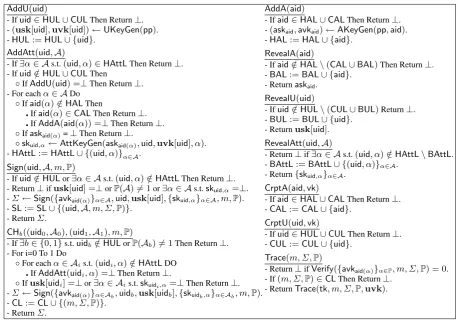
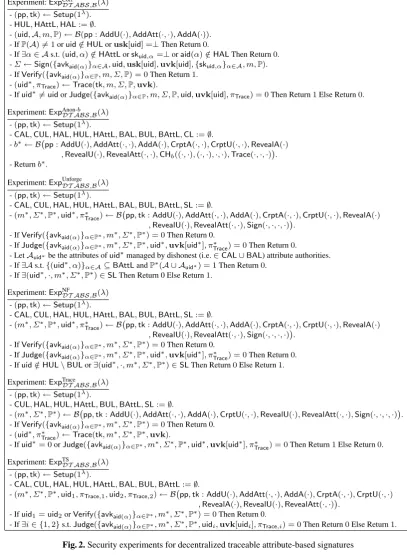
The experiments used to define the security requirements are shown in Fig. 2. In those experiments, the following global lists are used:HULis a list of honest users; HALis a list of honest attribute au-thorities;HAttLis a list of honestly created users’ attributes and has entries of the form(uid, α);BUL is a list of bad users whose personal secret keys have been revealed to the adversary;BAttLis a list of bad users’ attributes whose keys have been revealed to the adversary with entries of the form(uid, α); BALis a list of bad attribute authorities whose secret keys have been learned by the adversary;CULis a list of corrupt users whose keys have been chosen by the adversary;CALis a list of corrupt attribute authorities whose keys have been chosen by the adversary;SLis a list of signatures obtained from the Signoracle;CLis a list of challenge signatures obtained from the challenge oracle and is used only in the anonymity game.
The details of the following oracles are given in Fig. 1.
AddA(aid) adds an honest attribute authority with identityaid. AddU(uid) adds an honest user with identityuid.
AddAtt(uid,A)adds honest attributesA ⊆ Afor useruid. It can be called multiple times to add more attributes for an existing user.
CrptA(aid,vk) adds a corrupt attribute authority whose keys are chosen by the adversary.
CrptU(uid,vk)adds a corrupt user with identityuidwhose personal keys are chosen by the adversary. RevealA(aid) returns the secret keyaskaidof the honest attribute authorityaid.
RevealU(uid) returns the personal secret keyusk[uid]of useruid.
RevealAtt(uid,A) returns the secret keys{skuid,α}α∈Afor attributesA ⊆ Aowned by useruid. It can
be called multiple times.
Sign(uid,A, m,P) returns a signatureΣonmusing attributesAbelonging to useruidwhereP(A) = 1. CHb((uid0,A0),(uid1,A1), m,P) is a left-right oracle for defining anonymity. On input (uid0,A0),
(uid1,A1), a messagemand a signing policyPwithP(A0) =P(A1) = 1, it returns a signature on musing attributesAbbelonging to useruidbforb← {0,1}.
AddU(uid)
- Ifuid∈HUL∪CULThen Return⊥. -(usk[uid],uvk[uid])←UKeyGen(pp). -HUL:=HUL∪ {uid}.
AddAtt(uid,A)
- If∃α∈ As.t.(uid, α)∈HAttLThen Return⊥. - Ifuid∈/HUL∪CULThen
◦IfAddU(uid) =⊥Then Return⊥. - For eachα∈ ADo
◦Ifaid(α)∈/HALThen
Ifaid(α)∈CALThen Return⊥. IfAddA(aid(α)) =⊥Then Return⊥. ◦Ifaskaid(α)=⊥Then Return⊥.
◦skuid,α←AttKeyGen(askaid(α),uid,uvk[uid], α).
-HAttL:=HAttL∪ {(uid, α)}α∈A.
Sign(uid,A, m,P)
- Ifuid∈/HULor∃α∈ As.t.(uid, α)∈/HAttLThen Return⊥. - Return⊥ifusk[uid] =⊥orP(A)6= 1or∃α∈ As.t.skuid,α=⊥.
-Σ←Sign({avkaid(α)}α∈A,uid,usk[uid],{skuid,α}α∈A, m,P). -SL:=SL∪ {(uid,A, m, Σ,P)}.
- ReturnΣ.
CHb((uid0,A0),(uid1,A1), m,P)
- If∃b∈ {0,1}s.t.uidb∈/HULorP(Ab)6= 1Then Return⊥.
- For i=0 To 1 Do
◦For eachα∈ Ais.t.(uidi, α)∈/HAttLDO
IfAddAtt(uidi, α) =⊥Then Return⊥.
◦Ifusk[uidi] =⊥or∃α∈ Ais.t.skuidi,α=⊥Then Return⊥. -Σ←Sign({avkaid(α)}α∈Ab,uidb,usk[uidb],{skuidb,α}α∈Ab, m,P). -CL:=CL∪ {(m, Σ,P)}.
- ReturnΣ.
AddA(aid)
- Ifaid∈HAL∪CALThen Return⊥. -(askaid,avkaid)←AKeyGen(pp,aid). -HAL:=HAL∪ {aid}.
RevealA(aid)
- Ifaid∈/HAL\(CAL∪BAL)Then Return⊥. -BAL:=BAL∪ {aid}.
- Returnaskaid.
RevealU(uid)
- Ifuid∈/HUL\(CUL∪BUL)Return⊥. -BUL:=BUL∪ {uid}.
- Returnusk[uid].
RevealAtt(uid,A)
- Return⊥if∃α∈ As.t.(uid, α)∈/HAttL\BAttL. -BAttL:=BAttL∪ {(uid, α)}α∈A.
- Return{skuid,α}α∈A.
CrptA(aid,vk)
- Ifaid∈HAL∪CALThen Return⊥. -CAL:=CAL∪ {aid}.
CrptU(uid,vk)
- Ifuid∈HUL∪CULThen Return⊥. -CUL:=CUL∪ {uid}.
Trace(m, Σ,P)
- Return⊥ifVerify({avkaid(α)}α∈P, m, Σ,P) = 0. - If(m, Σ,P)∈CLThen Return⊥.
[image:6.595.68.527.68.397.2]- ReturnTrace(tk, m, Σ,P,uvk).
Fig. 1.Oracles used in the security games for DTABS
The details of the security requirements are as follows:
Correctness. This requires that honestly generated signatures verify correctly and trace to the user who produced them. In addition, theJudgealgorithm accepts the tracing proof produced by theTrace algo-rithm. Formally, a DTABS scheme iscorrectif for allλ∈ N, all PPT adversariesBhave a negligible advantageAdvCorrDT ABS,B(λ)where
AdvCorrDT ABS,B(λ) := Pr[ExpCorrDT ABS,B(λ) = 1]·
Anonymity. This requires that a signature reveals neither the identity of the user nor the set of attributes used in the signing. In the game, the adversary chooses a message, a signing policy and two users with two, possibly different, sets of attributes satisfying the signing policy. The adversary gets a signature by either user and wins if it correctly guesses the user.
In the game, the adversary can fully corrupt all attribute authorities and learn any user’s personal secret key/attribute keys including those used for the challenge. Thus, our definition captures full-key exposure attacks. Since the adversary can sign on behalf of any user, it is redundant to provide it with a sign oracle. The only restriction we impose on the adversary is that it may not query theTraceoracle on the challenge signature.
Our definition captures unlinkability since the adversary has access to all users’ personal secret keys/attribute keys.
Formally, a DTABS scheme is (fully) anonymous if for all λ ∈ N, all PPT adversaries B have a negligible advantageAdvAnonDT ABS,B(λ)where
AdvAnonDT ABS,B(λ) :=
Experiment:ExpCorr
DT ABS,B(λ)
-(pp,tk)←Setup(1λ).
-HUL,HAttL,HAL:=∅.
-(uid,A, m,P)← B(pp:AddU(·),AddAtt(·,·),AddA(·)). - IfP(A)6= 1oruid∈/HULorusk[uid] =⊥Then Return0.
- If∃α∈ As.t.(uid, α)∈/HAttLorskuid,α=⊥oraid(α)∈/HALThen Return0.
-Σ←Sign({avkaid(α)}α∈A,uid,usk[uid],uvk[uid],{skuid,α}α∈A, m,P). - IfVerify({avkaid(α)}α∈P, m, Σ,P) = 0Then Return1.
-(uid∗, πTrace)←Trace(tk, m, Σ,P,uvk).
- Ifuid∗6=uidorJudge({avkaid(α)}α∈P, m, Σ,P,uid,uvk[uid], πTrace) = 0Then Return1Else Return0.
Experiment:ExpAnon-b DT ABS,B(λ)
-(pp,tk)←Setup(1λ).
-CAL,CUL,HAL,HUL,HAttL,BAL,BUL,BAttL,CL:=∅. -b∗← B`
pp:AddU(·),AddAtt(·,·),AddA(·),CrptA(·,·),CrptU(·,·),RevealA(·)
,RevealU(·),RevealAtt(·,·),CHb((·,·),(·,·),·,·),Trace(·,·,·)´
. - Returnb∗.
Experiment:ExpUnforgeDT ABS,B(λ)
-(pp,tk)←Setup(1λ).
-CAL,CUL,HAL,HUL,HAttL,BAL,BUL,BAttL,SL:=∅. -(m∗, Σ∗,P∗,uid∗, π∗Trace)← B`
pp,tk:AddU(·),AddAtt(·,·),AddA(·),CrptA(·,·),CrptU(·,·),RevealA(·)
,RevealU(·),RevealAtt(·,·),Sign(·,·,·,·)´
. - IfVerify({avkaid(α)}α∈P∗, m
∗, Σ∗,
P∗) = 0Then Return 0. - IfJudge({avkaid(α)}α∈P∗, m∗, Σ∗,P∗,uid
∗,uvk[uid∗], π∗
Trace) = 0Then Return0.
- LetAuid∗be the attributes ofuid∗managed by dishonest (i.e.∈CAL∪BAL) attribute authorities. - If∃As.t.{(uid∗, α)}α∈A⊆BAttLandP∗(A ∪ Auid∗) = 1Then Return0.
- If∃(uid∗,·, m∗, Σ∗,
P∗)∈SLThen Return 0 Else Return1. Experiment:ExpNF
DT ABS,B(λ)
-(pp,tk)←Setup(1λ).
-CAL,CUL,HAL,HUL,HAttL,BAL,BUL,BAttL,SL:=∅. -(m∗, Σ∗,P∗,uid∗, π∗Trace)← B`
pp,tk:AddU(·),AddAtt(·,·),AddA(·),CrptA(·,·),CrptU(·,·),RevealA(·)
,RevealU(·),RevealAtt(·,·),Sign(·,·,·,·)´
. - IfVerify({avkaid(α)}α∈P∗, m∗, Σ∗,P∗) = 0Then Return 0.
- IfJudge({avkaid(α)}α∈P∗, m
∗, Σ∗,
P∗,uid∗,uvk[uid∗], π∗Trace) = 0Then Return0. - Ifuid∈/HUL\BULor∃(uid∗,·, m∗, Σ∗,
P∗)∈SLThen Return0Else Return1. Experiment:ExpTrace
DT ABS,B(λ)
-(pp,tk)←Setup(1λ).
-CUL,HAL,HUL,HAttL,BUL,BAttL,SL:=∅. -(m∗, Σ∗,P∗)← B`
pp,tk:AddU(·),AddAtt(·,·),AddA(·),CrptU(·,·),RevealU(·),RevealAtt(·,·),Sign(·,·,·,·)´
. - IfVerify({avkaid(α)}α∈P∗, m∗, Σ∗,P∗) = 0Then Return 0.
-(uid∗, πTrace∗ )←Trace(tk, m∗, Σ∗,P∗,uvk).
- Ifuid∗= 0orJudge({avkaid(α)}α∈P∗, m∗, Σ∗,P∗,uid∗,uvk[uid∗], πTrace∗ ) = 0Then Return1Else Return0. Experiment:ExpTS
DT ABS,B(λ)
-(pp,tk)←Setup(1λ).
-CAL,CUL,HAL,HUL,HAttL,BAL,BUL,BAttL:=∅. -(m∗, Σ∗,P∗,uid1, πTrace,1,uid2, πTrace,2)← B
`
pp,tk:AddU(·),AddAtt(·,·),AddA(·),CrptA(·,·),CrptU(·,·)
,RevealA(·),RevealU(·),RevealAtt(·,·)´
. - Ifuid1=uid2orVerify({avkaid(α)}α∈P∗, m∗, Σ∗,P∗) = 0Then Return 0.
- If∃i∈ {1,2}s.t.Judge({avkaid(α)}α∈P∗, m
∗, Σ∗,
[image:7.595.89.497.75.631.2]P∗,uidi,uvk[uidi], πTrace,i) = 0Then Return0Else Return1.
Fig. 2.Security experiments for decentralized traceable attribute-based signatures
attributes required for satisfying the policy used in the forgery. The adversary can also fully corrupt the tracing authority.
Our definition is adaptive and allows the adversary to adaptively choose both the signing predicate and the message used in the forgery. Note that we consider the stronger variant of unforgeability, i.e. (strong unforgeability) where the adversary wins even if it forges a new signature on a message/predicate pair that was queried to the sign oracle. It is easy to adapt the definition if the weaker variant of unforge-ability is desired.
Formally, a DTABS scheme isunforgeableif for allλ∈N, all PPT adversariesBhave a negligible
advantageAdvUnforgeDT ABS,B(λ)where
AdvUnforgeDT ABS,B(λ) := Pr[ExpUnforgeDT ABS,B(λ) = 1]·
Non-Frameability. This ensures that even if all authorities and users collude, they cannot produce a signature that traces to an honest user whose personal secret key has not been learned by the adversary. Our definition guarantees that even if the secret attributes’ keys for attributes owned by a user are leaked (for instance, by means of interception or leakage by dishonest attribute authorities), it is still impossible to sign on behalf of the user without knowledge of her personal secret key. Thus, our model overcomes the shortcoming of previous models [11, 10] and ensures that an innocent user cannot be framed by dishonest attribute authorities or parties who intercept the communication between the user and the attribute authorities.
In the game, the adversary can fully corrupt all attribute authorities as well as the tracing authority. It can also corrupt as many users of the system as it wishes. We just require that the forgery output by the adversary is a valid signature and traces to a user whose personal secret key has not been revealed to the adversary.
Formally, a DTABS scheme isnon-frameableif for allλ∈N, all PPT adversariesBhave a negligible advantageAdvNFDT ABS,B(λ)where
AdvNFDT ABS,B(λ) := Pr[ExpNFDT ABS,B(λ) = 1]·
Traceability. This ensures that the adversary cannot produce a signature that cannot be traced. In the game, the adversary is allowed to corrupt the tracing authority and learn both the personal secret key and attributes’ keys of any user. However, unlike in the unforgeability and non-frameability games, we require that all the attribute authorities are honest. We emphasize that such an assumption is inevitable as knowing the secret key of any attribute authority would allow the adversary to grant attributes to dummy users resulting in untraceable signature.
Formally, a DTABS scheme is traceableif for allλ ∈ N, all PPT adversaries Bhave a negligible advantageAdvTraceDT ABS,B(λ)where
AdvTraceDT ABS,B(λ) := Pr[ExpTraceDT ABS,B(λ) = 1]·
Tracing Soundness. This new requirement, which was not defined in previous models, ensures that even if all authorities (including the tracing authority) and users in the system are all corrupt and collude, they cannot produce a valid signature that traces to two different users. Among other things, this prevents users from claiming authorship of signatures they did not produce or imputing possibly problematic signatures to other users.
Formally, a DTABS scheme satisfiestracing soundnessif for allλ∈N, all PPT adversariesBhave
a negligible advantageAdvTSDT ABS,B(λ)where
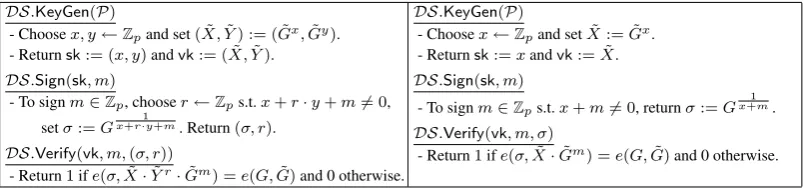
DS.KeyGen(P)
- Choosex, y←Zpand set( ˜X,Y˜) := ( ˜Gx,G˜y).
- Returnsk:= (x, y)andvk:= ( ˜X,Y˜). DS.Sign(sk, m)
- To signm∈Zp, chooser←Zps.t.x+r·y+m6= 0,
setσ:=Gx+r·1y+m. Return(σ, r).
DS.Verify(vk, m,(σ, r))
- Return1ife(σ,X˜·Y˜r·G˜m) =e(G,G˜)and 0 otherwise.
DS.KeyGen(P)
- Choosex←Zpand setX˜ := ˜Gx.
- Returnsk:=xandvk:= ˜X. DS.Sign(sk, m)
- To signm∈Zps.t.x+m6= 0, returnσ:=G
1 x+m.
DS.Verify(vk, m, σ)
[image:9.595.97.499.71.165.2]- Return1ife(σ,X˜·G˜m) =e(G,G˜)and 0 otherwise.
Fig. 3.The full Boneh-Boyen (Left) and the weak Boneh-Boyen (Right) signatures
4 Building Blocks
In this section we present the building blocks that we use in our constructions.
4.1 Digital Signatures
Adigital signaturefor a message spaceMDSis a tuple of polynomial-time algorithmsDS:= (KeyGen,
Sign,Verify), where KeyGenoutputs a pair of secret/verification keys (sk,vk);Sign(sk, m) outputs a signatureσon the messagem;Verify(vk, m, σ)outputs 1 ifσis a valid signature onm.
Existential unforgeability under an adaptive chosen-message attack requires that all PPT adversaries
Bhave a negligible advantage in the following game:
• A key pair(sk,vk)is generated andvkis given toB.
• AdversaryBmakes a polynomial number of queries to a sign oracleSign(sk,·).
• Eventually,Bhalts by outputting(σ∗, m∗)and wins ifσ∗is valid onm∗andm∗was never queried
toSign.
A weaker variant of existential unforgeability (i.e. existential unforgeability under a weak chosen-message attack) requires that the adversary sends all its queries before seeing the verification key. We use two digital signatures by Boneh and Boyen [8], which we refer to as the full (Fig. 3 (Left)) and weak (Fig. 3 (Right)) Boneh-Boyen signature, respectively. Both schemes are secure under theq -SDH assumption. The weaker scheme is only secure under a weak chosen-message attack. LetP := (G1,G2,GT, p, G,G, e˜ )be the description of an asymmetric bilinear group. The schemes are given in
Fig. 3.
4.2 Tagged Signatures
Tagged signatures [10] are digital signatures where the signing and verification algorithms take as an additional input a tagτ. Formally, a tagged signature scheme for a message spaceMT Sand a tag space TT S is a tuple of polynomial-time algorithmsT S := (Setup,KeyGen,Sign,Verify), whereSetup(1λ)
outputs common public parameters param; KeyGen(param) outputs a pair of secret/verification keys
(sk,vk);Sign(sk, τ, m)outputs a signatureσon the tagτ and the messagem;Verify(vk, τ, m, σ)outputs 1 ifσis a valid signature onτ andm. Besides correctness, the security of a tagged signature [10] requires existential unforgeability under an adaptive chosen-message-tag attack which is similar to the definition of existential unforgeability of digital signatures.
T S.KeyGen(P)
-x1, x2, y←Zp, set(X1, X2,Y˜) := (Gx1, Gx2,G˜y).
- Return`
sk:= (x1, x2, y),vk:= (X1, X2,Y˜)
´
. T S.Sign(sk,˜τ ,M˜)
-a←Zp,A:=Ga,B:=Ay,D˜:= ( ˜G·τ˜−x1·M˜−x2)1a.
- Returnσ:=“A, B,D˜”. T S.Verify(vk,˜τ ,M , σ˜ )
- Return 1 ife(A,Y˜) =e(B,G˜)
ande(A,D˜)e(X1,˜τ)e(X2,M˜) =e(G,G˜).
T S.KeyGen(P)
-w, x,{yi}3i=1←Zp, set( ˜W ,X,˜ Y˜i) := ( ˜Gw,G˜x,G˜yi).
- Return`
sk:= (w, x,{yi}3i=1),vk:= ( ˜W ,X,˜ {Y˜i}3i=1)
´
. T S.Sign(sk, τ, M)
-R←G,a←Zp,A:=Ga,D˜ := ˜G
1 a,
B:=Gx−aw·R−y1·τ−y2·M−y3.
- Returnσ:=
“
A, B,D, R˜
”
. T S.Verify(vk, τ, M, σ)
- Return 1 ife(A,D˜) =e(G,G˜)and
[image:10.595.88.506.70.188.2]e(G,X˜) =e(A,W˜)e(B,G˜)e(R,Y˜1)e(τ,Y˜2)e(M,Y˜3). Fig. 4.Two instantiations of tagged signatures
in Fig. 4 (Right)) is based on the strongly unforgeable signature scheme from [3] whose unforgeability reduces to the non-interactiveq-AGHO assumption (cf. Section 2). The message space of the underlying signature scheme is G31 (where the first element is chosen randomly by the signer), we refer to the underlying scheme as AGHO2. The tag space of this instantiation is TT S := G1, and the message space is MT S := G1. The signature size is G31 ×G2. In both instantiations T S.Setup(1λ) outputs
P := (G1,G2,GT, p, G,G, e˜ )which is the description of an asymmetric bilinear group.
4.3 Strongly Unforgeable One-Time Signatures
A one-time signature scheme is a signature scheme that is unforgeable against an adversary who makes a single signing query.Strong Unforgeabilityrequires that the adversary cannot even forge a new signature on a message queried the sign oracle on. We will instantiate the one-time signature using the full Boneh-Boyen signature scheme from Fig. 3.
4.4 Non-Interactive Zero-Knowledge Proofs
LetRbe an efficiently computable relation on pairs(x, w), where we call x the statement andwthe witness. We define the corresponding languageLas all the statementsxinR. A Non-Interactive Zero-Knowledge (NIZK) proof system [7] for R is defined by a tuple of algorithms N IZK := (Setup, Prove,Verify,Extract,SimSetup,SimProve).
Setup takes as input a security parameter 1λ and outputs a common reference string crs and an extraction keyxkwhich allows for witness extraction.Provetakes as input(crs, x, w)and outputs a proof π that(x, w) ∈ R. Verifytakes as input(crs, x, π)and outputs1if the proof is valid, or0otherwise. Extracttakes as input(crs,xk, x, π)and outputs a witness.SimSetuptakes as input a security parameter
1λand outputs a simulated reference stringcrsSimand a trapdoor keytrthat allows for proof simulation.
SimProvetakes as input (crsSim,tr, x)and outputs a simulated proofπSimwithout a witness.
We require: completeness, soundness and zero-knowledge. Completeness requires that honestly gen-erated proofs are accepted; Soundness requires that it is infeasible (but for a small probability) to produce a convincing proof for a false statement; Zero-knowledge requires that a proof reveals no information about the witness used. The formal definitions can be found in Appendix A.
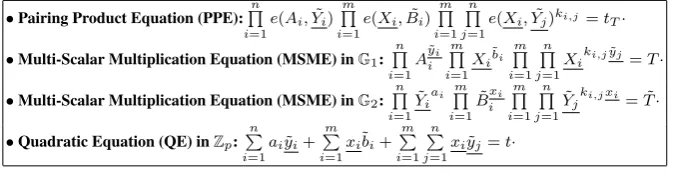
Groth-Sahai Proofs. Groth-Sahai (GS) proofs [19] are efficient non-interactive proofs in the Common Reference String (CRS) model. In this paper, we will be using the SXDH-based instantiation, which is the most efficient instantiation of the proofs [17]. The language for the system has the form
L:={statement| ∃witness:E1(statement,witness), . . . , En(statement,witness)hold},
whereEi(statement,·)is one of the types of equation summarized in Fig. 5, whereX1, . . . , Xm ∈G1,
˜
•Pairing Product Equation (PPE): n Q
i=1
e(Ai,Y˜i) m Q
i=1
e(Xi,B˜i) m Q i=1 n Q j=1
e(Xi,Y˜j)ki,j=tT·
•Multi-Scalar Multiplication Equation (MSME) inG1: n Q
i=1
Ayi˜i
m Q i=1 Xi ˜ bi m Q i=1 n Q j=1 Xi
ki,jy˜j =T·
•Multi-Scalar Multiplication Equation (MSME) inG2: n Q
i=1 ˜
Yi ai Qm
i=1 ˜
Bxii
m Q i=1 n Q j=1 ˜ Yj ki,jxi
= ˜T· •Quadratic Equation (QE) inZp:
n P
i=1
aiy˜i+ m P
i=1
xi˜bi+ m P i=1 n P j=1
[image:11.595.130.468.72.158.2]xiy˜j=t·
Fig. 5.Types of equations over bilinear groups
to be mapped to groupG2with˜. The system works by first committing to the elements of the witness and then proving that the commitments satisfy the source equations.
The proof system has perfect completeness, (perfect) soundness, composable witness-indistinguishabil-ity/zero-knowledge. Refer to [19] for the formal definitions and details of the instantiations.
4.5 Robust Non-Interactive Distributed/Threshold Tag-Based Encryption
In distributed tag-based encryption [4, 15], the (tag-based) ciphertexts can only be decrypted if all n decryption servers compute their decryption shares correctly. In the threshold variant, at least κ out ofndecryption servers must compute their decryption shares correctly for the decryption to succeed. The scheme isnon-interactiveif decrypting a ciphertext involves no interaction among the decryption servers. The scheme isrobustif invalid decryption shares can be identified by the combiner. If the well-formedness of the ciphertext is publicly verifiable, we say the scheme haspublic verifiability.
Formally, a DTBE scheme for a message space MDT BE and a tag space TDT BE is a tuple of
polynomial-time algorithms(Setup,Enc,IsValid,ShareDec,ShareVerify,Combine),whereSetup(1λ, n)
outputs a public key and vectorssvk= (svk1, . . . ,svkn)andsk= (sk1, . . . ,skn)of verification/secret
keys for the decryption servers; Enc(pk, t, m) outputs a ciphertextCdtbe on the messagem using tag
t; IsValid(pk, t, Cdtbe) outputs 1 if the ciphertext is valid under the tag t w.r.t. pk or 0 otherwise;
ShareDec(pk,ski, t, Cdtbe) outputs the i-th server decryption shareνi ofCdtbe or the reject symbol⊥;
ShareVerify(pk,svki, t, Cdtbe, νi)outputs 1 if the decryption shareνiis valid or 0 otherwise.Combine(pk, {svki}ni=1,{νi}ni=1, Cdtbe, t)outputs either the messagemor⊥.
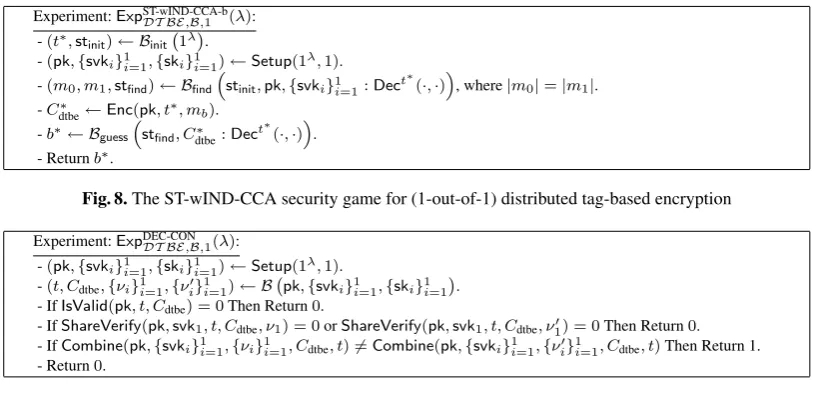
Besides correctness, we require Selective-Tag weak Indistinguishability against Adaptive Chosen Ciphertext Attacks (ST-wIND-CCA)[24] andDecryption Consistency (DEC-CON). Informally, the for-mer requires that an adversary who gets a decryption oracle for any ciphertext under a tag different from the target tag (which is chosen beforehand), cannot distinguish which challenge message was encrypted. The latter requires that an adversary cannot output two different sets of decryption shares of a ciphertext which open differently. The formal definitions can be found in Appendix B.
For our purpose, it suffices to have a single decryption server, i.e. 1-out-of-1 scheme, therefore the se-curity definitions hereafter are for this setting. We stress, however, that any variant of distributed/threshold tag-based encryption scheme satisfying the properties above can be used in our constructions.
Besides the original scheme given in [15], we also use a second variant of the scheme in [15] (shown in Fig. 6) where we transpose the groups in which the public key and the ciphertext lie. Note that since here we only consider a single decryption server, the verification keysvkis redundant as we include all the public elements in the public key pk. Maintaining it is solely for the sake of consistency with the definition of the algorithms.
5 Our Generic Construction
DT BE.Setup(1λ,1)
-P ←BGrpSetup(1λ).
-h, w, z, u, v←Zp,(H,H˜) := (Gh,G˜h),
(U,U˜) := (Hu,H˜u),(V,V˜) := (U1 v,U˜v1),
(W,W˜) := (Hw,H˜w),(Z,Z˜) := (Vz,V˜z).
-sk:= (u, v),svk:=⊥.
-pk:= (P, H,H, U,˜ U , V,˜ V , W,˜ W , Z,˜ Z˜). DT BE.Enc(pk, t,M˜)
-r1, r2←Zp;C˜1:= ˜Hr1,C˜2:= ˜Vr2,C˜3:= ˜M·U˜r1+r2, ˜
C4:= ( ˜Ut·W˜)r1,C˜5:= ( ˜Ut·Z˜)r2.
-Cdtbe:=
“
˜
C1,C˜2,C˜3,C˜4,C˜5
”
. DT BE.Combine(pk,svk, ν, Cdtbe, t)
- IfDT BE.IsValid(pk, t, Cdtbe) = 0Then Return⊥ - ParseCdtbeas( ˜C1,C˜2,C˜3,C˜4,C˜5)andνas(˜η1,η˜2).
- Return⊥ifDT BE.ShareVerify(pk,svk, t, Cdtbe, ν) = 0. - ReturnM˜ := C˜3
˜
η1·η˜2.
DT BE.ShareDec(pk,sk, t, Cdtbe)
- IfDT BE.IsValid(pk, t, Cdtbe) = 0Then Return⊥. - ParseCdtbeas( ˜C1,C˜2,C˜3,C˜4,C˜5)andskas(u, v).
- Returnν:= (˜η1:= ˜C1u,˜η2:= ˜Cv2).
DT BE.ShareVerify(pk,svk, t, Cdtbe, ν)
- Parseνas(˜η1,η˜2).
- ParseCdtbeas( ˜C1,C˜2,C˜3,C˜4,C˜5).
- IfDT BE.IsValid(pk, t, Cdtbe) = 0Then Return0
- Ife(H,η˜1)=6 e(U,C˜1)Or
e(V,η˜2)=6 e(U,C˜2)Then Return 0.
- Else Return 1.
DT BE.IsValid(pk, t, Cdtbe)
- ParseCdtbeas( ˜C1,C˜2,C˜3,C˜4,C˜5).
- Ife(Ut·W,C˜1)6=e(H,C˜4)Or
e(Ut·Z,C˜2)6=e(V,C˜5)Then Return 0.
[image:12.595.86.508.69.258.2]- Else Return 1.
Fig. 6.The transposed 1-out-of-1 variant of the distributed tag-based encryption scheme from [15]
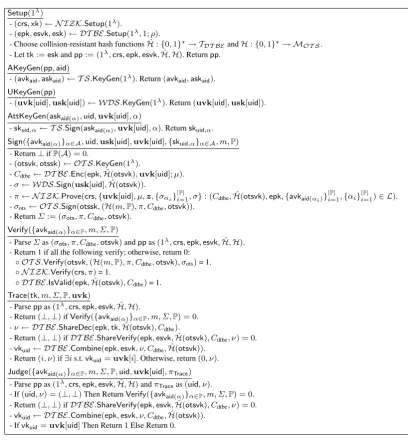
Overview of the construction. Unlike previous constructions, e.g. [10], we dispense with relying on the so-called pseudo-attribute technique to bind the signature to the message and eliminate the need for some of the costly tools required by previous constructions which improves the efficiency of our constructions while offering stronger security than previous ones. Also, we dispense with the need for the expensive zero-knowledge proofs required for proving tracing correctnessns. As a result, tracing (i.e. opening) signatures in our constructions is significantly more efficient than in previous constructions, e.g. [10].
Our construction requires a NIZK proof of knowledge proof systemN IZK, a selective-tag weakly IND-CCA robust non-interactive (1-out-of-1) distributed tag-based encryption schemeDT BE, a tagged signature schemeT S, an existentially unforgeable digital signature schemeWDS that is secure against a weak chosen-message attack, and a strongly unforgeable one-time signature schemeOT S. Addition-ally, we require two collision-resistant hash functionsHˆ :{0,1}∗ → TDT BEandH:{0,1}∗→ MOT S. It is sufficient forWDSto be existentially unforgeable against a weak chosen-message attack as we will use this scheme to sign the verification keys of the one-time signature schemeOT S.
TheSetupalgorithm generates a common reference stringcrsforN IZKand runsDT BE.Setupto generate the server’s secretesk, the verification keyesvkand the public keyepk. The public parameters of the system is set topp:= (1λ,crs,epk,esvk,Hˆ,H). The tracing authority’s key is set totk:=esk.
When a new attribute authority joins the system, it creates a verification/secret key pair(avkaid,askaid)
for the tagged signature schemeT S. When a user joins the system, she generates a verification/secret key pair(uvk[uid],usk[uid])for the digital signature schemeWDS.
To generate a signing key for attribute α ∈ Afor useruid, the managing attribute authority signs
the user’s public keyuvk[uid](used as tag) along with the attributeαusing her secret tagged signature signing key. The resulting signatureσαis used as the secret keyskuid,αfor that attribute by useruid.
To sign a messagemw.r.t. a signing policyP, the user chooses a fresh key pair(otsvk,otssk)for the
one-time signatureOT S and encrypts her public keyuvk[uid]using the distributed tag-based encryp-tion schemeDT BE (and possibly some randomnessµ) usingH(ˆ otsvk) as a tag to obtain a ciphertext Cdtbe. She then signsH(ˆ otsvk) using the digital signature scheme WDS and her personal secret key
usk[uid]to obtain a signatureσ. Using N IZK, she then computes a proofπ that: she encrypted her public key correctly, she has a signatureσonH(ˆ otsvk)that verifies w.r.t. her public keyuvk[uid], and she has enough attributes on her public key to satisfy the signing predicateP. To prove the latter, we use
signa-Setup(1λ)
-(crs,xk)← N IZK.Setup(1λ).
-(epk,esvk,esk)← DT BE.Setup(1λ,1;ρ).
- Choose collision-resistant hash functionsHˆ:{0,1}∗→ T
DT BEandH:{0,1}∗→ MOT S.
- Lettk:=eskandpp:= (1λ,crs,epk,esvk,H,Hˆ ). Returnpp.
AKeyGen(pp,aid)
-(avkaid,askaid)← T S.KeyGen(1λ). Return(avkaid,askaid).
UKeyGen(pp)
-(uvk[uid],usk[uid])← WDS.KeyGen(1λ). Return(uvk[uid],usk[uid]). AttKeyGen(askaid(α),uid,uvk[uid], α)
-skuid,α← T S.Sign(askaid(α),uvk[uid], α). Returnskuid,α. Sign({avkaid(α)}α∈A,uid,usk[uid],uvk[uid],{skuid,α}α∈A, m,P)
- Return⊥ifP(A) = 0.
-(otsvk,otssk)← OT S.KeyGen(1λ).
-Cdtbe← DT BE.Enc(epk,Hˆ(otsvk),uvk[uid];µ). -σ← WDS.Sign(usk[uid],Hˆ(otsvk)).
-π← N IZK.Prove(crs,{uvk[uid], µ,z,{σαi}
|P|
i=1, σ}: (Cdtbe,Hˆ(otsvk),epk,{avkaid(αi)}
|P|
i=1,{αi}|iP=1| )∈ L).
-σots← OT S.Sign(otssk,(H(m,P), π, Cdtbe,otsvk)). - ReturnΣ:= (σots, π, Cdtbe,otsvk).
Verify({avkaid(α)}α∈P, m, Σ,P)
- ParseΣas(σots, π, Cdtbe,otsvk)andppas(1λ,crs,epk,esvk,H,ˆ H).
- Return 1 if all the following verify; otherwise, return 0: ◦ OT S.Verify(otsvk,(H(m,P), π, Cdtbe,otsvk), σots)= 1. ◦ N IZK.Verify(crs, π)= 1.
◦ DT BE.IsValid(epk,Hˆ(otsvk), Cdtbe)= 1.
Trace(tk, m, Σ,P,uvk)
- Parseppas(1λ,crs,epk,esvk,H,Hˆ ).
- Return(⊥,⊥)ifVerify({avkaid(α)}α∈P, m, Σ,P) = 0.
-ν← DT BE.ShareDec(epk,tk,Hˆ(otsvk), Cdtbe).
- Return(⊥,⊥)ifDT BE.ShareVerify(epk,esvk,Hˆ(otsvk), Cdtbe, ν) = 0. -vkuid← DT BE.Combine(epk,esvk, ν, Cdtbe,Hˆ(otsvk)).
- Return(i, ν)if∃is.t.vkuid=uvk[i]. Otherwise, return(0, ν).
Judge({avkaid(α)}α∈P, m, Σ,P,uid,uvk[uid], πTrace)
- Parseppas(1λ,crs,epk,esvk,H,Hˆ )andπTraceas(uid, ν).
- If(uid, ν) = (⊥,⊥)Then ReturnVerify({avkaid(α)}α∈P, m, Σ,P) = 0.
- Return(⊥,⊥)ifDT BE.ShareVerify(epk,esvk,Hˆ(otsvk), Cdtbe, ν) = 0. -vkuid← DT BE.Combine(epk,esvk, ν, Cdtbe,Hˆ(otsvk)).
[image:13.595.90.499.64.508.2]- Ifvkuid=uvk[uid]Then Return1Else Return0.
Fig. 7.Our generic construction for DTABS
ture on each attribute in the signing predicatePfor which the corresponding element inzis non-zero.
For attributes appearing inPthat the signer does not own, she chooses random signatures. Finally, she
signs(H(m,P), π, Cdtbe,otsvk)using the one-time signatureOT S to obtain a one-time signatureσots.
To verify the signature, one just needs to verify the proofπ and the one-time signature σots. We note
here that ifT Sand/orWDS are re-randomizable, one can reveal in the clear the signature components which are independent ofuvk[uid]after re-randomizing them. This simplifies the NIZK proof π and subsequently improves the efficiency.
To trace a signature, the tracing authority uses its secret key to produce the decryption shareνof the ciphertextCdtbewhich allows anyone to recover the user’s public keyvkuidencrypted. It then searches
in the public key tableuvkto identify the entry matchingvkuid. It returns(uid, ν)if such entry exists,
The construction is in Fig. 7, whereas the language associated with the NIZK system is as follows, where for clarity we underline the elements of the witness:
L:n (Cdtbe,H(ˆ otsvk),epk,{avkaid(αi)}
|P|
i=1,{αi} |P|
i=1),(uvk[uid], µ,z,{σαi}
|P|
i=1)
:
zS= [1,0, . . . ,0]V|P|
i=1 ifzi6= 0⇒ T S.Verify(avkaid(αi),uvk[uid], αi, σαi) = 1
∧ WDS.Verify(uvk[uid],H(ˆ otsvk), σ) = 1 ∧ DT BE.Enc(epk,H(ˆ otsvk),uvk[uid];µ) =Cdtbe
o
·
The full proof of the following Theorem is in Appendix C.
Theorem 1. The construction in Fig. 7 is a secure decentralized traceable attribute-based signature if the building blocks are secure w.r.t. their security requirements.
Next, we present two instantiations of the generic framework in the standard model.
6 Instantiations in the Standard Model
6.1 Instantiation I
We instantiate T S using the AGHO1 signature scheme (see Fig. 4 (Left)) and instantiateWDS and
OT S using the weak and full Boneh-Boyen signature schemes, respectively. We instantiateN IZK
using the Groth-Sahai system, andDT BE using the scheme in Fig. 6. LetS∈Z|P|,β
p be the span program forP. To sign, the signer provides the following proofs:
• To prove thatzS= [1,0, . . . ,0], the signer proves the following linear equations:
P|P|
i=1(ziS˜i,1) = 1 P
|P|
i=1(ziS˜i,j) = 0, forj= 2, . . . , β
• To prove ifz
i 6= 0⇒ T S.Verify(avkaid(αi),uvk[uid], αi, σαi) = 1, whereσαi = (A
0
i, Bi0,D˜0i) ∈ G21×G2 andavkaid(αi) = (Xi,1, Xi,2,Y˜i) ∈ G
2
1 ×G2. The signer re-randomizesσαi by choosing
a0 ←Z∗pand computingσαi := (Ai, Bi,D˜i) = (A
0 i a0
, Bi0a0,D˜0i 1
a0), and proves the following
˘ ˜
Di = ˜Di
zi ˘˜
Yi= ˜Y zi
i
˘ ˜
vki= ∼
uvk[uid]zi G˘˜
i = ˜Gzi
e(Ai,Y˘˜i) =e(Bi,G˘˜i) e(Ai,D˘˜i)e(Xi,1,vk˜˘i)e(Xi,2,G˘˜i αi
) =e(G,G˘˜i)
Note that the verifier can on her own compute a Groth-Sahai commitment to the value G˘˜i αi
by
computing Cαi
˘ ˜
Gi
, where C˘˜
Gi is the Groth-Sahai commitment (which is ElGamal ciphertext) to
˘ ˜
Gi.
Such an observation improves the efficiency. In addition, the way we express the witness of the equations only requires committing to the elements of the vector zinG1, which further improves the efficiency.
• To prove thatWDS.Verify(uvk[uid],H(ˆ otsvk), σ) = 1, the signer proves that
e(σ,
∼
uvk[uid])e(σ,G˜Hˆ(otsvk))e(G,G˜) = 1 G−G= 0
• To prove DT BE.Enc(epk,H(ˆ otsvk),uvk[uid]; (r1, r2)) = C
dtbe, the signer proves she computed
the ciphertext( ˜C1,C˜2,C˜3,C˜4,C˜5) = H˜r1,V˜r2,U˜r1+r2·
∼
uvk[uid],( ˜UHˆ(otsvk)·W˜)r1,( ˜UHˆ(otsvk)·
˜
Z)r2correctly. It is sufficient to prove thatC˜
1,C˜2andC˜3were computed correctly and the rest can be verified by checking thate(H,C4˜ ) =e(UHˆ(otsvk)·W,C1˜ )ande(V,C5˜ ) =e(UHˆ(otsvk)·Z,C2˜ ). Thus, this requires provingC˜1 = ˜Hr1,C˜2= ˜Vr2 andC˜3 = ˜Ur1·U˜r2 ·
∼
uvk[uid].
The total size of the signature isG271 ·|P|+19+G
22·|P|+15
2 +Z
β+3
p . The proof for the following Theorem
follows from that of Theorem 1.
Scheme Signature Size Model Setting No.of.A. Tracing
Size Compute Verify
[11] G|P|+β+7 ROM Composite One N/A N/A N/A
[10] G341 ·|P|+28+G
32·|P|+32
2 +Z
β+1
p STD Prime Many G31×G424EG1 + 6EG1 34P Inst. I G271 ·|P|+19+G222 ·|P|+15+Zβp+3 STD Prime Many G22 2EG2 4P Inst. II G301 ·|P|+18+G
30·|P|+16
2 +Z
β+3
[image:15.595.77.520.72.162.2]p STD Prime Many G21 2EG1 4P
Table 1.Efficiency comparison
6.2 Instantiation II
To get an efficient instantiation that is based on falsifiable intractability assumptions [29], we instantiate
T Susing the AGHO2 signature scheme as shown in Fig. 4 (Right). We needed to transpose the groups from which the public key and the signature components of WDS are chosen. We also transpose the groups inDT BE. The rest of the tools remain the same as in Instantiation I.
LetS∈Z|P|,β
p be the span program forP. To sign, the signer provides the following proofs:
• To prove thatzS= [1,0, . . . ,0], the signer proves the following linear equations:
P|P|
i=1(˜ziSi,1) = 1
P|P|
i=1(˜ziSi,j) = 0, forj= 2, . . . , β
• To prove ifz
i 6= 0⇒ T S.Verify(avkaid(αi),uvk[uid], αi, σαi) = 1, whereσαi = (Ai, Bi, Ri,D˜i)∈
G31×G2andavkaid(αi)= ( ˜Wi,X˜i,Y˜i,1,Y˜i,2,Y˜i,3)∈G
5
2, the signer proves:
˘
Ai =Ai˜zi B˘i=Biz˜i R˘i =Ri˜zi G˘i =Gz˜i vk˘i =uvk[uid]˜zi
e( ˘Ai,D˜) =e( ˘Gi,G˜) e( ˘Gi,X˜i) =e( ˘Ai,W˜i)e( ˘Bi,G˜)e( ˘Ri,Y˜i,1)e( ˘vki,Y˜i,2)e( ˘Gi αi
,Y˜i,3) The same two efficiency-enhancing observations used in Instantiation I apply but now in the opposite groups.
• To prove thatWDS.Verify(uvk[uid],H(ˆ otsvk),σ˜) = 1, the signer needs to prove that
e(uvk[uid],σ˜)e(GHˆ(otsvk),σ˜)e(G,G˜) = 1 G−G= 0
• To prove DT BE.Enc(epk,H(ˆ otsvk),uvk[uid]; (r1, r2)) = C
dtbe, the signer proves she computed
the ciphertext(C1, C2, C3, C4, C5) = Hr1, Vr2, Ur1+r2·uvk[uid],(UHˆ(otsvk)·W)r1,(UHˆ(otsvk)· Z)r2correctly. It is sufficient to prove thatC
1,C2andC3were computed correctly and the rest can be verified by checking thate(C4,H˜) =e(C1,U˜Hˆ(otsvk)·W˜)ande(C5,H˜) =e(C2,U˜Hˆ(otsvk)·Z˜). Thus, this requires provingC1 =Hr˜1,C2=V˜r2 andC3 =U˜r1·Ur˜2 ·uvk[uid].
The total size of the signature isG301 ·|P|+18+G
30·|P|+16
2 +Z
β+3
p . The proof for the following Theorem
follows from that of Theorem 1.
Theorem 3. The instantiation is secure if the assumptions XDLING1,q-SDH,q-AGHO, and SXDH all hold.
We end by noting that in both instantiations signature verification can be mode more efficient by batch verifying GS proofs [16, 6].
6.3 Efficiency Comparison
7 Conclusion
We have presented a new security model for decentralized traceable attribute-based signatures that is stronger than existing models. In doing so, we have circumvented some shortcomings in existing models. We have also provided a generic framework for obtaining constructions secure w.r.t. our strong model and provided concrete instantiations in the standard model which outperform existing constructions. In addition, tracing signatures in our constructions is much more efficient than previous constructions.
Acknowledgments.The author was supported by ERC Advanced Grant ERC-2010-AdG-267188-CRIPTO and EPSRC via grant EP/H043454/1.
References
1. M.Abe, M. Chase, B. David, M. Kohlweiss, R. Nishimaki and M. Ohkubo. Constant-Size Structure-Preserving Signatures: Generic Constructions and Simple Assumptions. InASIACRYPT 2012, Springer LNCS 7658, 4–24, 2012.
2. M. Abe, G. Fuchsbauer, J. Groth, K. Haralambiev and M. Ohkubo. Structure-preserving signatures and commitments to group elements. InCRYPTO 2010, Springer LNCS 6223, 209–236, 2010.
3. M. Abe, J. Groth, K. Haralambiev and M. Ohkubo. Optimal Structure-Preserving Signatures in Asymmetric Bilinear Groups. InCRYPTO 2011, Springer LNCS 6841, 649–666, 2011.
4. S. Arita and K. Tsurudome. Construction of Threshold Public-Key Encryptions through Tag-Based Encryptions. InACNS 2009, Springer LNCS 5536, 186–200, 2009.
5. M. Bellare and P. Rogaway. Random oracles are practical: A Paradigm for Designing Efficient Protocols. InACM-CCS 1993, ACM, pp. 62–73.
6. O. Blazy, G. Fuchsbauer, M. Izabach‘ene, A. Jambert, H. Sibert and D. Vergnaud. Batch Groth-Sahai. InACNS 2010, Springer LNCS 6123, 218–235, 2010.
7. M. Blum, P. Feldman and S. Micali. Non-interactive zero-knowledge and its applications. InSTOC 1988, 103–112, 1988. 8. D. Boneh and X. Boyen. Short Signatures Without Random Oracles and the SDH Assumption in Bilinear Groups. In
Journal of Cryptology, volume 21(2), 149–177, 2008.
9. R. Bobba, O. Fatemieh, F. Khan, C.A. Gunter and H. Khurana. Using Based Access Control to Enable Attribute-Based Messaging. InACSAC 2006, IEEE Computer Society 3027, 403–413, 2006.
10. A. El Kaafarani, E. Ghadafi and D. Khader. Decentralized Traceable Attribute-Based Signatures. InCT-RSA 2014, Springer LNCS 8366, 327–348, 2014.
11. A. Escala, J. Herranz and P. Morillo. Revocable Attribute-Based Signatures with Adaptive Security in the Standard Model. InAFRICACRYPT 2011, Springer LNCS 6737, 224–241, 2011.
12. K.B. Frikken, J. Li and M.J. Atallah. Trust negotiation with hidden credentials, hidden policies, and policy cycles. In
NDSS 2006, The Internet Society, 157–172, 2006.
13. Ma. Gagn´e, S. Narayan and R. Safavi-Naini. Short Pairing-Efficient Threshold-Attribute-Based Signature. InPairing 2012, Springer LNCS 7708, 295–313, 2012.
14. S. Galbraith, K. Paterson and N.P. Smart. Pairings for cryptographers. Discrete Applied Mathematics,156, 3113–3121, 2008.
15. E. Ghadafi. Efficient Distributed Tag-Based Encryption and its Application to Group Signatures with Efficient Distributed Traceability. InLATINCRYPT 2014. Springer LNCS 8895, 327–347, 2015.
16. E. Ghadafi, N.P. Smart and B. Warinschi. Practical zero-knowledge proofs for circuit evaluation. InCoding and Cryptog-raphy: IMACC 2009, Springer LNCS 5921, 469–494, 2009.
17. E. Ghadafi, N.P. Smart and B. Warinschi. Groth-Sahai proofs revisited. InPKC 2010, Springer LNCS 6056, 177–192, 2010.
18. V. Goyal, O. Pandey, A. Sahai and B. Waters. Attribute-Based Encryption for Fine-Grained Access Control of Encrypted Data. InACM-CCS 2006, ACM ,89–98 , 2006.
19. J. Groth and A. Sahai. Efficient non-interactive proof systems for bilinear groups. In SIAM Journal on Computing, volume 41(5), 1193–1232, 2012.
20. J. Herranz, F. Laguillaumie, B. Libert, and C. R´afols. Short Attribute-Based Signatures for Threshold Predicates. In
CT-RSA 2012, Springer LNCS 7178, 51–67, 2012.
21. M. Karchmer and A. Wigderson. On span programs. In8th IEEE Structure in Complexity Theory, 102–111, 1993. 22. D. Khader. Attribute Based Group Signatures with Revocation. InCryptology ePrint Archive, Report 2007/241,http:
//eprint.iacr.org/2007/241.pdf.
23. D. Khader, L. Chen, J. H. Davenport. Certificate-Free Attribute Authentication. InCryptography and Coding: IMACC 2009, Springer LNCS 5921, 301–325, 2009.
25. J. Li, M. H. Au, W. Susilo, D. Xie and K. Ren. Attribute-based signature and its applications. InASIACCS ’10, ACM, 60-69, 2010.
26. J. Li and K. Kim. Attribute-Based Ring Signatures. InCryptology ePrint Archive, Report 2008/394,http://eprint. iacr.org/2008/394.pdf.
27. H.K. Maji, M. Prabhakaran and M. Rosulek. Attribute-Based Signatures: Achieving Attribute-Privacy and Collusion-Resistance. InCryptology ePrint Archive, Report 2008/328,http://eprint.iacr.org/2008/328.pdf. 28. H.K. Maji, M. Prabhakaran and M. Rosulek. Attribute-Based Signatures. InCT-RSA 2011, Springer LNCS 6558, 376–
392, 2011.
29. M. Naor. On cryptographic assumptions and challenges. InCRYPTO 2003, Springer LNCS 2729, 96–109, 2003. 30. T. Okamoto and K. Takashima. Efficient Attribute-Based Signatures for Non-Monotone Predicates in the Standard Model.
InPKC 2011, Springer LNCS 6571, 35–52, ,2011.
31. T. Okamoto and K. Takashima. Decentralized Attribute-Based Signatures. InPKC 2013, Springer LNCS 7778, 125–142, 2012.
32. A. Sahai and B. Waters. Fuzzy Identity-Based Encryption InEUROCRYPT 2005, Springer LNCS 3494, 457–473, 2005. 33. Y. Sakai, J. C. N. Schuldt, K. Emura, G. Hanaoka and K. Ohta. On the Security of Dynamic Group Signatures: Preventing
Signature Hijacking. InPKC 2012, Springer LNCS 7293, 715–732, 2012.
34. S. F. Shahandashti and R. Safavi-Naini. Threshold Attribute-Based Signatures and Their Application to Anonymous Credential Systems. InAFRICACRYPT 2009, Springer LNCS 5580, 198–216, 2009.
A Properties of Non-Interactive Zero-Knowledge Proofs
The properties we require from a non-interctive zero-knowledge proof system are:
• (Perfect) Completeness:∀λ∈N,∀(x, w)∈ R, we have
Pr
h
(crs,xk)←Setup(1λ);π←Prove(crs, x, w) :Verify(crs, x, π) = 1
i
= 1 .
• Soundness:∀λ∈N,∀x /∈ L, we have for all adversariesB
Prh(crs,xk)←Setup(1λ);π← B(crs, x) :Verify(crs, x, π) = 1i≤2−λ .
If the above probability is 0, we say the system hasperfect soundness.
• Knowledge Extraction: A proof system is aProof of Knowledge or hasKnowledge Extraction if
there exists an efficient extractor algorithmExtract which can extract the witness from any proof the adversary outputs. Note that if a proof system is a proof of knowledge then it is sound. More formally, for all adversariesB, we have
Prh(crs,xk)←Setup(1λ); (x, π)← B(crs);w←Extract(crs,xk, x, π) :Verify(crs, x, π) = 0OR(x, w)∈ R]≤1−ν(λ) .
If the above probability is 1, we say the system hasperfect knowledge extraction.
• Zero-Knowledge:The system iszero-knowledgeif∀(x, w)∈ R, we have for all PPT adversariesB
Prh(crsSim,tr)←SimSetup(1λ) :BSim(crsSim,tr,·,·)(crsSim) = 1
i
≈Pr
h
(crs,xk)←Setup(1λ) :BProve(crs,·,·)(crs) = 1
i ,
Experiment:ExpST-wIND-CCA-b
DT BE,B,1 (λ):
-(t∗,stinit)← Binit
`
1λ´
. -(pk,{svki}1
i=1,{ski}1i=1)←Setup(1λ,1).
-(m0, m1,stfind)← Bfind
“
stinit,pk,{svki}1i=1:Dec
t∗(·,·)”, where|m
0|=|m1|.
-Cdtbe∗ ←Enc(pk, t∗, mb).
-b∗← B
guess
“
stfind, Cdtbe∗ :Dec
t∗(·,·)”.
[image:18.595.94.502.69.266.2]- Returnb∗.
Fig. 8.The ST-wIND-CCA security game for (1-out-of-1) distributed tag-based encryption
Experiment:ExpDEC-CONDT BE,B,1(λ):
-(pk,{svki}1
i=1,{ski}1i=1)←Setup(1λ,1).
-(t, Cdtbe,{νi}1i=1,{νi0}1i=1)← B
`
pk,{svki}1
i=1,{ski}1i=1
´
. - IfIsValid(pk, t, Cdtbe) = 0Then Return0.
- IfShareVerify(pk,svk1, t, Cdtbe, ν1) = 0orShareVerify(pk,svk1, t, Cdtbe, ν10) = 0Then Return0.
- IfCombine(pk,{svki}1
i=1,{νi}1i=1, Cdtbe, t)6=Combine(pk,{svki}1i=1,{ν
0
i}1i=1, Cdtbe, t)Then Return 1.
- Return0.
Fig. 9.The decryption consistency game for (1-out-of-1) distributed tag-based encryption
B Security of Robust Non-Interactive Distributed Tag-Based Encryption
Here we define the security requirements of a (1-out-of-1) distributed tag-based encryption.
• Selective-Tag weak Indistinguishability against Adaptive Chosen Ciphertext Attacks
(ST-wIND-CCA): This requires that for allλ∈N, for all polynomial-time adversariesBthe advantage
AdvST-wIND-CCADT BE,B,1 (λ) :=
Pr[ExpST-wIND-CCA-1DT BE,B,1 (λ) = 1]−Pr[ExpST-wIND-CCA-0DT BE,B,1 (λ) = 1]
is negligible inλ, where the game is shown in Fig. 8. In the game,Dect∗rejects any query on(t∗,·)
and returns the decryption of the ciphertext otherwise.
• Decryption Consistency (DEC-CON): This requirement [15] requires that for allλ∈N, for all PPT
adversariesB, the advantageAdvDEC-CONDT BE,B,1(λ) := Pr[ExpDEC-CONDT BE,B,1(λ) = 1]is negligible inλ, where the game is defined in Fig. 9.
C Proof of Theorem 1
Proof. Correctness of the construction follows from that of the underlying building blocks.
Lemma 1. The construction is non-frameable if N IZK is sound, the hash functions Hˆ and H are collision-resistant, and the one-time signature OT S and the digital signatureWDS are existentially unforgeable.
Proof. We start by initiatingN IZKin the soundness setting which ensures that the adversary cannot break non-frameability by faking proofs for false statements. We show that if there exists an adversary
Bthat breaks non-frameability, we can construct adversaries:F1 against the unforgeability of the dig-ital signature scheme WDS, adversaryF2 against the strong unforgeability of the one-time signature schemeOT S, and adversariesF3andF4against the collision-resistance ofHandHˆ, respectively, such that
AdvNFDT ABS,B(λ)≤κ(λ)·AdvUnforgeWDS,F1(λ) +δ(λ)·Adv
Unforge
OT S,F2(λ) +Adv
CR H,F3(λ)+ AdvCRH,Fˆ
4(λ) +Adv
Sound
N IZK,F5(λ),
The collision-resistance ofHensures thatBhas a negligible probability in finding pairs(m∗,P∗)6= (m,P) s.t.H(m∗,P∗) = H(m,P). If this is not the case, we can useB to construct an adversaryF3 that breaks the collision-resistance of H. Similarly, the collision-resistance ofHˆ ensures thatB has a negligible probability in finding two different one-time signature keysotsvk 6=otsvk0 s.t.H(ˆ otsvk) =
ˆ
H(otsvk0). If this is not the case, we can useBto construct an adversaryF4 that breaks the collision-resistance ofHˆ. Thus, from now on we assume that there are no hash collisions.
• AdversaryF1: AdversaryF1 randomly chooses i← {1, . . . , κ(λ)}and guesses thatBwill frame
user i. We have a probability κ(1λ) of guessing the correct user. Let η(λ) denote the number of sign queries by user i adversary B makes in the game. F1 chooses random key pairsOTSK :=
{(otsvk,otssk)j}ηj=1(λ) for the one-time signature. It forwards H(ˆ otsvk1), . . . ,H(ˆ otsvkη(λ)) to its game and gets back a verification keyvkand signaturesσ1, . . . , ση(λ). AdversaryF1runs(crs,xk)←
N IZK.Setup(1λ)and chooses a key tuple(epk,esvk,esk)forDT BE. It then forwardspp:= (1λ, crs,epk,esvk,H,H)ˆ andtk:=esktoB.
To answer AddAqueries, F1 chooses the secret/verification keys for the authority itself so it can answer anyAddAttqueries. To answerAddUqueries, for all users other than useri,F1chooses the personal key pair for the user itself. However, for useri, it sets its verification key tovkit got from its game (and thus it does not know the corresponding secret key). If in the gameBissues aRevealU query on useri,F1aborts the game.
To answerSignqueries(uid,A, m,P)for anyuid6=i,F1first chooses a fresh key pair(otsvk0,otssk0) for the one-time signatureOT S and encryptsuvk[uid]usingH(ˆ otsvk0)as a tag and generates the rest of the signature itself. For the j-th sign query by useri,F1uses the j-th key pair in the setOTSK and encryptsuvk[uid]usingH(ˆ otsvkj)as a tag, and generates the rest of the signature. The rest of
B’s queries are answered normally as in Fig. 1.
Eventually, whenBoutputs its forgery,F1uses theN IZK’s extraction keyxkto extract the witness and returns the signatureσ∗onH(ˆ otsvk∗)that is different from allotsvk1, . . . ,otsvkη(λ)thatF1has used in answering signing queries if B’s forgery involved framing useri as was guessed by F1. Otherwise, it aborts.
By the existential unforgeability of the signature scheme WDS, the probability of B winning is negligible.
• Adversary F
2: Adversary F2 gets otsvk∗ from its game and has access to an oracle Signthat it uses to obtain a single one-time signature that verify w.r.t.otsvk∗on a message of its choice. It runs
(crs,xk)← N IZK.Setup(1λ)and chooses a key tuple(epk,esvk,esk)for the tag-based encryption schemeDT BE. It then forwardspp:= (1λ,crs,epk,esvk,H,H)ˆ andtk:=esktoB.
To answerAddAqueries,F2chooses the authority keys itself. To answerAddUqueries,F2chooses the user’s key pair itself. To answerAddAttqueries, F2 uses the corresponding authorities’ secret keysaskaid(α)to create the attributes’ keys for the user.
AdversaryF2randomly choosesi← {1, . . . , δ(λ)}and guesses thatB’s forgery will involve forging a one-time signature that verifies underotsvk∗used in answering the i-th signing query.
When asked for the j-th Sign query on (uid,A, m,P), if j 6= i, F2 chooses a fresh key pair
(otsvk,otssk) for the one-time signature scheme and answers the query by itself. If j = i, F2 encryptsuvk[uid]usingH(ˆ otsvk∗)(i.e. the verification key it got from its game) as a tag to obtain Cdtbe. It then generatesσby signingH(ˆ otsvk∗)usingusk[uid]that it chose, and constructs the proof
π. It then forwards(H(m,P), π, Cdtbe,otsvk∗)as the message to its one-time signing oracle to get a
one-time signatureσots.F2then sends the signatureΣtoB. The rest ofB’s queries are answered normally as in Fig. 1.

![Fig. 6. The transposed 1-out-of-1 variant of the distributed tag-based encryption scheme from [15]](https://thumb-us.123doks.com/thumbv2/123dok_us/620911.562673/12.595.86.508.69.258/fig-transposed-variant-distributed-tag-based-encryption-scheme.webp)