E & G Quaternary Science Journal
Volume 62 / Number 1 / 2013 / 4–13 / DOI 10.3285/eg.62.1.01 www.quaternary-science.net
GEOZON SCIENCE MEDIA ISSN 0424-7116
A stratigraphic concept for Middle Pleistocene Quaternary sequences in Upper Austria
Birgit Terhorst
How to cite: Terhorst, B. (2013): A stratigraphic concept for Middle Pleistocene Quaternary sequences in Upper Austria. – E&G Quaternary Science Journal, 62 (1): 4–13. DOI: 10.3285/eg.62.1.01
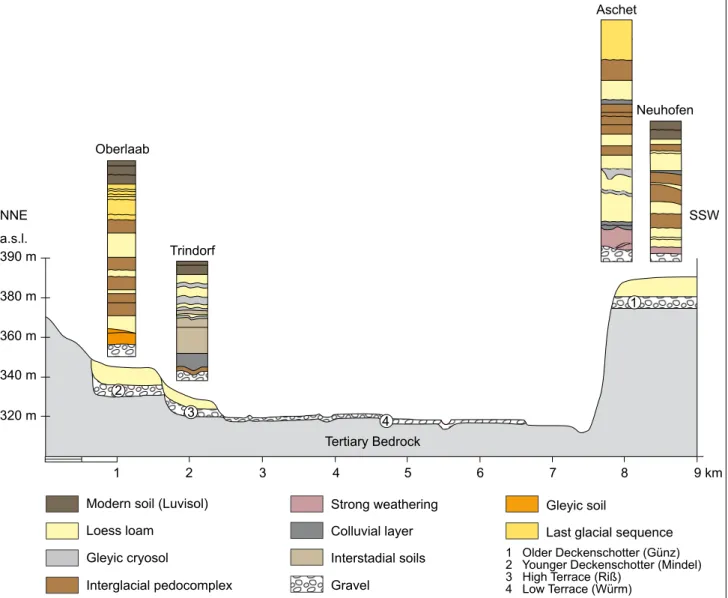
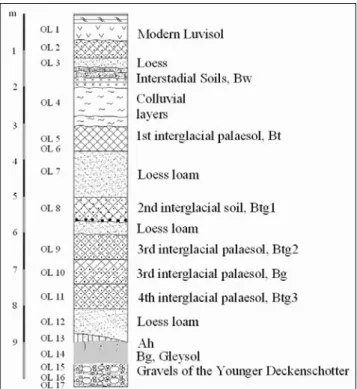
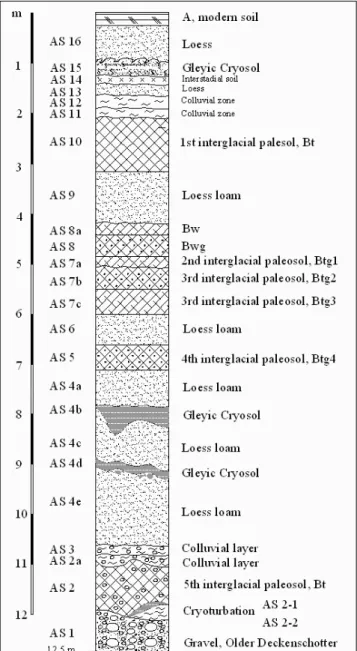
Abstract: Three profiles of loess-palaeosol sequences on top of Middle Pleistocene fluvioglacial terraces of the Traun-Enns-Plate are in- vestigated in the region of Wels (Upper Austria), each of them representing characteristic Middle Pleistocene sequences for the northeastern Alpine Foreland. The sequences comprise thick pedocomplexes, providing the opportunity to distinguish and to clas- sify specific interglacial palaeosols. The loess-palaeosol sequence of Oberlaab developed on top of the fluvioglacial terrace of the classical Mindel (Younger Deckenschotter) shows four interglacial palaeosols. This fact suggests that the age of the terrace is at least the fifth to last glacial period, correlative to MIS 12. The cover layers on top of classical Günz terrace (Older Deckenschotter) in Neuhofen and Wels-Aschet include five palaeosols. Both sites are characterised by intense pedogenesis in the basal pedocomplex, which is considerably more pronounced than in the overlying palaeosols. Pedostratigraphic results point out that the genesis of the studied Günz Deckenschotter can be correlated to MIS 16 (minimum age).
Ein stratigraphisches Konzept für mittelpleistozäne Quartärabfolgen in Oberösterreich
Kurzfassung: Auf den mittelpleistozänen fluvioglazialen Terrassen der Traun-Enns-Platte in der Region um Wels (Oberösterreich) wurden drei Löss-/Paläobodensequenzen untersucht. Jedes dieser Profile ist für mittelpleistozäne Abfolgen im nordöstlichen Alpenvorland charakteristisch. Die Profile umfassen mächtige Pedokomplexe, welche eine Differenzierung und Einstufung von interglazialen Paläoböden erlauben. Die Löss-/Paläobodensequenz von Oberlaab ist auf der fluvioglazialen Terrasse des Mindel-Glazials im klas- sischen Sinne entwickelt (Jüngere Deckenschotter) und weist vier interglaziale Paläoböden auf. Diese Tatsache macht eine Ein- stufung der Jüngeren Deckenschotter mindestens in die fünftletzte Kaltzeit wahrscheinlich (MIS 12). Die Deckschichten auf den Günz-Deckenschottern im klassischen Sinn (Ältere Deckenschotter) beinhalten fünf Paläoböden. Beide Lokalitäten weisen eine sehr intensive Pedogenese in ihrem basalen Pedokomplex auf, die wesentlich ausgeprägter ist, als in den überlagernden Paläoböden. Die pedostratigraphischen Ergebnisse lassen eine Einstufung der Älteren Deckenschotter mindestens ins MIS 16 zu.
Keywords: Quaternary stratigraphy, Wels-Aschet, Oberlaab, landscape formation, palaesols, loess
Address of author: B. Terhorst, University of Würzburg, Institute of Geography and Geology, Am Hubland, D-97074 Würzburg, Germany. E-Mail:
[email protected]
1 Introduction
By now, numerous palaeoclimatic curves based on marine drillings give a distinct idea of the number of glacial-inter- glacial cycles, as well as of the palaeoclimatic evolution of the Middle Pleistocene. Terrestrial studies in Europe are un- able to accomplish these targets as they lack dating methods.
This is the case especially for the Middle Pleistocene time span in the northern Alpine Foreland. In this context, Habbe (2003) mentions a time gap in numerical datings between the classical Günz and the Upper Pleistocene. The palaeo- magnetic boundary at the transition from Lower to Middle Pleistocene (≈780.000 yrs) is therefore of crucial stratigraphi- cal importance as it is one of the rare opportunities to date in the middle and lower Middle Pleistocene. The stratigraphical position as well as the ages of the four classical glacial depos- its (sensu Penck & Brückner 1901–1909) are still under dis- cussion. The Quaternary sediments of the western and the
eastern Alpine Foreland are hardly correlative also because of the use of different stratigraphic systems and because of the fact that terrace bodies can comprise more than one for- mation period (Doppler et al. 2011, Schellmann et al. 2010).
For example, on the one hand, the Matuyama/Brunhes
boundary (MBB) could be proved in Günz deposits at the
location Heiligenberg (Ellwanger et al. 1995) for the west-
ern Alpine Foreland in Baden-Württemberg. On the other
hand, however, the palaeomagnetic reversal occurred with-
in the Younger Deckenschotter (classical Mindel) near Basel
(Zollinger 1991), which coincides with pedostratigraphical
results (Bibus 1990). Actually, the stratigraphical system of
the Pleistocene Rhineglacier area classifies the formation of
the Mindel Deckenschotter as a terrace complex prior to and
during the MBB. Furthermore, the Günz Deckenschotter are
ranked as Early Pleistocene formations there (Ellwanger et
al. 2011). Doppler et al. (2011) developed a stratigraphical
scheme for the Bavarian Alpine Foreland, which integrates
Mindel into the Brunhes-Epoch and Günz sediments mainly to the Matuyama-Epoch. The authors do not exclude that Günz sediments in parts belong to the Brunhes-Epoch. Single datings in the Bavarian foreland obtained with cosmogenic nuclides resulted in 0.68+0.23/−0.24 Ma for a Mindel deposit and 2.35+1.08/−0.88 Ma for a Günzian site (Häuselmann et al. 2007). The error rate for the datings are remarkable high.
Furthermore, it has to be mentioned that the formation pe- riod of Günz, respectively Mindel sediments in Bavaria do not correspond to those in Baden-Württemberg, in general (Doppler et al. 2011).
In the northeastern Alpine Foreland of Austria the “Günz complex” is assumed slightly above the MBB (Van Husen 2000, Van Husen & Reitner 2011b), as the transition from reverse to normal magnetisation was not yet verified in any sequence, and the studied sediments show positive magneti- sation throughout (cf. Kohl 2000).
A stratigraphic classification of Quaternary forms and sediments in the northern Alpine Foreland above the MBB remains problematic. Absolute ages of Middle Pleistocene deposits are ambiguous (cf. Preusser & Fiebig 2009), and detailed subdivisions are still impossible. This eventually re- sults in the difficulty that even comparably complete Qua- ternary sequences are not available for a correlation on a su- praregional scale. As a consequence, this is also shown in the stratigraphic chart of the German Stratigraphic Commission (Deutsche Stratigraphische Kommission 2002), which
displays large uncertainties below the Riß complex within the chronostratigraphic correlation of glacial complexes be- tween the northwestern and northeastern Alpine Foreland.
The problem further becomes evident in the Austrian strati- graphic chart (Österreichische Stratigraphische Kom- mission 2004).
For these reasons, palaeopedological/pedostratigraphi- cal studies represent an important factor for the study area in assessing the stratigraphic position of the Younger and Older Deckenschotter. Scholger & Terhorst (this volume) proposed a stratigraphic scheme for the loess-palaeosol se- quence of Wels-Aschet, which is situated on top of the Günz Deckenschotter. The authors proved Middle Pleistocene pal- aeomagnetic excursions and classified them on the base of pedostratigraphy. According to the mentioned study, the up- permost section of the Günz Deckenschotter is older than 570–560 ka (Emperor - Big Lost - Calabrian Ridge 3 ex- cursion) and thus is correlated with MIS 16 (Scholger &
Terhorst, this volume). The palaeomagnetic approach was applied for the first time in loess sequences in order to es- tablish a chronological framework for Middle Pleistocene in the study area. In this context, it has to be mentioned that Markovic et al. (2009, 2011) applied rock magnetic param- eters to build up a Middle Pleistocene stratigraphy for pal- aesols and loess sediments of the Middle Danube Basin. The authors were able to correlate their results to marine isotopic curves (see also Bronger 1970).
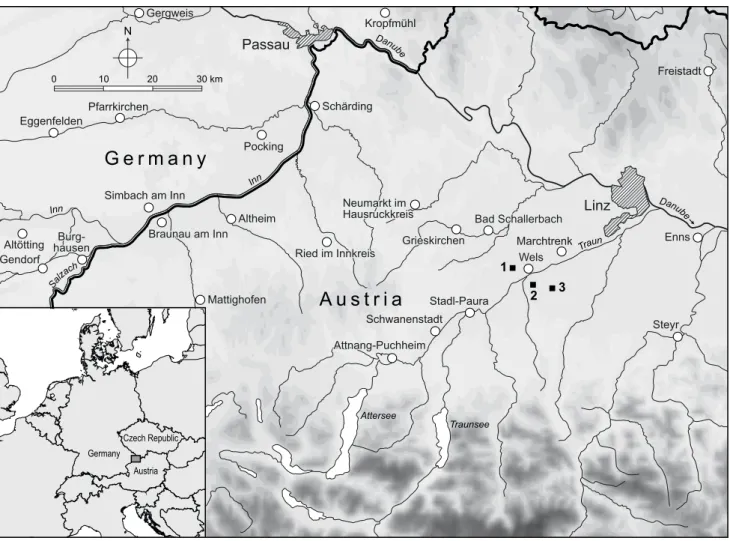
Braunau am Inn Burg-
hausen Ried im Innkreis
Attnang-Puchheim Grieskirchen Neumarkt im
Hausruckkreis Bad Schallerbach Danube
Danube Inn
Inn
Salzach
Traun
Attersee
Traunsee
Salzburg
Bad Reichenhall Freilassing in
Gergweis
Pfarrkirchen
Passau
Schärding Pocking
Simbach am Inn
Braunau am Inn Altheim Burg-
hausen GendorfAltötting
Mattighofen
Ried im Innkreis
Schwanenstadt Stadl-Paura Attnang-Puchheim
Grieskirchen Neumarkt im
Hausruckkreis Bad Schallerbach Wels Marchtrenk
Linz
Enns Freistadt Kropfmühl
Eggenfelden
Steyr
1
2 3
0 10 20 30 km
N
G e r m a n y
A u s t r i a
Germany Austria Czech Republic