415
Received: 15 July 2013 Revised: 1 September 2013 Accepted article published: 16 October 2013 Published online in Wiley Online Library: 18 November 2013(wileyonlinelibrary.com) DOI 10.1002/jsfa.6449
Comparison of ambient solvent extraction
methods for the analysis of fatty acids in
non-starch lipids of flour and starch
Niloufar Bahrami,
a
∗
Lina Yonekura,
a
Robert Linforth,
a
Margarida Carvalho
da Silva,
a
Sandra Hill,
a
Simon Penson,
b
Gemma Chope
b
and Ian Denis Fisk
a
∗
Abstract
BACKGROUND: Lipids are minor components of flours, but are major determinants of baking properties and end-product quality. To the best of our knowledge, there is no single solvent system currently known that efficiently extracts all non-starch lipids from all flours without the risk of chemical, mechanical or thermal damage. This paper compares nine ambient solvent systems (monophasic and biphasic) with varying polarities: Bligh and Dyer (BD); modified Bligh and Dyer using HCl (BDHCL); modified BD using NaCl (BDNaCl); methanol–chloroform–hexane (3:2:1, v/v); Hara and Radin (hexane–isopropanol, 3:2, v/v); water-saturatedn-butanol; chloroform; methanol and hexane for their ability to extract total non-starch lipids (separated by lipid classes) from wheat flour (Triticum aestivum L.). Seven ambient extraction protocols were further compared for their ability to extract total non-starch lipids from three alternative samples: barley flour (Hordeum vulgareL.), maize starch (Zea mays L.) and tapioca starch (Manihot esculentaCrantz).
RESULTS: For wheat flour the original BD method and those containing HCl or NaCl tended to extract the maximum lipid and a significant correlation between lipid extraction yield (especially the glycolipids and phospholipids) and the polarity of the solvent was observed. For the wider range of samples BD and BD HCl repeatedly offered the maximum extraction yield and using pooled standardized (by sample) data from all flours, total non-starch lipid extraction yield was positively correlated with solvent polarity (r=0.5682,P<0.05) and water ratio in the solvent mixture (r=0.5299,P<0.05).
CONCLUSION: In general, BD-based methods showed better extraction yields compared to methods without the addition of water and, most interestingly, there was much greater method dependence of lipid yields in the starches when compared to the flour samples, which is due to the differences in lipid profiles between the two sample types (flours and starches).
c
2013 The Authors.Journal of the Science of Food and Agriculturepublished by John Wiley & Sons Ltd on behalf of Society of Chemical Industry.
Supporting information may be found in the online version of this article.
Keywords:flour; starch, lipid; solvent extraction; neutral lipids; glycolipids; phospholipids; fatty acid
INTRODUCTION
Lipids are minor components of flour but are important in the cereal industry for a variety of functional reasons; for example in baked products such as bread, the texture and volume of the final product are strongly determined by the gas bubble retention properties of the dough. Gas bubble retention is affected by the presence of surface-active compounds, which include lipids, at the gas bubble surface. Their functionality is further highlighted in previous studies,1,2which have shown that in a model system the addition of polar lipids to defatted flour can increase the loaf volume of baked products (e.g. bread and cake); it is also known that wheat kernel hardness and endosperm texture are dependent on friabilin proteins which, in association with polar lipids, determine end baked product quality.3,4 However, it is important to note that flour lipids undergo several significant
changes during storage and this can impact, both positively and negatively, the final product quality of baked goods.1,2,5–9
Although lipids comprise only 1.5–7.0% of cereal grains,10they display a large structural diversity and are unequally distributed across the wheat grain; neutral lipids originate from the rough endoplasmic reticulum and are mainly present in the germ, aleurone and scutellum, while polar lipids are more abundant
∗ Correspondence to: Niloufar Bahrami or Ian Denis Fisk, Division of Food Sciences, University of Nottingham, Sutton Bonington Campus, Sutton Bonington, Loughborough LE12 5RD, UK. E-mail: [email protected], [email protected]
a Division of Food Sciences, University of Nottingham, Sutton Bonington, Loughborough, LE12 5RD, UK
b Campden BRI Group, Chipping, Campden, GL55 6LD, USA
c
416
in the starchy endosperm.5 Neutral lipids typically comprise acylglycerols, free fatty acids, sterols, sterol esters, waxes and hydrophobic pigments. In the cereal grain, triacylglycerols are the main storage lipid and are contained in small stable subcellular organelles termed oil bodies,11,12triacylglycerols can also be found to a lesser extent in the starchy endosperm.13 Polar lipids, in addition to a range of minor fractions, comprise glycolipids, such as mono- and digalactosyl acylglycerides, and phospholipids which are mainly present in wheat starchy endosperm in association with friabilin proteins.3Wheat flour contains mainly endosperm lipids plus a small proportion of lipids from the germ depending on the milling fraction;14thus the ratio of non-polar to polar lipids and neutral–glycolipid–phospholipid can be modulated by flour milling procedures,15allowing for the production of flour with the desired baking functionalities. Storage and shelf life also have a direct effect on flour lipids; the most common example being the development of free fatty acids over storage by enzymatic (lipase) and oxidative lipid degradation pathways.16Among the flour lipid classes, polar lipids are probably the most important effectors on baking functionality, with minor amounts producing marked improvements in the quality of low-moisture17and high-moisture dough, where the amphiphilic nature of these lipids helps to stabilize air cells and increase gas retention in the dough.18
In flour, ‘non-starch lipids’ can be used to refer to all endosperm lipids including those present in the outer surface of starch granules,13while lipids entrapped inside the starch granules are termed ‘internal starch lipids’ and can only be extracted when starch granules are mechanically broken down or when starch granules are gelatinized. The functional properties of starch are strongly determined by the presence of non-starch lipids on the granule surface,15especially during gelatinization. The importance of non-starch lipids is more evident when dealing with purified starches such as maize and tapioca, where other free lipids are absent; furthermore, tapioca originates from cassava root, so it does not contain endosperm lipids.
Given the importance of non-starch lipids in determining flour’s functionality and the characteristics of the final baked products, it is of great importance to have a reliable and robust method for the accurate quantification of those lipids. This method will act as the starting point for a more thorough investigation of the various factors affecting flour quality (e.g. genotype, phenotype, processing and ageing) and on the manufacture of flours with the desired characteristics. While there is some excellent work that has been carried out over the last 10 years,19–22there is still discussion over which extraction method would ensure the most representative extraction of non-starch lipids, including free lipids and bound lipids, in a single type of extraction, without thermal or mechanical damage;20,23,24this is unsurprising given the wide variation of polarity,25accessibility and location of lipids in flour, and the extremely low concentration of surface lipids in cereal and tuber starches.
Compendium methods, such as those provided by the AACC26 for crude lipid extraction, make use of non-polar solvents under reflux (e.g. Soxhlet and Goldsfisch); however, non-polar solvents are well known for their inability to extract polar lipids, and the need for refluxing limits the solvent choice to single low-boiling-point solvents or azeotropes. There have been a number of attempts to increase the extraction yield of non-starch lipids by using solvent mixtures, especially those containing water, as it appears to help break the associations between lipids and the flour matrix.27Methods developed for extraction of wet tissues28have also been applied for flour lipid extraction. In general, non-polar
solvents (e.g. petroleum ether or hexane) are recommended for the extraction of free lipids and other non-polar compounds from wheat flour, and polar solvents (e.g. water-saturatedn-butanol) are recommended for the extraction of more polar bound lipids (i.e. glycolipids and phospholipids) after extraction of free lipids;29 polar solvents have also been used for the extraction of total non-starch lipids, including free and bound lipids.20In general, the use of a two-step solvent extraction process for the extraction of total non-starch lipids could be considered time consuming and a single-step process would be most convenient for laboratory users. Unfortunately, there is no single recommended method for the extraction of all lipid classes present in flour and starch with a single extraction solvent and, therefore, the overall aim of this work was to find a fast and robust method for the measurement of flour non-starch lipids by quantification of their associated fatty acids with a single-solvent system (i.e. only one extraction run) without the use of elevated temperatures. This was to be achieved by comparing and evaluating a range of ambient solvent systems for their ability to extract non-starch lipids from two types of flour: barley (Hordeum vulgareL.) and wheat (Triticum aestivum L.); and two types of starch: maize (Zea mays L.) and tapioca (Manihot esculentaCrantz).
MATERIAL AND METHODS
MaterialPlain wheat flour (Asda stores Ltd, Leeds, UK), barley flour (P&B Foods, Bradford, UK), maize starch (Dr Oetker Ltd, Leeds, UK) and tapioca starch (Infinity Foods, Brighton, UK) were purchased and stored prior to use at−20◦C for no longer than 2 months. Solvents and fatty acid standards were sourced from Sigma-Aldrich (Pampisford, UK). All reagents used were of analytical grade.
Extraction procedures
The following extraction procedures were evaluated for their capacity to extract non-starch lipids at ambient temperature:
• Bligh and Dyer (BD). Samples (500 mg) were extracted as follows: vortexed with 1 mL water (10 min); to form a wet slurry, addition of 3.75 mL chloroform–methanol (1:2, v/v); vortexed for 10–15 min; addition of 1.25 mL chloroform; vortexed for 1 min; addition of 1.25 mL water; vortexed for 1 min; centrifuged for 10 min (2700×g, 5◦C) and the lower phase collected by aspiration. The aqueous phase was discarded as no lipids were detected and the pellet and interfacial layer were re-extracted twice by following the same procedure described above.28
• Bligh and Dyer method with acid modification (BDHCl). Samples were extracted following the same protocol described above for BD, but using 0.02 mol L−1HCl instead of water, to improve extraction yields of acidic phospholipids; this followed the method as described by Hajra.30
• Bligh and Dyer method with salt modification (BDNaCl). Samples were extracted as per BD, although extraction water was replaced with 0.2 mol L−1sodium chloride to enhance phase separation.
417
Bligh and Dyer based methods (BD, BDHCl, BDNaCl, 5.90),methanol (5.1); chloroform (4.1); water-saturated n-butanol (WSB, 4.47); methanol–chloroform–hexane, 3:2:1, v/v (CMHex, 3.77); hexane–isopropanol, 3:2, v/v32(Hara, 1.62); hexane (0.1). Snyder polarity is calculated based on the ratio of solvents in the mixture multiplied by the polarity of that pure solvent.
All extracts were dried in a stream of nitrogen, stored under nitrogen and suspended in 1 mL chloroform for storage at−80◦C. Fractionation of lipid classes
Lipid isolates were fractionated by solid-phase extraction according to the method of Ohm and Chung, used recently by Hobbardet al.22,33Silica solid-phase extraction (SPE) columns (GracePureTMSPE Silica 1000 mg/6 ml, Grace Davison Discovery Sciences, Lokeren, Belgium) were conditioned with 5 mL hexane, followed by 5 mL chloroform. Lipid extract (1 mL in chloroform) was then loaded on to the SPE column and the eluting solvents were tested for the absence of lipids, to confirm total retention of lipids by the solid phase. Neutral lipids were eluted with 10 mL chloroform–acetone (4:1, v/v), then glycolipids were eluted with 15 mL acetone–methanol (9:1, v/v), and finally 10 mL methanol was added to elute phospholipids. The elution rate was adjusted to 0.7 mL min−1 by applying a 846.6 Pa vacuum (6.35 mmHg) using a vacuum manifold. Quality of separation was evaluated using authentic standards of different lipid classes.
Fatty acid analysis by gas chromatography–mass spectrometry (GC-MS)
Crude and fractionated lipid extracts were evaporated to dryness under a nitrogen stream, dissolved in chloroform (1 mL) and stored at−80◦C until analysis. Lipid samples were thawed, combined with internal standard (40µg 20µL heptadecanoic acid–chloroform) and derivatized to fatty acid methyl esters (FAME) with 200µL of 0.25 mol L−1trimethyl sulfonium hydroxide (TMSH) in methanol (10 min at ambient temperature).34FAME samples (1µL) were then separated by gas chromatography (Carlo Erba GC 8000, Milan, Italy; ZB-FFAP column, 30 m, 0.25 mm i.d.; oven temperature 120◦C held for 1 min then ramped at 5 ◦C min−1 to 125 ◦C, then ramped to 260 ◦C at 10◦C min−1) and FAME were detected by mass spectrometry (DSQ II Thermoelectron, Austin, TX, USA; positive ion mode, full scan from 50 to 385m/z, scan rate 500 amu s−1 and scan time of 0.69 s, source temperature 200◦C). Compound identification was achieved by matching with database mass spectra (NIST/EPA/NIH Mass Spectral Library, Version 2.0d, NIST, Gaithersburg, MD, USA), and comparing retention time and mass spectra with those of authentic FAME standards (Supelco, Bellafonte, PA, USA). Quantification was achieved using the ratio of each target compound’s peak area relative to that of the internal standard.
The total lipid concentration in each sample was expressed as the sum of the five major fatty acids (palmitic, stearic, oleic, linoleic and linolenic acid) as g kg−1 flour or g kg−1 starch, to maximize comparability and minimize analytical variation that may be introduced by including minor lipid fractions. Triplicates of all samples were extracted three times by each extraction protocol (three sequential extraction steps), at ambient temperature. All results are expressed as mean±standard deviation.
Experimental design and statistical analysis
All experiments were conducted with a fully balanced experimental design, with randomized analysis order and three
sample replicates. Comparison between extraction methods was carried out by one-way analysis of variance and Tukey’s HSD post hoctest using IBM SPSS Statistics, version 19 (IBM Corp., Armonk, NY, USA). Probability values lower than 0.05 were considered significant. Linear correlation (Pearson’s correlation coefficients) was used to identify trends between solvent polarity (Snyder polarity) and extraction yield of total fatty acids, neutral lipids, glycolipids and phospholipid from wheat flour data to identify correlations (IBM SPSS Statistics, version 19). Principal component analysis (PCA) was performed on extraction yield, fatty acid profile, solvent polarity and water ratio in the solvent mixture, with values relative to total lipid per sample standardized (value−mean of lipid extracts per sample / standard deviation of lipid extracts per sample) across the different sample matrices using STATISTICAsoftware (Statistica release 7, Statsoft Inc., Tulsa, OK, USA).
RESULTS AND DISCUSSION
Impact of choice of solvent on the yield of extraction of lipid classes from wheat flour
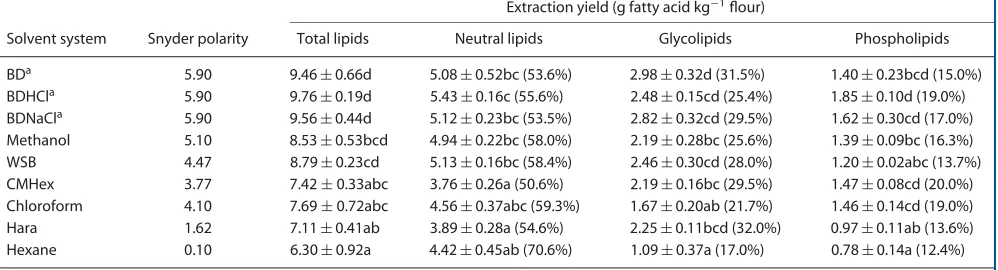
For total lipids, BD methods (including the variants using HCl and NaCl) showed the highest extraction yields (Table 1), followed by methanol and WSB, although there was no statistically significant difference. The remaining extraction solvents showed lower yields compared to BD methods; hexane was the solvent system with the lowest extraction yield. Hexane extraction yields were 35% lower than the BD techniques; this is presumably due to its low polarity. For external comparison, it should be noted that total lipid values correspond to the sum of the five major fatty acids and therefore do not accommodate non-fatty acid lipid components.
Total lipids extracted by each solvent regime were fractionated by SPE, prior to analysis by GC-MS, into fractions enriched in neutral lipids, glycolipids and phospholipids. BDHCl extracted the maximum neutral lipids (5.43±0.16 g kg−1flour), although there was no significant difference between BDHCl and BDNaCl, BD, methanol and WSB. Chloroform and hexane had intermediate yields, while CMHex and Hara had the lowest extraction yields (Table 1). When comparing extraction protocols for glycolipid extraction, BD showed the best performance (2.98±0.32 g kg−1 flour), followed by BDNaCl, BDHCl, WSB and Hara (not significantly different from BD). Methanol and CMHex had intermediate performance, and chloroform and hexane had the lowest glycolipid yield of extraction with absolute yields reduced by 63% and 43% respectively when compared to BD (Table 1). For phospholipids, BDHCl was the method with the highest yield (1.85±0.10 g kg−1 flour), while hexane was the least efficient, with 58% reduction in extracted phospholipid (Table 1).
The range of relative amounts of each lipid class extracted is shown in Table 1 (51–71% neutral lipids, 17–32% glycolipids and 12–20% phospholipids), which highlights the differences between the various solvent systems. A selective enrichment in neutral lipids can be seen in the more non-polar solvent, hexane, which is presumably due its inability to extract the more polar lipid analytes from the matrix, or an inability to diffuse through or hydrate the matrix sufficiently to extract bound lipid fractions.35
418
Table 1. Yield of extraction (g kg−1flour±standard deviation) of total non-starch lipid, neutral lipids, glycolipids and phospholipids from wheat
flour by different solvent systems and the proportion of each lipid class within total lipids extracted as percentages in parentheses
Extraction yield (g fatty acid kg−1flour)
Solvent system Snyder polarity Total lipids Neutral lipids Glycolipids Phospholipids
BDa 5.90 9.46±0.66d 5.08±0.52bc (53.6%) 2.98±0.32d (31.5%) 1.40±0.23bcd (15.0%) BDHCla 5.90 9.76±0.19d 5.43±0.16c (55.6%) 2.48±0.15cd (25.4%) 1.85±0.10d (19.0%) BDNaCla 5.90 9.56±0.44d 5.12±0.23bc (53.5%) 2.82±0.32cd (29.5%) 1.62±0.30cd (17.0%) Methanol 5.10 8.53±0.53bcd 4.94±0.22bc (58.0%) 2.19±0.28bc (25.6%) 1.39±0.09bc (16.3%) WSB 4.47 8.79±0.23cd 5.13±0.16bc (58.4%) 2.46±0.30cd (28.0%) 1.20±0.02abc (13.7%) CMHex 3.77 7.42±0.33abc 3.76±0.26a (50.6%) 2.19±0.16bc (29.5%) 1.47±0.08cd (20.0%) Chloroform 4.10 7.69±0.72abc 4.56±0.37abc (59.3%) 1.67±0.20ab (21.7%) 1.46±0.14cd (19.0%) Hara 1.62 7.11±0.41ab 3.89±0.28a (54.6%) 2.25±0.11bcd (32.0%) 0.97±0.11ab (13.6%) Hexane 0.10 6.30±0.92a 4.42±0.45ab (70.6%) 1.09±0.37a (17.0%) 0.78±0.14a (12.4%)
aFor BD methods, Snyder polarity refers to the first solvent mixture, i.e. water–chloroform –methanol (1:1.25:2.5, v/v/v).
Means with different letters within a column are significantly different by ANOVA and Tukey’s HSD test (P<0.05).
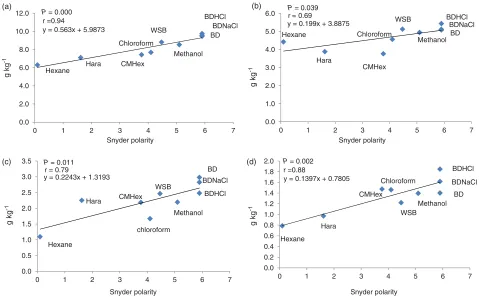
extraction has been under discussion.23,24,28 In recent years a range of different solvent systems optimized for specific analytes have typically been used to extract non-starch lipids from wheat flour20 but still more studies are needed to determine a fast and efficient one-step procedure for the extraction of total lipids, including different lipid classes with different polarities.19 Our results confirm that different methods provide high yields for specific lipid classes, and in general high-polarity solvents allowed better extraction of total lipids (Table 1). Indeed, we observed a significant correlation between solvent polarity and the yield of total lipids (r=0.94,P=0.000), which was driven mainly by the positive correlation between polarity and yield of phospholipid (r=0.88, P=0.002) and glycolipid (r=0.79, P=0.011); neutral lipid yields were weakly correlated with solvent polarity (r=0.69, P=0.039) (Fig. 1).
The method dependence of the lipid classes may be in part due to the fact that the addition of water to the solvent mixture may promote partial hydration of the flour particles and enhance solvent accessibility. In addition, some lipid species occur as complexes with carbohydrates and proteins, so extraction is more difficult and only possible when the solvent is able to overcome the hydrophobic, van der Waals and ionic forces that exist between lipid and the matrix.36Historically, water-saturatedn-butanol has been the solvent of choice for extraction of wheat lipids and preparation of lipid-free flours;37however, the high boiling point of n-butanol makes sample preparation lengthy as the solvent usually has to be evaporated prior to derivatization and quantification of fatty acid esters or gravimetric lipid determinations.
As our aim was to find a fast and robust ambient method for quantitative measurement of flour lipids by quantification of fatty acid methyl esters, the extraction of non-lipids by a water-rich solvent would not interfere with the results. Thus, the BD methods28 appear to be the best choice, as they use a water-rich solvent (water–chloroform–methanol; 1:1.25:2.5, v/v/v) in the first step of extraction, and gradually lower the polarity to ensure extraction of neutral lipids. Our results corroborate previous studies that have shown BD-based methods as a good choice for extraction of lipids from wheat flour, as they offered the highest yield in all lipid classes; furthermore, BDHCl was significantly more effective than WSB for the extraction of phospholipids (>25%). Among BD methods, there was a tendency of BDHCl to offer greater extraction yields for neutral lipids (including free fatty acids) and
phospholipids, although no significant differences were observed (Fig. 1). These results are in line with previous reports on the addition of acid to the aqueous phase to improve the recovery of polar (acidic) phospholipids.30
The relative abundance of key fatty acids in each lipid fraction is hereinafter discussed.
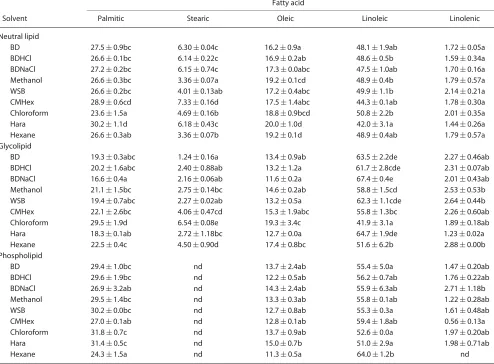
The five major fatty acids present in the neutral lipid fraction were palmitic (C16:0), stearic (C18:0), oleic (C18:1), linoleic (C18:2) and linolenic acid (C18:3). To increase comparability and maximize reproducibility only the five major fatty acids listed are considered here (Table 2), although others were identified. The presence of minor fatty acids has been studied by many authors previously and therefore is not included for clarity. In general, linoleic acid was the most predominant neutral lipid fatty acid, followed by palmitic acid, oleic acid, stearic acid and linolenic acid. It has been shown by previous studies that the triglyceride fraction constitutes about 30–36% of the wheat flour neutral lipids38–40and that the fatty acid composition of esterified fatty acids (e.g. glycerides) is 60–70%, 17–24%, 7–15%, 0.3–1.2% and 2.5% for linoleic, palmitic, oleic, stearic and linolenic acid, respectively. When comparing extraction methods by the abundance of individual fatty acids within the neutral lipid fraction it was found that the range of fatty acids within this lipid class was 42.0–50.8% for linoleic, 23.6–30.2% for palmitic, 16.2–20.0% for oleic, 3.36–7.33% for stearic and 1.44–2.14% for linolenic acid.
419
y = 0.1397x + 0.7805
0.0 0.2 0.4 0.6 0.8 1.0 1.2 1.4 1.6 1.8 2.0 y = 0.563x + 5.9873
0.0 2.0 4.0 6.0 8.0 10.0 12.0
y = 0.2243x + 1.3193
0.0 0.5 1.0 1.5 2.0 2.5 3.0 3.5
y = 0.199x + 3.8875
0.0 1.0 2.0 3.0 4.0 5.0 6.0
0 6 7
0 3 6 7
2 6 7 4 5
1 2 4 5
1 2 3
3 4 5
2 3 4
0 1
0 1 5 6 7
BDHCl BDNaCl BD Methanol WSB CMHex Chloroform Hara Hexane (b) (a) Hara Hexane WSB Chloroform CMHex BDHCl BDNaCl BD Hexane Hara WSB CMHex chloroform BD BDNaCl Methanol BDHCl (c) Methanol Hexane Hara CMHex Chloroform BDHCl Methanol WSB BDNaCl BD (d)
P= 0.000 P= 0.039
P= 0.011 P= 0.002
r =0.94 r=0.69
r =0.88 r = 0.79
[image:5.595.58.537.59.356.2]Snyder polarity Snyder polarity Snyder polarity Snyder polarity g kg -1 g kg -1 g kg -1 g kg -1
Figure 1.Correlation between the solvent polarity (Snyder polarity) and extraction yields (g kg−1) of total (a) fatty acids, (b) neutral lipids, (c) glycolipids
and (d) phospholipids from wheat flour (correlations are expressed byras correlation coefficient andP-value and are considered significant when<0.05).
to hydrate the sample, diffuse through the matrix and overcome the association of the bound glycolipids with cellular structures.
Comparison of the ability of seven ambient solvent systems to extract non-starch lipids from flours and isolated starches Lipids in starch-rich fractions of flour generally contain more bound lipids and less free lipids than flour lipids, and it was hypothesized that their extraction ability would therefore be more dependent on the solvent extraction conditions chosen; we therefore compared BD-based methods and a range of selected solvents for their ability to extract lipids from two flour sources (barley and wheat) and two starch sources (maize and tapioca). Fatty acid profile of each sample is shown in the supporting information.
Barley and wheat flour contain total fatty acids at concentrations of 25±2.1 and 11±2.5 g kg−1 flour, respectively; maize and tapioca starches had lower fatty acid concentrations of 0.77±0.10 and 0.22±0.05 g kg−1starch, respectively. The measured total lipids are comparable to those presented in the literature, with barley and wheat having published values of 20–7041–44and 13 g kg−1,45respectively, and 0.5 and 0.8 g kg−1for maize and tapioca, respectively.46
When comparing extraction regimes applied to barley flour, BD extracted the maximum total fatty acids, although there was no statistically significant difference between this technique, the acid and salt-modified Bligh and Dyer methods (BDHCl and BDNaCl) and the direct methanol extraction. CMHex, Hara and hexane were significantly less efficient than BD (Fig. 2).
Among the starches, BDHCl and BD showed the maximum extraction yields (Fig. 2). In the tapioca starch, BDNaCl resulted in a statistically lower yield compared to BDHCl. Hexane gave the lowest extraction yield, while the other methods (CMHex, Hara
and methanol) offered variable results depending on the analysed sample (Fig. 2). The method dependence was more significant in the starch samples compared to the flour samples and there was a significant difference between the tapioica and maize samples.
The method dependence of the analytes discussed is clearly shown in Fig. 2 and highlights the risk of assuming that one method will be effective across all similar matrices and derived isolates (e.g. starch derived from flour). The dependence of extraction yield on both sample and analyte is further discussed below, using principal component analysis (PCA) to illustrate the factors influencing the performance of the different methods for lipid extraction applied to flours and starches.
420
Table 2. Fatty acid profile within lipid classes extracted from wheat flour by different methods expressed as percentage fatty acid per lipid class
Fatty acid
Solvent Palmitic Stearic Oleic Linoleic Linolenic
Neutral lipid
BD 27.5±0.9bc 6.30±0.04c 16.2±0.9a 48.1±1.9ab 1.72±0.05a
BDHCl 26.6±0.1bc 6.14±0.22c 16.9±0.2ab 48.6±0.5b 1.59±0.34a BDNaCl 27.2±0.2bc 6.15±0.74c 17.3±0.0abc 47.5±1.0ab 1.70±0.16a Methanol 26.6±0.3bc 3.36±0.07a 19.2±0.1cd 48.9±0.4b 1.79±0.57a WSB 26.6±0.2bc 4.01±0.13ab 17.2±0.4abc 49.9±1.1b 2.14±0.21a CMHex 28.9±0.6cd 7.33±0.16d 17.5±1.4abc 44.3±0.1ab 1.78±0.30a Chloroform 23.6±1.5a 4.69±0.16b 18.8±0.9bcd 50.8±2.2b 2.01±0.35a
Hara 30.2±1.1d 6.18±0.43c 20.0±1.0d 42.0±3.1a 1.44±0.26a
Hexane 26.6±0.3ab 3.36±0.07b 19.2±0.1d 48.9±0.4ab 1.79±0.57a Glycolipid
BD 19.3±0.3abc 1.24±0.16a 13.4±0.9ab 63.5±2.2de 2.27±0.46ab BDHCl 20.2±1.6abc 2.40±0.88ab 13.2±1.2a 61.7±2.8cde 2.31±0.07ab BDNaCl 16.6±0.4a 2.16±0.06ab 11.6±0.2a 67.4±0.4e 2.01±0.43ab Methanol 21.1±1.5bc 2.75±0.14bc 14.6±0.2ab 58.8±1.5cd 2.53±0.53b WSB 19.4±0.7abc 2.27±0.02ab 13.2±0.5a 62.3±1.1cde 2.64±0.44b CMHex 22.1±2.6bc 4.06±0.47cd 15.3±1.9abc 55.8±1.3bc 2.26±0.60ab Chloroform 29.5±1.9d 6.54±0.08e 19.3±3.4c 41.9±3.1a 1.89±0.18ab Hara 18.3±0.1ab 2.72±1.18bc 12.7±0.0a 64.7±1.9de 1.23±0.02a Hexane 22.5±0.4c 4.50±0.90d 17.4±0.8bc 51.6±6.2b 2.88±0.00b Phospholipid
BD 29.4±1.0bc nd 13.7±2.4ab 55.4±5.0a 1.47±0.20ab
BDHCl 29.6±1.9bc nd 12.2±0.5ab 56.2±0.7ab 1.76±0.22ab
BDNaCl 26.9±3.2ab nd 14.3±2.4ab 55.9±6.3ab 2.71±1.18b
Methanol 29.5±1.4bc nd 13.3±0.3ab 55.8±0.1ab 1.22±0.28ab
WSB 30.2±0.0bc nd 12.7±0.8ab 55.3±0.3a 1.61±0.48ab
CMHex 27.0±0.1ab nd 12.8±0.1ab 59.4±1.8ab 0.56±0.13a
Chloroform 31.8±0.7c nd 13.7±0.9ab 52.6±0.0a 1.97±0.20ab
Hara 31.4±0.5c nd 15.0±0.7b 51.0±2.9a 1.98±0.71ab
Hexane 24.3±1.5a nd 11.3±0.5a 64.0±1.2b nd
‘nd’ indicates that the fatty acids were not detected. Means with different letters within each column in each lipid class are significantly different by ANOVA and Tukeys HSD test (p<0.05).
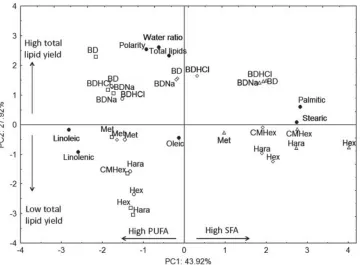
barley flour samples the extraction methods were not distributed along PC1, indicating no major shift in the fatty acid profile regardless of the method used and relatively similar fatty acid profiles in wheat and barley flours. On the other hand, for the starch samples, extraction methods are distributed along PC1 (fatty acid profile), indicating a wider variation of fatty acid profiles across the different extraction methods; this is confirmed in Fig. 2. The BD method and its variants (HCl and NaCl) generally showed more efficient extraction compared to methods using solvents without addition of water, as denoted by the positioning of all BD, BDNaCl and BDHCl on the positive side of PC2, as opposed to all other extraction methods in the negative side. It was expected that starch samples would contain a greater proportion of polar lipids than flour samples and that the greater differences in fatty acid profile (across the different methods) in the starch samples may be explained by the presence of polar lipids interacting with the starch granule surface; water in the BD-based techniques is proposed to improve the solvent extraction efficiency by facilitating the dissociation of lipids from other components27(e.g. starch and protein); modification of BD using NaCl shows a trend towards a reduced extraction of total lipids, which is more evident in the starch samples and may be explained by the formation
of fatty acid salts and subsequent increase in solubility of the fatty acids in water,17which would reduce their solubility in the organic phase. On the other hand, modification of BD using HCl in starch samples improved total extraction yield and this could be explained through the presented work, as BD using HCl showed a tendency towards greater recovery of phospholipids (Table 1).
421
0 2 4 6 8 10 12 14
g kg
-1
0 4 8 12 16 20 24 28
g kg
-1
0.0 0.2 0.4 0.6 0.8 1.0 1.2
g kg
-1
BD
BDHCL
CMHex
Hara Hexane
Methanol 0.00
0.05 0.10 0.15 0.20 0.25 0.30
g kg
-1
a
a a
a
a a
b
ab
ab ab
a a
a
cd d
bc
a
b
a c
b b
b
ab
a a a
BDNaCl
(a) (b)
(c) (d)
BD
BDHCL
CMHex
Hara Hexane
Methanol BDNaCl
BD
BDHCL
CMHex
Hara Hexane
Methanol BDNaCl BD
BDHCL
CMHex
Hara Hexane
[image:7.595.82.514.73.371.2]Methanol BDNaCl
Figure 2.Total fatty acid (g kg−1) extracted from (a) wheat flour, (b) barley flour, (c) maize starch and (d) tapioca starch. Means with different letters
within each figures are significantly different (ANOVA and Tukey’s HSD test,P<0.05,n=3). CMHex for wheat was excluded due to sample loss.
Figure 3.Principal component scores for lipid extraction methods applied to wheat (open circle) and barley (open square) flour, and maize (open
[image:7.595.119.479.425.690.2]422
biphasic system whereby non-lipids are partitioned out of the extraction phase. It should be noted that QUASIMEME,48a multi-laboratory trial, showed that small differences in the BD method can result in significant differences in inter- and intra-laboratory results, and therefore methodologies should be followed strictly to ensure comparability and optimized extraction efficiencies; and that the BD method does result in the formation of interfacial material that needs to be treated carefully and could ultimately result in greater analytical variation over time.
Future development work is expected to include a more rigorous investigation of the impact of hydration state (i.e. moisture content) of the analyte matrix and the application of a wider range of solvents on specific industrial milling fractions to evaluate the impact of de-branning and flour milling on specific solvent efficiencies, especially with respect to the mechanical damage of starch granules through processing.
CONCLUSION
Bligh and Dyer based methods (BD, BDNaCl and BDHCl) gave better extraction yields compared to methods without the addition of water, and there was greatest method dependence in the starches when compared to the flour samples, which we believe is important for the academic community to recognize and to incorporate into their work in future studies.
ACKNOWLEDGEMENTS
The authors would like to thank the Biotechnology and Biological Sciences Research Council and Campden BRI for their financial and intellectual support throughout this project.
SUPPORTING INFORMATION
Supporting information may be found in the online version of this article.
REFERENCES
1 Chung OK and Ohm JB, Wheat lipid as a quality determinant, in Proceedings of the International Wheat Quality Conference, Manhattan,KS, pp. 83–100 (1997).
2 MacRitchie F, The liquid phase of dough and its role in baking.Cereal Chem53:318– 326 (1976).
3 Finnie SM, Jeannotte R, Morris CF and Faubion JM, Variation in polar lipid composition among near- isogenic wheat lines possessing different puroindoline haplotypes.J Cereal Sci51:66– 72 (2010). 4 Pauly A, Pareyt B, De Brier N, Fierens E and Delcour JA, Starch isolation
method impacts soft wheat (Triticum aestivumL. cv. Claire) starch puroindoline and lipid levels as well as its functional properties.J Cereal Sci56:464– 469 (2012).
5 Morrison WR, Wheat lipid composition. Cereal Chem 55:548– 558 (1978).
6 Riisom T, Krog N and Erikson J, Amylose complexing capacities of
cis- and trans- unsaturated monoglycerides in relation to their functionality in bread.J Cereal Sci2:105– 117 (1984).
7 Konopka I, Czaplicki S and Rotkiewicz D, Differences in content and composition of free lipids and carotenoids in flour of spring and winter wheat cultivated in Poland.Food Chem95:290– 300 (2006). 8 Wang L, Yin Z, Wu J, Sun Z and Xie B, A study on freeze–thaw
characteristics and microstructure of Chinese water chestnut starch gels.J Food Eng88:186– 192 (2008).
9 Simmonds DH,Wheat and Wheat Quality in Australia. CSIRO Australia, Queensland (1989).
10 Ruibal-Mendieta NL, Delacroix DL and Meurens M, A comparative analysis of free, bound and total lipid content on spelt and winter wheat wholemeal.J Cereal Sci35:337– 342 (2002).
11 Fisk ID, White DA, Lad M and Gray DA, Oxidative stability of sunflower oil bodies.Eur J Lipid Sci Technol110:962– 968 (2008).
12 White DA, Fisk ID and Gray DA, Characterisation of oat (Avena sativa
L.) oil bodies and intrinsically associated E-vitamers.J Cereal Sci
43:244– 249 (2006).
13 Morrison WR, Starch lipids: a reappraisal.Starch – St¨arke33:408– 410 (1981).
14 Ando H, Sugi K, Watanabe K, Morita N and Mitsunaga T, Distribution of food components in each fraction of wheat grain.Food Sci Technol Res8:10– 13 (2002).
15 Marion D, Dubreil L and Douliez J, Functionality of lipids and lipid–protein interactions in cereal-derived food products.
Ol´eagineux, Corps Gras, Lipides10:47– 56 (2003).
16 Barnes PJ,Lipids in Cereal Technology. Academic Press, London (1983). 17 Pareyt B and Delcour JA, The role of wheat flour constituents, sugar, and fat in low moisture cereal based products: a review on sugar-snap cookies.Crit Rev Food Sci Nutr48:824– 839 (2008).
18 Ukai T and Urade R, Cooperation of phosphatidylcholine with endogenous lipids of wheat flour for an increase in dough volume.
Food Chem102:225– 231 (2007).
19 Pareyt B, Finnie SM, Putseys JA and Delcour JA, Lipids in bread making: sources, interactions, and impact on bread quality.J Cereal Sci
54:266– 279 (2011).
20 Gerits LR, Pareyt B and Delcour JA, Single run HPLC separation coupled to evaporative light scattering detection unravels wheat flour endogenous lipid redistribution during bread dough making.
LWT – Food Sci Technol53:426– 433 (2013).
21 Finnie SM, Jeannotte R, Morris CF, Giroux MJ and Faubion JM, Variation in polar lipids located on the surface of wheat. starch.J Cereal Sci
51:73– 80 (2010).
22 Hobbard JD, Downing JM, Ram MS and Chung OK, Lipid extraction from wheat flour using supercritical fluid extraction.Cereal Chem
81:693– 698 (2004).
23 Wootton MJ, Binding and extractibility of wheat flour lipid after dough formation.J Sci Food Agric17:297– 301 (1966).
24 Macmurray TA and Morrison WR, Composition of wheat-flour lipids.J Sci Food Agric21:520– 528 (1970).
25 Morrison WR, Mann DL and Coventry WSAM, Selective extraction and quantitative analysis of non-starch and starch lipids from wheat flour.J Sci Food Agric26:507– 521 (1975).
26 AACC,Approved Methods of Analysis. AACC International, St Paul, MN (1999).
27 Clements RL, Quantitative studies of wheat-flour lipids extracted with various solvents by an elution method. Cereal Chem 54: 1198–1206 (1977).
28 Bligh EG and Dyer WJ, A rapid method of total lipid extraction and purification.Can J Biochem Physiol37:911– 917 (1959).
29 Morrison WR, Lipids in cereal starch: a review.J Cereal Sci8:1– 15 (1988).
30 Hajra AK, An extraction of acyl and alkyl dihydroxyacetone phosphate from incubation mixtures.Lipids9:502– 504 (1974).
31 Snyder LR, Classification of the solvent properties of common liquids.
J Chromatogr Sci16:223– 234 (1978).
32 Hara A and Radin NS, Lipid extraction of tissues with a low-toxicity solvent.Anal Biochem90:420– 426 (1978).
33 Ohm JB and Chung OK, Estimation of free glycolipids in wheat flour by high performance liquid chromatography.Cereal Chem76:873–876 (1999).
34 Fisk I, Gkatzionis K, Lad M, Dodd CR and Gray D, Gamma-irradiation as a method of microbiological control, and its impact on the oxidative labile lipid component ofCannabis sativaandHelianthus annus.Eur Food Res Technol228:613– 621 (2009).
35 Morrison WR, Lipids in cereal starches: a review.J Cereal Sci8:1– 15 (1988).
36 Smedes F and Askland TK, Revisiting the development of the Bligh and Dyer total lipid determination method.Mar Pollut Bull38:193– 201 (1999).
37 Bloksma A, Extraction of flour by mixtures of butanol-1 and water.
Cereal Chem43:602– 622 (1966).
38 MacMurray T and Morrison W, Composition of wheat-flour lipids.J Sci Food Agric21:520– 528 (1970).
423
40 Nelson JH, Glass RL and Gedde WF, The triglycerides and fatty acids of wheat.Cereal Chem40:343– 350 (1963).
41 Osman RO, Abd El Gelil FM, El Noamany HM and Dawood MG, Oil content and fatty acid composition of some varieties of barley and sorghum grains.Grasas Aceites51:157– 162 (2000).
42 Price PB, Breeding for improved feed quality of barley.Barley Newsl
37–41 (1972).
43 Fedak G and De La Roche I, Lipid and fatty acid composition of barley kernels.Can J Plant Sci57:257– 266 (1977).
44 Madazimov SHT, Tukhtamuradov ZT and Ibragimova KI, Fatty acid composition of Uzker barley and changes during malting.
Pirkladnaya Biokhimiyai Microbiologiya12:734 (1976).
45 Prabhasankar P, Kumar MV, Lokesh BR and Rao PH, Distribution of free lipids and their fractions in wheat flour milled streams.Food Chem
71:97– 103 (2000).
46 Vasanthan T and Hoover R, Comparative study of the composition of lipids associated with starch granules from various botanical sources.Food Chem45:19– 29 (1992).
47 Christie WW,Lipid Analysis: Isolation, Separation,Identification, and Structural Analysis of Lipids. The Oily Press, Cambridge, UK (2003). 48 Roose P and Smedes F, Evaluation of the results of the QUASIMEME