A Scalable Architecture Supporting QoS Guarantees Using
Traffic Engineering and Policy Based Routing in the
Internet
Priyadarsi NANDA1, Andrew SIMMONDS2
1
School of Computing and Communications, Engineering and IT University of Technology, Sydney, Australia
2
Mathematics, Computing and Technology, the Open University, England, UK Email: [email protected], ajs2244@tutor.open.ac.uk
Received February 25, 2009; revised April 10, 2009; accepted June 21, 2009
ABSTRACT
The study of Quality of Service (QoS) has become of great importance since the Internet is used to support a wide variety of new services and applications with its legacy structure. Current Internet architecture is based on the Best Effort (BE) model, which attempts to deliver all traffic as soon as possible within the limits of its abilities, but without any guarantee about throughput, delay, packet loss, etc. We develop a three-layer policy based architecture which can be deployed to control network resources intelligently and support QoS sensi-tive applications such as real-time voice and video streams along with standard applications in the Internet. In order to achieve selected QoS parameter values (e.g. loss, delay and PDV) within the bounds set through SLAs for high priority voice traffic in the Internet, we used traffic engineering techniques and policy based routing supported by Border Gateway Protocol (BGP). Use of prototype and simulations validates function-ality of our architecture.
Keywords:QoS, BGP, Policy Based Routing, Traffic Engineering, Bandwidth Broker (BB)
1. Introduction
The success of the Internet has brought a tremendous growth in business, education, entertainment, etc., over the last four decades. With the dramatic advances in multimedia technologies and the increasing popularity of real-time applications, end-to-end Quality of Service (QoS) support in the Internet has become an important issue, which in this paper we address using Traffic En-gineering and Policy Based Routing using BGP (Border Gateway Protocol), the core routing protocol of the Internet.
The Internet can be considered as a connection of Autonomous System (AS) domains, where each AS do-main controls traffic routing in their own dodo-main based on their own policies. These policies are defined to bene-fit the AS domain without consideration of other AS domains, which may result in policy conflicts while es-tablishing a flow to achieve a certain degree of QoS on an end-to-end basis. Traffic Engineering concerned with resource allocation mechanisms has been widely studied
[8,11–13] and also by us with a proposal for an inte-grated architecture bringing routing and traffic engineer-ing along with resource management to support end-to- end QoS in the Internet [1]. The novelty of our scheme is mapping traffic engineering parameters into QoS paths available in the network and using policy routing to support end-to-end QoS. This is discussed in terms of the architecture of Figure 1 in Section 2 and how our schemes can be used to achieve some well known QoS objectives such as Delay, Throughput and Packet Delay Variation (PDV) for high priority voice traffic in the Internet. We conducted simulations to validate our re-sults.
(BGP) is presented in Section 5. Simulation results to validate our model are discussed in Section 6 and finally our conclusion is given in Section 7.
2. An Integrated Architecture
In order to achieve a better service oriented model for the Internet, we propose a three layer policy based ture for the Internet. The main functions of the architec-ture are presented in Figure 1.
One of the key components of our architecture is to separate out the control plane from the data forwarding plane by hierarchically grouping network management functions.
In this architecture, layer 3 end-to-end QoS, would be responsible for policy based routing and traffic engi-neering to dynamically provision bandwidth between different domains. Having determined the route, the layer 3 policy agent would inform the layer 2 of the preferred route. This route provisioning provides a connectivity overlay on top of the normal IP routing, such that if the route from Domain A to Domain B changes at the IP
layer it is not necessary to change the overlay routing. The fall back position for a null layer 3 is that routes will be statically provisioned between individual domains so as to carry the flow to the destination domain.
[image:2.595.81.261.505.707.2]Layer-2, Network Level QoS. The management unit in this layer is a Bandwidth Broker (BB) [2,3,14]. This terfaces to layer 1 and 3 devices, but also supports in-ter-domain resource control functions in cooperating with BBs in neighboring domains. Note that the policy function is an add-on to the BB function, i.e. with a null policy to accept everything, BBs can support end to end QoS, but any domain which wishes to implement net-work policies can do so to its benefit without affecting the functionality of the BB layer.
Figure 1. Logical view of the architecture.
The inclusion of null policies and layers is important to enable a gradual take-up of these tools in the Internet. It is not necessary for all domains to implement all levels before anything can work. We present the prototype of our BB design in Section 3 of this paper.
Layer 1, Device Level, is where network devices are configured to support the QoS levels agreed on in the higher levels, getting their instructions from higher lay-ers in the architecture. One possible QoS mechanism being Differentiated Services (DiffServ) (RFC 2475) with Common Open Policy Service (COPS) [13] (RFC 2748, RFC 3084) and being used for signaling. Units in this layer are network devices such as routers and switches and the operation is purely intra-domain.
3. Bandwidth Broker (BB) Design
The conventional definition [2,3] of a Bandwidth Broker (BB) is an agent, running in an Autonomous System (AS), which manages resources within its own domain and with adjacent BB domains, to provide Quality of Service (QoS) support for traffic flows across multiple domains. BBs use hop-by-hop based routing to negotiate with other BBs (the inter-domain function) to provide agreed levels of service for selected traffic flows. Flows getting this preferential treatment will normally be ex-pected to pay more, and this is exex-pected to be a driver in sharing Internet resources as well as providing a revenue stream for Internet Service Providers (ISPs).
A BB controls the network devices in its own domain (the intra-domain BB function) which provide QoS func-tionality, such as routers and switches. Note that for scalability it is best if the core routers have as little to do as possible apart from forwarding packets, so there should be no interaction between a BB and the core routers. As no particular QoS mechanism is linked to the BB function, different domains can run different QoS mechanisms if they choose. As long as BBs can commu-nicate with each other and agree on common definitions for the level of service required by different priority flows, then a consistent level of QoS support can be set up across different domains for a particular flow. When a new request for a particular QoS arrives, BBs pass the request from one to another, such that if resources are free all along the chain from source to destination then the request is allowed, else it is rejected.
1) Network traffic – 11100000 (used for BB signaling) 2) Expedited Forward (EF) - 1011 10xx (used e.g. for VoIP)
3) Assured Forward Gold (AFg) - 0111 10xx, AF33 4) Assured Forward Silver (AFs) - 0101 10xx, AF23 5) Assured Forward Bronze (AFb) - 0011 10xx, AF13 6) Best Effort (BE) - 0000 00xx, default
RFC 2597 [16] defines the Assured Forward “Olym-pic” Per Hop Behavior (PHB) classes and RFC 3246 [17] the EF PHB class. A drop precedence of 3 was chosen for the AF values for compatibility with the deprecated TOS field of the IP packet header, giving flag settings for (D = 1) low delay, (T = 1) high throughput, and (R = 0) normal reliability.
The resources monitored in our implementation are simply additive, but statistical multiplexing could be used to carry more paying traffic over reserved links, as [18] suggests. Our current implementation is open loop, that is available resources are entered in a database (DB) and the BB subtracts resources from the available total as requests are granted, and adds resources when flows fin-ish. Eventually the aim is to have closed loop control, by deploying a resource discovery mechanism to actually measure queue length, etc., e.g. as proposed by one of us using Fair Intelligent Admission Control (FAIC) [19].
The design philosophy we chose is one we believe is consistent with the design philosophy of the Internet: where we faced a design choice we chose the simplest solution, and we implement a minimum function set which can then be extended to provide added functional-ity.
4. Traffic Engineering Issues
An important objective of Internet traffic Engineering is to facilitate reliable network operations by providing proper QoS to different services through mechanisms which will enhance network integrity and achieve net-work survivability. The objective of traffic engineering measures in our architecture is to achieve load balancing between neighboring ASs using BGP parameters. By doing so, the architecture then optimizes resource utiliza-tion across multiple links, maps divergent QoS parame-ters to the paths which can support end-to-end service qualities, and avoids congestion hot-spots across the Internet.
In our architecture we used BGP routing to send traffic between domains. But BGP routing policies are not de-signed specifically to address traffic engineering issues in the Internet. Instead, they are designed to support routing policies determining network reachability be-tween ASs. Obtaining a globally optimized routing path in the Internet is a difficult task due to different policy requirements. Our aim to achieve a scalable solution is based on the following assumptions while incorporating
traffic engineering into the architecture:
1) The use of community attributes in policy routing to add extra policy information into the BGP path an-nouncements, enabling traffic engineering to map dif-ferent QoS parameters to the available paths computed using policy routing.
2) That load balancing traffic with different policies across multiple available routes to the same destination is performed only when the policy co-ordination algorithm for a specific path fails.
Hence our proposed traffic engineering solution can be stated as parameter mapping to different QoS paths available in the Internet, using a policy co-ordination algorithm to resolve any policy conflicts between differ-ent ASs while selecting a QoS routing path. In order to be more specific on the issue of parameter mapping, we identified three important parameters related to real-time services such as VoIP application:
a) Bandwidth: When different bandwidth capacities
are available in different AS domains for a specific pol-icy in an end-to-end QoS path, the BW allocated is the BW of the AS with the minimum available BW. This minimum bandwidth also needs to satisfy the perform-ance requirements for VoIP traffic in order for the path to be selected.
b) Delay: Two components of end-to-end delay are
important for VoIP traffic: delay due to codec processing and propagation delay. ITU-T recommendation G.114 [4] recommends one way delay values less than 150 ms for most user applications, 150 to 400 ms for international connections, with more than 400 ms deemed to be unac-ceptable. ASs can indicate end-to-end delay in their own domain between edge routers. Hence, complete end-to- end delay for a QoS path would be the sum of all the delays offered by individual AS provided that the sum satisfied the delay requirements specified by G.114. An AS receiving the path announcement along with the de-lay value from its neighbor adds its own dede-lay and then announces the sum to other ASs further along.
c) Packet Delay Variation (PDV): as it is now
Maximum PDV = Max {Abs [(tn’ - tn-1’) - (tn - tn-1)], …, Abs[(t2’ - t1’) - (t2 - t1)]} = Max {Abs [(tn’ - tn) - (tn-1’ - tn-1)], …, Abs[(t2’ - t2) - (t1’ - t1)]}
PDV can also be signed, where a positive PDV indi-cates that the time difference between the packets at the destination is more than that at the source, and vice-versa.
Hence, while mapping QoS parameters such as band-width (BW), Delay (d), and PDV (j) for a specific QoS path, traffic engineering considers the following, where 1 ≤ i ≤ k are the ASs involved in the end to end path:
BW = Min {BW1, BW2, … BWk} Delay = Sum (d1, d2, … dk) PDV = Max{Abs (j1, j2, …., jk)}
And minimizing cost over all the announced path would be given by:
Min [C1|P1 – A1 | + C2|P2 – A2 | + … Ck|Pk – Ak |], where P is the required policy parameter, A is the an-nounced value of the policy parameter by a neighbor which exported the path and C is the cost associated with these parameters which determines the weight for them. Such costs are important to consider when different ASs have different QoS objectives to satisfy a given Service Level Agreement (SLA) for their customers. In a stan-dard traffic engineering problem, the aim is to minimize the maximum utilization of links, whereas in our archi-tecture it is to maximize the number of AS domains which support the above mentioned constraints. Hence traffic with different policies can be distributed among those paths, improving overall traffic engineering objec-tives by using the traffic engineering framework of Sec-tion 4 and the policy routing of SecSec-tion 5.
4. Traffic Engineering Framework
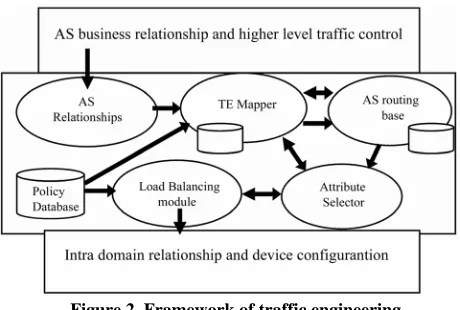
The framework is based upon the fact that ASs must communicate with their neighbors to get a fair picture about which relationships they must hold with them in order to apply specific traffic engineering policies in their respective domains. At the same time, ASs must also protect themselves against route instabilities and routing table growth which may otherwise occur due to misconfigurations or problems in other ASs. Manually configuring routing will of course achieve optimum re-sults if the routing is configured optimally. However, Internet routing is complicated so manually configuring routing will not achieve optimal routing in practice, and misconfigurations may well cause catastrophic failure to the Internet. Hence we seek an automatic solution. The components of our traffic engineering framework are presented in Figure 2.
[image:4.595.309.539.77.232.2]The middle layer (network layer QoS) of our architec-ture presented in Section 2 has the necessary compo-nents for including network policies in traffic engineering.
Figure 2. Framework of traffic engineering.
AS relationships play an important role supporting QoS in the Internet. But obtaining data on such relationship is a difficult task, as ASs such as ISPs may not reveal such data to their competitors. Hence we propose to use a measurement based approach where an ISP ranks ASs based on the frequency of their presence in the routing table. A heavily used AS in the path list is one where some kind of traffic engineering should be applied if selected for next hop forwarding. For example the deci-sion of selecting local preference is very much local to an ISP in order to balance its outgoing traffic (selecting the path to forward packets to the next ISP). On the other hand, an AS which is used less frequently is less con-gested and has a better chance of providing QoS re-sources [5].
Traffic Engineering Mapper (TEM) has a repository that holds AS relationships and the hierarchy for inter-connectivity between various ASs. TEM is responsible for directing those relationships to the Attribute Selector as well maintaining a list of those attributes once selected. Because the routing table holds information regarding import and export policy filters, as well the attributes associated with them, TEM also investigates their valid-ity in the AS routing base. One of the export rules based on the business relationship between ASs is for the TEM to enforce the provider to send all routes (customer as well as provider routes) that the provider knows from its neighbors. Alternatively, TEM could ensure that peer or provider routes are not sent when sending routes to an-other provider (i.e. just send customer routes). TEM is an essential component of traffic engineering framework.
takes a final decision on traffic engineering. The process is the same for both importing and exporting a route be-tween neighboring ASs.
Several efforts on finding solutions to BGP based traf-fic engineering and AS relationships have been explored in the past [6–9]. While the authors described some drawbacks of BGP in the first instance and then proposed their schemes on better management of BGP for traffic engineering, our approach is different as we consider the relationship between ISPs as a central issue in defining necessary traffic engineering policies for the Internet, and add a community policy attribute to BGP to solve this issue. Hence our proposal builds on BGP to provide a solution. Policy routing using BGP is presented in the following section of this paper.
5. Policy Routing
Routing protocols play an important role in exchanging routing information between neighboring routers. Such information may be used to update routing tables and to share information about network status so that traffics to appropriate destinations will be set up quickly, effi-ciently and achieve the required QoS between end sys-tems. Different types of routing protocols are in wide-spread use across the Internet. Apart from determining optimal routing paths and carrying traffics through the networks, these routing protocols should have additional functionalities such as resource discovery, policy map-ping and policy negotiation mechanisms to support net-work policies, traffic engineering and security.
BGP is a path vector protocol that uses AS path in-formation between neighboring routers in different AS domains to determine network reachability. Such net-work reachability information includes information on the list of ASs and the list of AS paths. One of the im-portant features supported by BGP is policy routing, where an individual AS can implement network policies to determine whether to carry traffic from different users (mostly users from other ASs) with diverse QoS re-quirements. Such network policies are not part of BGP, but provide various criteria for best route selection when multiple alternative routes exist and help to control re-distribution of routing information, resulting in a rich support by BGP for policy routing and traffic engineer-ing in the Internet.
Current Internet Traffic Engineering depends heavily on both Intra and Inter Domain routing protocols using network policy in order to configure the routers across various domains. The support for policy based routing using BGP can provide source based transit provider selection, whereby ISPs and other ASs will then route traffic originating from different sets of users through different connections across the policy routers. Also QoS support for Diffserv networks can be supported using
policy routing through the use of the DiffServ field in the IP packets. Hence, a combination of traffic engineering for load balancing across network links offered by desti-nation based routing, and policy based routing, can en-able implementation of policies that distribute traffic among multiple paths based on traffic characteristics.
Policy routing in the Internet can be based on the fol-lowing principles:
1) Each AS to take action on routing based upon in-formation received from neighbors. Such decision proc-ess is central within each AS.
2) Neighbors are free to negotiate any policy conflict by adjusting their traffic parameters and waiting for con-firmations from all the domains involved in routing.
3) Incorporation of a direct relationship between net-work level flow management and traffic engineering objectives.
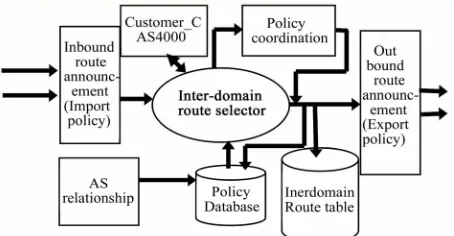
Routing traffic across several routers in the same do-main to support QoS between the edges of the network is relatively easy to achieve, as we can gather knowledge on QoS paths and select edge routers administrated by a single network entity. But inter-domain QoS path selec-tion is difficult to achieve and to demonstrate how we can approach such a problem, we present the policy routing framework in Figure 3. We assume that the in-tra-domain QoS path computations are already optimized based on the local knowledge of intra-domain routing protocol and this information is already stored in layer-2 of our architecture.
[image:5.595.311.538.574.692.2]Standard BGP routing process involves applying an import policy onto routes received from neighbors, de-ciding the best route based on BGP routing decision process [10] and then applying export policy to the computed routes before announcing to neighbors. Such a process does not take all policy decisions into account, particularly while computing the routing paths in support of QoS in the Internet. The inter-domain route selector which is central to the routing module within an AS do-main receives path announcements from the neighbors through the inbound route announcement. Apart from applying standard BGP decision process on selecting certain route advertisement from its neighbor, the route
selector needs further consultation for QoS path selection by interacting with the following components:
It is important to decide which types of neighbor (e.g., provider, customer or peer) the route advertisement came from and based on that, the AS will then decide whether to announce the path to its neighbor. Such relationships are held in a policy database which then inputs the information to the route selector.
The route selector gets path information within its own domain by communicating with the intra-domain QoS path repository. Actions such as changing values for LOCAL_PREF, MED, IGP Cost, and Pre-pending AS_PATH results in directing incoming traffic to a specific edge router.
The decision process also needs to consider which QoS policies are supported by the AS domain which sent such path announcements. For this, each AS, which can support different policies in relation to QoS services (e.g., Premium, Gold, Silver, Bronze), adds a “COMMUNITY” policy attribute along with the path announcement.
In case of policy mismatch i.e., advertised policies by neighbor does not match with the AS’s own policy, the route selector will apply “policy co-ordination al-gorithm” (Subsection 5.1) to resolve such conflict. Finally routes selected by either the route selector without any policy mismatch, or applying policy co-or-dination algorithm in case of any policy conflict, are fur-ther announced to ASs through outbound route an-nouncement. The announced route is stored in the AS’s inter-domain routing table.
5.1 Policy Co-Ordination Algorithm
An algorithm performing such functions is presented below:
Get list of policies from neighbor For each neighbor policy {
Compare policy support with own policy list If match {
Set values and put policy in End-to-End (E-E) list }
Else (no match) {
Tag policy as non-confirmed and put policy in Temp list
}
} (All policies checked)
For all policies in the Temp list {
Check if another route satisfies policy constraints If match {
Set values and put policy in E-E list } (End the process of policy comparison) Else (no match) {
For all policy mismatch {
Adjust own policy and apply traffic engineering parameters for new policy
Select the ones which contribute to maximum revenue
Announce all paths to neighbors in the list }
Set values and put policy in E-E list } (End the process of policy adjustment) } (Temp list emptied)
Finally in order to validate our algorithm and func-tional models, we conducted a series of experiments us-ing OPNET based simulation to take into account the effect of traffic engineering and policy routing which are presented in the next section of this paper.
6. Simulation Results
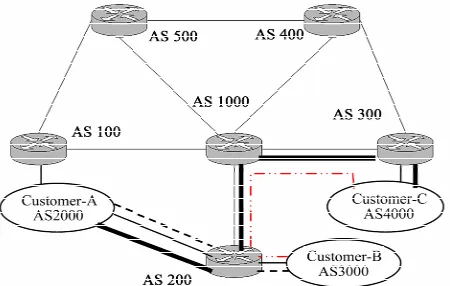
In order to validate our algorithm and functional models we performed a series of experiments and obtained vari-ous statistics from the simulation. The topology and the default routing paths between customers A, B and C are presented in Figure 4 below:
A-B , A-C and B-C
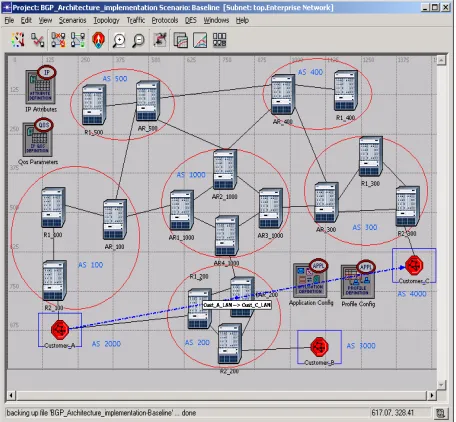
As presented in Figure 4, the network is created by configuring all default values into the devices and net-work reachability test is performed to ensure end-to-end connectivity between each AS domains in the network. Once these are performed, based on routing table entries, we performed our analysis on how BGP paths are re-corded between different AS domains without any policy but with its default routing decision process. The com-plete network diagram is presented in Figure 5 below which also presents end-to-end connectivity between all the domains.
[image:6.595.312.537.562.705.2]Our second scenario in Figure 6 demonstrates the ef-fect of our proposed policy mechanism compared with the base-line scenario in Figure 4. The end-to-end path between customers now have different routes as a result of policy enforcements across all the AS domains.
Figure 5. End-to-end network configuration.
Figure 6. End-to-end path using policy.
The results show effect of our proposed Community attribute for selecting specific QoS domains using BGP routing process between end nodes. Such a scheme not only balances traffic distribution across inter-domain links but also fine tunes traffic engineering for better provisioning of QoS between end domains. However, the scheme does increases complexity in BGP decision process due to extra information involving the commu-nity attribute.
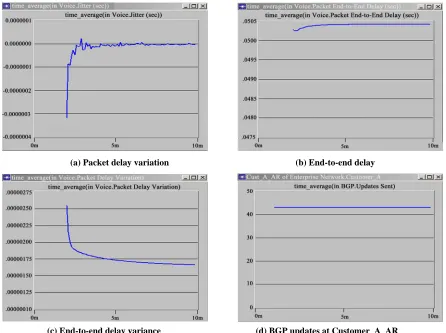
Traffic was generated from a G_711 interactive voice source with duration of 1 hour and several experiments were conducted to demonstrate the quality of voice traf-fic on an end-to-end basis. We assigned a DSCP value of B8 (EF=184) to the VoIP traffic which is then mapped to a BGP community value of 0x00640184 to ensure voice quality is maintained strictly between end domains. A series of graphs representing QoS parameters for VoIP applications are presented through Figure 7 (a-d).
While sending QoS aware applications in the Internet such as VoIP, we are mainly concerned about maintain-ing delay budget within the limit set for QoS assurance.
The plots in Figure 7 (a-d) represent Packet Delay Varia-tion (defined as jitter by OPNET), end-to-end delay, variance of the end-to-end delay and BGP updates, av-eraged over a 10 minute period for the scenario with policy routing enabled on all the routers running BGP. The actual VoIP traffic starts after 2 minutes and is de-liberately set to make sure that BGP timer values are taken into account.
In our experiment, plot (a) demonstrates the variation in packet end-to-end delay (PDV) and shows that it is kept to low bounds (-0.3 μs to +0.1 μs), in spite of acti-vating multiple QoS and routing policy configurations across the whole network. The PDV is influenced by packet scheduling and queuing strategy implemented across the routers (layer-1 functions) in order to support QoS within and across various domains. PDV is reported as the maximum absolute time difference between the instances when successive packets are received at the destination minus the time difference between the in-stances when these packets are sent at the source, aver-aged over 10 minutes, which is equivalent to the IETF definition assuming constant packet processing times at the destination.
The end to end delay for VoIP traffic is maintained at a value ≤ 50.4 ms (plot b), well within the SLA of 150 ms, while PDV converges to less than 0.1 μs (Plot a).
Plot c shows that the variance of the end-to-end delay falls to less than 1.75 μs after 5 min. This is confusingly defined as Packet Delay Variation (PDV) by OPNET, but we will use the IETF definition for PDV.
Plot d presents number of BGP updates. In our simula-tion the access router in Customer_A network (Cus-tomer_A_AR) is the one where most policies related to load balancing and traffic engineering are enforced. For this reason we collected the BGP updates sent by this router which contains either new routes or unfeasible routes or both in the system. In our case this access router sent 43 updates at 69 s due to strong policy en-forcement.
As shown above, voice traffic sent between Cus-tomer_A network and Customer_C network experienced QoS parameters well within our design limits. However these parameters could be further improved by carefully selecting other QoS strategies within individual domains.
7. Conclusions
(a) Packet delay variation (b) End-to-end delay
(c) End-to-end delay variance (d) BGP updates at Customer_A_AR
Figure 7 (a-d) VoIP QoS measurement.
This is substantially different from the default routing which does not select the AS domains based on QoS requirements for an application. Such results are evi-dence that our scheme improves end-to-end QoS re-quirements for high priority voice traffic particularly when many other applications are running simultane-ously in the Internet.
The objective of our design is how BGP can be used to select QoS domains for QoS support. For this reason we are mainly concerned with AS domain traffic behavior contributing to policy routing and traffic engineering.
8. References
[1] P. Nanda and A. J. Simmonds, “Policy based QoS sup-port using BGP routing,” International Conference on Communications in Computing, CIC’06, Las Vegas, Ne-vada, USA, CSREA Press, ISBN 1–60132–012 –4, pp. 63–69, June 26–29, 2006.
[2] B. Teitelbaum, “QBone bandwidth brokerarchitecture,” [Online]Available:http://qbone.internet2.edu/bb/bboutline 2.html.
[3] K. Nichols, V. Jacobson, and L. Zhang: “A two-bit dif-ferentiated services architecture for the internet,” IETF
RFC 2638, July 1999.
[4] ITU–T Recommendation G.114, One way transmission time, 1996.
[5] A. D. Yahaya and T. Suda, “iREX: Inter–domain QoS automation using economics,” IEEE Consumer Commu-nications and Networking Conference, CCNC’06, USA, January 2006.
[6] N. Feamster, J. Winick, and J. Rexford, “A model of BGP routing for network engineering,” SIGMETRICS/ Performance’04, New York, USA, June 12–16, 2004. [7] D. O. Awduche, A. Chiu, A. Elqalid, I Widjaja, and X.
Xiao, “A framework for internet traffic engineering,” Draft 2, IETF, 2002.
[8] B. Quoitin, S. Uhlig, C. Pelsser, L. Swinnen, and O. Bonaventure, “Internet traffic engineering with BGP,” Quality of Future Internet Services, Springer, 2003. [9] G. Di Battista, M. Patrignani, and M. Pizzonia,
“Com-puting the types of relationships between autonomous systems,” IEEE INFOCOM, 2003.
[10] Y. Rekhter and T. Li, “A border gateway protocol 4 (BGP-4),” Internet draft, draft-ietf-idr-bgp4-17.txt, work in progress, January 2002.
[image:8.595.75.521.76.409.2]engineer-ing,” Int’l. J. Network Mgmt, 2005.
[12] R. Yavatkar, D. Pendarakis, and R. Guerin, “A frame-work for policy-based admission control,” RFC 2753, January 2000.
[13] S. Salsano, “COPS usage for Diffserv resource allocation (COPS-DRA),” Internet Draft, October 2001.
[14] P. Nanda and A. Simmonds, “Providing end-to-end guar-anteed quality of service over the Internet: A survey on bandwidth broker architecture for differentiated services network,” CIT’01, 4th International Conference on IT, Berhampur, India, pp.211–216, 20–23 December 2001. [15] K. Nichols, S. Blake, F. Baker, and D. Black, “Definition
of the differentiated services field (DS Field) in the IPv4 and IPv6 headers,” IETF RFC 2474, Dec. 1998.
[16] J. Heinanen, F. Baker, W. Weiss, and J. Wroclawski, “Assured forwarding PHB group,” IETF RFC 2597, June 1999.
[17] B. Davie, et al., “An expedited forwarding PHB (per-hop
behavior),” IETF RFC 3246, March 2002.
[18] P. Pan, E, Hahne, and H. Schulzrinne, “BGRP: Sink- tree-based aggregation for inter-domain reservations,” Journal of Communications and Networks, Vol. 2, No. 2, pp. 157–167, June 2000.