Choice Optimisation Problems
by
Uwe Aickelin
(Dipl Kfm, EMBSc)
School of Computer Science University of Nottingham
NG8 1BB UK [email protected]
Thesis submitted to the University of Wales
In candidature for the
Degree of Doctor of Philosophy
European Business Management School
University of Wales Swansea
This work has not previously been accepted in substance for any degree and is not
concurrently being submitted in candidature for any degree.
Signed ………. (Candidate)
Date ……….
Statement 1
This thesis is the result of my own investigations, except where otherwise stated. Other
sources are acknowledged by endnotes giving explicit reference. A bibliography is
appended.
Signed ………. (Candidate)
Date ……….
Statement 2
I hereby give consent for my thesis, if accepted, to be available for photocopying and
for inter-library loan, and for the title and summary to be made available to outside
organisations.
Signed ………. (Candidate)
Everybody has someone or something to thank for their success. Primarily I want to
use this opportunity to thank my supervisor Dr Kathryn Dowsland for her guidance and
support throughout my work. No doubt without the many of our discussions both this
thesis and my research would not have been possible. Additionally, I am very grateful
for the advice and support of Dr Bill Dowsland, the computer support staff and other
people of the European Business Management School. Furthermore, special thanks go
to Dr Jonathan Thompson for his early work on the nurse scheduling problem. I would
also like to thank my family who in their own ways always supported me. Finally,
thank you to Sonya for motivation, support and distraction at the appropriate times over
1 INTRODUCTION...1
1.1 THE NATURE OF THE PROBLEM...1
1.2 THE SOLUTION METHOD AND RESULTS...2
1.3 THE STRUCTURE OF THE THESIS...4
2 INTRODUCTION TO NURSE SCHEDULING...6
2.1 PROBLEM FORMULATION...6
2.2 INTRODUCTION TO NURSE SCHEDULING...14
2.3 CYCLIC NURSE SCHEDULING...15
2.4 LINEAR,INTEGER,CONSTRAINT AND GOAL PROGRAMMING...16
2.5 HEURISTIC SCHEDULING...19
2.6 META-HEURISTIC SCHEDULING...20
2.7 CONCLUSIONS...23
3 GENETIC ALGORITHMS FOR CONSTRAINED OPTIMISATION...25
3.1 GENETIC ALGORITHM INTRODUCTION...25
3.2 CONSTRAINED OPTIMISATION WITH GENETIC ALGORITHMS...28
3.3 IMPLEMENTING CONSTRAINTS INTO THE ENCODING...29
3.4 PENALTY FUNCTIONS...30
3.5 REPAIR...33
3.6 SPECIAL OPERATORS...36
3.7 DECODERS...37
3.8 MISCELLANEOUS METHODS...42
3.9 CONCLUSIONS...46
4 A DIRECT GENETIC ALGORITHM APPROACH FOR NURSE SCHEDULING ...47
4.1 ENCODING OF THE PROBLEM...47
4.2 DESCRIPTION OF EXPERIMENTS...52
4.4 DYNAMIC PENALTY WEIGHTS...68
4.5 CONCLUSIONS...73
5 AN ENHANCED DIRECT GENETIC ALGORITHM APPROACH FOR NURSE SCHEDULING ...75
5.1 EPISTASIS OR WHY HAS THE GENETIC ALGORITHM FAILED SO FAR? ...75
5.2 CO-OPERATIVE CO-EVOLUTION...78
5.3 SWAPS AND DELTA CODING...87
5.4 HILL-CLIMBER,REPAIR AND INCENTIVES...94
5.5 CONCLUSIONS...100
6 AN INDIRECT GENETIC ALGORITHM APPROACH FOR NURSE SCHEDULING ...103
6.1 WHAT IS AN ‘INDIRECT’APPROACH? ...103
6.2 PERMUTATION CROSSOVER AND MUTATION...105
6.3 THE DECODER FUNCTION...110
6.4 PARAMETER TESTING...119
6.5 DECODER ENHANCEMENTS...126
6.6 EXTENSIONS OF THE NURSE SCHEDULING PROBLEM...135
6.7 CONCLUSIONS...140
7 THE MALL LAYOUT AND TENANT SELECTION PROBLEM ...142
7.1 INTRODUCTION TO THE PROBLEM...142
7.2 SIMPLE DIRECT GENETIC ALGORITHM APPROACH...154
7.3 ENHANCED DIRECT GENETIC ALGORITHM APPROACH...164
7.4 INDIRECT GENETIC ALGORITHM APPROACH...173
7.5 FURTHER DECODER ENHANCEMENTS...179
7.6 NURSE SCHEDULING REVISITED...186
7.7 CONCLUSIONS...187
8 CONCLUSIONS AND FUTURE RESEARCH ...190
8.1 CONCLUSIONS...190
8.2 FUTURE RESEARCH...194
APPENDIX A GENETIC ALGORITHM TUTORIAL...209
APPENDIX B SUMMARY OF DIPLOM THESIS...222
APPENDIX C NURSE SCHEDULING DATA ...225
APPENDIX D ADDITIONAL NURSE SCHEDULING RESULTS...232
APPENDIX E MALL PROBLEM DATA ...242
FIGURE 4-1:POPULATION SIZE VERSUS AVERAGE AND BEST SOLUTION COST. ...57
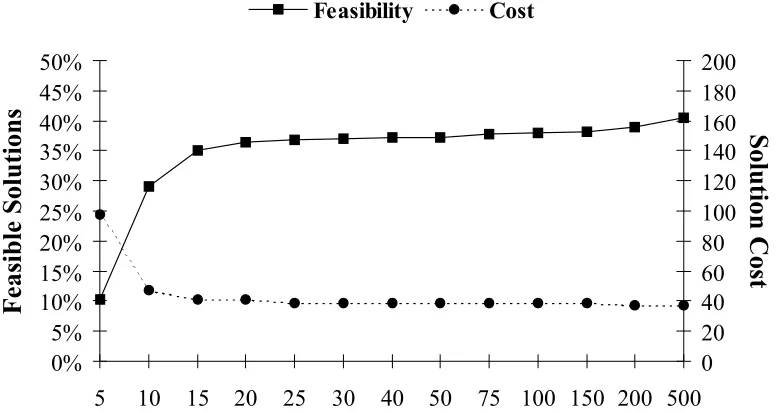
FIGURE 4-2:POPULATION SIZE VERSUS FEASIBILITY AND SOLUTION COST. ...58
FIGURE 4-3:POPULATION SIZE VERSUS SOLUTION TIME. ...58
FIGURE 4-4:PENALTY WEIGHT VERSUS FEASIBILITY AND SOLUTION COST...59
FIGURE 4-5:PERFORMANCE OF DIFFERENT TYPES OF CROSSOVER STRATEGIES...62
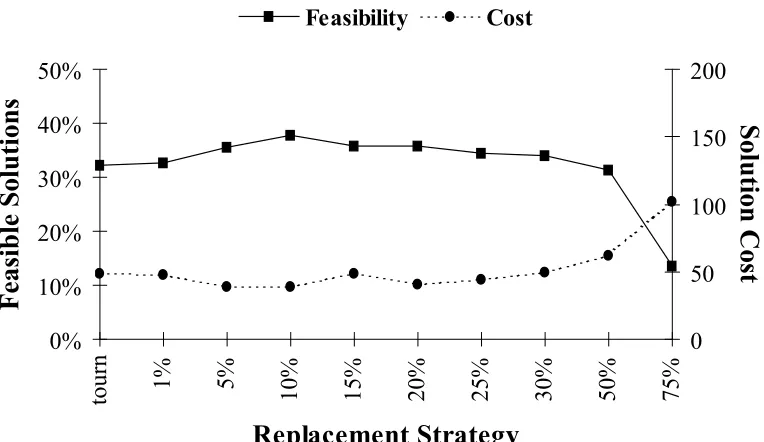
FIGURE 4-6:VARYING THE MUTATION RATE VERSUS FEASIBILITY AND SOLUTION COST. .63 FIGURE 4-7:COMPARISON OF DIFFERENT REPLACEMENT STRATEGIES. ...65
FIGURE 4-8:STOPPING CRITERIA VERSUS FEASIBILITY AND SOLUTION COST...66
FIGURE 4-9:STOPPING CRITERIA VERSUS SOLUTION TIME...67
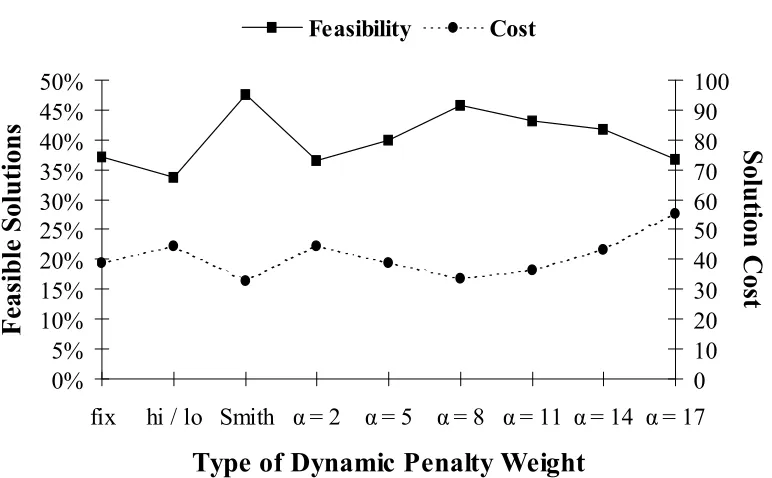
FIGURE 4-10:COMPARISON OF VARIOUS TYPES OF DYNAMIC PENALTY WEIGHT STRATEGIES...72
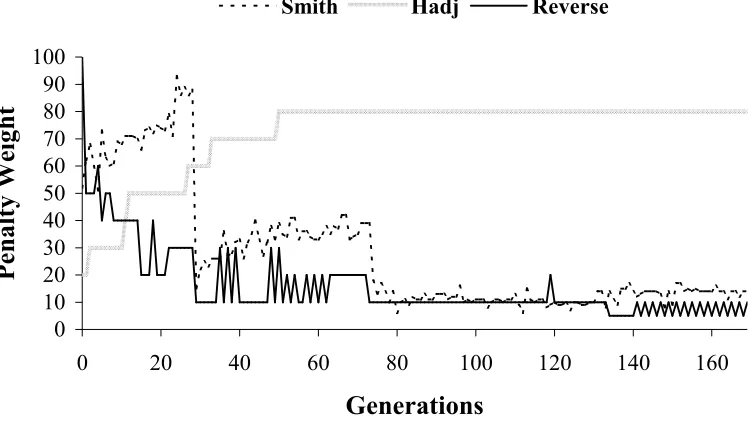
FIGURE 4-11:DEVELOPMENT OF DYNAMIC PENALTY WEIGHTS UNDER THREE STRATEGIES. ...73
FIGURE 4-12:. COMPARISON OF SIMPLE DIRECT GENETIC ALGORITHMS WITH TABU SEARCH FOR NURSE SCHEDULING. ...74
FIGURE 5-1:COMPARISON OF DIFFERENT MIGRATION TYPES WITH NO MIGRATION AND NO SUB-POPULATIONS...87
FIGURE 5-2:RESULTS FOR VARIOUS TYPES OF SWAPPING. ...90
FIGURE 5-3:COMPARISON OF SOLUTION QUALITY FOR VARIOUS DELTA CODING PROBABILITIES. ...93
FIGURE 5-4:DIFFERENT INCENTIVES (I), INCENTIVES AND REPAIR (R) AND DISINCENTIVES (D)...98
FIGURE 5-5:VARIOUS LOCAL HILLCLIMBING STRATEGIES. ...99
FIGURE 5-6: COMPARISON OF NURSE SCHEDULING RESULTS FOR VARIOUS DIRECT GENETIC ALGORITHM APPROACHES AND TABU SEARCH...102
FIGURE 6-1:EXAMPLE OF ORDER BASED CROSSOVER. ...106
FIGURE 6-2:EXAMPLE OF PARTIALLY MAPPED CROSSOVER (PMX). ...108
FIGURE 6-3:EXAMPLE OF ORDER BASED UNIFORM CROSSOVER. ...108
FIGURE 6-5:CROSSOVER OPERATORS AND OTHER VARIATIONS FOR THE OVERALL
CONTRIBUTION DECODER. ...123
FIGURE 6-6:WEIGHT RATIOS FOR THE OVERALL CONTRIBUTION DECODER...124
FIGURE 6-7:DIFFERENT SHIFT PATTERN ORDERINGS FOR THE OVERALL CONTRIBUTION DECODER...126
FIGURE 6-8:COMBINED DECODER WITH DIFFERENT PREFERENCE WEIGHTS. ...128
FIGURE 6-9:DIFFERENT TYPES OF CROSSOVER AND MUTATION. ...130
FIGURE 6-10:EXAMPLE OF CROSSOVER AND MUTATION BEFORE A BOUNDARY POINT. ..132
FIGURE 6-11:DIFFERENT WAYS OF USING BOUNDS. ...134
FIGURE 6-12:RESULTS OF THE EXTENDED NURSE SCHEDULING PROBLEM. ...138
FIGURE 6-13:. COMPARISON OF RESULTS FOR DIFFERENT DATA SETS BETWEEN THE DIRECT AND INDIRECT GENETIC ALGORITHM, TABU SEARCH AND XPRESSMP...140
FIGURE 6-14:COMPARISON OF GENETIC ALGORITHM APPROACHES WITH TABU SEARCH. ...141
FIGURE 7-1:FLOOR PLAN OF THE CRIBBS CAUSEWAY MALL NEAR BRISTOL...143
FIGURE 7-2:POPULATION SIZE VERSUS FEASIBILITY AND RENT. ...159
FIGURE 7-3:POPULATION SIZE VERSUS AVERAGE SOLUTION TIME. ...160
FIGURE 7-4:STOPPING CRITERIA VERSUS FEASIBILITY AND RENT. ...160
FIGURE 7-5:STOPPING CRITERIA VERSUS AVERAGE SOLUTION TIME...161
FIGURE 7-6:PENALTY WEIGHT VERSUS RENT AND FEASIBILITY. ...162
FIGURE 7-7:SINGLE BIT MUTATION PROBABILITY VERSUS FEASIBILITY AND RENT. ...163
FIGURE 7-8:CROSSOVER OPERATORS VERSUS RENT AND FEASIBILITY...164
FIGURE 7-9:COMPARISON OF VARIOUS TYPES OF DIRECT GENETIC ALGORITHMS. ...168
FIGURE 7-10:... VARIOUS INDIRECT GENETIC ALGORITHMS COMPARED WITH THE DIRECT APPROACH. ...179
FIGURE 7-11:FINAL AVERAGE WEIGHTS FOR TWO INITIALISATION RANGES AND DIFFERENT DATA SETS...182
FIGURE 7-12:DIFFERENT CROSSOVER STRATEGIES FOR THE INDIRECT GENETIC ALGORITHM...184
FIGURE 7-13:CROSSOVER RATES FOR ADAPTIVE CROSSOVER AND A ‘RELAXED’ FILE. ..185
FIGURE 7-15:CROSSOVER RATES FOR ADAPTIVE CROSSOVER AND A ‘TIGHT’ FILE...185
FIGURE 7-16:... VARIATIONS OF THE DECODER WEIGHTS AND CROSSOVER STRATEGIES FOR THE INDIRECT GENETIC ALGORITHM SOLVING THE NURSE SCHEDULING PROBLEM. 187 FIGURE 7-17:VARIOUS GENETIC ALGORITHMS FOR THE MALL PROBLEM...189
FIGURE I:ROULETTE WHEEL FOR FIVE INDIVIDUALS. ...213
FIGURE II:SCHEMATIC FOUR-POINT CROSSOVER. ...215
FIGURE III:EXAMPLE OF ONE-POINT CROSSOVER GOING WRONG FOR PERMUTATION ENCODED PROBLEMS. ...215
FIGURE IV:EXAMPLE OF C1 ORDER BASED CROSSOVER. ...216
FIGURE V:TYPICAL GENETIC ALGORITHM RUNS WITH VARIOUS STRATEGIES. ...232
FIGURE VI: COMPARISON OF AVERAGE SOLUTION COST FOR VARIOUS TYPES OF GENETIC ALGORITHMS AND A TYPICAL DATA SET. ...233
FIGURE VII: COMPARISON OF BEST FEASIBLE SOLUTION COST FOR VARIOUS TYPES OF GENETIC ALGORITHMS AND A TYPICAL DATA SET...234
FIGURE VIII:DETAILED RESULTS FOR BASIC GENETIC ALGORITHM. ...236
FIGURE IX: DETAILED RESULTS FOR A GENETIC ALGORITHM WITH DYNAMIC WEIGHTS AND OPTIMISED PARAMETERS...237
FIGURE X:DETAILED RESULTS FOR A CO-OPERATIVE CO-EVOLUTIONARY APPROACH. ..237
FIGURE XI: DETAILED RESULTS FOR A CO-OPERATIVE CO-EVOLUTIONARY APPROACH WITH REPAIR AND INCENTIVES. ...238
FIGURE XII:DETAILED RESULTS FOR AN INDIRECT GENETIC ALGORITHM WITH FIXED DECODER WEIGHTS...238
FIGURE XIII: .. DETAILED RESULTS FOR AN INDIRECT GENETIC ALGORITHM WITH DYNAMIC CROSSOVER RATES AND DECODER WEIGHTS. ...239
FIGURE XIV:QUADRATIC PENALTY WEIGHTS...240
FIGURE XV:MIGRATION OF FIVE BEST INDIVIDUALS OF EACH SUB-POPULATION...241
FIGURE XVI:RANDOM MIGRATION BETWEEN SUB-POPULATIONS...241
TABLE 4-1:INITIAL PARAMETER SETTINGS FOR THE DIRECT GENETIC ALGORITHM. ...54
TABLE 4-2:FINAL PARAMETER VALUES AND STRATEGIES FOR THE DIRECT GENETIC ALGORITHM...68
TABLE 5-1:EXAMPLES OF BALANCED, UNBALANCED AND UNDECIDED SOLUTIONS. ...95
TABLE 6-1: PARAMETERS AND STRATEGIES USED FOR THE INDIRECT GENETIC ALGORITHM AND NURSE SCHEDULING...120
TABLE 7-1:SPECIFICATIONS OF MALL PROBLEM DATA SETS. ...152
TABLE 7-2:INITIAL PARAMETERS AND STRATEGIES OF THE DIRECT GENETIC ALGORITHM. ...157
TABLE 7-3:PARAMETERS USED FOR THE INDIRECT GENETIC ALGORITHM. ...175
TABLE 7-4:THREE TYPES OF WEIGHT SETTINGS FOR THE MALL PROBLEM DECODER...178
TABLE I:EXAMPLE OF A WEEK’S DEMAND FOR NURSES. ...225
TABLE II:EXAMPLE OF NURSES’ GENERAL PREFERENCES AND QUALIFICATIONS. ...226
TABLE III:EXAMPLE OF NURSES’ WEEKLY PREFERENCES. ...227
TABLE IV:LIST OF ALL POSSIBLE SHIFT PATTERNS. ...230
TABLE V:EXAMPLES OF FINAL SHIFT PATTERN COST VALUES...231
TABLE VI:FULL GENETIC ALGORITHM, TABU SEARCH AND INTEGER PROGRAMMING RESULTS FOR ALL DATA SETS. ...235
TABLE VII:PROBLEM SIZE. ...242
TABLE VIII:LOCATION DISTRIBUTION...242
TABLE IX:GROUP MEMBERSHIP OF SHOP TYPES. ...242
TABLE X:LIMITS ON THE NUMBER OF SHOPS OF ONE SIZE...243
TABLE XI:EFFICIENCY FACTOR VERSUS SHOP COUNT...243
TABLE XII:ATTRACTIVENESS OF AREAS...243
TABLE XIII:LIMITS ON THE NUMBER OF SHOPS OF ONE TYPE. ...243
TABLE XIV:FIXED SHOP TYPE AND AREA RENT...244
TABLE XV:GROUP BONUS FACTORS...244
Multiple-choice problems come in many varieties: Choosing one’s lottery numbers,
deciding what to wear in the morning or assigning which shift pattern a nurse should
work. What all these problems have in common is that for each decision, be it a lottery
number, piece of clothing or a worker, there is only one object we can assign to it.
Hence, these are known as multiple-choice problems. Also, there are usually a number
of hard and soft constraints of different importance guiding our decisions. For instance,
it is only allowed to choose a particular lottery number once (hard constraint) or one
would like to wear clothes that match each other (soft constraint). This thesis uses
genetic algorithms to optimise multiple-choice problems, with the emphasis on
balancing those soft and hard constraints.
In this research, we will concentrate on two multiple-choice problems with covering
constraints. The research was motivated by the first problem to be tackled, which is to
find work schedules for nurses in a major UK hospital. The hospital operates 24 hours
per day using three shifts and nurses are graded into three bands. The required
schedules have to be calculated weekly and must consider various hard and soft
constraints. For instance, schedules must be perceived fair by staff and thus the
preferences of nurses, their past working history and other objectives have to be taken
into consideration. Furthermore, for each grade band and shift, strict covering
requirements are set which must be met.
This problem was chosen for a variety of reasons. It is a linear problem but difficult to
solve due to the multiple-choice component. Thus, although computationally
expensive, optimal solutions can be obtained for a comparison of results. Furthermore,
some insight into the problem structure existed from the tabu search approach reported
in Dowsland [55]. Additionally, the existence of a large number of real-life data sets
optimal solutions but to develop and compare new methods of handling constraints,
which can then be applied to more complex problems.
After developing suitable solution methods for this problem, we turn our attention to
mall layout and tenant selection. Although the problem and data in this case are
artificial, it is modelled closely after similar problems in real-life. This problem was
chosen as it is similar to yet more complex than the nurse scheduling problem. In
particular, the objective is non-linear. The aim is to place shops into locations of the
mall such that the overall revenue is maximised. This in turn maximises the rent
generated by the shops, the actual objective, as it is largely proportional to the revenue.
Constraints that have to be taken into account include upper and lower bounds on the
number of shops of one type and restrictions on the number of shops of a certain size
class. Soft constraints include some shops creating more revenue in certain areas of the
mall, synergy effects between similar shops and efficiency savings of larger shops.
1.2
The Solution Method and Results
The methods chosen to solve these multiple-choice problems are genetic algorithms.
They are inspired by evolution in nature and have the ‘survival of the fittest’ idea at
their heart. In contrast to other solution methods, they work with a population of
solutions in parallel and use stochastic crossover and mutation operators similar to those
found in nature. Recently, a lot of interest has been shown in using genetic algorithms
to solve real-life problems because of their flexibility and robustness. However,
canonical genetic algorithms are not function optimisers and in particular, there is no
explicit or generic way to include constraints. Thus, the purpose of this research is to
add to the knowledge in the area of constraint handling in a genetic algorithm
In a pilot study to this thesis (Aickelin [4]), it was shown that the nurse scheduling
example is both a difficult and interesting problem to apply genetic algorithms to.
Results for a very limited number of data sets were promising, although the main
stumbling block was as anticipated the constraints. It was concluded that once this was
overcome, the genetic algorithm would provide a robust and flexible solution method
for this problem. One of the first tasks of this research was to investigate if the results
found during the pilot study carry over for the much more extensive real-life data sets.
For further details of the pilot study, see the full summary, which is contained in
Appendix B.
Since the nurse scheduling problem is linear, optimal solutions for all data files are
known. This allows for a thorough comparison of the results of our various genetic
algorithm approaches. Additionally, Dowsland [55] solved the same problem with tabu
search. Both methods will be compared in terms of solution quality, robustness and
ease of including possible future expansions of the problem. Once successful genetic
algorithms are established, they are tested on the non-linear mall layout problem. This
allows for more general conclusions to be drawn about the suitability of our ideas for
other scheduling and related problems.
Due to the nature of genetic algorithms, the focus of this thesis is on finding suitable
ways of striking a balance between the soft and hard constraints of the problem. Our
task is to find the best possible solution in terms of the soft constraints without violating
any of the hard constraints. Over the years, many ways of doing this within a genetic
algorithm framework have been suggested: Penalty functions, repair algorithms, special
genetic operators and decoders to name but a few. A comprehensive literature review
of these methods is provided.
In the course of the research, many of these traditional methods are applied to the nurse
scheduling and mall layout problems. In particular, two avenues of research are
followed: Direct genetic algorithms, which solve the actual problem themselves and
indirect genetic algorithms, which solve the problem in combination with external
approach is in fact shown to be less complex. This is because it lends itself better to the
inclusion of problem-specific knowledge, which is the key to overcoming the problems,
caused by the constraints.
1.3
The Structure of the Thesis
An introduction to genetic algorithms, their operators and the theory behind this type of
meta-heuristic can be found in Appendix A. A summary of the pilot study for the nurse
scheduling problem, assessing its difficulty and suitability to the proposed optimisation
approach, is given in Appendix B. The rest of this work is structured in the following
way.
Chapter 2 introduces the nurse scheduling problem in hand and a corresponding integer
program is set up. The remainder of the chapter looks at various solution methods to
nurse scheduling problems, with particular emphasis on linear programming and
meta-heuristic approaches. The chapter concludes that the approaches described in the
literature are not sufficient to solve the problem.
An overview of current genetic algorithm literature is given in chapter 3. The emphasis
of the chapter is on the treatment of constraints, as the pilot study found that the issue of
implementing constraints into a genetic algorithm framework is the most critical area of
the research. A detailed review of various methods, including penalty functions, repair,
decoders, special operators and others is given.
Chapter 4 details the encoding of our problem and presents the standard direct genetic
algorithm approach. After experimenting with various parameter and strategy settings,
the best values are retained. Then the first enhancement of the direct approach is
population. The chapter concludes with a summary of results and reasons for failure of
the methods used so far.
After discussing the issue of epistasis and its relevance to our research, chapter 5
presents co-operative and hierarchical sub-populations in an attempt to overcome the
problems encountered. Together with a special crossover operator and migration
between the sub-populations, this method is shown to be very effective at solving the
nurse scheduling problem. To improve upon the results, various further enhancements,
namely delta coding, swaps and a local hillclimber, are introduced next. The chapter
ends with a comparison of all direct genetic algorithm approaches used so far.
Chapter 6 is concerned with the indirect approach to the problem. After explaining the
idea of an indirect genetic algorithm, permutation based genetic operators, made
necessary by this type of genetic algorithm, are introduced. Then, some possible
decoders are detailed and shortened parameter tests are performed. Further
enhancements of the decoders and a new crossover operator are presented. Finally, the
original nurse scheduling problem is extended and it is shown that genetic algorithms
are flexible and robust enough to deal with this. The chapter concludes with a summary
and comparison of all nurse scheduling results.
To validate the results found so far, all previous methods are applied to the mall layout
problem in chapter 7. The superiority of the indirect over the direct approach is
confirmed and possible problems with the co-operative co-evolutionary approach are
discovered. Further enhancements of the indirect genetic algorithm are presented,
which after proving to be successful, are applied to the nurse scheduling problem as
well. A final comparison of results concludes the chapter.
The final chapter of this thesis summarises the findings of this project and makes
various recommendations as to the best way of solving multiple-choice problems with
genetic algorithms. This work is then put into the context of more general scheduling
2.1.1
General Introduction
This chapter gives details of the nurse scheduling problem tackled in this research and
presents an equivalent integer programming formulation. Following on from this, the
many ways in which similar problems have been solved by other researchers are
reviewed. A wide array of different methods has been proposed, all with their own
strengths and weaknesses. However, due to the nature of nurse scheduling problems,
most approaches described rely heavily on the particular problem structure, making
their use for our problem impossible.
Our task is to create weekly schedules for wards of up to 30 nurses at a major UK
hospital. These schedules have to satisfy working contracts and meet the demand for a
given number of nurses of different grades on each shift, while seen to be fair by the
staff concerned. The latter objective is achieved by meeting as many of the nurses’
requests as possible and considering historical information to ensure that unsatisfied
requests and unpopular shifts are evenly distributed. This will be further detailed in
section 2.1.3. For additional details, refer to Dowsland [55] and for example data to
Appendix C.
For scheduling purposes, the day at the hospital is partitioned into three shifts: Two day
shifts known as ‘earlies’ and ‘lates’, and a longer night shift. Note that until the final
scheduling stage, ‘earlies’ and ‘lates’ are merged into day shifts. Due to hospital policy,
a nurse would normally work either days or nights in a given week, and because of the
difference in shift length, a full week’s work would normally include more days than
nights. For example, a full time nurse works five days or four nights, whereas typical
part time contracts are for four days or three nights, three days or three nights and three
days or two nights. However, exceptions are possible and some nurses specifically
As described in Dowsland [55] the problem can be decomposed into the three
independent stages set out below. This thesis deals with the highly constrained second
step.
1. Ensuring via a knapsack model that enough nurses are on the ward to cover the
demand, otherwise introducing dummy and / or bank nurses to even out the cover.
2. Scheduling the days and nights on and off for a nurse.
3. Splitting the day shifts into early and late shifts using a network flow model.
2.1.2
The Three Solution Steps
In the following chapters, the nurse scheduling problem is often referred to as being
particularly ‘tight’. In order to understand this ‘tightness’ of the problem, one has to
know that all data is pre-processed by a knapsack routine to smooth out over- and
under-staffing. A knapsack is necessary due to the day / night shift imbalance, i.e.
nurses usually working more day shifts than night shifts. Hence, the knapsack
determines the maximum number of day shifts available subject to the night shifts being
covered. The consequence of this is that there is no slackness in most of the covering
constraints.
More precisely, the hospital requested that if any over-cover occurred it should be
spread out over day shifts only such that weekdays are covered first and weekends last.
To achieve this, additional dummy nurses are introduced who work as follows:
Weekend dummies can only work day patterns not including any weekdays. Weekday
dummies can only work day patterns not including any weekend days. They work as
many shifts as necessary to complement the over-cover to five days.
An example of the knapsack’s operation is as follows. Assume that there are 10 nurses
that the knapsack has found that 15 full time nurses are available to work days with the
remaining nurse required on nights. Since each full time nurse works five shifts, this
gives a total of 75 nurse shifts available on days. So overall, there is a surplus of five
nurse shifts. As the hospital requires the overstaffing to be spread over non-weekend
days first, the demand for Monday to Friday is raised by one shift each. This eliminates
the surplus and the knapsack routine is finished.
Now assume that one of the 15 nurses would only work four shifts in this week due to a
day off work. As before the demand for Monday to Friday will be increased by one
shift. In this case, this leads to an artificial ‘shortage’ of one shift. This is met with the
introduction of a weekday dummy nurse who works one day shift. Again the overcover
is smoothed out and the knapsack routine is finished. Situations with other
combinations of over- and under-staffing are met in a similar way. The following list
describes all possibilities grouped by the amount of over staffing, where a ‘unit’ refers
to one single nurse shift:
• More than seven units: The demand is raised by one for all seven days until the
over-staffing is by seven units or less.
• Seven units: The demand is raised by one for all seven days.
• Six units: The demand is increased by one for all seven days and additionally a
weekend dummy nurse is introduced.
• Five units: The demand is raised by one unit for weekdays only.
• Less than five units: The demand is raised by one unit for weekdays only and
additionally a weekday dummy nurse is introduced.
• If the knapsack determines that there are not enough nurses to cover the demand,
then as many bank nurses as necessary are introduced. Bank nurses can only work
one day shift each.
As ‘earlies’ and ‘lates’ are not yet merged at this stage, the second step of the problem
can be modelled as follows. Each possible shift pattern worked by a given nurse can be
represented as a zero-one vector with 14 elements, where the first seven elements
the vector denotes a scheduled day or night on and a 0 a day or night off. These vectors
will be referred to as shift patterns and examples can be found in appendix C.4.
Depending on the working hours of a nurse there are a limited number of shift patterns
available to her or him. For instance, a full time nurse working either 5 days or 4 nights
has a total of 21 (i.e. 5
7 ) feasible day shift patterns and 35 (i.e. 4
7 ) feasible night shift
patterns. Typically, a nurse has around 40 possible shift patterns available to her / him.
Other data dimensions are between 20 and 30 nurses per ward, three grade-bands, nine
part time options and 411 different shift patterns.
The third step, the network flow algorithm, is of little interest to us. It splits the day
shifts into early and late shifts. The algorithm is always exact and takes little time to
find an optimal solution. Again, more details can be found in Dowsland [55].
2.1.3
Setting Up of the Nurse Shift Pattern Cost p
ijBefore setting up this problem, the cost pij of nurse i working shift pattern j has to be determined. This is done in the following way after close consultation with the hospital.
For each nurse, the number of day and night shifts she must work is given. Each of
these shift patterns is then assigned a ‘cost’ pij according to their suitability. For sample data of these costs and the factors that contribute to them, refer to Appendix C. More
precisely, the cost of a shift pattern is the sum of the following factors:
(1) Each shift pattern has been given a basic cost between one (no problems with
pattern) and four (very unattractive). This cost generally depends on whether the
pattern means that a nurse will have her days off together or separate. Note that
some patterns in which a nurse will work both days and nights are given a cost of
18. This cost is imposed if the shift pattern means that a nurse will work some night
(2) Nurses may prefer to work days or they may prefer to work nights. A nurse may be
classified as one of the following, depending on her or his contract and general
preferences:
• Days Only – in which case night shifts are not considered.
• Nights Only – in which case day shifts are not considered.
• Days Important – a cost of 12 is added to all night shifts.
• Nights Important – a cost of 12 is added to all day shifts.
• Days Preferred – a cost of 3 is added to all night shifts.
• Nights Preferred – a cost of 3 is added to all day shifts.
(3) A nurse may request not to work certain shifts and all shift patterns, which do not
satisfy these requests, are given a cost. Thus, if a shift pattern means that n requests are not satisfied, n costs are added. These requests are graded from one (relatively unimportant) to five (binding). Note that if a nurse requests not to work an early but
does not mind working a late, no cost is imposed as the nurse can be allocated a late
shift in the subsequent network flow phase. Likewise, for a nurse who requests not
to work a late but does not mind working an early. The costs added are:
• Grade 1 request – 3
• Grade 2 request – 8
• Grade 3 request – 12
• Grade 4 request – 18
• Grade 5 request – 90
(4) Nurses should not work more than seven days in a row. The cost added is equal to
the number of days above seven that they would have to work in a row.
(5) The shift pattern costs do not include continuity problems with previous schedules.
Thus, if the pattern a nurse worked last week finished 01, i.e. day off, day on; then
any shift pattern which begins with a day off is penalised by three. Likewise, a cost
of three is added if a nurse finished last week working 0 and starts this week
(6) Nights must be rotated: If a nurse worked nights last week, all night shift patterns
for this week have an additional cost of ten. If a nurse has worked nights the week
before, a cost of five is added.
(7) To rotate weekend work the following cost is added. If a nurse worked Saturday
and Sunday last week, a cost of one is added to each pattern that involves working
Saturday or Sunday this week.
(8) Before the problem is solved, one is deducted from the cost of each shift pattern for
each nurse. Thus, perfect shift patterns have a cost of zero. However, if the cost of
a shift pattern is above 89, it is set to 100. Costs for dummy and bank nurses are
always set to zero.
(9) Finally, the working history of a nurse is taken into account. If a nurse had a cost
for the shift pattern that she worked last week, then this is added to all non-zero cost
shift patterns (but not above 100).
2.1.4
Integer Programming Formulation
The problem can now be formulated as an integer linear program as follows.
Indices:
i = 1...n nurse index.
j = 1...m shift pattern index.
k = 1...14 day and night index (1...7 are days and 8...14 are nights).
Decision variables: = else 0 pattern shift works nurse
1 i j
xij
Parameter:
n = number of nurses.
m = number of shift patterns.
p = number of grades.
= else 0 night day / covers pattern shift
1 j k
ajk = else 0 higher or grade of is nurse
1 i s
qis
pij = Penalty cost of nurse i working shift pattern j.
F(i) = Set of feasible shift patterns for nurse i.
Ni = Working shifts per week of nurse i if night shifts are worked.
Di = Working shifts per week of nurse i if day shifts are worked.
Bi = Working shifts per week of nurse i if both day and night shifts are worked.
Rks = Demand of nurses with grade s on day respectively night k.
Target function:
! min
1 ()
Subject to:
1. Every nurse works exactly one shift pattern:
i x
i F j
ij = ∀
∑
∈ 1 ) ( (1)2. The shift pattern corresponds to the number of weekly working shifts of the nurse:
i shifts combined j B a or shifts night j N a or shifts day j D a i F i k jk i k jk i k jk ∀ ∈ ∀ = ∈ ∀ = ∈ ∀ = =
∑
∑
∑
= = = 14 1 14 8 7 1 )( (2)
3. The demand for nurses is fulfilled for every grade on every day and night:
s k R x a q ks i F j n i ij jk is , ) ( 1 ∀ ≥
∑ ∑
∈ = (3)Constraint sets (1) and (2) ensure that every nurse works exactly one shift pattern from
her feasible set, and constraint set (3) ensures that the demand for nurses is covered for
every grade on every day and night. Note that the definition of qis is such that higher graded nurses can substitute those at lower grades if necessary. This problem can be
regarded as a multiple-choice covering problem. The sets are given by the shift pattern
vectors and the objective is to minimise the cost of the sets needed to provide sufficient
cover for each shift at each grade. The multiple-choice aspect derives from constraint
set (1), which enforces the choice of exactly one pattern (or set) from the alternatives
available for each nurse. Although this problem looks similar to the generalised
assignment problem, it is different due to the additional shift pattern level, i.e. nurses
2.2
Introduction to Nurse Scheduling
There are many different ways of solving manpower scheduling and in particular nurse
scheduling problems. However, almost all solve a simplified version or are otherwise
very problem-specific, for example no grades are taken into account, all nurses are
assumed to be full time, or under- and over-staffing is allowed. During the course of
this research, it therefore became clear, that these methods could not be used to solve
our particular problem.
For the purpose of this chapter, nurse scheduling solution methods are classified into
four types following the recommendation of Bradley and Martin [27]: Exact cyclical,
heuristic cyclical, exact non-cyclical and heuristic non-cyclical. The problem in hand is
of a non-cyclical nature, because the hospital wants high flexibility to allow nurses their
requested days off and requests vary from week to week. Therefore, cyclical scheduling
approaches are only discussed briefly in section 2.3. The remainder of chapter 2 deals
with non-cyclical algorithms.
Exact non-cyclical solution methods, i.e. linear, integer and constraint programming, are
presented in section 2.4. The most commonly used algorithms are heuristic (section
2.5) and meta-heuristic (section 2.6). Although heuristic algorithms do not guarantee to
find the optimal solution, they tend to find very good solutions in a short time. The
term meta-heuristic refers to algorithms that contain a number of simpler heuristics.
This gives them the ability to be used for various problems with only slight
modifications. Examples of these methods are tabu search, simulated annealing and
genetic algorithms. In contrast, the methods of the heuristic section tend to be very
problem-specific and not suitable for other problems.
Many of the early approaches to manpower scheduling were of a manual nature. This
usually meant following a set of greedy rules when constructing a suitable roster. Due
to their limitations, they are not reported here in detail. The interested reader is referred
to Tien and Kamiyama [165] who give a good summary and comparison of many such
Bibliographies of more recent staff scheduling algorithms that concentrate on hospital
nurse scheduling are given by Hung [97], Sitompul and Randhawa [151] and Bradley
and Martin [27]. Additionally to the methods reviewed in this thesis, the authors
mention self-scheduling, that is the (manual) scheduling by the nurses themselves.
Self-scheduling is not further referred to in this thesis. The authors of the bibliographies
conclude that most methods surveyed are limited and that decision support systems or
the use of artificial intelligence might be possible future avenues for research.
2.3
Cyclic Nurse Scheduling
Cyclic nurse scheduling, as presented by Rosenbloom and Goertzen [141], is a common
way of solving the nurse scheduling problem. It first generates all possible basic work
patterns, usually on a weekly basis, by taking into account a variety of labour
constraints (work stretches, weekends off, no isolated days off or on etc). Furthermore,
only patterns that can be part of a larger schedule are allowed. For instance, if basic
patterns are for one week then for work-stretch constraints reasons, certain patterns
cannot be combined with others.
Once all feasible pattern pairs are determined, a linear programming optimisation
decides how often each pattern pair is used. Finally, the patterns are assigned to the
nurses who usually move onto a different pattern in every new planning horizon.
Hence, the name cyclic scheduling as nurses cycle through all patterns. For a practical
application of cyclic nurse scheduling, see Ahuja and Sheppard [3].
The nature of this approach is to regard all nurses as identical and hence no personal
preferences can be taken into account. At best, nurses can choose from the set of
optimal cyclic patterns. Our problem is not cyclic, because nurses’ preferences, which
will differ from week to week, must be taken into account. Thus, cyclic approaches
2.4
Linear, Integer, Constraint and Goal Programming
This section presents classical approaches that guarantee to find the optimal solution to
the non-cyclical problem. However, the drawback of this is the often prohibitively long
execution time. Thus, even though the problem formulation is still aimed at an optimal
solution, the actual execution is often of a heuristic nature, for example cyclic descent or
rounding of fractional variables rather than a full branch and bound approach.
One of the earliest examples of modelling the nurse scheduling problem as a
mathematical program can be found in Warner and Prawda [169]. The authors
formulate a linear program with the decision variables as the number of nurses of one
grade working a particular shift on a specific day. Should a solution become fractional,
a simple heuristic is used to correct it. To facilitate finding a solution, some substitution
between nurses of different grades is allowed. Furthermore, only an absolute lower
limit on the nurses required per shift is set. The target function is then to minimise any
staffing below the required level. No preferences or working constraints are taken into
account and the authors do not explain how to assign the shifts required in a solution to
the actual nurses.
Warner [170] presents an extension of the above. This time the problem is formulated
as an integer program, with the decision variables being the fortnightly shift patterns
worked by a nurse. As in our approach, each shift pattern is given a penalty cost.
However, Warner only bases this cost on work-stretch and isolated day on or off
preferences of the nurses. The number of possible shift patterns for each nurse is kept
small by having a fixed day and night rotation, alternate weekends off and further
restrictions. Limited under-covering of shifts is also allowed. The target function is to
minimise the sum of the costs of shift patterns for all nurses. The problem is solved via
a block pivoting heuristic. The solution found is then manually improved as far as
possible to form the final schedule.
Miller et al. [117] use the same problem formulation as Warner [170]. However, rather
setting constraints for maximum work-stretches and not allowing any isolated days on.
Nurses may request a particular day off which reduces the number of patterns further.
Moreover, they only consider full time nurses working ten days per fortnight and do not
distinguish between early, late and night shifts. The objective function is to minimise
under-staffing. The problem is solved with a cyclic descent algorithm.
A constraint programming approach to the nurse scheduling problem is given by Weil et
al. [171]. Constraint programming is similar to linear programming. However, rather
than a ‘blind’ branch-and-bound on the full domain of the decision variables, the
domains are dynamically reduced via the constraints in accordance with variables
already fixed. The problem formulation differs from ours, as nurses working a
particular shift on a specific day are the decision variables. The hard constraints are the
same as in our problem. However, Weil et al. considerably reduce complexity by only
scheduling full time nurses and not considering grades. Their objective is to minimise
the violation of soft constraints regarding isolated days on or off and work-stretches.
No individual preferences are considered. The authors are able to solve problems of
similar sizes to ours on a workstation within seconds. No solution quality is reported.
Cheng and Yeung [37] present a hybrid expert system combined with a linear zero-one
goal programming method to schedule full time nurses of one grade. The scheduling of
days on and off is done by the goal programming module. The goals are to satisfy
minimum staff levels, to minimise overtime, to grant requested days off, to limit
work-stretches to maximal six consecutive working days and to prevent off/on/off patterns.
For each goal, an aspiration level is set, for example the minimum required staff level
on a particular day. Each goal also has a priority level assigned to resolve conflicts.
The actual allocation to early, late and night shifts is done by the expert system
component, taking requests and required staff levels and other fairness measures into
account. An expert system consists of a set of rules of ‘if ... then ... else’ format. These
rules are gained by questioning experts, hence the name. The resulting hybrid system is
halving constraint violations. However, this approach would be unsuitable for us
because all goals have ‘soft’ aspiration levels, which is in conflict with our problem.
A similar goal programming approach is taken by Musa and Saxena [122]. In contrast
to Cheng and Yeung they include three grades and allow for various part time options.
However, they fail to include any preferences apart from the nurses choosing which one
out of two alternative weekends to be off work. The most similar goal programming
approach to our problem is given by Ozkarahan [124]. His problem is almost as
complex as ours, apart from only using two grades of nurses and not allowing any
substitution between the grades.
Arthur and Ravindran [7] present another two-phase goal programming heuristic to
solve their nurse scheduling problem. Only full time nurses are considered and the
three grades of nurses are scheduled independently. Since every other weekend is
strictly scheduled to be off, only five shift patterns are available to each nurse. The
goals are to meet the minimal staffing requirements and the individual preferences of
the nurses. Although the authors propose to extend their model to allow part time
nurses and to schedule all grades at the same time, it is not clear from the paper how
they will achieve this. Furthermore, there is no limit on the work-stretch length and the
model seems to rely on the use of an even number of nurses to function properly.
The nurse scheduling problem tackled in this thesis is also solved by Fuller [72] with
XPRESS MP, a commercial integer programming software package. When solved as
an integer program, as set up in section 2.1.4, optimisation times can be up to overnight.
Using different branching rules and a different formulation with additional variables and
constraints, computation time was reduced such that all files were solved within a
reasonable time frame. Her full results are reported and compared to our genetic
algorithm solutions in appendix D.2. These results show that in principle the problem is
solvable with branch and bound methods. However, sophisticated extensions and
2.5
Heuristic Scheduling
Gierl et al. [76] present a knowledge-based heuristic for scheduling physicians. Due to
the nature of their problem, no grades are taken into account. In addition, no personal
preferences are considered. Instead, an overall fairness measure is calculated. This is
based on the working history of each physician and aims at spreading out undesired
shifts and overtime. The algorithm then continuously cycles through all physicians,
assigning shifts to maximise the overall fairness.
A simple staff scheduling heuristic for full time nurses of one grade only is presented by
Anzai and Miura [6]. Cyclic descent and 2-opt heuristics are used to optimise the
schedule. Schedules of reasonable quality are found after some 90 seconds on an IBM
PC. However, the authors conclude that their model was too simplified which is to be
addressed in a yet unpublished future paper.
Kostreva and Jennings [104] solve the nurse scheduling problem in two phases. In the
first phase, groups of feasible schedules are computed. Each group fulfils the minimum
staffing requirements and each individual schedule all major working constraints. Then
in a second stage, the best possible aversion score is calculated for each group of
schedules. The aversion score is based on the preferences of each nurse and
corresponds to the pij values as described in section 2.1. The group of schedules with the lowest score is chosen. In contrast to our model, Kostreva and Jennings schedule all
grades independently from each other. Solution times are reported as approximately ten
minutes to generate one schedule on a Macintosh PC.
Blau and Sear [25] solve the problem using full time nurses of three grades, where
higher grades may substitute lower grades. In a first step they generate all possible shift
patterns over a two week period and evaluate them for all nurses based on their
preferences. The best 60 patterns for each nurse are kept and in a second step a cyclic
descent heuristic is used to find an optimal overall schedule taking both the nurses’
Decision support systems to solve the nurse scheduling problem are offered by
Randhawa and Sitompol [132] and by Smith et al. [153]. Both work in a similar way:
The usual constraints as well as nurses’ preferences are taken into account. The user is
asked to provide weights for various objectives. The algorithm then solves the problem
greedily. The focus of these decision support systems is on the interaction between the
user and the software, providing a what-if analysis for various sets of weights, rather
than optimal solutions.
2.6
Meta-Heuristic Scheduling
This section looks at examples of the use of meta-heuristics to solve the nurse
scheduling problem. The term meta-heuristic derives from the fact that these algorithms
contain many smaller heuristics inside them. This makes meta-heuristics very generic
in nature and they can often be used for various problems with only slight
modifications. The three meta-heuristics presented here are simulated annealing, tabu
search and genetic algorithms. For a concise summary and comparison of these three
approaches see Glover and Greenberg [77].
Simulated annealing is a neighbourhood search method where downhill moves are
always accepted and uphill moves are allowed under certain conditions to avoid being
trapped in local optima. The probability of an uphill move being accepted depends on
the change in the objective function value and on the temperature parameter. This
parameter controls the search and generally starts out high and then cools down
according to a cooling scheme. A higher temperature makes an uphill move more
likely.
Isken and Hancock [98] use simulated annealing to solve a variant of the nurse
scheduling problem. Their problem is more complex than the one tackled in this
shifts. On the other hand, complexity is reduced by the fact that they only schedule
nurses of one grade and that under- and over-staffing is penalised but allowed. The
problem is modelled as an integer program and then solved with a simulated annealing
heuristic. The authors found solutions within 25% of the optimal linear programming
solution in less than 15 minutes on a 386/25MHz personal computer.
Another popular meta-heuristic is tabu search. Tabu search is a neighbourhood search
method that usually accepts the best possible move. This can include uphill moves if no
downhill moves are available. To avoid cycling, a tabu list of the last few moves is
introduced. With every new move, the list is updated and moves currently on the list
must not be made. The main control parameter of tabu search is the length of the tabu
list.
Berrada et al. [21] formulate the nurse scheduling problem as a multi-objective
optimisation problem. The authors decompose the problem such that they schedule
early, late and night shifts separately and do not consider grades. The resulting problem
is modelled with covering constraints and nurses working their contracted number of
days as hard constraints and all other constraints (work-stretch, off/on/off patterns,
preferences) as soft constraints. The authors use both tabu search and standard
mathematical programming techniques to find pareto optimal solutions with regard to
the soft constraints. The results presented show that tabu search is capable of solving
the problem to the same quality as a commercial software packet (CPLEX), although
tabu search was much slower.
Burke et al. [32] also use tabu search on their nurse scheduling problem. However, as
their problem is of a very high complexity (planning horizon four weeks with up to 15
possible duties per day), they need to hybridise it with local search heuristics. The
results are of better quality than manual solutions and are usually found within minutes.
The same nurse scheduling problem as discussed in this thesis is also solved by
Dowsland [55]. Her tabu search algorithm uses a combination of different
solution and improving it in terms of preference cost. Furthermore, a succession of
problem-specific special neighbourhood moves is used to improve upon solutions
found. The final results match the quality of solutions produced by a human expert.
Her results and findings will be compared to ours throughout this thesis and full results
are reported in appendix D.2.
The final meta-heuristics presented in this section are genetic algorithms. As they are
our chosen method of solving the nurse scheduling problem they are explained in detail
in chapter 3 and in Appendix A. In a nutshell, genetic algorithms mimic the
evolutionary process and the idea of the survival of the fittest. Starting with a
population of randomly created solutions, better ones are more likely to be chosen for
recombination into new solutions. In addition to recombining solutions, new solutions
may be formed through mutating, i.e. randomly changing old solutions. Some of the
best solutions of each generation are kept whilst the others are replaced by the newly
formed solutions. The process is repeated until stopping criteria are met.
Easton and Mansour [56] use an enhanced genetic algorithm to solve an employee
staffing and scheduling problem. Their approach includes penalty functions to cope
with constraints (refer to sections 3.4 and 4.4), local hill climbing to improve solutions
(refer to sections 3.5 and 5.4), rank-based selection (refer to section 4.3.4) and
sub-populations (refer to section 5.2). The authors compare their results with those of
various other heuristics and manage to improve on the best results found so far on a set
of 36 test problems. No direct comparison of their tour scheduling problem to our
rostering problem is possible as their emphasis is on minimising the number of
employees needed to fulfil the schedule and does not take personal preferences into
account.
Tanomaru [164] uses a genetic algorithm based heuristic for a staff scheduling problem
of similar complexity to ours. He also has a weekly planning horizon and employees of
distinct grades. However, rather than using a three shifts approach (early, late and
night), employees can start at any time on the hour. Thus, solutions are represented by a
In contrast to our problem, the number of employees is not fixed and overtime is
allowed. Hence, the author’s objective is to minimise total wage cost. His algorithm
also makes use of penalty functions to cope with constraints such as total workforce
requirements and maximum individual working shifts.
To reduce the number of infeasible solutions, crossover is only allowed such that
‘whole employees’ are exchanged. The major optimisation work is then done by a set
of nine different heuristic operators. They act as a very sophisticated mutation operator
on a single employee basis. Solutions for moderate sized problems obtained after ten
minutes on a workstation were of similar quality as those of a human expert. Again,
Tanomaru shows the capabilities of genetic algorithms to solve highly complex
problems. However, he fails to report to what extent the nine heuristics used are
responsible for his results, which makes a comparison to our findings difficult. He also
concludes that for real-life problems, his heuristic mutation operators might be too time
consuming and suggests a parallel implementation for speed-up.
2.7
Conclusions
As the literature review shows, a lot of interest has been paid to the area of nurse
scheduling. This indicates that the problem is both interesting and difficult to solve.
However, due to the nature of nurse scheduling problems, problem-specific knowledge
was required in most cases to achieve good results. This makes it difficult to impossible
to include any specific ideas into our model. For instance, cyclic models cannot be used
due the importance of the nurses’ preferences in our example. Nevertheless, it has been
shown that heuristic approaches and in particular genetic algorithms have been
successful at solving similar problems.
Two methods have been suggested to solve the same nurse scheduling problem as is
Fuller [72]. As has been shown in section 2.1.4, the nurse scheduling problem shares
some similarities with set covering and generalised assignment problems. Fuller takes
advantage of this and uses an advanced integer programming approach to solve our
problem. However, this relies on having access to a sophisticated software package and
can involve up to overnight computer runs. Nevertheless, the results found by Fuller
allow for a thorough comparison and assessment of our results.
Results found by Dowsland are also of excellent quality. However, her algorithm is
domain dependent due to the special moves employed. For instance, some moves take
advantage of the fact that if one shift pattern containing a particular day is unfavourable
so are all others containing this day. This reduces the robustness of her algorithm. In
section 6.6, it is shown that this leads to poorer solution quality for more random data.
This leaves room for improvement for the genetic algorithm to capitalise on. As
mentioned earlier, genetic algorithms are well known to be very robust for a variety of
problems and data. In particular, as the section on meta-heuristic approaches has
shown, genetic algorithms have been successful in solving similar manpower problems.
Moreover, an earlier pilot study by Aickelin [4] had shown that using genetic
algorithms is a challenging but promising approach for this particular problem. The
pilot study concluded that the focus point of any future research into solving the nurse
scheduling problem with genetic algorithms has to be the handling of the problem’s
constraints. The next chapter will outline current research into genetic algorithms and
3.1
Genetic Algorithm Introduction
Due to the increasing popularity of genetic algorithms, a vast amount of research has
been published in this area. Thus, no literature review could possibly contain all the
information available. Moreover, as mentioned earlier, it was established in the pilot
study that the focus of future research into solving nurse scheduling problems with
genetic algorithms has to be the successful treatment of constraints. Therefore, this
literature review will concentrate on this area. Throughout this chapter examples of
related problems, such as scheduling, set covering and generalised assignment
problems, are used wherever possible.
However, beforehand this section will introduce the current state of research into
genetic algorithms for optimisation purposes. Note that there will not be an extensive
explanation of their actual workings. A more precise genetic algorithm tutorial based
on Davis [48] and Whitley [174] can be found in Appendix A. Good textbooks on the
topic are Goldberg [81] for earlier work up to 1989 and Michalewicz [115], Mitchell
[119] and Bäck [9] for more recent research. After a quick summary of the main
features of genetic algorithms, this section will go on to discuss recent research about
the merits of using them for function optimisation. The remainder of this chapter will
review the relationship between genetic algorithms and constraints.
Genetic algorithms are generally attributed to John Holland [96] and his students in the
1970s, although evolutionary computation dates back further (refer to Fogel [68] for an
extensive review of early approaches). Genetic algorithms are stochastic
meta-heuristics that mimic some features of natural evolution. Canonical genetic algorithms
were not intended for function optimisation, as discussed by De Jong [51]. However,
slightly modified versions proved very successful. For an introduction to genetic
implementations can be found in Bäck [8], Chaiyaratana and Zalzala [35], Hedberg [91]
and Ross and Corne [142].
To optimise a function, possible solutions are first encoded into chromosome-like
strings, in order that the genetic operators can be applied to them. Genetic algorithms
start with a population of usually randomly generated solutions. The two main genetic
operators are crossover and mutation, both loosely based on their natural counterparts.
The crossover operator takes (usually) two solutions, the so-called parents, and
recombines them to form one or more new solutions, the so-called children. Parents are
chosen from amongst all the solutions of the current population. However, the selection
is stochastically biased towards solutions with better objective function values. These
are also known as solutions with a higher fitness in evolutionary terms. Therefore,
genetic algorithms follow Darwin’s theory of ‘survival of the fittest’.
Mutation takes one solution and modifies it slightly to form a new solution. After
performing a certain number of crossovers and mutations, some of the solutions in the
old population are replaced by new solutions and this concludes one generation of the
algorithm. These generations are then repeated until a stopping criterion is met. Many
additional features are usually necessary in order to optimise real-life problems: Elitism,
i.e. the automatic survival of the x% best solutions, is used to preserve the best solution throughout generations. Additionally, some form of fitness scaling or ranking is often
necessary for a robust performance. However, one major problem remains. How does
one optimise constrained functions with genetic algorithms, which were originally
intended for unconstrained problems? This issue will be discussed in more detail in
section 3.2.
The inner workings of a genetic algorithm are often described in terms of the building
block hypothesis. The hypothesis says that short low-order solution sub-strings, also
known as schema, with higher than average fitness will be reproduced exponentially
and spread throughout the population. This is because of the Darwinian selection of
parents. The crossover operator then combines such schema or building blocks to form
Two articles discussing the merits of genetic algorithms for operational researchers are
Dowsland [54] and Reeves [135]. Dowsland shows how researchers and practitioners
were at first reluctant to use genetic algorithms. She argues that this was due to the lack
of comparisons of results with those of other methods. Further problems mentioned are
the impression that it is difficult to get started with genetic algorithms because of the
biological background and terminology and the problems of dealing with constraints.
Dowsland continues to point out that more and more of these obstacles are overcome
and as this happens, the interest in genetic algorithms is growing. At the time of
publication in 1996, she concluded that it was yet to be determined whether genetic
algorithms will become a useful part of the operational researcher’s toolbox.
As the overview of Reeves [135] from 1997 shows, genetic algorithms have become
increasingly popular, especially in solving hard combinatorial optimisation problems.
He summarises their essential attractions as:
• Generality: Only the encoding and the fitness function need to be changed from one
problem to another.
• Non-linearity: No assumptions of linearity, convexity or differentiability of the problem are necessary.
• Robustness: A wide range of parameter settings will work well.
• Ease of modification: Unlike most other heuristics, variations of the original
problem are modelled quickly.
• Parallel nature: There is a great potential for parallel implementation.
One of the most recent discussions surrounding genetic algorithms is the Free Lunch
Theorem, which was originally presented by Wolpert and Macready [181] for
non-revisiting algorithms. Non-non-revisiting algorithms are defined as not visiting the same
point in the solution space twice during the course of the optimisation. Wolpert and
Macready argue that the performance of all search algorithms on average over all
functions is the same, i.e. there is no such thing as a ‘best’ meta-heuristic or a ‘best’
performance on other functions may be misleading and it would be better to model the
search algorithm after the actual function that needs to be optimised.
The theorem is extended to cover evolutionary algorithms by Radcliffe and Surry [130].
They argue in similar fashion to Wolpert and Macready that the role of the problem
representation is central and point to the importance of incorporating problem-specific
knowledge into representation and operators. The authors conclude that a much better
understanding is still needed to establish a methodology and an underpinning theory.
Finally, a related and interesting observation is made by Ross et al. [144]. After
experimenting with evolutionary algorithms to solve timetabling problems, they found a
niche in the solution space in which these algorithms outperform hillclimbers. This
situation occurred when there was a ‘medium number’ of constraints. If the problem
was too tight, the algorithm had problems escaping local optima, whilst if the problem
had only few constraints there would be many flat and unfriendly plateaux.
3.2
Constrained Optimisation with Genetic Algorithms
As seen from the descriptions in the previous section, there is no pre-defined way of
including constraints into an optimisation using genetic algorithms. This is probably
one of their biggest drawbacks, as it does not make them readily amenable to most real
world optimisation problems. To solve this dilemma, many ideas have been proposed.
These form the remainder of chapter 3. A good overview of most of the techniques
presented in this chapter can be found in Michalewicz [115] and more concisely in
Michalewicz [114].
Many genetic algorithms, including ours, often use a combination of the strategies
described in the following. However, for easier understanding, all methods are