© 2019, IRJET | Impact Factor value: 7.211 | ISO 9001:2008 Certified Journal
| Page 3318
Closed Loop Control of BLDC Motor for Solar Water Pumping System by
using PI Controller
R. Durgaprasad
1, P. Guruvulunaidu
2, Ch. Prasad
31
M.Tech Scholar, Dept. of EEE, AITAM, Tekkali
2Sr. Asst. Professor, Dept. of EEE, AITAM, Tekkali
3
Asst. Professor, Dept. of EEE, AITAM, Tekkali
---***---Abstract -
This paper proposes the solar water pumpsystem with closed loop operation of BLDC motor by using PI controller. To extract the maximum power from the solar array a zeta converter is used and it is controlled by incremental conductance MPPT. Because of this soft starting of BLDC motor achieved. The voltage source inverter feeds the BLDC motor and the inverter operates with fundamental frequency switching. The speed of the BLDC motor is controlled by the PI controller, which is in feedback path between the motor and inverter. The water pumping system is designed and modeled such that the performance is not affected even under the dynamic conditions and a closed loop speed control is obtained to get desired value of speed. This closed loop control is performed by the PI controller. Suitability of the designed system under dynamic conditions is demonstrated by the simulation results using MATLAB/Simulink software.
Key words: BLDC motor, PV array, zeta converter, PI controller.
1. Introduction
In the present scenario most of the energy is generating by the thermal power plants. But due to the shortage of fossil fuels effect the power generation in future. To avoid this problem in future the whole world looking for alternative for energy generation i.e, renewable energy sources such as solar energy, wind power etc. The researchers are very much interested in solar energy among them, because of less maintenance and pollution free. At present in India most of solar power applications are used in agriculture sector and mini roof top power generation.
In this project designed a solar water pumping system for agriculture purpose. This water pump is driven by the BLDC motor with closed loop operation. For getting the required voltage for motor a zeta converter is used between solar panel and motor system. Because of it will operate continuous conduction mode and it will give non inverting output, the zeta converter is selected as
intermediate converter. The duty cycle for zeta converter is given by the Incremental conductance MPP technique. Because of this we get maximum power from the solar array and for soft starting of BLDC motor. The BLDC motor is controlled by the voltage source inverter (VSI). The fundamental frequency switching is adopted in voltage source inverter, so the switching losses reduced. The speed control is achieved by using a PI controller in the closed loop of BLDC motor. With this total arrangement we get a effective water pumping system to operate under any atmospheric conditions. The different sections of the arrangement is discussed in below sections.
2. Photo voltaic technology
Photo voltaic (PV), which means conversion of light energy into electrical energy by using some semiconductor devices (which exhibits photo voltaic effect). The photo voltaic system uses solar panels, each panel has number of cells connected in series. This solar cell is the basic component in the PV technology. The solar cell is simply a semiconductor diode which directly converts light energy into dc electric energy by the PV effect, which is physical and chemical action. Equivalent solar cell model is shown in the fig.1. A typical solar cell produces maximum voltage of 0.5 to 0.6 volts. All these solar cells connected in series to get a solar panel i.e., all the voltages from the cells will sum up at the end terminals of solar panel to get the required voltage.
© 2019, IRJET | Impact Factor value: 7.211 | ISO 9001:2008 Certified Journal
| Page 3319
Where Isc is the current from the solar cell, Rs and Rp are
the series and parallel resistances of solar cell. The equation for current is given by
p s KT
I R v q
SC
R
I
R
v
e
I
I
I
s
1
) (
0
Where I0 is the reverse saturation current in diode in
Amperes, q is the electric charge in Coulomb, K is the Boltzmann’s constant, and T is the temperature in Kelvin.
The output of the solar panel is depends upon atmospheric conditions, i.e., when more irradiation available output will be more. In cloudy conditions the ooutput power may reduce. To overcome this problem and to get a constant power in all atmospheric conditions Maximum power point tracking (MPPT) techniques are used.
3. Incremental conductance MPPT
MPPT techniques are used in variable power applications such as wind energy and in PV applications to get optimize power. As the atmospheric conditions changes the load characteristics of the solar panel changes and thereby efficiency of power transfer falls. MPPT is the process of matching characteristics of source and load to get the optimum power. There are several maximum power point algorithms available, like P&O method, Incremental conductance method, current sweep, current voltage etc. In this project Incremental conductance method is used.
In the Incremental conductance method, the controller calculates the changes in PV array current and voltages to envisage the effect of voltage change. This method needs more calculations in the controller, but it can trace incremental changes very fast than the P&O method. In P&O method requires oscillating output power around MPP even under steady state condition. This problem is overcome in the incremental conductance method. This method calculates the MPP by comparing the incremental conductance (∆I/∆V) to the array conductance (I/V). When these two are same, the output voltage is the MPP voltage. The controller maintains this voltage until the irradiation changes and the process is repeated.
The incremental conductance method is based on the observation of PV curve. The slope is positive on the left of MPP, zero at MPP and negative on right of MPP.
at mpp
left of mpp
right of mpp
Since the current from the array can be expressed as a function of the voltage: P=i(v).V
( )
Therefore
The illustration of the Incremental conductance is shown in the fig.2 below
Fig.2: PV curve in the INC-MPPT method
4. Zeta converter
© 2019, IRJET | Impact Factor value: 7.211 | ISO 9001:2008 Certified Journal
| Page 3320
Fig.3: Zeta converterThe zeta converter is buck boost converter i.e., it is capable of increase or decrease of input voltage. It has advantage over the normal buck boost converter is it gives output without changing the polarity i.e., non inverting output. The circuit diagram for the zeta converter is shown in fig.3. It has two inductors and two capacitors. The changes in output voltage is obtained by the transfer of energy between the charging elements.
Fig.4: Mode1 operation of zeta converter
The operation of the zeta converter is as follows. It has two modes of operation. In mode 1, the switch is in ON condition, the circuit configuration is shown in figure. In this condition both the inductors are charging and capacitor C1 discharging i.e, the current in the inductors
increased linearly.
Fig.5: Mode 2 operation of zeta converter
In mode 2, the switch is in off condition, the circuit configuration is shown in figure. In this case the diode is short circuited, so both the inductors are discharged
through diode and load. Therefore the currents through inductors decreased linearly.
In continuous conduction mode the duty cycle of the converter is given by
5. Voltage Source Inverter (VSI)
Inverters are static power converters that produce an AC output waveform from a DC power supply. If a DC input is a voltage source, then the inverter is called a Voltage Source Inverter (VSI). For high power applications, three phase voltage source inverters are preferred to provide three phase voltage source in addition to that the magnitude, phase and frequency of voltages should be controlled. The typical three-phase VSI topology is shown in Figure 6 and middle points of the inverter legs are connected to three phase RL load. There are the eight valid switch states which are given in Table 1. The switches of any leg of the inverter (S1 and S4 , S3 and S6 or S5 and S2 )
cannot be switched on simultaneously. Because it would result in short circuit across the DC link voltage supply. Similarly, the switches of any leg of the inverter cannot be switched off simultaneously to avoid undefined states in the VSI and thus undefined ac output line voltages.
© 2019, IRJET | Impact Factor value: 7.211 | ISO 9001:2008 Certified Journal
| Page 3321
Table-1: Switching states and output voltage of threephase VSI
State Switching state Va Output voltage Vb Vc
1 S1,S2 and S6 are ON -Vdc 0 Vdc
2 S2,S3 and S1 are ON -Vdc Vdc 0
3 S3,S4 and S2 are ON 0 Vdc -Vdc
4 S4,S5 and S3 are ON Vdc 0 -Vdc
5 S5,S6 and S4 are ON Vdc -Vdc 0
6 S6,S1 and S5 are ON 0 -Vdc Vdc
7 S1,S3 and S5 are ON 0 0 0
8 S4,S6 and S2 are ON 0 0 0
Two of eight valid states (7 and 8) are called as zero switch states to produce zero AC line voltages. In this case, the AC line currents freewheel through either the upper or lower shown in fig.6. Different sections in the system are designed carefully to get efficient water pumping system, which can operate efficiently under any atmospheric conditions.
Fig.6: Proposed water pumping system
7.1 PV array
[image:4.612.59.270.362.484.2]In actual conditions some losses dissipated in the some sections such as converter, inverter and in motor. So as to overcome these losses and stable operation we have to select size of pv array is somewhat more than the required capacity. The pv panel specifications are given in the below Table 2.
The current in the pv array at maximum power point is given by
A
V
P
I
mpp mppmpp
18
.
16
2
.
187
3400
The number of modules connected in series is given by
6
2
.
31
2
.
187
m mpp SV
V
N
The number of modules connected in parallel is given by
2
07
.
9
16
.
18
m mpp pI
I
N
Table 2: Specifications of the Solar panel
Peak power, Pm (W) 280
Open circuit voltage, Vo (V) 39.5
Voltage at MPP, Vm (V) 31.2
Short circuit current, Is (A) 9.71
Current at MPP, Im (A) 9.07
Number of cells connected in series, Nss 60
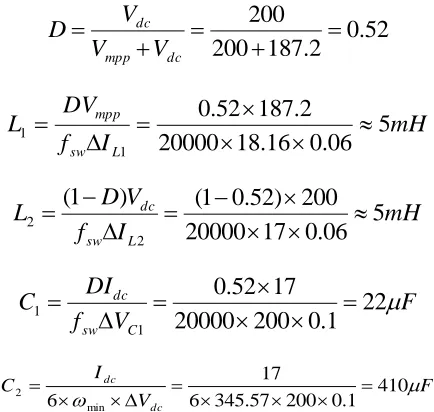
7.2 Zeta converter
To operate the zeta converter with high efficiency we need to have correct values of inductors and capacitors, for these values of L and C are as follows:
52
.
0
2
.
187
200
200
dc mpp dcV
V
V
D
mH
I
f
DV
L
L sw mpp5
06
.
0
16
.
18
20000
2
.
187
52
.
0
11
mH
I
f
V
D
L
L sw dc5
06
.
0
17
20000
200
)
52
.
0
1
(
)
1
(
22
F
V
f
DI
C
C swdc
22
1
.
0
200
20000
17
52
.
0
11
F V I C dc dc 6 345.57 200 0.1 410 17
6 min
2
7.3 Speed control of BLDC motor
[image:4.612.341.558.407.613.2]© 2019, IRJET | Impact Factor value: 7.211 | ISO 9001:2008 Certified Journal
| Page 3322
of armature is changed through PWM model. When motor is operated above rated speed, the flux is weakened by means of advancing the exiting current. In Closed loop speed control , it involves controlling the input supply voltage through the speed feedback from the motor. Thus the supply voltage is controlled depending on the error signal.
In the sensored BLDC drive, to obtain the rotor position information, shaft encoder or hall sensors are used. For this drive control system we need two controllers viz., an inner current loop for current control and an outer speed loop for speed control. In conventional we need three separate current sensors are used for measuring the phase currents. But here we used only one current sensor, and it is placed on the DC link.
In speed control loop, Proportional Integral (PI) controller is used. The PI controller will correct the error between the measured speed value and the required speed by calculating and then give correction action to adjust the speed accordingly. The controller is the combination of Proportional and Integral controllers. The Proportional controller give the output based on the current error, and Integral controller gives the output based on the recent error. The weighted sum of these two outputs will give corrective action for the speed control. For its simple design and structure, the PI controller is widely used in industries. The PI controller algorithm can be implemented as
t
I
p
e
t
K
e
d
K
t
output
0
)
(
)
(
)
(
Here the speed error is the input to speed controller and the output of speed controller is considered as a reference torque. Based on the maximum winding currents, the speed controller output is limited.
8. Matlab/simulation results
Fig.7: Matlab/Simulink circuit of water pumping system fed by SPV array
Fig.8: PV array output voltage
© 2019, IRJET | Impact Factor value: 7.211 | ISO 9001:2008 Certified Journal
| Page 3323
Fig.10: BLDC motor speed
9. Conclusion
The designed model of solar pumping system with speed control of BLDC motor is designed and observed the simulink results in MATLAB/simulink. The effective speed control is achieved by the PI controller by selecting proper values of P and I controllers. The switching losses converter and losses associated with motor are overcome by the selection of appropriate size of PV array. Maximum power from the PV array is achieved by the INC-MPPT method. The high frequency switching losses are eliminated in the inverter because of fundamental switching. The constant speed of motor under uncertain conditions is achieved by the PI controller.
References
[1].R. Kumar and B. Singh, “BLDC motor driven solar PV array fed water pumping system employing zeta converter,” in Proc. 6th IEEE India Int.Conf. Power Electron. (IICPE), Dec. 8–10, 2014, pp. 1–6.
[2].Ahana Malhotra and Dr. Prema Gaur, “Design, Analysis amd performance of Zeta converter in renewable energy systems” in Proc. IEEE India Int.conf.on computing for sustainable global development, Mar.16-18,2016, pp. 2487-2491.
[3]. M. A. Elgendy, B. Zahawi, and D. J. Atkinson, “Assessment of the incremental conductance maximum power point tracking algorithm,”IEEETrans. Sustain. Energy, vol. 4, no. 1, pp. 108–117, Jan. 2013.
[4]. R.Krishnan, Electric motor Drives modeling, analysis and control, prentice hall, 2001
[5]. V. Salas, E. Olias, A. Barrado, and A. Lazaro, “Review of the maximum power point tracking algorithm for stand-alone photovoltaic
system,” Solar Energy Mater. Solar Cells, vol. 90, no. 11, pp. 1555–1578, 2006.
[6]. P.Suganthi, S.Nagapavithra, S.Umamaheswari, “Modeling and simulation of closed loop speed control for BLDC motor” in Proc IEEE conf. on emerging devices and smart systems(ICEDSS), Mar 3-4,2017, pp. 229-233.