"
SPRING .JOINT COMPUTER CONFERENCE ATLANTIC CITY MAY 18-20.1971
ALSO: A METHOD Foe ColUICK ANALYSIS OF COMMON CARRIER TARIFF RATES
We've made a great computer
a lot better.
Varian's new 620/L has a dramatic price/performance ratio that gives more computer in less space at lower cost. The 620/L is an
advanced design of the reliable, field-proven (over 1300 installed worldwide), systems-oriented 620/i
computer.
Priced at only $7700, the 620/L
has an 8K, 16-bit, high-perform-ance memory that can be expanded to 32K inexpensively. Each 4K memory increment is$2300. What's
more, if you don't need 8K, you'll find the basic 4K, 16-bit 620/L very
attractive at $5400!
The 620/L is small, so small that when fully expanded -a 32,768-word system with all main frame options and up to eight peripheral controllers-fits into just 21 inches of rack height.
The 620/L is 100% I/O-and
soft-ware-compatible with the 620/i,
and new peripherals and software have been, added. All peripherals,
software, and application packages (developed for earlier 620 models), as well as the 620/L itself, are
off-the-shelf.
You know us. You know that when we say we have something better, we can prove it. Talk to the big com-pany in small computers.
('1Wvarian
~~
data machines
The Big Company in Small Computers
U.S. Sales Offices: Downey (213-927-1371), San Diego (714-298-9292), San Francisco (415-968-9996), Calif.lWashington (301-773-6770), D.C.lChicago (312-692-7184), 1II./Wailham (617-899-8055), Mass.lDetroit (313-645-9950), Mich.!M inneapol is (612-926-6571), Minn.! Albuquerque (505-298-5570), N. Mex.!New Roctlcllc (914-636-8118), Rochester (716-586-3273), NY.!Fort Washington (215-643-2355), Pa.!Dalias (214-231-5145), Houston (713-781-0105), Tex'/Canada: Malton, Ontario (416-677-9303). Other offices worldwidelVariJn Data Machines, a Varian subsidiary, 2722 Michelson Drive, Irvine, California 92664. Telephone 714/833-2400.
May
1, 1971Tally Corporation 8301 South 180th Street Kent, Washington 98031 (phone 206-251-5500)
Tell me more about saving my company money by moving more data for less.
Name Title
Company Phone
Address
City State Zip
" . . . , . ,
••..
i.~nlll·
....
(Jrdy
.·thatcan
ltangeitsmind.
Take alook atoufoptical masks. They
.. program the OM-1000 Read-Only Memory.
To. change the program, change the
mask. Just slide one out and another in.
If you're a computer manufacturer,
this means you can totally re-program
your customer's ROM by mail;
or
if
you're the user, you can
even change individual bits.
It's that easy.
Now take a look at the
OM~
1 000 Read-Only Memory.
It's the one that uses the
interchangeable optical
masks. Access time is less
than 70 nano$econds, and
storage capacity is 16,384
to 147,456 bits. Word length is
16 to 144 bits in almost any
word/bit organiz'ation. Output is
TTL compatible.
.
For more complete information about
our interchangeable program masks
OM-1000 Read-Only Memory, write
0at Optical Memory Systems, 1520 Sout
Street,
Santa Ana, California 92705,Phone (714) 547-4344.
optical memory systems
DATAMATIaN®
MAV1, 1971
volume 17
number 9
departments
Calendar
9
Letters to the Editor
13
Look Ahead
19
Perspective
52
News Scene
56
Hardware
75
Software
81
World Roundup
87
People
96
Index to Advertisers
100
May
1, 1971MANAGEMENT
28 Analysis of Common Carrier
Tariff Rates
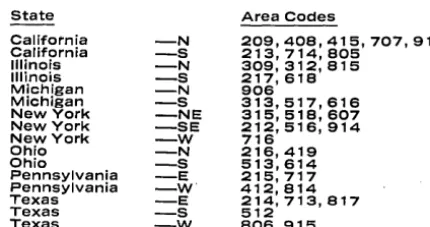
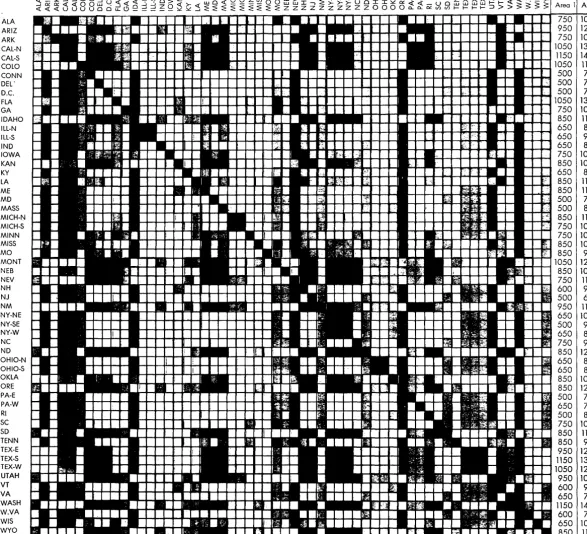
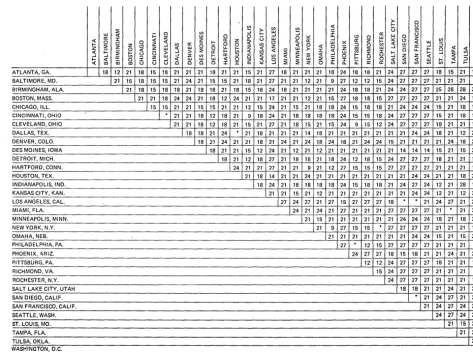
The tools offered in this article should help the communications designer to perform at least a first-order analysis. reasonably rapidly.
[Ci]ENERAL
36
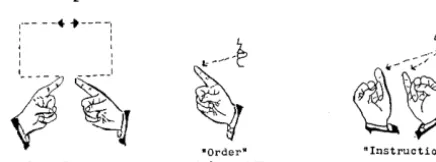
Computing Signs to Help Train the Deaf
There is evidence that the deaf make above-average programmers, but training presents a formidable problem. Standard hand signs for com-puter jargon could be the solution.
42
Spring Joint Computer Conference
After a year of great technological change and an economic crunch that has changed the face of the industry, computer community people gather to take stock this month in Atlantic City. A report on what the conference will be like and essays by leaders of six sessions is featured.
[CJ
DMMENTARV
52
Perspective
Frederick Adler, the venture capitalist, does well with his technology investments, despite the eco-nomic crunch ... The hotel industry, long resistant to using data processing, has mellowed as such names as Hilton and Sheraton announce systems.
About the Cover
The annual spring trail leads back to Atlantic City again and the Spring Joint Computer extrava-ganza. This design of varicolored aisles by our art director is offered as one of the more pleasant
forms of
deja
vu associated with the season, theshore and the salt water taffy.
BURROUGHS,
CONTROL OAT A,
HONEYWELL,
IBM,
NCR,
RCA,
SDS(XEROX),
UNIVAC ...
THEY ALL
COOL THEIR OWN COMPUTERS
WITH...
.
EDPAC
S Y S T E M S
ElECTRONIC DATA PROCESSING AIR CONDITIONING
MADE BY:
AC
MANUFACTURING COMPANYOLD CUTHBERT AND DEER ROAD,
CHERRY HILL, NEW JERSEY 08034, (609) 428-9800
CIRCLE 21 ON READER CARD
4
DATAMATION@
MAY
'II
'197'1
volume 17
number 9
This issue
112,560
copies
EDITOR
ROBERT B. FOREST
EDITORIAL STAFF
Managing Editor Senior Associate Editors Associate Editors Copy E,ditor Assistant Editors
Special Features Editor Eastern Editors New England Editor Washington Editor Midwestern Editor EUropean Editor Australian Editor Contributing Editors
Editorial Adviser Technical Consultant
EDWARD K. YASAKI WILLIAM J. ROLPH, TOM McCUSKER AUBREY DAHL, RICHARD A. McLAUGHLIN, EDITH D. MYERS, JOHN T. WATERHOUSE JANET EYLER MICHAEL WILLIAM CASHMAN ALMA O'STEEN ANGELINE PANTAGES JOHN WESSLER, F. BARRY NELSON W. DAVID GARDNER PHIL HIRSCH LAWRENCE RAGAN PEARCE WRIGHT FREDERICK A. BLAND HOWARD BROMBERG, ROBERT V. HEAD, PHILIP H. DORN, LOUIS B. MARIENTHAL, DANIEL D. McCRACKEN, F. G. WITHINGTON, PAUL ARMER, ROBERT P. BIGELOW ROBERT L. PATRICK LOWELL AMDAHL
EDITORIAL OFFICES
HEADQUARTERS: 94 S. Los Robles Ave., Pasadena, Calif. 91101, Phone: (213) 681-8486; EASTERN: 35 Mason St., Greenwich, Conn. 06830, (203) 661-5400; 19 Marlborough St., Boston, Mass. 02116, (617) 267-9414; 9805 Singleton Dr., Bethesda, Md. 20034, (301) 365-8671; MIDWESTERN: 407 S. Dearborn St., Chicago, III. 60605, (312) 922-8245. FOREIGN: 65, Hill Road, Chelmsford, Essex, England; 322, Park RegiS, Park St., Sydney, NSW 2000, Australia.
GRAPHIC DESIGN
AND PRDCUCTICN
Art & Production Director CLEVE MARIE BOUTELL
Production Manager MARILEE PITMAN
Production Assistants GLORIA J. FASANA, LOUISE T. O'CONNOR
CIRCULATION
35 Mason Street Greenwich, Conn. 06830
Circulation Manager Marketing Research Director
PUBLISHER
GARDNER F. LANDON
ASSISTANT PUBLISHER
JAMES M. MORRIS
Circulation audited by ~ Business Publications .Audit
IiiIIIil
MAE VAN RENNES DOUGLAS DeCARLO
~
--AB~ Member, American
~~ Business Press, Inc,
tp
~ATAMATION is published twice monthly on or about the first and fifteenth day of every month by Technical Publishing Company, 1301 South Grove Ave., Barrington, Illinois 60010; Arthur L. Rice Jr., Presi-dent; Gardner F. Landon, Executive Vice President. Executive, Circu-lation and Advertising offices, 35 Mason Street, Greenwich, Conn. 06830 (203) 661-5400. Editorial offices, 94 So, Los Robles Avenue, Pasadena, California 91101. Published at Chicago. III.DATAMATION is cirCUlated without charge by name and title to certain qualified individuals who are employed by companies involved with automatic information handling equipment. Available to others by subscription at the rate of ~25
annually .in the U,S, and. Cana~a. Reduced rate for qualified students, Foreign subscrrpt,ons are on a paId basIs only at a rate of $38 annually, No subscription agency is authorized by us to solicit or take orders for subscriptions. Controlled Circulation paid at Columbus, O. and Form 3579 to be sent to Technical Pub-lishing Company, P,O, Box 2000, Greenwich, Conn, 06830. Copyright 1971, Tech-nical Publishing Company. Microfilm copies of DATAMATION may be obtained from University Microfilms, A Xerox Company, 300 North Zeeb Road, Ann Arbor, Michigan 48106.
Pri nted by Beslow Associates, Inc,
If you have a
2780
budget
and a
360/20
workload ...
You used to have a problem.
No more. The Atron 360/20-1 and
20-11 are here. They're comparable in
performance to IBM 360/20 remote
batch terminals, but rent for 25
to 37% less!
For example, the ATRON 20-1 with
similar peripheral hardware as a
common Sub-model 2 configuration (300 LPM printer and 600 CPM
reader) rents for $833 less ... including
maintenance. And the 20-11 will take
$763 less out of your monthly budget than IBM's Submodel 5 (1100 LPM printer, 1000 CPM reader)!
So, without having to head another "budget reapportionment" campaign, you can have all the conveniences
of a 360/20 operation - high-speed or
TelPac communications, interleaving, job status checks and stand alone computer capabilities.
CIRCLE 59 ON READER CARD
What about maintenance with ATRON equipment? You won't find better. We have a n.etwork of over 75 service facilities across the country. If you have a problem, we're equipped and ready to help NOW.
Why not give us a call if you have a budget/work conflict.
SJCC Booth Numbers 1461 -1463 -1465
ATRON CORPORATION
True.
Here we are, the cocky young
It's always been this way.
kid on the block, introducing the first
Ever since we said that our
all monolithic memory in a mini
first I6-bit multi-accumulator mini
computer and people didn't just accept
computer, the Nova, was the best
it. They expected it.
small computer in the world.
Now we're telling people that
That we'd back everything up
it's not enough to love us for our low
with software, peripherals, and world- main-frame prices. They should love
wide sales and service. That we'd
us for the way we can put main frames,
become a high volume manufacturer
software and peripherals together in
in a hurry.
configurations that meet real-world
Well; we've delivered on all
computing requirements at the lowest
counts.
prices possible.
With one very interesting
Reaction? Disk Operating
result: We still make outrageous
Systems, Real-Time Operating
Sys-c~aims.
But with our delivery record,
terns, Time Sharing BASIC Systems,
people simply refuse to be surprised
all kinds of systems, are installed
by anything we say.
and running. Right now.
For instance, we introduced
Sure we make outrageous
three new members of the Nova line,
claims.
featuring LSI, MSI and all-monolithic
But with more than 1000
com-memory, at the 1970 Fall Joint, and
puters, and all kinds of software,
the only people to get nervous were
peripherals, and systems installed all
the competition.
over the world, it's getting harder.
We told everybody that the
Because people 'are simply
Nova 1200, the first mini computer
buying everything we say.
to take advantage of large- and
~
medium-scale integration to achieve
• •
DATA GENERAL
°
d
d 1· bOlO
Southboro, Mass. (617) 485-9100/ Hamden, Conn.maXImUm spee an re Ia I Ity, was
(203) 624-7010/ Commack, L.r., New Yorkth
e eas expenSIve mu I-accumu a or
1
t
.
ItO
1
t
Saddlebrook, N. J. (516) 368-3304/Rochester,NewYork (716)235-5959/ (201) 843-0676/ Bryn Mawr, Pa.16'bOt
- I compu er on e mar e
t
th
k t
° Atlanta, Georgia (215) 527-1630 /Washington, D.C. (404) 458-0118/ Orlando, Fla. (202) 296-0380/DOd
I we s a e any
h k
b d ?
0y up.
Ohio (216) 486-5852/ Houston, Texas (713) (305) 425-5505/ Chicago, Ill. (312) 539-4838/ Cleveland, 622-2820/N
0,
we JUs wro e or ers.
Ot
t
d
Dallas, Texas (214) 233-4496/ Denver, Colorado (303) 758-5080/ Manhattan Beach, Cal. (213) 376-7917/A d th
n
en,
t
0cap I
Ot
0if
,we
Palo Alto, Calif. (415) 321-9397 / London, England 014997735/ Munich, W. Ger. 0811295513 / DATAGENd
1
°dth N
800'
th h d
OFCANADALTD.:Hull,Quebec(819)7702030/e Ivere
e ova
a mon a ea
Montreal, Quebec (514) 341 4571 / Toronto, Ontarioof schedule, and the Nova I200.t· w'
0 (416) 4478000 /Vancouver, British Columbia(604) 7312711.
months ahead of schedule (which is
really outrageous in this business)
°At the same time, we introduced
the Supernova SC.
8
Timely news about
Data-Phone®
from Western Union.
"AT&T is no longer installing
terminals (under 300
baud) for Data-Phone.
We are, right now."
Z.V. Zakarian, president Western Union \ Data Services Company.
If you plan to install or expand Western Union Data Services
Data-Phone service, you should "~~~~~ Company.
be
aware of this important de- ' " Weare a newWestern Union velopment. While AT& Twill con-II ~\ company. Our mission is to assisttinueto maintain its presently \ customers with data handling
installed terminals, it will not \ problems by providing data
term-provide additional terminals \ inals and systems. We have a
under 300 baud - F.C.C. docket
#
18519 staff of systems and applications people 'Western Union acquisition of TWX from available to help you. And we offernation-AT&T." This includes units such as the wide servicing, engineering, training model 33 and model 35 teleprinter. and support.
Who can? Western Union Data For your Data-Phone or other data Services Company. And we're prepared handling needs, call on us.
to respond immediately to your needs. Contact me at Western Union Data In addition, we can look at your Services Company, 16 McKee Drive, future requirements and help you plan Mahwah, New Jersey 07430. Phone:
for them. 201-5294600. Outside N.J. call
toll-If you're considering installing or free 800-631-7050 . . . expanding Data-Phone terminals think of Telex: 12-5077. western union
western union
data ser\llces compan!::l
See us at SJCC Booth 2631.DATE EVENT/SPONSOR LOCATION CONTACT COST ~\
May 18-20 Spring Joint Atlantic City AFIPS Preregistration
1~~~
~
~
Computer Conference : 210 Summit Ave. $20, members
\~
,,~~~Montvale, N.J. 07645 $50, others
May 25-28 20th Annual Convention Washington, D.C. NMA Unknown
C
: National Microfilm Assn.
June 22-25 DPMA Conference & Expo Houston
July 26-30 : International Computer Mexico City
: Expo. for Latin America
Aug. 3-5 1971 National Conf. Chicago
of the ACM
Aug. 16-20 Jerusalem Conference on Jerusalem
Information Technology
Aug. 23-28 ; IFIP Congress 71 Ljubljana,
Yugoslavia
This is the ultimate memory system for storing large blocks of random data. 12%" of panel height houses an
entire 1,179,648 bit memory system. The Mini·l\~assTt.4
can be configured as a 32K x 36, 65K x 18, 131K x 9. Capacities start at 16K x 18 or 8K x 36 and can be expanded by simply inserting a single PC board for each 4K increment. Data save, byte control, power supply, systems enclosure, temperature tracking and wide range lithium core arrays are standard features. Field expan·
Suite 1101 8728 Colesville Rd.
A
Silver Spring, Md. 20910
,
)
L
DPMA Unknown
505 Busse Highway
I Park Ridge, III. 60068
E
: Sociedad Mexicana de Unknown
N
i
Computacion ElectronicaI Yacatas, 435
Mexico 12, D.F.
D
ACM Unknown
A
1133 Ave. of the Americas New York, N.Y. 10036
Jerusalem Conf. on Info Unknown
R
Technology P.O. Box 7170 Jerusalem, Israel
IFIP Congress 71
Box 4197, Grand Central New York, N.Y. 10017
MINI-MASS:;I:
ELIMINATES TRADE-OFFS
OF SIZE, SPEED,
OR ECONOMY!
sion is ultra fast and ultra simple. Remember, the memory controller is built to address 65K words. By using two (2) controllers, the word length can be doubled to 36 bits with 32K words or you can operate as two separate 32K x 18 memory systems in the same en· closure. The entire I/O wiring for 65K x 18 is con· tained on two (2) 86 pin connectors and four (4) 86 pin connectors for two (2) 32K x 18 or a 32K x 36 unit.
For all memory requirements, call or .write today:
*
750 NANOSECOND FULL CYCLE TIME
325 NANOSECOND ACCESS TIME
May
1, 1971STANDARD
INC 0 R P 0 RAT E D
A Subsidiary of Applied Magnetics Corporation
CIRCLE 66 ON READER CARD
15130 Ventura Boulevard Sherman Oaks, California 91403 (213) 788-3010 TXW 910-495-1738
10
(Plus thousands
of other hotels
and cars allover
North AmeriCa,
all
over Europe. )
International Reservations, a subsidiary of Planning Research Corporation, 16055 Ventura Blvd., Encino, California 91316
Now, one phone call does it all:
800-336-0336.
In Virginia, call 800-552-0386.Free
,instant, confirmed reservations.
(You don't pay for the
reservation. The hotels do.
You don't pay for the phone call.
We do.)
Call a thousand places at once.
Get a room reservation and
a rental car reservation with
one phone call.
International Reservations:
May 1, 197]
We don't make them like
they used to.
Now, unless you have a
photographic memory,
tear out this ad and write us
or call us. We'll send you the
phone number on a wallet card.
QUADRI.
••
ON
THE MOVE!
1\\ <~ ~:!r(,.~~ I \ ~ ,,~! ,",.~l' ,
<~\~, 'Hl'r
o
DSpecifically designed to provide an intermix of high speed, standard speed and ROM MEMORY IN ONE STANDARD RETMA card rack.
rnle
Con1pa~i[)lesare:
PAorn 009-01 The only field re-programmable semi-conductor ROM system available ... and in less than 30 seconds by unskilled personnel.
Capacity is 8K bits per card cycling at less than 100 nanoseconds.
BIPOLAR 011-01 R/'.!'! Its another quality QUADRI product. QUADRI's experience in signal handling and systems design assures you of fault-free high speed operation.
Capacity is
i
OK bits per card cycling at less than 100 nanoseconds.r.~os 011-02 R/VJ A large capacity, high speed memory system specifically designed for main frame memory applications.
QUADRI's proprietary low-power clock drivers provide ultra-reliable operation with minimal power requirements.
Capacity is 40K bits per card cycling at 500 nanoseconds.
All of the Compatibles may be expanded to any size system by DOT-DRing.
As an option to the Compatibles, we offer a universal wire-wrap interface card.
And, you can purchase them individually,
in any combination, or any configuration required.
These off-the-shelf units may be mixed for quantity discounts.
12 CIRCLE 8 ON READER CARD
Call or write today:
LJ(\
QUADRI
\J
~.-)
CORPORATION7
2950 WEST FAIRMONT'- C./
PHOENIX, ARIZONA 85017~_
... __ J
(602) 263-9555LETTERS
Tag party
Sir:
In your issue of November 15th (pp. 129-131), F. Barry Nelson reported my comment that anyone could du-plicate the new NCR color-bar mer-chandise tag with a Polaroid camera.
Since then, one of our technicians, for fun, altered several NCR tags, us-ing as a color source a green pencil and a black Japanese felt-tipped pen. We tested these altered tags on the lone NCR register exhibited at a re-cent National Retail Merchants Association show in New York. The tags were accepted and the altered data printed just as predicted. Unfor-tunately, we did not try Polaroid du-plicates.
Subsequently, in your issue of February 1st (p. 15), an NCR execu-tive who was apparently unaware of this successful fraud in New York reported that the Polaroid camera " ... and most other attempts to alter the color coded tag data content, will render the tag completely unread-able due to the extensive error check-ing designed into the NCR codcheck-ing and reader system."
Our man stands ready to risk pub-lic ridicule demonstrating that NC~
tags and credit cards can be dupli-cated with a Polaroid camera. There is, however, one serious obstacle: we cannot find an NCR sales office with this remarkabl~ 280 register. Immedi-ately following NCR'S announcement of this product last autumn, we or-dered one. Their promised delivery: two years. We suspect the only such register extant is the model NCR brings to retail exhibitions, and, for all we know, their tag maker is a draftsman out in Dayton with a ruler and a colored pencil.
WILLIAM R. BURKHART
President, Transaction Systems, Inc. Palo Alto, California
NCR is installing its 280 terminals in Montgomery Ward and the Hecht Company, Washington, D.C. Try there.
Whelmed over
Sir:
Although I enjoyed reading about campus computers in your March 1 issue, I was overwhelmed by the
ar-May
1, 1971gument given by Mr. Roberts Jor separate facilities (p. 28). His argu-ments are reminiscent of those of the old batch processor fans. I felt as if I were being propelled back into the past rather than reading a current DATAMATION.
I was also surprised by the lack of discussion about the successful time-sharing systems and regional comput-ing facilities which have been devel-oped on various campuses by Na-tional Science Foundation grants in the past three years.- Oregon State Univ., Dartmouth, Univ. of Texas, North Carolina and Iowa, to name a few, have very successfully imple-mented regional computing facilities, some of which serve both "adp" (administrative) functions, and all
inst~uctional computing needs. I hope your reade"rs are not misled into believing that all the country's campuses are still in the dark world of batch processing and separate fa-cilities. Most of the" users who have
had the good fortune of working with a reliable time-sharing system would never return to the tedium of batch operation.
I also question Mr. Roberts' state-ment that academic researchers are more concerned with machine cap-ability than machine relicap-ability and stability. In a time-sharing environ-ment, everyone is inconvenienced when the machine goes down, and reliability is very important to the individual user.
There are many universities that have successfully combined admini-strative and instructional applica-tions on a time-sharing system, and I believe that this trend will continue in the future.
KAY PORTER
Oregon State University Corvallis, Oregon
Telling a Fibonacci
Sir:
I might ask Paul Blackwell ( Jan. 15 Letters, p. 11) whether he has inves-tigated the Fibonacci series starting with 3.7. Many clues point to a far more remote antiquity for these most elementary number relations. In fact, they undoubtedly date back to minus infinity, B.C.
ELVIN LEE Chicago, Illinois
Von wiseacre
Sir:
With reference to Mr. Paul Black-well's interest in the applicability of the Fibonacci numbers to the plan-ets, may I refer him to the following: My own paper entitled "Fibonacci Series in the Solar System," Fibonacci Quarterly, Vol. 8, No.4, October 1970, and an excellent article by H. W. Gould, Department of Mathematics, West Virginia Univer-sity, entitled "Cale's Rule for Plane-tary Distances," Proceedings of West Virginia Academy of Science (Vol. 37) 1965.
The presence of the Fibonacci numbers, which are closely related to a logarithmic spiral, have been pro-posed by Gould to originate out of von Weizsacher's Theory that the so-lar system began as a soso-lar nebula in which turbulent vortices were created that condensed into the sun and planets.
Marvin L. White, at the Space Physics Laboratory, AFCRL, Hanscom Field, Massachusetts, has recently developed vortex theory based on at-mospheric circulations which coun-ters the arguments which claim that angular momentum will not be con-served in Weizsacher's model but will be dissipated into smaller eddies. The Fibonacci numbers have come a long way since first applied to the rabbit problem!
BARRY A. READ
Maior, Canadian Armed Forces U.S. Army, Satcom Agency Fort Monmouth, New Jersey
Host boast
Sir:
Your February 15th "Look Ahead" incorrectly stated that IBM System/7 can only be used with "large host
"ti'Key
Rollover.
It
remembers
your every
touch.
Our new Un" key 'rollover solid state keyboard h1:\s a memory like an elephant.
Data bits from the first key depressed are stored in our MOS memory until a
second key is activated .•. even though the first key is still depressed. So any
number of keys can be depressed without interfering with the sequence of
data entry.
Which makes operator error practically nil. Tests have indicated
up to 30% fewer errors than with two-key rollover keyboards.
And no special training is needed to switch from an electric
typewriter. In fact, most any secretary can sit down and
start operating.
Our
~~n"key rollover is also more reliable.
Because pulse output is part of the solid
state chip within the key, rather than
a pulse network of discrete
cODl};)C?~e!\ts~For even more things
you~~~~~~to remember for your next
k~y})q'fI,application, call or write
you~MICRO SWITCH Branch Office.
MICRO SWITCH
FREEPORT, IL.L.INOIS 61032
A DIVISION OF HONEYWELL
Sales and Service offices in all principalcilies '01 Ih~ ;;";orl~i M"':;~Iaclurinl! on Auslraloa. Canada. Finl~nd. FIance, Germany. Japan, Mexico. "em'ero~n'o ••
Letters ...
113M machines."
System/7 can operate either as a stand-alone computer or connected to a host computer. And the host computer need not be a large ma-chine. System/7 can attach to an IBM
1130, 1800, System/370 or most models of System/360 for additional input/output and computational capability.
D. C. POTTER
IBM
White Plains, New York
Cute couple
Sir:
I have noted with interest a certain passage in the just-arrived March 15, 1971 issue. This passage is in "Look Ahead." It reads as follows: " . . . A well known, influential computer scientist active in standards work discovered to his horror recently that he couldn't figure out how to hook up to a time-sharing service via an acoustical coupler from his house. He has a Princess telephone. A standard dilemma? .. "
I wonder if the telephone was ac-tually something other than the Prin-cess type. The Bell System has an-other offering, called a Trimline, and it may be that that particular tele-phone was actually the item in the computer scientist's home.
As far as I know, the Princess tele-phone is a standard Bell System 500 series, made more compact, and fitted with a standard 500 series handset. The Trimline telephone is somewhat different in packaging, featuring a telephone dial built into its handset. Incidentally, the Trim-line is harder to couple into a modem than the 500 series; hence my in-quiry.
It may be of interest to you to know that we here at Applied Com-munications Corp. are working with telepho.nic communication systems for the deaf. One of our products is PHONETYPE Terminal Unit; it is an acoustic/inductively coupled mo-dem, enabling the operation of a tele-typewriter in conjunction with an or-dinary Bell System 500 series tele-phone. Many such units are now in use all over the U.S.A., in homes and offices where deaf people are located. At any rate, our equipment has been highly successful in operation, and the deaf owners concerned are deep-ly appreciative for this means of communication with each other.
Needless to say, I am wondering,
May
1, 1971too, as to whether telephones are well standardized. In fact, I have had sim-ilar experience, with our acoustic/in-ductive coupled computer modem, that the above mentioned computer scientist had in trying to reach n time-share service from his telephone. RODERT H. WEITBRECHT Menlo Park, California
Tuna in, Charlie
Sir:
In the letters section of the February 15th issue, Charlie Connoy states the number of operational Univac II
computers should be revised upward to five. Sorry Charlie, but we turned the old prototype off 21 November 1969.
LEON D. MORRISON
Univac Federal Systems Division St. Paul, Minnesota
Novel approach
Sir:
I am interested in studying the role computers and computer specialists play in contemporary literature. Some' of the novels in which they figure prominently have been: 480, Killing Zone, The Tin Men, Giles Goat-Boy, The Literature Machine, Player Piano.
I would appreciate it if your read-ers could alert me to other works of this type.
L. MEZEI
Computer Systems Research Group University of Toronto
Toronto, Canada
... your local serif
Sir:
In the current debate between the supporters of A and those of OCR-B, two vital points have been over-looked. The first point is "Why OCR?" Obviously OCR is to serve as a hard-copy communications medium for man-machine interfacing. For ma-chine-machine interfacing, such hard-copy media as magnetic tape, punched cards, disc packs, and per-forated tape have already been im-plemented and are all much more reliable in both generation and in reading than is immediately foreseen for OCR. For man-man interfacing, there are many type fonts already existing which are more pleasant and less distracting than even OCR-B, let alone OCR-A.
The second overlooked point is "Why automation?" The answer-ap-parently not obvious to everyone-is "To make things convenient." Many software systems and their designers and users have had much grief when tasks were automated merely because it was possible to do so, even though it was definitely inconvenient to do so. Convenience may be economic: it
costs less to do the task by automa-tion (costs including capital, the cost of extra time from increased paper-work, etc.). Convenience may be procedural: it is easier to do the task by automation. Convenience may be "operational": it is impossible to do
the task without automation.
Before an OCR standard is adopted, it should be shown to improve the convenience of man-machine com-munication. If an OCR font does not improve the convenience of man-ma-chine communication, there is no point in automating the task of hav-ing machines read printed charac-ters. But there is a conflict between OCR-A and OCR-B: Procedurally, the former is convenien t for machines and the latter is convenient for men. Further, the current technology makes OCR-A more economically con-venient than OCR-B. What is needed is a scale of values to determine which font has the greatest overall convenience.
J.
Rabinow asserted in the "For-um" (Feb. 1) that OCR-A is inconve-nient to men only because it is new. This is not true. A font is easy to read only when its design does not distract the reader. An extensive text printed entirely in italics is tiring to read, yet italic is one of the oldest fonts. Any-one who is familiar with IBM ref-erence manuals (prepared from ma-chine listings) knows that extensive use does not make the font any less distracting. Mr. Rabinow seems to believe that a font which is currently feasible is defensible as a standard. This ignores the requirement that it be convenient. If OCR-B is not now procedurally convenient for ma-chines (as is the case of OCR-A for men), then the technology has not yet advanced sufficiently for the use of OCR. In that case, no standard OCR font should be adopted until both font designs and technical advances preserit us with an OCR capability with high overall convenience for both sides of the man-machine inter-face. To adopt a standard now would freeze oUf underdeveloped technol-ogy to an inconvenient font.DAVID Ross
Canoga Park, California •
You're looking at some of the Teletype® basics used in building a data commu-nications system. Printer, keyboard, tape sending and receiving combina-tions in a variety of speed capabilities. Teletype's modular design concept gives you the opportunity to extract the best terminal combination for system
model 33 series: An extremely economical 100 wpm terminal line. Has 4-row keyboard, uses 8-level ASCII code. The most widely used terminal in time-sharing systems today.
16
What happened
.
to the
model19?
needs today, and refine, add to, sub-tract and adapt as system modifica-tions are called for. Just as important as the basics, are some of the things not obvious in the photos below. The logic devices, options and accessories that add almost limitless possibilities for making things happen exactly as
model 35 series: A rugged, heavy-duty line of 100 wpm terminals. Uses ASCII. Units in foreground are self-contained paper tape punch and paper
tape reader.
your system requires. We have some solid state logic devices that provide precise control of data traffic. That en-able your computer to automatically poll data from a number of terminals and feed each terminal with processed data. There are error detection, correc-tion and signal regeneracorrec-tion opcorrec-tions to
Telespeed™ equipment: A line of high-speed tape-to-tape terminals capable of sending and receiving at speeds of 750, 1050 (shown above), or 1200 words per minute.
keep data flowing faultlessly. Options such as pin-feed platens and form'feed controls that make it possible to fill multiple copy business forms on-line. And many, many more. What did
hap-pen to the model 19? Believe it or not,
there are still some of these old, die-hard terminals around. And that's
model 37 series: One of the most versatile heavy-duty terminal lines going. Generates all 128 characters of
ASCII. Operates at 150 wpm. Prints in upper and lower case.
Teletype is a trademark registered in the U.S. Pat. Office
May
1, 1971DATA COMMUNICATIONS
equipment for on-line, real-time processing
another advantage your data communi-cations dollar buys when you specify Teletype equipment. It lasts. Moves data reliably, economically, for a long time. On a price/performance basis, Teletype equipment is in a class by itself.
Inktronic® data terminals: A unique electronic, solid state terminal. Prints up to 1200 wpm. Forms characters through electrostatic deflection (no typebox). ASCII compatible.
Teletype data communications equip-ment is available in send-receive capa-bilities of up to 2400 words per minute. If you would like specific information about any of the equipment described here, write: Teletype Corporation, Dept. 81-17,5555 Touhy Ave.,Skokie, III. 60076.
magnetic tape data terminals: Use compact reusable tape cartridges. Operate on-line at up to 2400 wpm, and connect IIlocally" to lower speed Teletype terminals using ASCII code.
TELETYPE
machines that make data move
'0'
. . _ . . . ®
BURROUGHS B6700
Its the lllost advanced business
data
pr~cessing syste~
now avaIlable for servIce.
18
Because it provides:
POWER. One, two or three central processors.
One, two or three input/output processors.
Double-size main memory (up to six million bytes).
Electronic exchange architecture.
MUITIPROCESSING. It's automatic. With
any mix of programs. For flexibility and throughput.
DYNAMIC RESOURCE ALLOCATION.
For "fail-soft" security and continuous operating
efficiency.
COMPLETE SELF-REGULATION. The
computer runs itself under Master Control Program
supervision.
EXPANDABILITY. You can
add equipment as you add the work.
Any time. With no reprograming.
DATA COMMUNICATIONS.
Service for more than 3,000 lines.
. Without burdening the central system.
VIRTUAL MEMORY. No
more limits on program size. It's
independent, so programmers don't
have to plan for it.
COMPILER LANGUAGE
PROGRAMING. Exclusively. It
makes program writing and
modification a lot easier.
DISK STORAGE.
Massive-with up to 72 billion bytes on-line. Fast-Massive-with
access to any record in as little as 1/500th of a second.
These important systems design capabilities
are ready for you now in the B 6700.
From the company that's recognized for
leadership in systems design ...
LESSORS GROUP STUDIES
360 EXTENSION MOVES
SOME LEASING FIRMS
RECONSIDER 3705
TELEMAX GROUNDS
RESERVATIONS PLANS
DOD WANTS UPDATE
ON COBOL STANDARDS
The Computer Lessors Assn. is now mulling the report
on means to extend the life of the IBM 360, completed
in March by Compata, Inc. We hear it discusses
th~feasibility of the f91lowing: As is now actually
occurring, the purchase from inqependent firms of
bulk memory and main memory add-ons up to and beyond
the machine's stated limits; expansion of the 360
instruction set to include the new 370 instructions;
cpu modifications to permit use of new 370 peripherals,
such as the 3330 disc drive;
install~tionof cache
memory on the model 65; development of universal
controllers; and doubling the transfer rate and
density of the 2314 disc drive.
Down the pike, when
IBM releases the 360-incompatible Advanced Operating
System, lessors may consider modifying it for use on
souped-up 360s. The lessors will have to contract'
for any of the above modifications, and some will
weigh that cost against buying the
high-purchase-to-lease-ratio 370s -- depending on the installation.
A few leasing companies, because of the currently low
prime interest rate, are bidding 370 contracts and
more are seriously considering limited 370 buying.
The contracts will be much longer than for 390S;
so~eput the
mini~umat four years, others at six to eight
years.
Surprisingly, banks like First National City
of New York are said to be going after "risk" leases
of less than full payout. Meanwhile, although few
expect independent maintenance firms to be able to
compete with IBM for 370 service for several years,
there are reports that some "large u.S. corporations"
are studying the cost of entry into computer
maintenqnce.
It's high.
Telemax Corp. has lowered its sights. The
reservations firm which once hoped to corner the
airline reservations market through interface with its
travel agents-based automated reservations system for
hotels, motels, and car rental agencies, has given up
all that to concentrate on railroads. Phil Fellows,
dismissed last year as Telemax president, was rehired
by the company's new parent firm, Heizer Corp.,
!eportedly because he was close to Railpax, the
government-chartered passenger railroad company.
Fellows worked in Washington for Intermodal
Transportation, a consulting firm working on Railpax
for the Dept. of Transportation.
Sources say Fellows
and Telemax are devoting full time trying to get the
contract to develop
a
reservations system for Rai Ip ax ,
Impatient with what it considers the inability of
ANSI to "respond to our needs," the Dept. of Defense,
through George W. Bergquist, deputy assistant
IF YOU CAN'T SELL EM:
JOIN EM
MORE IBM FOR RCA
RUMORS AND
RAW RANDOM DATA
DOD's participation in the development of these
extensions, Bergquist states in his memo of request
that he is "most anxious • • • that DOD maintain a
leadership position in the development and use of
COBOL."
However, one ANSI participant points out that
many of the CODASYL extensions to be considered are
already in the ANSI standard or have been approved by
X3J4 (the ANSI COBOL standardization committee) for
inclusion. He says there has been only a "bare"
participation by DOD in the ANSI effort and suggests
that "if they would devote their energies to
constructive participation on ANSI, we could get the
job done (maybe)."
Tenet, Inc., was formed in Sunnyvale, Calif., in late
'69 to build and market a time-sharing computer.
Last month, lacking a first order for its Model 210
sys~em
and seeking a badly needed third round of
financing in a market strongly resistant to anything
involving time-sharing hardware, the company sought
survival by plunging feet first into the time-sharing
market by selling time on its first working prototype.
Its first customer was Memorex Corp., Santa Clara,
Calif., peripheral manufacturer.
One of the last bastions of non-IBM leadership in RCA
has fallen.
The systems programming product
laboratory has a new manager -- IBM veteran Patricia
Gogins.
She replaced vp Arthur Carroll, Jr., who
moved up to head management information systems.
In
the process, the colorful Alonzo Grace, long-time
manager for systems programming development, chose to
depart.
IBM has reportedly firmed up a five-year trimback
plan to account for changing markets and technologies,
like the shift from core to semiconductor memories
• • • Users are expecting the announcement of
relocation features on the big 370s by the end of '71
and delivery by third or fourth quarter of '72.
Too,
the smaller siblings, the 135 and 145, are said to
need only the change of a floppy disc to put their
already built-in relocation hardware into action
• • • At a recent meeting in Los Angeles of SHARE,
the IBM users group, a company set up a hospitality
suite in the Biltmore Hotel conference headquarters
and placed invitations under the doors of SHARE
participants. SHARE's officers persuaded the firm it
was violating the user group's rules; so it left.
In
reserve, however, was a plan by the SHARE people to
distribute the invitations themselves to habitues of
Pershing Square across from the hotel who would have
made a colorful gathering in the suite when the word
of free booze got around • • • SHARE's insistence on
keeping meetings IBM-pure is understandable.
Of the
1,430 persons registered at the March meeting, 277
were from IBM and added $16,600 in registration
Sure, the Sycor 340
data communication
system gives you clean source
.
.
... ··data
Sycor 340. The one CRT terminal that does it all. Heart of the Sycor System. Trim. Tasteful. Yet
figuratively bulging with the newest of proven, mass-produced modular microprocessor technology. All of it operator-oriented. So easy to learn and use that any regular office guy or gal takes to it quickly and can achieve high productivity without knowing a thing about data processing.
Entry by electronic keyboard onto magnetic tape cassettes permits data
".,.,,, ..
~-:.ca.pture.
Like order forms. Remote invoicing. Remote payroll checks. Whatever.
Two 1 O-digit accumulators-,-a Sycor first, by the waccumulators-,-ay- way-to be recorded about 30 per cent faster than it would be
electromechanically. Sycor 340's unique automatic paging option handles even long or complicated forms by accept-ing them in small segments, or pages, easily scanned. Then, it automatically displays page after page of labels and field control characters, easy for the operator to follow. And (hallelujah!) no cards, no paper tape to mess with. Just compact cassettes that hold the equivalent of 1400 punch cards. Easy to load and to store. Thriftily re-usable.
generate totals or subtotals for zero balancing, de-tecting keying errors numeric data, without re-keying or verifying. Other error detection features include visual proof- reading from the CRT,
pro-You can interface the 340 with the Sycor printer and get all the versatility of high priced line printers. Use multipart, continuous, pre-printed forms for a host of applications.
grammed entry, format field and character checking, and check digit verification. Add and subtract operations give you automatic total and subtotal field computation and entry without re-keying on an adding machine. Result? Clean tape output-at the data source-that cuts delays and con-fusion, dramatically lowers mainframe processing costs.
May.1,
1971But data capture is only a part of what you really want a terminal system to do for you, isn't it? Sycor's modular system can be
configured for batch communication, via the voice-grade public telephone network, for attended or lower-cost unattended operation. Sycor's binary synchronous procedures, with automatic retransmission that provides automatic error detection, and speeds of 1200, 2000 and 2400 baud, are compatible with S/360 hardware and software. You can set up an off-line system that gives you the advantages, but none of the complexities, of teleprocessing, by using the Sycor 610 Communication Converter Station
at your central office to record on, or transmit from, computer compatible magnetic tape. That's another part, right?
---=ralk to Sycor.
100 Phoenix Drive, Ann Arbor, Michigan 313/971-0900 See the 340 communications terminal at Booth 2513 at the SJCC.
CIRCLE 33 ON READER CARD
51
SYCORINC
\
You've got the best computer for the job . ..
Why not buy the
best plotting system?
Used in 8 time sharing mode,
the PTC-4 Plotter/Teletypewriter Controller linked to the DP-1 Digital Plotter provides 11" wide reproducible graphs, charts, and drawings at a remote location-direct from the computer.
PTC-4 $5900 q
(:»
DP-1 $3500
Offline plotting in addition to computer 1/0 capability
The MTR-9 is a superior system offering faster plotting yet uses less computer time. New END- STEPtm MODE software reduces computer time and tape lengths by 10:1. Operates with any speed incremental plotter. Has high speed search with block selection. 7 or 9 track IBM format. Operates with the
DP-1,' DP-5 or DP-3 22" wide, 300 increment per second plotter.
MTR-9 $21,000. DP-3 $6,400.
©@)~~[b@)u,.
with me!
DP-5 $11,000.
o
~ Plotting online Is 4 times fasterwith the Ultra High Speed DP-5 Incremental Plotter. Designed for computer graphics, it plots at a continu.-ous speed of 1200 in crements per second. No special programs required. Step size is factory set at .005" or .0025".
Q
Offline plotting Is ,~ow
an economic rf.t.8l1ty
with the MTR-2 Magnetic Tape Reader. I t operates with df@ v OP-1, DP-3 and
DP-5 Plotters to form a complete offline system. The MTR-2 accepts IBM com-pati ble tapes.
[fi)@!]J]~~@01l
I
DIVISION OF8AUSCH&LOM8~
InSTrumenT
T E R M I N A L A V E N U E , B E L L A I R E . T E X A S
( 7 1 3 ) B 6 7 7 4 0 3 C A B L E H O I N C O
Library storage units, cabinets, desk racks, trucks, carrying cases and Data Bank Safes ... You'll find everything you need to build an efficient and beautifully styled system for handling and storing tape reels in Tape Seal® Belts, thin-line or standard canisters. Your Wright Line Catalog is the one complete source for information on Tape Storage and accessories for use in disk, eighty column and the new ninety-six column card systems.
It's so easy to solve your data processing ·accessory needs with the Wright Line Catalog
o
Select from the catalog and mail or phone your orders directly to your local Wright Line branch office or main plant in Worcester. Wright Line's more than 60 offices are listed in the yellow pages.II
If additional information is needed when ordering or planning installations, call your local branch office and ask to have one of Wright Line's more than 125 field specialists call on you.Everything for data-processing except the computer.
m
(I
.•.•
~~
W
-.~.
DATA BANK SAFES DISK PACK STORAGE GOLD STAR FILES TAPE STORAGE SYSTEM/3 ACCESSORIES
If you don't have a Wright Line Catalog, we'll be glad to send you one. Write or phone any of our offices or circle the readers' service number below.
DATA PROCESSING ACCESSDRIES
WRIGHT LINE • A DIVISION OF BARRY WRIGHT CORPORATION, 160 GOLD STAR BLVD., WORCESTER, MASS. 01606
"READY"
is .one of many messages INFOREX
gives your operators to increase data throughput.
HERE ARE
SOME OF THE OTHERS:
CANCELLED COLUMN ERROR DBL KEY END OF FILE ENTER LABELS EOT
ERROR FIELD FULL IN PROCESS INTERRUPTED INVALID KEY JOBNAME BUSY LABEL OVERFLOW NAME USED NOJCS NO JCS END NO PROGNAME NO RECORDS NO UPDATE NOT IN JOBFILE NOT READY PROCEED READY
RECORD < 16
REKEY STAT NOT C STAT NOT I STORED TAPE BUSY 95% FULL
We built these. messages into the INFOREX Intelligent Key EntryTM System because we believe a truly responsive system can significantly cut data entry errors and simulta-neously increase data throughput. For example:
Our 125-character display screen does a lot more than provide a visua I check on the operator's work. If she makes an error in procedure it tells her exactly what is wrong. Gives her the status of the job at any time. Issues instructions. Lets her resume work quickly and accurately after an interruption.
It helps the supervisor, too. She can use any station to check jobs in process or get a reading on each operator's performance and accu-racy at any time.
Write for full data to help evaluate the Intelligent Key Entry System in your operation. We would also be pleased to have you check with pres-ent users on System performance and service. Write I N FOR EX, Inc., 21 North Avenue, Burlington, Mass. 01803 or INFOREX AG, Dornacher-strasse 210, Basel, Switzerland.
EIGHT KEYSTATION SYSTEM FOR $120 A MONTH PER STATION
Up to eight keystations input to a memory and logic control unit capable of storing 128 pro-gram controls. Any keystation can simUlta-neously verify the work of any other by full record CRT display or key verification. Com- • pleted jobs are transferred to
7- or 9-track computer
compatible tape. fF~'=€==""'=§4I~~
P·IINFOREXI
\
28Tools for cutting through the
complexity of the telephone
rate structure
Analysis of
C0lT11T10n
~
~ With communications hecoming anin-M
creasingly common feature of computer systems, data processing managers and their staffs are now faced with the task of evaluating common carriers and their services. In addition to the technical complexities of grafting digital equipment into the analog telephone system, there is the not inconsiderable problem of making informed price comparisons of various services of-fered. The rate structure of the telephone system is a complex affair whose complete details are not readily available. Granted, the \VATS rates for servicebe-tween a given state and any other state are available from telephone company representatives in that state, and the operator in a given city can supply the long distance rates from that city to any other. But neither of these sources is sufficient for full information about the various rates hetween points which are both dis-tant to the inquirer. Such information is found in the files of the FCC, and presumahly in certain telephone
company files.
This paper contains a summary of the tariffs on file as of the end of 19701 for three types of voice grade
service: (1) private line, (2) the dial-up network, and (.3) \vATS. Further it pres en ts some techniques
for making rapid rough cost comparisons of the differ-ent types of service.
1. AT&T has filed increased tariffs with FCC for some types of dial-up service, effective January 21, 1971. These rate in-crea<;es mainly involve operator-handled calls and therefore should have negligible effect on this analysis.
The infonnation presented herein, and the results based on the comparison techniques, are not meant to be used in lieu bf quotes from the telephone com-pany, but can be used for preliminary planning pur-poses, prior to contacting local operating companies for the specific costs of a planned data communica-tion system.
Types of service available
Private line service. The private line service most applicable to data communications use is the type .3002 channel. Although basically of voice grade, this type of channel is somewhat hetter suited for data than dial-up connections, because its characteristics are better controlled. In addition, channel-condition-ing arrangements are available for improvchannel-condition-ing its suit-ability for data transmission. Such conditioning ad-justs the frequency and phase resp01lse characteristics of the channel to meet closer tolerance specifications. To the user, the effect of the different degrees of channel conditioning is roughly as follows:
1. Unconditioned or C1 conditioned lines allow 2000 to 2400 bps operation with modems using fixed equalizers.
2. C2 conditioning allows 4800 bps operation with modems using manually adjustable equalizers.
.3. C4 conditioning allows 7200 to 9600 hps opera-tion with some modems using adaptive equalizers.
(The equalizers in the modem perform hasically the
Carrier Tariff Rates
same function as channel conditioning, that is, they attempt to compensate for deviations from nominal in the gain/phase characteristics of the channel.)
Private lines are leased on a monthly basis with unlimited usage and the rate is a function of straight-line distance. Private straight-lines that connect more than two points are available; in these multipoint configu-rations the total mileage is equal to the sum of the
by Karl I. Nordling
individual legs. In addition to the mileage charge there is a monthly charge for each "service terminal" connected to the line. Channel conditioning is ap-plied at each exchange the line passes through. A two-point line would normally pass through two ex-changes, a three-point line through three exex-changes, and so on. The monthly rates are as shown in Tables
1,2, and 3. (Continued on page 30)
Rate per Airline Mile per Month
Type of L.ine First 25 Next 75 Next 150 Next 250 Add.
Miles Miles Miles Miles Mileage
Half-Duplex $3.00 $2.10 $1.50 $1.05 $0.75
Full-Duplex 3.30 2.31 1.65 1.155 0.825
Table 1. Monthly mileage rates: Private Line Service.
Charge per Service Terminal Monthly Installation
Charge Charge
First station in an exchange
Half-duplex $12.50 $10.00
Full-duplex 13.75 10.00
Each additional station on the same service and in the same service
Half-duplex 7.50 10.00
Full-duplex 8.25 10.00
Note: Where an interchange channel-switching arrangement is provided, each station at the switching point requires a service terminal for each private line to which it is connected which can be operated as a separate-private line.
Table 2. Monthly service terminal rates: Private Line Service.
[image:31.623.46.551.41.791.2] [image:31.623.57.553.504.737.2]ao
Tariff Rates . . .
An additional type of leased line service of interest to the data user is the foreign exchange line. This in effect connects a user to an exchange other than his own, thus allowing toll-free caning to telephones served by that exchange. The rates for foreign ex-change lines are the same as for type 3002 private line. Channel conditioning is not available.
Public switched (dial-up) network. The public switched network, or dial-up network, can also be used for data communications. As in the case of private lines, the unconditioned diup channel al-lows data transmission of approximately 2400 bps.
C1
C2
C4
Type of Conditioning Two-point channel
not arranged for switching per exchange arranged for switching per exchange Multipoint channel
not arranged for switching per exchange Two-point channel
onot arranged for sWitching per exchange °
arranged for switching per exchange Multipoint channel
not arranged for switching arranged for switching Two-point channel
for the first station in an exchange
for each additional station in the same exchange Three-point or four-point channel
for the first station in an exchange
for each additional station in the same exchange
Since each dial-up connection may involve a unique comhination of circuits, the telephone company does not guarantee the characteristics of dial-up channels. Therefore, to achieve high data rates on the dial-up network, the required conditioning, or equalization, must he performed within the modem. This is done most effectively with an automatic equalizer, which rapidly assesses the line characteristics and compen-sates for them at the start of the connection and then continuously adapt~ to any changes during the entire connect-time.
The rates for interstate dial-up network service are
Monthly oRate
$ 5.00 10.00 10.00
19.00 28.00 28.00 28.00
30.00 9.75 36.00 9.75 NOTE: On a three-point or four-point channel, C4 conditioning applies only between one exchange
(deSignated by the customer as the control paint) and each of the other two or three exchanges. C4 conditioning is not available on channels with more than four paints.
Table 3. Monthly channel-conditioning rates: Private ° Line Service.
STATION-DOD
Day* Evening* Night* Weekend *
Each Each Each Each
Rate Rate Initial Add'i Initial Add'i Initial Add'i Initial Add'i
Step Mileage 3min. Min. 3min. Min. 3min. Min. 3min. Min.
1 1-10 $ .15 $.05 $.15 $.05 $.10 $.05 $.15 $.05
2 11-16 .20 .05 .20 .05 .10 .05 .20 .05
3 17-22 .25 .05 .25 .05 .10 .05 .20 .05
4 23-30 .30 .10 .30 .10 .10 .05 .20 .05
5 31-40 .35 .10 .35 .10 .15 .10 .35 .10
6 41-55 .40 .10 .40 .10 .15 .10 .35 .10
7 56-70 .45 .15 .40 .10 .15 .10 .35 .10
8 71-85 .50 .15 .40 .10 .15 .10 .35 .10
9 86-100 .55 .15 .40 .1.0 .15 .10 .35 .10
10 101-124 .60 .15 .45 .15 .15 .10 .35 .10
1 1 125-148 .65 .20 .50 .15 .20 .15 .50 .15
12 149-196 .70 .20 .55 .15 .20 .15 .50 .15
13 197-244 .70 .20 .55 .15 .20 .15 .50 .15
14 245-292 .75 .25 .55 .15 .20 .15 .50 .15
15 293-354 .80 .25 .55 .15 .20 .15 .50 .15
16 355-430 .85 .25 .60 .20 .20 .15 .50 .15
17 431-675 .95 .30 .60 .20 .20 .15 .50 .15
18 676-925 1.05 .35 .65 .20 .20 .15 .50 .15
19 926-1360 1.15 .35 .70 .20 .25 .20 .65 .20
20 1361-1910 1.25 .40 .75 .25 .25 .20 .65 .20
21 1911-3000 1.35 .45 .85 .25 .35 .20 .70 .20
*Day, 8 am-5 pm, Mon-Fri;
Sat and 8 am-5 pm, Sun. eveOning, 5-1 1 pm, Sun-Fri; nigh~, 11 pm-8 am, daily; weekend, 8 am-11 pm,
Table 4. Interstate rates for dial-up service:
Message Schedule I Rate, effective February 1, 1970.
[image:32.627.44.536.212.745.2]