
2
Design and Application-based Research
MIRIAM STURDEE and JASON ALEXANDER,
Lancaster University, United KingdomShape-changing interfaces are physically tangible, interactive devices, surfaces or spaces which allow for rich, organic and novel experiences with computational devices. Over the last fifteen years, research has produced functional prototypes over many use-applications, and reviews have identified themes and pos-sible future directions—but have not yet looked at pospos-sible design or application based research. Here we gather this information together to provide a reference for designers and researchers wishing to build upon existing prototyping work, using synthesis and discussion of existing shape-changing interface reviews and comprehensive analysis and classification of 84 shape-changing interfaces. Eight categories of prototype are identified, alongside recommendations for the field.
CCS Concepts: •Human-centered computing→Human computer interaction (HCI);Interaction devices;Interface design prototyping;
Additional Key Words and Phrases: Shape-changing interfaces, TUI, GTUI, application design, classification ACM Reference Format:
Miriam Sturdee and Jason Alexander. 2018. Analysis and Classification of Shape-Changing Interfaces for Design and Application-based Research.ACM Comput. Surv.51, 1, Article 2 (January 2018),31pages.https:
//doi.org/10.1145/3143559
1 INTRODUCTION
Shape-changing interfaces are physically geometric dynamic computational systems which also support an additional range of inputs (such as touch and shape-deformation) and outputs (such as light or sound). Prototypes of this nature are becoming more common within HCI, as advances are made in Shape Changing Materials/Alloys (SCM/SMAs), flexible displays and actuation techniques, thus supporting increasingly more detailed and interactive user experiences. It is feasible to imagine that within the next 50 years, such devices will augment or replace the pervasive 2D screens with which we currently navigate digital space.
Now that the field is maturing quickly, with highly interactive, dynamic and usable prototypes in abundance, we must think beyond the initial test-phase and toward designing meaningful applica-tions (alongside the already identified interacapplica-tions) for tangible future input and output. Although
several research teams have begun to explore and discuss this exciting future, e.g. Roudaut [80]
and Jansen [38], at present many applications are either pre-existing program types (such as music
players or book readers) [52] or designed for one specific iteration of a device as a demonstration
of its capabilities [53]. However, it is because of these explicit investigations, that we have a solid
starting point for the evolution of these interfaces. The difficulty lies in creating content for such diverse and multi-dimensional devices.
Poupyrev [76] suggested in 2007 that future research might systematically investigate applications
of actuated devices for various uses, outlining how our notion of pixels might further develop as dimensionality is added to graphical information (see Figure 1). Additionally, whilst researchers Authors’ address: Miriam Sturdee; Jason Alexander, Lancaster University, Infolab21, South Drive, Lancaster University, Bailrigg, Lancaster, LA1 4WA, United Kingdom, [email protected],[email protected].
© 2018 Association for Computing Machinery.
This is the author’s version of the work. It is posted here for your personal use. Not for redistribution. The definitive Version
have started to try and make sense of the design space of shape-changing interfaces, where multiple
dimensions must be considered at the same time [11,50,102] thus far it appears that there has been
little consideration for designing generic applications for shape changing devices, as we might do for standard 2D UIs. Speculative work relating to solving current hardware problems, or the
qualities of future materials [35], leaves a space in between the prototypical present, and the near
future of marketable shape changing products.
The basis for this work is the significant body of research on gestures and interactions with
shape-changing displays [23, 100] (for example), but the results of these studies have not yet
been channelled into a consolidated, cross-paper set of guidelines for designers. There are even
prototypes designed specifically for the act of prototyping itself [28,32] to help designers make the
first step, but there appears to be no united front on where that first step falls.
In order to assist researchers and designers in continuing to examine the current state of the field and the potential applications, this review collates some of the existing theoretical work on
designing for shape-change—taken from several reviews [11,50,69,79], interaction studies [32,67],
prototyping tools for shape-change [28] and general prototype papers—to create a comprehensive
overview of dimensionality within shape-changing interfaces. The resulting amalgam from these detailed reviews (looking at such features as spatiality, temporality, interaction, and hardware) is then applied directly to existing work on these prototypes, so that categories of device are formed. These categories are discussed in relation to the design space, existing research, and limitations. The discussion looks at supporting application design, hybridisation, limitation in design, future use cases, emotionality and user experience, future use cases, perception theory, the notion of temporal design and ethics, whilst considering how speculation might inform future work.
Tangible User Interfaces(TUIs) are swiftly making inroads into retail reality (witness Nokia’s Kinetic Device[44]), merging with shape changing displays to create proto-GTUIs
(Graphical-Tangible User Interfaces). Holman & Vertegaal [33] comment on the complexity of designing
for this new generation of shape changing interface/display, stating that all physics acting upon displays, including their shape, will be used to manipulate information. So we must look not only to the manipulation of physical form to design our applications, but also to the other senses and beyond. The following work is the first consolidated review of shape-changing interface theory, and also the first to provide a comprehensive analysis and categorisation of existing prototypes. The latter is necessary in order to begin to formalise design for the field and should be used to inform detailed application design for current shape-changing interfaces in the research context. This paper contributes a contemporary meta-analysis of shape changing design theory, a detailed database of shape-changing prototypes, and a categorisation of types of shape-changing interface (Enhanced 2D, Bendable, Paper & Cloth, Elastic & Inflatable, Actuated, Liquid, Malleable and Hybrid).
The aim of the paper is to assist researchers interested in contributing novel prototypes and their applications to the field, and designers who wish to gain knowledge of current hardware to begin to create meaningful deformable applications for real world iterations of these devices. The main goal of this review is to set the stage for application design for shape-changing interfaces by providing a reference guide for each interface type and their associated interactions, with which we can inspire real use cases for existing prototypes and look beyond this, to the commercial future of shape-changing interfaces.
2 RELATED WORK
novelty of the consolidation of attributes and subsequent categorisation of prototypes within this context. This is the first time the field of shape-change has been looked at in as much breadth and depth, and builds upon the valuable contributions made by the researchers discussed below.
Rasmussen’s review of shape changing interfaces [79] suggests that there is a great deal of
research into hardware, but that the design possibility of this space is an underexplored direction. If,
as Vallgårda [102] states, a “new expectation of the computer is already being formed” we therefore
need to rise to the challenge of meeting this expectation with tangible shape changing interfaces that will appeal to the next generation of users. Vallgårda creates a baseline for the new type of interaction design necessary for shape changing interfaces, where temporality meets the physical and the interactive possibilities of such devices. This ‘trinity’ should form the cornerstone for any designer wishing to make a start in this area.
Kwak [50], held boot-camps for industrial designers to create platforms for prototyping design for
shape change, meaning that future designers can explore basic transitions and actions which then form the basis for the nascent application of shape changing interfaces and displays. Six prototyping tools were identified from an initial selection of ten which cover a range of deformations and actions (Piega, Gato, Yeti, Fantom, Squeezy & Bulge). These prototyping devices mirror the most common
deformation styles found in shape changing interfaces (bar those that make use of 2D flexible computers), and thus provide a neat overview of deformation styles, which can be aptly applied to the overview of shape-changing interfaces.
From a point of view based on the theory ofNon-Uniform Rational B-Splines, Roudaut et al. [80]
propose a framework for shape-resolution – aimed at assisting engineers in creating high resolution displays. This framework is only as good as the technology allows though, and its advanced features will need to be applied gradually. It also only applies to those mechanisms which can be thought of as having nodes/loci of control (as seen in a mesh overlay), and thus only applies in part to shape-changing materials, which also require thinking in other dimensions which may not be so constrained.
Coelho et al’s review [11] focuses on all possible realities for shape change in a speculative
manner, and further provides an interesting overview of the field as it was in 2011. By combining the multiple dimensionality of shape changing interfaces, they attempt to begin construction of a ‘soft’ mechanical alphabet for HCI (after 18th century engineer Polhem) with which designers can orientate themselves for this conceptually complex research area. This notion supports this review in regards to the need for a modular design theory for those wishing to engage in application design for GTUIs.
From the side of programming interactions, there has been a start on creating a specific languages
for designing shape-changing interactions (based on existing Shader languages [107]), but any
advances in programming will still need to be relatable to designers. At present, researchers must have a firm grounding in programming, electronics, and mechanical engineering to engage with shape changing interfaces, although this might change in the wake of the recent surge in interest toward interdisciplinary study.
3 CONSOLIDATION OF SHAPE-CHANGE THEMES
A meta-analysis of papers from Coelho [11], Roudaut [80], Taher [94], Rasmussen [79] and
Kwak [50] was conducted, alongside complimentary information from Nørgaard [69], Schmid [85]
and Hardy [28] in order to create a comprehensive overview of the state of shape-change as it
change which one needs to consider when thinking around the topic of design followed closely
to Vallgårda’s [102] “Trinity of Forms”. A separate area for back-end, hardware considerations
was created, in order to relate back to the hardware and mechanism of shape-changing interfaces, rather than the pure theory.
To summarise the sections in Figure 1, theSpatialsection relates to topology, expansion, height
and spread of the interface display area;Orientation/Pathtoward folding and turning abilities of
devices;Resolutiontoward textural and pixel quality (which may go hand-in-hand according to
Nørgaard [69] – a high enough shape resolution means that the generation of texture is a given);
Materialityconcerns the pliability and strength of the surface; andDivisibility, the separation of
component parts or ability of a material to let through matter.
The interactive qualities of a shape-changing interface are not expanded in this diagram, as
interaction is a multi-faceted aspect of a GTUI and requires a more detailed overview (see [79]).
Rasmussen et al. suggest three types of interaction in shape-change: direct, indirect and remote. These types have been used in applying classification to the existing prototypes in Tables 1-8, as well as including types of input/output. These are discussed in the next section.
Temporality is a relatively new concept in design, but known to those working on shape-change and therefore is vital to any theorist hoping to create content for these devices. Finally, the mechanistic aspects, or hardware in a device are held separate, but nonetheless accountable to the interface itself, for these component parts hold the key to the outer and inner limits of what is possible now, and in the future.
By examining the ways in which these dimensions map alongside each other and interact, we have ensured that we have an easily accessible summary from which we can begin to formalise the nature of this area – all these categories are discussed in more detail in section 4. The information in Tables 1 to 8 is based on this summary, and the nature of existing devices in relation to the wider theory-based dimensions is discussed later in the paper.
4 APPLICATION TO EXISTING PROTOTYPES
Having condensed current theory into a meaningful summary (Figure 1), the next stage was to apply this method of analysis to existing prototypes in order to gain an overview of the current state of the art with regards to design and applications. The category descriptions in the previous section have been changed to reflect existing deformation types (rather than future possibilities), and the interactive aspect constructed during analyses of the literature. It also proved of further use to add fields to the following tables which give additional information (such as 2D/2.5D/3D).
Tables 1–8 provide a comprehensive overview of 84 existing shape changing prototype interfaces from the past 16 years, as they were at time of writing. This builds upon Rasmussen’s review of
44 papers on shape-changing interfaces [79], but with a more refined criteria for inclusion and
an tabulated analysis which compares the field. Figure 3 provides a graphical overview of this categorisation in order to compare between groups at a glance. Further to this, a summary table (Table 9) outlines the main features of the display categories.
4.1 Inclusion Criteria
The inclusion criteria are that: each prototype must be interactive (have at least one human user),
have at least one type of input and output occurringon the same surface; and that each included
prototype must be composed of a malleable material or deformable mechanism. These criteria
mean thatShapePhone[18] andBehind-the-Tablet Jamming[18] are exempt (becauseShapePhone
is an input only deformable phone prototype with no display mechanism, andBehind-the-Tablet
Jammingseparates deformation area and display) but thatTunable Clayis included as the image is
Interface (TUI) input-only devices such asBendID[67] andAR-Jig[4]. Additionally, although Asif
Khan’sMegafaces[43] is an exemplar of an hydraulic actuated display – reflects user input (digital
photography and 3D image extrapolation) – it does not behave as a true interface (as described above) in its current iteration. The user in this case is passive, and unable to dictate or influence the output.
Another type of shape-changing prototype that is excluded is Guo et al’sGarden Agua[27] –
despite being described as shape-changing display in the literature – as it deals only with moveable
solid objects and not surface deformation. The same premise also applies toAriel Tunes[3] due
to the modular and limited nature of its current form-based output. Despite the pixel-like nature
of the floating balls inAriel Tunes, the display supports only one type of interaction and one type
of output. This is not to say that future iterations of such mechanisms may not fulfil the criteria outlined here. Finally, where there is more than one iteration of the same prototype, the most recent
is included, unless a significant change to the usage has been implemented – such asFuSA 2[63].
The reasoning behind setting strict inclusion criteria is that tangible input devices require design only for existing 2D output, which is a well established field, hence the same surface must be utilised in order to establish something novel. The same also applies to nondeformable surfaces -there is no need to establish a new framework of analysis or design. It is also worth noting that definitions of “interface” within shape-change differ between researchers, the criterion here are not intended to exclude without reason, merely to draw a line around what a shape-changing interface is for the purpose of analysis. Future work may expand on this analysis to look at the wider field of tangible TUIs and shape-displays within the overview provided here.
4.2 Dimensions of Shape-Change
In applying existing prototypes to category headers, we further condensed the dimensions from within Figure 1, and also identified types of prototype hardware currently used in the literature. The resulting fields of classification are discussed below in order to clarify their use.
4.3 Hardware
The mechanism, or hardware, of each device is directly linked to its shape-changing properties (see Figure 1). As advances are made in the field of shape-change, it is anticipated that the list of hardware types will grow. As of now, 24 basic hardware composites have been identified from current prototypes, which can be combined to create amalgams of shape and display. Each table outlines a primary and/or secondary mechanism where this is integral to the interaction of the prototype. Incidental structural materials, such as latex or wood, are omitted from this list.
Some of the dimensions of shape-changing interfaces were identified at the consolidation stage, but either do not apply to existing prototypes in a quantifiable manner (i.e. power requirement is something to be considered at the commercialisation phase) or would require additional levels of detail and discussion for each individual prototype which are not possible within the scope of this paper.
4.3.1 Bi-Directionality.Whereas Coelho stated that bi-directionality is specifically important for
designers [11] it is not an exclusive construct within shape-changing prototypes, and thus has not
Fig. 2. Current prototypes corresponding to the 8 categories of shape-changing interface identified by this
review: 1. Enhanced 2D –PaperFold[25]; 2. Bendable –Reflex[91]; 3. Papers & Cloths –PaperTab[99]; 4.
Elastics & Inflatables –Mudpad [39]; 5. Actuated –Emerge[93]; 6. Liquids –Linetic[48]; 7. Malleables –
Tunable Clay[18](courtesy of MIT Media Lab Tangible Media Group); 8. Hybrids –TableHop[83](courtesy of Deepak Sahoo)
Most examples have varying inputs and outputs but they are not always linked, for example,
form-input is not always directly related to form-output by the mechanism, such as withPaddle[77]
which utilises purely user-controlled deformation. ForPaddleto exhibit bi-directionality, it would
have to be able to deform itself in response to some other form of input, such as a telephone call activating a form-state.
Some examples do exhibit bi-directionality in limited ways however:ShapeClip [28] is
bi-directional in respect to the input/output of tangible form and light, but can only react to
image-based light input, not produce it (this limitation is addressed byShapeCanvas[15] however, which
BENDABL
E
ELAS
TIC & INFLATA
BLE
ACTUATED
ENHANCED 2D
PAPER & CL OTH
MALLEAB
LE
HYBRID
[image:8.486.61.426.85.272.2]LIQUID
Fig. 3. Overview of shape-changing prototype categories
as input/output, but deformation is an input only (the user can manipulate the cloths’ form, but the cloth cannot manipulate itself programmatically). Therefore it can be considered that bi-directionality is not a given, and as such not essential in the design of shape changing applications as meaningful interactions can be had across modalities.
4.3.2 Environmental compatibility/power requirement.Environmental compatibility (the
suit-ability of a device for its environment [11]) and power requirement are important considerations
for the future of shape changing devices, but at present are not included due to the prototypical nature of the examples – due to the immaturity of the field, these are future considerations. The application of shape change in real world scenarios must come before situational problem-solving at this stage.
4.3.3 Reversibility, transition quality & accuracy.Of the remaining aspects of the hardware, reversibility is a given for shape change in this case, as otherwise there would be no form-based interaction past the initial deformation. Transition quality and accuracy are difficult to assume from the literature alone: without analysis of these aspects in particular for each prototype, we cannot begin to attribute these qualities to the mechanics of each device. The remaining dimensions (accuracy, trainability and complexity of actuation) are rooted firmly in the material/actuation type, and can be related directly back to the primary hardware categories.
4.4 Interactive
The interactive aspects of shape-change have been expanded from Figure 1 as these are the most
important aspect of shape changing interfaces: without the user, a prototype is passive or remote [79].
Interaction is primarily defined by Rasmussen’s initial review of shape-change and can be defined asdirect,indirectandremote, this is discussed below. Interactive shape-changing art installations
are included if they fulfil the earlier criteria (such asAegisHyposurface[26] orProtrude, Flow[47]).
The proximal considerations for the user are based on Rasmussen’s classification of interaction (see previous paragraph), omitting only “none” as a type of interaction, for the reason given above.
(as withClaytricSurface[84]), without the need for an additional item such as a ring or wand
(as is the case withLinetic[48]).Indirectproximity requires an additional construct for the user
to interact (such as a connected laptop as withFlexkit[32]) or the user can use mid-air gestures
as a form of input – but this can exist in tandem withDirectproximity. This is also the case for
Remoteoperation, which suggests that the interface can be controlled via infrared, wireless or
Bluetooth technology, and therefore, in the case of wireless internet communication, from almost any distance.
Almost any kind of input or output could be designed for shape-changing interfaces, but the table
records only current iterations. Smell, for example, has been used inclayodor[40] as an output,
but this prototype is not included due to the separate nature of the input/output components. Future types of input might include those that are non-visible, such as radiation or air quality. Of the research surveyed, it can be seen that there is currently a greater variety of input than output. Inputs thus include: program (a program is used to control some aspect of the interface,
such as the bend of the SMA [23], or visual imagery [71]); gesture [28,48]; touch/haptic [68,101];
light [89]; sound [26]; and deform (separate from simple touch sensitivity, this implies some force
or movement is applied to change the shape of the available surface, whether it is bending [99],
pushing [19] or more advanced deformation[84]).
Output is currently limited to: form (as discussed in relation to bi-directionality) e.g. [81,104];
sound (deliberately generated, as opposed to an incidental sound generated by the mechanism) [49];
light (often as an artifact of projection [54], or internally generated [75]); and text/image [2,59].
Number of users was also found to be relevant to interactions with prototypes – because it changes the way designers think about their interface – although it was not always explicitly written how
many each device was designed for.Xpaaand[42] is a mobile device prototype based around one
user perspective, but the discussion highlighted the possibility that a large change in width supports
multiple user interaction. In comparison,inFORM/TRANSFORM’s physical telepresence [53] is
specifically designed to support remote interaction between two users.Aegis Hyposurface[26] is a
large public installation, and therefore can support multiple users, hence it is listed as supporting all three user bases. Where number of users is not explicit, then the prototype user base is estimated based upon size: mobile phone devices are attributed to one user, tablet size devices to two users, and anything of tabletop size and above is seen to support multiple users.
4.5 Temporal
The notion of temporality in design is in its infancy, but is inextricably linked to both the
phys-ical and interactive dimensions of interaction for shape changing interfaces [102] (see Figure 1).
Understanding the limitations of time and speed for each prototype is essential for implementing successful design strategies. Whilst categorizing existing work for Tables 1-8, the origin of control for speed was found to be important as it affects how interaction occurs and how the user
experi-ences the prototype. Interfaces were found to support three types of control:program defined– the
speed of change is defined by programming, as inAegis Hyposurface[26] which can move up to
100km an hour;material defined– limitations are placed on the speed with which a change can
take place due to material constraints, such as with SMAs [80] or actuators [68]; anduser defined–
the user controls the speed of deformation via direct deformation at a chosen speed (but within the
limits of the device) [48]; or all three [28].
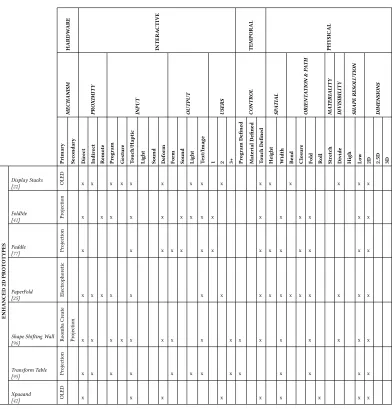
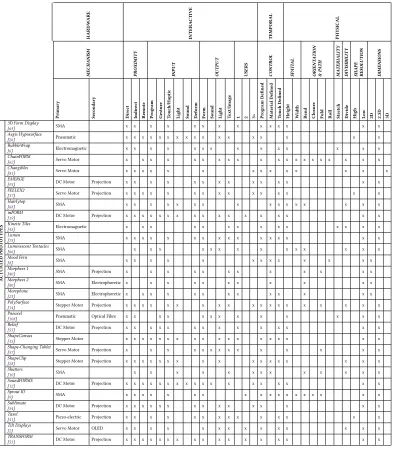
Table 1. Enhanced 2D prototypes comparison table based on the consolidated dimensions in Figure 2. HARD W ARE IN TERA CTI VE TEMPORAL PH YSICAL MECHANISM PROXIMI T Y INP U T OU TP U T USERS CON TROL SP A TIAL ORIEN T A TION & P A TH MA TERIALI T Y DI VISIBILI T Y SHAPE RESOLU TION DIMENSIONS Primar y Se condar y Dir e ct Indir e ct
Remote Program Gestur
e
T
ouch/Haptic
Light Sound Deform Form Sound Light Te
xt/Image
1 2 3+ Program
Define d Material Define d T ouch Define d
Height Width Bend Closur
e
Fold Roll Str
etch
Divide High Lo
w
2D 2.5D 3D
ENHANCED 2D PRO T O T YPES Display Stacks
[22] OLED x x x x x x x x x x x x x x x
FoldMe
[41] Pr
oje
ction
x x x x x x x x x x x x x x x
Paddle
[77] Pr
oje
ction
x x x x x x x x x x x x x x
PaperFold
[25] Ele
ctr
ophor
etic
x x x x x x x x x x x x x x x x
Shape Shifting Wall
[96] Ro omba Cr eate Pr oje ction
x x x x x x x x x x x x x x x x
Transform Table
[95] Pr
oje
ction
x x x x x x x x x x x x x
Xpaaand
[42] OLED x x x x x x x x x
These aspects and more must be designed for, or against: the application must be able to control the pace that is most conducive for its purpose.
4.6 Physical
The physical characteristics of shape change emerge as quite distinct from the consolidated di-mensions seen in Figure 1. Application of these didi-mensions to existing interface examples allows specific deformations to be noted and discussed. The physical changes of a surface range from the
basic (height/width/bend) to the complex (closure/divide).
Heightis the most commonly found change in actuated and material based deformations. It
is also applied as a change to those prototypes which make use of one axis, in one direction [26] as the same idea applies despite the change in orientation.
Width, on the other hand, requires a two-way expansion across a plane, regardless of direction.
This can be due to a stretch in the shape changing material from jamming for instance [72], or due
to a device having the capability to be unfolded, such as withPaddle[77].
Bend, is most common with flexible displays such asMorphees[80] where the thickness of the
OLED display or constraints of the SMA wires means that only a slight deformation of an otherwise 2D item is permissible.
Foldis closely related to closure – but the distinction lies between surface merely creasing and
the surface folding entirely in on itself. Reabsorption happens in the cases where a ferrofluid is
used (pBlob[104]) or edges meeting with a static surface (PaperFold[25]).
Rollalso often goes hand in hand with highly flexible static surfaces – the best example being
Xpaaandwhich is encased in rolls at either end [42].
Stretchis distinct fromwidth, as it implies an area expansion from baseline based on materiality
rather than simply displaying more of the same substrate. Stretchable materials are usually incidental
hardware (like latex) and used over actuators [29] or in jamming [84].
Dividesuggests either a modularity in actuators or components as seen inHairlytop[68],
Paper-Fold[25] andShapeClip[28] or where a solution can be split into parts and reunited as inpBlob
[104].Shutters[10] is an interesting hybrid, using folds and splitting simultaneously to allow for a
divided (or permeable) surface.
Resolutionrefers to shape-resolution as coined by Roudaut et al. [80] and incorporates the textural
element as discussed earlier in section 3 [69]. A high shape resolution is the same as a high pixel
resolution in that a 2 dimensional representation of a sphere on a low resolution screen would
show “squaring off” oraliasingaround the edges, whereas a low shape resolution sphere would
have angular blocks making up its surface. Liquid interfaces have high shape resolution due to fact they do not rely on set sized nodes as actuators do.
Dimensionfalls between 2D and 3D, referring to 2.5D as either a limited 3D display (i.e. one plane
of deformation only with projection as a separate construct) or as one where there is sufficient deformation possibility that the design-surface would need to allow for form if the display was to have an application design for it. 2D shape changing interfaces in this case are typically changing their area (width) but the design space is resolutely flat.
5 CATEGORISATION AND ANALYSIS OF PROTOTYPES
Following application of the previous consolidated dimensions to 84 existing prototypes, 8 distinct categories of prototypical device emerged based on the properties of the hardware and mechanism of the collected technologies. Physicality (hardware or primary mechanism) was the vital factor in assigning these categories as it had the most influence on user-interaction and shape-input/output. For example, a user interacts with an elastic interface in a very different way to an actuated interface (i.e. it is impossible to stretch a solid-state pneumatic pin).
The 8 categories are:Enhanced 2D(Table 1), Bendables(Table 2), Cloths & Papers(Table 3),
Elastics & Inflatables(Table 4),Actuated(Table 5),Liquids(Table 6),Malleables(Table 7) andHybrids
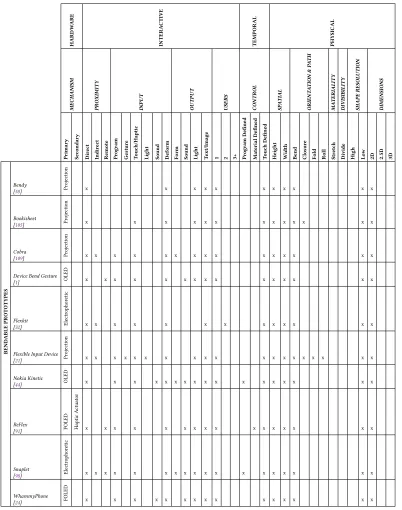
Table 2. Bendable prototypes comparison table based on the consolidated dimensions in Figure 2. HARD W ARE IN TERA CTI VE TEMPORAL PH YSICAL MECHANISM PROXIMI T Y INP U T OU TP U T USERS CON TROL SP A TIAL ORIEN T A TION & P A TH MA TERIALI T Y DI VISIBILI T Y SHAPE RESOLU TION DIMENSIONS Primar y Se condar y Dir e ct Indir e ct Remote Pr ogram Gestur e T ouch/Haptic
Light Sound Deform Form Sound Light Te
xt/Image
1 2 3+ Pr
ogram Define d Material Define d T ouch Define d
Height Width Bend Closur
e
Fold Roll Str
etch
Divide High Lo
w
2D 2.5D 3D
BEND ABLE PRO T O T YPES Bendy [58] Pr oje ction
x x x x x x x x x x x
Bookisheet
[105] Pr
oje
ction
x x x x x x x x x x x x x
Cobra
[109] Pr
oje
ction
x x x x x x x x x x x x x x x
Device Bend Gesture
[1] OLED x x x x x x x x x x x x x x x
Flexkit
[32] Ele
ctr
ophor
etic
x x x x x x x x x x x x x
Flexible Input Device
[21] Pr
oje
ction
x x x x x x x x x x x x x x x x x x x
Nokia Kinetic
[44] OLED x x x x x x x x x x x x x x x x x
ReFlex
[91] FOLED Haptic
A
ctuator
x x x x x x x x x x x x x x x x
Snaplet
[98] Ele
ctr
ophor
etic
x x x x x x x x x x x x x x x x x x
WhammyPhone
5.0.1 Enhanced 2D.Prototypes make use of multiple incidences of 2D screens which flex along either axis (see Table 1). Prototypes must have one or more screen or extra surface available which operates independently from its primary interface surface (see Figure 2.1 & Figure 3). The
primary method of shape-change is touch defined (with the exception ofTransformTable[95]).
Shape resolution is low.
These types of devices account for nearly 10% of the surveyed literature (7/84). Design for
Enhanced 2Dinterfaces should exploit multi-screen interactions or applications and either exploit
or avoid the ensuing perceptual angles allowed by such prototypes (such as when a geometric shape
such as a boat is constructed [23]). With regards to this, designers should also be a focus on user
perception over more than 2 screens, as well as number of users and how they communicate about differing screen-states during multiple use interactions. Single user scenarios fit more commonly
into existing device designs and therefore there are existing precedents (e.g.Nintendo DSTM).
5.0.2 Bendables. These devices have one display and interaction surface, but that surface has movement in terms of bend or flex at the corners, middle and edges (including twist) (Table 2). The image is essentially planar, and the shape-resolution low in comparison to the visual display, but the added emphasis on user interaction and programmed movement is how these prototypes
differ from theirEnhanced 2Dcounterparts. Design forBendableinterfaces is 2D single screen, with
additional movement as its key feature - creating multiple modes of interaction.
Bendablesaccount for just over 10% of the surveyed prototypes (10/84), largely focusing on
either input and interaction [105] or physical, unobtrusive notifications [58]. Physical changes in
shape to inform users of application states has links to theemotionalityin shape-change, which
has been explored in part by Rasmussen et al. [78,79]. The prospect of anthropomorphising our
user-interfaces adds a curious and exciting aspect to creating applications for shape-changing
interfaces. Design for aBendablealso largely needs to focus on mapping interactions and outputs
to the range of supported flexes for any given prototype (MorePhonesupports 17 interactions [23]).
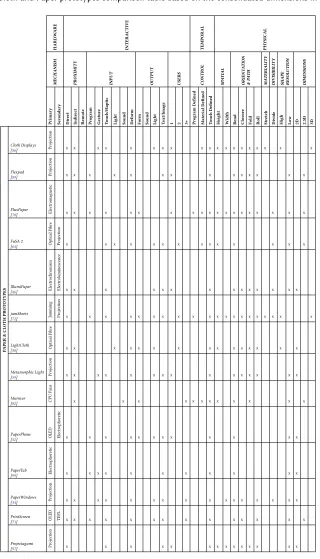
5.0.3 Papers & Cloths.Table 3 shows prototypes which fulfil the criteria ofPapers & Cloths.
These prototypes have one interaction surface, but are highly adaptive in terms of orientation and path, mimicking the characteristics of their non-interactive base-materials. Deformation is primarily user-controlled. These prototypes can borrow from web-design (in that re-flowable content to fit the visually available area is used) or be re-purposed into novel interface designs (wearables/furniture).
Around 16% of the prototypes in this summary arePapers & Cloths(14/84). Devices of this nature
would be beneficial in situations where they need to be portable, and condensed into small spaces for transport or covert use. For this reason they might be well-suited to multimedia applications where viewing size is important across a range of scenarios.
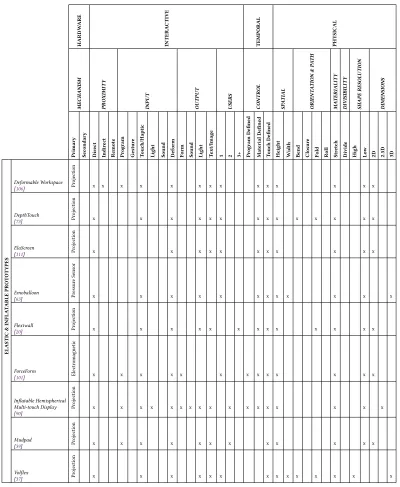
5.0.4 Elastics & Inflatables. Elastics & Inflatablesare deformable interfaces that are made up of
materials with built in stretch such asElascreen[111]. Control here is shared between the actor (user)
and the material (which has a high-speed return-to-baseline). These interfaces have an organic
appeal (such asEmoBalloon[63]) but usually have limited shape resolution (with the exception of
jamming interfaces [18]). LikeBendables, they can also exhibitemotionalcharacteristics.
Just over 10% of shape-changing prototypes exhibit criteria which assign them to this category
(9/84). Large scale elastic screens [100] suggest use cases such as exploration of data or gaming,
Table 3. Cloth and Paper prototypes comparison table based on the consolidated dimensions in Figure 2. HARD W ARE IN TERA CTI VE TEMPORAL PH YSICAL MECHANISM PROXIMI T Y INP U T OU TP U T USERS CON TROL SP A TIAL ORIEN T A TION & P A TH MA TERIALI T Y DI VISIBILI T Y SHAPE RESOLU TION DIMENSIONS Primar y Se condar y Dir e ct Indir e ct
Remote Program Gestur
e
T
ouch/Haptic
Light Sound Deform Form Sound Light Te
xt/Image
1 2 3+ Program
Define d Material Define d T ouch Define d
Height Width Bend Closur
e
Fold Roll Str
etch
Divide High Lo
w
2D 2.5D 3D
P APER & CLO TH PRO T O T YPES Cloth Displays [56] Pr oje ction
x x x x x x x x x x x x x x x x x x x
Flexpad
[89] Pr
oje
ction
x x x x x x x x x x x x x x
FluxPaper [70] Ele
ctr
omagnetic
x x x x x x x x x x x x x x x x x x x
FuSA 2 [64] Optical Fibr e Pr oje ction
x x x x x x x x x x x x x x
IllumiPaper [46] Ele ctr ochr omism Ele ctr oluminescence
x x x x x x x x x x x x x x
jamSheets [72] Jamming Pr
oje
ction
x x x x x x x x x x x x x x x x x x x x
LightCloth [30] Optical
Fibr
e
x x x x x x x x x x x x x x x
Metamorphic Light
[59] Pr
oje
ction
x x x x x x x x x x x x x x x
Murmur
[82] CP
U
Fans
x x x x x x x x x x x x
PaperPhone [52] OLED Ele
ctr
ophor
etic
x x x x x x x x x x x x
PaperTab [99] Ele
ctr
ophor
etic
x x x x x x x x x x x
PaperWindows
[34] Pr
oje
ction
x x x x x x x x x x x x x x x x
PrintScreen
[71] OLED TEFL x x x x x x x x x x x x x x
Projectagami
[97] Pr
oje
ction
Table 4. Elastic and Inflatable prototypes comparison table based on the consolidated dimensions in Figure 2. HARD W ARE IN TERA CTI VE TEMPORAL PH YSICAL MECHANISM PROXIMI T Y INP U T OU TP U T USERS CON TROL SP A TIAL ORIEN T A TION & P A TH MA TERIALI T Y DI VISIBILI T Y SHAPE RESOLU TION DIMENSIONS Primar y Se condar y Dir e ct Indir e ct
Remote Program Gestur
e
T
ouch/Haptic
Light Sound Deform Form Sound Light Te
xt/Image
1 2 3+ Program
Define d Material Define d T ouch Define d
Height Width Bend Closur
e
Fold Roll Str
etch
Divide High Lo
w
2D 2.5D 3D
ELASTIC & INFLA T ABLE PRO T O T YPES Deformable Workspace [106] Pr oje ction
x x x x x x x x x x x x x x
DepthTouch
[73] Pr
oje
ction
x x x x x x x x x x x x x x
ElaScreen
[111] Pr
oje
ction
x x x x x x x x x x x
Emoballoon
[63] Pr
essur
e
Sensor
x x x x x x x x x x x x
Flexiwall
[20] Pr
oje
ction
x x x x x x x x x x x x x
ForceForm
[101] Ele
ctr
omagnetic
x x x x x x x x x x x x x
Inflatable Hemispherical Multi-touch Display [90] Pr oje ction
x x x x x x x x x x x x x x x x x
Mudpad
[39] Pr
oje
ction
x x x x x x x x x x x x
Volflex
[37] Pr
oje
ction
x x x x x x x x x x x x x x
also have the potential to change their interaction area drastically, which would assist when multiple users need to collaborate on demand.
5.0.5 Actuated.Whilst the mechanics of each prototype are different, shape-change for these
covered with a material substrate to create an undulating surface [26]. Someactuatedprototypes
have visual displays built-in. These prototypes usually have one repeated movement (bi-directional) and a limited height from baseline (flattened plane).
Actuatedinterfaces make up the largest proportion of shape-changing interface prototypes at
just over a third of all those surveyed (29/84). This is likely because of the large variety of actuator types, outputs and ease with which each shape-pixel can be programmed to respond. As the largest
grouping,Actuatedinterfaces are also the most diverse – supporting current applications which
range from calm, environmental computing [8], to communicative architecture [10]. Researchers
have already begun to think around the problem of shape-pixels for actuated interfaces by adapting
an existing 3D programming language to allow for interaction and shape-change [107]. This is
a vital step in giving other researchers and application designers the tools they need to build meaningful interactions for such devices.
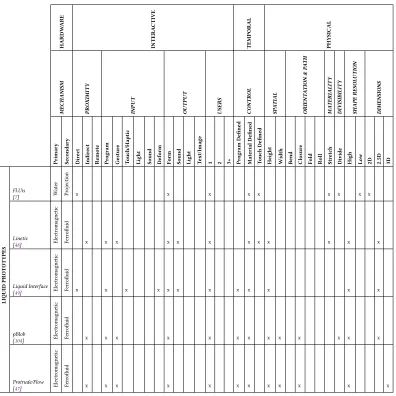
5.0.6 Liquids.Liquid prototypes are complex and span between highly organic 3D shapes and viscose 2D shapes. Interaction is mainly indirect, although some substrates allow the user to touch the surface of the interface. Despite apparent limitless parameters, the current prototypes support only selected output (namely shapes, or sounds). To keep a liquid in a rigid state, one must exert
continuous control, either via an indirect control device (such as a magnetic ring [48]) or via the
programming of the control mechanism (usually electromagnetic).
Liquidsaccount for the smallest number of single category prototypes in this area (5/84) - this
is possibly due to the complexity of programming interactions and exerting control over such substrates. Despite this complexity, the potential in this area is unbounded. Potential focus might
be on increasing direct interaction possibilities - such as through hybridisation withjamming[18].
5.0.7 Malleables.Malleablesare clay-like or jamming substrates that afford the user a pliable,
deformable surface with which to create high shape-resolution forms. Jamming does not take centre-stage here, as other materials have been used to create the same rigidity and control (e.g.
Tunable Clay[18]). These prototypes have multi-dimensional input/output, but rely mainly on
projection to supply equally high resolution graphics.
Malleableinterfaces also represent only a small number of the surveyed technologies at under
10% (7/78). Despite having high shape-resolution, the reliance on projection for visualising complex graphics means that these devices are not, as of yet, portable. In their current state, they are best suited to permanent installations or interactive multiple-user scenarios.
5.0.8 Hybrids.Hybrid interfaces are relatively new in the field, and combine two (with the
potential for more) of the former categories to create the interaction surface. This suggests that this category has more of an overarching nature, and could be addressed as such, however, given
the limited data we have on these they are shown as a final, complex category. BothTableHop[83],
Obake[13] and the second iteration ofMephistophone[31] combine anactuatedbase with an elasticsurface to create additional methods for user interaction. This layering up of mechanisms
is reminiscent of Seah et al’s [87] space-suit glove prototype which enables those in sealed suits
to experience physical textures – however, much attention has been given in the three hybrid
prototypes to the complexity of interactionbetweenlayers and in combination. Table 8 shows an
overview the current Hybrid interfaces.
Although some other of the included prototypes already make use of some materials from
other categories (eg.Projectionis used across the board), these prototypes do not fully support
the features of both categories at present, whereas thehybridexamples given here enable users
Table 5. Actuated prototypes comparison table based on the consolidated dimensions in Figure 2. HARD W ARE IN TERA CTI VE TEMPORAL PH YSICAL MECHANISM PROXIMI T Y INP U T OU TP U T USERS CON TROL SP A TIAL ORIEN T A TION & P A TH MA TERIALI T Y DI VISIBILI T Y SHAPE RESOLU TION DIMENSIONS Primar y Se condar y Dir e ct Indir e ct
Remote Program Gestur
e
T
ouch/Haptic Light Sound Deform Form Sound Light Text/Image 1 2 3+ Program
Define d Material Define d T ouch Define d
Height Width Bend Closur
e
Fold Roll Str
etch
Divide High Low 2D 2.5D 3D
A CT U A TED PRO T O T YPES
3D Form Display
[65] SMA x x x x x x x x x x x x x x
Aegis Hyposurface
[26] Pneumatic x x x x x x x x x x x x x x x x x
BubbleWrap
[6] Electromagnetic x x x x x x x x x x x x x x
ChainFORM
[62] Servo Motor x x x x x x x x x x x x x x x x x x x x
Changibles
[81] Servo Motor x x x x x x x x x x x x x x
EMERGE
[93] DC Motor Projection x x x x x x x x x x x x x x
FEELEX2
[37] Servo Motor Projection x x x x x x x x x x x x x x x
Hairlytop
[68] SMA x x x x x x x x x x x x x x x x
inFORM
[19] DC Motor Projection x x x x x x x x x x x x x x x x x
Kinetic Tiles
[45] Electromagnetic x x x x x x x x x x x x x x
Lumen
[75] SMA x x x x x x x x x x x x x x x x
Luminescent Tentacles
[66] SMA x x x x x x x x x x x x x x
Mood Fern
[8] SMA x x x x x x x x x x x x x
Morphees 1
[80] SMA Projection x x x x x x x x x x x x
Morphees 2
[80] SMA Electrophoretic x x x x x x x x x x x
Morephone
[23] SMA Electrophoretic x x x x x x x x x x x x x
PolySurface
[14] Stepper Motor Projection x x x x x x x x x x x x x x x x x x x
Pneuxel
[108] Pneumatic Optical Fibre x x x x x x x x x x x x x
Relief
[55] DC Motor Projection x x x x x x x x x x x x x x
ShapeCanvas
[15] Stepper Motor x x x x x x x x x x x x x x x x x x
Shape-Changing Tablet
[57] Servo Motor Projection x x x x x x x x x x x x x x
ShapeClip
[28] Stepper Motor Projection x x x x x x x x x x x x x x x x x
Shutters
[10] SMA x x x x x x x x x x x x x
SoundFORMS
[12] DC Motor Projection x x x x x x x x x x x x x x x x x x
Sprout IO
[9] SMA x x x x x x x x x x x x x x x x x x
Sublimate
[54] DC Motor Projection x x x x x x x x x x x x x x x
Taxel
[51] Piezo-electric Projection x x x x x x x x x x x x x x
Tilt Displays
[2] Servo Motor OLED x x x x x x x x x x x x x x
TRANSFORM
[53] DC Motor Projection x x x x x x x x x x x x x x x x x
The implications for application design for hybrids are that the interaction possibilities become extremely complex, cross different modalities, temporalities, and can support multiple users in each – potentially at the same time. The potential for mismatch, both interactive and perceptual, is such
Table 6. Liquid prototypes comparison table based on the consolidated dimensions in Figure 2. HARD W ARE IN TERA CTI VE TEMPORAL PH YSICAL MECHANISM PROXIMI T Y INP U T OU TP U T USERS CON TROL SP A TIAL ORIEN T A TION & P A TH MA TERIALI T Y DI VISIBILI T Y SHAPE RESOLU TION DIMENSIONS Primar y Se condar y Dir e ct Indir e ct
Remote Program Gestur
e
T
ouch/Haptic
Light Sound Deform Form Sound Light Te
xt/Image
1 2 3+ Program
Define d Material Define d T ouch Define d
Height Width Bend Closur
e
Fold Roll Str
etch
Divide High Lo
w
2D 2.5D 3D
LIQUID PRO T O T YPES Fl.Uis [7] W ater Pr oje ction
x x x x x x x x x
Linetic [48] Ele ctr omagnetic Ferr ofluid
x x x x x x x x x x x x
Liquid Interface [49] Ele ctr omagnetic Ferr ofluid
x x x x x x x x x x x x
pBlob [104] Ele ctr omagnetic Ferr ofluid
x x x x x x x x x x x x x
Protrude/Flow [47] Ele ctr omagnetic Ferr ofluid
x x x x x x x x x x x x
5.1 Categorisation Summary
The current state-of-the-art is largely represented by this categorisation of shape-changing inter-faces (Tables 1-8). The field as a whole however, is constantly evolving – and there may be additions or whole new categories within a relatively short space of time. Each interface category has its strengths and weaknesses, and these are continually evolving, making designing for such structures an iterative process. Many research papers suggest future design modifications for their existing prototypes, and it is these which enrich and take the field forward.
Table 7. Malleable prototypes comparison table based on the consolidated dimensions in Figure 2. HARD W ARE IN TERA CTI VE TEMPORAL PH YSICAL MECHANISM PROXIMI T Y INP U T OU TP U T USERS CON TROL SP A TIAL ORIEN T A TION & P A TH MA TERIALI T Y DI VISIBILI T Y SHAPE RESOLU TION DIMENSIONS Primar y Se condar y Dir e ct Indir e ct Remote Pr ogram Gestur e T ouch/Haptic
Light Sound Deform Form Sound Light Te
xt/Image
1 2 3+ Pr
ogram Define d Material Define d T ouch Define d
Height Width Bend Closur
e
Fold Roll Str
etch
Divide High Lo
w
2D 2.5D 3D
MALLEABLE PRO T O T YPES ClaytricSurface
[84] Jamming Pr
oje
ction
x x x x x x x x x x x x x x x x x x x x
deForm
[17] Clay Pr
oje
ction
x x x x x x x x x x x x x x
Illuminating Clay
[74] Plastiscene Pr
oje
ction
[image:19.486.47.443.104.524.2]x x x x x x x x x x x x x x x x x
GelTouch [60] Thermor esp onsiv e Hy dr ogel
Tablet x x x x x x x x x x x x x x x x x x
Malleable Surface Touch Interface
[103] Pr
oje
ction
x x x x x x x x x x x x
Sandscape [36] Glass Beads Pr oje ction
x x x x x x x x x x x x x
Tunable Clay
[18] Jamming Pr
oje
ction
x x x x x x x x x x x x x x x x x
5.1.1 The Problem with Projection. Over half of all prototypes included in this dataset rely on
one form or another of projection, e.g. backlit as withTableHop[83] or, more commonly, top-lit as
is the case withMetamorphic Light[59]. The overuse of projection to achieve detailed imagery or
interaction shows that there is a need to put more resources into embedded displays and shows the immaturity of the field in that respect – or that there is a need for advanced materials that
have not yet been developed, or are currently being developed, such as Yokota et al.’sUltraflexible
organic photonic skin[110]. Embedding high quality displays into shape-changing devices would
create a seamless user-experience that is lacking in current prototypes, enhancing the notion of the
phygital(combining physical and digital into one): Projection is a useful tool for rapid prototyping,
Table 8. Hybrid prototypes comparison table based on the consolidated dimensions in Figure 2. HARD W ARE IN TERA CTI VE TEMPORAL PH YSICAL MECHANISM PROXIMI T Y INP U T OU TP U T USERS CON TROL SP A TIAL ORIEN T A TION & P A TH MA TERIALI T Y DI VISIBILI T Y SHAPE RESOLU TION DIMENSIONS Primar y Se condar y Dir e ct Indir e ct Remote Pr ogram Gestur e T ouch/Haptic
Light Sound Deform Form Sound Light Te
xt/Image
1 2 3+ Pr
ogram Define d Material Define d T ouch Define d
Height Width Bend Closur
e
Fold Roll Str
etch
Divide High Lo
w
2D 2.5D 3D
H YBRID PRO T O T YPES Bioacoustic Cognition [31] Ser vo Motor Pr oje ction
x x x x x x x x x x x x x x x x x x
Obake
[13] Linear Pr
oje
ction
[image:20.486.46.445.104.374.2]x x x x x x x x x x x x x x x x x x x x
TableHop [83] IT O Array Pr oje ction
x x x x x x x x x x x x x x x x x x x
makes prototypes bulky and difficult to transport both when top and bottom-lit – meaning it is more difficult to get these devices out of the laboratory for meaningful testing, and that they will be unlikely to go into commercial development and production in their current form.
5.1.2 Multi-dimensional Change.Hardware and mechanism limitations can also effect the
in-teractive qualities of devices. Poupyrev’s notion ofRGBH shape-pixels[76] reflects the current
state of play, but does not leave space for the exploration of multi-dimensional change. As an example, actuated interfaces can always display height, but very rarely does this combine with the type of shape-change in the orientation/path category. To attempt to expand on the interactions available to this subset of interfaces, combining the properties of a paper or cloth interface with the mechanised movement of an actuated interface would give rise to some novel data, e.g. using paper-style creases alongside the fluidity of cloth, with the rigidity and movement of actuated shape-pixels.
5.1.3 Number of Users.User data across the categories shows that just over half of all the prototypes analysed are developed for single users, although there is still a significant number which do support 3 or more users. This is likely in most cases to be a constraint of size, lack of divisibility, or difficulties in enabling multiple users to interact on the same surface. Collaborative usage and shape-changing interaction on these interfaces has not yet been well documented, and relates to the complexities of perception which are discussed later.
5.1.4 Control.With regards to temporality and control, there is a tendency for the user to
be the primary locus of control of speed for most prototypes (around 84%), e.g. withBendable
the 84% also support multiply defined methods of control). The reasoning behind this could be that the user exerts primary control over shape-change merely because the materials used in such prototypes are not yet complex (e.g. paper or elastic rather than integrated hybrid forms with progammable actuated components) – however, given the importance of the user in any advancement in interaction design for shape-change, focusing on retaining the user as the primary factor in temporal control should be important to researchers.
6 DISCUSSION
The story of shape change so far is one of prototyping within existing technological constraints. By creating content for that which we have now, we will be able to lay the groundwork for a
future shape-changing application design. With Ishii’s [35] vision-driven design we look to the
future, but this can happen only when we have truly understood the present. Whereas Kwak’s
framework [50] supports design engagement for shape change via tangible models, it is not based
upon contemporary research prototypes. In contrast, Ishii works around existing technology to speculate as to the future of shape-changing interfaces. It is from/with Kwak’s explorations and toward Ishii’s speculation into which this paper places itself.
6.1 Supporting Application Design
The categorisations supplied in this paper break down the current state-of-the-art into clear boundaries. Therefore, a designer making an application for any existing interface will be able to look to the associated attributes and supported features, and sketch an outline for what must be
considered during the iterative design process. For anactuatedinterface, for example, one must
consider how many shape-pixels are available, the speed with which these are required to move to communicate the application’s intent, the level of visual detail supported, and so on.
To elaborate, for those wishing to apply the framework in context of interface design, it is suggested that those using the classification query the intended outcome of the research – for example – What is the desired interaction in mind – and therefore what type of actuation best suits this outcome? A study wishing to analyse latency on moving pins would almost certainly need bi-directional actuators, whereas a study examining calm computing and peripheral shape-change might wish to examine the biological movements of natto cells or SMAs. Alternatively, if there is a platform in mind but not the knowledge of the types of user interaction required to enable user-testing then the researcher might look at number of users and the types of input and output supported.
The taxonomy can be interrogated in varying degrees depending on the nature of the research, although it should also be noted that there is a "trade off" between different types of shape-changing interface, which is another factor that can be easily seen from the available data. To provide an example in context of the latter, if you require an approximation of natural movement then you would almost certainly use natto cells or SMAs in lieu of servo motors. Another example of "trading off" could be choosing between hardware types within one category - i.e. if you require
the portability of shape-clips but the advanced material properties ofTransform(recently examined
by [62]) you will need to decide which property is more salient for the research at hand.
Table 9. Category summary of Prototypical Shape-Changing Interfaces showing totals across the consolidated dimensions.
PROTOTYPE CATEGORY
Enhance
d
2D
Bendable Pap
er/Cloth
Elastic/ Inf
latable
A
ctuate
d
Liquid Malleable Hybrid TOTAL
7 10 14 9 29 5 7 3 84
MECHANISM
Clay 1 1
CPU Fans 1 1
DC Motor 6 6
Electromagnetic 1 1 2 4 8
Electroluminescent 1 1
Electrochromism 1 1
Electrophoretic 1 2 2 2 7
Ferrofluid 1 4 5
FOLED 2 2
Glass Beads 1 1
Haptic Actuator 1 1
ITO Array 1 1
Jamming 1 2 3
Linear Actuator 1 1
OLED 2 2 2 1 7
Optical Fibre 2 1 3
Piezoelectric 1 1
Plasticine 1 1
Pneumatic 2 2
Pressure Sensor 1 1
Projection 4 4 7 6 12 1 6 3 43
Servo Motor 5 1 6
SMA 10 10
Stepper Motor 3 3
Tablet 1 1
TEFL 1 1
Thermoresponsive Hydrogel 1 1
Water 1 1
PROXIMITY
Direct 7 10 13 9 27 2 7 3 78
Indirect 4 4 9 1 23 3 5 2 51
Remote 2 3 15 1 1 22
INPUT
Program 5 8 6 4 28 4 3 3 61
Gesture 2 1 4 10 3 2 22
Touch/Haptic 7 9 11 8 26 1 6 3 71
Light 1 3 1 9 5 19
Sound 2 1 2 2 7
Deform 5 10 12 9 21 1 7 3 68
OUTPUT
Form 3 3 5 2 29 5 4 3 54
Sound 2 5 1 5 2 1 16
Light 3 9 9 8 18 6 2 55
Text/Image 6 10 11 7 19 4 3 60
USERS
1 2 9 7 6 15 5 3 47
2 3 1 3 2 4 13
3+ 2 4 1 10 4 3 24
CONTROL
Program Defined 2 2 3 2 25 3 3 2 42
Material Defined 1 4 7 13 5 6 3 39
Touch Defined 6 10 14 9 20 2 7 3 71
SPATIAL Height 3 10 7 9 24 4 7 3 67
Width 6 10 5 2 5 2 3 1 34
ORIENTATION & PATH
Bend 2 10 14 2 10 3 3 44
Closure 3 1 10 2 2 1 1 20
Fold 5 1 9 3 6 5 1 30
Roll 1 1 10 2 14
MATERIALITY Stretch 2 9 3 2 6 3 25
DIVISIBILITY Divide 3 5 9 2 1 20
SHAPE RESOLUTION High 3 1 3 4 6 1 18
Low 7 10 11 8 26 1 1 2 66
DIMENSIONS
2D 7 10 7 6 4 1 35
2.5D 5 1 24 3 5 3 41
[image:22.486.85.400.112.662.2]6.2 Limitation in Design
A successful multi-dimensional application designer must not only design for the capacities of shape change but against the limitations imposed by the hardware of the device (it must conform
or have constraints [35]). These limiters actually reign in the design space, and offer a firm ground
from which to work backwards from. A future where devices have unlimited dimensional potential
(such as Ishii’sPerfect Red[35]) must be built up to, working toward a theory of content on the
lower fidelity devices first. Limitations are not merely device specific however, they can be built in as the program requires – working as areas of rigidity or non-interaction, like the background of a website around a clickable link. The challenge of programmed rigidity is not only one of hardware, but also of temporality – how quickly a force limiter is made or released can affect the users’ experience of an application, not to mention interface safety. An exception to rigidity might be for a free-form sculpting application. Hardware limiters include (but are not exclusive to) the following:
Distance from baseline: Several studies state the total usable height [28] or width of their
de-vice [42]. For material based interactions, total distance from baseline must be calculated from the
maximum stretch or available slack of the surface at one point at any given time.
Shape-resolution: As discussed in the previous section, deformation limiters are based on the type
of device for which the application is being designed for. The lower shape resolution but highly interactive devices have narrow limits in comparison to the high resolution liquid shape displays.
Image resolution: Based on the image resolution of the device – a block-pixel image will afford a
narrow design space with which to work with, whereas a projected, high resolution image will interact in multiple ways with areas of height and deformation, and present a challenge for users
utilizing multiple viewing angles [76].
Stretch: An important consideration when designing for areas of rigidity: rigid areas may limit
the deformation of surrounding interaction zones. Stretch ensures that deformation is still possible between closely spaced rigid objects.
Temporality: Speed of change is sometimes limited by the hardware (such as with motorized
actuators), and so will need to be built into design considerations. Maximum and minimum speeds for deformation should be made available to the designer, or tested prior to finalizing applications.
Holman [32] mentions the current limitations of readily available electrophoretic displays (less
than 1fps) and how designing for such device displays requires advanced programming knowledge. If this knowledge is lacking, the rapid development of applications will suffer. This supports research
in which those in the arts are encouraged to learn to code [88] and vice versa [16]. This new space
of shape changing interaction design requires a new generation of multi-skilled designer-makers – it is possibly not enough to simply be a competent developer or designer when new technology stretches the limits of imagination.
6.3 Future Use Cases
Application of shape-changing prototypes is so far mostly limited to improving items we already have in 2D such as phones, tablets and worktops. Those prototypes looking at shape construction begin to imply a new way of using form and interaction, however, user-driven research is needed to identify new types of interactive shape-changing product where need or desire exists. Following Bannon’s call for a more “human-centred perspective” on HCI, Sturdee et al. carried out a study
using a participant pool taken from the general public [92] and found that a range of
Table 10. Summary of the features, limitations and current use cases of Prototypical Shape-changing Inter-faces.
Prototype Primary Feature Limitation Current Use Cases
Enhanced 2D Multi-screen Inflexible Phone /Tablet
Bendable User-Interaction Low Shape-Resolution Phone /Tablet
Paper/Cloth Orientation User-Defined Temporality Phone /Tablet/Workspace
Elastic/Inflatable Stretch/Emotionality Material-Defined Temporality Emotional Communication/Workspace Actuated Bi-Directionality Low Shape-Resolution Physical Telepresence/Wrapped Interfaces Liquid High-Malleability Low User-Control Artistic Installation
Malleable High Shape-Resolution Projection-based Graphics Workspace
Hybrid Complex Interaction No full 3D version Information Visualisation
As the field develops, we may need to re-imagine the interface as something beyond the tablets and mobile-phones that we use today. Wearables and Internet-of-Things technology bring con-nectivity to the familiar and often mundane, whereas adaptive architecture (e.g. Schnadelbach’s
ExoBuilding[86]) turns our living space into an opportunity for interaction. Within shape-change, BubbleWrap[6] looks toward creating a technology that can be wrapped around anything to create
an on-demand interface. This is not the only example of future-use cases being highlighted in papers - others suggest the next iteration of their device as they write up the first, and some, like
Ishii [35] employ design fictions to envisage the future. It is because of this that it is likely that
interaction-driven rather than device-driven application design is likely to take priority in the
future, and hence developing user-experience design for this field is an important step.
6.4 User-Experience and Emotionality
User-centred design is a mature field and well applied in designing current interfaces and applica-tions, but is only just beginning to take the fore in shape-change literature. Most shape-changing prototypes are highly tangible, and usually support multi-sensory input or output. This means that the user must learn a new set of skills to interact with such technologies, alongside their
existing knowledge. The prototypes discussed here also have the added factor ofemotionality, that
is, that movement and shape-change can create an affective response. Deployment “in the wild”
of shape-changing devices has been studied, (such as in theShape-Changing Bench[78]), and it
is Rasmussen who is attempting to bring focus onto user-experience in this field. To successfully create applications for these “magical” devices, designer, researcher and user must collaborate in first developing a novel practice of user-experience.
6.5 Perception
Few researchers make the connection between actuation, and altered perceptive state. Poupyrev,
however [76] mentions that differing viewing angles will alter the experience, suggesting user
mobility and/or display adaptation as a solution, touching briefly upon the idea that the display could alter to make perception easier from multiple locations, which also relates back to optical illusions (such as distorted advertising blocks on football pitches which appear square when seen from a remote camera).
Fig. 4. Possible development of Shape-Pixel states based on RGB-H principle [76]
6.6 Ethical Considerations
If our computers become tangible, we open up ourselves to the notion of unwanted tangible
interaction, perhaps unbidden, in the case of 3D spam [61]. Chat rooms become a step more
dangerous for our children, as the unknown quantity of remote touch becomes possible. Control
thus becomes more important – ifAegisHyposurface[26] can move at speeds of 100kph, how can we
design to prevent injury? Can closure of a surface cause trapped fingers – will there be a safety cut off? This extra concern must be incorporated into design – physical safety adds an extra dimension of concern for designers – something that is not currently needed for 2D displays.
6.7 Future work
The field of shape-changing interface prototypes as it currently stands is outlined in detail in this paper. At the time of writing, researchers are already beginning to combine mechanisms and
interactions between prototypes to create hybridised interfaces [13,31,83]. This suggests that a
logical step forward for some researchers would be to combine the characteristics between other current prototypes to create high-fidelity and multiple-interaction supporting shape-changing interfaces.
Hybrids are capable of both sets of interactions, and thus present a more complex design space that must be built from the specifications of the component hardware. Future shape-changing interfaces are likely to incorporate even more aspects of the prototypes seen here, and whereas interaction and applications can be anticipated from the design for their predecessors to some extent, the design space where all interactions are possible registers and even more complex problem to users, researchers and designers. It is hoped that this categorisation of existing prototypes might prompt collaborative work between referenced groups to create such hybrids, and also bring designers on board to test their application potential.
Poupyrev discusses the notion of RGBH graphics, where colour information is as we expect to
find in GUIs, but with pixel height as an added numerical component [76]. Although a logical step
for actuated displays, for a shape-changing display to be truly malleable, it must not only move on one axis, but several – turning corners, expanding or folding into itself. It would therefore make
sense to use the RGB-H space, but replace ‘H’ withn, wherenrepresents a different dimensional
change in shape pixel state (see Figure 4 for examples of possible iterations based upon RGB-H). This idea of advanced shape-pixels is far from being realized, but could be expanded on via further reasearch.
The community surrounding these advances is often a highly specialized base of researchers
and students, and as such user testing and the resulting inferences might be biased. Bannon [5]
mentions that the ‘human’ side of HCI has been lacking in recent years, and Rasmussen [79] calls for


![GelTouch[Thermoresponsive Hydrogel60]Tablet](https://thumb-us.123doks.com/thumbv2/123dok_us/9350512.437111/19.486.47.443.104.524/geltouch-thermoresponsive-hydrogel-tablet.webp)
