© 2019, IRJET | Impact Factor value: 7.211 | ISO 9001:2008 Certified Journal
| Page 7671
Indoor Positioning System
Priyanka Rajmane
1, Hrishikesh Borkar
2, Aakash Jadhav
3, Vipul Jadhav
4, Arjun Shinde
51
Assistant Professor, Department of Computer Engineering, M. E. S. College of Engineering
2,3,4,5
Student, Department of Computer Engineering, M. E. S. College of Engineering,
Pune, India
---***---Abstract - This paper elaborates the implementation of Indoor Positioning System using Wi-Fi fingerprinting technique in android application. It also provides detail information about the design, architecture, algorithm, User interface of our indoor positioning system in android. Indoor location-based services a booming topic of research. Many technologies have been proposed to solved this issue. We have studied many of these technologies and decided to use wi-fi fingerprinting considering all of its advantages like cost effectiveness and use of existing wi-fi infrastructure in the system. Also, Wi-Fi fingerprinting does not require line of sight with Wi-Fi access points. We compare the performance of our system with already existing systems that use other technologies (e.g. Bluetooth Beacons, RFID etc.). As we have implemented Indoor Positioning System for our college building which already have Wi-Fi access points installed at multiple location with high bandwidth is the reason why we decided to use Wi-Fi Fingerprinting in our System.
Key Words: Indoor Positioning System, Wi-Fi Access
Points (Aps), Wi-Fi Fingerprinting, RSSI.
1. INTRODUCTION
With the rapid development of mobile communication and the pervasive computing technology, the requirement of obtaining location-aware services is rapidly increasing. Dramatic performance improvements in mobile communications standards have propelled mobile technology to become the fastest adopted technology of all times. Mobile network infrastructure costs have also fallen dramatically, while performance has soared.
Nowadays, the Global Positioning System (GPS) can provide accurate and reliable position information for location services. GPS cannot be used effectively under indoor environment since there is a signal degradation. In closed environment. GPS signals from satellite are weak as it is blocked by the buildings structure itself. Thus, various positioning-enabled sensors such as GPS receivers, accelerometers, gyroscopes, digital compasses, cameras, Wi-Fi etc. have been built in smartphones for communication, entertainment and location-based services.
Indoor localization systems employ a wide range of different technologies. [1] These systems could use any combination of the following:
• Infrared
• Radio frequency identification (RFID) • Bluetooth
• Camera
• Sound (ultra-sound or audible sound) • Wi-Fi
1.1 Infrared
Infrared radiation (IR) is a commonly used wireless technology used to localize objects or entities. Indoor Positioning System with IR consists of infrared receiver and transmitter placed in specific positions of the building. Emitter transmits IR waves which are received by the receiver after obstructed by the objects. receivers communicate to the algorithm used for localization that calculates position based on the distance and angle between the objects and the receiver.
1.2 RFID
Radio Frequency Identification (RFID) is a technology that has a great potential for quick responsive system. the ability to identify, locate and track information makes RFID an impressive technology. RFID, consists of RFID tags, RFID reader (reader contains multiple RFID reader antenna), RFID Base Station. RFID reader is equipped with the moving objects and the tags are distributed in the premises.
1.3 Bluetooth
Bluetooth. Beacons [2] are placed at several positions in the building and via Bluetooth they send signals to moving devices and thus it is possible to determine their position continuously and transmit it to the indoor positioning system (IPS). This technology offers significant advantage in the buildings that do not have pre-installed Wi-Fi infrastructure. Bluetooth beacons are costly if used in large quantities.
1.4 Camera
© 2019, IRJET | Impact Factor value: 7.211 | ISO 9001:2008 Certified Journal
| Page 7672
depending on the landmarks in environments localization can be performed.
1.5 Wi-Fi
This is the most widely used technology because most of the buildings are preinstalled with the wireless Wi-Fi Access Points, [5] which makes the system cost effective. Most smart phones are inbuilt with Wi-Fi adapter for connecting to wireless APs. This is the main reason why we have selected Wi-Fi as our have technologies for this project. Even though the Bluetooth Is as efficient as Wi-Fi but it is not pre-installed like Wi-Fi hence it is costly to use.
Technolog
y Location Accuracy Range Cost
GPS Outdoor 5-20 m World
wide Low Wi-Fi Indoor/
Outdoor 5-15 m <150 m Medium Bluetooth Indoor/
Outdoor 1-3 m <30 m High RFID Indoor <10 cm <100 m High Camera Indoor <50 cm <8 m High
Fig 1. Comparison between IPS technologies.
2. SYSTEM ARCHITECTURE
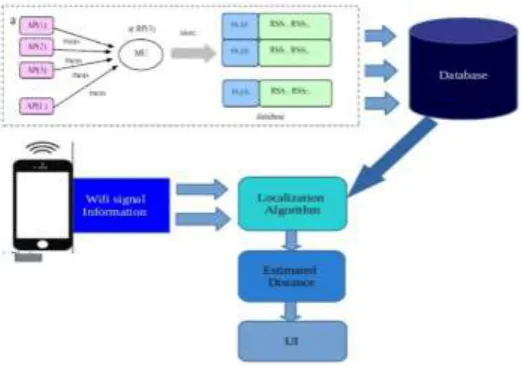
The system architecture consists of Mobile Unit, Wi-Fi fingerprinting, Database, Localization Algorithms, Map/UI. [6] System has two phases, one is Wi-Fi fingerprinting phase, second is query phase. In fingerprinting phase, a site survey is conducted to collect received signal strength of all detected Wi-Fi access points at many reference points of known location.
Fig 2. System Architecture
All the RSS vector from fingerprinting are stored in an online database. In query phase user measures an RSS vector as his position and sends it to localization algorithm. The algorithm compares this received vector with the fingerprints stored in database. The user location is estimated based on similar neighbors.
There are few terms we need to understand before moving forward.
1.Access Points:
It is a networking device that allows a Wi-Fi enabled device to connect to a wired network. For e.g., Wi-Fi routers.
2.RSS:
It is a measurement of how well your device can hear a signal from an access point or router. It is a value that is useful to determine if you have enough signal to get a good wireless connection.
3.BSSID:
Basic service set identifier which is used to uniquely identify the Wi-Fi enabled device
4.WLAN:
It is a wireless computer network that links two or more devices using wireless communication within a limited area such as a home, school, computer laboratory, or office building. 802. IEEE 802.11 standards: It refers to the set of standards that define communication for wireless LANs (wireless local area networks, or WLANs).
2.1 Components of the System
1.Wi-Fi fingerprinting
It is the first and most important step for the successful working of this system. This step is abstracted from the user and implemented by the developers. [3] Wi-Fi fingerprinting fetches the received signal strengths from nearby and authorized access points. This fetched signal strength is stored as an object along with x, y coordinates of the position on map in online database. The fingerprinting method is based on the relationship between a given location and its corresponding radio signature.
It’s been observed that points with a certain minimum distance between them and spread over the area of interest possess a unique set of RSSs [7] readings from APs and this is referred to as the fingerprint for that location.
2. Mobile Unit
[image:2.595.37.298.558.741.2]© 2019, IRJET | Impact Factor value: 7.211 | ISO 9001:2008 Certified Journal
| Page 7673
Basic service set identifier (BSSID), Frequency, Received Signal Strength (RSS-Level).
3. Database
The received signal strengths from the first step are stored in the database and we are using firebase service
Firebase is Google's mobile platform that helps you quickly develop high-quality apps and grow your business. [8] Firebase is built on Google infrastructure and scales automatically, for even the largest apps.
Object of firebase contains the BSSID, RSS, X-Y coordinates of the position. BSSID gives the unique id of access point where RSS is the received signal strength from the access point. While creation of database objects the developer has to double tap on the screen of android application which fetches the x-y coordinates, BSSID, RSS and stores in the online database. Double tap internally implemented by the listener and a stable internet connection is required to fetch the related contents.
Fig 3. Snapshot from the firebase database
4. Localization Algorithm
It uses both data from Mobile unit and Online Database when user enters in premises mobile application will execute the algorithm.
Algorithms [4] works in following steps:
Step 1: The Mobile Unit start scanning and fetches nearby authorized access points
Step 2: Create a vector from scanned data.
Step 3: The created vector is compared with fingerprinted data which is stored on online database.
Step 4: Finds similarity between current vector and stored neighbors in database using Euclidian distance method Step 5: Estimate user’s current location co-ordinates based on neighbors’ co-ordinates.
5.User Interface
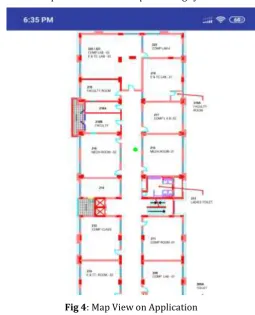
The means by which the user interacts with the system. Map is basic requirement for indoor positioning system.
Fig 4: Map View on Application
Image view is used to display the floor plans of the college building. Current position of the user will display on Image View via green dot.
3. RESULTS
Test Scenario 1: Single Readings from One Room Test
point Actual Co-ordinates
Calculated
Co-ordinates
Acceptab le
X Y X Y
1 370 73 325 94 YES
[image:3.595.302.558.245.561.2] [image:3.595.37.285.359.639.2]© 2019, IRJET | Impact Factor value: 7.211 | ISO 9001:2008 Certified Journal
| Page 7674
3 378 576 106 971 NO
4 678 918 702 920 YES
5 372 957 120 502 NO
6 685 1124 609 1198 YES
7 386 1236 299 1189 YES
8 651 1343 1002 1391 NO
9 385 1462 385 1488 YES
10 369 1546 307 1555 YES
11 666 1620 123 1206 NO
12 425 1751 479 1723 YES
13 676 1798 641 1750 YES
14 391 1960 380 890 NO
15 518 2006 610 1977 YES
Total Matching Rate = 10/15 * 100 = 66.67%
The result of the system is mentioned above in tables. The Actual location stands for the location on which we are testing the App and the location returned by the App is under location evaluated from the App in positioning phase. All the location values are approximated to the nearest integers. The acceptable column is judged by how much offset distance both the readings have. If it is greater than twice the interval, then it’s not acceptable.
Test scenario 1 has the match rate of 66.67% which is not acceptable. Single reading from the one room taken into consideration for the calculation of match rate.
Test scenario 2 has best match rate of 80% which is acceptable. Multiple readings from the one room taken into consideration for the calculation of match rate which can be improved by taking more readings at one room.
Test Scenario 2: Multiple Readings from One Room Test
point Actual Co-ordinates
Calculated
Co-ordinates
Acceptab le
X Y X Y
1 370 73 325 94 YES
2 665 334 650 398 YES
3 378 576 106 971 NO
4 678 918 702 920 YES
5 372 957 120 502 NO
6 685 1124 609 1198 YES
7 386 1236 299 1189 YES
8 651 1343 768 1321 YES
9 385 1462 385 1488 YES
10 369 1546 307 1555 YES
11 666 1620 698 1568 YES
12 425 1751 479 1723 YES
13 676 1798 641 1750 YES
14 391 1960 380 890 NO
15 518 2006 610 1977 YES
Total Matching Rate = 12/15 * 100 = 80%
4. CONCLUSION
We discussed indoor Wi-Fi positioning technology; including the various phases and process of Wi-Fi fingerprinting technology and introduced various methods. Test results show that when the multiple readings are taken from one room then the chances of that room correctly recognize increases due to density of points at that location and localization algorithm is based on nearby neighbors, hence the system which is implemented by considering multiple points at one room stands better. The performance of a positioning system is mainly determined by both positioning algorithm and number of readings. several aspects can be further explored which can affect the performance of the system such as changes in the infrastructure, changes in access points location.
5. FUTURE SCOPE
Indoor navigation system which helps user navigate them in the premises.
most current smartphones are equipped with other types of sensors such as accelerometer, gyroscope and digital compass, in addition to the built-in Wi-Fi adapter. Data obtained from these sensors could be very useful sources of information for indoor positioning system
use of virtual reality to guide users via virtual entities.
© 2019, IRJET | Impact Factor value: 7.211 | ISO 9001:2008 Certified Journal
| Page 7675
Further experiment needs to be carried out to investigate new methods to reduce the impact of device-dependent errors
6. REFERENCES
[1] Luca Mainetti, Luigi Patrono, Ilaria Sergi ”A Survey on Indoor Positioning Systems” Department of Innovation Engineering University of Salento Lecce, Italy
[2]Adam Satan ”Bluetooth-based Indoor Navigation Mobile System” Institute of Information Science University of Miskolc Miskolc, Hungary.
[3]Wondimu K. Zegeye , Seifemichael B. Amsalu , Yacob Astatke , Farzad Moazzami ”WiFi RSS Fingerprinting Indoor Localization for Mobile Devices” Department of Electrical and Computer Engineering Morgan State University, Baltimore, MD 21251, USA.
[4]Xingbin Ge, Zhiyi Qu ”Optimization Wifi Indoor Positioning KNN Algorithm Location-based Fingerprint” School of Information Science and Engineering, Lanzhou University Lanzhou, Gansu Province, China.
[5]Cornelius Toh and Sian Lun Lau ”Indoor Localization using Existing WiFi Infrastructure- A Case Study at a University Building”. Dept. of Computing and Information Systems Faculty of Science and Technology Sunway University, Bandar Sunway, Malaysia
[6]Suining He ”Wi-Fi Fingerprint-based Indoor Positioning: Recent Advances and Comparisons” Student Member, IEEE, S.-H. Gary Chan, Senior Member, IEEE.
[7]Omar Costilla-Reyes and Kamesh Namudur ”Dynamic Wi-Fi Wi-Finger-printing Indoor Positioning System” Department of Electrical EngineeringCollege of Engineering University of North Texas Denton, Texas,
[8]https://firebase.google.com/
BIOGRAPHIES
Hrishikesh Borkar
Aakash Jadhav
Vipul Jadhav