www.geosci-model-dev.net/8/669/2015/ doi:10.5194/gmd-8-669-2015
© Author(s) 2015. CC Attribution 3.0 License.
Generalized background error covariance matrix model
(GEN_BE v2.0)
G. Descombes1, T. Auligné1, F. Vandenberghe2, D. M. Barker3, and J. Barré4 1National Center for Atmospheric Research/MMM, Boulder, Colorado, USA 2National Center for Atmospheric Research/RAL, Boulder, Colorado, USA 3Met Office, Exeter, UK
4National Center for Atmospheric Research/ACD, Boulder, Colorado, USA
Correspondence to: G. Descombes ([email protected])
Received: 13 May 2014 – Published in Geosci. Model Dev. Discuss.: 10 July 2014 Revised: 31 January 2015 – Accepted: 4 February 2015 – Published: 20 March 2015
Abstract. The specification of state background error statis-tics is a key component of data assimilation since it affects the impact observations will have on the analysis. In the vari-ational data assimilation approach, applied in geophysical sciences, the dimensions of the background error covariance matrix (B) are usually too large to be explicitly determined and B needs to be modeled. Recent efforts to include new variables in the analysis such as cloud parameters and chem-ical species have required the development of the code to GENerate the Background Errors (GEN_BE) version 2.0 for the Weather Research and Forecasting (WRF) community model. GEN_BE allows for a simpler, flexible, robust, and community-oriented framework that gathers methods used by some meteorological operational centers and researchers. We present the advantages of this new design for the data assimilation community by performing benchmarks of dif-ferent modeling of B and showing some of the new features in data assimilation test cases. As data assimilation for clouds remains a challenge, we present a multivariate approach that includes hydrometeors in the control variables and new cor-related errors. In addition, the GEN_BE v2.0 code is em-ployed to diagnose error parameter statistics for chemical species, which shows that it is a tool flexible enough to im-plement new control variables. While the generation of the background errors statistics code was first developed for at-mospheric research, the new version (GEN_BE v2.0) can be easily applied to other domains of science and chosen to di-agnose and model B. Initially developed for variational data assimilation, the model of the B matrix may be useful for variational ensemble hybrid methods as well.
1 Introduction
Since the best estimate of the background error covariance matrix (B) is a key component of data assimilation improve-ments, various operational meteorological centers such as the European Centre for Medium-Range Weather Forecasts (ECMWF), the National Centers for Environmental Predic-tion (NCEP), and the UK Met Office, continue to develop new algorithms, techniques, and tools (Bannister, 2008a, b) to model B within a variational framework. The probabil-ity errors are supposed to be normally distributed and B is determined for a limited set of variables, called control vari-ables. The dimensions of B are also reduced by diagnosing several parameters that drive a series of operators to model B. However, necessities to extend the capabilities of B ex-ist. For example, improving cloud (Auligné et al., 2011) and pollution forecasts are major drivers of development of cloud and chemical data assimilation. In the meantime, as more and more observational data sets coming from radars, satellites, airplanes, and ground stations become available in real time, there is a tendency to generalize data assimilation to a large set of sensors that may involve more variables, which are present in geophysical numerical models.
ini-tial version, various branches of code have been developed at the National Center for Atmospheric Research (NCAR) and at the UK Met Office to address specific needs us-ing different models such as the Weather Research Forecast (WRF, Skamarock et al., 2008) and the Unified Model (UM, Davies et al., 2005) on different data assimilation platforms such as the Weather Research Forecast Data Assimilation (WRFDA, Barker et al., 2012) system and the Grid point Sta-tistical Interpolation (GSI, Kleist et al., 2009) system. Dif-ferent choices of control variables and their correlated er-rors used to mimic general physical balance (geostrophic, hydrostatic, etc.) in the atmosphere have been largely inves-tigated by different operational centers and are referenced in Banister (2008b). Since then, such multivariate relation-ship approaches have been studied to characterize heteroge-neous background errors in precipitating and nonprecipitat-ing areas for regional applications (Caron and Fillion, 2010; Montmerle and Berre, 2010). Special emphasis is made in Michel et al. (2011) to include hydrometeors in the back-ground error statistics, as their direct analysis increment can come from data assimilation of radar reflectivity and satellite radiances. The framework of the GEN_BE code version 2.0 has been developed to merge these different efforts using lin-ear regression to model the balance between variables, em-pirical orthogonal function (EOF) decomposition techniques and the diagnostic of length scales to apply recursive filters (RFs). It allows reading of input from different models and provision of output for different data assimilation platforms. This new flexibility associated with the possibility of defin-ing a set of control variables and their covariance errors as an input should potentially reduce further development efforts of the code and benefit the larger community of geophysical science in general.
This document describes the methods included in the GEN_BE code version 2.0 to investigate modeling of B for cloud and chemical data assimilation applications. Section 2 presents the role of the background error covariance and how a series of different operators (i.e., balance, vertical and horizontal transforms) can model B. The third section de-scribes the general structure of the code, the methods to es-timate the different parameters that model B, and their role in the data assimilation processes. It explains how to mod-ify and extend the control variables and define multivariate background errors when correlated errors between variables are modeled by linear regression (i.e., balance transform up). Section 4 presents results of a benchmark performed on two different systems of data assimilation (WRFDA and GSI) us-ing a different model of B based on a WRF model forecast involving the same set of five control variables (referenced as CV5 hereafter) available in GSI (Kleist et al., 2009). Finally, Sect. 5 presents results of a multivariate cloud data assimi-lation approach that includes hydrometeors as control vari-ables (referenced as CV9 hereafter) and their correlated er-ror with humidity. In addition, the diagnostic of parameters such as standard deviation and vertical and horizontal length
scales are discussed for the chemical species carbon monox-ide (CO), nitrogen oxmonox-ides (NOx)and ozone (O3)in a varia-tional data assimilation framework.
2 Role of the background error covariance matrix in the variational data assimilation method
2.1 The variational method
The solution of 3-D variational data assimilation (3DVAR) is sought as the minimum of the following cost function (Courtier et al., 1994):
J (x)=1
2Jb(x)+ 1
2J0(x)= 1
2(xb−x) TB(x
b−x)
+1
2[y0−H (x)] TR−1[x
b−H (x)], (1) wherexis the state vector composed of the model variables to be analyzed at every grid point of the 3-D model computa-tional grid.xbis the background state vector, and is usually provided by a previous forecast.yois the vector of observa-tions, andH, called the non-linear observation operator, is a map from the gridded model variables to the observation locations. TheJo term contains R, the observational error covariance matrix. TheJbterm contains B, the background error covariance matrix defined in Eq. (2):
B=(xb−xt)(xb−xt)T, (2) wherextis the true state vector and the overbar represents an average over a number of forecasts.
By definition, exact values of R and B would require the knowledge of the true state of the atmosphere at all times and everywhere on the model computational grid. This is not possible, and both matrices have to be estimated in prac-tice. Often, the R matrix is assumed to be diagonal, i.e., have uncorrelated observation errors with empirically prescribed variances. Notice also that the dimension of the B matrix is the square of the 3-D model grid multiplied by the number of analyzed variables. For typical geophysical applications as in meteorology, the size of the B matrix, being comprised of nearly 108×108=1016entries, is too large to be calculated explicitly and to be stored in present-day computer memo-ries. As a result, the B matrix needs to be modeled.
2.2 Modeling of the background error covariance matrix
2.2.1 Control variable transform
The cost function as defined in Eq. (1) is usually minimized after applying the change of a variable:
δx=(xb−x)=B1/2u, (3)
of the background error covariance matrix. The variableuis called the control variable and the cost function becomes
J (u)=1 2u
Tu+1 2
d−HB1/2uTR−1(d−HB1/2u), (4) where d is the innovation vector defined as d=(yo−
H (xb)), and it represents the difference between observa-tions and their modeled values using a non-linear observation operatorH. H is the linearized observation operator, which makes the cost function quadratic and easier to minimize. 2.2.2 Background error covariance matrix modeled by
a succession of operators
The square root of the B matrix as defined in Eq. (3) is de-composed to a series of sub-matrices, each corresponding to an elemental transform that can be individually modeled:
B1/2=UpSUvUh, (5)
where
– the Upmatrix, called physical transform or balance op-erator, defines the set of control variables and their re-lationships. In practice, the control variables are calcu-lated using the model variables and selected to mini-mize their correlations. Also, the existing cross-correlations, called the balanced part, can be reduced by applying statistical linear regressions (explained Sect. 3.2). The idea is that those new variables are less correlated with each other, and so the corresponding off-diagonal terms in the matrix vanish.
– the S matrix is diagonal and composed of the standard deviations of the background errors.
– The Uvmatrix, called the vertical transform, defines the vertical auto-correlations for each of theucontrol vari-ables. It is modeled either by homogeneous empirical orthogonal functions (EOFs) or application of a recur-sive iterative filter.
– The Uhmatrix, called the horizontal transform, defines the horizontal auto-correlations for theucontrol vari-ables. It is modeled through successive applications of recursive filters (Purser et al., 2003a, b).
Wu et al. (2002), Barker et al. (2004), and Michel and Auligné (2010) explain in more detail the methods used to construct these operators.
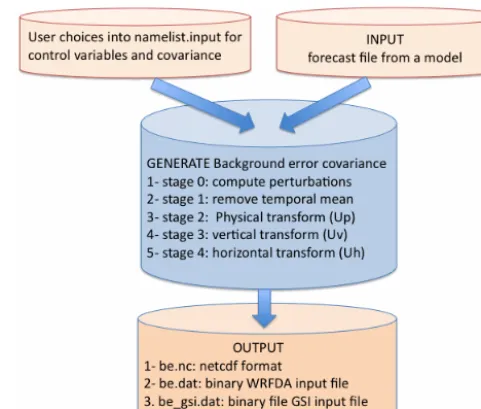
3 Five stages to generate the background error covariance statistics (GEN_BE code version 2.0) The general structure of the GEN_BE code version 2.0 has been designed to split the input, output, and algorithms into independent stages. The five steps, from stages 0 to 4, that
Figure 1. General structure of the code to generate a background
error covariance matrix. The input and output are represented by the orange boxes and the five main stages that lead to model B are in blue.
model a background error covariance matrix become inde-pendent of the choice of control variables and model in-put, which allows for more flexibility (Fig. 1). Stage 0 esti-mates the perturbations of the control variables based on vari-ables coming from a numerical weather prediction (NWP) model forecast. Stage 1 removes the mean of these pertur-bations and defines the applied binning. Stage 2 defines the balance operator (Up)by estimating covariance errors be-tween the control variables using linear regressions. Stage 3 determines the S operator by estimating the standard de-viation that weighs the analysis increment for a given vari-able. It also computes the necessary parameters for spread-ing out the information vertically (Uv)in data assimilation processes. Stage 4 computes the horizontal length scale pa-rameter used by the recursive filter to model correlated error on a 2-D plane (Uh). Technical details are presented in three Appendices. Appendix A describes the new features of the codes and should help to compute and implement new mod-eling of B. Appendix B presents the namelist options and Appendix C explains how to compile and run the code.
en-semble. Table 2, shown in Sect. 4, contains detailed setup information of this data assimilation experiment.
3.1 Sampling and binning (stage 0 and stage 1)
Since the background error covariance matrix is a statistical entity, samples of model forecasts are required to estimate the associated variances and correlations. Traditionally, two distinct techniques are used and are available in stage 0 to compute the perturbations.
– Differences between two forecasts valid at the same time but initiated at different dates (time-lagged fore-cast, e.g., 24 h minus 12 h forecasts) can be used to rep-resent a sample of model background errors. This is an ad hoc technique, called the NMC (named for the Na-tional Meteorological Center) method (Parrish and Der-ber, 1992), which has been widely used in operational centers where large databases of historical forecasts are available.
– Background error statistics can be evaluated from an en-semble of perturbations valid at the same time (Fisher, 2003; Pereira and Berre, 2006). This method tends to be more accurate because it better represents the back-ground error of the day, rather than a climatological er-ror, as with the NMC method. However, more computa-tional resources are required to run an ensemble simula-tion, and it may not provide automatically the optimum B for a particular system (Fisher, 2003).
Pereira and Berre (2006) highlight the consequences of the evaluation of perturbations using the NMC method ver-sus an ensemble approach (called ensemble of the day, D-ensemble). The authors point out that the NMC method tends to underestimate the background errors in data-sparse areas (when the forecast comes from cycling analysis). They show that correlation length scales, as described by Daley (1991), are smaller in D-ensemble methods compared to NMC. Ta-ble B1 summarizes the general options for computing these raw perturbations.
Since the number of sample of perturbations can be lim-ited, a strategy to model a static error covariance over an en-tire domain and filter the sampling noise is used. The statis-tics are spatially averaged by gathering grid points with sim-ilar characteristics. The different options available for this technique, referred as binning, are described in Table B2, and can be set up in the namelist input file (Table B3). The simplest way to compute statistics for a domain can be done by vertical levels (bin_type=5). Moreover, such formulation of B, which allows modeling of homogeneous and isotropic covariance, may be inadequate for specifying natural phe-nomena. Other binning options can be applied to the differ-ent transforms Up, Uv, Uh and S to have a heterogeneous formulation of B. For example, options bin_type=1, 2, 3, 4 compute statistics across the zonally averaged ensemble
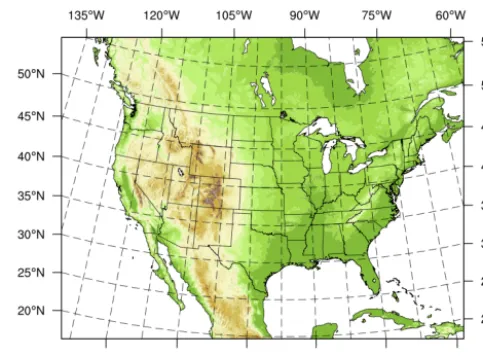
Figure 2. WRF domain over the conus area at the resolution of
15 km. Based on this configuration, the 50 members coming from a 6 h forecast (DART experiment) are used to generate background error statistics.
perturbations to create a latitude-dependent correlation func-tion, usually used for large and global domains where lati-tude flow dependency occurs (Wu et al., 2002). For example, the statistics of hydrometeors, as cloud liquid water, which are characterized by a high spatial and temporal variability, can be skewed (Michel et al., 2011) if, at a given grid point, only a few members of the D-ensemble indicate the pres-ence of clouds. For that reason, it may be preferable to use a cloud mask in the hydrometeor cloud calculations, referred to as “geographical binning”. Montmerle and Berre (2010) and Michel et al. (2011) show improvements using a rain mask (option 7) with the vorticity and divergence control variables to characterize convection events.
For this reason, the GEN_BE code has been modified to facilitate the introduction of new binning options for specific applications (see Appendix B). Stage 1 removes the mean of the perturbations and defines the binning, which is an im-portant component in the model of B, as it is applied in the following stages, especially in stage 2 for the balance opera-tor.
3.2 Balance through linear regressions (stage 2) Analysis increment for one variable may impact another if they have correlated errors. The simplest way to model these multivariate error cross-covariances is to use linear regres-sions that mimic physical balance between variables. First, the regression coefficient between variables can be estimated by solving Eq. (6) following the example of the regression of the temperature (t )by the stream function (psi):
between t and psi averaged over the vertical level k, l for the given binning class index b, and VARpsi(b, k) is the variance.
In practice, the regression coefficient can be directly calcu-lated as the ratio of the inverted variance with the covariance or by performing a Cholesky decomposition (see Appendix B for more details). Then, linear regressions are performed to derive uncorrelated (i.e., unbalanced) perturbations by re-moving the balanced part from other perturbation variables. Equation (7) shows how the unbalanced part of thet pertur-bation (δtu)is calculated by subtracting its full perturbation (δt )from its balanced part coming from psi:
δtu(i, j, k)=δt (i, j, k)− Nk X
j=1
αpsi,t(b, k, l)δpsi(i, j, l), (7)
where b is the index of the binning class according to the triplet indexes of the grid point position(i, j, k).Nk is the total number of vertical model levels.
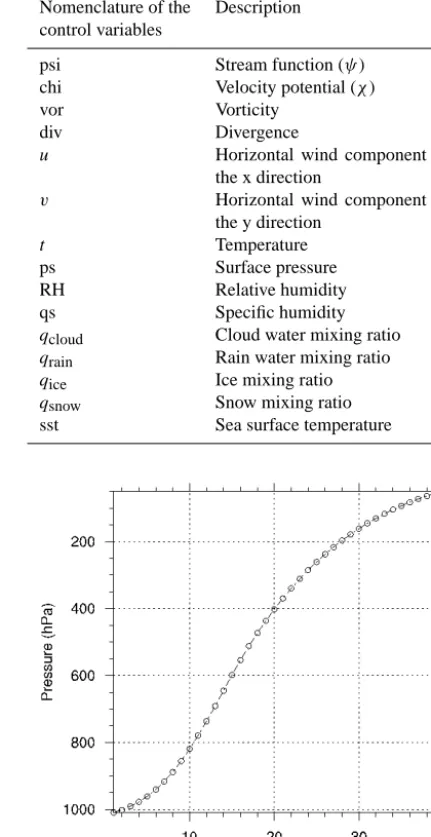
Note that, in variational data assimilation processes, the balance operator Up is applied to the variables themselves. It models correlations between variables and allows one to transform the B matrix as a block diagonal in the control (un-correlated) space. The GEN_BE code version 2.0 has been developed to allow the use of a broad set of control variables (shown in Table 1) and to allow the definition of the Up trans-form in a namelist input file. For example, Table B4 presents how to define the balance transform that involves five con-trol variables (CV5) as it can be used in the GSI system de-veloped at NCEP for analysis operational purposes (Kleist et al., 2009). The parameter covar equals 1 means that the unbalanced part of the velocity potential (chiu), the temper-ature (tu), and the pressure surface (psu)are calculated by subtracting their balanced part coming from the stream func-tion (psi). Benchmark results of a pseudo temperature test in-volving different modeling of B and the same Uptransform (CV5) are shown in Sect. 4.
Furthermore, Bannister (2008b) described the Up trans-form used in different operational centers, with special em-phasis on the definition of the balance operator for humid-ity. To determine a balance operator, diagnostics of verti-cal cross-covariance or vertiverti-cal cross-correlation are help-ful to analyze the relationship between variables and can also be done through stage 2. For example, Fig. 4 shows the cross-correlation between humidity and temperature for all atmosphere conditions (mixing dry and wet conditions). The errors are mostly anti-correlated, and specific humidity (Fig. 4a) has weaker correlated errors with respect to temper-ature than relative humidity (Fig. 4b). Moreover, the errors between specific humidity and temperature become highly correlated close to saturation (Holm et al., 2002; Ménétrier and Montmerle, 2011). At saturation, these statistics likely rely on processes of condensation and precipitation when the released latent heat flux warms the atmosphere (Holm et al., 2002). These characteristics highlight how binning that
dif-Table 1. Description of the control variables available for the
mete-orology.
Nomenclature of the Description control variables
psi Stream function (ψ ) chi Velocity potential (χ )
vor Vorticity
div Divergence
u Horizontal wind component in the x direction
v Horizontal wind component in the y direction
t Temperature
ps Surface pressure
RH Relative humidity
qs Specific humidity
qcloud Cloud water mixing ratio qrain Rain water mixing ratio qice Ice mixing ratio qsnow Snow mixing ratio sst Sea surface temperature
Figure 3. Plot of pressure (hPa) against vertical model levels (WRF,
resolution 15 km).
Figure 4. (a) Vertical cross-correlation between temperature (t) and specific humidity (qs); (b) vertical cross-correlation between temperature (t) and relative humidity (RH); (WRF, res. 15 km, D-ensemble).
ps). Montmerle and Berre (2010) show potential improve-ments on a convective scale by using a rainy mask in a mul-tivariate approach for specific humidity that involves vortic-ity, divergence, temperature and surface pressure variables, while Ménétrier and Montmerle (2011) show the benefit of balancing the specific humidity only with the mass fields (t
and ps) for fog data assimilation purposes. Dynamical vari-ables such as vorticity and divergence are not included in the balance humidity operator since they do not drive fog forma-tion processes.
Finally, results of an experiment that include hydrometeors and its correlated errors with humidity (CV9) are presented Sect. 5.1 and defined by the namelist input file Table B5.
3.3 Estimation of the vertical correlation and the variance (stage 3)
After calculating the vertical auto-covariance matrix (VACM), two techniques are currently available in stage 3 to compute the parameters useful for modeling the mean vertical auto-correlation transform (Uv). The first method diagonalizes the VACM, performing an EOF decomposition (i.e., computing eigenvectors and eigenvalues). The variable is re-written in this new base for each EOF. Stage 4 will later evaluate a length scale for each EOF mode. The vertical transform occurs with the change of base EOF physical space and the variances are represented by the eigenvalues. The second method estimates a vertical length scale from the vertical auto-correlation matrix directly in the physical space, to propagate the increment via recursive filters. The diagnostic of the vertical length scale (Lv) comes from Daley’s formula (1991, p. 110) for a 1-D homogeneous and
isotropic case,
Lv= v u u t
1 ∂2ρ(0)
∂2z
, (8a)
withρ(0)the correlation taken at the origin.
Approximating Eq. (8a) with finite difference to the second-order derivatives ofρ(δz) and assuming ρ is sym-metric around the origin results in
Lvp=
δz
√
2[1−ρ(δz)], (8b)
whereLvprepresents the vertical length scale approximated by a parabolic function.
If the correlation is approximated at the origin by a Gaus-sian function as follows,
ρ(δz)=exp − δz 2L2 vg
!
, (9a)
the length scaleLvgcan be written as
Lvg=
δz
√
−2 lnρ(δz). (9b)
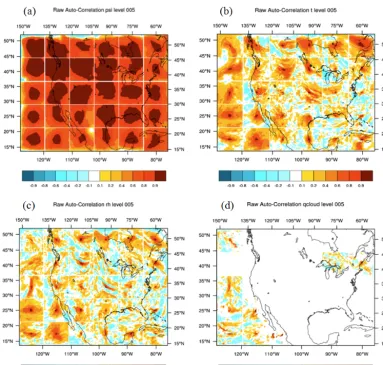
Figure 5. Horizontal autocorrelation performed at the center of each square grid over vertical model level 5, around 950 hPa, for control
variables (a) stream function (psi), (b) temperature (t), (c) relative humidity (RH), and (d) cloud mixing ratio (qcloud). Larger correlations are observed for stream function compared to temperature and relative humidity. Cloud mixing ratio has the smallest correlation due to theinhomogeneous distribution of hydrometeors (WRF, res. 15 km, D-ensemble).
3.4 Estimation of the horizontal correlation (stage 4) Horizontal auto-correlations can be computed for each con-trol variable at each grid point. Figure 5 shows a diagnostic of correlation for a few selected points of the WRF com-putational domain around 500 m above the ground (model level 5). The stream function (5a) and velocity potential con-trol variables have larger and more isotropic spatial corre-lations, while the temperature (5b) and the humidity (5c) control variables show smaller and anisotropic correlations at different locations. The radius of the area where the cor-relation overpasses 0.9 is within a range of 100 to 400 km for stream functions, while this radius reaches its maximum around 100 km for temperature and humidity. Hydrometeor mixing ratios show even more local structures due to their sparse location on the horizontal and the vertical (5d).
In stage 4, we estimate horizontal length scales averaged by vertical level or EOF mode for a field analysis in a 2-D plane. It represents the radius of influence, calculated in grid point space, around the position of an observation, and is an input parameter for recursive filters to spread out horizon-tally the increment (Uh). The different options available, as described below, are also contained in Table B6.
The first method (ls_method=1) employs a distribution function to fit the correlation for a 2-D field by vertical level or by EOF mode as explained in Sect. 3.3. If a Gaussian function is chosen, the length scale is determined by solving Eq. (10a):
ρ(r)=exp
−r 2 2L
, (10a)
If a second-order autoregressive (SOAR) correlation func-tion is used, the length scale L is determined by solving Eq. (10b):
ρ(r)=
1+ r
L
·exp r2
L
. (10b)
However, as this procedure is both computationally ex-pensive and prone to sampling errors, a second option (ls_method=2) based on the ratio of the variance of a field (φ)and the variance of its Laplacian has been added:
L=
8·Variance(ϕ) Variance(∇2ϕ)
1/4
. (10c)
Equation (11) was used by Wu et al. (2002) and is similar to the diagnostic of Pereira and Berre (2006), which was ana-lyzed in Pannekoucke et al. (2008).
The horizontal length scale can be uniformly calculated over a vertical model level or can be statistically binned. Homogeneous recursive filters are able to handle a unique length scale defined by model vertical level, or EOF mode. Inhomogeneous recursive filters (Purser et al., 2003b), as im-plemented in GSI, are able to handle heterogeneous length scales. In this case, the increment is spread out with a length scale according to the bin class of each grid point. Moreover, spatial filtering to smooth the length scale may be required because of recursive filter normalization issues (Michel and Auligné, 2010).
4 Comparison of different modeling of B for two data assimilation systems
We present a benchmark of different modeling of B per-formed on the GSI and WRFDA data assimilation platforms. Both systems can handle the set of five control variables (CV5) and their balance operator (Up)defined in Table B4. By default, the GSI system allows the use of B matrix statis-tics (Bnam), pre-computed over an enlarged CONUS do-main, using the NMC method and NAM (North American Mesoscale) forecasts. Bnamis used with GSI (Wu, 2005) to produce daily forecasts with NDAS (NAM Data Assimila-tion System; Rogers et al., 2009). Based on the D-ensemble data set coming from the DART experiment (i.e., Sect. 3 and Romine et al., 2014), we present in Sect. 4.1 the parameters that define the vertical transform Uvby using EOF decom-position for WRFDA (Beof)and by using recursive filters for GSI (Brcf). Table 2 gathers the general setup that leads to the modeling of these three B matrices (Beof, Brcfand Bnam)and additional information about the used data sets. The physics of the model can be found in Romine et al. (2014) and Rogers et al. (2009). Section 4.2 compares the results of a pseudo single observation test experiment using Beof, Brcfand Bnam on the WRFDA and GSI data assimilation systems.
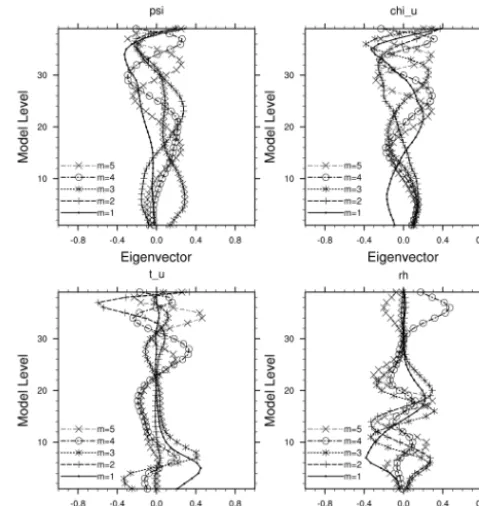
Figure 6. Representation of the first five eigenvectors resulting
from the EOF decomposition of the vertical autocovariance matrix, eigenvectors of (a) psi, (b) chiu, (c)tu, and (d) RH. The eigenvec-tors are parameters that define the vertical transform (Uv); (WRF, res. 15 km, D-ensemble, EOFs).
4.1 Statistics of the background error covariance matrix for different transforms
4.1.1 Decomposition by EOF and length scale
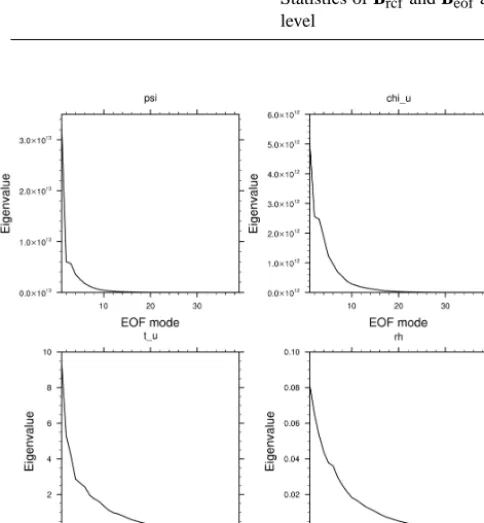
If the EOF decomposition is used, the eigenvectors model the vertical transform (Uv)and the associated eigenvalues repre-sent the variance. The length scale is estimated in the EOF space and represents the horizontal transform (Uh). In the data assimilation process, the eigenvalues weight the analy-sis increment and the recursive filter first spreads out the in-formation in the EOF space according to length scale value. Then, the transformation from EOF mode to physical space spreads out the information vertically. The first five eigenvec-tors are shown in Fig. 6 for the control variables (CV5) and Fig. 7 shows the associated eigenvalues. 99 % of the vari-ance of the stream function and the velocity potential are represented by the first ten and twenty modes, respectively, while more than 30 modes are useful for temperature and rel-ative humidity. Also, the EOF decomposition allows option-ally some filtering; as the largest variances (i.e., eigenvalues) are associated with the first EOFs, the latest EOFs may not be taken into account if they mostly represent vertical noise in the system.
po-Table 2. Description of the setup of the background error matrix modeling diagnosed over the CONUS domain. Beofand Brcfare diagnosed using GEN_BE code version 2.0 and the D-ensemble method, while Bnamis performed by NCEP using the NMC method.
B modeling
Beofand Brcf Bnam
Model configuration WRF model, resolution 15 km, 39 vertical lev-els on a sigma hybrid grid
WRF-NMM model, resolution 12 km, 60 verti-cal levels on an Eta grid
Data assimilation setup DART, EAKF with adaptive covariance infla-tion, cycling period of 6 h, perturbed boundary conditions from GFS, assimilation of conven-tional and cloud track wind observations
NDAS-GSI system, cycling period of 3 h, boundary conditions from GFS, assimilation of conventional and satellite radiances (clear-sky) observations
Method to compute the perturbations
D-ensemble method applied to 50 perturbations coming from 6 h forecasts of the different mem-bers of the ensemble
NMC method applied to 60 perturbations taken over a year, coming from time-lagged forecasts of 12 and 24 h valid at the same time
B transforms CV5 control variables
Brcf: Uh and Uvtransforms defined by recur-sive filters
Beof: Uvtransform defined by EOF decompo-sition
Statistics of Brcfand Beofaveraged by vertical level
CV5 control variables
Bnam: Uhand Uvtransforms defined by recur-sive filters
Statistics of Bnambinned by a latitude band of 1◦
Figure 7. Eigenvalues computed by EOF mode for (a) psi, (b) chiu,
(c)tuand (d) RH. They represent the variance of the control vari-ables (WRF, res. 15 km, D-ensemble, EOFs).
tential have the largest length scale value, reaching 600 km (39 grid points) for the first EOF mode, while the unbalanced temperature length scale has a strong variation for the first three EOFs passing approximately from 135 to 30 km (nine to two grid points) and, from there, slightly decreases from
30 km to reach 15 km (two to one point grid) for the last EOF mode. The relative humidity length scale remains small, de-creasing from approximately 30 to 15 km as a function of the EOF mode. The unbalanced temperature and the relative hu-midity have a relatively small length scale, which means that they have more local features represented by a small radius of influence. Thus, the analysis increment from these vari-ables will remain closer to the observation. As the horizontal length scale is associated with the EOF mode and is not di-rectly related to a vertical model level, further discussions on the association of length scale with physical event may be difficult.
4.1.2 Horizontal and vertical length scales defined in physical space
Figure 8. Length scales defined in grid point through EOF mode
for CV5. The analysis control variables representing the dynamical variables, psi and chiu, have longer length scales thantuand RH (WRF, res. 15 km, D-ensemble, EOFs).
Figure 9. Horizontal length scales for CV5.tuand RH, which have more local structures, are modeled by shorter length scales (WRF, res. 15 km, D-ensemble, RFs).
model, as they represent larger-scale events. Direct compar-ison of these statistics with the Bnamhorizontal length scale is difficult, as they are performed with different methods, models, configurations, and physical options (i.e., Table 2). However, it can be noted than the horizontal length scale was approximately twice as small than those for Bnam(Wu, 2005) performed by using the NMC method. Usually, sharper correlations are found in the D-ensemble compared to the NMC method (Fisher, 2003; Pereira and Berre, 2006).
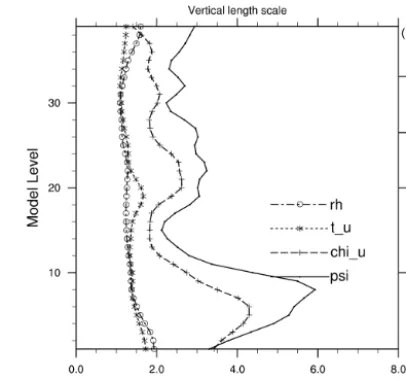
Fur-Figure 10. Vertical length scale for CV5 (WRF, res. 15 km,
D-ensemble, RFs).
thermore, a factor contributing to this difference may arise from the fact that we are comparing statistics from forecasts of different lengths.
The vertical correlation is modeled by the application of recursive filters based on the estimation of the vertical length scale coming from Eq. (8b). The stream function and the ve-locity potential in Fig. 10 that represent large-scale horizon-tal flow have a bigger vertical length scale than those of tem-perature and humidity. The vertical gradients of temtem-perature and humidity can vary strongly locally, decreasing the verti-cal correlation.
4.2 Pseudo single observation test on WRFDA and GSI data assimilation systems
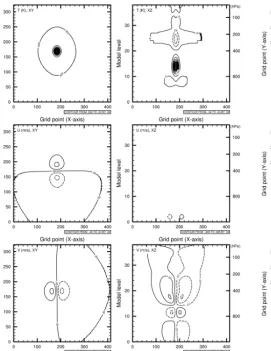
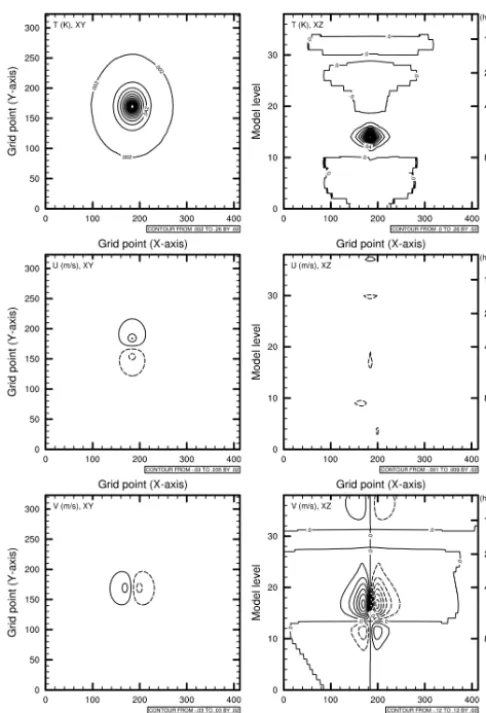
The single pseudo observation is a powerful way to provide a benchmark, as it allows visualization of the increment of an isolated observation and its impact on other variables. Thus, the following are pseudo observation tests of temper-ature with an innovation of 1 K and an observation error of 1 K using different modeling of B (Beof, Brcfand Bnam). The position of the pseudo observation is arbitrarily taken at the center of the domain and at the 500 hPa pressure level. The series of plots (Figs. 11–13) represents horizontal and verti-cal slices of the resulting increment for temperature and wind components.
As expected, the horizontal cross section at the 500 hPa level for temperature shows an isotropic response to the in-novation of 1 K. The maxima of intensity simulated depend on the standard deviation (diagonal matrix S) value coming from the B matrix.
eigen-Figure 11. Pseudo observation test of temperature (innovation of
+1 K) from the WRFDA application. The three plots in the left panel show, from top to bottom, horizontal cross sections (XY) of thet(K),UandV wind components (m s−1), respectively. Then, the right panel shows the corresponding cross section (XZ) of the former variables (Beof: WRF, res. 15 km, D-ensemble, EOFs).
values of Beof. On the other hand, Uvis modeled by the es-timation of a length scale and the recursive filters applied on the vertical (Brcf); the analysis is weighted by the standard deviation directly averaged on the vertical mesh grid. The in-crements of temperature are close for the three different tests and the increment from Bnam is slightly larger than that of Brcfand Beof. In the case of Bnam, recursive filters spread out the information in a larger area over a horizontal plane due to its larger length scales.
For the vertical cross section (XZ), vertical increments coming from Brcfand Beofspread out in the same range of altitude (∼ between the 800 and 450 hPa pressure levels). Based on the same D-ensemble data sets, the Uvoperator us-ing EOF decomposition and recursive filters gives similar re-sults on different platforms, as expected. Moreover, the tem-perature increment from Brcf spreads out even more along the vertical compared to the Bnamexperiment on the GSI
sys-Figure 12. Pseudo observation test of temperature (innovation of
+1 K) from the GSI application. The three plots in the left panel
show, from top to bottom, horizontal cross sections (XY) of thet (K),U andV wind components (m s−1), respectively. Then, the right panel shows the corresponding cross section (XZ) of the for-mer variables (Brcf: WRF, res. 15 km, D-ensemble, RFs).
tem. This discrepancy can be associated with the computed vertical length scales from two different data sets. The length scales diagnosed over a D-ensemble are larger in this case for Brcfthan the one averaged over a long period of time in the NMC method (60 perturbations selected over a year). Also, statistics of Bnamare performed over an Eta grid of 60 verti-cal levels of WRF-NMM, while the statistics of Brcfand Beof come from WRF defined on a hybrid-sigma grid of 39 ver-tical levels. Thus, the raw statistics of Bnamare interpolated on the WRF vertical grid in GSI before performing 3DVAR data assimilation. Furthermore, differences in the definition of the physics of the model and the assimilated data may be contributing factors.
adjust-Figure 13. Pseudo observation test of temperature (innovation of
+1 K) from the GSI application. The three plots in the left panel show, from top to bottom, horizontal cross sections (XY) of thet (K), U andV wind components (m s−1), respectively. Then, the right panel shows the corresponding cross section (XZ) of the for-mer variables (Bnam: WRF-NMM, res. 12 km, NMC, RFs).
ment that the linear cross-covariance statistics reproduce. The vertical cross section (XZ) follows the isocontour of 0 m s−1forU, while some differences can be observed in the slices ofV for the Beof, Brcf, and Bnamexperiments. A larger spread of the V increment along pressure levels is observed for Beofand Brcfcompared to the experiment of Bnam.
These ensemble-based background error Beofand Brcf co-variance matrices potentially have more skill in estimating error statistics related to the present meteorological event and using the same model configuration.
5 Cloud and chemistry variational data assimilation 5.1 Generation of a multivariate background error
covariance for hydrometeors
Code modifications have been done in the WRFDA code to add a multivariate balance operator for the hydrometeor vari-ables: cloud liquid water mixing ratio (qcloud), rain mixing ratio (qrain), ice mixing ratio (qice), and snow mixing ratio (qsnow), so that the WRFDA minimization is now performed over nine 3-D fields instead of the five previously included. The main scientific issue in this task is to define a proper B matrix and, particularly, the cross-correlation terms that will ensure that the analysis of the hydrometeors is multi-variate; i.e., the observed and unobserved model fields are modified simultaneously and consistently during the analy-sis. The question of the estimation of the forecast error co-variance matrix is the focus of this section. Figure 3 provides the conversion from vertical model level to pressure level. 5.1.1 Definition of the balance operator for
hydrometeors (CV9)
The Uptransform CV5 (defined in Table B4) is modified in the WRFDA code to include a multivariate analysis for hu-midity and hydrometeors (Eq. 12a–c). In a first approach, rel-ative humidity (RH) is balanced in Eq. (12a) with the mass fields of unbalanced temperature (tu)and unbalanced surface pressure (psu), and does not include dynamic variables such as the stream function (psi) and the unbalanced velocity po-tential (chiu):
RHu(i, j, k)=RHu(i, j, k)− Nk X
l=1
αRH,tu(b, k, l)tu(i, j, k)
−αRH,psu(b, k)psu(i, j ). (11a)
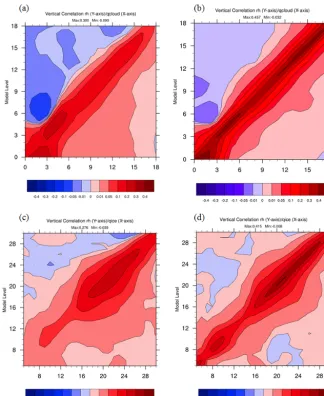
Figure 14. (a) Raw vertical cross-correlations between the cloud mixing ratio (qcloud)and relative humidity (RH), (b) filtered vertical cross-correlations betweenqcloudand RH, (c) raw vertical cross-correlations between the ice mixing ratio (qice)and RH, and (d) filtered vertical cross-correlations betweenqiceand RH. Taking into account the perturbations coming from the transition of a cloudy to a non-cloudy area only when reaching the threshold mixing ratio of 10−6kg kg−1, this intensifies the vertical correlation (WRF, res. 15 km, D-ensemble).
reason, the line covar6=0, 0, 0, 0, 1, 0, 0, 0, 0, 0 represented by Eq. (12b) can be replaced with the line covar6=0, 0, 0, 0, 2, 0, 0, 0, 0, 0 represented by Eq. (12c). In this case, only the diagonal terms of the regression coefficient are calculated, and the increment is spread out by the recursive filters.
qcloud(i, j, k)=qcloud(i, j, k)
− Nk X
l=1
αqcloud,RHu(b, k, l)RHu(i, j, l) (11b) qcloud(i, j, k)=qcloud(i, j, k)
−αqcloud,RHu(b, k)RHu(i, j, l). (11c)
A similar balance is applied toqice.qrainandqsnoware de-fined as univariate. Table B5 summarizes the definition of this balance operator called CV9.
5.1.2 Statistics of the background error covariance matrix for hydrometeors
The vertical and horizontal transforms retained are the recur-sive filters making the interpretation of the length scale pa-rameter easier, as they are directly associated with a vertical model level. The four main hydrometeors have been added in this study, as they could be useful for data assimilation in remote sensing such as satellite cloud radiances and radar reflectivity.
Figure 15. Horizontal length scale for the hydrometeors using (a) 50 members and (b) using 5 members. The plots show similar
character-istics regardless of the ensemble members (WRF, res. 15 km, D-ensemble).
below the 150 hPa pressure level forqiceandqsnowand below the 400 hPa pressure level forqcloudandqice. The maximum of theqcloud length scale, located approximately at 950 hPa, can be associated with the presence of low maritime clouds above the Pacific Ocean denoted by the high standard devi-ation in Fig. 18a and b. In the lower levels of the model, the length scale ofqicevanishes as expected.
The vertical correlation maxima of the precipitating hy-drometeors are higher compared to that of cloud water or cloud ice hydrometeors, as they can drop freely through mul-tiple levels (Fig. 16a). The vertical length scale ofqrain in-creases regularly from around 500 hPa until it reaches a max-imum at the ground. As the length scale increases quickly after 800 hPa, where the highest density of the lower levels occurs, an arbitrary cut-off equal to one-third of the total ver-tical grid point value is applied in order to avoid spreading out of increment information outside the area of potential presence of rain with the recursive filter. The length scale ofqsnowhas two local maxima. The first one happens where the precipitating hydrometeors have the highest density at around 400 hPa. A steep increase occurs from 950 hPa un-til it reaches the highest value close to the ground. The low presence of snow hydrometeors in the first model levels, i.e., close to the ground, is characterized by small values of the mixing ratio, averaged by vertical level, which tends to arti-ficially reinforce vertical correlation as well.
5.1.3 Example of a pseudo single observation of the cloud mixing ratio in a multivariate approach
To verify that our analysis is multivariate, we conducted a series of tests in which pseudo observations of hydromete-ors were assimilated into WRFDA, and the corresponding analysis increment was plotted. Figure 17 shows the analysis response for theqcloudandqvapormodel variables when three simulated observations of cloud liquid water are assimilated.
One observation is taken over the Pacific Ocean, a second one over Texas, and the last one in Canada.
The intensity of the increment can be weighted by the 1-D variance or by the 3-1-D variance (S operator) coming from the ensemble. The 1-D variance, displayed in Fig. 18a, gives general information by vertical level and binning type with-out any assumption of horizontal location. It is mostly used when the perturbations come from the NMC method or when the variance is not diagnosed at the analysis time. In our test case, the increment is modulated by the 3-D variance computed from a 6 h ensemble forecast with 50 members. The cloudy area coming from the background of the differ-ent members is represdiffer-ented by a high value of variance in Fig. 18b, while low variance takes place in the dry area. The increment is most likely greater than 10−3g kg−1where the variability of cloud presence exists (Fig. 17). The strongest increment occurs over the Pacific Ocean for a higherqcloud standard deviation. A minimum value would likely need to be set to retain the possibility of increments in the dry area.
The covariance between the mixing ratio of cloud water condensate and relative humidity, described in Sect. 5.1.1, can reinforce the ability to add clouds in the dry area or re-move clouds in the cloudy area. The univariate version of the balance operator for hydrometeors may be beneficial at the analysis time, as hydrometeors can be directly assimilated. The multivariate balance is present to help to propagate the
qcloudincrement in the forecast by balancing it with aqvapor increment.
En-Figure 16. Vertical length scale for the hydrometeors using (a) 50 members and (b) using 5 members. The plots show similar characteristics
regardless of the ensemble members (WRF, res. 15 km, D-ensemble).
Figure 17. (a) Horizontal slide (vertical model level 5) of a pseudo observation test of cloud water condensate (innovation and observation
error of 0.1 g kg−1)in a multivariate approach using the 3-D variance; (b) as a consequence, there is a positive increment on cloud vapor mixing ratio (WRF, res. 15 km, D-ensemble, RFs).
semble Prediction System (MOGREPS, Bowler et al., 2008; Migliorini et al., 2011) already use ensemble forecasts at high resolution to more accurately characterize specific me-teorological events, such as precipitation and convection. Nowadays, their ensemble size remains small (often fewer than 10 members) because the cost of CPU (central process-ing unit) time is still elevated. Studies have been dedicated to evaluating the sampling errors in the ensemble method and in the parameters, such as correlation length scales, that usu-ally model the background errors (Pannekoucke et al., 2008; Ménétrier et al., 2014). When the ensemble size is small, methods that combine general statistics of the background errors and local balance are found to perform better (Hamill and Snyder, 2000). Figures 15a, b and 16a, b, which display horizontal and vertical length scale parameters, respectively, for the hydrometeors in regards of the number of members, show stable results.
5.2 Background error for chemical species
As a proof of concept, this last section shows the direct ap-plicability of the GEN_BE v2.0 code as a diagnostic tool for topics other than meteorology. In recent decades, a large number of studies that investigate chemical data assimilation have been conducted. Some of the first studies on strato-spheric and tropostrato-spheric chemistry data assimilation were performed roughly two decades ago (e.g., Austin, 1992; Fisher and Lary, 1995; and Elbern et al., 1997). During the last two decades, efforts have been made in order to im-prove atmospheric chemical modeling and data assimilation scheme performances.
Figure 18. (a) Profile of standard deviation of the liquid water condensate mixing ratio (qcloudin g kg−1)averaged along the vertical and
(b) horizontal cross sections of the standard deviation ofqcloudat vertical model level 5 (950 hPa). Both plots indicate the presence of low maritime clouds noted by high standard deviation (WRF, res. 15 km, D-ensemble).
matrix. Barré et al. (2014) and Emili et al. (2014) estimated a quasi-constant B based on the Ménard and Chang (2000) and Desroziers et al. (2005) a posteriori statistics for tropo-spheric and stratotropo-spheric ozone data assimilation. Since the latter studies put their focus on large-scale events (global-scale chemical assimilation and synoptic events), data as-similation performs reasonably well with those first-order B matrix estimations. Depending on the region of the atmo-sphere that is analyzed, B needs to be updated on different timescales. Massart et al. (2012) showed the importance of using a monthly B matrix ensemble estimate for stratospheric ozone data assimilation purposes. For surface ozone assim-ilation, Jaumouillé et al. (2012) and Gaubert et al. (2014) showed that an hourly ensemble estimate of B that represents diurnal variations of model errors improves the data assimi-lation skills. In the last few years, studies on aerosol data as-similation within WRF-Chem (Pagowski et al., 2010, 2014; Schwartz et al., 2012) showed the importance of having a detailed estimation of the B matrix.
Statistics were analyzed in detail to ensure that B repro-duced relevant correlation structures during the data assimi-lation process. Since data assimiassimi-lation of chemical species is more recent than for meteorology, the GEN_BE code version 2.0 may be useful for testing new definitions of background error covariance matrices and for allowing its usage on dif-ferent platforms. Several chemical trace gases such as CO (carbon monoxide), NOx(nitrogen oxides) and O3 (ozone), but also dust, sea salt and particulate matter (PM), have al-ready been included as new possible control variables in the GEN_BE code. Results for CO, NOxand O3are shown next. The statistics are estimated using 20 members over the CONUS domain. Each member comes from a 12 h fore-cast of WRF-Chem (WRF model coupled with Chemistry,
Grell et al., 2005), valid at 12:00 UTC on 14 June 2008, at 36 km of horizontal resolution and 33 vertical levels. The lat-eral boundary conditions coming from MOZART (Model for OZone And Related chemical Tracers, Emmons et al., 2010) and emission factors coming from MEGAN (Model of Emis-sions of Gases and Aerosols from Nature, Guenther et al., 2006) are perturbed using a pseudo-normal random noise. In order to avoid unphysical or negative values of concentration and emissions and to keep ensemble mean boundary condi-tions values close to the original values, we then perturb the boundary conditions (emissions and boundary conditions) by using a standard deviation (sigma) of 25 % of the original boundary condition value, and we limit the perturbation to no more than 3 sigma (i.e., 75 %).
Figure 19 presents the standard deviations for the chemical species of interest. The standard deviation of the background error is directly related to the species concentrations. Most of the ozone variability takes place in the middle atmosphere (stratosphere) in the ozone layer around 100 hPa (Fig. 19a). Figure 19b and c highlight NOxconcentration fluctuations, due to photochemistry in the stratosphere and in the tropo-sphere. Because the NOx are also emitted from the ground with a short lifetime, a strong peak of standard deviation is observed. Carbon monoxide (Fig. 19d), which is also emitted at the surface and which has a relatively long lifetime (1–2 months), shows significant standard deviation values in all of the troposphere, with a maximum in the boundary layer.
G. Descombes et al.: Generalized background error covariance matrix model 685
66 1
2
Figure 19. Vertical standard deviation in ppmv of (a) O3, (b) NO2, (c) NO, and (d) CO
3
(WRF-CHEM, Res. 36 km, D-ensemble). 4
5
6
7
(c) (d)
(b) (a)
Figure 19. Vertical standard deviation in ppmv of (a) O3, (b) NO2, (c) NO, and (d) CO (WRF-Chem, res. 36 km, D-ensemble).
Figure 20. Horizontal length scale of O3, NO2, NO, and CO (WRF-Chem, res. 36 km, D-ensemble).
NO2, GEN_BE v2.0 evaluates the tropospheric horizontal length scale to be between 70 and 90 km. This range of val-ues is consistent with the valval-ues found by Silver et al. (2013),
who use the NMC method. Horizontal length scales increase in the upper troposphere, mostly due to the strong circulation (jets) and increased lifetime of species. Then, strong advec-tion of trace gases that are not short lived (with lifetimes that are more than a day) are likely to increase the horizontal cor-relations.
Figure 21. Vertical length scale of O3, NO2, NO, and CO (WRF-Chem, res. 36 km, D-ensemble).
presents the same behavior. Strong vertical correlation close to the surface, followed by a strong decrease to the levels di-rectly above, results in lower values in the upper levels of the boundary layer.
Here we have shown that the GEN_BE v2.0 code is able to model a B matrix for chemical variables with features that are associated with physical processes, i.e., ozone layer, tracer lifetime, emissions and planetary boundary layer mix-ing. The diagnostics of simple statistics of the background for chemical species are straightforward with the GEN_BE v2.0 code. Moreover, data assimilation of chemistry com-ponents remains a challenge because of the uncertainties of various parameters that predict chemical processes such as emission factors, deposition velocity and (photochemical) re-action constant. For these reasons, the analysis may fit the observation even if data assimilation does not involve the ori-gin of the mismatch. Hybrid and ensemble methods may help to diagnose complex covariance structures in future work. In this paper, the chemical B matrix generated by GEN_BE v2.0 has not been extensively diagnosed. More investigations such as the balance between chemical species, standard devi-ation and correldevi-ation length time and space variability could be investigated in further studies by the atmospheric chem-istry modeling community using GEN_BE v2.0.
6 Summary and discussions
While variational methods have been successfully used in operational centers for a long time, the estimation of back-ground errors needs to be continuously improved to assim-ilate new observations and to provide more accurate statis-tics. The GEN_BE v2.0 code has been developed to inves-tigate and model univariate or multivariate covariance errors
from control variables defined by a user as an input. It gath-ers some methods and options that can be easily applied to different model inputs and used on different data assimilation platforms by extending its former capabilities. The flexibil-ity of the framework of the GEN_BE V2.0 code should help the diagnostics of correlated errors and the implementation of new background error modeling.
This document describes first the different stages and transforms that lead to the modeling of the background er-ror covariance matrix B by performing benchmark tests and showing examples that use these new functionalities based on WRF and WRF-Chem forecasts. Parameters such as length scales, eigenvectors, eigenvalues, standard deviation and lin-ear regression coefficients were first estimated for the control variables (CV5) described in Kleist et al. (2009) for the GSI system developed at NCEP.
Second, the GEN_BE v2.0 code has been validated through multivariate single observation tests of temperature using three different modelings of B (Beof, Brcf, and Bnam) and on two different platforms. Based on the first data set, D-ensemble, the single observation test performed with Beof (Uv, EOF decomposition) in WRFDA shows similar results to the single observation test of temperature performed with Brcf(Uvrecursive filters) in GSI. The increments were spread out in a larger area along the vertical than those coming from the test using the Bnam statistics calculated with the NMC method on a different vertical grid, while the horizontal in-crements were spread out in a larger area using Bnam.
Third, the GEN_BE code has been used to perform the statistics over an extended set of control variables that in-clude the mixing ratio of hydrometeors (CV9) for multivari-ate cloud data assimilation purposes. As clouds have an in-termittent presence, the 3-D variance coming from an ensem-ble of the day gives a spatial envelope useful for weighting the analysis relative to the observation and the background confidence. The hydrometeors of cloud and ice condensate water are also balanced with humidity to be potentially able to create or remove misplaced clouds. The regression coeffi-cients calculated can be conserved for a next cycle analysis as they are averaged by bins or recalculated, as they are not so expansive with regard to CPU time. In this paper, a pseudo observation test of cloud mixing ratio was performed using WRFDA, and the next step is to test cloudy radiance data as-similation. Finally, statistics of background are estimated for chemical species such as carbon monoxide (CO), nitrogen oxides (NOx)and ozone (O3)coming from an ensemble of forecasts of WRF-Chem, discussed and compared with ex-isting studies. It has been shown that the statistics diagnosed are related to physical and chemical processes.
done on models with different vertical grid definitions. If we consider performing the background error statistics on an unstructured grid, the structure of the code can remain the same, but a few mathematical operators, such as differ-ential and Laplacian, and estimation of the distance between two grid points, would need to be re-defined according to the grid. In fact, the Uptransform needs to be performed in the unstructured grid according to the user’s choice of control variables. The Uvtransform will remain identical and the Uh transform would be modified according to the mathematical operators. Another option would be first to interpolate the input data set on a regular grid according to the data assim-ilation system used and then to compute the statistics. Thus, implementation of models with different grids can be done in the GEN_BE v2.0 code based on its general framework, and may be completed by adding new diagnostics.
The current trend is to model a more complex background error, expanding the control variables and correlated errors and using techniques to achieve more heterogeneity and anisotropy. The geographical binning and the 3-D variance available in the GEN_BE v2.0 code can be utilized with new data assimilation algorithms. For example, hybrid data as-similation that combines variational and ensemble methods may be helpful especially by adding flow dependence in the estimation of the background error while keeping a reduced ensemble size due to CPU time constraints (Hamill and
Appendix A: FORTRAN code and input/output description
New FORTRAN modules have been developed to general-ize the calculation of the error covariance matrix from dif-ferent input models and for new control variables. Table A1 contains a complete list of these modules and their con-tents. All the algorithms from stage 1 to stage 4 are now independent of the choice of control variables and driven by a unique namelist file, called namelist.input, and read by FORTRAN module configure.f90. Flexibility has been added for future experiments. Few modifications are needed in stage 0 to add new control variables. FORTRAN module io_input_models.f90 converts the standard variables from a given model to the analysis variables. The interface is al-ready made with the WRF model. Only FORTRAN module io_input_model.f90 needs to be updated to implement new model input and to run the different stages. The NetCDF for-mat has been chosen to improve robustness and flexibility in the input and output of the different stages, as shown in Ta-ble A2. The final NetCDF output file (be.nc) contains all the information needed for a variational data assimilation sys-tem, as shown in Table A3. Several converters from NetCDF format to binary have been developed to ensure backward compatibility to another data assimilation system. A be.dat binary file can be generated for the WRFDA application us-ing the gen_be_diags.f90 program, and a be_gsi.dat binary file can be created for GSI using the gen_be_nc2gsi.f90 con-verter.
Table A1. FORTRAN code description of the GEN_BE v2.0 framework.
FORTRAN modules Comments
variables_types.f90 It defines, declares and allocates new types such as state_type, mesh_type, bin_type, and state_matrix. Some basic operations such as addition, subtrac-tion, and calculation of variance and covariance are available.
configure.f90 It reads the namelist.input file and initializes the variables.
io_input_models.f90 It reads input standard variables from a model defined by the user and converts them into control variables. If the user needs to introduce a new input model, only this module needs to be updated to read and transform the data.
io_input.f90 It reads NetCDF input data and initializes new types.
io_output.f90 It writes the NetCDF output format for all new types.
Table A2. Input and output of the different components of the GEN_BE v2.0 code.
Programs Input Output Comments
gen_be_stage0.F Various models (ex: WRF) pert.ccyymmddhh It contains the perturbations for all the control variables defined in the namelist.
mesh_grid.nc All_mesh.grid.nc
It contains all the static data as a latitude array, longi-tude array, and map factors.
mask.ccyymmddhh This file exists only with the dynamical_mask option, which is activated with bin_type=7 or bin_type=8. standard_variable.txt
control_variable.txt
It contains the list of the control variables in ASCII for-mat.
gen_be_stage1.F pert.ccyymmddhh var. ccyymmddhh The input file is split per variable.
bins.nc All the information related to the binning options is in-cluded in this file.
gen_be_stage2.F var. ccyymmddhh gen_be_stage2_regcoeff.nc All the regression coefficients are included in this file. var(_u) ccyymmddhh If a linear regression is applied to the current variable to
remove its balanced part, an unbalanced output variable is written under this nomenclature.
gen_be_stage3.F var(_u). ccyymmddhh gen_be_stage3_vert_lenscale.var(_u).nc It contains the vertical length scale parameter for the full or unbalanced part of the variable.
gen_be_stage3_varce.var(_u).nc Variance three dimensions by grid point gen_be_stage3_vert_varce(_u).nc Binned vertical variance
var(_u).ccyymmddhh.ennn.kkk Intermediate binary files split by vertical level
gen_be_stage4.F var(_u).ccyymmddhh.ennn.kkk sl_print.blll.qcloud Intermediate ASCII file format that contains the hori-zontal length scale.
gen_be_diags.F Results of the precedent stages from 2 to 4 be.nc Final netcdf file that contains all the information to model B.
gen_be_nc2gsi.F be.nc be_gsi_little_endian.gcv
be_gsi_big_endian.gcv
Binary format directly readable by GSI
Table A3. Content of the final output file be.nc (NetCDF format) of the GEN_BE v2.0 code.
Name of the field Description
Fields defined by control variable name (e.g., cv1)
Lenscale_cv1 Horizontal length scale in EOF space or physical space
vert_lenscale_cv1 Vertical length scale available only if the flag data_on_levels is true and the control variable number 1 is 3-D
vert_variance_cv1 Vertical variance of the control variable number 1 per bin
eigen_value_cv1 Eigenvalue of the control variable number 1 only available if the flag data_on_levels is false
eigen_vector_cv1 Eigenvector of the control variable number 1 only available if the flag data_on_levels is false
varce_cv1 Variance 3-D
Regression coefficients
list_regcoeff Complete list of the regression coefficients used in the balance constraint regcoeff_cv1_cv2 Example of regression coefficient between control variables 1 and 2. It can be
1-D, 2-D or 3-D.
vert_autocov_cv1 Vertical autocovariance of the control variable number 1
Binning parameters
Appendix B: Description of the namelist options
The “namelist.input” file that drives the different stages 0 to 4 contains four different sections.
The “&gen_be_info” namelist section, described in Ta-ble B1, defines the options for computing perturbations in stages 0 and 1 from an input forecast model (e.g., WRF). Also, the data assimilation system can be specified.
Table B2 presents eight available binning options and Table B3 explains how to set up namelist section “&gen_be_bin”. In GEN_BE code version 2.0, all the in-formation that defines a binning option is encapsulated in type bins_type. Since the algorithms of the different stages from 1 to 4 do not make any specific assumption about the binning option used, the implementation of the new op-tion is simplified, as it needs to be defined just once in the
da_create_bins FORTRAN routine of module io_input.f90.
In the case of implementing a geographical mask, develop-ers have to introduce the method to update the mask in the
update_dynamical_mask routine. All information related to
binning is contained in the NetCDF bin.nc file created in stage 1.
The Up transform is defined in section “&gen_be_cv”, where the used control variables and balance operator are set up. Table B4 presents the CV5 control variable currently used
in the GSI system (Kleist et al., 2009). In this example, the use of the relative humidity (RH) (line covar5) allows statis-tics in GEN_BE to be performed for the normalized relative humidity described by Holm et al. (2002) and implemented in GSI. Furthermore, when the regression coefficients are computed for a GSI regional application, a Cholesky de-composition is used, and additional filtering is applied to the regression coefficients between stream function and tem-perature, and between stream function and pressure surface. This part of the code coming from the NCEP is flagged with the use_cholesky variable in the gen_be_stage2.F FOR-TRAN program, and the called subroutines are contained in the io_output_applications.f90 FORTRAN module. Table B5 shows the Uptransform, called CV9, which includes hy-drometeors in a multivariate approach.
Table B6 contains namelist section “&gen_be_lenscale” to diagnose parameters of the Uv and Uh transforms for stage 3 and stage 4, respectively. The vertical transform Uv can be performed by estimating a vertical length scale by model levels (data_on_level=true) or by a EOF
decomposi-tion (data_on_level=false). By default, statistics are binned
Table B1. General information defining the experiment in the namelist input file (&gen_be_info part).
&gen_be_info Namelist options Description
Model “WRF” Setting up the acronym for the model input allows GEN_BE to read different input models in stage 0.
Application “WRFDA” The “WRFDA” and “GSI” interfaces have been developed and tested.
be_method “ENS” or “NMC” Compute perturbations from an ensemble or from a different time-lagged forecast.
ne Number of members If NMC method ne=1.
cut 0, 0, 0, 0, 0, 0 Allows one to subset an area of a domain, defined in grid points: imin, imax, jmin, jmax, kmin, kmax.
use_mean_ens “false” If be_method=“ENS” is selected, the perturbation can be calculated from the mean of all the members or from two different members.
start_date “_START_DATE_” Initial date, format ccyymmddhh.
end_date “_END_DATE_” Final date, format ccyymmddhh.
Interval “hh” Frequency of the historical date data available, defined in hours (useful for the NMC method only).
Table B2. Description of the binning options.
Bin_type Description
0 Binning by grid point.
1 Binning by vertical level along the×direction point of the model.
2 Binning by vertical heights and by latitude num_bins_lat. The parameters binwidth_lat and binwidth_hgt define the width that splits the bins.
3 Binning by vertical model level and latitude dependent. The parameters lat_min and lat_max are computed from the model input data and the parameter binwidth_lat is defined in the namelist.input file.
4 Binning by vertical model level and along theydirection. 5 Binning on vertical model level including all the horizontal point. 6 Average over all points.
7 Binning rain/no-rain by vertical model level and based on thresholds in the model background (Michel et al., 2011).
Table B3. Parameters defining the binning options of the namelist input file (&gen_be_bin part).
&gen_be_bin Namelist options Description
bin_type 0–7 Bin type option
lat_min, lat_max Minimum and maximum of latitude defined in degrees. Used if bin_type=2.
binwidth_lat 5.0 Width of the bins defined by latitude in degrees Used if bin_type=2, 3, 4.
hgt_min 1000.0 Used if bin_type=2 (height, meters). binwidth_hgt 2000.0 Width of bins defined by height in meters
Table B4. Information related to the control variables and their covariance errors in the namelist input file (&gen_be_cv part, example CV5).
At present, the parameter covar can take three values, 0, 1, and 2, meaning “no regression”, “full regression” and “diagonal only”.
&gen_be_cv Namelist options Description
nb_cv 5 Number of control variables
cv_list ’psi’, ’chi’, ’t’, ’ps’, ’rh’ Variables used for the analysis fft_method 1, 2 Conversion ofuandvto psi and chi
1=cosine; 2=sine transform covar1 0, 0, 0, 0, 0, 0, 0, 0, 0, 0 First variable does not have covariance.
covar2 1, 0, 0, 0, 0, 0, 0, 0, 0, 0 Covariance of variable 1 (psi) and variable 2 (chi) covar3 1, 0, 0, 0, 0, 0, 0, 0, 0, 0 Covariance of variable 1 (psi) with variable 3 (t) covar4 1, 0, 0, 0, 0, 0, 0, 0, 0, 0 Covariance of variable 1 (psi) with variable 3 (ps) covar5 0, 0, 0, 0, 0, 0, 0, 0, 0, 0 Relative humidity univariate
covar6 0, 0, 0, 0, 0, 0, 0, 0, 0, 0 Other possible variables
use_chol_reg “false” By default, compute the regression coefficient as a ratio of covariance by variance. If true, use a Cholesky decomposition (specific to GSI and CV5).
Table B5. Information related to the control variables and their covariance errors in the namelist input file (&gen_be_cv part, example CV9,
definition of multivariate humidity and hydrometeor error covariance matrix).
&gen_be_cv Namelist options
nb_cv 9
cv_list ’psi’, ’chi’, ’t’, ’ps’, ’rh’, ’qcloud’, ’qice’, ’qrain’, ’qsnow’ covar1 0, 0, 0, 0, 0, 0, 0, 0, 0, 0
covar2 1, 0, 0, 0, 0, 0, 0, 0, 0, 0 covar3 1, 0, 0, 0, 0, 0, 0, 0, 0, 0 covar4 1, 0, 0, 0, 0, 0, 0, 0, 0, 0 covar5 0, 0, 1, 1, 0, 0, 0, 0, 0, 0 covar6 0, 0, 0, 0, 2, 0, 0, 0, 0, 0 covar7 0, 0, 0, 0, 2, 0, 0, 0, 0, 0 covar8 0, 0, 0, 0, 0, 0, 0, 0, 0, 0 covar9 0, 0, 0, 0, 0, 0, 0, 0, 0, 0
Table B6. Description of the options available in the namelist input file (&gen_be_lenscale part) to diagnose the length scale parameter.
&gen_be_lenscale Namelist options Description
data_on_levels “true” The statistics can be computed by vertical model level (GSI) or by EOF mode (WRFDA) in stage 3.
vert_ls_method 1, 2 Estimate the vertical length scale (stage 3). Option 1: parabolic approximation formula Option 2: Gaussian approximation formula
ls_method 1, 2 Estimate horizontal length scale (stage 4). See Sect. 3.4 for more details.
use_med_ls “false” Estimate the length using the median value or not.
stride 1 Subset of point to speed up stage 4
n_smth_ls 2 Number of points to smooth the length scale
Appendix C: Installation, compilation, setup and visualization
The GEN_BE code version 2.0 is a stand-alone package that can be installed on different UNIX/LINUX systems. It has been tested with the Intel FORTRAN compiler, the Port-land Group FORTRAN compiler, and the GNU FORTRAN compiler. It requires compilation of NetCDF libraries. First, a configuration file needs to be created using the command
configure in the main directory of the code. Then, the
com-pilation is launched by the command compile gen_be. Once successfully completed, the executables are created in the src directory.
Korn-shell scripts available in the scripts directory al-low one to set up the experiment. The wrapper script, named gen_be_wrapper.ksh, sets up some global