CrossMark
Published by DiscoverSys
ABSTRACT
Background: The sports facilities for the tonnis game in the form of a net and two poles symmetrically mounted on the right and left in accordance with the dimensions of the field are not ergonomically designed. The Dimensional design of the pole is very varied and using materials that are not standardized. The sports facilities of tonnis game are only designed for its function, but it has not considered the ease, speed, and convenience during assembling and disassembling by workers. It was found that the net pole ballast system exceeds the capabilities, limitations, and human capacity. Workers who perform assembling and disassembling activities of tonnis facilities are found unnatural movements in their body. It reduces the quality of their health. Thus, it is needed to redesign tonnis sports facilities with ease and needs of users in order to improve the health of workers through the reduction of fatigue, musculoskeletal disorders which result in an increase in convenience of work.
Object: The subjects in this study are the workers who assemble and disassemble net and the poles in tonnis sport. It starts from taking the sports facilities of the barn into the field, assembling the net and the poles on the right side and the left symmetrically. Criteria of the place
used as a point of sampling is a closed field designed specifically for sporting activities with different types of games.
Methods: This study is an experimental research by using subject design. Subjects were selected by using random sampling. Samples of 144 people had met the inclusion and exclusion criteria.
Results: The results showed that there is significantly increase with an average score of general fatigue amounted to 24.65%, consisting of activity fatigue by 26.60%, exhaustion by 23% motivation, and physical exhaustion by 24.31% (p <0.01), whereas the decrease in musculoskeletal disorders amounted to 23.98% (p <0.01). So overall, with an increase in work health, with the increase of worker comfort in assembling net and the poles the tonnis game amounted to 21.69% (p <0.01).
Conclusions: Redesigning Participatory-Ergonomics-Based Sports Facilities is able to improve the quality of healthcare that can be seen from the reduction in fatigue, musculoskeletal disorders and the increase of convenience of work. Participatory ergonomics approach not only can redesign facilities, but also can increase the worker’s roles in the improvement of the physical health of workers.
Keywords: participatory ergonomics, work health
Cite This Article: Susihono, W., Parwata, Y., Sandi, N. 2016. Ergonomics Participatory Decrease Fatigue, Musculoskeletal Disorders, and Increase the Comfort in Assembling the Net of Tonis Game. Bali Medical Journal 5(1): 179-184. DOI:10.15562/bmj.v5i1.341
Ergonomics participatory decrease fatigue,
musculoskeletal disorders, and increase the comfort
in assembling the net of tonis game
Susihono W,1* Parwata Y,2 Sandi N3
INTRODUCTION
Each worker always wants a guarantee of excellent health and being fit on each activity. Many facili-ties are designed only to consider their function and ignore the operational-procedure-based work attitude.
In tonnis game, sports facilities used commonly are in a net, two poles mounted on the right and left symmetrically in accordance with the dimensions of the field, and the ballast on the bottom of the poles.
The availability of the net can be purchased on the market freely. However, the pole to unfurl the net is not yet available and mass-produced. Thus, creativity is indispensable for the users to design the net, poles, and the support pillar so that the net can be stretched in the middle of the field symmetrically and strongly. The length and width of the net have been standardized, but the choice
of materials, ballast dimensions, and the maximum heights of the net pole size materials have not been standardized. This raises many variations, modifi-cations to the design, the size of the net pole, and ballast as the desire and free creativity of the user. These vary in design lead to a decrease in work health impact. Another effect is the work attitude, which is unnatural for lifting loads exceeding the maximum capability of workers. There is a move-ment that is not effective in the right hand and left hand, causing the hand movements in the cross and being repeated so that the process of assembling and disassembling of the net takes quite a long time. This condition causes discomfort and early fatigue. The cumulative disorders impact on the quality of work health.
The preparation of sports facilities for playing tonnis occur at least 2 times, morning and
1Industrial Engineering
Department, Faculty of Engineering, Sultan Ageng Tirtayasa University, Banten-Indonesia
2Sports Physiology Department,
Postgraduate Program, Udayana University, Bali-Indonesia
3Magister Program of Sport
Physiology, University of Udayana, Bali-Indonesia
*Correspondence to: W. Susihono,
Industrial Engineering Department, Faculty of Engineering, Sultan Ageng Tirtayasa University. [email protected]
Volume No.: 5
Issue: 1
First page No.: 179
P-ISSN.2089-1180
E-ISSN.2302-2914
afternoon, each day (12 times per week). At noon, the place is used for different sports. Although this activity is considered easy and simple, the process which is carried out repeatedly requires very seri-ous attention to the attitudes and movements to enable workers not to get an excessive additional load. The less ergonomic of work facility impacts on non-optimal labor productivity results and potential injuries on specific body parts due to work activities that are not balanced with human limitations.1,2
Complaints felt by the worker after assem-bling and disassemassem-bling tonnis sports facilities is excessive dehydration. This means the discharge or sweat from the body, thus it requires mineral water or containing isotonic. Fatigue that is perceived is different in each work cycle. The absence of a standard mechanism of assembling and disassembling causes imbalance work and not ergonomic. Physical fatigue also adds to the slowdown of work activities. Fatigue also affects the motivation of the emergence of ineffective movements.
A tired condition is caused by the complaints felt by workers who come from the muscles and bones, including joints and surrounding soft tissues that arise from setting up facilities of tonnis game that requires excessive energy consumption. Fatigue that occurs continuously causes musculoskeletal disorders.
Musculoskeletal disorders occur because work-ers are doing unnatural movements such as bend-ing, squattbend-ing, excessive liftbend-ing, and walking while turning the body. Bending cctivity at the workplace should be minimized or even eliminated because it can cause interference on the musculoskeletal system.3 The analysis of the most effective way to measure the level of work performance is by the ergonomics approach.4
Tonnis sports facility requires a redesign that comes from the idea or input of workers in order to accommodate the aspirations of various griev-ances felt by workers when completing the task. Participatory ergonomics approach is an approach that is based on the concept of development and a single application to the implementation and eval-uation. However, while a participatory approach is generally seen as helpful, sometimes the benefits arising from the invention participatory are little or nothing, and often lacking in the quality evaluation because the evaluation has no impact on earnings or, without evaluating, the company has been profitable.5
Participatory ergonomics aims to identify and analyze the risks faced by human labor, and can dig the design and implementation of best
working methods. It also aims to reduce accidents caused by the use of unnatural work postures and constructive atmosphere of psychosocial work in a sustainable manner.6,7 The purpose of the redesign is expected to improve processing time and use the body becomes more natural. An indicator of quality improvement of healthcare work can be seen from a decrease in fatigue, musculoskeletal disorders that ultimately impact on increasing convenience of work. Indirectly, if the worker has been in a comfortable position, then the worker motivation and productivity can be increased. The process of humanizing happens so the ability, skill, and human limitations become major factors in designing new working facilities.
The purpose of ergonomics intervention is to achieve logical and appropriate relationships with workers, machinery and work organization.8
METHOD
This study is an experimental research by using subject design. Subjects were selected by using random sampling. Samples of 144 people had met the inclu-sion and excluinclu-sion criteria. Control variables are age, work experience, the level of health, environmental conditions (temperature, humidity, wind speed, light intensity, and noise), and the independent variable (the redesign of work facilities). The dependent vari-able is the quality of health (fatigue, musculoskeletal disorders, and convenience of work).
Operating Procedure (SOP) to other workers in the implementation of assembling the net and the poles of tonnis game.
Measurement of subjective fatigue used a ques-tionnaire developed by the Subjective Rating Self-Test on Industrial Fatigue Research Committee (IFRC) Japan.8,9 Consisting of 30 items of rating scale into three categories; weakening of labor activity, motivation reduction, and physical fatigue.10 Measurement musculoskeletal disorders used a questionnaire of Nordic Body Map with the ranking scale,11 while the convenience of work level was measured by a questionnaire distributed freely by comparing statements before and after the new facility of work design.
RESULTS
Redesigning of the net poles of tonnis game
After creating a plan of action using 5W2H approach, it can be determined some alternative fixes and some of the wishes of the workers in order to facilitate the implementation of assembling the net and the poles in the tonnis game. Some expecta-tions that can be assembled are the part of a process of participatory ergonomics, such as strong materi-als, light ballast on the net poles, a place to put drink bottle, an ease to assemble and be disassembled, a poka-yoke system, a removable locking system, the type and characteristics of the safe and comfortable materials, a special handle which facilitates the process of bringing the material. Some input from the user is then translated into the design of new facilities net pole.
Based on Figure 2, the sports facilities for conventional Tonis game are a net with a standard size, the net pole height of 85 cm, ballast weight of 16 kg using paving size 20x20 cm amounted to 8 units (@ 2 kg). Pole height can be adjusted according to the need because there are two bolt
locks. At the bottom, there is a rectangle of 50 cm × 30 cm, equipped with four small wheels Φ 6 cm, two front wheels are provided with a locking spot. Assembling and disassembling sports facilities for tonnis games can be done by 1 person.
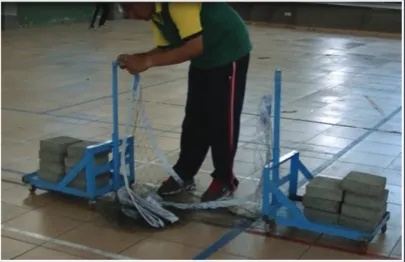
Based on Figure 1, the conventional sports facilities for tonnis game are a net with a standard height of 85 cm and a length of 1304 cm, net pole height of 100 cm, tires weight filled with 70 kg concrete. A minimum of 2 people is recommended to assemble and disassemble sports facilities for tonnis.
Health quality: fatigue
There is an increase in the quality of health workers after using the new facilities (Table 1). The reduc-tion in fatigue is due to the improvement in the organization of work, the natural posture of work-ing, using hand muscle appropriately according to the ability to lift weights. Movements are more economical by optimizing the net pole thrust, so it reduces the workload on both hands when carrying the load.
Statistical analysis of worker fatigue showed that there are significant differences. Worker fatigue has decreased in the form of general fatigue, activity fatigue, motivational fatigue, and physical fatigue with p <0.05.
Figure 1 Conventional Tonis game Facilities
Table 1 Statistical analysis results of worker fatigue (n=144)
Parameter Improvement Score Change (%) p
General fatigue Conventional
Facilities 96.07±1.78 24.65 0.001
New Facilities 72.39±4.48 Activity fatigue Conventional
Facilities 32.43±1.07 26.60 0.001
New Facilities 23.80±1.30 Motivational
fatigue Conventional Facilities 31.91±0.44 23.00 0.001
New Facilities 24.57±2.24 Physical fatigue Conventional
Facilities 31.73±0.84 24.31 0.001
Quality health: musculoskeletal disorders and convenience of work
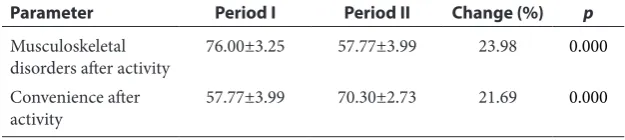
Redesigning tonnis sports facilities using partic-ipatory approaches ergonomics is able to improve working movement, the work attitude as the move-ments are more economical. Looking at the average score of the decrease of musculoskeletal disorders, the workers feel healthier. The body parts measured on assembling and disassembling activities of tonnis sports facilities, are a) part of the trunk muscles; the upper neck, lower neck, back, waist, buttocks, ass, b) muscular upper extremities: left shoulder, right shoulder, upper left and right arm, left and right elbow, left and right forearm, left and right wrist, left and right hands, c) lower extremi-ties: left and right thigh, left and right knee, left and right legs. Based on Table 2, the results of statistical analysis of musculoskeletal disorders of workers indicate that there are significant differences. It can be said that the workers’ musculoskeletal disorders were declined when assembling and disassembling between the conventional facilities and new facili-ties design results (p <0.05).
The decrease in worker fatigue and musculo-skeletal disorders impacts on improving the conve-nience felt by the workers. Conveconve-nience occurs due to various constraints and problems that had been obtained solutions that consider the user desires without forgetting the primary function of the net pole design. An extra facility such as a place to drink mineral water placed on the lots arranged in a square of the ballast provides more value for others. Until now, the ballast on the pole is only used to support the net so that it can be securely attached. In addition, due to the addition of gallons of mineral water as much as 19 liters when fully loaded, load parcels are reduced. Another function of gallons of mineral water is an ease for players to drink, especially novice players who still need a longer adaptation because the environment is still extreme and the body has not been acclimatized.
DISCUSSION
In general, the concept of participatory ergonomics has been developed in some countries, but the conditions between other places are very different.
This difference is because of the characteristics of workers, workplace culture, and human behavioral patterns in the work. In America, participatory ergonomics is used on a macro level for the devel-opment and implementation of technology. In Europe, the ergonomics approach is applied to the ergonomic intervention level with the key factors that involves the entire decision.5 In Indonesia, participatory ergonomics can be developed on any activity technology design and development of industrial products ranging from small, medium, until the industry by PT category.12,13
Designing products by considering some of the inputs to the workers or the perpetrator will directly impact on the sustainable guarantee of using the new tool. Ideas that use this part are in the form of workers’ creativity and innovation that is valued by management in the form of direct imple-mentation in the form of a new facility design. The participatory approach is a key to the success of the development scheme because the process of finding the problem and solutions independently raises awareness to preserve the findings for long periods of time.5 Participatory ergonomics approach also aims to increase the utility in the development of ergonomic aspects of work and workstations. It also aims to promote the initiative of workers to achieve the best solution to improving the working facilities. The participatory method provides a new experience in the form of worker participation to improve the workplace.5
Fatigue is a symptom of the decline in work performance. Fatigue is divided into two, namely fatigue in peripheral body and fatigue in the nerve center of the brain. In general, fatigue starts from the muscles that interact directly with the load from outside the body or the feeling experienced by workers in workload. Cumulative fatigue occurs and lasts until the completion of work activities or during breaks of the recovery of muscle power. In this study, the difference in the value of the maxi-mum fatigue occurs in each settlement process of assembling sports facilities of tonnis game or after 15 minutes of work using conventional facilities. Reduction in fatigue occurs due to the improve-ment of various aspects, such as work organization improvement, working in more natural posture, using hand muscle appropriately and according to the ability, consideration of the economic value of the movement, and a reduction in workload.
Various improvements made on the basis of participatory ergonomics are translated into rede-signing new products such as net pole and ballast for tonnis sports games. Direct involvement by workers provides benefits, such as breaking down some barriers, identifying problems, and choosing an alternative solution to determine the new draft
Table 2 Statistical analysis results of musculoskeletal disorders and convenience of work (n=144)
Parameter Period I Period II Change (%) p
Musculoskeletal
disorders after activity 76.00±3.25 57.77±3.99 23.98 0.000 Convenience after
that is considered suitable. The decrease fatigue can occur in manual work, repetitive, and sustainable.14 In this study, the change in the value of general fatigue felt by the workers by 24.65%.
Improving the quality of health through the reduction of fatigue is caused by repairing working facilities.15 Some of the complaints caused by unnatural body posture during the process of assembly and disassembly of tonnis sports facilities are also improved as evidenced by a decrease in worker complaints. It also has an impact on changes in work organization. The unnatural attitude to the body of workers began to decrease. Subjective complaints can be caused by unnatural working attitude and inadequate working conditions.16 In general, the work can be maintained within a few hours per day without fatigue if the power used does not exceed 80% of maximum muscle power.17 It is possible that the use of muscle power in the first period during the assembly and disassembly of tonnis sports facilities exceed the limit of maximum lift, i.e., when lifting tires contain 70 kg of concrete. Tires containing concrete should be moved by sliding or being rolled, so it reduces the power of elevating activity of the workers.
Applying ergonomics concept is useful to iden-tify musculoskeletal disorders and biomechanics load from the beginning.18 In order to achieve safe, comfortable, healthy, effective, and efficient work-ing conditions, it is required a redesign by uswork-ing the principles of anthropometry.19 Anthropometric data can be used as the basis for the design of the working facility design. One indicator of good work facilities is the impact on the reduction of musculo-skeletal disorders.
Musculoskeletal disorders can occur to workers during physical work activities and it would be quicker felt when workloads exceed the maximum working load of workers.20,21 Musculoskeletal disor-ders in this study had an average of 76.00 ± 3:25 at the beginning of the period, then, after the inter-vention, the average amounted to 57.77 ± 3.99 or decreased by 23.98%. This condition is caused by an improvement with emphasis on the human factor, consideration on the ability, skill, and labor capac-ity constraints. Each work has differences from the reduced rate of musculoskeletal disorders.22
Results of other studies that apply ergonomics intervention, it is known that changes in muscu-loskeletal disorders by 41.3% and fatigue by 46.8% between before and after work.23 In addition to the type of work that leads to differences in the level of perceived musculoskeletal disorders per worker, age also contributes to the changes. At the age of productive, fatigue felt by the workers is lighter when compared to the unproductive age.
In this study, it was obtained an average score of convenience after activity in the first period of 57.77 ± 3.99 and 70.30 ± 2.73 in the period II. In other words, there is an increase of 21.69% convenience of work. This condition is caused by redesigning work facilities using anthropometry approach humans and translating the user desires to redesign the technical characteristics of sports facilities of tonnis game. Working facilities in accordance with anthropometry can increase convenience.24,25 It is said to be comfortable when workers are protected from changes in the environment and can survive for a certain period. Humans can be convenient if they are able to survive on fluctuated energy, heat, cold, noise, vibration on the actual condition of the surrounding environment.26 Utilization of anthro-pometric data should consider the size percentile because it will increase the precision of the inter-action of man and machine. Implementation percentile is used to ensure conformity of the size of the product in order to obtain user comfort.27 Percentile applications have been received and the applicable to the public in order product design to be called ergonomic.28
CONCLUSIONS AND RECCOMENDATIONS
Redesigning participatory-ergonomics-based sports facilities is able to improve the quality of healthcare that can be seen from the decline in the general exhaustion of 24.65% consisting of 26.60% activity fatigue, 23:00% motivational fatigue, and 24.31% physical fatigue, 23.98% musculoskeletal disorders, and 21.69% convenience of work. The participatory ergonomics approach not only can redesign new work facilities by taking into account wishes of the user, but also can improve the role of workers in improving the quality of physical health.To obtain comprehensive results, the suggestion for future research is to include consideration of the health quality of mental and psychological factors of employees. The mental condition of the workers is important for further investigation because of the very complex effects of working facilities to improve the quality of health. Thus, the safe and comfortable working conditions can be maintained and controlled. Another suggestion is the need to evaluate the choice of net poles with material properties that remain strong, not brittle, as well as user-friendly during the process of assembly and disassembly.
REFERENCES
2. Susihono, W. Rubiati, E. 2013. Repairing Working Method Based on Rapid Upper Limb Assessment (RULA) on Construction and Fabrication Company. Spektrum Industri. Vol. 11. No. 1. p101-110
3. Susihono, W. Prasetyo, W. 2012. Repairing Working Posture to Reduce Musculoskeletal Disorders Using OWAS Approach (Case Study at UD. Rizki Ragil Jaya – Cilegon). Spektrum Industri. Vol. 10. No. 1. p1-107 4. Shaliza, A. M. Shahrul, K. Mohzani, M. Zalinda,
O. Khairanum, S. 2006. Application of Quality Function Deployment in Identifying Ergonomics Programs for Malaysian, The Effect of Ergonomics Applications in Work System on Mental Health of Visual Display Terminal Workers 354 Manufacturing Industries (CD ROM). Proceedings in International Conference on Technology Management. 2006
5. Kogi, K. 2006. Participatory methods effective for ergo-nomic workplace improvement. Applied Ergoergo-nomics. 37 (2006).p547–554
6. Manuaba, A. 2000. Participatory Ergonomics Improvement at the Workplace. Indonesia Ergonomic Journal. 1(1). p6-10.
7. Rupesh, K. Montakarn, C. Jan, L. 2005. Participatory Ergonomics and an Evaluation of a Low-Cost Improvement Effect on Cleaners’ Working Posture. International Journal of Occupational Safety and Ergonomics. Vol. 11, No. 2. p203–210
8. Sadra N. Abarghouei, H. Hosseini, N. 2012. An Ergonomic Evaluation and Intervention Model: Macro ergonomic approach. International Journal of Scientific & Engineering Research. Vol 3. No 2. p1-7
9. Tarwaka, 2010. Ergonomic Industry; Ergonomic Basic Knowledge and the Application in Working Place. Ed1 Cet
1. Harapan Press Solo. ISBN 9789791814416.
10. Yoshitake, H. 1971. Relations between The Symptoms and The Feeling of Fatigue. In Hashimoto, K; Kogi, K and Grandjean, E. (Eds). Methodology in Human Fatigue Assessment. London: Taylor and Francis Ltd
11. Corlett, E.N.1992. Static muscle loading and evalua-tion of posture. From Wilson, J.R and Corlet, E.N (eds). Evaluation of Human Work, A Practical Ergonomics Methodology. Taylor and Francis Great Britain, p: 544-570.
12. Susihono, W. 2014. Ergonomics Approach Analysis as Basis of Identification and Improvement of Working Conditions on the Induction Kitchen System Metal Casting Industry; A Case Study at PT. X Ceper Klaten. Proceeding Seminar National Industrial Engineering Conference. Industrial Engineering Department of Sebelas Maret University. Surakarta. p 284-290. ISBN 978-602-70259-2-9.
13. Susihono, W. 2016. The Implementation of Total Ergonomic Orientation of Net Production Technology in Improving Worker Performance, Environmental Quality, and Adding Value of Metal Stamping Station Waste in Batur, Ceper, Klaten. (Dissertation). Denpasar: Postgraduate Program, Udayana University
14. Adiatmika, I.P.G. 2009. Total Ergonomic Approach in Decreasing Quality of Fatigue of Metal Crafters. Anima, Indonesian Psychological Journal. Vol. 25. No. 1. p71-78 15. Husein, T. dan Kholil, M. 2009. Designing Ergonomic
Working System to Reduce Fatigue Level. INASEA, Vol. 10 No.1, April 2009: 45-58
16. Susetyo, J. Oes, T.I. Indonesiani, S.H. 2008. Prevalence of Subjective Complaint or Fatigue Caused by Non-Ergonomic Working Attitude on Silversmith. Technology Journal. Volume. 1 Nomor 2. December. 141-149. 17. Astrand, P.O and Rodahl, K. 1977. Textbook work
Physiology; Physiological. McGraw-Hill Book Company. The United States of America
18. Franco, G. Fusetti, L. 2004. Bernardino Ramazzini’s early observations of the link between musculoskeletal disor-ders and ergonomic factors. Applied Ergonomics. (35). 67–70
19. Sutajaya, I.M. 2014. Community Empowerment Through Ergonomics Training with Local Wisdom Oriented To Improve Quality Of Sculptor Health In The Peliatan Village, Ubud, Gianyar, Bali-Indonesia. Bali Medical Journal (Bali Med. J.). Vol 3. Nor 3. p157-160
20. Fischer, S.L. Woodcock, K. 2012. A cross-sectional survey of reported musculoskeletal pain, disorders, work volume and employment situation among sign language interpret-ers. International Journal of Industrial Ergonomics. (42). 335-340
21. Sato, T.D.O. Coury, H.J.C.G. 2009. Evaluation of musculo-skeletal health outcomes in the context of job rotation and multifunctional jobs. Applied Ergonomics. (40). 707–712 22. Dahlberg, R. Karlqvist, L. Bildt, C. Nykvist, K. 2004. Do
work technique and musculoskeletal symptoms differ between men and women performing the same type of work tasks?. Applied Ergonomics (35). 521–529
23. Heiden. B. Weigl, M. Angerer, P. Muller, A. 2013. Association of age and physical job demands with musculoskeletal dis-orders in nurses. Applied Ergonomics (44). 652 – 658 24. Pheasant, S. 1991. Ergonomics, Work and Health. London:
MacMillan Academic Professional Ltd.
25. Grandjean, E. 2000. Fitting the Task to The Man. A Textbook of Occupational Ergonomics. London: Taylor & Francis Ltd.
26. Bubb, H. 2006. A Consideration of The Nature of Work and The Consequences for The Human-Oriented Design of Production and Products. Journal of Applied Ergonomics. 37(4): 401-407.
27. Adiputra, N. 2003. Physical Working Capacity of Bali People. Udayana Medical Journal. 34(120): 108-110. 28. Sutalaksana, I.Z., Anggawisastra, R., dan Tjakraatmaja,
J.H. 1982. Working Procedure Technique. Bandung: Industrial Engineering Department, ITB