Evaluation and Re-Formulation Of XYZ Hotel Business Strategy
1 Lathif Arafat.A, 2 Syukri Lukman
1Master’s Student, 2 Professor, Departement Master of Management Faculty of Economic, Andalas University, Padang
City, West Sumatera, Indonesia.
Email: 1[email protected],2 [email protected]
( This is for only example: - Authors may use subtitles/contents as per research work/topic )
1. INTRODUCTION:
Hospitality businesses service in Padang was once collapsed after the September 30th 2009 earthquake which
hit the Padang City and its surroundings, however the situation started recover gradually for a year and then after many new investors built hotels in Padang. The development of hospitality businesses in the globalization era that offers a wide range of hospitality products caused competition which demanded the hospitality business in Padang to be actively and creatively a consequence of the dynamic of Opportunity and Threat that must be faced. The competition showed a growing number of hotels standing, good hotel or budget hotels. By looking at the large number of new hotels being built in Padang, caused the hospitality business had a good chance to thrive, so that business service hospitality had a very lucrative opportunity. The existence of the competition resulted in change of consumer behaviour in choosing the XYZ Hotel service. Data comparison of Occupancy (Occupancy rate), Market Share, Revenue, and Average Rate Room (ARR), XYZ Hotel and star hotels in Padang in a range of January – February 2018 as follows.
Table 1.1
Hotel Comparison Primary Competitor
Abstract:XYZ Hotel belongs to the State-Owned Enterprises (BUMN) after the 2009 earthquake in Padang. In order to achieve a competitive advantage for the hospitality service trade is influenced by both internal and external environment. This study aims to evaluate and re-formulate strategies and recommend the best alternative strategies used by XYZ Hotel in accordance with the environmental conditions of the company. Data analysis technique used 3 stages. The input stage used Internal Factor Evaluating Matrix and External Factor Evaluating Matrix, the competitors were then analysed with Competitive Profile Matrix. The matching stage used SWOT Matrix and Internal External Matrix to obtain some alternative strategies, the proper strategy was eventually decided at this stage through Quantitative Strategic Planning Matrix. The results of this study showed that the XYZ Hotel actually had the power of internal and external opportunities in order to develop business and face the level of competition by using Intensive Market Penetration Strategies through broader marketing efforts by having Online Travel Agent and marketing through Content Creative.
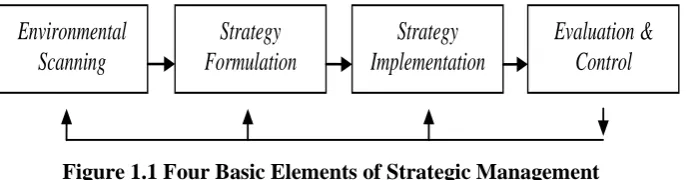
Environmental
Scanning
Strategy
Formulation
Strategy
Implementation
Evaluation &
Control
Source: Night Audit XYZ Hotel (2018)
January 2018 explained that the most market share position was PBH Hotel (16%) with rate of room occupancy 70% from available room with average of room price Rp509,374, then followed by RPH Hotel, BSK Hotel, TAH Hotel, and MCR Hotel, then position of XYZ Hotel with market only 11% of market with rate of room selling only 56% from available room, then if was observed next month on February 2018 the most market share position was MCR Hotel (16%) with rate of occupancy 99% from available room with average of room price Rp662,001, then followed by GZH Hotel, IBS Hotel, then position of XYZ Hotel with market only 10% of market with rate of room selling only 52% from available room.
Evaluation and re-formulation business strategy of XYZ Hotel aims to win the competition. Strategy is a process plan determination which gives direction to achieve the mission and company goals, by maximizing the competitive advantage and minimizing the competitive disadvantage (Wheelen & Hunger, 2012). The approach model was needed to be arranged from IFE Matrix, EFE Matrix, SWOT analysis, IE Matrix to invent the alternative strategies, then the prioritized alternative strategies would be recommended through QSPM (David, 2015). In developing the strategy management, there are four stages of the process which should be done namely environmental scanning, strategy formulation, strategy implementation, and evaluation (Wheelen & Hunger, 2012)
Figure 1.1 Four Basic Elements of Strategic Management Source: Whelen & Hunger (2012)
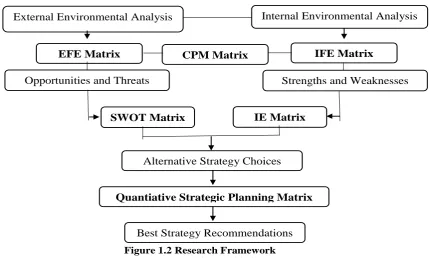
Input Stage
EFE CPM IFE
Matching Stage
SWOT IE
Decision Stage QSPM
Figure 1.2 Research Framework
Source: Processed Data (2018)
External Environmental Analysis Internal Environmental Analysis
EFE Matrix CPM Matrix IFE Matrix
Opportunities and Threats Strengths and Weaknesses
SWOT Matrix IE Matrix
Alternative Strategy Choices
Quantiative Strategic Planning Matrix
Best Strategy Recommendations
3. RESEARCH METHODS:
This study is exploratory study with a qualitative approach. Exploratory studies is done when not much is known about the situation that will happen, or there is no available information about how similar problems or research problems are completed in the past. Explorative research often depends on secondary research (such as literature review) or qualitative approach for data collection such as an interview, focus group, projective method, or case studies (Sekaran: 2017).
Sampling design in this research used purposive sampling which is the nature of sample is based on judgment sampling. Purposive sampling is a sampling in this case is limited in specific types of people who can provide the desired information, either because they are the only party who own it or who fulfill criteria determined by researcher (Sekaran, 2017).
This study used 16 subjects divided into 3 groups based on the first group from analysis of external environmental (tourism industry expert) as follows; a) Deputy of the Ministry of Tourism's Destination Development, Mr. Dr. Komang Mahawira, SH, M.Hum; b) Investment Service and One Door Service (DPMPTSP) Padang city, Mrs. Rina Melati S.STP, MM; c)Center for Economic and Social Studies of the Faculty of Social Sciences (PKESB-FIS) Padang State University, Mrs. Dr. Siti Fatimah, M.Hum; d) Center for Tourism Studies (PKESB-(PKESB-FIS) Andalas University, Mrs. Dr. Sari Lengonggeni, MM; and e) Chairman of the Indonesian Hotel and Restaurants Association (PHRI) of West Sumatra Province, Mr. Maulana Yusran. Further, the second group from analysis of management internal environmental of XYZ Hotel as follows; a) General Manager of XYZ Hotel, Mr. Mazri Tanjung; b) Human Capital Manager of XYZ Hotel, Mr. Osman Idayat and c) Marketing Analyst of XYZ Hotel, Mrs. Susti. The last group from competitive advantage analysis interview of 8 subjects each one Sales & Marketing of the competitor’s hotel.
Data analysis used analysis content techniques or interrater reability judgment evaluation and re-formulation strategy of comprehensive matrix integrated in the frame work below:
Figure 3. 1Comprehensive Analysis of Strategies Evaluation and Reformulation
This technique used a systematic analysis to identify information content specific to the characteristics of the message that was delivered by the subject, through interviews, questionnaires, and observations.
4. RESULTS AND DISCUSSION:
The XYZ Hotel strategy used today is horizontal integration strategy, where this strategy functions to seek ownership or increase control over competitors. It can be seen by instruction from the central government in the holding production at each sector of BUMN who does business in the same sector. It included PT. Hotel Indonesia Group (HIG) which was formed in 2017 by the Ministry of BUMN as hospitality virtual holding of BUMN. Each BUMN business unit is expected to increase the value with a strategy if it is a collaboration. After the observation and evaluation, it can be known that this strategy was not optimal in actualizing vision and mission of XYZ Hotel, then evaluation and re-formulation of strategy was carried out.
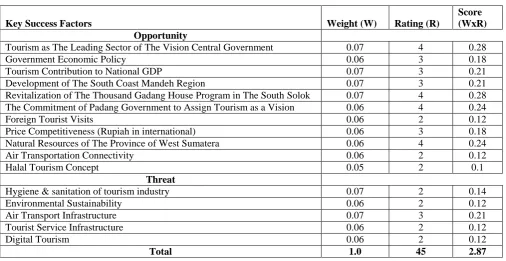
The results of interviews and secondary data analysis were carried out, analysis of External Factor Evaluation Matrix (EFE) as shown in the table below:
Table 4.1 EFE Matrix
Source:
Processed Data (2018)
Response to opportunity and threat analysis describes that XYZ Hotel is in a medium point with a score of 2.87. Furthermore, the internal analyze of XYZ Hotel management used Internal Factor Evaluation Matrix (IFE) with the calculation of the score below:
Table 4.2 IFE Matrix
No. Key Success Factors Weight (W) Rating (R) Score (WxR)
Strength
1 Room Income 0.05 4 0/2
2 Gross Operating Profit 0.04 4 0.16
3 No Room Income 0.05 4 0.2
4 EBITDA 0.04 4 0.16
5 Profit (Loss) Before Tax (PBT) 0.05 4 0.2
6 POMEC (Property Operation Maintenance Energy Cost) 0.05 4 0.2
7 Food & Beverage Cost 0.05 4 0.2
8 Annual Operating Profit Per Room 0.05 4 0.2
9 Net Profit / Employee 0.04 4 0.16
10 Room Occupancy 0.04 4 0.16
11 Room Inventory is Ready for Sale 0.05 4 0.2
12 Number of Rooms 0.03 4 0.12
13 Customer Complain Response Rate 0.05 4 0.2
14 Average Length of Stay of Guests 0.05 4 0.2
Key Success Factors Weight (W) Rating (R)
Score (WxR) Opportunity
Tourism as The Leading Sector of The Vision Central Government 0.07 4 0.28
Government Economic Policy 0.06 3 0.18
Tourism Contribution to National GDP 0.07 3 0.21
Development of The South Coast Mandeh Region 0.07 3 0.21
Revitalization of The Thousand Gadang House Program in The South Solok 0.07 4 0.28 The Commitment of Padang Government to Assign Tourism as a Vision 0.06 4 0.24
Foreign Tourist Visits 0.06 2 0.12
Price Competitiveness (Rupiah in international) 0.06 3 0.18 Natural Resources of The Province of West Sumatera 0.06 4 0.24
Air Transportation Connectivity 0.06 2 0.12
Halal Tourism Concept 0.05 2 0.1
Threat
Hygiene & sanitation of tourism industry 0.07 2 0.14
Environmental Sustainability 0.06 2 0.12
Air Transport Infrastructure 0.07 3 0.21
Tourist Service Infrastructure 0.06 2 0.12
Digital Tourism 0.06 2 0.12
Weakness
1 Market Share of Foreign Guests 0.05 2 0.1
2 ARR (Average Room Rate) 0.05 2 0.1
3 Customer Satisfaction Index 0.05 3 0.15
4 Number of Foreign Tourist Arrival 0.05 2 0.1
5 Number of Employees Divided Rooms 0.05 4 0.2
6 Human Resources Fulfill SKNI Certification 0.05 2 0.1
7 The Average Number of Innovation Proposals Once Per Year Per Unit 0.05 3 0.15
Total 1.0 74 3.46
Source:
Processed Data (2018)
The calculation results of the Internal Factor Evaluation Matrix (IFE) with a total score of 3.46 indicates that XYZ Hotel is at a strong point. Furthermore, in the final input stage, the competition analysis of Competitive Profile Matrix (CPM) found the result as the table follows:
Table 4.3 CPM (Competitive Profile Matrix)
R a n k S co re R a n k S co re R a n k S co re R a n k S co re R a n k S co re R a n k S co re R a n k S co re R a n k S co re
1. Hotel Name Recognition 0.005 3 0.02 4 0.02 4 0.02 3 0.02 1 0.01 4 0.02 4 0.02 4 0.02
2. Service 0.15 2 0.30 4 0.60 3 0.45 3 0.45 3 0.45 4 0.60 3 0.45 3 0.45
3. The Occupancy Rate 0.15 3 0.45 4 0.60 4 0.60 3 0.45 3 0.45 4 0.60 4 0.60 3 0.45
4. Market Segmentation 0.08 3 0.24 3 0.24 3 0.24 3 0.24 3 0.24 3 0.24 3 0.24 3 0.24
5. Market Share 0.1 3 0.30 3 0.30 3 0.30 3 0.30 3 0.30 3 0.30 3 0.30 3 0.30
6. Experience in This Business 0.18 3 0.54 4 0.72 4 0.72 3 0.54 3 0.54 4 0.72 4 0.72 4 0.72
7. Financial Strength 0.18 2 0.36 3 0.54 4 0.72 4 0.72 3 0.54 3 0.54 3 0.54 3 0.54
8. Location 0.1 3 0.30 3 0.30 4 0.40 1 0.10 3 0.30 3 0.30 3 0.30 3 0.30
9. Provision of Facilities 0.04 4 0.16 4 0.16 4 0.16 4 0.16 4 0.16 3 0.12 3 0.12 3 0.12
Total 1.0 2.7 3.5 3.6 3.0 3.0 3.4 3.3 3.1
GZH IBS KBM
Critical Success Factors Weight
BSK MCR PBH RPH TAH
Source: Processed Data (2018)
Analysis Data of Competitive Profile Matrix (CPM) explains that the competitive advantage is led by competitors with PBH code with a total score of 3.6. The main strength was in the experience in the hotel business Padang City, when confirmed at the interview, respondents gave the information that it was caused the first business hotel in Padang was PBH Hotel supported by small power with an occupancy rate of 80%-90%, strategic location, provision of facilities, name recognition, financial strength. When re-confirmed, tend to be the main weakness was hotel name recognition, location, and provision of facilities it was caused project of Padang City government which on process of building a flyover on the beach, this tends cause in the impression of hotel name recognitions as “view beach” was missing and strategic location position and provision of facilities which correlate with the beach would be negative impact (Desi, 2018).
Furthermore, the low score is on competitor with BSK code with a total score of 2.7. The main strength was in the provision of facilities, when confirmed at the interview, respondents explained that BSK Hotel was superior in providing of facilities with a standard five-star hotel, however it has a main weakness which is in the location with “traffic jam”, it was caused by provision of minimal vehicle parking facilities.
The next step is matching stage by using two matrices. The first matrix is External-Internal Matrix (IE). IE Matrix of two dimensions, namely total score from IFE Matrix on the X axis and total score from IFE Matrix on the Y axis. IE Matrix consists of two dimension namely total score of IFE Matrix on the X axis (horizontal) and total score of EFE Matrix on the Y axis. Based on results of analysis from IFE and EFE Matrices on XYZ Hotel, then it can be known X axis IE Matrix is a total score of IFE Matrix of 3.46 and Y axis IE Matrix with a total of 2.87. As for an illustration of the company’s position can be seen in the following figure:
Figure 4.1 External Internal Matrix
Source: Processed Data (2018)
Strong 3.0 - 4.0 (3.46)
Strong 2.0 – 2.99
Weak 1.0 – 1,99 High 3.0 - 4.0
The results of IE Matrix above shows that XYZ Hotel in the cell IV means that XYZ Hotel has alternative strategy to grow and develop. The appropriate strategies with this condition are better using Intensive & Integration Strategy(market penetration, forward integration and horizontal integration).
The evaluation and re-formulation step of business strategies for XYZ Hotel in next stage used SWOT analysis where the factors of challenges opportunity are correlated with the strength and weakness of management XYZ Hotel, in which analysis of IFE Matrix and EFE Matrix is the initial input for the SWOT Matrix analysis. Analysis of SWOT Matrix is an important match to assist company’s management in developing four types of strategies: 1) SO Strategy (strengths-opportunities) namely the driver of share value by increasing the level of corporate profitability and resource optimization and costs; 2) WO Strategy (weaknesses-opportunities) the differentiating value proposition; 3) ST Strategy (strengths-threats) Internal Business process (how value is created & sustained); and 4) WT Strategy (weaknesses-threats)Learning & Growth (role for intangible asset-people, system, climate & culture).
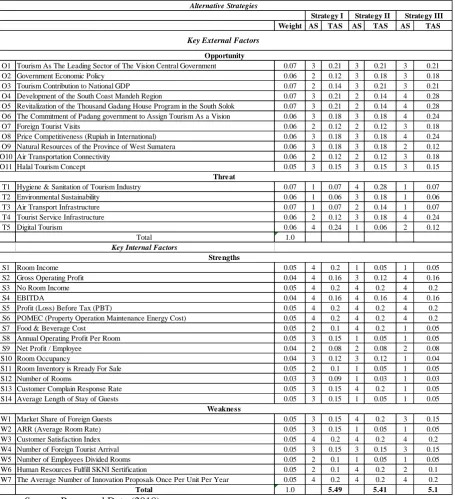
Decision stage is the final step in recommending the proper strategy by QSPM analysis (Quantitative Strategic Planning Matrix) that can be seen in the following table:
Table 4.4 QSPM Analysis
Weight AS TAS AS TAS AS TAS
O1 Tourism As The Leading Sector of The Vision Central Government 0.07 3 0.21 3 0.21 3 0.21
O2 Government Economic Policy 0.06 2 0.12 3 0.18 3 0.18
O3 Tourism Contribution to National GDP 0.07 2 0.14 3 0.21 3 0.21
O4 Development of the South Coast Mandeh Region 0.07 3 0.21 2 0.14 4 0.28
O5 Revitalization of the Thousand Gadang House Program in the South Solok 0.07 3 0.21 2 0.14 4 0.28
O6 The Commitment of Padang government to Assign Tourism As a Vision 0.06 3 0.18 3 0.18 4 0.24
O7 Foreign Tourist Visits 0.06 2 0.12 2 0.12 3 0.18
O8 Price Competitiveness (Rupiah in International) 0.06 3 0.18 3 0.18 4 0.24
O9 Natural Resources of the Province of West Sumatera 0.06 3 0.18 3 0.18 2 0.12
O10 Air Transportation Connectivity 0.06 2 0.12 2 0.12 3 0.18
O11 Halal Tourism Concept 0.05 3 0.15 3 0.15 3 0.15
T1 Hygiene & Sanitation of Tourism Industry 0.07 1 0.07 4 0.28 1 0.07
T2 Environmental Sustainability 0.06 1 0.06 3 0.18 1 0.06
T3 Air Transport Infrastructure 0.07 1 0.07 2 0.14 1 0.07
T4 Tourist Service Infrastructure 0.06 2 0.12 3 0.18 4 0.24
T5 Digital Tourism 0.06 4 0.24 1 0.06 2 0.12
Total 1.0
Key Internal Factors
S1 Room Income 0.05 4 0.2 1 0.05 1 0.05
S2 Gross Operating Profit 0.04 4 0.16 3 0.12 4 0.16
S3 No Room Income 0.05 4 0.2 4 0.2 4 0.2
S4 EBITDA 0.04 4 0.16 4 0.16 4 0.16
S5 Profit (Loss) Before Tax (PBT) 0.05 4 0.2 4 0.2 4 0.2
S6 POMEC (Property Operation Maintenance Energy Cost) 0.05 4 0.2 4 0.2 4 0.2
S7 Food & Beverage Cost 0.05 2 0.1 4 0.2 1 0.05
S8 Annual Operating Profit Per Room 0.05 3 0.15 1 0.05 1 0.05
S9 Net Profit / Employee 0.04 2 0.08 2 0.08 2 0.08
S10 Room Occupancy 0.04 3 0.12 3 0.12 1 0.04
S11 Room Inventory is Rready For Sale 0.05 2 0.1 1 0.05 1 0.05
S12 Number of Rooms 0.03 3 0.09 1 0.03 1 0.03
S13 Customer Complain Response Rate 0.05 3 0.15 4 0.2 1 0.05
S14 Average Length of Stay of Guests 0.05 3 0.15 1 0.05 1 0.05
W1 Market Share of Foreign Guests 0.05 3 0.15 4 0.2 3 0.15
W2 ARR (Average Room Rate) 0.05 3 0.15 1 0.05 1 0.05
W3 Customer Satisfaction Index 0.05 4 0.2 4 0.2 4 0.2
W4 Number of Foreign Tourist Arrival 0.05 3 0.15 3 0.15 3 0.15
W5 Number of Employees Divided Rooms 0.05 2 0.1 1 0.05 1 0.05
W6 Human Resources Fulfill SKNI Sertification 0.05 2 0.1 4 0.2 2 0.1
W7 The Average Number of Innovation Proposals Once Per Unit Per Year 0.05 4 0.2 4 0.2 4 0.2
Total 1.0 5.49 5.41 5.1
Alternative Strategies
Key External Factors
Opportunity
Strategy I Strategy II Strategy III
Threat
Strengths
Weakness
The Quantitative Strategic Planning Matrix (QSPM) can be known that the best strategy that researchers recommend that is flexible to be applied in XYZ Hotel is Intensive Strategy of Market Penetration with a total score of attractiveness of 5.49
5. CONCLUSION:
Based on explanation above, strategy of XYZ Hotel in “medium” position in the external environment and “strong” condition in the internal environment position, are in the cell IV defined as “grow and develop strategies” and if it is correlated with some strategies of SWOT Matrix, then it will create four strategies, namely SO Strategy, (strengths-opportunities); WO Strategy (weaknesses-opportunities); ST Strategy (strengths-threats); and WT Strategy (weaknesses-threats). On the basis of this match, then QSPM analysis researcher determined recommended prioritized alternative strategy is Market Development Strategic with a Total Attractiveness Score (TAS) 5.49. The intensive market penetration strategy referred to iss the increased market share for current product and service through broader marketing by having Online Travel Agent and marketing through Content Creative.
REFERENCES:
1. Ab Talib, M. S., & Hamid, A. B. A. (2014). Halal logistics in Malaysia: A SWOT analysis. Journal of Islamic Marketing, 5(3), 322–343. https://doi.org/10.1108/JIMA-03-2013-0018
2. Aji, A. A., Satria, A., & Hariono, B. (2014). Strategi Pengembangan Agribisnis Komoditas Padi Dalam Meningkatkan Ketahanan Pangan Kabupaten Jember. Jurnal Manajemen Dan Agribisnis, 11(1), 60–67. Retrieved from http://journal.ipb.ac.id/index.php/jmagr/article/view/8500/6657
3. Ariendi, G. T., Daryanto, A., & Sanim, B. (2015). Strategy for Increasing Business Competitiveness of Green Property. International Journal of Innovation and Scientific Research, 19(1), 24–32.
4. Danil (2018, Juni 28). Personal interview 5. Desy (2018, Juni 26). Personal interview
6. David, M. E., David, F. R., & David, F. R. (2017). The quantitative strategic planning matrix: a new marketing tool. Journal of Strategic Marketing, 25(4), 342–352. https://doi.org/10.1080/0965254X.2016.1148763
7. David, Fred R.and Forest R, David (2015). Strategic Management: A Competitive Advantage Approach,Concepts, and Cases, 15th ed (Novita Puspasari, Liza Nurbaini Puspitasari, Penerjemah). Jakarta: Pearson Education,Inc and Salemba Empat.
8. Fatimah, Siti (2018, Juni 29). Personal interview
9. Gumelar, Galih. (2011, Oktober 19). Kemenpar Klaim Pariwisata Jadi Kontributor Utama Devisa.Indonesia: CNNIndonesia. https://https://www.cnnindonesia.com/ekonomi/, diakses 13-03-2018, selasa, 08.25 WIB 10. Idayat, Osman (2018, Juli 09). Personal interview
11. Ira (2018, Juni 27). Personal interview
12. Kesrul, M. 2004. Meeting, Incentive Trip, Conference, Exhibition. Yogyakarta: Andi Offset.
13. Khotimah, K. (2017). Pandangan Berbasis Sumber Daya (Rbv) Dalam Pembahasan Organisasi Ekonomi. Seminar Nasional Ekonomi Dan Bisnis, 5(September), 1–8.
14. Knott, P. J. (2015). Does VRIO help managers evaluate a firm’s resources? Management Decision, 53(8), 1806–1822. https://doi.org/10.1108/MD-08-2014-0525
15. Lengonggeni,Sari (2018, Juli 10). Personal interview 16. Mahawira, Komang (2018, Juni 04). Personal interview 17. Mandangi, Dewi Amelia (2018, Juli 12). Personal interview 18. Melati, Rina (2018, Juli 09). Personal interview
19. Pearce,Jhon A. and Robinson, Jr, Richard (2013). Strategic Management: Formulation,implementation and Control, 12th ed (Nia Pramita Sari, Penerjemah). Jakarta: Mc Graw-Hill Education and Salemba Empat. 20. Rangkuti, (2015). Teknik Membedah Kasus Bisnis: Analisis SWOT. Jakarta: Gramedia.
21. Saghaei, M., Fazayeli, L., & Shojaee, M. R. (2012). Strategic Planning For A Lubricant Manufacturing Company Using SWOT Analysis, QSPM model (one of the Top companies of Iranian Oil, Gas and Petrochemical Products Exporters’ Association). Australian Journal of Business and Management Research, 1(10), 18–24.
22. Sekaran, Uman and Bougie, Roger (2017). Research Methods for Business, 6th ed (Kwan Men Yon, Penerjemah). Jakarta: Wiley,Inc and Salemba Empat.
23. Septiani (2018, Juni 26). Personal interview 24. Silvia, Yetti (2018, Juli 14). Personal interview
26. Susti (2018, Juli 09). Personal interview
27. Tanjung, Mazri (2018, Juli 11). Personal interview
28. Thompson, A., Strickland, A. J., Gamble, J., & Peteraf, M. A. (2015). Crafting and Executing Strategy: Concepts and Readings.
29. Utami, E., & Imron, A. (2012). Perumusan Strategi Perusahaan Berdasarkan Competitive Advantage. Jurnal Ilmiah Teknik Industri,11(2), 154–164.
30. Wheelen, T. L., & Hunger, J. D. (2012). Strategic Management and Business Policy. McGraw-Hill Education Irwin. https://doi.org/10.1017/CBO9781107415324.004
31. Yüksel, I. (2012). Developing a Multi-Criteria Decision Making Model for PESTEL Analysis. International Journal of Business and Management, 7(24), 52–66. https://doi.org/10.5539/ijbm.v7n24p52