Available Online at www.ijpret.com 74
INTERNATIONAL JOURNAL OF PURE AND
APPLIED RESEARCH IN ENGINEERING AND
TECHNOLOGY
A PATH FOR HORIZING YOUR INNOVATIVE WORKMOTION SMOOTHING WITH FILTER
PRASHANT A. BHALGE, DR. S. Y. AMDANI 1. Asst. Prof., BNCOE Pusad.2. Prof. BNCOE Pusad.
Accepted Date: 27/01/2016; Published Date: 01/02/2016
\
Abstract: - Accurate motion estimation is a key factor for achieving enhanced compression ratio. It is the process of determining an offset to a suitable reference area in previously coded frame and has a significant effect on performance of coders and decoders (CODEC).
Keywords:Block matching, Motion Estimation, Video Coding, Diamond Search.
Corresponding Author: MR. PRASHANT A. BHALGE
Access Online On:
www.ijpret.com
How to Cite This Article:
Available Online at www.ijpret.com 75 1. INTRODUCTION
Signal/Image processing always provides challenges when comes to approximating or predicting the next sample. The main reason being that samples/pixels have abrupt changes between each other. Thus it’s an arduous task to predict these abrupt changes. Linear filters were introduced to counter these challenges .But linear filters were not optimal class filters and often unable to recover the desired signal/pixel effectively. Thus weighted median filters were first introduced as generalization standard median filters, where a non-negative weight was assigned to each position in the filter window and median value is chosen using the samples and their corresponding weights [1, 8].
The efficiency of motion estimation is an important differentiating feature in commercial implementation of video encoders. As a result much research has been undertaken into fast motion estimation algorithm. Motion estimation is probably the one offering the greatest compression ratio. It not only resulted in great outcomes in video coding but also in other fields where motion analysis plays a key role, like semantic interpretation or target tracking.
The most computationally intensive element of a video encoder is the motion estimation, requiring 60-80% of computational resources of typical implementations [9].
The Block matching algorithm suffers from limitation concerning the fidelity of the predicted image: blocking effect is introduced for the lack of coherence of the estimated motion to the actual motion. It is possible to overcome this drawback partially by smoothing the estimated vector field in a further stage. Smoothing can be accomplished by using Adaptive weighted median filtering.
The foundation of commercially available video compression systems is the block based motion representation. The most common motion estimation algorithm is Full search block matching, the best being, from the quality point of view. This algorithm is exhaustive and guaranteed to be optimal with in rectangular search window, but has high computational load.
1.2 Image Filtering Basics
Noise reduction techniques are most often divided into two classes:
Available Online at www.ijpret.com 76
and implement. However, most of the linear techniques tend to blur structural elements such as lines, edges and other fine image details. Since image signals are nonlinear in nature due to the presence of structural information and are perceived via the human visual system which has strong nonlinear characteristics, nonlinear filters can potentially preserve important multichannel structural elements, such as color edges and eliminate degradations occurring during signal formation or transmission through nonlinear channel [2].
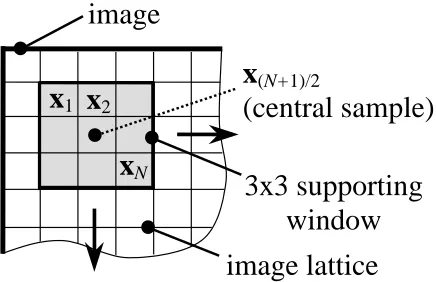
Since natural images should be considered non-stationary signals due to presence of edges, varying color information and noise, filtering schemes operate on the premise that an image can be subdivided into small regions, each of which can be treated as stationary. Most filtering techniques operate on some type of sliding window placing the pixel under consideration at the center of the processing window. This pixel's value is changed as a result of a filtering operation on the vectors included in a local neighborhood. This window operator slides over the entire image successively placing each image pixel at its center.
3x3 supporting
window
x
(N+1)/2(central sample)
image
image lattice
x
1x
2xN
Fig 1.1. A concept of running filter window
Rank filters
Rank filters are designed to operate on a numerically ordered set of pixels. The pixels from the local neighborhoods are gathered and sorted into a new set. For greyscale images, the ordering is determined by pixel intensity, but there is no obvious analogue for higher dimensional data such as color pixels. Digital images are often contaminated by noise. Thus, to some, it seemed natural to apply rank techniques to image denoising [3].
The median Filter
Available Online at www.ijpret.com 77
are an infinite number of solutions between the two middle pixels. In this case, the average of the two middle values is usually taken as the median.
Weighted Median Filter
Weighted Median filters belongs to the broader class of stack filters tools. A drawback of Median filter consist in the lack of tuning parameter .As a matter of fact, size of sliding window is, in practice, the only adjustable parameter of median filter. To overcome such a drawback weighted median filters have been introduced for scalar case. A set of weights controls the filter selectivity and ability to preserve thin lines, thus leading to a greater flexibility of use [1].
Adaptive filters
Most adaptive algorithms are based on either or both of the following two principles, whether they acknowledge it or not[4]:
1. Pixels that are spatially close are more likely to be in the same segment.
2. Pixels that are similar in intensity are more likely to be in the same segment.
Adaptive filters are the filters those change their filtering characteristics as they move through.
1.3 Applications:
1. Prediction and Filtering:
The regularity of the estimated vector field, which allows an efficient coding, may be comprised by the constraint of motion vectors being mathematically matching instead of physically matching. Median filters are suitable for smoothing digital signals/images, as they couple outlier filtering with edge preserving capabilities, thanks to their closure property, by which the filter is constrained to output one of the input samples.
Since their introduction, median filters have gained worldwide attention as powerful tool for impulse noise removal in digital signals and images.
1.4 Advantages/Disadvantages of weighted median filter (WM)
WM are best suited for “Salt and Pepper noise”
Available Online at www.ijpret.com 78
2. Each sample is given a weight according to its spatial position in the window.
3. Weights are defined by weighting mask.
REFEERENCES
1. S. Sowmyayani and P. Rani, “Block based Motion Estimation using Octagon and Square Pattern”, International Journal of Signal Processing, Image Processing and Pattern Recognition vol.7, no.4 , pp.317-324,2014.
2. Y. Guo, L. Chen, Z. Gao, and X. Zhang, “ Frame Rate Up-Conversion Method for Video Processing Applications”, IEEE Transactions On Broadcasting , vol. 60, no. 4, pp. 659-669,December 2014.
3. MÁRIA GAMCOVÁ, STANISLAV MARCHEVSKÝ, JÁN GAMEC “Higher Efficiency of Motion Estimation Methods” RADIOENGINEERING, Vol. 13, No. 4, December 2004.
4. KOIVUNEN, T., NIEMINEN, A. “Motion Field Restoration using Vector Median Filtering on High Definition Television Sequences”. In Visual Communications and Image Processing ’90, 1990, vol. 1360.
5. LI, W. SALARI, E. “Successive Elimination Algorithm for Motion Estimation”. IEEE Trans. Image Processing, 1995, vol. 4.
6. XAVIER MARICHAL. “Motion Estimation and Compensation for very low bit rate video coding”. Thesis submitted to laboratoire de telecommunications et tele detection catholic university Belgique.
7. TUUKKA TOIVONEN, JANNE HEIKKIL¨A, OLLI SILV´EN, “A New Algorithm For Fast Full Search Block Motion Estimation Based On Number Theoretic Transforms”. In Proc. of IWSSIP 2000. Maribor (Slovenia), 2000.
8. ALPARONE L, BARNI, M., BARTOLINI, F., CALDELLI, R. “Regularization of Optic Flow Estimates By Means of Weighted Vector Median Filtering”. IEEE Trans. Image Processing, 1999, vol.8, No. 10.
9. YEN-KUANG CHEN, True Motion Estimation Theory, Application, and Implementation”, a Dissertation Presented To the Faculty of Princeton University in Candidacy for the Degree of Doctor of Philosophy, November 1998.
10. ADEEL ASLAM BHUTTA, FAWAD UZ ZAMAN, “Analysis Tool for H.261”, a Project Report, December 15, 1999.