Available Online At www.ijpret.com
INTERNATIONAL JOURNAL OF PURE AND
APPLIED RESEARCH IN ENGINEERING AND
TECHNOLOGY
A PATH FOR HORIZING YOUR INNOVATIVE WORK
COMPACTED STABILIZED EARTHEN BLOCK
CHITTARANJAN NAYAK1, ROSHAN GUGALE2, VISHAL JAGADALE2 1. Assistant Professor Department of Civil Engineering, Baramati.
2. Department Of Civil Engineering, Baramati.
Accepted Date:
27/02/2013
Publish Date:
01/04/2013
Keywords
Compression testing,
Mix Design,
Water absorption,
Locally available material,
cost analysis,
Sieve analysis.
Corresponding Author Mr. Chittaranjan Nayak
Abstract
This Paper investigates the possibility of making compacted
earth block for construction of affordable residential
buildings using locally available materials such as soil, sand,
grits, jute etc. and blending them appropriately. The local soil
was mixed with local sand and stone grits (gravel) to make a
composite gravel soil 15 percent, Sand 40 percent, soil 35
percent approximately for compacted stabilized earth blocks
(CSEB). This mixture blended with Ordinary Portland Cement
(5.0 percent, 7.5 percent, and 10 percent), jute fibers of
different sizes (1 cm, 2.5 cm and 5.0 cm) and compacting
manually to the standard proctor density. They were cured
and tested for compressive strength, water absorption as
Available Online At www.ijpret.com
INTRODUCTION
Providing affordable housing is a challenge
around the world, especially in developing
countries. Local soil has always been the
most widely used material for earthen
construction in India. Approximately, 55 %
of Indian homes still use raw earth for wall
constructions.
Major limitations in using earth
construction are
1. Water penetration
2. Erosion of walls at the plinth level/
lower level by splashing of water
from ground surfaces.
3. Attacks by termites and pests
4. High maintenance requirement
5. Low durability
Compressed or compacted earth blocks
overcome these limitations. Mechanical
compaction of soil improves the block
density.
WHAT IS COMPRESSED STABILISED EARTH
BLOCKS (CSEB)?
Compressed Stabilized earth block (CSEB) is
a compressed block of mixture of sand,
cement, gravel with soil and locally
available materials. Good soil is a proper
mixture of gravel, sand and soil which mix
with cement for construction of CSEB blocks
(Fig.1). [3]
Fig.1 Mixture of Good soil
OBJECTIVES OF CSEB
Technical needs - Use of local soil, sand and
other resources minimizes the need for
importing building materials, reducing
transportation cost and ensuring product
availability.[1]
Social requirements- Application of existing
or easily transferable skills, avoids costly
training, minimizing displacement of labor
and social cultural disruptions.
Economic requirements- Reduced
dependence on outside sources, ensuring
low cost alternatives and requiring limited
Available Online At www.ijpret.com One of the main objectives was to promote
CSEB building constructions as a tool for
sustainable development for affordable
housing. [1]
SIEVE ANALYSIS OF MATERIALS
Individual materials first sieved and then
blended in proportion that was found to
give a good soil.
Blended soil is a mixture of nearly gravel 15
percent, 40 present sand, silt and clay 35
percent.
Sieve used for test- 40 mm,22.4 mm, 4.75
mm, 2.36 mm, 1.18 mm, 600 µ, 425 µ, 300
µ, 150 µ, 75 µ.
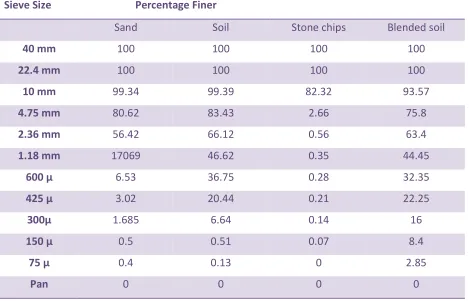
Table. 2 Result of sieve analysis for individual samples.
Sieve Size Percentage Finer
Sand Soil Stone chips Blended soil
40 mm 100 100 100 100
22.4 mm 100 100 100 100
10 mm 99.34 99.39 82.32 93.57
4.75 mm 80.62 83.43 2.66 75.8
2.36 mm 56.42 66.12 0.56 63.4
1.18 mm 17069 46.62 0.35 44.45
600 µ 6.53 36.75 0.28 32.35
425 µ 3.02 20.44 0.21 22.25
300µ 1.685 6.64 0.14 16
150 µ 0.5 0.51 0.07 8.4
75 µ 0.4 0.13 0 2.85
Available Online At www.ijpret.com
METHODOLOGY AND RESULTS
Blocks of 254mm×127mm×76mm size were
prepared by blending the soil with ordinary
Portland cement.
This blended soil mixed with different
quantity of cement (5 percent, 7.5 percent,
10 percent) for testing.
Table. 3 Variables of study [1]
Cement content by weight
No. Mix of dry blended soil & Maturity age,
percent of jute fibre used Days
1 M1 5.0 percent 7,28
2 M2 7.5 percent 7,28
3 M3 10.0 percent 7,28
4 M4J 5.0 percent + 1 percent Jute(2.5 cm) 7,28
5 M5J 5.0 percent + 0.5 percent Jute(2.5 cm) 7,28
6 M6J 5.0 percent + 0.25 percent Jute(2.5 cm) 7,28
STANDARD PROCTOR DENSITY TEST
About 3 kg air dried soil sample passing
through 425 mm sieve is mixed with about
150 ml water and compacted in three layers
by hammer in mould.
This soil extracted from mould and
determined water content by oven drying
method.
This soil is broken up and again addition of
Available Online At www.ijpret.com Table.4 Standard procter density test
Mix OMC MDD gm/cc Binders/ Jute Fibre
M1 12.00% 1.928 5% cement
M2 12% 1.92 7.5 % cement
M3 12% 1.954 10 % cement
M4J 16% 1.862 5 % cement + 1.0 % Jute(2.5 cm)
M5J 15.70% 1.86 5% cement + 0.5 % Jute(2.5 cm)
M6J 15% 1.78 5% cement + 0.25 % Jute(2.5 cm)
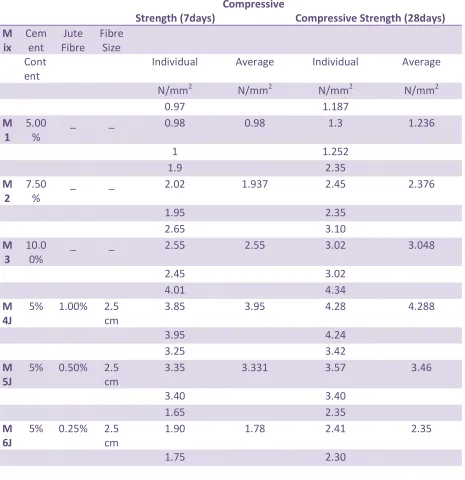
COMPRESSIVE STRENGTH
Compressive strength of blocks for
maturity age of 7 days and 28 days for
different mix are presented in Table.
The specimen with 5 percent cement did
not satisfy the BIS requirements (IS 1725) of
maximum strength of 2.0 to 3.0 N/mm²
whereas those with 7.5 percent and 10.0
Percent cement content did.
Adding jute fibre to the blended soil
increased compressive strength as well as
ductility.
The length of jute fibres also increases the
Available Online At www.ijpret.com Table. 5 Result of compressive result
Compressive Strength (7days)
Compressive Strength (28days) M ix Cem ent Jute Fibre Fibre Size Cont ent
Individual Average Individual Average
N/mm2 N/mm2 N/mm2 N/mm2
0.97 1.187
M 1
5.00 %
_ _ 0.98 0.98 1.3 1.236
1 1.252
1.9 2.35
M 2
7.50 %
_ _ 2.02 1.937 2.45 2.376
1.95 2.35
2.65 3.10
M 3
10.0 0%
_ _ 2.55 2.55 3.02 3.048
2.45 3.02
4.01 4.34
M 4J
5% 1.00% 2.5
cm
3.85 3.95 4.28 4.288
3.95 4.24
3.25 3.42
M 5J
5% 0.50% 2.5
cm
3.35 3.331 3.57 3.46
3.40 3.40
1.65 2.35
M 6J
5% 0.25% 2.5
cm
1.90 1.78 2.41 2.35
Available Online At www.ijpret.com
WATER ABSORPTION
The CSEB block satisfies the average water
absorption criteria as per IS
recommendations.
Different soil specimen taken in container
and weight. This container put into oven for
oven drying and finally weight of sample is
taken. From that water content is found
out.
Table. 6 Result of water absorption test
Water Average water
Mix Proportion absorption absorption
(percent) at 28 (percent) at 28
days days
16.67
M1 5.0 % cement 18.55 18.69
only 17.85
12.13
M2 7.5 % cement 12.56 12.20
only 11.91
9.14
M3 10 % cement 9.20 9.48
only 10.10
20.53
M5J 5 % cement + 19.76 20.13
0.5% jute fibres 20.10
CONCLUSION
The results of sieve analysis, standard
proctor density test, block density,
compressive strength, water absorption,
are presented in table
No significant change in optimum moisture
content due to increase in cement content.
However, maximum dry density increases
with increase in cement content.
Compressive strength- The compressive
strength increases with increasing cement
content and maturity age as 80 percent of
Available Online At www.ijpret.com Water absorption- Block having 5 percent
cement failed to satisfy the water
absorption criteria. Blocks having 7.5
percent seemed to be the most acceptable
alternative.
REFERENCES
1. “Stabilized compacted earth block for
affordable housing”, by K. Kabiraj and U. K.
Mondal , THE INDIAN CONCRETE JOURNAL,
page no. 52, August 2011.
2. Indian Standard 5454-1978, Method of
sampling of clay building bricks, Bureau of
Indian Standards, New Delhi.
3. Aurovillae Building Center, Earth unit,
Earthen Architecture for Sustainable
habitat, A Aurvillae’s case study.
![Table. 3 Variables of study [1]](https://thumb-us.123doks.com/thumbv2/123dok_us/8757002.1750173/4.595.66.533.274.450/table-variables-of-study.webp)