Will Geoengineering the Climate Bring the
World Hope and Safety or Desolation?
Esmeralda Shpuza
Johns Hopkins University Krieger School of Arts & Sciences, Advanced Academics Programs 1717 Massachusetts Avenue, NW Washington, DC 20036
Corresponding author: [email protected]
Executive Summary
This paper discusses a geoengineering technique considered under the umbrella of Solar Radiation Management (SRM) methods, Stratospheric Dispersion of Sulfate Particles (SDSP). According to The Royal Society, SRM methods seek to “reduce the net incoming short-‐wave solar radiation received, by deflecting sunlight or increasing the reflectivity (albedo) of the atmosphere, clouds, or the Earth’s surface” (The Royal Society, 2009). SDSP in particular aims to reduce the amount of solar insolation hitting the earth’s surface, allowing more outgoing long-‐wave radiation to escape back into space thus artificially cooling earth’s temperature. Further, this paper will discuss the technology that is being proposed for injecting the anticipated amounts of sulfate particles up in the stratosphere, how the particles will impact radiation reflection and the progress with such technologies to date. In addition, it will discuss the advantages and drawbacks of this specific technological approach, the costs associated with the proposed technology and the many environmental and climate impacts that it would have if they were to be deployed. The study will argue that geoengineering approaches related to SRM technologies, i.e. using stratospheric sulfate aerosols could cause various negative impacts and cause further issues in the fight against climate change, and that research and development efforts need to be focused on the mitigation technologies, rather than geoengineering techniques that act as a ‘band-‐aid measure’ to provide a bridge from a fossil fuel based energy mix to a renewable energy mix. Lastly the consideration of SDSP warrants the consideration of an international governance regime which would be able to control ethical, environmental and security aspects.
I. Introduction
Global climate change is an issue that is becoming more and more evident as each season and year goes by, and many in the scientific community view the trends in global temperature rises as tremendously menacing for humankind and earth’s ecosystems. Greenhouse gaseous emissions (GHGs) from anthropogenic sources continue to rise. If countries do not start introducing and promoting technologies that support climate change, global mean temperatures could potentially increase by 3.0 ºC – 6.0 ºC relative to pre-‐industrial levels by the end of this century (Marchal, 2011). This would lead to disastrous impacts on earth’s ecosystems and may bring “irreversible outcomes for natural systems and society” (Marchal, 2011). Recently geoengineering has emerged as a prospective method to deal with the issue of increased GHG emissions. Several studies (Govindasamy, 2002); (Stenchikov, 2002); (Caldeira, 2008); (Rasch P. e., 2008 a); (Rasch P. C., 2008 b); (Robock A. e., 2008) have assessed the impact that different proposed geoengineering technologies could have on GHGs and on technologies which reduce incoming solar insolation. It is thought that these technologies would provide a bridge between current technologies available to combat climate change and the future in which more renewable technologies are available.
SDSP, advantages and disadvantages associated with the approach, costs and environmental impacts that could be expected given their deployment. SRM entails policy considerations on the international level, given that the use of geoengineering in one country can affect not only its climate and the climate of neighboring countries but an entire continent. SRM also raises issues related to failure, and how this could affect countries’ relations, and the potential for conflict in the world. Organizations or policy makers should take a reasonable approach to geoengineering development given that unilateral or uncontrolled use of geoengineering schemes in the absence of an international governance system could bring many security, ethical, and environmental challenges.
II. Analysis of SDSP
SDSP has been studied extensively, even though at this point it has never been carried out (The Royal Society, 2009). The proponents point to volcanic eruptions and the impact of, for example, the 1991 eruption of Mount Pinatubo, which injected 20 megatons of sulfur dioxide gas into the stratosphere. Mount Pinatubo’s eruption resulted in a peak global cooling of approximately 0.5 K (Soden, 2002). This global cooling led to several regional impacts including a strengthening of the North Atlantic Oscillation, which is an extremely important mode in climate variability (Stenchikov, 2002). SDSP is a geoengineering scheme that mimics the volcanic effect by releasing large quantities of sulfur, a precursor gas, into the lower tropical layer of the stratosphere. This particle or precursor gas will react with other gases and oxidize in the lower stratosphere, then will circulate and scatter from the winds globally, and in the process will disperse incoming solar radiation back into space. The lower layer of the stratosphere already encloses a naturally occurring deposit of sulphuric acid particles which reflect sunlight away. These particles come from the troposphere layer, and may be natural sulfur gases, particles from the eruption of volcanoes, or manmade sulfur particles from the burning of fossil fuels for industrial uses which are circulated by winds all over earth. The stratospheric layer is very stable, and therefore the particles tend to stay in the layer for years, however, as shown from the eruption of Mount Pinatubo, the cooling effect of the particles becomes miniscule after 1-‐2 years. For this reason geoengineering of the
stratospheric layer with sulfate particles would require a constant injection of sulfur for decades or centuries to balance the increased radiative forcing by GHGs (Rasch P. e., 2008 a).
Several studies thus far have focused on simulating the amount of particles that would be needed to maintain the stratospheric sulfate layer through continuous injection of particles, as well as possible impacts that this would have on the environment, climatic systems, and earth’s ecosystems. Crutzen (2006) concluded that approximately 5 Tg S per year (5 trillion grams of sulfur) of sulfate aerosols would need to be introduced into the lower stratosphere to offset the warming impacts of a doubling of atmospheric carbon dioxide levels (Crutzen, 2006). The efficacy of this method, based on simulations as well as comparison with volcanoes, seems to be quite good, as a reduction of global temperatures could be expected within a few months to 1 year of deployment. However, once started this geoengineering scheme would need to be continued indefinitely given that human activities would be still pumping out carbon dioxide emissions. Nevertheless, in order to be able to counteract the temperature increases, total insolation would need to be reduced by 1.84% to restore annual mean temperatures and precipitation to levels seen when concentrations of atmospheric carbon dioxide were approximately 280ppm, as they were at the start of Industrial Revolution (Caldeira, 2008).
III. Technologies for deployment of SDSP
injection of 10 Tg of particles per year) to be dispersed into the lower stratosphere, approximately “one million flights and several thousand aircraft operating continuously into the foreseeable future would be needed to carry our this daunting undertaking” (The Royal Society, 2009). “Very rough cost estimates based on existing aircraft and artillery technology suggest that costs would be of the order of 3 to 30 $/kg putting the total annual cost at 10s of billion dollars” (The Royal Society, 2009). These cost estimates are still assumed to be low when compared to the costs of mass deployment of mitigation technologies (Rasch P. e., 2008 a).
Important factors in designing this custom built technology will be the delivery altitude (approximately 15 – 25 km up into the stratosphere) and the mass of aerosol that needs to be delivered. Most important will be the conditions in the altitude which will determine the types of materials that can be used in order to withstand the low temperatures and pressures at that altitude. Getting the right types of materials will require extensive research and development and this affects how funding for climate research is divided. Presently, studies have placed the cost for stratospheric sulfate aerosols incredibly low. David Keith testified before the Energy and Environment Subcommittee of the US House of Representatives, Committee on Science and Technology that “long-‐ established estimates show that SRM could offset this century’s global-‐average temperature rise, few
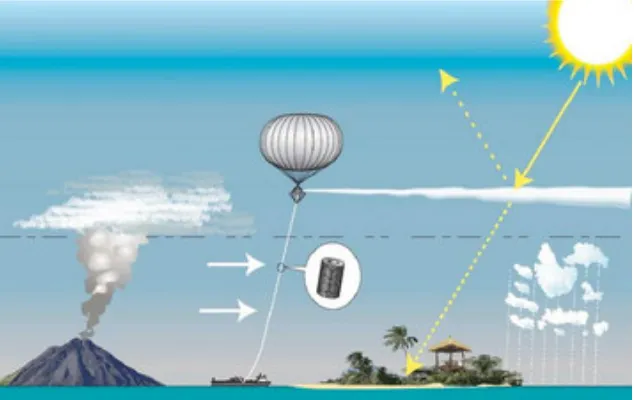
hundred times more cheaply than achieving the same cooling by emission cuts” (Keith D. , 2010). However, the fact is that extensive research and development is required and funding appropriated to geoengineering schemes will most likely diminish funds for research and development in mitigation technologies. In England, the Research Councils UK is funding a project focusing on delivery technology, concentrating on developing balloons and the corresponding technology needed for particle injection. Stratospheric Particle Injection for Climate Engineering, SPICE (SPICE, 2010) is a feasibility project funded by the government of England and its goal is to determine whether particles injected into the lower stratosphere can affect global temperatures by deflecting incoming radiation from the sun’s rays back into space. With the help of a government grant of a £ 1.6 million, SPICE has designed a 3 stage program that will investigate what would be the best particle to be injected (i.e. whether basic sulfate particles or a specially engineered particle would work best), the preeminent and most cost effective delivery method for releasing the particles up into the stratosphere, and the impacts that the injection of these particles would have on climate and earth’s ecosystems. The technology proposed by the SPICE project relies on a tethered balloon, which involves designing a pipe, a pumping system, and a balloon that can withstand the low pressures of the high altitude in which it is to be delivered. Figure 1, shows a model of what the tethered balloon delivery system would look like.
Figure 1. Tethered Balloon Delivery System. Source: LiveScience (Pappas, 2011)
SPICE had intended to perform a trial in the 2011 – 2012 timeframe, injecting initially “150 litres of water into the atmosphere from a weather balloon via a 1km pipe tethered to a ship” (Hale, 2012). However, the trial was cancelled due to a conflict of interest between the scientists (they had each submitted patents for similar technology). John Shepherd, chair of the Royal Society’s geoengineering group commented that "this shows how commercial and financial interests can complicate the management of research on geoengineering, especially SRM technology, even if everyone agrees that it is safe. The project teams have done the right thing, but this is an issue that needs to be explored in depth with stakeholders" (Vidal, 2011). Concerns from non-‐governmental organizations were also in abundance over the lack of a governance framework and this as well seems to have affected the trial. Consequently, no field experiments have been conducted to test any attempts with available technologies. It is relevant to note however, that only with the adequate level of technology development can any real progress be seen. In addition a proper governance system that defines the control mechanisms to be used for deployment of these technologies is paramount to any further development. Otherwise there would be no control over how much, when, or where stratospheric aerosol injection can occur. Thus even with the low estimated costs of deployment it would be difficult to allow any country or individual to proceed with this without testing it in nature to really see the impacts.
IV. Environmental and ecological implications of SDSP
The low cost of deployment and the almost immediate response in the cooling down of earth’s temperature have sparked a great deal of interest in SDSP as the salvation from the amplified greenhouse gaseous emissions and the resulting increase in global mean temperatures. Many proponents of this geoengineering scheme focus on the cooling of global temperatures and the benefits that this could bring. However, they downplay the many negative impacts to earth’s climate and ecosystems, as well as ethical issues and security concerns that could arise in between countries. As mentioned above, advocates point to the well-‐ known volcanic eruptions and the cooling down that could happen as a result of the injection of
thousands of tons of aerosol particles and sulfate gases. However, studies focusing on other impacts of volcanic eruptions have shown negative impacts on precipitation and hydrological cycles. For example, a study by Trenberth & Dai in 2007 examined the effect of the Mt Pinatubo’s eruption on the hydrological cycle and found that following the eruption there was “a remarkable slowing in 1992 as measured by precipitation over land and associated runoff and river discharge into the ocean” (Trenberth, 2007). Others have simulated the impacts caused by stratospheric sulfate particles and have found similar impacts as those experienced by the Mount Pinatubo eruption. Another study focused on impacts that sulfate aerosols would have on climate and precipitation patterns and concluded that injections of SO2 would
modify the Asian and African summer monsoons (Robock A. e., 2008). This would in turn reduce precipitation in East and Southeast Asia and Africa possibly undermining the food supply and food security of billions of people (Brovkin, 2009); (Robock A. e., 2008). Thus by trying to engineer
climate we might create much more dire consequences given that Asian and African monsoons provide fundamental fresh water resources to billions of people in these areas and without fresh water the food supply would greatly suffer. In general, injecting sulfate aerosols or engineered particles in the atmosphere will reduce the export of latent heat resulting in a climate with less precipitation and less evaporation than the preindustrial climate (Keith D. , 2010). The list of undesirable effects goes on, and it is not limited only to Asian and African states. Given that the sulfate aerosols are circulated by winds their effects will be seen globally. Some places will endure more negative effects and others less. Stratospheric sulfate dispersion could cause diebacks of tropical forests since substantial precipitation declines may be triggered in the Amazon and Congo valleys (Eliseey, 2010). Although SDSP would cool the atmosphere, increasing CO2 concentrations will
promote more ocean acidification and cause changes to ecosystems and biological system in the oceans. “With nothing to stop future CO2 emissions,
our oceans will continue to absorb the excess CO2
The ozone (O3) layer has been a topic of hot debate
in recent years. The Montreal protocol regulated refrigerants used in the refrigeration and air conditioning industries leading to a recovery of the ozone layer. A geoengineering of the stratospheric sulfate layer will potentially cause much more detrimental effects to the ozone layer. A recent study focused on stratospheric sulfate injection in the lower tropical stratosphere and the impact on ozone found that an annual decrease of 4.5% could be expected in stratospheric ozone levels. The authors conclude that this is “more than the annual mean global total loss due to the emission of anthropogenic ozone depleting substances… for the geoengineering scenarios the tropical O3 loss is
remarkable” (Heckendorn, 2009). Studies from
(Tilmes, 2008) and (Robock A. e., 2008) concur with the detrimental results in ozone deterioration. In addition, another well-‐known phenomenon is expected to worsen. With an increased amount of sulfur dioxide in the troposphere, acid deposition will increase and this will worsen the environment and ecosystems (Kravitz, 2008). Given that part of the injected sulfur particles will drop into the lower troposphere layer, this will introduce another unexpected player in this layer in addition to the manmade sulfur emissions and the volcanic eruption particles that usually get accumulated in the troposphere. Another negative impact that is often overlooked is how geoengineering the stratospheric sulfate layer and therefore diminishing the solar radiation hitting earth will affect already existing mitigation technologies, such as wind and in particular solar energy generating units. Studies have shown that “for every one percent reduction in solar radiation caused by the use of SRM geoengineering, the average output of concentrator solar systems that rely on direct sunlight will drop by four to five percent” (Olson, 2011). Therefore at present most studies indicate that the impacts introduced by geoengineering of the stratospheric sulfate layer would bring more problems than it would solve. Most studies point to major regional effects which may perhaps offset or reinforce the outcomes connected with climate change itself, and this would be contrary to what countries need at this time.
V. Deployment of SDSP and its impact on the development of mitigation technologies
geoengineering could bring, Keith notes that with “common estimates of the monetized cost of climate damages, the value of reducing climate change by geoengineering could exceed 1% of GDP, up to 1000 $/kg in this scenario” (Keith D. , 2010). This cost puts in perspective how expensive the geoengineering of earth’s climate could be. On the one hand, there is the potential of cheaply deploying this technology, however, the costs of adaptation if things to not go as planned would be as high as, or higher than, what is needed to successfully deploy renewable technologies on a mass scale.
VI. Governance implications brought forth by the use of SDSP
When considering the geopolitical issues brought forth by the deployment of SDSP one has to consider the framework which these would need to be deployed under, and if this framework will be accepted by all states. Looking at the slow progress that climate change mitigation paths have followed to date, be it in regards to finding an international agreement between the developed world and the developing one, or be it with the advances in technologies that mitigate CO2 emissions
worldwide, it is very difficult to assume that geoengineering efforts in both policy or research and development will be successful. When considering SDSP deployment, the most worrisome issues are misuse by a country or an individual as a threat to another country, the implications for local, regional and world politics, and the potential for wars and conflict. While there is some research ongoing regarding climate geoengineering, there are still many unknowns regarding the consequences that the widespread use of these techniques can bring. Simulations have shown potential negative environmental and climate impacts however not many have focused on the impending outcomes in terms of peace and security. As with anthropogenic climate change, the concerns and consequences of reducing incoming solar insolation will not be the same for all countries and peoples. As is the case with present estimates of climate change impacts, the consequences will be suffered by the most vulnerable. Low lying countries, developing countries, and their people are foreseen to have the worst impacts if changes in precipitation patterns, hydrological cycles and monsoon variations are to occur. This raises a whole new set of legal, ethical,
intergenerational, and national security apprehensions and it would lead to new national, regional and global security dilemmas. Suppose one country decides to deploy injection of sulfur particles to alleviate problems that it might be seeing in a specific region, such as high temperatures, drought, and/or lack of precipitation, among others. By cooling down regional temperatures it could modify the weather patterns, however, countries nearby could experience even worse conditions than those experienced in the country that decided to act unilaterally. This could lead to regional disagreements as it would be impossible to determine causation – i.e. was it just a bad drought year? Would this be attributable to the natural unpredictability in the climate system, attributable to climate change, or to geoengineering of climate? A scenario like this could create significant conflict.
There are many other considerations to be taken into account if we as a society ever decide to consider SDSP as a potential technology to be used to bridge to the next generation of renewable energy technologies that mitigate CO2 emissions.
Currently injection of particles in the stratosphere or any method considered under the umbrella of SRM techniques is not covered under any international framework. CO2 removal techniques
system that all parties could agree to for geoengineering. One of the advantages of SDSP is its low cost, and that could also prove to be its biggest pitfall if a governance framework is not set up correctly. Nations or individuals may proceed unilaterally without regard for interests of other countries, and this would increase the imminent threat that geoengineering could be used as a weapon against a country or a specific group. With conflicts of interest already developing early in the stages of development, as in the patent procedures for a small geoengineering trial in England, one cannot stop thinking of how major advances in the technology and comprehension of control over weather systems can be shared with terrorists groups to be later on utilized as a military tool. Thus, it would be of utmost importance that countries come together to re-‐write and amend the UNFCCC to include regulation of SRM in the Framework.
VII. Intergenerational Equity implications of SDSP
When considering the geopolitical issues brought forth by the use of SDSP one also has to consider inter-‐generational impacts. A successful deployment of geoengineering schemes does not only affect the current generation, it also “sows the seeds of major peril for future generations” (Burns, 2011). Let’s assume that our generation, in dire need of trying to find a cheap solution to the impending global increase in temperatures, decides to go ahead and deploy SDSP. Let us presume that the method is deployed for 50 years. CO2 emissions are still being pumped into the atmosphere from the continued burning of fossil fuels based on the belief that it is now safe to produce as much CO2 as we desire to keep our economies going, given that now we have a switch that stops climate warming. The CO2 accumulation will be quite significant if we continue with the same technologies that are being used presently, and progress in mitigation technologies slows down. If the next generation believes that we are damaging the climate much more than helping it with the injection of sulfur particles into the stratosphere, and they decide to stop the use of the technique there would be significant warming potential stored in the atmosphere. A recent study found that if sulfate injection is stopped, there will be a very rapid increase in temperature in the first 10-‐20 years after ceasing. The study showed that the temperature would increase 3-‐4◦ C in 11 years,
20 times more rapidly than in same period of continuous warming under IPCC scenarios (Rasch P. e., 2008 a). The adaptation of humans and ecosystems to this abrupt change would be almost impossible. And it would be difficult to reverse anything that we had done at that point. The deployment of SDSP would imply that this method would have to be used for centuries on end, until all the accumulated carbon dioxide is removed from the atmosphere by the natural sink cycles in the climate system. In summary, extreme caution must be used with any efforts regarding practices that modify earth’s climate given the implications they have over equity, security risks, ethics, regional and global politics, and intergenerational equity.
VIII. Conclusions
Climate change represents a very real and significant threat to our world. The approach taken to deal with the threat could prove to be a very decisive factor on what happens in the future since an approach towards mitigation will take funds, time, and dedication while an approach towards deployment of SDSP could be cheap, fast and effective but would bring countless unintended consequences. One has to stop and think, does the society even have the moral standing to employ geoengineering? By analyzing the situation in detail one can conclude that a form of geoengineering got us into this situation in the first place; by spewing large amounts of CO2 into the atmosphere we
(Goudie, 2008). Studies thus far have shown that SDSP will bring more uncertainty than benefits to climatic systems. For this reason, the attention should be in developing, mass producing, and deploying large scale energy production resources that are known to work well by harnessing the power found in nature such as onshore and offshore wind, wave, tidal, biomass and solar, among others, while increasing efficiency measures across industries and allowing enough time and financial resources for the research and development in these areas to succeed. Moreover these measures would not include scenarios that lead to many moral, ethical, political, and security issues on a national, regional, and international level. The fundamental political veracity of geoengineering and in particular SDSP is that unlike other responses to climate
change, geoengineering might be implemented by one state, a large corporation, or an individual acting alone. The low costs of deployment make this possible. Whether or not that entity was the culprit of events that followed a certain geoengineering operation, it will certainly be blamed for detrimental climatic events, and this would set in motion considerable political strains in the region. The bottom line is that humanity already carries the technological and social capacity to divert us from the current trajectory of climate disaster. No silver bullet technology is needed to save us, nor is there much place for it in the current efforts. All our time and resources should be exhausted on expanding the capabilities we already possess and know will work when properly manipulated.
References
1. American Meteorological Society. (2013). Geoengineering the Climate System. Boston: American Meteorological Society. Retrieved from http://www.ametsoc.org/policy/2013geoengine eringclimate_amsstatement.html
2. Block, G. S. (2010, January 27). Research on global ‘sun block’ needed now. Retrieved from University of Calgary:
https://www.ucalgary.ca/news/january2010/gl obalsunblock
3. Brovkin, V. e. (2009). Geoengineering Climate by Stratospheric Sulfur Injections: Earth System Vulnerability to Technological Failure. Climatic Change, 92, 243 -‐ 252. doi:10.1007/s10584-‐008-‐ 9490-‐1
4. Burns, W. C. (2011). Climate Geoengineering: Solar Radiation Management and its Implications for Intergenerational Equity. Stanford Journal of Law, Science and Policy, 49, 46. Retrieved from http://www.stanford.edu/group/sjlsp/cgi-‐ bin/orange_web/users_images/pdfs/61_Burns% 20Final.pdf
5. Caldeira, K. L. (2008, November). Global and Arctic climate engineering: numerical model studies. Philosophical Transcactions of the Royal Society, 366, 4039-‐4056. Retrieved from
http://rsta.royalsocietypublishing.org/content/3 66/1882/4039.full
6. Crutzen, P. (2006). Albedo enhancement by stratospheric sulfur injections: a contribution to resolve a policy dilemma?. Climatic Change, 77(3-‐ 4), 211-‐220. doi:10.1007/s10584-‐006-‐9101-‐y 7. Eliseey, A. V. (2010). Global Warming Mitigation
by Sulphur Loading in the Stratosphere:
Dependence of Required Emissions on Allowable Residual Warming Rate. Theoretical Applied Climatology, 67, 79.
8. Goudie, A. C. (2008). The Oxford Companion to Global Change. Oxford University Press. 9. Govindasamy, B. e. (2002). y, Geoengineering
Earth’s Radiation Balance to Mitigate Climate Change from a Quadrupling of CO2. Global and Planetary Change, 37. doi:10.1016/S0921-‐ 8181(02)00195-‐9
10. Hale, E. (2012, May 16). Geoengineering experiment cancelled due to perceived conflict of interest. Retrieved from theguardian:
http://www.theguardian.com/environment/201 2/may/16/geoengineering-‐experiment-‐
cancelled#start-‐of-‐comments
11. Heckendorn, P. e. (2009). The Impact of Geoengineering Aerosols on Stratospheric Temperature and Ozone. ENVIRONMENTAL RESEARCH LETTERS, 4. doi:10.1088/1748-‐ 9326/4/4/045108
12. Keith, D. (2010, February 4). Learning to manage sunlight: Research needs for Solar Radiation Management . Retrieved from Committee on Science, Space and Technology:
http://science.house.gov/sites/republicans.scien ce.house.gov/files/documents/hearings/020410 _Keith.pdf
13. Keith, D. (2010). Photophoretic levitation of engineered aerosols for geoengineering. PNAS, 107(38), 1628, 1630.
doi:10.1073/pnas.1009519107
http://climate.envsci.rutgers.edu/pdf/aciddeposi tion7.pdf
15. Marchal, V. e. (2011). OECD Environmental Outlook to 2050, Climate Change Chapter. (p. 6). OECD. Retrieved from
http://www.oecd.org/env/cc/49082173.pdf 16. Olson, R. (2011, November 16). Geoengineering
for Decision Makers. Retrieved from Wilson Center, New Security Beat:
http://www.newsecuritybeat.org/2011/11/geoe ngineering-‐for-‐decision-‐makers/#.UdoNsNK38vo 17. Pappas, S. (2011, September 15). Climate Cooling
Ballon Put to First Test. Retrieved from LiveScience:
http://www.livescience.com/16070-‐
geoengineering-‐climate-‐cooling-‐balloon.html 18. Rasch, P. C. (2008 b). Exploring the
geoengineering of climate using stratospheric sulfate aerosols: The role of particle size. Geophysical Research Letters, 35.
doi:10.1029/2007GL032179. 19. Rasch, P. e. (2008 a). An overview of
geoengineering of climate using stratospheric sulphate aerosols. Philosophical Transactions of the Royal Society, 366, 4007, 4013, 4014. 20. Robock, A. (2008). 20 Reasons Why
Geoengineering may be a Bad Idea. 64(2), 14 -‐ 18. 21. Robock, A. e. (2008). Regional climate responses
to geoengineering with tropical and Arctic SO2 injections. 113. doi:10.1029/2008JD010050. 22. Rotman, D. (2013, February 8). MIT Technology
Review. Retrieved from Meet the Man with a Cheap and Easy Plan to Stop Global Warming: http://www.technologyreview.com/featuredstor y/511016/a-‐cheap-‐and-‐easy-‐plan-‐to-‐stop-‐global-‐ warming/
23. Soden, B. W. (2002). Global Cooling After the Eruption of Mount Pinatubo: A Test of Climate Feedback by Water Vapor. Science, 296, 727 -‐ 730. doi:10.1126/science.296.5568.727
24. SPICE. (2010). The Spice Project. Retrieved from SPICE: http://www.spice.ac.uk/
25. Stenchikov, G. R. (2002). Arctic Oscillation response to the 1991 Mount Pinatubo eruption: Effects of volcanic aerosols and ozone depletion. JOURNAL OF GEOPHYSICAL RESEARCH, 107. doi:10.1029/2002JD002090,
26. The Royal Society. (2009). Geoengineering the Climate: Science, Governance and Uncertainty. Retrieved from
https://royalsociety.org/~/media/Royal_Society _Content/policy/publications/2009/8693.pdf 27. Tilmes, S. e. (2008). The sensitivity of polar ozone
depletion to proposed geo-‐engineering schemes. Science, 320, 1201–1204.
doi:10.1126/science.1153966
28. Trenberth, K. D. (2007, August 1). Effects Of Mount Pinatubo Volcanic Eruption On The Hydrological Cycle As An Analog Of
Geoengineering. Geophysical Research Letters, 34. doi:10.1029/2007GL030524,
29. UNFCCC. (1992). REPORT OF THE INTERGOVERNMENTAL NEGOTIATING
COMMITTEE FOR A FRAMEWORK CONVENTION ON CLIMATE CHANGE. New York: United Nations, Commission on Sustainable Development. Retrieved from
http://www.un.org/documents/ga/ac237/ac237 -‐18pt2add1
30. Vidal, J. (2011, August 31). Giant Pipe and Balloon to Pump Water into the Sky in Climate Experiment. Retrieved from theguardian:
http://www.theguardian.com/environment/201 1/aug/31/pipe-‐balloon-‐water-‐sky-‐climate-‐ experiment
Esmeralda Shpuza earned a B.S. in Industrial Engineering from the Georgia Institute of Technology. Currently, she is pursuing her M.S. in Energy Policy and Climate from Johns Hopkins University. She has over ten years of experience in the manufacturing industry in which her focus has been process optimization, emission controls and alternative fuel use for leading cement manufacturers such as Holcim US Inc. Moreover in the past 6 years, she has conducted extensive training seminars for equipment, processes and operation and energy efficiency in the cement industry in the Americas with FLSmidth Inc. Her research and future interests are focused towards international climate change issues and policy, sustainable energy systems, renewable technology development and carbon emissions management. She is hopeful that her skillset can contribute to the reduction of climate change impacts on a global scale, and to a more sustainable future.