Available Online at www.ijpret.com
719
INTERNATIONAL JOURNAL OF PURE AND
APPLIED RESEARCH IN ENGINEERING AND
TECHNOLOGY
A PATH FOR HORIZING YOUR INNOVATIVE WORK
A SURVEY ON NODE AUTHENTICATION IN SPONTANEOUS WIRELESS
AD-HOC NETWORK
SARITA D. SAPKAL, PROF UMESH K. RAUT, PROF DEEPAK D. SAPKAL Computer Department, MIT Pune, Computer Department, PVG’s COET Pune.
Accepted Date: 15/02/2014 ; Published Date: 01/04/2014
\
Abstract: Authentication of nodes in the spontaneous wireless ad hoc networking is a vital task in wireless networking. These networks are formed by a set of nodes placed together in the close area which will communicate with each other, for limited time,” anywhere anytime”. To achieve this requirement of ad hoc networking we have to authenticate the individual node as they come in the network range of wireless network. We present a survey paper which will focus on the different ways of authentication policies and their privileges; we will also compare these policies.
Keywords: Ad-Hoc Network, Authentication, Deployment, Public key Cryptosystems, Wireless communication, Wireless Network.
Corresponding Author: MISS. SARITA D. SAPKAL
Access Online On:
www.ijpret.com
How to Cite This Article:
Sarita Sapkal, IJPRET, 2014; Volume 2 (8): 719-726
Available Online at www.ijpret.com
720 INTRODUCTION
A Spontaneous Wireless Ad Hoc network is formed, when two or more nodes come together for interaction and for sharing resources. These networks are in the closed area and their existence is for limited period of time. The communication in wireless network is different from the traditional wired networks. The wireless network is always formed of mobile terminals or nodes; which have limited bandwidth, power and the capacity of computation is also limited. We must find out some new methods which fits the characteristics of the wireless communication. Here with we give literature survey which will focus on some methods of wireless communication.
I.LITURATURE SURVEY
Available Online at www.ijpret.com
721 Fig1.Challenge/Response authentication in public wireless
The above solution for authentication in wireless network requires maintaining different database, related to the Mobile Nodes. An ad hoc network must operate independent of pre-established or centralized network management infrastructure, while still providing administrative services needed to support applications. Address allocation, name resolution, service location, authentication, and access control policies represent just some of the functionality that must be supported-without pre-configuration or centralized services [11].
Author Marc Danzeisen used a cellular network in formation of the spontaneous wireless adhoc networks. Authentication of mobile node is done with the Mobile subscriber Integrated Services Digital network Number (MSISDN) for every node, willing to communicate in ad hoc network[9]. The node should have the MSISDN number. Pre-configuration is required for mobile node. Hardware and software requirements are there in the system. This type of system is not beneficial in time and place specific spontaneous wireless adhoc networking.
Available Online at www.ijpret.com
722 There is a wide range of environments in which these networks can be applied. This special issue tries to collect the most recent research of these types of networks. In paper [10] Rekimoto introduced the concept of synchronous user operation, for establishing spontaneous adhoc network connections in-between nodes. When two or more user wants to communicate with each other using their devices then they will presses and release the connection button on their devices. This method can also deal with multiple overlapping connection requests by detecting collision situations by devices. In this system author used Diffi Hellman algorithm for communication after connection is established between the nodes. The Sync Tap button can be specially installed for communication purpose, which increases the hardware requirements.
The permanently growing networked IT-infrastructure, the need for more mobility as well as the expansion of computer-aided applications to new areas demand new methods to simplify the handling of IT systems. Spontaneous networking is a means for simple integration of devices and services into networks. It seems to be one way to achieve more flexibility, more mobility, a better usability and less administration effort. This paper provides a definition of spontaneous networking and lists mandatory and optional features. It takes a closer look at the evolving technologies Jini (Java intelligent network infrastructure), JetSend, Inferno/Limbo, HAVi (Home Audio Video interoperability), and UPnP (Universal Plug and Play). Their basic concepts and functionalities are explained and their conformance to the principles of spontaneous networking is outlined [13].
Available Online at www.ijpret.com
Available Online at www.ijpret.com
724
II. CONCLUSION
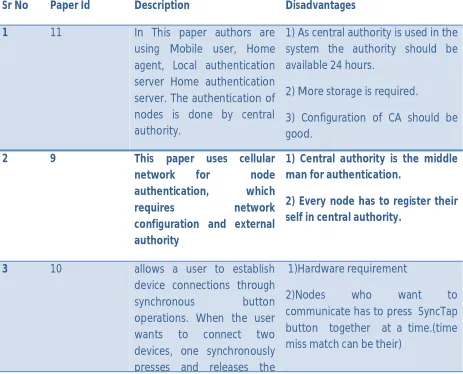
In this Paper, we have shown the different ways of the authentication of nodes in the Spontaneous Wireless Ad-Hoc Network. The AdHoc wireless network is created when two or more nodes come together for communication and to share resources, without any infrastructure. So power consumption is the major factor in the network. The comparison between different ways of authentication is given in Table1.
Table 1 : Comparison of Authentication Systems
Sr No Paper Id Description Disadvantages
1 11 In This paper authors are
using Mobile user, Home agent, Local authentication server Home authentication server. The authentication of nodes is done by central authority.
1) As central authority is used in the system the authority should be available 24 hours.
2) More storage is required.
3) Configuration of CA should be good.
2 9 This paper uses cellular
network for node
authentication, which
requires network
configuration and external authority
1) Central authority is the middle man for authentication.
2) Every node has to register their self in central authority.
3 10 allows a user to establish
device connections through
synchronous button
operations. When the user
wants to connect two
devices, one synchronously presses and releases the
1)Hardware requirement
2)Nodes who want to
Available Online at www.ijpret.com
725
III.ACKNOWLEDGMENT
This work is supported by my guide Prof. U.K.Raut. I am grateful to Prof D.D. Sapkal for his support. I am grateful to Prof. Mrs. S. S. Paygude (HOD of Computer Engineering Department) for providing infrastructure facilities.
I am also grateful to Prof. Jaime Lloret (Associate Professor in the Polytechnic University of Valencia), for his valuable time and technical support.
REFERENCES
1. Raquel Lacuesta, Jaime Lloret, Miguel Garcia,"A Secure Protocol for Spontaneous Wireless
Ad Hoc Networks Creation", IEEE Transactionm on Parallel and distributed systems, Vol. 24, No. 4, April 2013.
2. J. Lloret, L. Shu, R. Lacuesta, and M. Chen, “User-Oriented and Service-Oriented Spontaneous
Ad Hoc and Sensor Wireless Networks,” Ad Hoc and Sensor Wireless Networks, vol. 14, nos. 1/ 2, pp. 1-8, 2012.
3. K. Sahadevaiah and P.V.G.D. Prasad Reddy, Impact of Security Attacks on a New Security
Protocol for Mobile Ad Hoc Networks, Network Protocols and Algorithms, vol 3, no. 4, pp. 122-140, 2011.
4. M. Mukesh and K.R. Rishi, Security Aspects in Mobile Ad Hoc Network (MANETs): Technical
Review, Intl J. Computer Applications, vol. 12, no. 2,pp. 37-43, Dec. 2010.
4 3,4,5 These Papers shows the
pre-distribution key
algorithm for security.
1) Initial Network Configuration is required.
5 1 This paper uses the trust
model and RSA algorithms
for authentication to
authenticate node in
spontaneous wireless ad hoc network.
Available Online at www.ijpret.com
726
5. J. Yan, J. Ma, F. Li, and S. J. Moon,” Key Predistribution scheme with Nodes Revocation for
Wireless Sensor Networks” Ad Hoc and Sensor Wireless Networks, vol.10,nos 2/3,pp.235-251,2010.
6. R. Lacuesta, J. Lloret, M. Garcia, and L. Pen˜ alver, “A Spontaneous Ad-Hoc Network to Share
WWW Access,” EURASIP J. Wireless Comm. and Networking, vol. 2010, article 18, 2010.
7. M. Danzeisen, T. Braun, S. Winiker, D. Rodellar, Implementation of a Cellular Framework for
Spontaneous Network Establishment, Proc. IEEE Wireless Comm. and Networking Conf. (WCNC 05),Mar. 2005.
8. J. Rekimoto, SyncTap: Synchronous User Operation for Spontaneous Network Connection,
Personal and Ubiquitous Computing, vol. 8, no. 2, pp. 126-134, May 2004.
9. Wei Liang, Wenye Wang “On performance analysis of challenges/response based
authentication in wireless networks” Elsevier, Science Direct,4 Oct 2004.
10.L.M. Feeney, B. Ahlgren, and A. Westerlund, “Spontaneous Networking: An
Application-Oriented Approach to Ad-hoc Networking,” IEEE Comm. Magazine, vol. 39, no. 6, pp. 176-181, June 2001.
11.S. Preuß and C.H. Cap, “Overview of Spontaneous Networking -Evolving Concepts and