Abstract. The concept of massively parallel processors has been taken to the extreme with the introduction of the BlueGene architectures from IBM. With hundreds of thousands of processors in one machine the parallelism is extreme, but so are the techniques that must be applied to obtain performance with that many processors. In this work we present optimizations of a Grid-based projector-augmented wave method software, GPAW, for the Blue Gene/P architecture. The improvements are achieved by exploring the advantage of shared and distributed memory programming also known as hybrid programming and blocked communication to improve latency hiding. The work focuses on optimizing a very time consuming operation in GPAW, the stencil operation, and different hybrid programming approaches are evaluated. The work succeeds in demonstrating a hybrid programming model, which is clearly beneficial compared to the original flat programming model. In total an improvement of 1.94 compared to the original implementation is obtained. The results we demonstrate here are reasonably general and may be applied to other stencil codes.
Key words: GPAW, HPC, Hybrid-programming, Multicore platforms
1. Introduction. Grid Based Projector Augmented Wave (GPAW) [8] is a simulation software, which simulates many-body systems at the sub-atomic level. GPAW is primarily used by physicists and chemists to investigate the electronic structure, principally the ground state, of many-body systems. The GPAW users often have a desire to increase the system size and resolution to the point where the simulation time escalates to weeks and sometimes even months. A massively parallel implementation of GPAW, which is able to fully utilize a supercomputer, is therefore highly desirable.
The performance profile of GPAW dependence almost entirely on the electronic structures that are being simulated. Therefore, it is difficult to measure the general performance of GPAW. However, a significant part of any GPAW computation consists of a distributed stencil operation. Thus an optimization of this stencil operation will result in an improvement of the general performance of GPAW. The main object of this paper is to optimize the stencil operation for the Blue Gene/P [9] (BGP) architecture.
The current trend in HPC hardware is towards systems of shared-memory computation nodes. The BGP also follows this trend and consists of four CPU-cores per node. Furthermore, it is quite possible that future versions of the Blue Gene architecture will consists of even more CPU-cores per node.
To exploit the memory locality in shared-memory computation nodes a paradigm that combines shared and distributed memory programming may be of interest. The idea is to avoid communication between CPU-cores on the same node. Unfortunately, it is not trivial to obtain good performance when combining shared-memory programming with distributed memory programming. Even though inter-CPU communication is avoided, it is often the case that the sole use of MPI [5] outperforms a combination of threads and MPI when computing on clusters of shared-memory computation nodes [6, 7, 10].
We evaluate two different hybrid programming approaches. One approach in which inter-node communica-tion is handled individually by every thread and another approach in which one thread handles the inter-node communication on behalf of all the other threads in a node. The work shows that, on the Blue Gene/P, the first approach is clearly superior the latter. In [3] the authors concludes that, on a well balanced system, a loop level parallelization approach, corresponding to our second hybrid approach, is unfavorably compared to a strict MPI implementation. Our first hybrid approach was developed on the basis of that conclusion.
2. GPAW. GPAW is a real-space grid implementation of the projector augmented wave method [2]. It uses uniform real-space grids and the finite-difference approximation for the density functional theory calculations.
A central part of density functional theory and a very time consuming task in GPAW, is to solve Poisson and Kohn-Sham equations. Both equations rely on stencil operations when solved by GPAW. When solving the Poisson equation, a stencil is applied to the electrostatic potential of the system. When solving the Kohn-Sham equation, a stencil is applied to all functions in the system. Both the electron density and the wave-functions are represented by real-space grids. A system typically consists of one electron density and thousands of wave-functions. The number of wave-functions in a system depends on the number of valence electrons in the system. For every valence electron there may be up to two wave-functions.
∗Niels Bohr Institute, Copenhagen, Denmark.{madsbk, happe, vinter}@nbi.dk
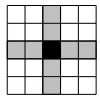
Fig. 2.1: A stencil operation on a 2D grid.
Table 3.1: Hardware description of a Blue Gene/P node
Node CPU Four PowerPC 450 cores CPU frequency 850 MHz
L1 cache (private) 64KB per core
L2 cache (private) Seven stream prefetching L3 cache (shared) 8MB
Main memory 2GB
Main memory bandwidth 13.6GB/s Peak performance 13.6 Gflops/node
Torus bandwidth 6×2×425MB/s = 5.1GB/s
The computational magnitude of a GPAW simulation depends mainly on three factors: The world size, simulation system resolution and the number of valence electrons. The world size and resolution determine the dimensions of the real-space grids and the number of valence electrons determines the number of real-space grids.
A user is typically more interested in adding valence electrons to the simulation than to increase the size or resolution of the world. The real-space grid size will ordinary be in the interval 1003 to 2003 where as the total number of real-space grids will be greater than thousand.
2.1. Stencil Operation. A stencil operation updates a point in a grid based on the surrounding points. A typical 2D example is illustrated in Fig. 2.1 where points are updated based on the two nearest points in all four directions.
Stencil operations on the real-space grids (3D arrays) are used for the finite-difference approximation in GPAW. The stencil operation used is a linear combination of a point’s two nearest neighbors in all six directions and itself. The stencil operations do normally use periodic boundary condition but that is not always the case. If we look at the real-space gridAand a predefined list of constantsC, a pointAx,y,z is computed like this:
A′
x,y,z = C1Ax,y,z+C2Ax−1,y,z+C3Ax+1,y,z+ C4Ax−2,y,z+C5Ax+2,y,z+C6Ax,y−1,z+ C7Ax,y+1,z+C8Ax,y−2,z+C9Ax,y+2,z+ C10Ax,y,z−1+C11Ax,y,z+1+
C12Ax,y,z−2+C13Ax,y,z+2
3. Blue Gene/P. Blue Gene/P consists of a number of nodes interconnected with three independent networks: a 3D torus network, a collective tree structured network, and a global barrier network. All point-to-point communication goes through the torus network and every node is equipped with a direct memory access (DMA) engine to offload torus communication from the CPUs. The collective tree structured network is used for collective operation like the MPIreduce operation and the global barrier network is used for barriers.
Table 3.1 is a brief description of a BGP node. One thing to highlight is the ratio between the speed of the CPU-cores and the main memory. Since the CPU-cores are relatively slow and the main memory is relatively fast compared to today’s standard, the performance of the main memory is not as far behind the CPU as usually. Furthermore, the torus bandwidth is only three times lower than the main memory bus when all six connections are used. The von Neumann bottleneck [1] associated with main memory and network is therefore reduced.
0 50 100 150 200
10^0 10^1 10^2 10^3 10^4 10^5 10^6 10^7
Bandwidth in MB/sec
Message size in bytes
Fig. 3.1: A bandwidth graph showing how the message size influence the bandwidth. In this experiment, one MPI message is send between two neighboring BGP nodes.
The same MPI process Grids
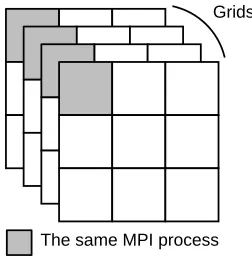
Fig. 4.1: Four 2D grids distributed over nine processes.
would then look like four individual nodes with each 512MB of main memory. This virtual partitioning is called virtual mode.
3.1. MPI. BGP implements the MPICH2 library, which comply with the MPI-2 specification [4]. MPI-2 specifies different levels of threaded communication. BGP supports the fully thread-safe mode calledMULTIPLE that allows any thread to call the MPI library at any time. Since there is an overhead associated withMULTIPLE (e.g. locks), it is also possible to use the more restricted SINGLE mode that do not allow concurrent calls to MPI.
The MPICH2 implementation is tailored to utilize the BGP’s DMA engine which means that non-blocking MPI communication is handled asynchronously with minimum CPU involvement.
BGP supports theMPI Cart createfunction, which tells BGP to reorder the MPI ranks in order to match the torus network. We make use of this function in all the following.
To investigate how much the message size influence point-to-point bandwidth, we have performed an ex-periment in which one MPI message is send between two neighboring BGP nodes (cf. Fig. 3.1). The result of the experiment clearly shows that in order to maximize the bandwidth, a message size greater than 105 bytes
is needed, while half the asymptotic bandwidth is achieved at approximate 103bytes.
4. The GPAW Implementation. GPAW is implemented using C and Python. The intention is that the users of GPAW should write the model description in Python and then call C and Fortran functions from within Python. It is in this context a user would apply the C implemented stencil operation on one or more real-space grids.
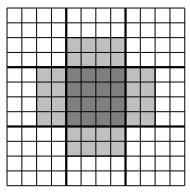
Fig. 4.2: 2D grid distributed over nine processes. A process needs some of its neighbor’s surface points, to compute its own surface points.
computation, like the orthogonalization of wave-functions, requires the same subset of every real-space grid in the simulation. This domain decomposition is illustrated in Fig. 4.1 with 2D real-space grids instead of 3D grids.
The grids are simply divided into a number of quadrilaterals matching the number of available MPI pro-cesses. If no user-defined domain decomposition is present, GPAW will try to minimize the aggregated surface of the quadrilaterals. A real-space grid is represented as a three dimensional array where every point in the grid can be a real or complex value (8 or 16 bytes)
4.1. Distributed Stencil Operation. Generally, it should be easy to obtain good scalability for a dis-tributed stencil operation since computation grows faster than communication. If we look at a 3D grid of size n×n×n the aggregated computation isO n3
where as the aggregated communication is only O n2 . The operation should scale very well when ngrows at the same rate as the number of CPUs. In GPAW, however, scalability is very hard to obtain since the grid size will ordinarily not exceed 2003. Thus, thenis smaller than
200 even when parallelizing over thousands of CPUs.
The fact that the number of independent grids grows linearly with the number of valence electrons that a simulated would normally make the problem embarrassingly parallel. Each MPI process could compute a whole grid without the need of any communication, since no communication between grids is required in GPAW. However, this is not possible because GPAW requires that every MPI process gets the same subset of every grid (cf. Fig. 4.1).
One feature in GPAW, which makes it easier to parallelize, is the fact that the input grid and the output grid used in the stencil operation is always two separate grids. We need therefore not consider the order in which the grid-points are computed.
Applying a stencil operation on a grid involves all MPI processes. It is possible for an MPI process to compute most of the points in the sub-grid assigned to it. However, points near the surface of the sub-grid,
surface points, are dependent on remote points located in neighboring MPI processes. This dependency is illustrated in Fig. 4.2.
The straightforward approach, and the one used in GPAW, for making remote points available, is to exchange the surface points between neighboring MPI processes before applying the stencil operation. The serialized communication pattern looks like this:
1. Exchange surface points in the first dimension. 2. Exchange surface points in the second dimension. 3. Exchange surface points in the third dimension. 4. Apply the stencil operation.
5. Optimizations. In order to make GPAW run faster on the BGP, we have explored different optimiza-tions. In this section, we will discuss the optimizations that have been beneficial for the overall performance.
The most obvious optimization is to exchange surface elements simultaneously in all three dimensions by using the following non-blocking communication pattern:
1. Initiate the exchange of surface points in all three dimensions. 2. Wait for all exchanges to finish.
3. Apply the stencil operation.
Fig. 5.1: Flow diagram illustrating double buffering. Then’th iteration is expressed with an and Comm and Comp stands for communication and computation, respectively. n++ is an iteration ton’s successor.
Another important performance aspect is how to map the distributed real-space grids onto the physical network topology. The 3D torus network is used for point-to-point communication in MPI, thus it is the network, we should attempt to map the distributed real-space grids onto. Since the grids have the same number of dimensions as the torus network, and since the stencil operation may use periodic boundary condition, a torus topology is a perfect match to our problem. However, the BGP requires a partition with 512 or more nodes to form a torus topology. A partition under 512 nodes can only form a mesh topology.
5.1. Multiple Real-space Grids. Double buffering and communication batching are two techniques which can improve the performance of the stencil operation. Both techniques requires multiple real-space grids but the stencil operation is typically applied on thousands of real-space grids.
5.1.1. Double Buffering. Double buffering is a technique that makes it possible to overlap communica-tion and computacommunica-tion. The following communicacommunica-tion pattern illustrates how (cf. Fig. 5.1):
1. Initiate the exchange of surface points in all three dimensions for the first grid. 2. Initiate the exchange of surface points in all three dimensions for the second grid. 3. Wait for all exchanges of the first grid to finish.
4. Apply the stencil operation on the first grid.
5. Initiate the exchange of surface points in all three dimensions for the third grid. 6. Wait for all exchanges of the second grid to finish.
The performance gain is dependent on the ability of the MPI library and the underlying hardware to process non-blocking send and receive calls. On the BGP, progress in non-blocking send and receive calls will be maintained by the DMA engine and increased performance is therefore expected.
5.1.2. Batching. An way to obtain critical packet size is to pack real-space grids into batches; inspired by the message size experiment (cf. Fig. 3.1).
Continuously dividing the grids between more and more MPI processes reduces the number of surface points in a single sub-grid. That is, at some point the amount of data send by a single MPI call will be reduced to a size in which the MPI overhead and network latency will dominate the communication overhead. The idea is to send a batch of surface points in each MPI call, instead of sending surface points, individually. This will reduce the communication overhead considerably, as the size of the sub-grids decreases. The number of grids packed together in this way, we callbatch-size.
When using double buffering, it is important to allow the CPUs to start computing as soon as possible. Combining a large batch-size with double buffering will therefore introduce a penalty as the initial surface points exchange cannot be hidden. One approach to minimize this penalty, is to increase the batch-size continuously in the initial stage. For instance a batch-size of 128 could be reduced to 64 in the initial exchange. This technique we callsloped batching.
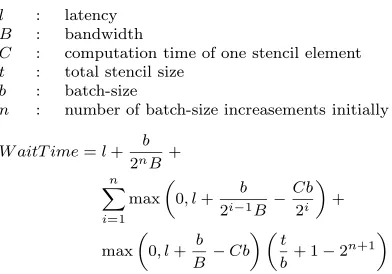
The amount of time used by waiting on non-hidden communication depends on many factors – some related to the runtime system and some related to the implementation. A general expression of the relationship is given in figure 5.2, which can be used to find the optimal batch-size and the optimal number of initial batch-size increasements when doing sloped batching. The CPU overhead associated with a implementation of double buffering and sloped batching is not included in the expression likewise the memory access time associated with the stencil computation is also not included.
l : latency B : bandwidth
C : computation time of one stencil element t : total stencil size
b : batch-size
n : number of batch-size increasements initially
W aitT ime=l+ b 2nB+ n X
i=1
max „
0, l+ b 2i−1B−
Cb 2i «
+
max „
0, l+ b B−Cb
« „ t b+ 1−2
n+1
«
Fig. 5.2: Formula of the amount of time used by waiting on non-hidden communication when using double buffering and sloped batching. The first line represents the initial communication, which can not overlap computation. The second line represents the sloped bashing, in which the block-size is doubled in each iteration and the third line represents the rest of the iterations, in which the block-size remains constant.
Fig. 6.1: A illustrates of the relationship between the four programming approaches – going from the Flat-original approach to the Hybrid-multiple approach.
The following is a description of different programming approaches that we have investigated. Every pro-gramming approach except the Flat-original uses the optimizations described in Sect. 5.
Flat-original is the approach originally used in GPAW. It uses the BGP’s virtual mode, where the four CPU-cores are treated as individual nodes, to utilize all four CPU-CPU-cores. Therefore, it is not necessary to modify anything to support the BGP architecture.
Flat-optimized is an optimized version of the original approach and just like the Flat-original it uses the virtual mode.
Hybrid-multiple does not use the virtual mode. Instead, one hardware thread per CPU-core is spawned. Every thread handles its own inter-node communication. The node will distribute the real-space grids between its four CPU-cores, not by dividing the grids into smaller pieces but by assigning different grids to every CPU-core. Because of this no synchronization is needed until all grids are computed and the synchronization penalty is therefore constant. This way of exploiting multiple grids is the main advantage of this approach.
Hybrid-master-only also spawns one thread per CPU-core, but only one thread, themaster thread, handles inter-node communication. Since we have to synchronize between every computation, each grid-computation will be divided between the four CPU-cores. The synchronization penalty thus become proportional to the number of grids. On the other hand, this approach does work inSINGLEMPI-mode and the overhead associated withMULTIPLEis therefore avoided.
Fig. 6.1 illustrates the relationship between the four programming approaches – from the original approach, in which pure MPI programming is used and the wave-functions are partitioned inside the nodes, to the hybrid approach where hybrid programming is used and the wave-functions are shared inside the nodes.
Time
MPI-p
ro
ce
sses
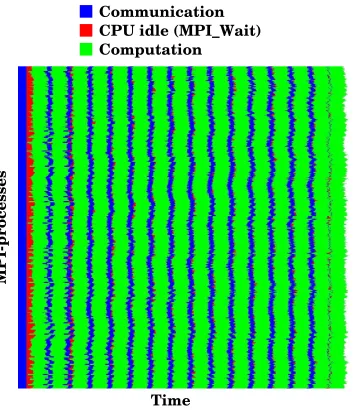
Fig. 7.1: Profile of the communication and computation pattern when computing 1024 real-space grids on 1024 CPU-cores and the Hybrid-multiple approach is used. A line represents a MPI-process and the length of the line represents the progress of time.
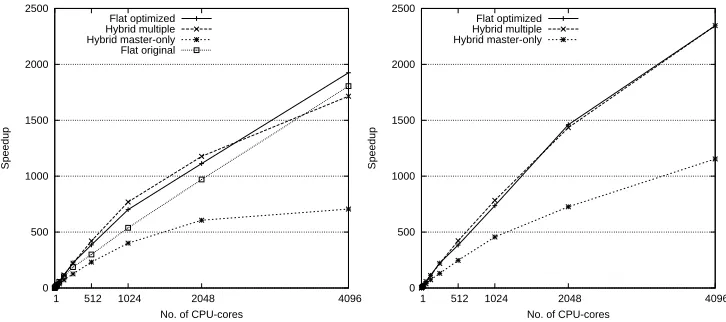
Fig. 7.2 is a classic speedup graph comparing every implemented approach with a sequential execution. It is a relatively small job containing only 32 real-space grids. But because of the memory demand, it is not possible to have more than 32 grids running on a single CPU-core.
The result clearly show that the best scaling and running time is obtained with Flat-optimized and Hybrid-multiple both using a batch-size of 8 grids. Since the job only consists of 32 grids a batch-size of 8 is the maximum if all four CPU-cores should be used. Another interesting observation is that the advantage of batching is greater in Hybrid-multiple than in Flat-optimized. This indicates that if a job consist of more grids, the Hybrid-multiple approach may become faster than Flat-optimized.
7.1. Communication and Computation Profile. The communication and computation profile be-comes very important when scaling to a massive number of processes. As the number of MPI processes in-creases the communication time has a tendency to increase due to network congestion. It is therefore essential that communication is spread evenly between the CPU-core and that the diversity of the communication and computation time is minimized.
Fig. 7.1 is a profile of the Hybrid-multiple approach executing on 1024 CPU-cores. It shows a distinct pattern in which the communication and the computation phase are aligned throughout the execution. From that it is evident that Hybrid-multiple actually do execute in a fairly synchronized manner and no ripple effect of waiting processes is observed.
7.2. Multiple Real-space Grids. As the number of grids grow there is a corresponding linear growth in the computation required in the stencil operation. It is therefore possible to create a Gustafson graph by increasing the number of grids in the same rate as the number of CPU-cores (cf. Fig. 7.3). It is important to note that the required communication per node increases faster than the needed computation. This is due to the increased surface size associated with the additional partitioning of the grids. To illustrate this communication increase, the right graph in Fig. 7.3 shows the needed communication per node for Flat-optimized and Hybrid-multiple respectively.
If we, for example, look at a computation of a grid with a size of 1923 using 1024 nodes, the grid will
either be divided between 1024 MPI processes when using Hybrid-multiple or 4096 MPI process when using Flat-optimized. Flat-optimized needs to communicate approximately 140KB more data per node than Hybrid-multiple. Note that this is only for a single real-space grid, the different will grow linearly with the number of grids in the computation.
0 500 1000 1500 2000 2500
1 512 1024 2048 4096
Speedup
No. of CPU-cores Flat optimized
Hybrid multiple Hybrid master-only Flat original
0 500 1000 1500 2000 2500
1 512 1024 2048 4096
Speedup
No. of CPU-cores Flat optimized
Hybrid multiple Hybrid master-only
Fig. 7.2: Speedup of the stencil operation. The job consist of only 32 real-space grids all with a size of 1443. In
the left graph batching is disabled and in the right graph batching is enabled using a batch-size of 8.
needed communication. Flat-optimized divides the grids four times more than the Hybrid-multiple. We did not see this effect in the speedup graph, Fig. 7.2, because of the small number of grids. Furthermore, Hybrid-multiple is better to exploit an increase in grids because of the thread synchronization overhead. The overhead is small and constant, but since the total running time is very small for 32 grids (9 milliseconds with 2048 CPU-cores), the impact of the synchronization overhead is drastically reduced when the number of grids, and thereby the total running time, is increased.
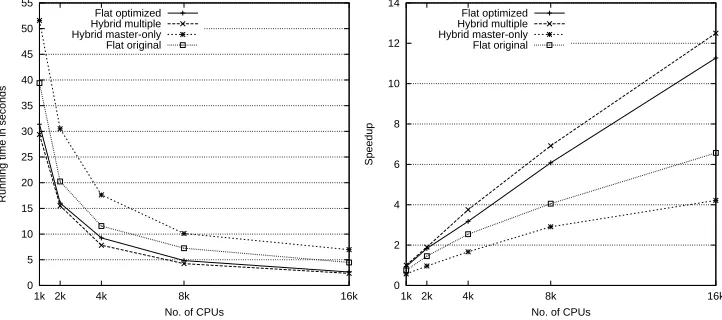
To investigate the scalability of a large job with many real-space grids, we have made a scalability graph beginning at 1k CPU-cores, which allows for a 2816 grid job (cf. Fig. 7.4). Again Hybrid-multiple has the best performance - going from 1k to 16k CPU-cores gives a speedup of approximately 12.5 where 16 would be linear but unobtainable due to the increase in the needed communication. If we compare the running time of Hybrid-multiple with Flat-original, we see a 94% performance gain at 16384 CPU-cores.
To further investigate the performance difference between Hybrid-multiple and Flat-optimized, we have made a small experiment. We modifies Flat-optimized to statically divide the real-space grids into four sub-groups. It is now possible for all four CPU-cores to work on its own sub-group and the real-space grids will be divided into the same level as in Hybrid-multiple. The only difference between the two approaches is that Flat-optimized uses the virtual mode in Blue Gene/P and Hybrid-multiple uses threads. It should be noted, however, that in a real GPAW computation this modification does not work, since GPAW requires that every MPI process gets the same subset of every real-space grid, see Sect 4. The experiment is not included in any of the graphs since its performance is identical with the Hybrid-multiple. Because of the identical performance, we find it reasonable to conclude that the level of real-space partitioning is the sole reason for the performance difference between Hybrid-multiple and the non-modified Flat-optimized.
8. Conclusions. Overall this work has managed to improve the performance of a domain specific stencil code when scaling to a very high degree of parallelism. The primary improvements are obtained through the introduction of asynchronous communication which, even in a well balanced system such as the Blue Gene, efficiently improves processor utilization. Furthermore, two hybrid programming approaches have been explored: the hybrid multiple and the master-only approach.
The hybrid programming approach, in which inter-node communication is handled individually by every thread, has shown a positive impact on the performance. By allowing every thread to handle its own inter-node communication, the overhead for thread synchronization remains constant and the application becomes faster than the non-hybrid version.
On the other hand, the alternative hybrid programming approach, in which one thread handles the inter-node communication on behalf of all threads in the process, cannot compete with the non-hybrid version. That is explained by the overhead that is introduced by thread synchronization which grows proportional to the number of grids in the computation.
0 5 10 15 20 25
1 2048 4096 8192 16384
Running time in seconds
No. of CPU-cores and real-space grids
0 100 200 300 400
1 2048 4096 8192 16384
Communication per node in MB
No. of CPU-cores and real-space grids
Fig. 7.3: Gustafson graphs showing the running time of the stencil operation and the needed inter-node communication when the number of realspace grids is increasing in the same rate as the number of CPUcores -one grid per CPU-core. The left graph shows the running time and the right graph shows the needed inter-node communication. The grid size are 1923and the best batch-size has been found for every number of CPU-cores.
0 5 10 15 20 25 30 35 40 45 50 55
1k 2k 4k 8k 16k
Running time in seconds
No. of CPUs Flat optimized Hybrid multiple Hybrid master-only Flat original 0 2 4 6 8 10 12 14
1k 2k 4k 8k 16k
Speedup
No. of CPUs Flat optimized Hybrid multiple Hybrid master-only Flat original
Fig. 7.4: A scalability graph starting at 1024 CPU-cores running the stencil operation. In the left graph the running time of every approach is shown and in the right graph every approach is compared against the fastest approach on 1024 CPU-cores namely the Hybrid-multiple. All jobs consists of 2816 real-space grids all size of 1923, and the best batch-size has been found for every number of CPU-cores.
ming approach combined with the latency-hiding techniques is 94% faster at 16384 CPU-cores. Translated into utilization this means that CPU utilization grows from 36% to 70%.
While latency-hiding is the primary factor for the improvement we observe, the hybrid implementation is still 10% faster than the non-hybrid approach.
8.1. Further Work. Overall we are satisfied with the performance of the new implementation of the stencil operation, still a lot of work remains if the entire GPAW computation should utilize latency-hiding and hybrid programming. It may not be worth the hard work that is needed to rewrite most of GPAW.
Acknowledgments. The authors would like to thank The Danish Agency for Science, Technology and Innovation and the GPAW team at the Technical University of Denmark in particular Jens J. Mortensen and Marcin Dulak. Furthermore we would like to thank Argonne National Laboratory for giving us access to the Blue Gene/P.
[1] J. Backus,Can programming be liberated from the von neumann style?: A functional style and its algebra of programs, Communications of the ACM, 16 (1978), pp. 613–641.
[2] P. E. Blochl,Projector augmented-wave method, Phys. Rev. B, 50 (1994), pp. 17953–17979.
[3] F. Cappello and D. Etiemble,Mpi versus mpi+openmp on the ibm sp for the nas benchmarks, SC Conference, 0 (2000), p. 12.
[4] W. Gropp, S. Huss-Lederman, A. Limsdaine, E. Lusk, W. Saphir, and M. Snir,The Complete Reference: Volume 2, the MPI-2 Extensions, MIT Press, 1998.
[5] W. Gropp, E. Lusk, and A. Skjellum,Using MPI Portable Parallel Programming with the Message Passing Interface, The MIT Press, 1994.
[6] D. S. Henty,Performance of hybrid message-passing and shared-memory parallelism for discrete element modeling, Super-computing, ACM/IEEE 2000 Conference, (2000), pp. 10–10.
[7] M. Hipp and W. Rosenstiel,Parallel Hybrid Particle Simulations Using MPI and OpenMP, Springer-Verlag Berlin Heidel-berg, 2004, pp. 189–197.
[8] J. J. Mortensen, L. B. Hansen, and K. W. Jacobsen,Real-space grid implementation of the projector augmented wave method, Physical Review B, 71 (2005), p. 035109.
[9] I. B. G. TEAM,Overview of the ibm blue gene/p project, IBM Journal of Research and Development, 52 (2008).
[10] B. Vinter and J. M. Bjørndalen,A comparison of three mpi implementations, in Communicating Process Architectures 2004, I. R. East, D. Duce, M. Green, J. M. R. Martin, and P. H. Welch, eds., 2004, pp. 127–136.
Edited by: Dana Petcu and Marcin Paprzycki
Received: May 1, 2011