Original Article
Cost Effectiveness of Malaria Interventions from Preelimination
through Elimination: a Study in Iran
Mohsen Rezaei-Hemami1, *Ali Akbari-Sari2, Ahmad Raiesi3, Hassan Vatandoost4, Reza Majdzadeh5
1
Department of Epidemiology and Biostatistics, School of Public Health, Tehran University of Medical Sciences, Tehran, Iran
2
Department of Health Management and Economics, School of Public Health, Tehran University of Medical Sciences, Tehran, Iran
3
National Malaria Control Programme Manager, Center for Disease Management, Teheran, Iran
4
Department of Medical Entomology and Vector Control,School of Public Health and National Institute of Health Research,Tehran University of Medical Sciences, Tehran, Iran
5
School of Public Health, Knowledge Utilization Research Center, Tehran University of Medical Sciences, Tehran, Iran
(Received 25 June 2012; accepted 16 Sep 2013)
Abstract
Background: Malaria still is considered as a public health problem in Iran. The aim of the National Malaria Control
Department is to reach the elimination by 2024. By decreasing the number of malaria cases in preelimination phase the cost effectiveness of malaria interventions decreases considerably. This study estimated the cost effectiveness of various strategies to combat malaria in preelimination and elimination phases in Iran.
Methods: running costs of the interventions at each level of intervention was estimated by using evidence and expert
opinions. The effect of each intervention was estimated using the documentary evidence available and expert opin-ions. Using a point estimate and distribution of each variable the sensitivity was evaluated with the Monte Carlo method.
Results: The most cost-effective interventions were insecticide treated net (ITN), larviciding, surveillance for
diag-nosis and treatment of patients less than 24 hours, and indoor residual spraying (IRS) respectively, No related evi-dence found for the effectiveness of the border facilities.
Conclusion: This study showed that interventions in the elimination phase of malaria have low cost effectiveness in
Iran like many other countries. However ITN is the most cost effective intervention among the available interven-tions.
Keywords:Malaria, prevention and control, Iran, cost effectiveness, IRS, ITN
Introduction
Based on the endemicity of the disease, malaria-hit areas are classified into four main groups: control, pre-elimination, elimination and prevention of reintroduction. The measures to be adopted to fight the disease are differ-ent in each of these stages. As the incidence of the disease reduces over time across the country elimination programs mainly focus on
malaria foci rather than whole region (Mendis et al. 2009).
num-ber of affected cases. At the time being, vari-ous measures, such as vector control activi-ties, early diagnosis systems and some other complementary measures have been adopted to fight malaria in elimination phase around the world (Moonen et al. 2007), but there are limited studies about their efficacy and cost-effectiveness in this phase, in addition many of the previously-approved strategies includ-ing early warninclud-ing system have never been adopted in the Iranian health care system.
Many researchers have studied the cost-effectiveness of different strategies adopted to fight malaria across the globe; but most of them were conducted in malaria-endemic ar-eas. In other words, not many studies have targeted the low-endemic areas (Goodman et al. 2000, Yukich et al. 2008, Kang et al. 2008) so using models seems necessary in this sit-uation. Developing an accurate model, there-fore, can play an important role in this regard, particularly in conditions in which there is limited evidence or unapproved documents and reports. The importance of these model-ing is highlighted at times when the policy-makers are to decide upon setting up a pro-gram (Goodman et al. 2000).
The present study aims to estimate the cost as well as cost-effectiveness of main strate-gies to combat malaria in the pre-elimination and elimination phases in a malaria focus as a unit of malaria combat operation in Iran.
Materials and Methods
Interventions assessed
A total of seven interventions were assessed. These interventions include: larviciding, door residual spraying (IRS), distributing in-secticide treated net (ITN), set up the diag-nosis and treatment in less than 24 hours, and set up the border facilities.
General consideration
This study was conducted in perspective
of Ministry of Health and Medical Education (MOHME), time period for effects was con-sidered one year, we consider the case avert-ed as outcome. Basis for evaluating most of intervention was a focus with 500 peoples pop-ulation. The interventions defined as bellow:
Larviciding: a focus with 200m2water re-source area, which needs 10 times larviciding operation every year.
IRS: A focus with 200 building, in each building there is 100m2 area needs to insec-ticide spraying two rounds a year.
ITN distribution: A focus with 100 house-holds (each having an average of 5 mem-bers), for each household a bed net would be distributed with 5 years life time.
Establishment diagnosis and treatment in less than 24 hours: it means intensified ac-tivities for detecting ant treatment of malaria cases using the current structure of health care system in affected regions.
Set up border posts: The intervention in-cluded the establishment of a facility that has been deployed in the border areas. Their task is providing diagnosis and treatment services to those who live and travel to the edge of the border.
Cost assessment
Cost for each intervention were assessed in different central and peripheral levels in five expenses groups, by using expert opin-ions, current evidences and documents. When a resource was used for several tasks, its cost was calculated proportionally. These five groups consist of: building and its currents expense (water, electricity power, telephone, warming and cooling), capital expenses, oper-ational expenses, human force, and transport. In case of building we consider the rent of similar building, in addition a 3% discount rate considered for capital goods.
Effectiveness
con-trolled trials and meta-analyses if possible. The case averted considered as outcome var-iable in our study. The evidence was select-ed from studies in low-endemic areas and as for conditions with no reliable evidence ex-pert panels were held. The comparison was made based on the epidemiologic status of the region (control, pre-elimination, elimina-tion) as well as the endemicity status at the time when no strategy against the disease had been adopted (Raeisi et al. 2004).
Sensitivity analysis
Considering the effect of undetermined variables of cost and efficacy on the inter-vention, Mont Carlo analysis was used to as-sess the sensitivity of the interventions. In this regard the triangle distribution was used to calculate the cost for each variable. The point estimation, as the most likely estimate, was considered the vertices of the triangle distribution (Goodman et al. 2000) As for the maximum and minimum values, 10 percent was added to and subtracted from the point estimation value, respectively. Sampling was repeated in 20000 times.
Results
Table 1 provides a list of different costs met in this study. As mentioned in the material and methods section, these interventions have been followed at different levels and therefore
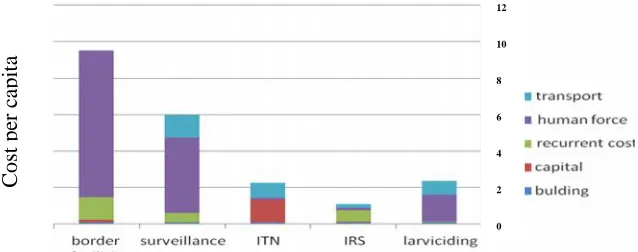
var-ious numbers of individuals may have bene-fited from the intervention. The development of border posts and providing prophylactic treatment accounted for the highest cost per capita. Figure 1 shows the combination of fees spent on different strategies. Similarly, the highest fee was paid for human resources for border posts and diagnostic and therapeutic system in less than 24 hours. Building charg-es hold the smallcharg-est share in the funds.
In view of the available evidence and the expert panel, the relative risk of the protec-tive properties of each of these strategies were determined, the highest case averted was for diagnosing and treating the patients in less than 24 hours. No evidence was found re-garding the development of border posts. The decline noted in the number of affected cases was then calculated in four different scenarios based on the incidence of malaria in the region (Table 2).
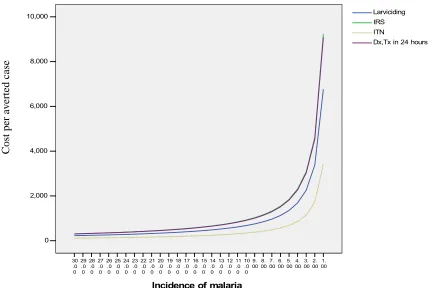
IRS (Indoor Residual Spraying), ITN (In-secticide Treated Net), API (Annual Parasite Incidence). The most cost-effective interven-tions, were the use of insecticide-treated nets, larviciding, diagnosis and treatment in less than 24 hours and indoor residual spraying (Table 3, Fig. 2) along with the changes made in the cost effectiveness as the incident of the disease declines over time are shown. As shown in the Fig. 2, the cost per averted cas-es increascas-es considerably as the number of affected cases decreases.
Fig. 1.Cost per capita for each intervention based on its components (US Dollar) IRS (Indoor Residual Spraying), ITN (Insecticide Treated Net)
C
os
t pe
r c
api
ta
12
10
8
6
4
2
Table 1.Annual cost of studied intervention based on their components and their cost per capita (US Dollar)
Costs Building Capital expense
Operational expense
Human
force Transport Total Population*
Per capita
larviciding
49 0 24 741 370 1184 500 2.37
IRS
49 12 309 74 111 555 500 1.11
ITN
49 311 0 57 407 824 500 1.65
Surveillance
49 0 267 2052 630 2997 500 5.99
Border
facilities 49 63 630 4024 0 4765 500 9.53
* This includes the proportion of whole cost needed for each interventions. IRS (Indoor Residual Spraying), ITN (Insecticide Treated Net), API (Annual Parasite Incidence)
* population under service ** cost per capita for each intervention, calculated by dividing total price by population
Table 2.The composition of cost for each intervention
Costs building Specialized equipment. (life time> 1year)
Supply (life time<
1year) Human force
larviciding
Rent for building, cost of warming and cooling, office
equipment and current expense
0 Larvicide
Larvicidinig activity and supervision
IRS
Pump Insecticide
IRS operation and supervision
ITN
200 ITN 0
Distribution, training and supervision
surveillance
0
RDT, antimalaria drug
Active and passive surveillance,
supervision
border facilities
Microscope, medical equipment
RDT, antimalaria drug
Active and passive surveillance,
Table 3.Estimating the efficacy of the strategies in reducing the incidence of the disease and the number of affected cases (relative risk)
intervention Point estimate
Interval Reference Number of averted cases in different epidemio-logic setting
Elimina-tion API=
0.34
Preelimi nation API=2.4
Control, API=12.9
Historical evidence API=350
Larviciding 0,35 0,3–0,4
(Invest and
Lucas 2008) 0.0595 0.42 2.2575 61.25
IRS
0,12 0.10–0.14 (Pluess et al.
2010) 0.0204 0.144 0.774 21
ITN 0,48 0,52–0,44
(Lengeler
2004) 0.0816 0.576 3.096 84
Diagnosis, treatment in less than 24 hours
0,66 0,7–0,62 (Carrara et al.
2006) 0.1122 0.792 4.257 115.5
Table 4.The cost-effectiveness rate for case averted in each intervention
Intervention Cost effectiveness in assumed population Point estimate (CI 95%)
Preelimination API= 2.4
control API= 12.9 Historical evi-dence API= 350 Elimination API=
0.34
Larviciding 22378.4 (20247.52–
24901)
3170.27 (2865.58–
3541.81)
589.82 (533.59–
656.1) 21.74 (19.65–24.2)
IRS 30582.42 (27373.73–
34550.42)
4332.51(3864.05–
4886.9)
806.05(720.8–
910.85) 29.71(26.57–33.6)
ITN 19891.91 (17646.76–
22617.98)
2818.02 (2497.5–
3214.54)
524.28 (465.11–
596.94)
19.32 (17.11–
21.97)
Diagnosis, treatment in less than 24 hours
30049.15 (28246.64–
31928.47)
4256.96 (3999.47–
4524.27)
791.99 (743.78–
841.09)
29.19 (27.45–
31.04)
IRS (Indoor Residual Spraying), ITN (Insecticide Treated Net), API (Annual Parasite Incidence)
Table 5.The cost-effectiveness of the intervention in other studies
Intervention Location Cost effectiveness Cost per capita (US $)
Program phase Reference
ITN South Africa 18 --- control (Goodman et al. 2001)
IRS Mozambique 20–29 3,84 control (Conteh et al. 2004)
IRS Eritrea- Togo --- 1.2–6 control (Yukich et al. 2008)
ITN Eritrea- Togo --- 1.38–1.91 control (Yukich et al. 2008)
ITN Togo 3.26 --- control (Mueller et al. 2008)
Larviciding Sri lanka 0,50 --- control (Konradsen et al.
1. 00 2. 00 3. 00 4. 00 5. 00 6. 00 7. 00 8. 00 9. 00 10 .0 0 11 .0 0 12 .0 0 13 .0 0 14 .0 0 15 .0 0 16 .0 0 17 .0 0 18 .0 0 19 .0 0 20 .0 0 21 .0 0 22 .0 0 23 .0 0 24 .0 0 25 .0 0 26 .0 0 27 .0 0 28 .0 0 29 .0 0 30 .0 0
Incidence of malaria
10,000 8,000 6,000 4,000 2,000 0
Dx,Tx in 24 hours ITN
IRS Larviciding
Fig. 2.Changes of cost effectiveness of different strategies with changes of malaria incidence
Discussion
The present study suggested that the most cost effective strategies in fighting malaria were the use of insecticide-treated nets, larviciding, diagnosing and treating the affected cases in less than 24 hours and indoor residual spray-ing respectively. The most important point in all of these strategies is the reduction noted in the cost effectiveness as the incidence de-clines. As a result, the cost effectiveness of the strategies has been reported to be much lower in our study in comparison with the malaria-endemic areas. The difference is be-lieved to increase as the incidence declines. Compared with the cost-effectiveness rate of other researches (Table 4), our study had the highest rate. As shown in the table, there is a considerable difference in the our cost-effec-tiveness rate and the cost per capita which could be due to the difference noted in the fees,
effectiveness and the incidence. The latter is the main reason contributing to the difference. This also points out the considerable difference noted in the control and elimination phase.
Larviciding
Larviciding is among the strategies long been used in this regard. It had the second rank of cost effectiveness among used inter-vention but yet it seems so expensive in com-parison with other studies (Table 5). It is more frequently adopted in areas with limited wa-ter resources and obviously the urban areas. The three Iranian malaria-endemic provinces are also reported to have low and scattered water resources. The adaptation of the tech-nique in these areas, however, needs to con-sider its technical feasibility and efficiency.
Distributing insecticide-treated nets
Our study showed ITN as the most cost ef-fective intervention, and considering its bet-ter acceptance in comparison with IRS, how-ever it is less cost effective comparing with control setting in other studies (Table 5). More-over, its use doesn’t need any specific exper-tise or skilled human resources. In addition, the longevity of its effects lowers the distri-bution cost.
Indoor residual spraying
Vector control is one of the main compo-nents in malaria-elimination programs (Green-wood et al. 2008). This intervention had a less-er cost effectiveness and thless-ere is a high dif-ference between our finding and similar stud-ies (Table 5), furthermore it needs some equip-ments which make it harder to than other in-tervention, despite these fact, indoor residual spraying is one of the most important tools in this regard yet. Its use, however, is associ-ated with certain challenges including re-sistance to the poison and not well being accepted in the society. Recent improvements in the housing conditions has also lowered the acceptability of spraying, limiting the meas-ure to places used for keeping animals. It should be added that using the techniques in these places worsens the condition through forcing the mosquitoes to move to the places where humans live.
Diagnosing and treating the patients in less than 24 hours
The measure is among the priciest malaria-control interventions, and this is mainly be-cause of its high cost of human resources. During the elimination phase, while the num-ber of vector-control activities decline that of the healthcare activities increase. Referring to the WHO list for granting the malaria-elimination certificate, a vast number of ac-tivities should be adopted in the malaria care system, each of which is pricey and time con-suming (Elimination 2007). Their main objec
tive is to develop an efficient system for rapid diagnosis and treatment of the patients and at the same time preventing from the spread of the disease in its early stages. As a result, the act, regardless of its cost, is necessary for achieving an elimination phase and hence one should benefit from the available healthcare system to lower the cost of surveillance to the lowest amount possible. For instance, us-ing a delivery system by usus-ing motorcycle to send the samples to the laboratories equipped with microscopes can help considerably lower the cost of diagnosis and improve the accu-racy of detecting the suspicious samples. This delivery system currently is used in some part the malarial region and it is successful.
Establishing border posts
This strategy is adopted in many parts of the world and there are sufficient evidence sup-porting its efficacy, particularly when used in confined areas. In this regard, one could high-light the successful attempt in Saudi Arabia, where the country built several posts on its border with Yemen and is paying for more than half of the total cost of the program (Meleigy 2007). In view of Iran’s long border (2000 km) with Pakistan and Afghanistan, the ad-aptation of the strategy seems rather chal-lenging, making it a great concern in the coun-try’s malaria elimination program (Tatem et al. 2010). Despite all these, establishing such posts play an important role in reducing the number of infected cases entering Iran and subsequently lowering the parasite reservoir in the country. Hence, despite its high cost, adopting such a measure seems necessary and more research is needed to be conducted to assess its impact.
Costs
a considerable difference between their ef-fectiveness. As a result, the most important factor in choosing the most appropriate in-tervention is its technical feasibility and effi-ciency and its cost. For instance, WHO stress-es that indoor rstress-esidual spraying is effective only if the whole area is sprayed (Najera and Zaim 2001). As a result, the strategy would not be effective if less than 80–85% of the area is sprayed and in these conditions, other efficient interventions should be considered.
Another important point is the composi-tion of costs (Fig. 1), we can see in costs of two relatively expensive intervention, border facility and diagnosis and treatment of pa-tients less than 24 hours the most component is human force expense, so applying multi-function staff can be considered an effective strategy to decrease their costs.
The present study showed a reduction in the cost-effectiveness of the interventions as the number of affected cases decline. As a result, assessing outcomes such as mortality and the number of affected cases on their own cannot be used as an acceptable indi-cator of cost-effectiveness and thus different aspects of the disease should be studied. In other words, each country should develop a criteria based on its current condition.
It should be noted that success of malaria elimination in many countries needs accept-ing financial risk which necessitate the para-digm shift to investing in malaria instead of a rapid and striking result (Sachs and McAr-thur 2005).
Malaria elimination program needs long term expenses until the disease totally elimi-nated (Sabot et al. 2010). Several studies have pointed out that the policymakers should not expect a short-or mid-term positive economic feedback from the program (Sabot et al. 2010). The high cost of the program, even at the time when the incidence of the disease is low, is the main point which should be highlighted before launching a control or elimination pro-gram. It should be kept in mind that the costs
may even increase in the latter condition and this is because of the high charges of inten-sified surveillance. Hence, the policymakers should be informed that several decades may be needed before malaria is completely elimi-nated and thus they should be committed to support the program for long-term at the be-ginning (Lines et al. 2007). It should be kept in mind that the only and at the same time the most important reason which caused the fail-ure of the malaria program in 1960s was the governments’ irresponsibility regarding the program (Hommel 2008). This comes while the results of a control plan are more noticeable than those of the elimination programs in the policymakers’ point of view. As a result, pol -icymakers should be briefed regarding the cost of the program and possible forthcom-ing challenges.
Considering the decline noted in the num-ber of malaria cases and uncertainty regard-ing the efficacy of other interventions in Iran, the best measure for fighting malaria should be selected based on technical concerns and the cost. Moreover, it is necessary to define a more comprehensive outcome rather than con-ventional outcome like, morbidity and mor-tality of malaria for convincing the policy mak-er to sustain the elimination malaria program.
Limitations
One of criteria for search strategy was finding evidence of effectiveness in low endemicity region, but yet we expect differ-ence in efficacy in different low endemic area due to variation in climate, health sys-tem, ... We, however, had tried to reduce this bias through adopting the most conservative method.
Conclusion
This study showed that interventions in the elimination phase of malaria have low cost ef-fectiveness in Iran like many other countries. However ITN is the most cost effective in-tervention among the available inin-terventions.
Acknowledgements
We thank all experts in MOHME malaria office and in Sistan and Baluchestan, Kerman and Hormozgan Provinces. Furthermore we especially thank Mrs Nikpur for her help in this study. This article was part of PhD thesis in epidemiology supported by Tehran University of Medical Sciences. The authors of study declare that they have no competing interests.
References
Carrara VI, Sirilak S, Thonglairuam J, Roja-nawatsirivet C, Proux S, Gilbos V, Ashley EA, McGready R, Krudsood S, Leemingsawat S (2006) Deployment of early diagnosis and mefloquine-artesunate treatment of falciparum ma-laria in Thailand: the Tak Mama-laria Initi-ative. PLoS Medicine. 3: 856–864. Conteh L, Sharp BL, Streat E, Barreto A,
Konar S (2004) The cost and cost ef-fectiveness of malaria vector control by residual insecticide house spraying in southern Mozambique: a rural and
urban analysis. Trop Med Int Health. 9: 125–132.
Edrissian GH (2006) Malaria in Iran: Past and present situation. Iran J Parasitol. 1(1): 1–14.
Elimination WHOM (2007) A Field Manual for Low and Moderate Endemic Coun-tries. Geneva: World Health Organiza-tion.
Goodman C, Coleman P, Mills A, Research GF (2000) Economic analysis of ma-laria control in sub-Saharan Africa. Global Forum for Health Research Ge-neva, Switzerland.
Goodman C, Mnzava A, Dlamini S, Sharp B, Mthembu D, Gumede J (2001) Com-parison of the cost and cost effective-ness of insecticide treated bednets and residual house spraying in KwaZulu Na-tal, South Africa. Trop Med Int Health. 6: 280–295.
Greenwood BM, Fidock DA, Kyle DE, Kappe SHI, Alonso PL, Collins FH, Duffy PE (2008) Malaria: progress, perils, and prospects for eradication. J clin invest. 118: 1266–1276.
Hommel M (2008) Towards a research agen-da for global malaria elimination. Ma-laria journal. 7: S1.
Invest J, Lucas J (2008) Pyriproxyfen as a mosquito larvicide. In WH Robinson, D Bajomi (eds), Proceedings of the 6th International Conference on Urban Pests. Veszprem, Hungary, pp. 239–245. Janssen MA, Martens WJ (1997) Modeling
malaria as a complex adaptive system. Artif Life. 3: 213–236.
Kang YH, Lim HS, Lee HM, Lee KS, Choi KM (2008) Evaluation of usefulness of the panel test composed of malaria non-specific tests as a surrogate mark-er. Korean J Lab Med. 28: 332–338. Konradsen F, Steele P, Perera D, Van Der
Lanka. Bull World Health Organ. 77: 301–309.
Lengeler C (2004) Insecticide-treated bed nets and curtains for preventing malaria. status and date: Edited (no change to conclusions), published in.
Lengeler C (2004) Insecticide-treated bed nets and curtains for preventing malaria. Cochrane Database Syst Rev, 2(2). Lines J, Whitty C, Hanson K (2007)
Pro-spects for eradication and elimination of malaria: a technical briefing for DFID. London: London School of Hy-giene and Tropical Medicine.
Meleigy M (2007) Arabian Peninsula states launch plan to eradicate malaria. BMJ: British Medical Journal. 334(7585): 117. Mendis K, Rietveld A, Warsame M, Bosman A, Greenwood B, Wernsdorfer WH (2009) From malaria control to eradi-cation: The WHO perspective. Trop Med Int Health. 14: 802–809.
Moonen B, Cohen JM, Snow RW, Slutsker L, Drakeley C, Smith DL, Abeyasinghe RR, Rodriguez MH, Maharaj R, Tan-ner M, Targett G (2007) Operational strategies to achieve and maintain ma-laria elimination. The Lancet. 376: 1592– 1603.
Mueller DH, Wiseman V, Bakusa D, Morgah K, Dare A, Tchamdja P (2008) Cost-effectiveness analysis of insecticide-treated net distribution as part of the Togo Integrated Child Health Cam-paign. Malar J. 7(73): 1–7.
Najera J, Zaim M (2001) Malaria vector control–insecticides for indoor residual
spraying.WHO Dengue Bulletin. 25: 126–127.
Pluess B, Tanser F, Lengeler C, Sharp B (2010) Indoor residual spraying for preventing malaria. Cochrane Data-base Syst Rev, CD006657.
Raeisi A, Shahbazi A, Ranjbar M, Shoghli A, Vatandoost H, Faraji L (2004) Nation-al strategy Plan for MNation-alaria Control in IR Iran. Diseases Management Center, Ministry of Health and Medical Edu-cation Seda Publ Center.
Sabot O, Cohen JM, Hsiang MS, Kahn JG, Basu S, Tang L, Zheng B, Gao Q, Zou L, Tatarsky A (2010) Costs and finan-cial feasibility of malaria elimination. The Lancet. 376(9752): 1604–1615. Sachs J, McArthur J (2005) The Millennium
Project: a plan for meeting the millen-nium development goals. The Lancet. 365: 347–353.
Tatem AJ, Smith DL, Gething PW, Kabaria CW, Snow RW, Hay SI (2010) Rank-ing of elimination feasibility between malaria-endemic countries. The Lancet. 376: 1579–1591.