Available Online at www.ijpret.com 38
INTERNATIONAL JOURNAL OF PURE AND
APPLIED RESEARCH IN ENGINEERING AND
TECHNOLOGY
A PATH FOR HORIZING YOUR INNOVATIVE WORK
A THEORETICAL STUDY OF PHYSICAL PROPERTIES OF QUANTUM WIRE AND
EVALUATION OF CHANGES OF REFRACTIVE INDEX AS A FUNCTION OF PHOTON
ENERGY FOR DIFFERENT INCIDENT OPTICAL INTENSITIES AND FIXED LENGTH OF
QUANTUM WIRE
PANKAJ KUMAR SINHA1 AND L. K. MISHRA2
1.29 Lala Babu Road, New Godwon, Gaya-823001(Bihar)
2.Department of Physics, Magadh University, Bodh-Gaya-824234(Bihar)
Accepted Date: 16/01/2018; Published Date: 01/02/2018
\
Abstract: - Using the theoretical formalism of Reza Khordad [J. Theor & Appl. Phys, 6, 19(2012)] and R Khordad etal [Commun. Theor Phys, 57, 1076(2012)], we have evaluated inter subband optical refractive index changes of the wire as a function of photon energy. The evaluation has been performed in two ways: (1) Keeping length of the wire fixed and varying the incident optical intensity (2) Keeping incident optical intensity fixed and varying the length of the wire. We observed that in the first case the total refractive index changes decreases with increase of the optical intensity. In the second case, the total refractive index changes decreases as the quantum size decreases. These results have great importance in the quantum confinement of the charge carriers of the nanostructured material. Our theoretically evaluated results are in good agreement with the other theoretical workers
Keywords: Quantum wire, quantum dots, Quantum confinement, Inter subband total refractive changes, Linear and nonlinear refractive index changes, Optoelectronic and photonic devices, Parallelogram Cross section.
Corresponding Author: MR. PANKAJ KUMAR SINHA Access Online On:
www.ijpret.com
How to Cite This Article:
Pankaj Kumar Sinha, IJPRET, 2018; Volume 6 (6): 38-50
Available Online at www.ijpret.com 39
INTRODUCTION
In the past two decades, there has been considerable interest in the physics of low-dimensional semiconductor structures. These structures are superlattices, quantum wires, single and
multiple quantum wells and quantum dots1-8. The physical properties of these structures have
been extensively studied both theoretically and experimentally1,2. These structures confine
charge carriers in one, two and three dimensions. Quantum confinement of the charge carriers in these structures leads to the formation of discrete energy levels, the enhancement of the density of states at specific energies. Due to these facts, the optical absorption spectra of the system are drastically changed. One of the most intensively explored classes of semiconductor structures is the class of quantum wires. With technological progress in the fabrication of semiconductor structures like chemical lithography, molecular beam epitaxy, and etcing, it has been made possible to fabricate a wide variety of quantum wires with well-controlled shape and composition. Among hetrostructures, quantum wires with rectangular, T-shaped, V-groove, triangular, and other cross sections have received lots of attention by researchers during the last decade4-8.
The linear and nonlinear optical properties of low dimensional semiconductor structures are of considerable current interest in connection with their potential applications in optoelectronic
and photonic devices9,10. It has been seen that there are many novel optical properties which
are not seen in the bulk materials11-13. The linear and nonlinear optical properties of
nanostructures have been widely studied by several workers14,15. The linear inter subband
optical absorption within the conduction band of a GaAs quantum well without and with an
electric field has been experimentally studied16,17. Nonlinear inter subband optical absorption in
a semiconductor quantum well was also calculated by Ahn and Changin18. Rappen etal19 studied
the non-linear absorption for two-dimensional magnetoexcitons in InxGa1-xAs/InyAl1-yAs
quantum well. Bockelman and Bastard20 discussed interband absorption in quantum wires with
a magnetic field and without magnetic field21. Inter subband optical absorption in coupled
quantum wells under an applied electric field was studied by Yuh and wang22. Cui etal23
experimentally studied the absorption saturation of inte rsubband optical transitions in
GaAs/AlxGa1-xAs multiple quantum wells. R Khordad24 has studied the optical properties of
quantum disk in the presence of an applied magnetic field. He has also investigated the optical
properties of a modified Gaussian quantum Dot under hydrostatic pressure25. The inter
subband optical absorption coefficients and refractive index changes in nanostructured
materials have attracted considerable and continuous attention during one decade26. Wang
Available Online at www.ijpret.com 40
semiparabolic quantum well. Unlu etal28 investigated the optical rectification in a semiparabolic
quantum well. Several workers29-32 have studied the optical properties of low-dimensional
systems over last five to seven years.
In this paper, using theoretical formalism of Reza Khordad33 and R. Khordad etal34, we have
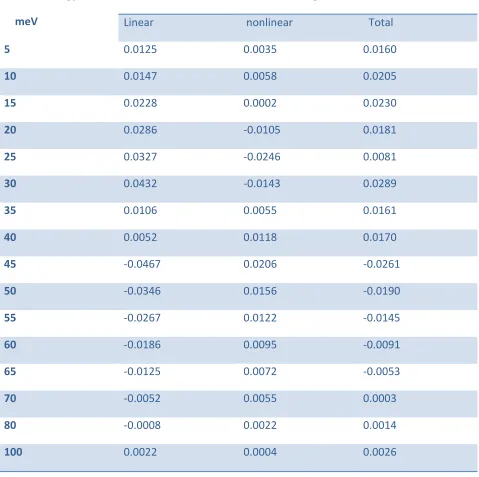
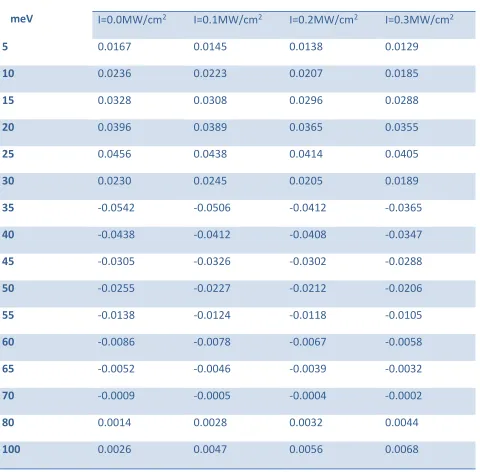
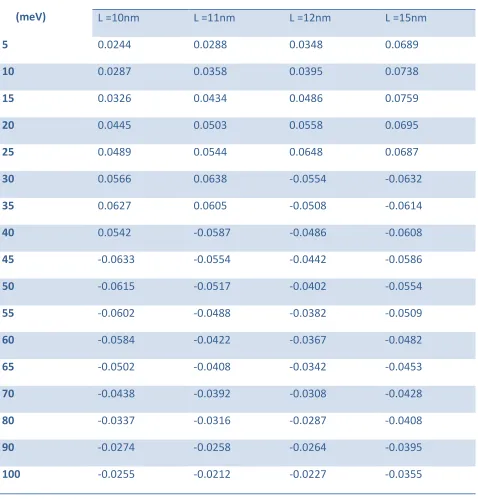
theoretically studied the optical properties of quantum wire. We have evaluated inter subband refractive index changes as a function of photon energy for fixed value of incident optical intensity and length of the wire. We have performed three works related to optical properties of quantum wire. As a first work, we have evaluated linear, nonlinear and total refractive index changes for a given length of wire and incident optical intensity as a function of photon energy (meV). We observed that the linear refractive index change is opposite to that of nonlinear part. As a second work, we have determined the total refractive index changes keeping length of the wire fixed and varying the incident optical intensities. We observed that the total refractive index changes decreases as a function of photon energy with increase of the optical intensity. As a third work, we have calculated total refractive index changes as a function of photon energy keeping incident optical intensity fixed and varying the length of the wire. In this case, we observed that the total refractive index changes decreases as the quantum size L decreases. Our theoretically evaluated results are in good agreement with other theoretical workers35-37.
MATERIALS AND METHODS:
Here, one solves the Schrodinger equation for an electron confined in a parallelogram quantum wire. One obtains the energy levels and wave functions analytically. Then, one tries to study the linear, nonlinear and total absorption coefficients and refractive index changes of the system. For this purpose, one considers only the two-level system for electronic transition. One shows that both the incident optical intensity and the structure parameter have great effects on the total absorption coefficients and refractive index changes of a parallelogram quantum wire.
The Hamiltonian of a charge carrier in a quantum wire is given by
2 2
( , ) 2
H V x y
m
(1)
Where m* is the effective mass. V(x, y) is the confining potential
V(x, y) =0, inside
Available Online at www.ijpret.com 41
To obtain energy levels and wave functions, one solves the Schrodinger equation in the Cartesian coordinates
2 2 2
*[ 2 2] ( , ) ( , ) ( , ) ( , )
2m x y x y V x y x y E x y
(3)
Now, one considers a superposition of a finite number N of plane wave in two-dimensions,
1
( , ) exp( )
N
s s s
s
x y c i x i y
(4)
Where
*
2 2
2
2 s
s s
m E
(5) s1, 2...N
One applies a mathematical lemma to obtain the coefficients s, s and the energy levels .
One considers a set of particular tilings of the plane which are obtained by reflections of a single fundamental region. Using this procedure, one can generate a parallelogram of the plane starting from the reference tilt and reflecting it successfully in its side.
Let ai and aj are two adiacent sides of lengths L (ai) and L(aj) respectively. Let and are the
reference to coordinate axes which must satisfy the translation33
'
( )
i i
p L a
, '
(6)
And
' ,
'
( )
j j
p L a
(7)
where pi and pj are integers. Considering the smallest pi and pj in equation (6) and (7), minimal
parallelogram is defined corresponding to each pair of adjacent sides. Workers38,39 have used
this procedure to generate convex plane polygons. In terms of Cartesian coordinate axes x and
y, if δ is the angle between ai and aj, the two independent translations can be written as
x’ =x + Pi L (ai), y’ =y (8)
and x’ =x +pi L (ai) cos, y’ =y+pj L (aj) sin (9)
Available Online at www.ijpret.com 42
( , )x y exp(xy) (10)
Where 2 ( ) i i n p L a
(11a)
2 ( ) 2 ( ) cos
( ) ( ) sin
i i j j
i j i j
m p L a n p L a
p p L a L a
(11b)
The corresponding eigenvalues are given by
2 2
2
2 ( , )
( , ) ( , )
m E n m
n m n m
(12)
Using geometrical consideration, the eigenvalues and eigenfunctions for quantum wire with a parallelogram cross-section can be written as
( 2) / 2 ,
2 3 2 2 3 ( )
( , ) sin[ ]sin[ ] ( 1) sin[ ]
3 3 3 2
m n m
m n
x y nx my x
L L L
( ) / 2
2 (3 ) 2 3 ( ) 2 (3 )
sin[ ] ( 1) sin[ ]sin[ ]
3 2 3 2 3 2
m n
n m n m n m
y x x
L L L
(13) and 2 2 2 2 2 2
( , ) ( )(3 )
9
E n m n m
L m
(14)
where L is the side length. In the above equation, m and n are integers and have the following conditions
n0, m0, m 3n, m n (15)
An evaluation of refractive index changes:
In order to calculate refractive index changes of a quantum wire with parallelogram
cross section. One uses density matrix formulation. This is related to an optical inter subband transition. As one knows that the system under study can be excited by an electromagnetic
Available Online at www.ijpret.com 43
E( )t E e i t E e i t (16)
The time evaluation of the matrix elements of the one-electron density operator can be
written as27,28
(0) 0
1
[H qxE t( ), ] ( ) t i
(17)
Where H0 is the Hamiltonian of the system without electromagnetic field E (t) and q is the
electronic charge. The symbol [ ,] is the quantum mechanical commutator, (0) is the
unperturbed density matrix operator, is the phenomenological operator responsible due to
the electron-phonon interaction, collisons among electrons, and etc. It is assumed that is a
diagonalized matrix and its elements are equal to the inverse of relaxation time T. In order to
solve equation (17), one38 uses the standard iterative method by expanding
( )
( ) n ( )
n
t t
(18)
Inserting equation (18) into (17), one can obtain density matrix elements as given below
( 1)
( 1) ( 1) ( )
0
1 1
[ , ] [ , ] ( )
n
ij n n n
ij ij ij ij
H qx E t
t i i
(19)
After obtaining the density matrix ρ, one calculates39 the electronic Polarization P(t) and
susptibility ( )t
( ) 0 ( ) 0 ( )
i t i t
P t E e Ee
1
( )
Tr M
V
(20)
Where and V are one-electron density matrix and the volume of the system, 0 is the
permittivity of free space, and the symbol; Tr (trace) denotes the summation over the diagonal
elements of the matrix, M is the dipole moment. One can obtain analytical forms40 of the linear
(1) and the third –order nonlinear (3) susceptibility coefficients using equation (20) and (21).
Available Online at www.ijpret.com 44 2 ( ) ( ) Re[ ] 2 r r n n n (21)
where nr is the refractive index. The linear and the third-order nonlinear refractive index
changes can be expressed as40
2 (1)
21 21
2 2 2
0 21 21
( )
( )
[ ]
2 ( ) ( )
r r
M E
n
n n E
(22)
And
2 (3)
21
2 2 2 2
0 21 21
( )
[{ }
4 (( ) ( ) )
r r
M
n cI
n n E
2
2 21 11
21 21 2 2
21 12
( )
{4( )
( ) ( )
M M
x E M
E
2
21 21 21 12
['( )[" ( ) ( ) ]"
x E E E ( 12) (22 E21 )]'}] (23)
Where ν is the carrier density, is the permeability, Eij =Ei –Ej is the energy difference,
ij i j
M qx
is the matrix element of electric dipole moment. In this work, one has selected the polarization of the electric field in the x-direction. Using equations (21), (22) and (23), one can write the total refractive index changes as
(1) (3)
( ) ( ) ( )
r r r
n n n
n n n
(24)
RESULTS AND DISCUSSION:
Using the theoretical formalism of Reza Khordad33 and R. Khordad etal34, we have
theoretically studied inter subband optical properties of quantum wire. We have performed three problems related to the total refractive index changes as a function of photon energy (i) by keeping length and incident optical intensity fixed (ii) by keeping length of the wire fixed and varying incident optical intensities (iii) by keeping incident optical intensity fixed and varying the length of the wire. The evaluated results are shown in table T1, T2 and T3 respectively. The numerical calculations were carried out by taking the parameters for GaAs parallelogram
quantum wire. nr =3.2, T12 =0.2ps, 12 =1/T12 , =3.0x 1016 cm-3. Here nr is the refractive
index, is the carrier density, is diagonal zed matrix and T is the relaxation time. In table
Available Online at www.ijpret.com 45
photon energy with incident optical intensity I = 0.4 MW/cm2 and L=10nm. The linear and
nonlinear contributions are found opposite in nature. Therefore the total refractive index changes decreases with increase of photon energy. From this calculation, it also appears that the nonlinear term is strongly dependent on the incident optical intensity. In table T2, we have shown the evaluated results of total refractive index changes as a function of photon energy by keeping length of the wire fixed and varying the incident optical intensities. We have kept
L=10nm fixed and Varied I =0, 0.1, 0.2 and 0.3 MW/cm2. Our evaluated results show that total
refractive index changes decreases with increase of optical intensity. This is quite apparent because the linear term is independent of optical intensity while nonlinear depends strongly. In table T3, we have evaluated the total refractive index changes keeping optical intensity fixed
and varying the length of the wire. We have kept optical intensity I=0.4 MW/cm2 and taking
L=10, 11, 12 and 15nm. Our theoretically evaluated results indicate that the total refractive index changes decreases as the quantum size L decreases. This is because the refractive index is
dependent on the dipole matrix element Mij. By decreasing Li the wave functions associated
with the electron is more compressed and localized. Therefore the dipole moment and thereby, the total refractive index changes reduce. The main reason for this behaviour is the increase of the quantum confinement with decreasing L. Also the energy difference between two
electronic states increase by decreasing the length L. There is some recent calculations41,42
which also reveals the identical behaviour.
CONCLUSION:
From the above investigations and theoretical analysis, we have come across the following conclusions:
(1)We have theoretically evaluated the linear, nonlinear and total refractive index changes as a
function of photon energy. We observed that linear and nonlinear contribution of refractive index changes are opposite in nature.
(2)Our theoretical results indicate that total refractive index changes with length of the wire
and also with change of incident optical intensities.
(3)We observed that the total refractive index changes reduce when the incident optical
intensity increases.
(4)We also observed that the total refractive index changes decrease with decrease of the
Available Online at www.ijpret.com 46
(5)These calculations confirm that both the incident optical intensity and structure parameter L
has great effects in the refractive index of the wire. These findings can be utilized in quantum confinement of the charge carriers in nano structured material.
Table T1: An evaluated result of linear, nonlinear and total refractive index changes as a
function of photon energy (meV) with incident optical intensity I=0.4MW/cm2 and L=10nm
Photon energy
meV
<---Refractive index changes---
Linear nonlinear Total
5 0.0125 0.0035 0.0160
10 0.0147 0.0058 0.0205
15 0.0228 0.0002 0.0230
20 0.0286 -0.0105 0.0181
25 0.0327 -0.0246 0.0081
30 0.0432 -0.0143 0.0289
35 0.0106 0.0055 0.0161
40 0.0052 0.0118 0.0170
45 -0.0467 0.0206 -0.0261
50 -0.0346 0.0156 -0.0190
55 -0.0267 0.0122 -0.0145
60 -0.0186 0.0095 -0.0091
65 -0.0125 0.0072 -0.0053
70 -0.0052 0.0055 0.0003
80 -0.0008 0.0022 0.0014
Available Online at www.ijpret.com 47
Table T2: An evaluated result of total refractive index changes as a function of photon energy (meV) for different values of incident optical intensities and fixed value of quantum wire
length L=10nm.
Photon energy
meV
<---Total refractive index changes---
I=0.0MW/cm2 I=0.1MW/cm2 I=0.2MW/cm2 I=0.3MW/cm2
5 0.0167 0.0145 0.0138 0.0129
10 0.0236 0.0223 0.0207 0.0185
15 0.0328 0.0308 0.0296 0.0288
20 0.0396 0.0389 0.0365 0.0355
25 0.0456 0.0438 0.0414 0.0405
30 0.0230 0.0245 0.0205 0.0189
35 -0.0542 -0.0506 -0.0412 -0.0365
40 -0.0438 -0.0412 -0.0408 -0.0347
45 -0.0305 -0.0326 -0.0302 -0.0288
50 -0.0255 -0.0227 -0.0212 -0.0206
55 -0.0138 -0.0124 -0.0118 -0.0105
60 -0.0086 -0.0078 -0.0067 -0.0058
65 -0.0052 -0.0046 -0.0039 -0.0032
70 -0.0009 -0.0005 -0.0004 -0.0002
80 0.0014 0.0028 0.0032 0.0044
100 0.0026 0.0047 0.0056 0.0068
Available Online at www.ijpret.com 48
Table T3: An evaluated result of total refractive index changes as a function of photon energy (meV) for different values of quantum wire length L with fixed value of incident optical
intensity I=0.4MW/cm2
Photon energy
(meV)
<----Total refractive index changes---
L =10nm L =11nm L =12nm L =15nm
5 0.0244 0.0288 0.0348 0.0689
10 0.0287 0.0358 0.0395 0.0738
15 0.0326 0.0434 0.0486 0.0759
20 0.0445 0.0503 0.0558 0.0695
25 0.0489 0.0544 0.0648 0.0687
30 0.0566 0.0638 -0.0554 -0.0632
35 0.0627 0.0605 -0.0508 -0.0614
40 0.0542 -0.0587 -0.0486 -0.0608
45 -0.0633 -0.0554 -0.0442 -0.0586
50 -0.0615 -0.0517 -0.0402 -0.0554
55 -0.0602 -0.0488 -0.0382 -0.0509
60 -0.0584 -0.0422 -0.0367 -0.0482
65 -0.0502 -0.0408 -0.0342 -0.0453
70 -0.0438 -0.0392 -0.0308 -0.0428
80 -0.0337 -0.0316 -0.0287 -0.0408
90 -0.0274 -0.0258 -0.0264 -0.0395
Available Online at www.ijpret.com 49
REFERENCES:
1. D.K. Ferry and S. M. Goodnick., ‘Transport in Nanostructure (Cambridge University Press,
Cambridge (1997)
2. V. S Imry, ‘Introduction to Mesocpic Physics (Oxford University Press, Oxford (1997)
3. R. Charrour etal., J. Appl. Phys. 91, 232 (2002)
4. M. Tanaka etal., Phys. Rev. B67, 045305(2003)
5. E. Kasapoglu etal., Physica E19, 332 (2003)
6. D. H.Feng etal., Phys. Rev. B68, 035334(2003)
7. B. Vaseghi etal , Phys. Stat. Sol b243, 2772(2006)
8. R. R. Khordad etal, Current Appl. Phys. 10, 199 (2010)
9. T. Angelova etal., J. Appl. Phys. 104, 033523 (2008)
10. J. He etal , Nano Lett. 8, 702(2008)
11. J. Fabian etal., Acta Phys. Slovala 58, 567 (2008)
12. I. Zutic ,J. Fabian and S.Das Sarma, “Spintronics: Fundamentals and applications, Rev.
Mod. Phys. 76, 323(2004)
13. J. Fabian etal., Appl. Phys. Lett. 84, 85 (2004)
14. I. Karabulent etal., Euro. Phys. JB56, 283 (2008)
15. G. Rezai etal., Physica E43, 1853(2011)
16. B. F. Levine etal., Appl. Phys. Lett. 50, 273 (1987)
17. A. Hazwett etal., Appl. Phys. Lett. 50, 685 (1987)
18. D. Ahn etal., J. Appl. Phys. 62, 3052(1987)
19. T. Rappen etal., Phys. Rev. B41, 13093(1991)
Available Online at www.ijpret.com 50
21. U. Bockelmann and G. Bastard, Phys. Rev. B45, 1688 (1992)
22. F. F. Yuh and K. L. Wang,’ Phys. Rev.B38, 8377(1988)
23. D. F. Cei etal, Phys. Rev. B47, 6755 (1993)
24. R. R. Khordad etal., Physica B407, 533(2012)
25. R. R. Khordad, Physica B407, 1128(2012)
26. W. Xie and S. Liang , Physica B406, 4657 (2011)
27. C. H. Wang etal., Chin J. Phys. 41, 296 (2003)
28. S. Unlu etal., Physica E33, 319(2006)
29. I. Karabulut and S. Baskoutas, J. Appl. Phys. 103, 073512(2008)
30. K. Lathur etal., Phys. Rev. Lett. (PRL) 95, 076801(2006)
31. H. Steinberg etal., Phys. Rev. B73, 113307(2006)
32. V. Amar etal., J. Math phys., 32, 2442(1991)
33. D. Ahn and S.L. Chuang , IEEE J. Quant. Elect. 23, 2196(1987)
34. K. J. Kuhn etal., J. Appl. Phys. 70, 5010(1991)
35. D. E. Aspnes, Phys. Rev. B14, 5331(1976)
36. G. G. Jabrailova and T. G. Ismailov , J. Korean Phys. Soc. 60, 787(2012)
37. H.Yuan etal., Anal. Chem. 85, 208 (2012)
38. X. Xu etal., Adv. Funci. Mater 23, 4332(2013)
39. Duan Xiu-Zhi etal., IEEE J. Sel. Top. Quant. Elect. 20, 152(2014)
40. Carolivic Shgirtha etal., Eur. Phys. J. B88, 253(2015)
41. R. R. Khordad and B. Mirhossrin , Indian Academy of Science Vol 85, 723 (2015)