ISSN: 1942-9703 / © 2012 IIJ
Abstract— This paper presents the latency of Artificial Neural Network based Elman models for predicting the shelf life of processed stored at 30oC. Soluble nitrogen, pH, standard plate count, yeast & mould count, and spore count were taken as input parameters, and sensory score as output parameter. Mean square error, root mean square error, coefficient of determination and nash - sutcliffo coefficient performance measures were used for testing prediction potential of the developed models. In this study, Elman models predicted the shelf life of processed cheese very close to the experimentally determined shelf life.
Index Terms— ANN, Shelf Life, Elman, Backpropagation, Processed Cheese
I. INTRODUCTION
ROCESSED cheese is very nutritious and generally manufactured from ripened Cheddar cheese, but sometimes less ripened Cheddar cheese is also added in lesser proportion. Its manufacturing technique includes addition of emulsifier, salt, water and sometimes selected spices. The mixture is heated in jacketed vessel with continuous stirring in order to get homogeneous paste. This variety of cheese has several advantages over raw and ripened Cheddar cheese, such as tastier and longer shelf life. It is a protein rich food, and is a comparable supplement to meat protein. Neural Networks have become very famous topic of interest since last few years and are being implemented in almost every technological field to solve wide range of problems in an easier and convenient way. Such a great success of neural networks has been possible due to their sophisticated nature as they can be used with ease to model many complicated functions. In human body, neural networks are the building blocks of the nervous system which controls and coordinates the different human activities. Neural network consists of a
Sumit Goyal is Senior Research Fellow at the National Dairy Research Institute, Karnal, India. He can be contacted at [email protected].
Gyanendra Kumar Goyal is Emeritus Scientist at the National Dairy Research Institute, Karnal, India.
group of neurons (nerve cells) interconnected with each other to carry out a specific function. Each neuron or a nerve cell is constituted by a cell body call cyton and a fiber called axon. The neurons are interconnected by the fibrous structures called dendrites by the help of special gapped connections called synapses. The electric impulses (called Action Potentials) are used to transmit information from neuron to neuron throughout the network. Artificial neural networks (ANNs) have been developed based on the similar working principle of human neural networks. Artificial Neurons are similar to their biological counterparts. The input connections of the artificial neurons are summed up to determine the strength of their output, which is the result of the sum being fed into an activation function, the most common being the Sigmoid Activation Function which gives output varying between 0 (for low input values) and 1 (for high input values).
Fig.1. Input and output parameters for Elman backpropagation models
The resultant of this function is then passed as the input to other neurons through more connections, each of which are weighted and these weights determine the behavior of the network. An ANN is devised for specific applications, such as
Artificial Intelligence Elman Backpropagation
Computing Models for Predicting Shelf Life of
Processed Cheese
Sumit Goyal and Gyanendra Kumar Goyal
P
Soluble nitrogen
pH
Standard plate count
Yeast & mould count
Spore count
pattern recognition or data classification, through a learning process [1]. ANNs predicted shelf life of Kalakand [2], milky white dessert jeweled with pistachio [3], and instant coffee flavoured sterilized drink [4, 5]. Time-Delay and Linear Layer ANN models were developed for predicting shelf life of soft mouth melting milk cakes [6], and soft cakes [7]. Radial Basis models were successfully applied for predicting shelf life of brown milk cakes [8]. The objective of this research is to develop Elman single and multilayer backpropagation computing models for predicting the shelf life of processed cheese stored at 30o C.
II. MATERIAL AND METHODS
A. Data Modeling
The data consisted of 36 samples, which were divided into two subsets, i.e., 30 were used to train and 6 to validate the Elman backpropagation models. Soluble nitrogen, pH, standard plate count, yeast & mould count, and spore count were taken as input variables, and sensory score as output variable for developing Elman single and multilayer models (Fig.1).
Several combinations were tried and tested, as there is no defined rule of getting good results rather than hit and trial method. As the number of neurons increased, the training time also increased. Algorithms like Levenberg Marquardt algorithm, Gradient Descent algorithm with adaptive learning rate, Bayesian regularization, Powell Beale restarts
conjugate gradient algorithm and BFG quasi-Newton
algorithms were tried. Backpropagation algorithm based on
Bayesian regularization was finally selected for training the networks, as it gave most promising results. ANN was trained upto100 epochs with single as well as double hidden layers and transfer function for hidden layer was tangent sigmoid
while for the output layer, it was pure linear function.
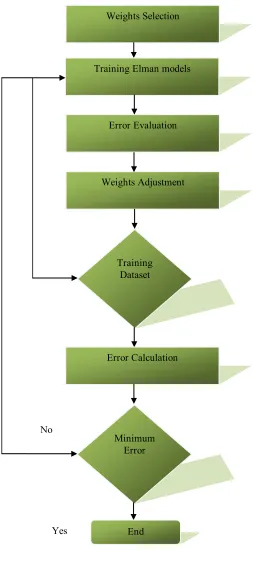
The Neural Network Toolbox under MATLAB software was used for developing the models. Training pattern of Elman models is presented in Fig.2.
Fig .2. Training pattern of Elman models Weights Selection
Error Evaluation
Weights Adjustment Training Elman models
Training Dataset
Error Calculation
Minimum Error
End No
ISSN: 1942-9703 / © 2012 IIJ
B. Measures for Prediction Performance
Mean Square Error (MSE) (1), Root Mean Square Error RMSE (2), Coefficient of Determination: R2 (3), and Nash -
Sutcliffo Coefficient: E2 (4) were used in order to compare the
prediction ability of the developed models.
2 1 exp N caln
Q
Q
MSE
(1)
2 1 exp exp1
N calQ
Q
Q
n
RMSE
(2)
21 exp2
exp
2
1
N calQ
Q
Q
R
(3)
21 exp exp
exp
2
1
N calQ
Q
Q
Q
E
(4) Where, expQ
= Observed value;cal
Q
= Predicted value;exp
Q
=Mean predicted value;n
= Number of observations in dataset.III. RESULTS AND DISCUSSION
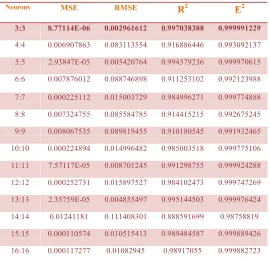
Elman model’s performance matrices concerning the single layer and multilayer models for predicting sensory scores based on equations 1, 2, 3 and 4 are presented in Table 1 and Table 2, respectively.
Table 1: Performance of single layer for predicting sensory score
Neurons MSE RMSE R2 E2
3 7.04669E-05 0.008394454 0.991605546 0.999929533 5 0.000176202 0.013274109 0.986725891 0.999823798 7 0.001911122 0.043716386 0.956283614 0.998088878 9 0.000191461 0.01383696 0.98616304 0.999808539 11 0.000227001 0.015066536 0.984933464 0.999772999 13 0.00022446 0.014981988 0.985018012 0.99977554 15 0.000428985 0.020711958 0.979288042 0.999571015 17 0.001079962 0.03286278 0.96713722 0.998920038 20 0.000437028 0.020905211 0.979094789 0.999562972 25 0.000491983 0.022180685 0.977819315 0.999508017
30 1.21846E-05 0.003490644 0.996509356 0.999987815
Table 2: Performance of multilayer for predicting sensory score
Neurons MSE RMSE R2 E2
3:3 8.77114E-06 0.002961612 0.997038388 0.999991229
4:4 0.006907863 0.083113554 0.916886446 0.993092137 5:5 2.93847E-05 0.005420764 0.994579236 0.999970615 6:6 0.007876012 0.088746898 0.911253102 0.992123988 7:7 0.000225112 0.015003729 0.984996271 0.999774888 8:8 0.007324755 0.085584785 0.914415215 0.992675245 9:9 0.008067535 0.089819455 0.910180545 0.991932465 10:10 0.000224894 0.014996482 0.985003518 0.999775106 11:11 7.57117E-05 0.008701245 0.991298755 0.999924288 12:12 0.000252731 0.015897527 0.984102473 0.999747269 13:13 2.35759E-05 0.004855497 0.995144503 0.999976424 14:14 0.01241181 0.111408301 0.888591699 0.98758819 15:15 0.000110574 0.010515413 0.989484587 0.999889426 16:16 0.000117277 0.01082945 0.98917055 0.999882723
The developed Elman ANN single and multilayer models showed that single layer model with 30 neurons performed the best (MSE: 1.21846E-05, RMSE: 0.003490644, R2:
0.996509356, E2: 0.999987815); while multilayer with 3:3 neurons (MSE: 8.77114E-06, RMSE: 0.002961612, R2:
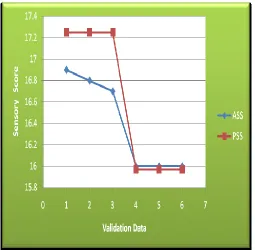
for predicting the shelf life. The comparison of Actual Sensory Score (ASS) and Predicted Sensory Score (PSS) for single layer and multilayer models are illustrated in Fig.3 and Fig.4, respectively.
Fig. 3. Comparison of ASS and PSS single layer model
Fig. 4. Comparison of ASS and PSS for multilayer model
Coefficient of determination (R2) was calculated based on the
total variation as explained by sensory scores. Period of
storage (days) for which the processed cheese has been in the shelf is illustrated in Fig.5.
Fig.5. Sensory score and period of storage for processed cheese
The shelf life is calculated by subtracting the obtained value of days from experimentally determined shelf life, which was found to be 29.31 days. The predicted value is quiet close to the experimentally obtained shelf life of 30 days suggesting that the developed model is quite effective in detecting the shelf life of processed cheese.
IV. CONCLUSION
Soluble nitrogen, pH, standard plate count, yeast & mould count, and spore count were taken as input variables, and sensory score as output variable for developing Elman models for predicting the shelf life of processed cheese stored at 30o
C. Mean square error, root mean square error), coefficient of determination and nash - sutcliffo coefficient were used in order to compare the prediction ability of the developed models. Bayesian regularization was selected for training Elman ANN models. Regression equations were developed for predicting the shelf life of processed cheese which gave 29.31 days shelf life vis-à-vis 30 days experimentally obtained shelf life. From the study it is concluded that the developed Elman models are very efficient for predicting the shelf life of processed cheese.
REFERENCES
[1] http://www.engineersgarage.com/articles/artificial-neural-networks (accessed on 11.1.2011).
[2] Sumit Goyal and G.K. Goyal “Advanced computing research on cascade single and double hidden layers for detecting shelf life of kalakand: an artificial neural network approach”. International Journal of
Computer Science & Emerging Technologies, vol. 2, no.5, pp. 292- 295,
ISSN: 1942-9703 / © 2012 IIJ [3] Sumit Goyal and G.K. Goyal “A new scientific approach of intelligent
artificial neural network engineering for predicting shelf life of milky white dessert jeweled with pistachio”. International Journal of Scientific and Engineering Research, vol. 2, no.9, pp. 1-4, 2011.
[4] Sumit Goyal and G.K. Goyal “Cascade and feedforward backpropagation artificial neural networks models for prediction of sensory quality of instant coffee flavoured sterilized drink”. Canadian Journal on Artificial Intelligence, Machine Learning and Pattern Recognition, vol. 2, no.6, pp.78-82, 2011.
[5] Sumit Goyal and G.K. Goyal “Application of artificial neural engineering and regression models for forecasting shelf life of instant coffee drink”.
International Journal of Computer Science Issues, vol.8, no.4, pp.320- 324, 2011.
[6] Sumit Goyal and G.K. Goyal “Development of intelligent computing expert system models for shelf life prediction of soft mouth melting milk cakes”. International Journal of Computer Applications, vol.25, no.9, pp. 41-44, 2011.
[7] Sumit Goyal and G.K. Goyal “Simulated neural network intelligent computing models for predicting shelf life of soft cakes”. Global Journal
of Computer Science and Technology, vol.11, no.14, Version1.0, pp.
29-33, 2011.
[8] Sumit Goyal and G.K. Goyal ” Radial basis artificial neural network computer engineering approach for predicting shelf life of brown milk cakes decorated with almonds”. International Journal of Latest Trends in
Computing, vol.2, no.3, pp.434-438, 2011.
Sumit Goyal is Senior Research Fellow at National Dairy Research Institute, Karnal (Haryana) India. He received Bachelor of Information Technology degree and Masters in Computer Applications from a central university of Government of India, New Delhi, India. He received his Master of Philosophy degree in computer science from Vinayak Missions University, Tamil Nadu, India. His research interests have been in the area of artificial neural networks and prediction of shelf life of food products. His research has appeared in Canadian Journal on Artificial Intelligence, Machine Learning and Pattern Recognition,
International Journal of Computer Applications,
International Journal of Computational Intelligence and Information Security, International Journal of Latest Trends in Computing, International Journal of Scientific and Engineering Research, International Journal of Computer Science Issues, International Journal of Computer Science & Emerging Technologies, Global
Journal of Computer Science and Technology, amongst
others. He is member of IDA.
Gyanendra Kumar Goyal is Emeritus Scientist at National Dairy Research Institute, Karnal, India. He received the B.S. degree and Ph.D. degree from Panjab University, Chandigarh, India. In the year 1985-86, he did specialization in Dairy and Food Packaging from School of Packaging, Michigan State University, USA; and in the year 1999 he specialized in Education Technology at Cornell University, New York, USA. His research interests include dairy & food packaging and shelf life determination of food products. He has published more than 150 research papers in national and international journals. His research work has been published
in Int. J. of Food Sci. Technol. and Nutrition, Nutrition and
Food Science, Milchwissenschaft, American Journal of Food Technology, British Food Journal, Canadian Journal on Artificial Intelligence, Machine Learning and Pattern
Recognition, International Journal of Computer
Applications, International Journal of Computational Intelligence and Information Security, International Journal of Latest Trends in Computing, International Journal of Scientific and Engineering Research, International Journal of Computer Science Issues, International Journal of Computer Science & Emerging Technologies, Global Journal of Computer Science and
Technology, amongst others. He is life member of IDA and