Asian Journal of Pharmaceutical Education and Research
Vol -4, Issue-1, January-March 2015
ISSN: 2278-7496
RESEARCH ARTICLE
Formulation and Evaluation of Self-microemulsifying drug delivery system of
Curcumin for enhanced solubility and dissolution
Asit R Sahu1*, Sunil B Bothara2
1
C.U.Shah College of Pharmacy & Research, Surendranagar, Gujarat, India
2
Shri Bhagwan College of Pharmacy, Aurangabad, Maharashtra, India
Abstract:
Curcumin is a poorly water-soluble drug and its oral
bioavailability is very low. A new self- microemulsifying
drug delivery system (SMEDDS) has been successfully
developed to improve the solubility and oral absorption of
curcumin. Suitable compositions of SMEDDS formulation
were screened via solubility studies of curcumin and
compatibility tests. Pseudoternary phase diagrams were used
to evaluate the micro emulsification existence area.
Formulation development and screening was done based on
results obtained from phase diagram and characteristics of
resultant microemulsion. The SMEDDS formulation showed
complete release in 10 min as compared with crude drug.
Key Words: Curcumin, Dissolution, SMEDDS, Solubility
Article Received on
26 November 2014
Accepted on
24 February 2015
*Correspondence for
Author:
Asit Ranjan Sahu
Department of Pharmaceutics C. U. Shah College of Pharmacy & Research, Surendranagar, Gujarat
AJPER January-March 2015, Vol 4, Issue 1 (48-59)
INTRODUCTION:
The fundamental step in the solubilisation of drug compounds is the selection of an
appropriate salt form, or for liquid dosage forms, adjustment of pH of the solution. This is an
especially important selection process for polar compounds as the majority of newer
solubilisation techniques such as nanosuspensions and microemulsions utilize co-solvents
when applied to a polar compound1. These technologies include both traditional methods
of solubility enhancement, such as particle size reduction via comminution, spray
drying, addition of surfactants, inclusion in cyclodextrin-drug complexes, and the use of more
novel mechanisms such as self- emulsifying systems, micronisation via nanoparticles, pH
adjustment and salting-in processes 2,3.
Microemulsions and self-emulsifying systems have emerged as potential solubility
enhancing technologies, whose solubilising and absorption promoting effect is thought to lay
in the reactivity of triglycerides and surfactants with the walls of the gastrointestinal
tract. Traditionally, long and medium-chain triglycerides (LCTs and MCTs,
respectively) have been employed with surfactants to incorporate drugs into self- emulsifying
systems4,5. Non-ionic surfactants, such as Tweens (polysorbates) and Labrafil
(polyoxyethylated oleic glycerides), with high hyrophile-lipophile balances (HLB) are often
used to ensure immediate formation of oil-in-water (o/w) droplets during production.
Amphiphilic, non-ionic surfactants allow higher degrees of drug solubilisation to occur
and may prevent the precipitation of drug out of the microemulsion in vivo.
Co-surfactants are frequently employed to increase the amount of drug capable of being
dissolved into the lipid base, because the concentration of surfactant in most
self-emulsifying systems is required to be in excess of 30 per cent w/w. These co-surfactants are
often organic solvents suitable for oral administration, such as ethanol, propylene
glycol and poly ethylene glycol. Similar to the impact of introducing organic solvents
elsewhere in drug product manufacture, the use of co- solvents increases processing
complexity while improving the potential drug load of the emulsion 6. Most self-
emulsifying systems are limited to administration in lipid-filled soft or hard-shelled gelatin
capsules due to the liquid nature of the product. Interaction between the capsule shell and
the emulsion should be considered so as to prevent the hydroscopic contents from
dehydrating or migrating into the capsule shell. Curcumin, a naturally active constituent
extracted from the plants of the Curcuma longa, its structure shown in Figure 1. Curcumin is the
AJPER January-March 2015, Vol 4, Issue 1 (48-59)
(Zingiberaceae). It has a variety of biological activities and pharmacological actions, such as
anti-tumor, anti-inflammatory, anti-virus, anti-oxidation and anti- HIV, and low toxicity with
promising clinical application 7 which have low oral bioavailability i.e. 40-85 percent of an oral
dose of Curcumin passes through the gastrointestinal tract unchanged, with most of the absorbed
flavonoid being metabolized in the intestinal mucosa and liver8. In present study
SMEDDS of curcumin was prepared for enhanced solubility and dissoloution of poorly soluble
drug.
MATERIAL AND METHODS:
Materials
Curcumin was received as a generous gift sample from Konark Herbals And Health Care,
Daman, Gujarat. Capmul MCM C-8 were gifted by ABITEC Corporation LTD., India.
Cremophore EL, Cremophore RH 40 were gifted by Sigma Aldrich PVT LTD. and Other
chemicals and reagents used were of analytical grade.
Solubility Studies
The solubility of curcumin in various oils, surfactants, co-surfactants and Oil; surfactant
mixture was measured using shake flask method 8 - 12. An excess amount of curcumin was
added into each vehicle followed by vortex mixing for 30 sec . Mixtures were shaken for
48 hr at 300 C in a thermostatically controlled shaking water bath, followed by equilibrium for
24 hr. Mixtures were then centrifuged at 3000 rpm for 10 min and the supernatant was filtered
through a Millipore membrane filter (0.45µ). Samples were suitably diluted with methanol and
drug concentration was obtained via UV validated method at 432 nm using hydro alcoholic
AJPER January-March 2015, Vol 4, Issue 1 (48-59)
solvent (Methanol: Distilled Water. 3:7) as a blank. The experiment was repeated in
triplicates. Results are represented as mean value (mg/ml) ± SEM.
Preliminary screening of surfactant
Different surfactants for the peroral use were screened for emulsification ability. Briefly, Excess
amount of drug in 5ml of selected oils (Soya bean oil, Paraffin oil, Peanut oil, Ethyl Oleate) was
taken in stopper vials and was then mixed by vortex mixer. The mixture vials were then kept at
37±2.0 0 C in an isothermal orbital shaker for 72 hr to reach equilibrium. The equilibrated
samples were removed from shaker and centrifuged at 5000 rpm for 15 min. The solubility
profile of drug in oil was determined from the supernatant using UV-VIS spectrophotometer at
432 nm. Insoluble drug from the settled material was determined and mass balance was then
found out. HLB value, drug solubility, biocompatibility and compatibility with drug are the
parameters evaluated in the selection of surfactant. Since the formulation to be developed was
o/w microemulsion, surfactants having HLB value ranges between 8 to15 were first screened
followed by drug solubility as described earlier. Various surfactants (Tween-60, Tween-80,
Cremophor EL, and Capmul MCM) were used for this study.
Along with drug compatibility, the main selection criterion for cosurfactant in the development
of microemulsion is its ability to form clear and stable formulation with relevant surfactant at a
minimum concentration. Cosurfactant is selected that is having no considerable interaction with
drug. Various cosurfactant (PEG 400, Iso-propyl Alcohol, Ethanol, Methanol) were used for this
study.
Phase diagram Study
In pseudotemary phase diagrams of curcumin based micro emulsion were prepared by CHEMIX
software. The systems consisting of Ethyl Oleate as oil, Capmul MCM as surfactant, and
PEG 400 as co-surfactant were titrated with water, and self-emulsifying formulations were
selected observing regions of infinite dilution.
Formulation of SMEDDS
A series of SMEDDS formulations were prepared using Capmul MCM and PEG 400 as the
Surfactant/cosurfactant combination and (Table 5). Briefly, accurately weighed curcumin was
AJPER January-March 2015, Vol 4, Issue 1 (48-59)
were mixed by gentle stirring and vortex mixing on a magnetic stirrer, until curcumin was
perfectly dissolved. The mixture was stored at room temperature until further use.
Evaluation of SMEDDS
Self Emulsification and Phase Separation:
Different compositions were categorized on speed of emulsification, clarity, and apparent
stability of the resultant emulsion 13, 14. Visual assessment was performed by drop wise addition
of the pre concentrate (SMEDDS) into 100, 250 and 1000 mL of distilled water, 0.1N HCl and
pH 6.8 phosphate buffer. This was done in a glass beaker at room temperature, and the contents
were gently stirred with glass rod. Precipitation was evaluated by visual inspection of the
resultant emulsion after 24 hours. The formulations were then categorized as clear
(transparent), nonclear (turbid), stable (no precipitation at the end of 24 hours), or unstable
(showing precipitation within 24 hours).
Droplet Size
Particle size of emulsion was determined by using dynamic light scattering technique by
Malvern zetasizer (NANO ZS) 8, 15. Samples were diluted to 50 times and 100 times with the
Distilled water for the measurement
Drug Content
The SMEDDS containing curcumin was measured using UV visible spectroscopic method. The
2 µg/ml of aliquot was prepared using microemulsion formulation using diluting solvent. The
samples were measured as 432 nm using UV-VIS spectroscopic method. 5,8 16.
In Vitro Dissolution
In vitro dissolution studies were carried out for all formulations using dissolution test apparatus
USP Type II, at 37±50C, 50 rpm paddle speed. The formulations were filled in a hard gelatin
capsule and introduced into dissolution medium. Aliquots were collected periodically and
replaced with fresh dissolution medium. Aliquots, after filtration through whatman filter paper
(No. 41), were analyzed spectrophotometrically at 432 nm for curcumin content. The data was
AJPER January-March 2015, Vol 4, Issue 1 (48-59) Stability Studies:
In order to evaluate the stability of the optimized SMEDDS the formulation was added into
sealed glass vials and the vials were subjected to stability studies at
400C±20C/75%±5% RH for a period of three months. Samples were charged in stability
chambers with humidity and temperature control. The samples were evaluated for clarity,
phase separation, Drug content and in vitro drug release at predetermined intervals20, 21.
RESULT AND DISCUSSION:
Solubility studies
Selection of right component is important prerequisite for formulation of stable SMEDDS.
The drug should have good solubility in components of microemulsion so as the
precipitation of drug during shelf life of formulation and after dilution in GI lumen can be
avoided. Therefore, the solubility of Curcumin was determined in various oils, surfactants
and cosurfactant mixtures. Among the various components studied Ethyl Oleate, Capmul
MCM, PEG 400 showed maximum solubility. The solubility results are showed in Table 1
& Table 2. As the solubility of curcumin was maximum in Ethyl Oleate, Capmul MCM,
PEG 400 these were selected as oil, surfactant and cosurfactant component for further
development of SMEDDS. Final selection among different components would
secondly be confirmed according to emulsification properties with other ingredients.
Regarding surfactants and co-surfactants selection, drug solubility would come second to
the main selection perspective: emulsification efficiency.
Table1: Solubility of Curcumin in various oils, , ,
Sr No. Oil Compatibility Solubility (mg/ml)
1 Soya bean oil + 0.142±0.018
2 Paraffin oil ++ 0.127±0.017
3 Peanut oil + +++ 0.257±0.026
4 Ethyl Oleate ++++ 0.368±0.035
Table 2: Solubility of Curcumin in various surfactants
Sr No. Surfactant Compatibility Solubility (mg/ml)
1 Tween-60 ++ 1.145±0.084
2 Tween-80 +++ 1.353±0.115
3 Cremophor EL ++ 1.447±0.168
AJPER January-March 2015, Vol 4, Issue 1 (48-59) Preliminary screening of surfactants
The surfactants were compared for their emulsification efficiencies using different oily
phases. It has been reported that well formulated SMEDDS is dispersed within seconds
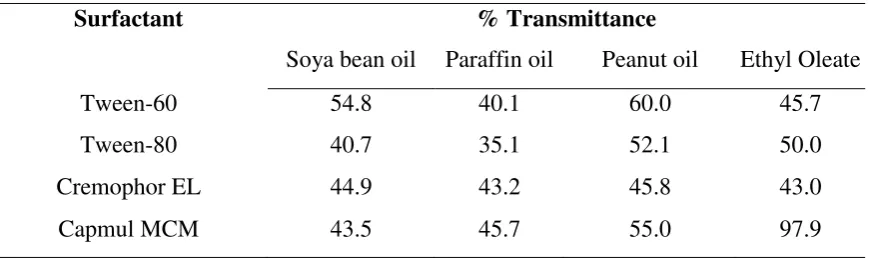
under gentle stirring conditions. Transmittance values of different mixtures are
demonstrated in Table 3. Results inferred that among all the surfactants employed the oily
phase Ethyl Oleate exhibited the highest emulsification efficiency with Capmul MCM
ranking first. It was observed that the solubility of Curcumin was found to be highest in
Ethyl Oleate as compared to other oils. This may be attributed to the polarity of the poorly
water soluble drugs that favor their solubilization in small / medium molecular volume oils
such as medium chain triglycerides or mono- or diglycerides. The solubility of Curcumin
was found to be highest in Capmul MCM as compared to other surfactant.
Table 3: Preliminary Screening of Surfactants
Surfactant % Transmittance
Soya bean oil Paraffin oil Peanut oil Ethyl Oleate
Tween-60 54.8 40.1 60.0 45.7
Tween-80 40.7 35.1 52.1 50.0
Cremophor EL 44.9 43.2 45.8 43.0
Capmul MCM 43.5 45.7 55.0 97.9
Preliminary screening of co-surfactants
The PEG 400 was selected and used as cosurfactant due to the fact that transient negative
interfacial tension and fluid interfacial film can only be achieved by the use of single
surfactant along with a cosurfactant. The presence of PEG 400 enhances the stability of the
formulation by reducing the interfacial tension and hence transparent formulation obtained.
Pseudoternary phase diagrams:
From the result it was observed that microemulsion existence zone was relatively more
profound with S mix 1:1 and 2:1. The result was given in Table 4. In figure 2 the ternary
graphs are shown. Figure 2 (B) and (D) show the maximum microemulsion zone. Both
ratios show stability upon infinite dilution with water. While the other ratios were become
AJPER January-March 2015, Vol 4, Issue 1 (48-59)
Figure 2: Pesudoternary phase diagrams (A) Smix=0.5:1 (B) Smix=1:1 (C) Smix=1.5:1 (D) Smix=2:1 (E) Smix=3:1
EVALUATION OF SMEDDS:
Self emulsification, phase separation study and Globule Size
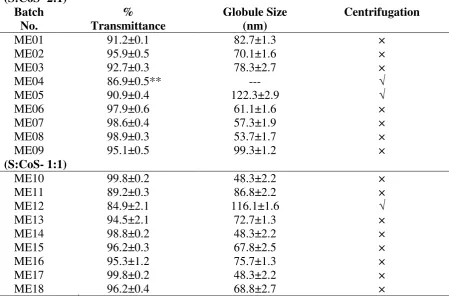
The concentration of oil, surfactant and co-surfactant was optimized by preparing different
batches of two selected Smix (2:1&1:1) and one optimized formulation from each ratio was
selected based on globule size, zeta potential, % transmittance and physical stability
(centrifugation) characterization. Results were given in Table 5.
Drug content
ME08 and ME17 were showing drug content 98.1% ±0.85 and 98.7%± 1.03 respectively.
Drug content of the developed formulation was found near to 100% showing the chemical
stability.
Centrifugation
As showed in figure 3 that no phase separation on centrifugation indicating physical
AJPER January-March 2015, Vol 4, Issue 1 (48-59)
Figure 3: Centrifugation study of ME08 and ME17
Table 5: Various SMEDDS formulation
(S:CoS- 2:1) Batch No. % Transmittance Globule Size (nm) Centrifugation
ME01 91.2±0.1 82.7±1.3 ×
ME02 95.9±0.5 70.1±1.6 ×
ME03 92.7±0.3 78.3±2.7 ×
ME04 86.9±0.5** --- √
ME05 90.9±0.4 122.3±2.9 √
ME06 97.9±0.6 61.1±1.6 ×
ME07 98.6±0.4 57.3±1.9 ×
ME08 98.9±0.3 53.7±1.7 ×
ME09 95.1±0.5 99.3±1.2 ×
(S:CoS- 1:1)
ME10 99.8±0.2 48.3±2.2 ×
ME11 89.2±0.3 86.8±2.2 ×
ME12 84.9±2.1 116.1±1.6 √
ME13 94.5±2.1 72.7±1.3 ×
ME14 98.8±0.2 48.3±2.2 ×
ME15 96.2±0.3 67.8±2.5 ×
ME16 95.3±1.2 75.7±1.3 ×
ME17 99.8±0.2 48.3±2.2 ×
ME18 96.2±0.4 68.8±2.7 ×
(** - Becomes hazy)(√- phase separation, ×- no phase separation)
In Vitro dissolution
Release of curcumin crud drug powder and SMEDDS was compared in figure 4. Curcumin
was released completely from SMEDDS at 10 minutes, where as the release percentage of
curcumin crud drug powder was limited to 41.22% within 60 minutes because of its
hydrophobic property. it could be suggested that curcumin dissolved perfectly in SMEDDS
form could be released because of small globular size which permits a faster rate of drug
release into aqueous phase, and it could affect the bioavailability.
Stability Studies
Samples of SMEDDS were charged on accelerated and long term stability conditions.
Chemical and visual observations of samples were done. No significant change in the
drug content in the formulations was observed over the period of 3 months at
accelerated and long term stability conditions. The drug release in both the mediums for all
AJPER January-March 2015, Vol 4, Issue 1 (48-59) Figure 4: Release percentage of curcumin SMEDDS and curcumin powder.
CONCLUSION:
An optimized curcumin loaded formulation consisting of Ethyl Oleate Capmul MCM, and
PEG 400 offers the advantage of good solubilization of Curcumin. Thus our studies
confirmed that SMEDDS can be used as a possible alternative to conventional oral
formulation of curcumin. Results further conclude that SMEDDS can be explored as a
potential drug carrier for dissolution enhancement of curcumin and other insoluble drugs.
ACKNOWLEDGEMENTS:
The authors wish to express their gratitude to Konark Herbals And Health Care, Daman,
Gujarat, ABITEC Corporation LTD., India Sigma Aldrich PVT LTD. and Gattefosse India
PVT LTD. for providing the gift sample for the research.
REFERENCES:
1. Pouton CW. Self-emulsifying drug delivery systems: assessment of the efficiency of
emulsification. Int. J. Pharm. 27: 335-348 (1985).
2. Singh A., Chaurasiya A., Singh M., Upadhyay S., Mukherjee R., and Khar R.,
ExemestaneLoaded Self-Microemulsifying Drug Delivery System (SMEDDS):
Development andOptimization AAPS PharmSciTech, Vol. 9, No. 2, (2008)628-634.
3. Robinson, J.R., 1996. Introduction: Semi-solid formulations for oral drug delivery. B.
T.Gattefosse. 89, 11-13.
4. Yuksel, N., Karatas, A., Ozkan, Y., Savaser, A., Ozkan, SA., Baykara, T., 2003. Enhanced
bioavailability of piroxicam using Gelucire 44/14 and labrasol: in vitro and in vivo
AJPER January-March 2015, Vol 4, Issue 1 (48-59)
5. Charman, S.A., Charman, W.N., Rogge, M.C., Wilson, T.D., Pouton,C.W., 1992.
Selfemulsifying drug delivery systems: formulation and biopharmaceutical evaluation of
aninvestigational lipophilic compound. Pharm Res. 9, 87-93.
6. Li, P., Ghosh, A., Wagner, R.F., Krill, S., Joshi, Y.M., Serajuddin, A.T.M.,2005. Effect
ofcombined use of nonionic surfactants on formation of oil in-water emulsions. Int. J.
Pharm. 288,27-34.
7. Jing Cui,Bo yu,Yu Zhao,Weiwei Zhu,Houli Li, Hongxiang Lou and Guangxi Zhai,
Enhancement of oral absorbtion of curcumin by self microemulsifying drug delivery
systems, DOI:10.1016/j.ijpharm.2008.12.009.
8. Patil, P., Joshi, P., Paradkar, A., 2004. Effect of formulation variables on preparation and
evaluation of gelled self-emulsifying drug delivery system (SEDDS) of ketoprofen. AAPS
PharmSciTech. 5(3), E 42.
9. Kanga,K.B. Lee,S.J .Chona, K.S. Jeong,Y.S., Yuk,H.S. Khanga,G, Development of
Selfmicroemulsifying drug delivery systems for oral bioavailability enhancement of
Simvastatin in Beagle Dogs Int.J.Pharm,(2004)274,6573
10.Subramanian, N., Ray, S., Ghosal, S., Bhandra, R., Moulik, S. P.,
Formulation design of Self-Microemulsifying drug delivery systems for improved oral
bioavailability of Celecoxib, Bio,Pharm, Bull., (2004) 27(12),1993-1999.
11.Bora, D., Borude,P.,Bhise, K.,Formulation and evaluation of self emulsifying drug delivery
system of low solubuility drug for enhanced solubility and dissolution,Asian journal of
biomedical and Pharmaceutical Sciences.,2(15),(2012),7-14.
12.Wei Wu, Yang Wang, Li Que Enhanced bioavailability of silymarin by
selfmicroemulsifying drug delivery system, European Journal of Pharmaceutics and
Biopharmaceutics 63 (2006) 288–294
13.Eman A., Albert AB, Formulation and in vitro and in vivocharacterization of a
phenytoin self-emulsifying drug delivery system(SEDDS), European journal of
pharmaceutical sciences 35 (2008) 257–263
14.Kim, J. Y., Young, S. K.,(2000), Enhanced absorption of Indomethacin after oral or rectal
administration of Self emulsifying system containing Indomethacin torats, Int.J.Pharm,194,
81- 89.
15.Grove, M., Mullertz, A., Nielsen, J. L and Pedersen, G. P., (2006), Bioavailability of
seocalcitol II: Development and characterization of self microemulsifying drug delivery
systems (SMEDDS) for oral administration containing medium and long chain
AJPER January-March 2015, Vol 4, Issue 1 (48-59)
16.Nazzal, S., Nutan, M., Palamakula, A., Shah, R., Zaghloul, A.A., Khan,M.A., 2002.
Optimization of self-nanoemulsified tablet dosage form of ubiquinone using response
surface methodology: effect of formulation ingredients. Int. J. Pharm. 240, 103-114.
17.Pouton, C.W., Charman, W.N., 1997. The potential of oily formulations for drug
delivery to the gastro-intestinal tract. Adv. Drug Del. Rev. 25, 1-2.
18.Yu, X. L., wang, T.J., Hussain, S.A., (2002), Evaluation of USP apparatus 3 for
dissolution testing of immediate release products, AAPS Pharmsci., article 4(1).
19.Odeberg, J. M., Kaufmann, P., Kroon, K.G., and Hoglund P., (2003),Lipid drug delivery
and rational formulation design for Lipophilic drugs with low oral bioavailability, applied
to Cyclosporine, Eur. J.Pharm.Sci,20, 375-382.
20.Patel A. and Vavia P. , Preparation and In Vivo Evaluation of SMEDDS (Self -
Microemulsifying Drug Delivery System) Containing Fenofibrate, The AAPS
Journal 2007; 9(3) Article 41.
21.Jing C., Bo Y., Yu Z., Weiwei Z., Houli L., Hongxiang L., Guangxi Z., Enhancement of
oralabsorption of curcumin by self microemulsifying drug delivery systems, Int.J.Pharm,