International Journal of Science Technology
Management and Research
Available online at: www.ijstmr.com
IJSTMR
©
2018 | All Rights Reserved 9Design And Development Of Integrated
Disaster Management System
Mrunalee Deore
Department of Computer Engineering NDMVP’S KBTCOE,Nashik, India Priya Patil
Department of Computer Engineering NDMVP’S KBTCOE,Nashik, India
Snehal mogal
Department of Computer Engineering NDMVP’S KBTCOE,Nashik, India Nikita Thete
Department of Computer Engineering NDMVP’S KBTCOE,Nashik, India
Abstract-: To monitor physical environmental conditions, wireless sensor network is very effective distributed sensors in independent manner. The Internet of things (IOT) is the network of computed physical objects which enables these things to connect, collect and exchange data. In this paper , we propose an earthquake early warning system and in this system we use IOT in Wsn. Due to earthquake number of changes occur in environmental condition. It damage the human life, property as well as many geo hazards with the major type of landslide which should bring continuous threats to the affected region. For the security concern of all and to overcome the hazards of earthquake, we Proposed system with multiple disaster detection system which will help users to be prepared against earthquake, cloud burst and landslide. We had also plan to add summarization techniques based on disaster news.
Keywords: Embedded System, Raspberry Pi3, IoT, Ontology.
I. INTRODUCTION
Natural disaster being one of the most devastating disasters from the ancient history of mankind. Whole civilizations have being vanished because of natural disasters like earthquake, tsunami, volcanic eruptions, land slide, cloudburst etc. This is a genuine attempt to help our society to live free without being under burden of life threat because some spontaneous event, like natural disaster. So there is an urgent need of the heavy rain/snowfall alarming system so that the valuable human life and property can be saved in advance. However there are number of sites which displayed weather forecast but they never send any intelligent alert to the people of particular region.
For cloudburst by doing geotropically survey we are implementing semantic duck structures. Making three holes to that duck structure. when there is normal rain then water will flow out of that holes, and when there is cloudburst (an extreme amount of water) then that holes will get blocked and this change will be sense by that sensor then this will indicate something has happened in upward area. Ultrasonic sensor will be used for the same.
For earthquake we will mount meas sensor in the mud in our prototype. In the actual scenario means sensor will be placed.7km down to the earth near tactonic plates. When earthquake is going to happen that plates will hit to one another and this hitting will be sensed by that meas sensor this will indicate that earthquake is going to occurred and our disaster system will work accordingly.
IJSTMR
©
2018 | All Rights Reserved 10 A. Wireless Sensor NetworkWireless Sensor Network can be used to monitor the condition of civil infrastructure and related physical processes closed to real time. WSN is similar to Wireless ad-hoc network in the sense that they rely on wireless connectivity and spontaneous formation of networks so that sensor data can be transported wirelessly.
B. Cloud Server
A cloud server is a logical server that built, hosted and delivered through a cloud computing platform over the internet. There are two types of cloud server: physical and logical. A cloud server is considered to be logical when it is delivered through server virtualization and physical server is logically distributed into two or more logical server. In our system cloud server send sense data to the registered user.
II. RELATED WORK
The core type of data driven IOT system used for environment disaster risk mainly for tsunami. It helps prevent loss of life and reduces economic and material impact of disaster monitoring and warning by means of relevant parameters used for forecasts to generate accurate and timely warning. In the coastal regions the system is deployed, this sensor data is then transmitted upstream to either an onsite or remote, data processing centre, or to both when federated. These data centers run the downstream routine operational event detection. The techniques include are GIS (geographical information system) to capture, store, analyze and support for information alerts. It was deployed for tsunami detection and IOT for accurate and timely warning and dissemination and communication of risk information and warning to those at risk [1]. An overview of the development of technology based on the IOT, WSN and gaining significant importance in communication. Next the IOT end to end architecture is designed and evolved in this paper. The flow begins from the wireless sensor devices where the sensors are placed and formed a network with the main gateway in that network and the communication protocol is initiated to facilitate. Then the second flow is the data connectivity where the Ethernet is commonly deployed for the communication purpose where the big data analytics are undergoing and finally the flow ends up in the management protocol, hereby the smart phones and the other electronic communication devices are hit by the communicated information. Hereby the architecture and the protocols are being explained in this paper [2].
III. PROPOSED FRAMEWORK
Integrated Disaster management System is proposed for human well-fare and safe lifestyle. This System Save valuable human life and property in advance. The architecture of our system shown in following figure.
Year Paper Title Author Description Limitation
2014,IEEE An Empirical study of Ontology- Based Multi-Document Summa- rizationin Disaster
Management
Lei Li, Tao Li Extract highly salient sentences into the summary based on syntactic or statistical features.
MEAD[1]is an implementation of the centroid based method in which the sentence scores are computed basedon sentence-level and inter-sentence features.
2016,IEEE Design of Disaster Management System using IoT Based Interconnecd Network with Smart City Monitoring
Prabodh Sakhardande, Sumeet Hanagal, Savita Kulkarni
In this paper a system of interconnectd smart modules is developed
IJSTMR
©
2018 | All Rights Reserved 11 Fig. 1: Block Diagram of Disaster Management SystemIV. MATHEMATICAL MODEL
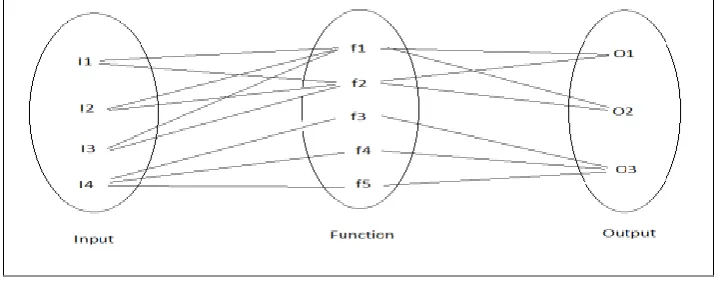
Where, S=proposed system of bridge monitoring S = {I, F, O}
I=set of inputs I={I1,I2,I3,I4}
I1: Threshold value of cloudburst I2: Threshold value of earthquake I3: Threshold value of landslide I4: Data mining query
F=set of functions F={f1,f2,f3,f4,f5}
f1: Reorganization of disaster f2: Detection of sensor f3: Insertion of query f4: Selection of data f5: Data search O=set of outputs O={O1,O2,O3} O1: Message display
O2: Buzzer O3: Output to query
IJSTMR
©
2018 | All Rights Reserved 12V. ALGORITHM SOLUTION
A. Conflation Algorithm steps:
1.open and read each input file and create a single index file. 2.remove or filter out all stop words .
3.remove all suffixes/affixes from each word if present. 4.count frequencies of occurrences for each root word from 3.
5.apply porters rules/algorithm for each root word from 3 and store in index file
B. Clustering Algorithm
1.Randomly select ‘c’ cluster centers.
2. Calculate the distance between each data point and cluster centers.
3. Assign the data point to the cluster center whose distance from the cluster center is minimum of all the cluster centers..
4. Recalculate the new cluster center using:
5. Recalculate the distance between each data point and new obtained cluster centers. 6. If no data point was reassigned then stop, otherwise repeat from step 3.
C. Step Sequence Algorithm
Cases: 1.Cloudburst:
if(a==val) show message a; if(b==val) show message b; if(c==val) show message c; else
normal situation; 2.Landslide:
if(lasser_bim!=initial mirror) show message alert;
3.Earthquake:
if there is vibration; then
show alert message;
VI. EXPECTEDRESULT
With the help of methods and algorithm mentioned in proposed system, we are developing Integrated Disaster Management System. Different expected that come for development process are as follows:
1.Recognition of Disaster. 2.Detection of Sensor. 3.Selection of data .
CONCLUSION
In our proposed system, disaster alarming system is presented. The pro-posed system is created with the use of different sensors, Raspberry Pi as controller and Cloud for storing the data from Raspberry Pi and sending the command to raspberry-pi for detecting disaster. The generated data can be viewed using web interface. The advantage of the system is to provide the immediate message alarming of the naturally occurring disaster to each worshipper, user, and others. The proposed model can be implemented as a part of the smart city.
IJSTMR
©
2018 | All Rights Reserved 13 REFERENCE1. Poslad S, Middleton S.E., Chaves F., Ran Tao Necmioglu O and Bugel U., “A Semantic IOT Early Warning System for Natural Environment Crisis Management”, IEEE Transaction on Emerging in Computing, vol. 3, Issue 6, pp. 246-257, 2015. 2. Zhengguo Sheng, Mahapatra C, Chunsheng Zhu and Leung VCM, “Recent Advances in Industrial Wireless Sensor
Networks toward Efficient Management in IoT”, IEEE access, vol. 3, pp. 622-637, 2015.
3. Federal Emergency Management Agency FEMA, US Department of Homeland Security, USA. IEEE pp: 978-1-5090, 2016. 4. D. Radev, H. Jing, M. Sty, and D. Tam, Centroid-based summarization of multiple documents, Inf. Process. Manage., vol.
40, no. 6. IEEE pp.919938, 2004.
5. V. Nastase, “Topic-driven multi-document summarization with encyclopedic knowledge and spreading activation,” in Proc. EMNLP, 2008,pp. 763–772.
6. C. Lee, Z. Jian, and L. Huang, “A fuzzy ontology and its application to news summarization,” IEEE Trans. Syst., Man, Cybern., B Cybern.,vol. 35, no. 5, pp. 859–880, Oct. 2005.