w w w . a a s s j o u r n a l . c o m ISSN (Online): 2322 – 4479 ISSN (Print): 2476–4981
Original Article
www.AESAsport.com Received: 17/04/2018 Accepted: 07/09/2018
The Effects of Neurofeedback, Yoga Interventions on
Memory and Cognitive Activity in Children with Attention
Deficit/Hyperactivity Disorder:
A Randomized Controlled Trial
1
Meysam Rezaei
*,
1Tayebe Salarpor Kamarzard,
2Mahdi Najafian Razavi,
1Department of Physical Education and Sport Sciences, Mashhad Branch, Islamic Azad University, Mashhad, Iran. 2Department of Physical Education and Sport Sciences, Fariman Branch, Islamic Azad University, Fariman, Iran.
ABSTRACT
Background. Neuro-feedback (NFB) and physical activities are considered alternative treatments for children with ADHD that aims to optimize brain activity. Assessments of the behavioral efficacy of NF and physical interventions have produced inconsistent results. Like physical activity, yoga has been argued to be beneficial for improvement of neurological and physiological activity and behavior in a range of populations. Objectives. The present randomized controlled trial (RCT) evaluates effects of NFB and yoga exercise intervention on sustained attention in children with ADHD. Methods. Using a multicenter three-way parallel group RCT design, children with ADHD, aged 7–11, were randomly assigned to NFB (n = 7), yoga (n = 7) or control (n = 7) over a period of 8 weeks. NFB training consisted of 24 sessions of theta/beta training at Cz and Yoga exercise training composed of 24 sessions of 45 minutes over 8 weeks. Sustained attention and memory were assessed using parameters derived from the Continuous Performance Test (CPT) Wechsler Intelligence Scale for Children-Revised (WISC-R). Results. Significant improvements in sustain attention and memory were observed over time in both Yoga and NFB compare to control group. To our knowledge, this is the first study that simultaneously evaluates NFB with Yoga treatment. Conclusion. These findings suggest that alternative therapies such as yoga exercises and NFB can be complementary to behavioral interventions for children with attention problem. Hence, the findings do not support NFB and yoga training applied as a stand-alone treatment in children with ADHD.
KEY WORDS: ADHD, Neurofeedback, Sustained Attention, Yoga Intervention.
INTRODUCTION
Attention-Deficit Hyperactivity Disorder (ADHD) is a neurobiological condition, which majorly occurs in schoolchildren and averagely involves5 to 8% of children, out of which, 60% show sustainable symptoms of the disorder until adulthood. In other words, only 4% of adults suffer from the disorder (1, 2). Of the problems related to this disorder, abandoning assigned
duties, lack of perseverance and lack of concentration can be mentioned. These problems ultimately lead to educational problems, weak social skills and family crises (3). Due to the causes of this disorder, different hypotheses as well as many studies have been conducted and each has investigated one or several factors based on their idea. Brain dopaminergic pathways hypo
function, disruption of cortical and sub cortical brain networks, disorders of the dopaminergic and noradrenergic system, inheritance, puberty crisis, increased frequency in the forehead and frontal cortex can be mentioned as such factors (4). Based on conducted studies, in 92% of hyperactive children with attention-deficit, there is 3 times more beta waves than theta as compared to normal children (2).
Of the common treatments, the use of stimulants for the children is recommended. Although, these medicines reduce the symptoms of hyperactivity syndrome, their long term use has side effects of sleeping disorders, headache, loss of appetite, digestive problems, allergy and disorder in spiritual moods of children (5-7).
Neuro-feedback is one of non-medical treatment methods, and its effectiveness in improving similar and comparable symptoms to stimulants in hyperactive children has been reported in related studies. The treatment approach of neuro-feedback is one of those approaches that have been noticed in the recent decades. Training neuro-feedback is a kind of learning strategy that enablesone to change his/her brain waves. When the related information to brain waves is accessible to persons, they learn and change them. This approach is like an exercise to the brain. The studies indicate the effect of increasing beta wave, inhibiting high theta waves and low alpha on attention improvement (8). Increase in theta wave and reduction in the activity of beta wave in resting mood as well as during activities requiring attention are observed in the children with ADHD (9).
Neuro-feedback training has been discussed as an appropriate alternative for medical treatment, which is capable of reducing the symptoms of behavioral problems and improving cognitive variables (10). Based on conducted studies, neuro-feedback is an appropriate treatment method for reducing the rate of attention deficit disorder and hyperactivity and concentration improvement in these children (8, 11). The aim of using neuro-feedback is to make the brain activity reach desired range. This process is created by providing visual and auditory feedback from electroencephalogram activity. This method seems to be used to improve cognitive nervous function and ultimately behavioral functions (12).
As mentioned earlier, children with hyperactivity syndrome have higher theta wave level as well as lower beta wave than normal children (13). Treatment protocol which is used for hyperactive children using neuro-feedback is usually concentrated on reducing the activity of theta wave and increasing the activity of beta wave (10, 11).
Moreover, physical exercise is one of the new methods, recommended to improve brain performance for treating and helping hyperactive children. Although, the effectiveness and affectability of using physical activities for hyperactive children is still under investigation and experimentation, most review studies in this case have confirmed the effectiveness of these treatment methods in children. On this basis, physical activity can be considered as a low risk treatment to improve hyperactivity symptoms and according to studies carried out, physical exercise can improve indexes such as the speed of responding, impulse control, alertness and control of mental moods in hyperactive people (14). Additionally, physical readiness may be also related to the level of brain activity and the ability to inhibit inappropriate impulses, improve the ability to change between duties and increase the capability of creating response in children. The mechanism of physical activity impact on hyperactive children seems to be created because of brain structure change, improvement of brain chemical transferors and adjustment of the level of arousal (15-19).
Confirming the concept of this question, the next step is to determine the best model of physical activity to achieve the best ideal response in the field of cognitive functions, to reduce hyperactivity symptoms.
Yoga is another non-medical treatment intervention which can improve mental, physical and cognitive activities in the form of physical activity. As a treatment, yoga, with different components such as different asana, pranayama practices and meditation techniques, can be particularly influential in improving cognitive indicators such as controlling anxiety, depression, executive functions, attention, intelligence, concentration and memory (20-26).
Based on the reports of studies conducted in the field of yoga effectiveness in improvement of hyperactive children, yoga can improve and
increase the activity level of waves with slow frequency (27). It can also affect the increase of brain secretion factors such as dopamine, serotonin and reduced levels of cortisol (28). Other studies have considered the effectiveness of yoga in relation to the reduction of the activity of
sympathetic system and increase of
parasympathetic activity and following that, balance between the body structures, increase of self-regulatory and excitations (29).
Now, given the relatively high prevalence of ADHD which has been reported by American Psychiatric Association (5%) and in Iran (5.8%) and also the type of attention-deficit which is about 3.2% among school children, as well as the effect of malfunction of these children on mental health of the family and education place and parents’ tendency to use low risk treatment methods, using new treatments is inevitable, thus, conducting study in this case seems necessary. Based on researcher’s investigation on existing national and international research resources, no study has investigated the treatment approaches of training neuro-feedback and yoga exercises in ADHD children; thus, this study was conducted with the aim to compare the effect of treatment approaches of training neuro-feedback and yoga exercises on ADHD children.
MATERIALS AND METHODS
The methodology of the current study is quasi-experimental with pretest and posttest using control and experimental groups. The statistical population of this study includes students with ADHD disorder symptoms who are studying in primary schools of Mashhad, among which, girls and boys7-11 years of age who were suspected of having ADHD were screened. After screening, based on diagnosis forms of ADHD (the adopted form based on ADHD symptoms from DSM-5 and Parents’ form of Connors), observing the behavior (naturally without structure) and interviewing the intended parents and children, the qualified children who had normal IQ of 80-119 based on the Wechsler Intelligence Measurement Scale were chosen. After screening the patients in terms of the severity of symptoms and equalizing the dosage of medicines based on expertise physician, 21 students were selected as statistical sample and randomly classified into three sample groups of neuro-feedback, yoga
exercise and control group. All the participants in this study took pretest and posttest based on continuous performance tests and micro tests of attention (driven to distraction) WISC-R (mathematics, digit memory, coding), and the parents and patients of each research group were treated as the group intended approach.
Measurements
1- Continues Performance Test (CPT) Continues Performance Test: This test was prepared in 1965 by Ruz et al. to measure alertness process. It measures sustainable attention and impulse control or impulsivity. Various forms were prepared and used for different medical and research goals. In all the forms, the participant should concentrate on a relatively simple visual or audible stimulants and respond by pressing a key when target stimulant emerges. There were 150 Persian digits or images as stimulants in this study, among which 30 movements were considered as target stimulant. The duration of representing each stimulant is 200 ms and the interval of two stimulants is 1s. The duration of executing training with practice phase is 200 s. Scoring was based on the number of correct responses(Correct Detection), reaction time and two types of error (commission and omission error). In this test, the participant should sit in front of a monitor and react to the target digit or word, determined by therapist, by pressing a key of keyboard.
2- Wechsler Intelligence Scale for Children-Revised )
This scale has 12 micro tests of 6 verbal tests and 6 performance tests. 2 micro tests are for storage. The three following micro tests were used in the current study:
1- Arithmetic micro test: This micro test requires concentration as well as basic skills of mathematics and the ability to use this skill. Low scores might be due to attention and concentration weakness.
2- Letter – number sequencing micro test: It is considered as recalling the digits of a short-term memory and attention test and the participant should respectively remember and repeat the audio information. In this micro test, the person should carefully listen to the information, requiring attention and encoding. Those who are easily distracted, have problem in this phase. This micro test consists of direct and reverse digits sections.
3- Coding micro test: This micro test requires learning non-familiar tasks, the accuracy of eye and hand coordination in skills, the ability of attention continuity and short-term memory.
Practice interventions Neuro-feedback intervention:
Dual-channel pro camp device, made in Canada, and biography software were used in the neuro-feedback approach. The initial evaluation in neuro-feedback approach was conducted according to base lines of 4 activities (with open eye, closed eye, sensory accuracy and cognitive sensitivity) based on global 1020 system and on the site of CZ for each participant. The duration of each section of this intervention was 2 min and 10 s and each session of treatment was conducted as unipolar for 45 min and with one-way and two-way practices on site FCZ. Neuro-feedback intervention I: this study was determined for 24 sessions during 8 weeks and each session for 45 min. The interval of each practice was regarded as 30 to 60 s. The participant’s success in receiving score in each time could be seen on the monitor and successful practice progress could be perceived in any moment for the persons (30, 31).
Yoga intervention
In the section of yoga practices, the practices related to meditation, relaxing of body and mind, deep breathing with regular exhales, playing and imitating animals and mental imagination, were executed. These practices were designed for the people of 4-12-year-old, which consists of classification of common and useful groups in Education System. In yoga intervention, each participants trained in three sessions a week and totally, for 24 sessions of 45 min. In yoga practices, there were 5 to 6 min of resting and muscular relaxation, 2 to 3 min of deep breathing with regular exhales, 5 min of meditation, 20 min of yoga exercises and finally, 5 min of speaking about the effect of practices on daily life, to increase the rate of children’s perception and understanding.
RESULTS
The number of individuals in the
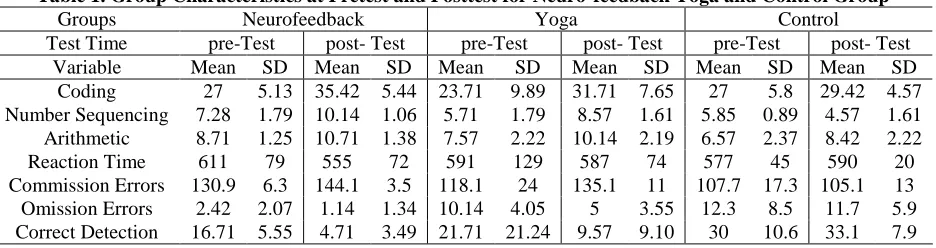
experimental (neuro-feedback training and yoga practices) and control groups is7. Descriptive information related to mean, standard deviation and experimental groups in pretest and posttest is presented in Table 1.
Table 1. Group Characteristics at Pretest and Posttest for Neuro-feedback Yoga and Control Group
Groups Neurofeedback Yoga Control
Test Time pre-Test post- Test pre-Test post- Test pre-Test post- Test Variable Mean SD Mean SD Mean SD Mean SD Mean SD Mean SD
Coding 27 5.13 35.42 5.44 23.71 9.89 31.71 7.65 27 5.8 29.42 4.57 Number Sequencing 7.28 1.79 10.14 1.06 5.71 1.79 8.57 1.61 5.85 0.89 4.57 1.61 Arithmetic 8.71 1.25 10.71 1.38 7.57 2.22 10.14 2.19 6.57 2.37 8.42 2.22 Reaction Time 611 79 555 72 591 129 587 74 577 45 590 20 Commission Errors 130.9 6.3 144.1 3.5 118.1 24 135.1 11 107.7 17.3 105.1 13 Omission Errors 2.42 2.07 1.14 1.34 10.14 4.05 5 3.55 12.3 8.5 11.7 5.9 Correct Detection 16.71 5.55 4.71 3.49 21.71 21.24 9.57 9.10 30 10.6 33.1 7.9
Based on the comparison between the mean of scores of pretest and posttest, the results show that in the variable, respond error, the mean of the control group in the pretest is 30 and in posttest, it is 33.14; in the neuro-feedback group, the mean score of pretest is 16.71 and posttest, it is 4.71; in the yoga group, the mean of pretest scores is 21.71 and posttest is 9.57. In the variable, omission response, the mean of the control group in the pretest is 12.28 and in the posttest, it is 11.71, in the neuro-feedback group, the mean scores of pretest is 2.43 and in the posttest, it is 1.14; in the
yoga group, the mean of pretest scores is 10.14 and posttest is 5. In the variable, correct answer, the mean of the control group in the pretest is 107.71 and in the posttest, it is 105.14; in the neuro-feedback group, the mean score of pretest is 130.85 and in the posttest, it is 144.14, and in yoga group, the mean of pretest scores is 118.14 and in the posttest, it is 135.43. In the variable, response time, the mean of control group in the pretest is 577.27 and in the posttest, it is 589.71; in neuro-feedback group, the mean score of pretest is 611.28 and in the posttest, it is 555.43; in the yoga group, the
mean of pretest score is 591 and 587 in the posttest. In the variable, mathematics, the mean of the control group in the pretest is 6.57 and in the posttest, it is 8.43; in neuro-feedback group, the mean score of pretest is 8.71 and posttest is 10.71; in the yoga group, the mean of pretest score is 7.57 and posttest is 10.14. In the variable, digit memory, the mean of control group in the pretest is 5.85 and in the posttest, it is 4.57; in the neuro-feedback group, the mean score of pretest is 7.28 and posttest is 10.14; in the yoga group, the mean of pretest scores is 5.71 and posttest is 8.57. In the variable, coding, the mean of control group in the pretest is 27 and in the posttest, it is 29.43; in the neuro-feedback group, the mean scores of pretest is 27 and posttest is 35.43; in the yoga group, the mean of pretest scores is 23.71 and posttest is 31.71.
Based on the results of covariance analysis, therapeutic approach of neuro-feedback showed
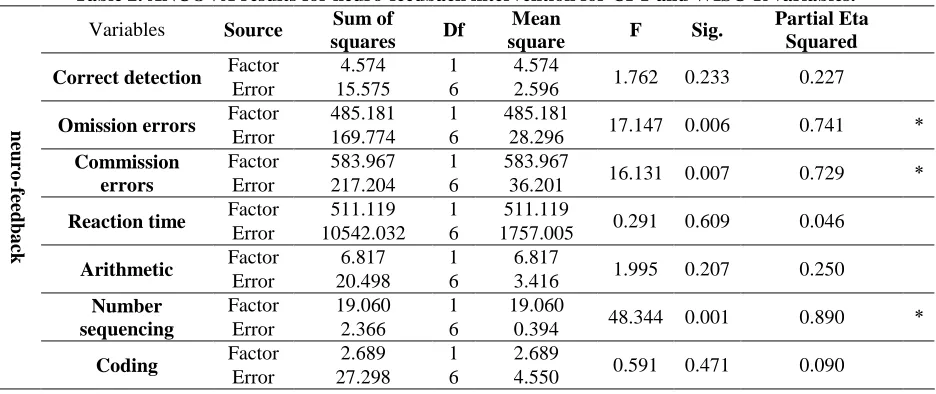
significant effect on attention variables of ADHD children in comparison between the pretest and posttest with the control group (P=0.00 and F=40.484). Now to show whether neuro-feedback treatment has effect on the variables of this study, univariate analysis was used.
Given the results in Table 2, univariate analysis showed that neuro-feedback treatment as compared to control group significantly affected the variables, omission response (P=0.006 and F=17.147), correct response (P=0.007 and F=16.131) and digit memory (P=0.00 and F=48.344) but in the variables, response error (P=0.233 and F=1.762), response time (P=0.609 and F= 0.291), mathematics (P=0.207 and F=1.995) and coding (P=0.471 and F=0.591), there was no significant difference between neuro-feedback treatment and control groups.
Table 2. ANCOVA results for neuro-feedback intervention for CPT and WISC-R variables.
neuro
-f
ee
db
a
ck
Variables Source Sum of
squares Df
Mean
square F Sig.
Partial Eta Squared
Correct detection Factor 4.574 1 4.574 1.762 0.233 0.227
Error 15.575 6 2.596
Omission errors Factor 485.181 1 485.181 17.147 0.006 0.741 *
Error 169.774 6 28.296 Commission
errors
Factor 583.967 1 583.967
16.131 0.007 0.729 *
Error 217.204 6 36.201
Reaction time Factor 511.119 1 511.119 0.291 0.609 0.046
Error 10542.032 6 1757.005
Arithmetic Factor 6.817 1 6.817 1.995 0.207 0.250
Error 20.498 6 3.416
Number sequencing
Factor 19.060 1 19.060
48.344 0.001 0.890 *
Error 2.366 6 0.394
Coding Factor 2.689 1 2.689 0.591 0.471 0.090
Error 27.298 6 4.550
Given the results in Table 3, univariate analysis showed the significant effect of yoga intervention as compared to attention variables of ADHD children in comparison between pretest and posttest with the control group (P=0.009 and F=4.28). The results of univariate analysis showed that there was a significant effect between pretest and posttest of the yoga group as compared to the control group in the variables, response error (P=0.001 and F=43.321), response omission (P=0.008 and F=15.523), correct response (P=0.00 and F=47.693), digit memory
(P=0.004 and F=0.059) and coding (P=0.015 and F=11.238) but in the variables, response time (P=0.816 and F=0.059) and mathematics (P=0.252 and F=1.609), there was no significant difference between yoga exercise and control groups.
Now, given the significant difference between neuro-feedback approach and yoga exercise in pretest and posttest with control group, the effect of each of the study variables was compared using Shidak follow up test.
Table 3. ANCOVA results for Yoga intervention for CPT and WISC-R variables.
yoga
Variables Source Sum of
squares df
Mean
square F Sig.
Partial Eta Squared
Correct detection Factor 1378.296 1 1378.296 43.321 0.001 0.878 * Error 190.897 6 31.816
Omission errors Factor 71.071 1 71.071 15.523 0.008 0.722 *
Error 26.471 6 4.579
Commission errors
Factor 2075.326 1 2075.326
47.693 0.001 0.888 *
Error 281.084 6 42.514
Reaction time Factor 161.711 1 161.711 0.059 0.816 0.010
Error 16348.302 6 2724.717
Arithmetic Factor 5.728 1 5.728 1.609 0.252 0.211
Error 21.367 6 3.561
Number sequencing
Factor 50.119 1 50.119
0.267 0.004 0.772 *
Error 14.838 6 2.473
Coding Factor 55.726 1 55.726 11.238 0.015 0.652 *
Error 29.774 6 4.962
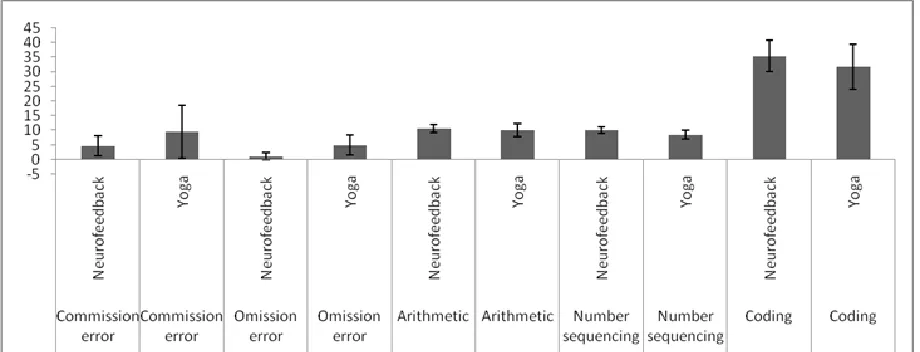
From diagrams 1 and 2, it can be concluded that there is a statistically significant difference between the mean of scores of response error of the neuro-feedback training and yoga exercises groups (P=0.008); thus, the therapeutic approach of neuro-feedback is more efficient than yoga exercises in reducing the response
error. There is also a statistically significant difference between the mean of scores of correct responses of neuro-feedback training and yoga exercises (P=0.007); thus, therapeutic approach of the neuro-feedback is more efficient than yoga exercises in increasing correct response.
Diagram 1. The results of Shidak follow up test for comparison Effectiveness of Yoga and Neuro-feedback
intervention.
DISCUSSION
The current study investigated the
effectiveness of each variable in neuro-feedback and yoga physical intervention alone and compared the effect of each on attention factors of children. Based on existing literature in this field, neuro-feedback is the only method
comparable with medical treatment in curing and reducing symptoms of hyperactivity. The most important problem of hyperactive children is attention deficit and in the current study, the
improvement of attention function and
sustainable attention has-been shown in the form of CPT and Wechsler performance tests.
One of the strength of this study among studies conducted in the field of physical activity and neuro-feedback, is the use of accurate tools with high validity to determine the effectiveness of interventions in participant as compared to the use of questionnaires in previous studies, filled by parents and teachers, use of sensitive screening indicators in the field of determining the level of children’s hyperactivity before entering the study,
equalizing participants’ IQ, use of a profoundly
standard protocol for neuro-feedback
interventions and considering 24 sessions for the treatment and finally, creating the condition of comparison between yoga and neuro-feedback interventions; it can be mentioned that a similar case has not been observed given the searches of the researcher in national and international literature.
Diagram 2. The results of Shidak follow up test for comparison Effectiveness of Yoga and Neuro-feedback
intervention.
According to the findings of this study, the use of neuro-feedback interventions with theta-beta protocol is effective in improving the processes of sustainable attention, short term memory and the ability for attention continuity (micro test of Arithmetic, Letter – number sequencing and coding);thus, it can be used besides the medical
treatment to reduce the symptoms of
hyperactivity. However, based on the findings of some studies, in this case, the effect of neuro-feedback intervention is zero and the use of stimulants is still recommended as the best treatment for hyperactivity (32-34). Moreover, studies that have reported on the effect of this therapeutic method are very limited and somehow ignorable (11).
The most important reported reason for contradictions in the results is the use of
numerous protocols in neuro-feedback
interventions, though the difference between
numerous methods has been argued by some researchers (35).
As mentioned in the introduction part, hyperactive children face two electrophysiological pattern, first, the spontaneous EEG activity, featuring the increase of theta waves and following that, reduction of activity of beta wave (9) and ultimately, event-related potentials that children experience with reduction in the range of change and prolonging the delay of P300 waves as compared to normal children. These waves represent the changes of the threshold of stimulation of the upper cortical layer (36). Based on therapeutic protocol of theta-beta, the therapist tries to change the ratio of waves; it then teaches the child to maintain waves in desired level voluntarily. In the therapeutic protocol of slow cortical potentials (SCP), the aim of the treatment is to change the threshold of stimulating the cortical cells of the brain. Hyperactive children
seem to have disorder in adjusting slow cortical potentials (37).
Given the results of the current study, based on the effectiveness of neuro-feedback practices in
improving hyperactivity symptoms, the
abovementioned results are similar to those of Gouselbon et al. (2012), Laphtus et al.(2012), Artes et al. (2009), Gouselbon et al. (2014) and Laber et al. (1984) (41, 38, 35, 11, 8). Of the probable reasons for this effectiveness, as mentioned earlier, the changes in children’s brain waves system can be mentioned. One noticeable point in justifying the effectiveness of neuro-feedback in this study is the length of the exercises. Given the high costs of each session, neuro-feedback was not considered as an available method and most studies in this field have used limited session and short course duration. According to the findings of Gouselbon et al.(2012, 2014), duration of treatment and the interval of sessions directly affect treatment process and is sometimes far more effective than the method and protocol used. According to this study, the number of sessions of less than 18 cannot create sustainable changes (8, 38). Some of the other reasons why neuro-feedback is an appropriate method for treatment, is the time that therapist spend in interacting with the child, the rate of more motivation for changing and finally, behavioral cognitive practices (39, 40).
The results of the current study on therapeutic interventions of yoga in improving the attention level of ADHD children show significant effect, indicating the positive effect of yoga on improving the attention level of experimental group rather the control one. Given that one of the yoga principles is concentration, based on which the person concentrates on doing the moves completely, mental concentration on yoga seems to increase attention. Also, because the yoga exercise emphasizes the power of imagination and dreaming, it can positively affect improvement of children’s attention level and reduce the symptoms of ADHD. The results of this study are similar to those of Laber et al. (1984), Cyril Orbina (2015), Cyril Orbina et al. (2015), Majork et al. (2004) and Peck et al. (2005) (41-44) on the effectiveness of yoga in improving and reducing hyperactivity symptoms.
In meta-analysis study by Cyril Orbina (2015), it was shown that yoga can improve variables
such as anxiety, impulse responses, social problems as well as attention in hyperactive children (44). In addition to these, the reports of Smith et al. (2013) and Werth et al. (2012) indicate the long-term effects of yoga on sustainable attention of hyperactive children (45-46).
To explain these findings, numerous concepts can be mentioned: the first reason for changes arising from yoga, complicated changes in brain neuro-chemical structures and moderation of brain functions in limbic area. Studies in this field show relationship between yoga exercise and reduction of the level of cortisol, increase in BDNF, dopamine and serotonin (47). These biological mechanisms are related to process concepts of attention and adjusting the level of arousal and improving the executive functions of neural system (48). The results of studies on animals also indicate increasing BDNF in hippocampus after activity and improvement of memory and learning processes (49). According to the study of Palmer (2013), being involved in movement programs which include using motor skills, can improve the level of sustainable attention and this improvement is because of more activity of the forehead area involved in sustained attention after physical activity (47). Therefore, yoga always requires complicated compound motor skills flexibly such as controlling body which directly involves balance receivers (50).
CONCLUSION
Based on the findings of this study, both methods (neuro-feedback and yoga) could improve some attention variables but in terms of comparison, neuro-feedback practices seem to lead to better and wider progress in some of the variables. This difference in the results can be viewed from two perspectives. The first point is that neuro-feedback exercises are particularly designed for improving the brain functional structure of hyperactive people which make it more purposeful than yoga and secondly, according to existing studies in the field of physical activity and hyperactivity, physical activity of high intensity is recommended and of course, yoga cannot create high severity of physical activity because of its nature.
There are some concepts and limitations in this study, improving and changing it, which may pave the way for future studies and underlie more appropriate changes in improvement of these practices effectiveness. The first concept is using more standard samples in all studies on children and even adults with hyperactivity. These people use medicine which is not equalized in most studies and all the samples used medicine even during practices but in the case of executing practicing protocols on the groups without using medicine, the effectiveness of these practices can be more clearly investigated as compared to the other even with stimulants. Lack of determination of intensity and pressure in yoga physical activities due to
the nature of activity is one of the other limitations of this study. Controlling these variables in physical activity seems to lead to more accurate results.
REFERENCES
1. Barbaresi WJ, Katusic SK, Colligan RC, Pankratz VS, Weaver AL, Weber KJ, et al. How common is attention-deficit.hyperactivity disorder? Incidence in a population-based birth cohort in Rochester, Minn. Archives of pediatrics & adolescent medicine. 2002;156(3):217-24.
2. Froehlich TE, Lanphear BP, Epstein JN, Barbaresi WJ, Katusic SK, Kahn RS. Prevalence, recognition, and treatment of attention-deficit.hyperactivity disorder in a national sample of US children. Archives of pediatrics & adolescent medicine. 2007;161(9):857-64.
3. Harpin VA. The effect of ADHD on the life of an individual, their family, and community from preschool to adult life. Archives of disease in childhood. 2005;90 Suppl 1:i2-7.
4. Barry RJ, Clarke AR, Johnstone SJ. A review of electrophysiology in attention-deficit.hyperactivity disorder: I. Qualitative and quantitative electroencephalography. Clinical neurophysiology : official journal of the International Federation of Clinical Neurophysiology. 2003;114(2):171-83.
5. Briars L, Todd T. A Review of Pharmacological Management of Attention-Deficit.Hyperactivity Disorder. The journal of pediatric pharmacology and therapeutics : JPPT : the official journal of PPAG. 2016;21(3):192-206. 6. Elia J, Ambrosini PJ, Rapoport JL. Treatment of attention-deficit-hyperactivity disorder. The New England journal
of medicine. 1999;340(10):780-8.
7. Pliszka S. Practice parameter for the assessment and treatment of children and adolescents with attention-deficit.hyperactivity disorder. Journal of the American Academy of Child and Adolescent Psychiatry. 2007;46(7):894-921.
8. Gevensleben H, Rothenberger A, Moll GH, Heinrich H. Neurofeedback in children with ADHD: validation and challenges. Expert review of neurotherapeutics. 2012;12(4):447-60.
9. Monastra VJ, Lubar JF, Linden M, VanDeusen P, Green G, Wing W, et al. Assessing attention deficit hyperactivity disorder via quantitative electroencephalography: an initial validation study. Neuropsychology. 1999;13(3):424-33. 10. Moriyama TS, Polanczyk G, Caye A, Banaschewski T, Brandeis D, Rohde LA. Evidence-based information on the
clinical use of neurofeedback for ADHD. Neurotherapeutics : the journal of the American Society for Experimental NeuroTherapeutics. 2012;9(3):588-98.
11. Lofthouse N, Arnold LE, Hersch S, Hurt E, DeBeus R. A review of neurofeedback treatment for pediatric ADHD. Journal of attention disorders. 2012;16(5):351-72.
12. Gelade K, Bink M, Janssen TW, van Mourik R, Maras A, Oosterlaan J. An RCT into the effects of neurofeedback on neurocognitive functioning compared to stimulant medication and physical activity in children with ADHD. European child & adolescent psychiatry. 2017;26(4):457-68.
13. Snyder SM, Hall JR. A meta-analysis of quantitative EEG power associated with attention-deficit hyperactivity disorder. Journal of clinical neurophysiology : official publication of the American Electroencephalographic Society. 2006;23(5):440-55.
14. Chou CC, Huang CJ. Effects of an 8-week yoga program on sustained attention and discrimination function in children with attention deficit hyperactivity disorder. PeerJ. 2017;5:e2883.
APPLICABLE REMARKS
The abovementioned methods are usedcautiously not like the certain alternative method but as complementary and combined methods besides classical therapeutic methods, to cover wider aspects of mental, behavioral and cognitive effects of this disorder.
15. Chang YK, Hung CL, Huang CJ, Hatfield BD, Hung TM. Effects of an aquatic exercise program on inhibitory control in children with ADHD: a preliminary study. Archives of clinical neuropsychology : the official journal of the National Academy of Neuropsychologists. 2014;29(3):217-23.
16. Huang C-J, Huang C-W, Tsai Y-j, Tsai C-L, Chang Y-K, Hung T-M. A Preliminary Examination of Aerobic Exercise Effects on Resting EEG in Children With ADHD2014.
17. Lustig C, Shah P, Seidler R, Reuter-Lorenz PA. Aging, training, and the brain: a review and future directions. Neuropsychology review. 2009;19(4):504-22.
18. Smith AL, Hoza B, Linnea K, McQuade JD, Tomb M, Vaughn AJ, et al. Pilot physical activity intervention reduces severity of ADHD symptoms in young children. Journal of attention disorders. 2013;17(1):70-82.
19. Tang SW, Chu E, Hui T, Helmeste D, Law C. Influence of exercise on serum brain-derived neurotrophic factor concentrations in healthy human subjects. Neuroscience letters. 2008;431(1):62-5.
20. Udupa K, Madanmohan, Bhavanani AB, Vijayalakshmi P, Krishnamurthy N. Effect of pranayam training on cardiac function in normal young volunteers. Indian journal of physiology and pharmacology. 2003;47(1):27-33. 21. Akhtar P, Yardi S, Akhtar M. Effects of yoga on functional capacity and well being. International journal of yoga.
2013;6(1):76-9.
22. Mandanmohan, Jatiya L, Udupa K, Bhavanani AB. Effect of yoga training on handgrip, respiratory pressures and pulmonary function. Indian journal of physiology and pharmacology. 2003;47(4):387-92.
23. Yadav RK, Das S. Effect of yogic practice on pulmonary functions in young females. Indian journal of physiology and pharmacology. 2001;45(4):493-6.
24. Sharma VK, Das S, Mondal S, Goswami U, Gandhi A. Effect of Sahaj Yoga on neuro-cognitive functions in patients suffering from major depression. Indian journal of physiology and pharmacology. 2006;50(4):375-83. 25. Shapiro D, Cook IA, Davydov DM, Ottaviani C, Leuchter AF, Abrams M. Yoga as a complementary treatment of
depression: effects of traits and moods on treatment outcome. Evidence-based complementary and alternative medicine : eCAM. 2007;4(4):493-502.
26. Sharma VK, Das S, Mondal S, Goswampi U, Gandhi A. Effect of Sahaj Yoga on depressive disorders. Indian journal of physiology and pharmacology. 2005;49(4):462-8.
27. Arambula P, Peper E, Kawakami M, Gibney KH. The physiological correlates of Kundalini Yoga meditation: a study of a yoga master. Applied psychophysiology and biofeedback. 2001;26(2):147-53.
28. Pal R, Singh SN, Chatterjee A, Saha M. Age-related changes in cardiovascular system, autonomic functions, and levels of BDNF of healthy active males: role of yogic practice. Age (Dordrecht, Netherlands). 2014;36(4):9683. 29. Streeter CC, Gerbarg PL, Saper RB, Ciraulo DA, Brown RP. Effects of yoga on the autonomic nervous system,
gamma-aminobutyric-acid, and allostasis in epilepsy, depression, and post-traumatic stress disorder. Medical hypotheses. 2012;78(5):571-9.
30. Monastra VJ. Unlocking the potential of patients with ADHD : a model for clinical practice. Washington, DC: American Psychological Association; 2008.
31. Norvilitis JME. Current Directions in ADHD and Its Treatment: InTech. 41 Madison Avenue 31st Floor, New York, NY 10010. Tel: 917-769-7640; e-mail: [email protected]; Web site: http:..www.intechopen.com; 2012. 32. Skokauskas N, McNicholas F, Masaud T, Frodl T. Complementary medicine for children and young people who
have attention deficit hyperactivity disorder. Current opinion in psychiatry. 2011;24(4):291-300.
33. Lansbergen MM, van Dongen-Boomsma M, Buitelaar JK, Slaats-Willemse D. ADHD and EEG-neurofeedback: a double-blind randomized placebo-controlled feasibility study. Journal of neural transmission (Vienna, Austria : 1996). 2011;118(2):275-84.
34. Ogrim G, Hestad KA. Effects of neurofeedback versus stimulant medication in attention-deficit.hyperactivity disorder: a randomized pilot study. Journal of child and adolescent psychopharmacology. 2013;23(7):448-57. 35. Arns M, de Ridder S, Strehl U, Breteler M, Coenen A. Efficacy of neurofeedback treatment in ADHD: the effects
on inattention, impulsivity and hyperactivity: a meta-analysis. Clinical EEG and neuroscience. 2009;40(3):180-9. 36. Johnstone SJ, Barry RJ, Anderson JW. Topographic distribution and developmental timecourse of auditory event-related potentials in two subtypes of attention-deficit hyperactivity disorder. International journal of psychophysiology : official journal of the International Organization of Psychophysiology. 2001;42(1):73-94. 37. Rockstroh B, Elbert T, Lutzenberger W, Birbaumer N, editors. Biofeedback: Evaluation and Therapy in Children
with Attentional Dysfunctions1990; Berlin, Heidelberg: Springer Berlin Heidelberg.
38. Gevensleben H, Moll GH, Rothenberger A, Heinrich H. Neurofeedback in attention-deficit.hyperactivity disorder - different models, different ways of application. Frontiers in human neuroscience. 2014;8:846.
39. Loo SK, Barkley RA. Clinical utility of EEG in attention deficit hyperactivity disorder. Applied neuropsychology. 2005;12(2):64-76.
40. Linden M, Habib T, Radojevic V. A controlled study of the effects of EEG biofeedback on cognition and behavior of children with attention deficit disorder and learning disabilities. Biofeedback and self-regulation. 1996;21(1):35-49. 41. Cerrillo-Urbina AJ, Garcia-Hermoso A, Sanchez-Lopez M, Pardo-Guijarro MJ, Santos Gomez JL,
Martinez-Vizcaino V. The effects of physical exercise in children with attention deficit hyperactivity disorder: a systematic review and meta-analysis of randomized control trials. Child: care, health and development. 2015;41(6):779-88. 42. Majorek M, Tuchelmann T, Heusser P. Therapeutic Eurythmy-movement therapy for children with attention deficit
hyperactivity disorder (ADHD): a pilot study. Complementary therapies in nursing & midwifery. 2004;10(1):46-53. 43. Peck HL, Kehle TJ, Bray MA, Theodore LA. Yoga as an intervention for children with attention problems. School
Psychology Review. 2005;34(3):415.
44. Cerrillo‐Urbina A, García‐Hermoso A, Sánchez‐López M, Pardo‐Guijarro MJ, Santos Gómez J, Martínez‐Vizcaíno V. The effects of physical exercise in children with attention deficit hyperactivity disorder: A systematic review and meta‐analysis of randomized control trials. Child: care, health and development. 2015;41(6):779-88.
45. Smith AL, Hoza B, Linnea K, McQuade JD, Tomb M, Vaughn AJ, et al. Pilot physical activity intervention reduces severity of ADHD symptoms in young children. Journal of attention disorders. 2013;17(1):70-82.
46. Verret C, Guay M-C, Berthiaume C, Gardiner P, Béliveau L. A physical activity program improves behavior and cognitive functions in children with ADHD: an exploratory study. Journal of attention disorders. 2012;16(1):71-80. 47. Palmer KK, Miller MW, Robinson LE. Acute exercise enhances preschoolers’ ability to sustain attention. Journal
of Sport and Exercise Psychology. 2013;35(4):433-7.
48. del Campo N, Chamberlain SR, Sahakian BJ, Robbins TW. The roles of dopamine and noradrenaline in the pathophysiology and treatment of attention-deficit.hyperactivity disorder. Biological psychiatry. 2011;69(12):e145-e57.
49. Vaynman S, Ying Z, Gomez‐Pinilla F. Hippocampal BDNF mediates the efficacy of exercise on synaptic plasticity and cognition. European Journal of Neuroscience. 2004;20(10):2580-90.
50. Budde H, Voelcker-Rehage C, Pietraßyk-Kendziorra S, Ribeiro P, Tidow G. Acute coordinative exercise improves attentional performance in adolescents. Neuroscience letters. 2008;441(2):219-23.