*Address for correspondence
B. Sree Giri Prasad*
Teegala Krishna Reddy College of Pharmacy, Medbowli, Meerpet, Saroor Nagar,
Hyderabad, Telangana, India., E–mail:[email protected]
Mobile No:09441893479
SOLUBILITY AND BIOAVAILABILITY ENHANCEMENT OF NATEGLINIDE BY SOLID DISPERSION TECHNIQUES
Sree Giri Prasad. B*1, Siva Subramanian. N
1* Teegala Krishna Reddy College of Pharmacy, Hyderabad, Telangana, India.
2Gland Instiute of Pharmaceutical Sciences
A RT I C L E I N F O
Article history:
Received: 14 may 2016 Revised: 15 May 2016 Accepted: 20 May 2016
Key words:
Urea, Dextrose, Mannitol, Nateglinide, Solid Dispersion.
Journal of Global Trends in Pharmaceutical Sciences
An Elsevier Indexed Journal
Address for correspondence
Teegala Krishna Reddy College of Pharmacy, Medbowli, Meerpet, Saroor Nagar,
Telangana, India.,
09441893479
SOLUBILITY AND BIOAVAILABILITY ENHANCEMENT OF NATEGLINIDE BY SOLID DISPERSION TECHNIQUES
, Siva Subramanian. N2, M. Rajini1, T. Mammatha1, B. Sharanya
* Teegala Krishna Reddy College of Pharmacy, Hyderabad, Telangana, India. Gland Instiute of Pharmaceutical SciencesShangri-la, Kothapet, Medak, Telangana, India
A B S T R AC T
In the present investigation, an attempt were made to improve the solubility and dissolution rate of a poorly soluble drug, Nateglinide by solid dispersion method using Urea, Dextrose and Mannito as Hydrophilic Inert carriers. Solid dispersion of Nateglinide was pr pared by Kneading Method (KM), Solvent Evaporation Method (SEM), and Co-grinding Method (CM). In vitro release profiles of all Solid dispersions were comparatively evaluated and also studied against pure Nateglinide. Faster dissolution was exhibited by NDK3, Solid dispersion containing 1:3 ratio of drug: Dextrose by Kneading Method. The prepared Solid dispersions were subjected for Drug Content, Infrared (I.R.) Spectroscopic Studies and Diffe ential Scanning Calorimetry (DSC). FT‐IR spectra revealed no chemical incompatibility between drug and Carrier. Drug
interaction were investigated using differential scanning calorimetry (DSC). In addition to dissolution studies, XRD
that Nateglinide was converted to its amorphous dissolution rate of the prepared solid dispersion determined in 0.1N Hydrochloric Acid Buffer pH 1.2 formulation showed marked improvement in the solubility and di solution rate of drug which may be due to hydrophilic polymers would improve the aqueous solubility, dissolution rate and thereby enhancing its systemic availability. The dissolution
hanced in the following order KM > SEM > hancement of dissolution rate may be due to increase tability, dispersibility as well as particle size reduction drug.
INTRODUCTION:
Oral bioavailability of drugs depends on its sol bility and/or dissolution rate, therefore problems associated with these drugs was its very low solubility in biological fluids, which results into poor bioavailability after oral administration Poorly water‐soluble drugs present many diff culties in the development of pharmaceutical dosage forms due to their limited water solubi ity, slow dissolution rate and low bioavailability. The enhancement of oral bioavailability of poor
Journal of Global Trends in Pharmaceutical Sciences
Indexed Journal ISSN-2230-7346
SOLUBILITY AND BIOAVAILABILITY ENHANCEMENT OF NATEGLINIDE BY
, B. Sharanya1, P. Naresh1
la, Kothapet, Medak, Telangana, India
made to improve the solubility and dissolution rate of a poorly soluble drug, Nateglinide by solid dispersion method using Urea, Dextrose and Mannito as Hydrophilic Inert carriers. Solid dispersion of Nateglinide was
pre-nt Evaporation Method grinding Method (CM). In vitro release profiles of all Solid dispersions were comparatively evaluated and also studied against pure Nateglinide. Faster dissolution was exhibited by ratio of drug: Dextrose by Kneading Method. The prepared Solid dispersions were subjected for Drug Content, Infrared (I.R.) Spectroscopic Studies and
Differ-IR spectra revealed no nd Carrier. Drug ‐polymer interaction were investigated using differential scanning calorimetry results revealed amorphous state. The dispersion systems were 0.1N Hydrochloric Acid Buffer pH 1.2 All the formulation showed marked improvement in the solubility and dis-solution rate of drug which may be due to hydrophilic polymers
solution rate and thereby dissolution rate was
> CM. The en-increase in wet-reduction of the
Oral bioavailability of drugs depends on its solu-bility and/or dissolution rate, therefore problems
s its very low solubility in biological fluids, which results into poor bioavailability after oral administration1-5. soluble drugs present many diffi-culties in the development of pharmaceutical dosage forms due to their limited water solubil-ity, slow dissolution rate and low bioavailability. The enhancement of oral bioavailability of poor
water soluble drugs remains one of the most challenging aspects of drug development6. To-gether with the permeability, the solubility be-haviour and the dissolution rate of a drug is a key determinant of its oral bioavailability and is one of the most important concerning aspects of the pharmaceutical industries6-8.
Many methods are available to improve dissolu-tion rate, solubility characteristics, including salt formation, micronization and addition of solvent or surface active agents. Solid dispersion (SDs) is one of these methods, which was most widely and successfully applied to improve the solubil-ity, dissolution rates and consequently the bioavailability of poorly soluble drugs8. Solid dispersions have been widely reported as an ef-fective method for enhancing the dissolution rate and bioavailability of poorly water soluble drugs9. The dissolution rate is directly propor-tional to solubility of drug10. The term ‘solid dispersion’ refers to the dispersion of one or more active ingredients in an inert carrier or ma-trix in the solid state prepared by the fusion, sol-vent evaporation and melt solsol-vent methods3. The release mechanism of drug from a variety of solid dispersions depends on the physical proper-ties of carriers as well as drug substances and preparation methods9. Solid dispersions have been used for a long time to solve many prob-lems related to poor water solubility, low bioavailability and stability of many drugs10-11. Many procedures can be used to prepare solid dispersions such as fusion, solvent evaporations and solvent-fusion methods12. Other relevant methods can be used to prepare solid dispersions such as spray drying13, freeze-drying14 and mi-crowaves15. Despite the great potential of solid dispersions for enhancing drug dissolution, the methods traditionally used have some problems such as physical instabilities of some drugs and difficulty in completely removing liquid sol-vent16-17. For drug delivery purposes, hydro-phobic drugs may be solubilized within the core of the micelle or conjugated to the mi-celle- forming polymer. These amphiphilic co-polymers are available in different grades as poloxamer 188 and poloxamer 40718-20. Polox-amer 407 was used to enhance the dissolution rate of several drugs such as atenolol21, pirox-icam22and ibuprofen23-24.
The aim of the present investigation was to enhance the solubility, dissolution rate of Na-teglinide with solid dispersion technique using U r e a , D e x t r o s e a n d M a n n i t o l as a hydrophilic I n e r t carrier. Solid dispersion systems of the drug with U r e a , D e x t r o s e
a n d M a n n i t o l were prepared in different ratios by Kneading Method (KM) Solvent E v a p o r a t i o n T echniques (SEM) and Co-grinding Method (CM). The physicochemical properties of the prepared solid dispersion were evaluated using different methods.
Materials and Methods:
Nateglinide was supplied by Cadilla Health Care Pvt., Ltd, Ahmedabad. All other reagents were of analytical grade.
Preparation of Nateglinide Solid Dispersions (SDs) using different techniques:
Different drug: polymer ratios were used for preparing Nateglinide solid dispersions in U r e a , D e x t r o s e a n d M a n n i t o l , via
Solvent Evaporation Method (SEM), Co-grinding method (CM), and Kneading Method (KM).
Kneading Method (KM):
In this method, Nateglinide, Urea, Dextrose and Mannitol were weighed according to the drug and carrier ratios (1:1, 1:2 and 1:3) and were triturated using a small volume of Ethanol: Wa-ter (80:20) to give a thick paste, which was kneaded for 30 minutes and then dried at 40° C in an oven. NUK1 to NUK3 corresponds to preparations containing Urea, NDK1 to NDK3 Corresponds to preparations containing Dextrose and NMK1 to NMK3 Corresponds to prepara-tions containgin Mannitol. The dried mass was then pulverized, passed through mesh no. 30, stored in a vacuum desiccator (48 hrs) and passed through sieve no. 60 before packaging in an airtight container.
Solvent Evaporation Method (SEM):
Co-Grinding Method (CM):
In this method, Nateglinide, Urea, Dextrose and Mannitol were weighed according to the drug and carrier ratios (1:1, 1:2 and 1:3) and they were co-grinded with inert carrier for about 30hr in a glass mortar. The dried mass was then pul-verized, passed through mesh no. 30, stored in a vacuum desiccator (48 hrs) and passed through sieve no. 60 to make various formulations before packaging in an airtight container. NUC1 to NUC3 corresponds to preparations containing Urea. NDC1 to NDC3 Corresponds to prepara-tions containing Dextrose and NMC1 to NMC3 Corresponds to preparations containing Manni-tol.
Characterization of Nateglinide - Carrier Mixture:
Solubility Study:
For determination of solubility of Nateglinide, excess amounts of drug were added to 10.0 mL Distilled Water, 2% w/v SLS, 0.1N HCL (pH 1.2), Phosphate Buffer (pH 7.4) sonicated for 1 h (J. P. Selectasa., Spain) and shaken in a shaker water bath with the temperature maintained at 37 °C for 48 h (SBS Instrument, Germa-ny). The suspension was filtered (0.45 µm mi-cro-filter), suitably diluted and analyzed spectro-photometrically at 210 nm for Nateglinide con-tent.
Differential Scanning Calorimetry (DSC) Calorimetric studies of the drug and the prepared solid dispersion systems were performed using a DSC-60 (Shimadzu, Kyoto, Japan). The 4– 5 mg samples were placed in hermetically sealed alu-minum pans. A 10°C/ min scanning rate was used over the 25–200°C temperature range. In-dium was used as the temperature and enthalpy standard.
Powder X-ray diffractometry (PXD)
Powder X-ray diffraction patterns of the drug-Carriers solid dispersions were compared to the individual components that were generated using a wide-angle Rigaku Ultima IV X-ray diffract-meter (Rigaku Corporation, Tokyo, Japan). The instrument was operated on the 2θ scale. The angular range was 10° to 50° (2θ) and counts were accumulated for 1 sec at each step.
In-vitro Dissolution Study: The dissolution of Nateglinide from different samples was carried out in 900 mL Hydrochloric Acid buffer pH 1.2
maintained at 37±0.5°C under 50 rpm stirring rate (Electro Lab TDT – 08L). 100 milligrams of the drug or its equivalent in SD was dispersed on the surface of the dissolution medium. Five mL were withdrawn at appropriate time intervals, and filtered. The % cumulative amount of drug released with time was determined spectropho-tometrically at 210 nm. Triplicate runs were car-ried out and the amount of drug dissolved was calculated.
Statistical Analysis:
All data were expressed as mean standard devia-tions (± SD). Statistical analysis was performed using student t-test at 0.01 level of significance.
RESULTS AND DISCUSSION
To investigate the potentiality and performance of Urea, Dextrose and Mannitol based systems for enhancement of drug solubility and dissolu-tion, the solid dispersion of Nateglinide-Urea, Nateglinide-Dextrose and Nateglinide-Mannitol binary systems were prepared by different me-thods. These techniques include, Kneading Me-thod and Solvent Evaporation MeMe-thod, Co-grinding Method.
Characterization of prepared Solid Dispersion: Solubility Analysis:
The solubility profile of Nateglinide in various solvents are shown in table -1. The solubility of Nateglinide in water was found to be approx-imately 30µg/ml. Significantly, an increase in solubility of Nateglinide with 0.1N HCL (pH 1.2) and Phosphare Buffer (pH 7.4). Table -1. Maximum solubility was observed in Hydroch-loric Acid pH 1.2. So 0.1N HCL (pH 1.2) was selected for estimation of drug content and also performed in-vitro dissolution in the same me-dia.
FTIR:
The figure – 1, shows the FTIR spectra of Nateg-linide, Urea, Dextrose, Mannitol, and solid dis-persion systems. The infrared spectrum of pure Nateglinide exhibited the characteristic bands corresponding to the functional groups of the drug at 3,433 cm−1(due to the mutual
overlap-ping of NH and OH stretching),
shifting of peaks. The IR spectrum of dispersion shows shifting of the characteristic peak of N-H from 3429 to 3419 due to hydrogen bonding. However the IR spectrum does not showed any additional peak indicating the absence of any chemical interaction between Nateglinide and hydrophilic inert carriers. From the above data it was assumed that physical interaction of drug with polymer is responsible in dissolution en-hancement. Figure - 1 indicates that drug and excipient (polymer) interaction was not seen in the formulation.
DSC:
Differential scanning calorimetry (DSC) is frequently used in the pharmaceutical field as a thermal analysis technique, to provide de-tailed information about both the physical and energetic properties of substances. The thermal behaviour of Nateglinide, Nateglinide-Urea,
Nateglinide-Dextrose,
Nateglinide-Mannitol solid dispersion systems prepared by different methods and carriers are shown in Figure - 2. Nateglinide displayed an endother-mic peak at 140 °C corresponding to its melting point. Urea, Dextrose and Mannitol showed en-dothermic peak at 1600C, 1000C and 120°C due to its melting point. Thermal traces for Solid dispersion at 1:3 ratio showed very weak peak shifted to lower melting point. The peak ap-peared at 140°C with heat of fusion -76.3 mJ and -68.5 mJ respectively for the ratio 1:3 with lower intensity of peak appearance in case of Kneading Method. The decrease of the in-tensity of the peak may be due to the dilution effect by the carrier used. Other SD systems prepared using different drug: polymer ratios showed the disappearance of the characteristic peak of the drug. This may be due to decreased crystallinity of the drug. These results were in agreement with that found by Shin and Cho. It is worthy to note that the heat of fusion for all solid dispersions systems decreased which might indicate that Nateglinide has been transformed to an amorphous or less crystal-line form in its-polymer Solid Dispersion sys-tems.
XRD:
Figure – 3, show XRD Photographs of pure drug and formulations. XRD study reveals the physi-cal interaction between the drug and polymers. Nateglinide is a highly crystalline powder with several characteristic diffraction peaks that ap-peared at diffraction angle 2θ (6.0, 13.0, 14.2, 19.1, 22.1 and 26.2). All prepared dispersions
showed changes in the number of peaks or few diffuse peaks were observed in all dispersions as compared to XRD spectra of raw Nateglinide drug, which indicate decrease in crystallinity in dispersed Nateglinide. The intensities of the ma-jor drug peaks of Nateglinide were slightly de-creased in Solid Dispersions of Kneading Me-thod ratio 1:3. But the most of drug peaks were disappeared in all different solid dispersion sys-tems. This means that in Solid Dispersion, the drug was still in a crystalline state but the in-tensity was decreased due to the dilution effect of the carrier, but in all Solid Dispersion systems the disappearance of the characteristic peaks of drug may be due to change into amorphous one, as observed in the DSC studies. The decreased drug crystallite size can explain the faster disso-lution and increased solubility, which indicates that there is physical interaction between drug and polymers.
Drug Content Analysis:
The drug content was found in the range of 92.47 ± 2.25 to 99.89 ± 0.58 % in Hydrochloric Acid (pH 1.2). % yield was within 100% to 101% in-dicating the acceptability of method for prepara-tion of solid dispersions. Low values of standard deviation of drug content in SDs indicates uni-form drug distribution in all the prepared batches. The values are given in Table-1.
In-vitroDrug Release:
3289.857 910.367 3064.014 26.841
3027.884 37.075
2923.903 642.754 2857.895 277.032
1710.784 1310.836 1648.281 1090.393
1538.827 1268.627 1497.324 84.665
1441.975 46.811
1421.530 182.329 1384.918 39.051 1367.021 52.865 1339.454 92.737
1289.214 79.071 1265.990 28.926 1240.483 137.798
1212.471 325.870 1186.590 97.161 1157.242 80.342 1113.598 56.083
1079.786 48.972
933.670 37.333
901.925 32.964 845.424 26.252
698.930 358.092 670.219 1.758 557.017 223.520 491.016 16.854457.057 44.214 424.918 53.666
DF1
3800 3600 3400 3200 3000 2800 2600 2400 2200 2000 1800 1600 1400 1200 1000 800 600 400 200 100
90 80 70 60 50 40
Wavenumber
%
T
ra
n
s
m
itta
n
c
e
Table-1: Drug Content and In-VitroRelease Studies of Nateglinide and its solid dispersion in Hydrochloric Buffer pH 1.2.
S.no Formulation code
Drug Content (% w/w) (± SD, n =4) In-vitroRelease in Hcl pH 1.2
HCL pH 1.2 T80% (min) (± SD) n=4
1 Pure Drug 23.56(0.47) 23 ± 0.11
2 NUK1 96.72(1.46) 42 ± 0.21
3 NUK2 98.43(1.87) 38 ± 0.21
4 NUK3 96.69(1.11) 36 ± 0.91
5 NDK1 98.72(1.44) 32 ± 0.61
6 NDK2 98.16(1.39) 26 ± 0.15
7 NDK3 99.89(0.58) 20 ± 0.43
8 NMK1 96.84(2.49) 36 ± 0.21
9 NMK2 97.50(2.90) 28 ± 0.34
10 NMK3 96.90(0.99) 22 ± 0.56
11 NUS1 95.14(2.24) 40 ± 0.67
12 NUS2 95.44(1.12) 3 ± 0.78
13 NUS3 96.07(1.71) 34 ± 0.98
14 NDS1 98.66(1.56) 35 ± 0.54
15 NDS2 99.62(1.56) 31 ± 0.43
16 NDS3 95.35(1.27) 27 ± 0.32
17 NMS1 97.45(1.74) 35 ± 0.56
18 NMS2 98.65(1.99) 31 ± 0.67
19 NMS3 94.81(0.37) 29 ± 0.76
20 NUC1 96.85(0.43) 45 ± 0.91
21 NUC2 95.85(0.86) 43 ± 0.61
22 NUC3 94.34(1.54) 40 ± 0.67
23 NDC1 96.44(1.55) 39 ± 0.76
24 NDC2 98.97(1.53) 37 ± 0.43
25 NDC3 90.46(2.69) 36 ± 0.32
26 NMC1 92.47(2.25) 39 ± 0.78
27 NMC2 98.43(1.87) 36 ± 0.98
28 NMC3 96.69(1.11) 33 ± 0.21
Table-2: Solubility Analysis of Nateglinide in Various Solvents.
S.no Solution System Solubility (µg/ml)
1 Distilled Water 30
2 2% SLS 35
3 0.1N HCl (pH 1.2) 98
Figures -1: FTIR Studies of Pure Drug, Inert Hydrophilic Carrier, Solid Dispersions.
(A) (B) (C) (D)
(E) (F) (G)
Figures -2 : DSC Thermograms of Drug(A) , Excipients (B-Urea, C-Mannitol, D-Dextrose along with Solid
Dispersion Formulations
(A) (B) (C) (D)
(E) (F) (G)
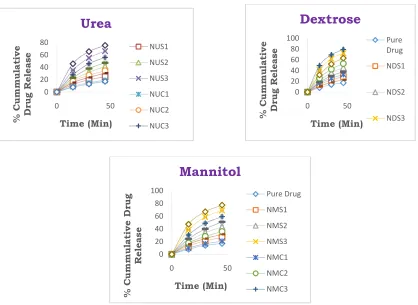
Fig-4, 5 & 6: In-Vitrodrug release of Nateglinide
Solvent Evaporation Method &
Fig – 7: Comparative Drug Release Profile of Nateglinide using Urea, Dextrose and Manni 0
20 40 60 80
0 50
%
C
u
m
m
u
la
ti
v
e
D
ru
g
R
el
e
as
e
Time (Min)
Urea
%
C
u
m
m
u
la
ti
v
e
D
ru
g
R
el
ea
se
Nateglinide using Urea, Dextrose and Mannitol in Hcl Buffer pH 1.2 by Kneading Method,
Solvent Evaporation Method & Co-grinding Method.
7: Comparative Drug Release Profile of Nateglinide using Urea, Dextrose and Mannitol in Hydrochloric Acid Buffer pH 1.2.
NUS1 NUS2 NUS3 NUC1 NUC2 NUC3
0 20 40 60 80 100
0 50
%
C
u
m
m
u
la
ti
v
e
D
ru
g
R
el
ea
se
Time (Min)
Dextrose
0 20 40 60 80 100
0 50
Time (Min)
Mannitol
Pure Drug NMS1 NMS2 NMS3 NMC1 NMC2 NMC3
by Kneading Method,
tol in Hydrochloric Acid
Time (Min)
Dextrose
Pure Drug NDS1
NDS2
An increase in Nateglinide dissolution rate, was also achieved by the other techniques for differ-ent solid dispersion systems, but this increase was less than ratio (1:3). It was noticed that SD systems prepared by Kneading Method were capable of improving drug dissolution rate high-er than those produced by Solvent Evaporation and Co-grinding Method significantly (p< 0.01). On the other hand, the corresponding percentage release of pure drug in 0.1N HCl was only about 38%. T80% of all solid Dispersion was kept in table-1. It could be seen that, dextrose has effec-tively enhanced the drug dissolution and this effect depends on the ratio of the carrier used and the method of the preparation of solid dis-persion. In addition figure-7, showed the compa-ritive dissolution behaviors of the drug from all different systems. It has shown that, the Knead-ing method had the priority of enhancKnead-ing the dissolution rate. The enhancement of dissolution of Nateglinide from the drug carrier may be due to several factors such as lack of crystallinity, increased wettability, amorphization and disper-sibility. Incorporation of drug with a hydrophilic carrier system offered an increased wetting and reduction in interfacial tension between hydro-phobic drug and dissolution medium. As indica-tive from dissolution data of Kneading mixtures, improvement could be attributed to higher wet-tability and dispersibility. Wet mixing of drug with a hydrophilic carrier and grinding with Co-solvent results in greater wetting and increases surface available for dissolution by reducing in-terfacial tension between hydrophobic drug and dissolution media. Furthermore, kneading results in uniform distribution of drug in the polymer crust in a highly dispersed state. Thus, when such a system comes in contact with an aqueous dissolution medium, the hydrophilic carrier dis-solves and results in precipitation of the embed-ded drug into fine particles, which increase the dissolution surface available. Moreover, other factors such as absence of aggregation and/or reagglomeration phenomenon during dissolution and particle size reduction could be attributed to a better dissolution profile.
CONCLUSION:
Solid dispersion of Nateglinide in U r e a , D e x t r o s e a n d M a n n i t o l could be prepared by different methods. Nateglinide solid dispersion systems prepared by Kneading Method using Dextrose in comparasion to other two techniques had showed higher solubility and dissolution rate than the drug alone. The Kneading Method had a priority to enhance
the solubility and dissolution rate over the other studied methods.
Acknowledgements:
Authors are thankful to Principal T.K.R College of Pharmacy, Hyderabad (India) for providing all the necessary facilities to carry out this work and also extend thanks to Cadilla Health Care, Pvt. Ltd, Hyderabad (India) for providing gift sample of Nateglinide.
REFERENCES
1. Sekiguchi, 1961. Studies on absorp-tionof eutectic mixture I. A comparison of the behaviour of eutectic mixture of sulfathiazole and that of ordinary sul-fathiazole in man. Chemical and Phar-maceu. Bull., 9: 866-872.
2. Chiou, W.L. and S. Riegelman, 1971. Pharmaceutical applications of solid dispersion systems. Journal of Pharma-ceu. Sci., 60(9): 1281-1302.
3. Brahmankar, D.M. and S.B. Jaiswal, 1995. Biopharmaceutics and Pharma-cokinetics: ATreatise. 1 ed., st Delhi: VallabhPrakashan, pp: 171-172.
4. Swarbrick, B., 2002. Encycolpedia of Pharmaceutical Technology. 2nd ed., New York: Marcel Dekker Inc, 1: 641-647.
5. Leunner, C. and J. Dressman, 2000. Im-proving drug solubility for oral delivery using solid dispersions. Eur.J. Pharma-ceu. and BiopharmaPharma-ceu., 50(1): 47-60. 6. Aulton, M.E., 2007. Aulton’s,
Pharma-ceutics, The Design and manufacture of medicine. 3rded., Churchill Livingstone, pp: 293.
7. Vippagunta, 2006. Factors affecting the formation of eutectic solid dispersions and their dissolution behaviour. J. Pharmaceu. Sci., 96: 294-304.
8. Shahroodi, A.B., 2008. Preparation of a solid dispersion by a dropping method to improve the rate of dissolution of meloxicam. Drug Devel. and Indust. Pharm., 34: 781-788.
9. Chiou WL and Riegelman S. Pharma-ceutical applications of solid dispersion system. J. Pharm. Sci 1971; 60: 1281‐1302.
11. Arias MJ, Influence of the preparation method of solid dispersions on their dissolution rate: study of triamterene ‐ D ‐ mannitol system. Int.J. pharm 1995; 123: 25‐31.
12. Vasconcelos, Solid dispersions as strategy to improve bioavailability of poor water soluble drugs. Drug Discov Today. 2007, 12:1068-1075.
13. Leuner C, Dressman J. Improving drug solubility for oral delivery using solid dispersions. Eur J Pharm Biopharm. 2000, 50: 47-60.
14. EL-Badry M, Properties of Solid Dis-persion of Piroxicam in Pluronic F-98. J Drug Del Sci. Tech. 2004, 14 (3):199-205.
15. Fouad. The use of spray drying to en-hance celecoxib solubility. Drug Dev Ind Pharm. 2011, 37 (12): 1463- 1472. 16. EL-Badry M. Preparation and
charac-terization of Albendazole Microparti-cles prepared by freeze-drying tech-nique. Bull. Pharm. Sci. Assiut Univer-sity. 2008, 31 (1):123-135.
17. Moneghini M, Influence of the micro-wave technology on the physical-chemical properties of solid dispersion with nimesulide. Powder technology. 2009, 195: 259-263.
18. Craig D Q. The mechanisms of drug release from solid dispersions in water solublepolymers. Int J Pharm. 2002, 231:131-144.
19. Karavas E, Investigation of the release mechanism of a speringly water-soluble drug from solid dispersions in hydrophilic carriers based on physical state of drug, particle size distribution and drug polymer interactions. Eur J Pharm Biopharm. 2007, 66: 334-347. 20. Shin SC, Cho CW. Physico
chemi-cal characterization of piroxicam-poloxamer solid dispersions.Pharm
Dev Tech.1977,2: 403- 407.
21. Narasimha S. Managoli, Raghaven-dra V. Kulkarni, N. Ramarao, I. S. Muchandi, Crosslinked chitosan hydrogel matrix tablets for con-trolled release of gabapentin,
Far-macia, 2012, 60(2), 272-286
22. A Wade; PJ Weller; Handbook of Pharmaceutical Excipients, Ameri-can Pharmaceutical Association, Washington, DC, 907, 1994.
23. Monti S, Burgalassi S, Rossato M S, Albertini B , Passerini N , Rodri-guez L, Chetoni P. Poloxamer 407 microspheres for orotransmucosal drug delivery. Part II: In vitro/in vivo evaluation.Int J Pharm. 2010, 400:32–36.
24. Newa M, Bhandari KH , Oh D H , Kim YR, Sung JH, Kim JO, Woo JS, Choi H G, Yong CS. Enhancement dissolution of ibuprofen using solid dispersion with poloxamer 407. Arch
Pharm. Res.2008, 31: 1497-1507.
How to cite this article:
Sree Giri Prasad. B*, Siva Subramanian. N, M. Rajini, T. Mammatha, B. Sharanya, P. Naresh, Solubility and bioavailability enhancement of nateglinide by solid dispersion techniques, 7 (2): 3102 – 3110 (2016)