Ames Laboratory Publications
Ames Laboratory
11-15-2014
Green's function multiple-scattering theory with a
truncated basis set: An augmented-KKR formalism
Aftab Alam
Indian Institute of Technology Bombay
Suffian N. Khan
Ames LaboratoryAndrei V. Smirnov
Ames Laboratory, [email protected]
D. M. Nicholson
Oak Ridge National Laboratory
Duane D. Johnson
Iowa State University, [email protected]
Follow this and additional works at:
http://lib.dr.iastate.edu/ameslab_pubs
Part of the
Condensed Matter Physics Commons
,
Engineering Physics Commons
, and the
Materials Science and Engineering Commons
The complete bibliographic information for this item can be found at
http://lib.dr.iastate.edu/
ameslab_pubs/265
. For information on how to cite this item, please visit
http://lib.dr.iastate.edu/
howtocite.html
.
Green's function multiple-scattering theory with a truncated basis set: An
augmented-KKR formalism
Abstract
The Korringa-Kohn-Rostoker (KKR) Green's function, multiple-scattering theory is an efficient site-centered,
electronic-structure technique for addressing an assembly of N scatterers. Wave functions are expanded in a
spherical-wave basis on each scattering center and indexed up to a maximum orbital and azimuthal number
Lmax=(l,m)max, while scattering matrices, which determine spectral properties, are truncated at Ltr=(l,m)tr
where phase shifts δl>ltr are negligible. Historically, Lmax is set equal to Ltr, which is correct for large enough
Lmax but not computationally expedient; a better procedure retains higher-order (free-electron and
single-site) contributions for Lmax>Ltr with δl>ltrset to zero [X.-G. Zhang and W. H. Butler,
Phys. Rev. B 46, 7433
(1992)
]. We present a numerically efficient and accurate
augmented
-KKR Green's function formalism that
solves the KKR equations by exact matrix inversion [R3 process with rank N(ltr+1)2] and includes higher-L
contributions via linear algebra [R2 process with rank N(lmax+1)2]. The augmented-KKR approach yields
properly normalized wave functions, numerically cheaper basis-set convergence, and a total charge density
and electron count that agrees with Lloyd's formula. We apply our formalism to fcc Cu, bcc Fe, and L10CoPt
and present the numerical results for accuracy and for the convergence of the total energies, Fermi energies,
and magnetic moments versus Lmax for a given Ltr.
Keywords
Materials Science and Engineering
Disciplines
Condensed Matter Physics | Engineering Physics | Materials Science and Engineering
Comments
This article is from Phys. Rev. B
90
, 205102 (2014), doi:
10.1103/PhysRevB.90.205102
. Posted with
permission.
PHYSICAL REVIEW B90, 205102 (2014)
Green’s function multiple-scattering theory with a truncated basis set:
An augmented-KKR formalism
Aftab Alam,1,*Suffian N. Khan,2A. V. Smirnov,2D. M. Nicholson,3,†and Duane D. Johnson2,4,‡
1Department of Physics, Indian Institute of Technology, Bombay, Powai, Mumbai 400 076, India
2Division of Materials Science & Engineering, Ames Laboratory, Ames, Iowa 50011, USA
3Oak Ridge National Laboratory, Oak Ridge, Tennessee 37831, USA
4Department of Materials Science & Engineering, Iowa State University, Ames, Iowa 50011, USA
(Received 16 August 2014; revised manuscript received 6 October 2014; published 4 November 2014)
The Korringa-Kohn-Rostoker (KKR) Green’s function, multiple-scattering theory is an efficient site-centered, electronic-structure technique for addressing an assembly ofN scatterers. Wave functions are expanded in a spherical-wave basis on each scattering center and indexed up to a maximum orbital and azimuthal number Lmax=(l,m)max, while scattering matrices, which determine spectral properties, are truncated atLt r=(l,m)t r where phase shiftsδl>lt rare negligible. Historically,Lmaxis set equal toLt r, which is correct for large enough
Lmax but not computationally expedient; a better procedure retains higher-order (free-electron and single-site)
contributions forLmax> Lt rwithδl>lt rset to zero [X.-G. Zhang and W. H. Butler,Phys. Rev. B46,7433(1992)].
We present a numerically efficient and accurateaugmented-KKR Green’s function formalism that solves the KKR equations by exact matrix inversion [R3process with rankN(lt r+1)2] and includes higher-Lcontributions via
linear algebra [R2process with rankN(l
max+1)2]. The augmented-KKR approach yields properly normalized
wave functions, numerically cheaper basis-set convergence, and a total charge density and electron count that agrees with Lloyd’s formula. We apply our formalism to fcc Cu, bcc Fe, and L10CoPt and present the numerical
results for accuracy and for the convergence of the total energies, Fermi energies, and magnetic moments versus Lmaxfor a givenLt r.
DOI:10.1103/PhysRevB.90.205102 PACS number(s): 71.15.Ap,71.15.Dx,61.50.−f
I. INTRODUCTION
Multiple-scattering theory, as formulated by Korringa [1], Kohn, and Rostoker [2] (KKR), continues to be a powerful and efficient method to study the electronic structure of solids [3]. KKR theory is Rayleigh-Ritz variational, like the related muffin-tin orbital (MTO) and augmented plane-wave (APW) methods. KKR Green’s function (GF) techniques have facilitated numerous successful applications to spectral and energy-related properties, such as surfaces [3], alloys [4–7], interfaces [8,9], quantum criticality [10], and transport [11]. Due to its inherent multiple-scattering nature, KKR GF techniques are used extensively to predict and analyze exper-imental results [12] involving low-energy electron diffraction (LEED) [13,14], photoemission [15–17], and neutron and x-ray scattering [18–20].
A key parameter controlling KKR convergence is the maximum orbital and azimuthal numberLmax=(l,m)max of
the truncated spherical-wave basis on each scattering center. Historically, at a wave vector k and energy E, Lmax was also chosen to control truncation of the single-site scattering tLL(E) matrices and KKR scattering-path operatorτLL(k;E)
that dictates spectral properties of the system. However, τLL(k;E), i.e., the Green’s function (G), could be truncated
atLtr< Lmax, where phase shiftsδl>lt r are negligible (set to
zero), giving smaller matrices to invert if we could directly
†Present address: Department of Physics, University of North Carolina Asheville, Asheville, NC 28804.
include the contribution of higherL’s (Lmax> Ltr) via the
single-site and free-electron part ofG.
All electronic-structure methods based on density func-tional theory (DFT) involve numerous approximations from, e.g., exchange correlation, pseudopotentials, and shape of potential. For multiple-scattering theory,L truncation yields an inherent error often ignored because of the rapid rise in computational cost withLmax. In addition, the errors arising from L truncation often are handled in an uncontrollable fashion. For Ltr equal to Lmax, researchers find apparent
convergence in close-packed systems usinglmax∼3. Yet, a key
source of error is due to the normalization of wave functions (), affecting the charge density ρ(r) and density of states (DOS)n(E) calculated from the Green’s functions. As such, if is not correctly normalized, the integrated DOS from theLtr-truncated basis does not exactly reproduce the total
number of electrons in the system, and the Fermi energy EF is slightly incorrect—a possible issue in systems with spectral gaps. Also,Ltruncation introduces error in the dipole matrix elements, which couplel andl±1 states, needed for calculations of transport, electron-phonon, and atomic forces. So, a balance is struck between convergence of KKR GF properties versuslmax and numerical efficiency for inverting KKR matrices with rankN(lmax+1)2. Butler [21]
investig-ated the accuracy and convergence of multiple-scattering theory versusl for two muffin-tin scatterers in a two-center expansion, showing a solution can be made arbitrarily accurate at some numerically costlylmax→60. Zhang and Butler [22] established a more proper procedure: Solve the secular equation toLtrand retainLmax> Ltrcontributions withδl>lt r
set to zero, yielding continuous and correctly normalized wave functions and an electron count from the DOS that agreed with that from Lloyd’s formula. This formalism was derived
ALAM, KHAN, SMIRNOV, NICHOLSON, AND JOHNSON PHYSICAL REVIEW B90, 205102 (2014)
in real space but never implemented for realistic materials. No equivalent KKR GF in reciprocal space was derived or tested. We present an augmented-KKR GF formulation that yields normalized wave functions, numerically fast basis-set conver-gence, and an electron count that agrees with Lloyd’s formula. Importantly, the augmented KKR formulation agrees well with the standard KKR formulation using exact inversion toLmax. We tested convergence of total energy,EF(integrated DOS),
and magnetic moments in three systems: fcc Cu, magnetic bcc Fe, and magnetic L10CoPt. The efficiency of the augmented
KKR formulation arises because the matrices of rank (R) N(ltr+1)2 are solved by direct inversion (R3 process) and
contributions aboveLtr are included by a closed-form (δl→
0) linear algebra (R2process) augmentation of the matrices of
rankN(lmax+1)2.
II. FORMALISM
In KKR GF theory, the site-diagonal Green’s function at a specific energyEis given by
G(r,r;E)=
LL
ZnL(r,E)τLLnn(E)ZLn(r,E)
−ZLn(r<,E)JLn(r>,E)δLL
, (1)
where L=(l,m) for the site-centered, spherical-harmonic basis set. Here, r< (r>) denotes one of two vectors r
or r with the smaller (larger) absolute value. The tensor τLLnn(E) is the scattering-path operator [23] describing the propagation pathway of electrons in an array of scattering centers. Zn
L(r,E) andJLn(r,E) are, respectively, the regular
and irregular solutions of the Schr¨odinger equation in thenth Wigner-Seitz cell.Zn
L(r,E) has the form
ZnL(r;E)=κ
L
φnL(r,E)
SLnL(E) −1
, (2)
whereκ=√E−v0. Here,v0is an arbitrary reference energy for an exact theory, but, for approximate cases, such as muffin-tin (MT) or atomic sphere approximations (ASAs), it can be chosen variationally to match the trace of eigenvalues of the exact theory [24].φn
L(r,E) is the wave-function solution with potentialvn(r), i.e.,
[−∇2+vn(r)]φLn(r,E)=Eφ n
L(r,E). (3)
The potential vanishes outside the convex cell, so φn L joins
smoothly to a combination of spherical Bessel jl(κr) and
Neumannnl(κr) functions beyond the circumscribing sphere
(CS) radii around the cell (r > RCS), i.e.,
φnL(r,E)=
L
nl(κr)SLnL(E)−jl(κr)CnLL(E)
YL(r). (4)
The sineSand cosineCmatrices are calculated by matching the continuity of the logarithmic derivative ofφLn across the cell boundary. Notably,JLn(r,E) has the asymptotic limit
JLn(r,E)→jl(κr)YL(r), r > RCS. (5)
A. KKR GF formalism
While constructing τLLij (E), the propagation of electrons from one scattering center i to another j is defined by
the free-electron Green’s function gijLL(E) (in a spherical-harmonic basis) or in a solid the KKR structure constant matrix gnnLL(k;E) with basis sites onn,nsublattices. In a solid, with
periodic boundary conditions invoked,τLLnn(k;E) is given in finite matrix form as
τ =(1−tg)−1t=t+tgt+tgτgt, (6)
wheretis the single-site scattering matrix, which in a cellnis generally given by
tn= −κ−1(Cn−iSn)−1Sn. (7) For a spherically symmetric scatterer [25] (used here), the single-sitetmatrices simplify as
tLL(E)→tl(E)δLL = −κ−1sinδl(E)eiδl(E). (8)
For MT or ASA scattering centers, the KKR phase shifts are determined by matching the free-electron solution on the sphere boundary.
Generally, the full GF (1) can be rewritten by Eq. (6) in terms of single-site and multiple-scattering pieces, i.e.,
G(r,r;E)=(ZtZ−ZJ)+Z(τ −t)Z
=(ZtZ−ZJ)+Zt(g)tZ+Zt(gτg)tZ. (9) Each quantity above is a supermatrix in a space of angular momentum [rank (l+1)2] and of unit cell size N, giving a
total rank ofR=N(l+1)2.
The three major computational expenditures in KKR GF theory are calculations of (1) structure constantsg; (2) wave functionsZandJ; and, most costly, (3)τfrom Eq. (6), which requires anR3operation for the inversion. Now, withNfixed,
Lis usually truncated in numerical calculations to a small but necessary value (e.g.,L=3), above which the phase shiftsδl
are assumed to be zero, but not anLwhere the higher-order terms can necessarily be ignored—an error.
B. Augmented-KKR GF
While free-electron contributions remain at all L’s, the phase shift δl for a spherical scatterer decays rapidly (at
standard temperatures and pressures) with increasing value ofL. Thus, while the first line of Eq. (9) is convenient nu-merically (e.g., for pole cancellation and contour integration, and finite-temperature Matsubara sums [26–28]), the second line provides a simple means to account for KKR multiple-scattering solutions exactly the same way as in the conventional KKR GF theory up toLtrand then augmented with single-site
and free-electron contributions fromLtr < LLmax, while
maintaining symmetry and relative accuracy.
So, in augmented-KKR theory, we analytically evaluate Eq. (9) to include L > Ltr (in the limit δl→0) terms via
linear algebra, rather than full matrix inversion. First,gLL is
calculated for LLmax to where augmentation is desired.
Second, for LLtr, the terms in Eq. (9) are evaluated as
usual, while, forL > Ltr in the δl →0 limit, the first two
terms can be analytically simplified using
Zt−−→
δl→0
+j(κr)
(ZtZ−ZJ)−−→
δl→0
−κj(κr)[ij(κr)−n(κr)]. (10)
GREEN’s FUNCTION MULTIPLE-SCATTERING THEORY . . . PHYSICAL REVIEW B90, 205102 (2014)
Equation (10) is derived rigorously (see the Appendix) using expressions for spherical potentials, which vanish outside of spheres inscribed within each cell. They do not hold for full-cell potentials, where nondiagonalL,Lterms can contribute generally, but can be derived.
Last, the most crucial step is evaluating the last term in Eq. (9). Positing negligible scattering for large L’s, the last term is calculated in three steps:
(1) Calculate τL1L2=[(1−tg)− 1
t]L1L2 for Li Ltr by
exact inversion.
(2) WithgLL(∀L,L=Lmax> Ltr), calculategτgusing
(gτg)LL =
Lt r
L1
Lt r
L2
(gLL1)(τL1L2)(gL2L). (11)
(3) Having gτg, multiply (Zt)LL from both sides to get G(r,r,E) for allL=Lmax.
With this, one needs to perform an inversion (R3operation)
only for matrices up toLtr, and the higher-Lcontributions are
included by matrix multiplication (gτg), which is computa-tionally much faster (R2operation).
For nonspherical potentials, one can derive expressions similar to Eq. (10) having off-diagonal (L,L) components. So, our three-step process to get the last term of Eq. (9) remains un-changed, except thattis nondiagonal. As such, the advantage of a rank-one update is lost when multiplying diagonal and off-diagonal matrices, i.e.,twithgorZtwithgτg. Yet, the scaling for the multiple-scattering calculations remains unaltered. The solution of the nondiagonal components of the matrices, such as t, are more rapidly calculated using the analytic diagonal solutions and iterating Dyson’s equation until convergence, with integrations performed over convex Voronoi polyhedra, rather than spheres [29]. For full potentials involving arbitrarily shaped convex polyhedra, we have developed an efficient three-dimensional (3D) isoparametric method [30] to perform the integrations for solution of Schr¨odinger and Poisson’s equations [31]. This method is more accurate and multiple orders of magnitude faster than conventional shape-function methods. Implementing the augmented-KKR formalism for full potentials is planned. Because the numerical effort of solving the multiple scattering is the same for both spherical and nonspherical potentials, the additional effort for the full-potential case in KKR theory scales linearly with the number of nonequivalent atoms.
In an all-electron,ab initiocalculation for real systems,l truncation enters at several places and collectively affects, e.g., the cell DOS, and charge and magnetization densities. In turn, the Fermi energyEFand magnetization M, defined from the sum rules
N(EF)=
EF
Ebot
[n↑(E)+n↓(E)]dE=Zval,
M=
EF
Ebot
[n↑(E)−n↓(E)]dE, (12)
are affected, as is the total energy. Here, Ebot designates the bottom of the valence band, n↑(n↓) is the spin majority (minority) DOS, andZvalis the average number of valence
electrons. As will be shown, l truncation plays a significant role in correctly evaluating theEFand M.
III. COMPUTATIONAL DETAILS
An all-electron, DFT KKR GF code [32] is used to perform the calculations, as previously done [4,7,8]. For the present results, the von Barth–Hedin [33] local spin-density approximation (LSDA), as parametrized by Moruzzi, Janak, and Williams [34], was used. The site-dependent Voronoi polyhedra were represented within an ASA sphere [35], with multicomponent cases handled by an optimal basis [24], where ASA spheres are adjust by saddle points in the electronic density. Complex energy contour integration with 24 energy points was used to integrate the Green’s function. Monkhorst and Pack’s [36] specialk-point method was used for Brillouin zone integration.
Following the above theory, distinct from conventional KKR theory, whereLis truncated where δL(E)≈0 (rather
than where free-electron contributions are small, which isE,L, and temperature dependent), two distinctLtrandLmaxindices
are used. All the calculations up toLtr are performed in the
standard way; i.e., for each energyE, we evaluate (Z,J),t, and gand getτ by inversion. For augmented-KKR theory, beyond Ltr, we calculate the truncatedτ forL,LLtr and use the
fullgLLmatrix to augmentg+gτgEq. (11) up toLmax, which
can be chosen manually or to be below a specified tolerance for GF error. Recall from Eq. (9) that we know the analytic form of ZtZ−ZJandZtforL > Ltr, so the only effort is in evaluating
the matrix elements ofg+gτgforLtr< LLmax.
IV. RESULTS AND DISCUSSION
We apply theab initioaugmented-KKR formalism to fcc Cu, bcc Fe, and L10 CoPt. The first two systems provide a
stringent test of our formalism for a simple nonmagnetic and a magnetic system, respectively. The third illustrates application to a multisublattice, magnetic example.
A. Convergence of total energy and Fermi energy
Figure1shows the convergence of total energy (bottom) and Fermi energy (top) versus the augmentation lmax, with ltr=2,3,4 for fcc Cu in our KKR ASA code [32]. The
left-hand (right-left-hand) panel indicates the results for a basis of one Cu atom (atom+octahedral hole). The right-hand panel shows improvement in both augmentation and basis set, as the hole site makes the Voronoi polyhedra for each scattering site (atom and hole) more spherical, and the atom is better represented by an ASA sphere (and reduces the ASA overlap error), while the interstitial volume is greatly reduced.
The energies are not converged withltr =2 and largelmax
compared to converged values. Bylmax=5 the total energy
(EF) reaches an asymptotic value, and the ltr=2 value is
higher by 9 mRy (4 mRy) relative to those calculated with ltr=4. Beyondlmax=5, the error in total energy (EF) is less
than 0.05 mRy (0.01 mRy), i.e., the order of 1×10⁻⁵Ry. For
the one-atom Cu basis (left-hand panel), the total energy (EF)
withltr =4 converged to within 1 mRy (0.1 mRy) compared
to that withltr =3. With an octahedral hole added to the basis
(right-hand panel), the results are exactly the same forltr =3
or 4. This is due to the use of a better basis set. As such, a faster convergence in thel space can be achieved by an improved basis set, but with a concomitant increase in theR3process.
ALAM, KHAN, SMIRNOV, NICHOLSON, AND JOHNSON PHYSICAL REVIEW B90, 205102 (2014) 0.67 0.68 0.69 0.70 0.78 0.79 0.80 0.81
l =2 l =3 l =4
2 3 4 5 6 7 8
0 5 10 15 20 25
2 3 4 5 6 7 8
0 5 10 15 20 25
E - E (mRy) E (Ry)
F
0
lmax lmax
fcc Cu 1 Cu + 1 Octahedral hole tr tr tr
FIG. 1. (Color online) Left: Convergence properties of total en-ergyE(bottom) and Fermi levelEF(top) vslmaxusing differentlt r
for one atom/cell fcc Cu. Right: Same as left, but for one Cu site plus one octahedral-hole site per cell.E0is defined by thelt r=4,lmax=8
result.EFis different on the left because of the Madelung potential
inherent on the right.
Moghadamet al.[37] carried out a test oflconvergence for fcc Cu in a real-space KKR, linear-scaling multiple-scattering (LSMS) method. The difference between the total energy (EF)
forlmax=3 andlmax=8 is 7 mRy (6 mRy). For thek
-space-based, augmented-KKR theory, the differences are 6.5 mRy (8 mRy) for the one-Cu-site basis, and 5 mRy (7 mRy) for a basis with a Cu plus an octahedral hole. The present method, however, is computationally faster due to the augmentation used to evaluate the contribution of higherl’s.
Figure2shows the convergence of total energy (bottom), EF (middle), and magnetic moments (top) for magnetic bcc
Fe (left-hand panel) and L10 CoPt (right-hand panel). As
in the case of fcc Cu, the total energy and EF converge by
lmax=5 with ltr =4. The converged moment of bcc Fe is
2.30μB, which compares well with the experimental value [38]
2.30 2.31 2.32 2.33 1.70 1.75 1.80 1.85 1.90 1.95 0.680 0.685 0.690 0.695 0.69 0.70 0.71
0.72 l =2l =3 l =4
2 3 4 5 6 7 8 0
5 10 15 20
2 3 4 5 6 7 8 0 10 20 30 40 50
E - E (mRy) E (Ry) m
Fe
(µ )
F 0 B 0.36 0.37 0.38 0.39 0.40 0.41
E - E (mRy) E (Ry) m
0F
Pt
(µ )B
m
Co
(µ )B
bcc Fe L1 CoPt0
lmax lmax
tr tr tr
FIG. 2. (Color online) Convergence of total energyE(bottom), EF(middle), and magnetic moments (top) vslmax at differentlt rfor a one-atom bcc Fe (left), and for a two-atom L10CoPt (right).E0is
anLmax=8 reference value.
1 2 3 4
0 1e-07 2e-07 3e-07 4e-07
1 2 3 4 5 6 7 8 9
Distinct Matrix elements 0 1e-07 2e-07 3e-07 4e-07 5e-07 6e-07 0 1e-07 4e-07 3e-07 2e-07 6e-07 5e-07 4e-07 3e-07 2e-07 0 1e-07
Re ( )
T
Im ( )
T
l =2, l =3
l =2, l =4tr
tr max
max
l=3 block
l=4 block
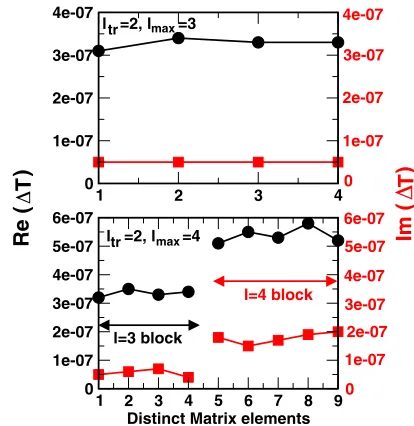
FIG. 3. (Color online) Absolute difference in distinct elements of TLL=(g+gτg)LLcalculated using fullτLLwithL,LLmaxand
the augmented-KKRτLL withL,LLt r=2 andLmax=3 (top)
andLmax=4 (bottom) atE=(−0.76,0.003) Ry. Similar accuracy
is found along the entire semicircular contour of integration. For spherically symmetric scatterers withLmax=3 (4), there are four
(five) distinct matrix elements in theL=3 (4) block of the T matrix.
of 2.2μB. The Co and Pt moment in L10 CoPt converges
relatively slower compared to that of Fe. This is due to a slight c/adistortion in the L10 structure (c/a =0.984). Calculated
moments for Co and Pt are 1.91μBand 0.396μB, respectively,
compared to 1.76μB and 0.35μB from experiment at finite
temperature [39].
Last, for comparison of matrix elements from full-KKR versus augmented-KKR theory, we first calculated τ for L,LLmax by direct inversion, and then calculated the
T=g+gτgmatrix using both full and truncatedτ matrices. Figure3shows the absolute error (T) in the matrix elements of the larger (L > Ltr) block of the augmented T-matrix
calculated using full τ and truncated τ for fcc Cu. With ltr=2, the augmentation is compared forlmax=3 (lmax=4)
in the top (bottom) panel. For fcc symmetry, there are four (five) distinct matrix elements in the l=3 (l=4) block of the T matrix, which are labeled along the horizontal axis. Clearly, augmented-KKR theory well reproduces the higher-l block of T matrices compared to full-KKR inversion (quite well below 1×10⁻⁶), showing that the computationally faster augmentation has very good accuracy.
B. Comparison to Lloyd’s formula
Lloyd’s formula is theN-site generalization of the Friedel (single-site) sum rule, or optical theorem, for the electronic integrated DOS:
N(E)=Nfree(E)+
2 π
(2+1)δ(E), (13)
where Nfree(E) is the integrated DOS of the free electrons,
known analytically in three dimensions, i.e.,E3/2/(6π2). [For
[image:6.608.329.536.69.282.2] [image:6.608.50.295.70.256.2]GREEN’s FUNCTION MULTIPLE-SCATTERING THEORY . . . PHYSICAL REVIEW B90, 205102 (2014)
complex E, Eq. (13) is incorrect but can be generalized via scattering matrices.] The KKR Lloyd’s formula for an ordered system can be written in spectral representation at any complex Eas [40–42]
N(E)=Nfree(E)+
1
πIm ln||α(E)||
− 1
Nk k
1
πIm ln||1−t(E)g(k,E)|| (14)
for discrete samples in k space, with α(E) defined by the scattering solutions of v(r) near the scattering centers. The determinant is performed over both basis-site and angular-momentum indices, and it is equivalent to an eigenvalue sum, albeit done by constant-E scan. The formula is also related to Krein’s theorem [43,44]. Lloyd’s formula is an amazing result being the closed-form expression for the integrated DOS at anyE (total electrons)! Moreover, a variation of Lloyd’s formula with respect to potentialv(r) yields the density at any energyρ(r;E) to second order in changes in the self-consistent potential (e.g., higher-orderL’s) and, hence, inEF[4].
Because the KKR determinant passes through zero at every Bloch solution, it picks up a phase of π at these locations, giving the number of electrons up toE. Equation (14) counts jumps in phases in the KKR determinant (“Im log” operation). There is a practical implementation issue: At a given Ethe phase is known to modulo 2π (or total electrons within a whole number), but trivially handled with a goodEFestimate from the real-space GF. Thus, Lloyd’s formula gives an exact (noLtruncation)EFand electron count from a few values of
E.
Importantly, here, the augmented-KKR formulation is expected to yield a value ofEFconsistent with that obtained by Lloyd’s formula. Also, for thermodynamics of a system, an analytic expression for the free-energy functional can be directly derived from Lloyd’s formula using a Gibbs relation [4], which we use to calculate the total (free) energy. At finite temperature it directly yields Mermin’s theorem, or the Kohn-Sham theorem at 0 K [4]. Hence, the spectral Lloyd’s formula specifies the thermodynamics and correct Fermi surface atEF.
To assess the augmented-KKREFand electron count, we
must compare three results: (1) convergence of the augmented-KKR spectral GF—Lloyd’s formula; (2) convergence of the augmented-KKR real-space GF, as given by the trace of Eq. (9); and (3) convergence of items 1 and 2 with improved basis. Notably, approach 2 is used in a typical self-consistent-field (SCF) KKR GF for computational expediency because G(r,r;E) is always handy.
To be clear, results 1 and 2 should agree for an exact method. However, these values will differ if there is any approximation that is not handled equivalently in k space and real space, as in the ASA. For result 1 above,G(r,r;E) is evaluated within an ASA sphere and then Fourier transformed to obtainG(k;E) commensurate with the Brillouin zone of the full unit cell; hence, for ordered systems, it is a calculation of the volume enclosed by the Fermi surface and corresponds to the count over anonsphericalcharge distribution. In contrast, for result 2, the trace ofG(r,r;E) is evaluated in an ASA sphere, which does not account for the volume as done in result 1, and it must
2 3 4 5 6 7 8
-20 -10 0 10 20
2 3 4 5 6 7 8-20
-10 0 10 20
SCF Lloyd
lmax
E - E (mRy)
max
l
F
0
fcc Cu 1 Cu + 1 Octahedral hole
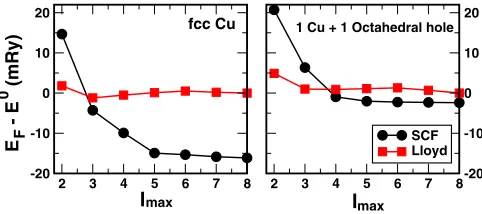
FIG. 4. (Color online) EF by real-space GF (circle) relative to
spectral Lloyd’s formula (square) for Cu (left) and Cu plus hole (right) forLt r=Lmax.E0is a reference energy.
suffer a modest error because only a spherical charge density is considered. Therefore, result 1 above should be correct, and a small error may appear from result 2, which will decrease with, say, improving basis.
For comparison, a wave-function approach using the ASA solves the secular equation after Fourier transform by diagonalization to get the eigenvalues, andEFis then obtained by counting states within the volume enclosed by the Fermi surface; then the remaining quantities are determined by referencing only k space. As such, it is equivalent to the value from the spectral Lloyd’s formula, Eq. (14).
From the SCF KKR approach, Fig.4comparesEFversus Lmax (=Ltr) from a real-space Green’s function (circle) and
from a spectral (k-space) Lloyd’s formula (square) for basis with one Cu (left) and for one Cu plus an octahedral hole (right). These results agrees with those from the augmented-KKR approach withLtr =3 but evaluated for eachLmax8.
As is apparent, the spectral Lloyd’s results converge rapidly, whereas those from real space converge slower and suffer a small error because only a spherical charge density is considered. As is obvious from Fig.4, the discrepancy inEF
obtained from the two methods reduces when an octahedral hole is inserted into the fcc cell (right-hand panel) because the ASA then better represents the real-space volume; the k-space result is also improved because the nonspherical charge density is better represented.
As discussed elsewhere (e.g., for applications to warm-dense matter), further improvements to the agreement between real-space and k-space results (not shown) are possible, which leads to much less than 1 mRy discrepancy. Example changes include improving the normalization of scattering functions (Z, J), and includingNfree(E) analytically (infinite L sum),
as in Lloyd’s formula, while simultaneously removing theL -truncated free-electron Green’s function contributions from the KKR Green’s function during the SCF cycle.
C. Convergence of structural parameters
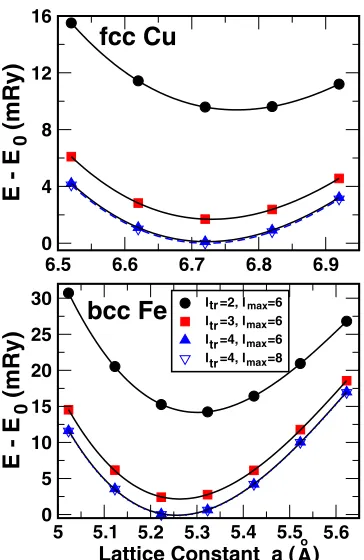
Up to now we have investigated the convergence properties at a fixed lattice parameter. Another important thing to check is how convergence affects the accuracy of the equilibrium (ground-state) lattice parameter. Figure5shows the energy ver-sus lattice constant (a) for fcc Cu (top) and bcc Fe (bottom) at different sets ofltruncation. Notably, for both systems, the en-ergy curve withltr=4 andlmax=6 is almost indistinguishable
[image:7.608.316.557.69.176.2]ALAM, KHAN, SMIRNOV, NICHOLSON, AND JOHNSON PHYSICAL REVIEW B90, 205102 (2014)
6.5 6.6 6.7 6.8 6.9
0 4 8 12 16
E - E (mRy)
l =2, l =6 l =3, l =6 l =4, l =6 l =4, l =8
5 5.1 5.2 5.3 5.4 5.5 5.6
Lattice Constant a ( )
0 5 10 15 20 25 30
E - E (mRy)
bcc Fe
o
0
0
A
fcc Cu
tr tr tr tr
max max max max
FIG. 5. (Color online) Total energy vs a for various sets of augmentation (Lt r,Lmax) for Cu (top) and Fe (bottom).
from that withlmax=8, indicating the convergence bylmax=
6. Alreadyltr =3 finds a similar minimum to that from larger ltr; however, ltr =2 is not a reliable choice for converged
results. The calculated 0 K lattice constants for fcc Cu and bcc Fe are 6.72 and 5.26 a.u., respectively, which compare well with room-temperature experimental values (6.82 and 5.42 a.u., respectively) and previous LSDA results.
D. Estimate of numerical savings
In the current implementation the augmented-KKR ap-proach requires [N3(l
tr+1)3+N2(lmax+1+1)(ltr+1)]
op-erations compared to [N(lmax+1)]3operations in the standard
KKR approach. For reliable convergence in the present examples, we found ltr =3 and lmax=8 to be sufficient
for lattice constants and structural energy differences, in which case we require (64N3+36N2) operations as opposed
to 278N3 operations. Hence, about three- to fourfold less computational time is required for cells with 1–10 atoms—an estimate that holds the calculations done here.
V. CONCLUSION
Motivated by physics and resulting numerical efficiency, we have presented and implemented an augment-KKR Green’s function formalism that accurately handles multiple scattering (where phase shifts are not zero) by direct inversion of a smaller Ltr-truncated basis and includes higher L > Ltr
by linear algebra for necessary single-site and free-electron contributions. We applied the augmented-KKR formalism to three systems and showed very good convergence properties
and accuracy compared to KKR with direct inversion toLmax, although we discovered that a largerL basis is needed over that generally assumed. To be mathematically consistent, the L-sum truncations for wave functions and scattering matrices need to be done in tandem with each other [see Eq. (9)] due to a normalization factor occurring in both the single-site wave functions andtmatrices. By identifying this common normalization, one can analytically evaluate theδl →0 limit
to include higher L’s via simple linear algebra, instead of the exact inversion as required in the conventional KKR approach, saving significant computational effort while im-proving accuracy. For nonspherical potentials, one can derive the expressions witht’s no longer diagonal, but the approach and the scaling for the multiple-scattering calculations remains unchanged. The augmented-KKR approach can be extended to the coherent potential approximation (CPA) and dynamical cluster approximation (DCA) to handle disorder, as will be presented elsewhere.
ACKNOWLEDGMENTS
A.A. acknowledges support from SEED Grant (sponsored Project No. 13IRCCSG020) at IIT Bombay. Work was sup-ported by the U.S. Department of Energy, Office of Science, Basic Energy Sciences, Materials Science and Engineering Division, partially through the Center for Defect Physics, an Energy Frontier Research Center (A.A., D.M.N., and S.N.K. for Ph.D. thesis), and through Ames Laboratory under Contract No. DE-AC02-07CH11358 for materials discovery (A.S., D.D.J., and S.N.K. for post-doc), and Contract No. DE-FG02-03ER46026 for supplemental code (A.S. and D.D.J.). The research was performed at Ames Laboratory, operated for the U.S. Department of Energy by Iowa State University under Contract No. DE-AC02-07CH11358.
APPENDIX: DERIVATION OF EQ. (10)
To derive Eq. (10), consider the matrix representation of Eqs. (2), (4), (5), and (7). In the limitδl→0, the sine and
cosine matricesSandCgo to, respectively, zero and unitary matrix, where|C| ∼ |eiφ| =1. Then, accounting for cancella-tions of sine matrices in the numerator and denominator, we find
Zt= −(nS−jC)e+iδl −−→
δl→0
j(κr). (A1)
Similarly,
ZtZ= −κ(nS−jC)(nS−jC)e
+iδl
S ,
ZJ=κ(nS−jC)j
S .
Asδl →0, and we apply limit evaluation rules, we find
ZtZ−−→
δl→0
−κ[ij(κr)j(κr)−2j(κr)n(κr)],
ZJ−−→
δl→0
+κj(κr)n(κr).
Therefore,
ZtZ−ZJ−−→
δl→0
−κj(κr)[ij(κr)−n(κr)]. (A2)
[image:8.608.83.265.68.348.2]GREEN’s FUNCTION MULTIPLE-SCATTERING THEORY . . . PHYSICAL REVIEW B90, 205102 (2014)
[1] J. Korringa,Physica (Utrecht)13,392(1947). [2] W. Kohn and N. Rostoker,Phys. Rev.94,1111(1954). [3] H. Ebert, D. K¨odderitzsch, and J. Min´ar,Rep. Prog. Phys.74,
096501(2011), and references therein.
[4] D. D. Johnson, D. M. Nicholson, F. J. Pinski, B. L. Gyorffy, and G. M. Stocks,Phys. Rev. Lett.56,2088(1986); ,Phys. Rev. B
41,9701(1990).
[5] D. D. Johnson, A. V. Smirnov, J. B. Staunton, F. J. Pinski, and W. A. Shelton,Phys. Rev. B62,R11917(R)(2000).
[6] A. V. Smirnov, W. A. Shelton, and D. D. Johnson,Phys. Rev. B
71,064408(2005).
[7] Aftab Alam and D. D. Johnson, Phys. Rev. B 85, 144202
(2012).
[8] Aftab Alam, Brent Kraczek, and D. D. Johnson,Phys. Rev. B
82,024435(2010).
[9] W. H. Butler, X-G. Zhang, T. C. Schulthess, and J. M. MacLaren,
Phys. Rev. B63,054416(2001).
[10] Aftab Alam and D. D. Johnson,Phys. Rev. Lett.107,206401
(2011).
[11] W. H. Butler and G. M. Stocks,Phys. Rev. B29,4217(1984); G. M. Stocks and W. H. Butler,Phys. Rev. Lett.48,55(1982). [12] Application of Multiple Scattering Theory to Materials Science:
Symposium Held December 2-5, 1991, Boston, Massachusetts, USA, edited by W. H. Butleret al.(Materials Research Society, Pittsburgh, PA, 1992), Vol. 253.
[13] J. B. Pendry, Low Energy Electron Diffraction (Academic, London, 1974).
[14] M. A. Van Hove,Low Energy Electron Diffraction: Experiment, Theory and Surface Structure Determination(Springer-Verlag, New York, 1986).
[15] P. J. Durham, R. G. Jordan, G. S. Sohal, and L. T. Wille,Phys. Rev. Lett53,2038(1984); see also P. J. Durham,J. Phys. F: Met. Phys.11,2475(1981).
[16] J. E. Inglesfield,Rep. Prog. Phys.45,223(1982); H. Ebert,ibid.
59,1665(1996).
[17] J. Braun, J. Min´ar, S. Mankovsky, V. N. Strocov, N. B. Brookes, L. Plucinski, C. M. Schneider, C. S. Fadley, and H. Ebert,Phys. Rev. B88,205409(2013).
[18] J. B. Staunton, D. D. Johnson, and F. J. Pinski,Phys. Rev. Lett.
65,1259(1990).
[19] J. D. Althoff, D. D. Johnson, and F. J. Pinski,Phys. Rev. Lett.
74,138(1995); J. D. Althoff, D. D. Johnson, F. J. Pinski, and J. B. Staunton,Phys. Rev. B53,10610(1996).
[20] J. B. Staunton, J. Poulter, B. Ginatempo, E. Bruno, and D. D. Johnson,Phys. Rev. Lett.82,3340(1999).
[21] W. H. Butler,Phys. Rev. B41,2684(1990).
[22] X.-G. Zhang and W. H. Butler,Phys. Rev. B46,7433(1992). [23] B. L. Gy¨orffy and M. J. Stott, Solid State Commun.9, 613
(1971).
[24] Aftab Alam and D. D. Johnson,Phys. Rev. B80,125123(2009); also, derivation by D. D. Johnson (unpublished).
[25] Albert Messiah,Quantum Mechanics, Vol. 1 (Wiley, New York, 1966), Chaps. IX and X.
[26] D. D. Johnson, F. J. Pinski, and G. M. Stocks,Phys. Rev. B30,
5508(1984).
[27] Duane D. Johnson, Ph.D. thesis, University of Cincinnati, 1985. [28] F. J. Pinski and G. M. Stocks,Phys. Rev. B32,4204(1985). [29] N. Papnikolau, R. Zeller, and P. H. Dederichs,J. Phys.: Condens.
Matter14,2799(2002).
[30] Aftab Alam, S. N. Khan, B. G. Wilson, and D. D. Johnson,Phys. Rev. B84,045105(2011).
[31] Aftab Alam, B. G. Wilson, and D. D. Johnson,Phys. Rev. B84,
205106(2011).
[32] D. D. Johnson and A. Alam, MECCA: Multiple-scattering Electronic-structure Calculations for Complex Alloys (KKR-CPA Program, ver. 2.0) (University of Illinois, Urbana-Champaign, IL, 2008).
[33] U. Von Barth and L. Hedin,J. Phys. C: Solid State Phys.5,1629
(1972).
[34] V. L. Moruzzi, J. F. Janak, and A. R. Williams,Calculated Electronic Properties of Materials(Pergamon, New York, 1978). [35] P. Phariseau and W. M. Temmerman,The Electronic Structure
of Complex Systems(Plenum, New York, 1984).
[36] H. J. Monkhorst and J. D. Pack,Phys. Rev. B13,5188(1976). [37] N. Y. Moghadam, G. M. Stocks, X.-G. Zhang, D. M. C.
Nicholson, W. A. Shelton, Yang Wang, and J. S. Faulkner,J. Phys.: Condens. Matter13,3073(2001).
[38] Mathias Ekman, Babak Sadigh, Kristin Einarsdotter, and Peter Blaha,Phys. Rev. B58,5296(1998).
[39] W. Grange, I. Galanakis, M. Alouani, M. Maret, J.-P. Kappler, and A. Rogalev,Phys. Rev. B62,1157(2000).
[40] P. Lloyd,Proc. Phys. Soc. London90,207(1967). [41] P. Lloyd and P. V. Smith,Adv. Phys.21,69(1972). [42] Rudolf Zeller,J. Phys.: Condens. Matter16,6453(2004). [43] M. G. Krein, Mat. Sb.33, 597 (1953).
[44] J. S. Faulkner,J. Phys. C: Solid State Phys.10,4661(1977).