4
Abstract
This survey research compares the structure and practices of 7 community studio art programs for artists with disabili-ties in Europe to 8 studio art therapy programs in the United States. Art therapy and disability arts literature was reviewed to establish a theoretical context for this project. A survey research method was used, with statistical and narrative analysis to interpret the data. In general, more similarities than differences were found between the two samples. The theoretical and philosophical implications of these compar-isons are discussed with respect to expanding models of art therapy practice.
Introduction
This research project was inspired by the studio-based programs for artists with disabilities across Europe that I (first author) visited during a sabbatical in 2003. “We do not do art therapy!” was the claim I heard shortly after arriving at nearly every workshop site I visited along the route. It reminded me of the 1929 painting by the Belgian surrealist René Magritte titled “The Treachery of Images” that I saw during the same trip. The painting features a large image of a smoking pipe with the hand-lettered cap-tion “Ceci n’est pas une pipe.” (This is not a pipe.) The seeming disconnect between text and image has the effect of leaving the viewer perplexed. This painting reminded me so much of my experiences when visiting the various studio programs that this paper could easily have been titled “Ceci n’est pas de l’art-thérapie.”
My gracious hosts described the purpose of their pro-grams variously as addressing self-esteem, vocational, and quality of life issues, as well as shifting perceptions of both the artists and the general public about people with disabil-ities. “How” I wondered, “is this not art therapy?” This study was designed to systematically examine the compo-nents of these programs and compare them to art therapy programs in the United States that also used a studio-based approach to provide services to special needs populations.
Literature Review
Delineated in the earliest days of the profession (Ulman, 1961), the continuum stretching from “dynamically-oriented art therapy” to “art as therapy” continues to be used as a dominant model in art therapy practice. Although serviceable and surprisingly adaptable, it is still a paradigm linked to the medical concepts of identifying and treating pathology. Though the notion of the healing stu-dio has deep roots in the art therapy literature (Adamson, 1984), increasing numbers of authors have ventured beyond this template by taking positions more conducive to community practice (Allen, 1995; Franklin, 1996; McGraw, 1995; Timm-Bottos, 1995). A well-known example of this trend is the long-running Open Studio Project (Block, Harris, & Laing, 2005). Beyond the art therapy literature, however, lie additional theoretical posi-tions that can inform and vitalize our profession.
For over three decades, the philosophies of “normaliza-tion” and “social role valoriza“normaliza-tion” have been debated extensively in the rehabilitation literature. In both these models, people are seen not as “sick” or “disabled” but as “socially devalued.” First articulated by Nirje (1969), nor-malization principles stress full participation, regardless of disability, in the daily rhythms and practices of life (unlike the artificial patterns of institutional life) as a central birthright of all human beings. A leading voice in this debate in the English-language literature has been the psy-chologist Wolfensberger, who in 1983, with co-author Thomas, defined normalization as “the use of culturally normative, and optimally even culturally valued, means to enable (societally devalued) persons to achieve and main-tain valued social roles” (p. 18). At least three authors with
A
rticles
Community-Based Art Studios in Europe and the United
States: A Comparative Study
Randy M. Vick,
Chicago, IL, and
Kathy Sexton-Radek,
Elmhurst, IL
Editor’s note:Randy M. Vick, MS, ATR-BC, LCPC, is an associate professor of art therapy at the School of the Art Institute of Chicago and a member of the Editorial Review Board of Art Therapy. Parts of this paper were presented at the 37th annual conference of the American Art Therapy Association, New Orleans, LA. Copies of the original survey are available by request by writing Mr. Vick at [email protected]
direct ties to programs in this study (Gronert, 2002; Höss, 1987; Timmerman, n.d.) acknowledged the influence of normalization principles on the development of collective studios for artists with disabilities. Wolfensberger (2000) later broadened this model as “social role valorization” when considering individuals who are socially marginalized due to their impairments, disordered behaviors, physical characteristics, social rebellion, poverty, skill deficits, or cultural differences (p. 106). In this model, the “problem” is the social devaluation; intervention strategies focus on working with individuals and institutions to help shift public perceptions, both by taking actions to change social image and to improve personal competencies.
Another nonclinical stance is the decidedly political “disability rights” position in which self-advocacy by peo-ple with disabilities is stressed. “The ultimate goal is the freedom to choose, to belong, to participate, to have digni-ty, and the opportunity to achieve,” wrote Funk (1987, p. 24). To meet this goal, civil rights legislation has been created to assist each person with a disability in achieving “a normal life experience as a citizen, not to create a nearly normal person as has been the focus of human service providers” (Funk, p. 8). Tillyer and Accordino (2002) pro-posed similar values by adopting a vocational mission in a program designed to train and place artists with psychiatric disabilities in art careers.
Europe has a relatively long tradition of communal “ateliers” for artists with disabilities, some going back four decades (Lemanczyk, 2004). The Haus der Künstler near Vienna (Maizels, 2001), for example, originally was devel-oped in a clinical context with therapeutic staff and intent. Others, like the Galerie Atelier Herenplaats in Rotterdam (Gronert, 2002), have always been located within commu-nities and staffed by facilitators with fine arts backgrounds. In the United States, fine arts workshops like Oakland’s Creative Growth Art Center (DeCarlo, 2006) began to emerge in the 1970s, whereas community studios facilitat-ed by art therapists (Block et al., 2005) are a more recent development. Early pioneers of “creative art centers” for people with disabilities include the artist/educator Florence Ludins-Katz and her husband, psychologist Elias Katz, though he maintained that their programs were “grounded in the ‘developmental’ model…rather than the ‘medical’ model that underlies the theory and practice of art thera-py” (1994, p. 33). Similar sentiments were expressed by Feilacher (2004) who described the well-known “House of Artists” when he wrote of the abandonment of the “doctor-patient paradigm” in favor of a “helper” model to “take care of all those things that the patients can’t accomplish for themselves” (p. 17).
Programs such as these that function outside the high-ly regulated walls of clinical settings demand a reexamina-tion of tradireexamina-tional “therapy” roles and styles of relating. When considering the exhibition of client artwork, for instance, issues such as the sale of works, the use of artists’ names, and the handling of profits inevitably arise. At first glance, the online Art Therapy Credentials Board’s Code of Professional Practice (n.d.) seems to discourage such prac-tices for reasons of confidentiality and dual relationship.
Yet a closer reading suggests that if client control and wel-fare are given top priority, activities such as exhibition of client artwork can be adapted to conform to ethical prac-tice standards. There are certainly arguments against plac-ing very private works on exhibit, yet it is also evident that providing an opportunity for an otherwise marginalized individual to share his or her art with others can be an empowering experience (Vick, 2000). Spaniol (1994) rec-ommended that issues relating to confidentiality and exhi-bition be negotiated with the client/artist. She also wrote thoughtfully about the related issues of selecting art for exhibition and handling public dimensions of shows, such as press interviews and openings (1990). Circumstances become more complicated as the price of art tops four fig-ures and exhibition venues include internationally known museums and galleries. At least one such program has established oversight mechanisms within their organiza-tional structure to oversee the financial welfare of partici-pant artists (Feilacher, 2004).
Method
A survey research method was selected for this study. A four-page, multi-item electronic survey (with a cover letter) was sent to a total of 22 community-based, therapeutic art studio programs. The survey had seven components: a glos-sary of terms and six content areas covering descriptive information, range of services, funding, participant in-volvement, staff functions, and mission statement. Items required short answer and multiple choice responses and a comments area was provided at the end of each section; all survey materials were in English. The surveys were sent elec-tronically both in the body of an email as well as in attach-ment form to facilitate ease of access. Reply was by email.
Of the 22 programs, 12 were in Europe and 10 were in the United States. Most of the European programs did not have an art therapist on staff and of the 7 that re-sponded with completed surveys, only one employed someone trained as an art therapist (although he insisted that he does not conduct art therapy). Of the 10 U.S. pro-grams, all had one or more art therapists on staff; 8 re-turned completed surveys.
Results
programs described time-limited classes or workshops while others offered “on-going” involvement of members who could continue on for years. New participants arrive by a wide variety of methods from formal referral, to self-referral, to recruitment. Because most of these programs make a long-term commitment to the participants, several programs indicated that a trial period of some weeks is required prior to full membership to be certain of a good fit. It was reported that participants leave if interests change or if physical or psychological status declines to a point where they can no longer be managed effectively within the setting. Time-limited workshops ending, participants mov-ing away, and even participants’ death were also cited as reasons people leave the programs. Curiously, insurance benefit issues were not cited in any of the surveys.
When asked to describe the “special needs” of their participants, both groups cited developmental disability (in the U.S., 2 programs and in Europe, 6 programs), mental illness (U.S. 3, EU 1), and physical disability (U.S. 1, EU 1) as areas of need served. The U.S. programs also went on to list artistic development (1), “at-risk” status (1), commu-nity networking (2), homelessness (2), personal growth (2), sensory impairments (1), and spirituality (1), and one European program indicated the special needs of its popu-lation as “not specifiable.” The mean number of popula-tion categories cited by the U.S. programs was 3, whereas the European sample listed 1.3.
Another descriptive feature of the program survey was the nomenclature used to identify participants and staff. The preferred term for participants was “artists,” used in four of the U.S. and seven of the EU programs. Other terms shared by both groups were “clients” (U.S. 4, EU 1), “members” (U.S. 1, EU 1), and “participants” (U.S. 2, EU 1). One program in the U.S. group also gave the terms “facilitators,” “people who make things,” and “students,” whereas “artistically working individuals” and “users” were offered by a European program.
Even greater diversity appeared in the use of titles for staff members, with only one term, “facilitator,” shared between groups (U.S. 4, EU 2). The U.S. terms included “art therapist” (1), “art worker” (1), “art mentor” (1), “group leader” (1), “therapist” (2), and “wellness staff ” (1). Titles used by the European group included “animateur” (1), “art teacher” (1), “artistic leader” (2), “artistical advi-sor” (1), assistant” (1), “gallerist” (1), and “manager” (1). It must be remembered that in the case of the European pro-grams, these terms were translated from German, Dutch, or French and may carry a somewhat different connotation in the original language.
Because this study was designed to compare U.S. pro-grams that have studio-based art therapy services to European communal studio programs that do not, it is not surprising that eight U.S. programs had trained art thera-pists on their staff, whereas only one EU program did. By contrast, seven of the EU programs cited art as the primary designation of staff members as compared to only two of the U.S. programs. One program from each group also claimed administration as the primary training for one of their staff members. Other disciplines cited in the U.S.
group were dance and music therapy; and art education, gallery management, psychiatry, and special education appeared on the EU discipline list. The administrative structure of the programs seem comparable with programs endorsing one of the three descriptions included in the sur-vey: independent program (U.S. 3, EU 2), distinct pro-gram within an agency (U.S. 4, EU 4), and a location with-in a network of services (EU 1). Only one program charac-terized its administrative structure as being outside these three options: A U.S. program which described its struc-ture as a community art program within a graduate art therapy program. In terms of art processes used in each program, similar profiles for the use of traditional art mate-rials (ceramics, drawing, painting, performing arts, photog-raphy, and sculpture) were found in both groups, and addi-tional activities such as drumming (1), fabric arts (1), gar-dening (2), and puppet making (1) were identified by U.S. participants. In addition, media arts (video, radio, or inter-net) (U.S. 4, EU 1), mixed media (U.S. 1, EU 1), and writ-ing (U.S. 1, EU 2) were cited as program activities.
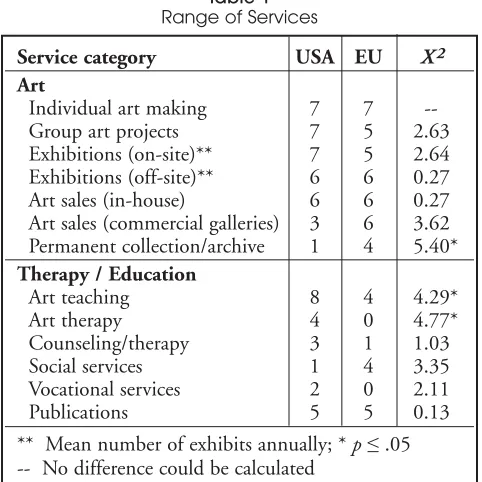
Section 2 of the survey focused on the range of servic-es offered by each program. Thservic-ese servicservic-es can be loosely categorized as relating to art, therapy/education, or daily living (Table 1). In the category of art, most items were parallel with the exception of maintaining a permanent collection or archive, which was statistically more likely among European sites. With respect to therapeutic and educational services, only the items of art teaching and art therapy rose to the level of statistical difference, with both having stronger representation among the U.S. programs. There were no significant differences when the daily living services were compared.
Section 3 asked questions related to funding, but because some participants answered with percentages and others with yes/no responses, solid figures on funding sources cannot be calculated. Counting either a “yes” or a
Service category USA EU X2
Art
Individual art making 7 7
--Group art projects 7 5 2.63
Exhibitions (on-site)** 7 5 2.64 Exhibitions (off-site)** 6 6 0.27 Art sales (in-house) 6 6 0.27 Art sales (commercial galleries) 3 6 3.62 Permanent collection/archive 1 4 5.40*
Therapy / Education
Art teaching 8 4 4.29*
Art therapy 4 0 4.77*
Counseling/therapy 3 1 1.03
Social services 1 4 3.35
Vocational services 2 0 2.11
Publications 5 5 0.13
[image:3.612.319.560.60.301.2]** Mean number of exhibits annually; * p≤.05 -- No difference could be calculated
number as a positive response in a category, the following percentage comparisons were derived: government funds (U.S. 75%, EU 71%), private funds (U.S. 50%, EU 0%), gallery sales (U.S. 50%, EU 57%), health insurance (U.S. 25%, EU 29%), fund raising/donations (U.S. 75%, EU 57%), participant fees (U.S. 38%, EU 14%), private foun-dation (U.S. 6%, EU 14%), and other (grants, corporate sponsors, Medicaid waivers, and “Friends of ” organiza-tions) (U.S. 50%, EU 14%). Clearly most programs have a mix of income streams, with the U.S. sample averaging slightly more, with an average of 4.4 sources per program as compared to an average of 2.6 sources of income in the EU programs. When programs are involved in the sale of participant work (U.S. 75%, EU 86%), there are varying ways the programs handle the proceeds: 100% to the artist (U.S. 1, EU 1), 100% to the program (U.S. 1, EU 2), or an artist/program split (U.S. 5, EU 4). These splits ranged from 90/10 to 50/50 to a three-way division among artist, program, and gallery.
Section 4 of the survey dealt with participant involve-ment in decision-making regarding the policies and prac-tices of the programs. No significant differences between the groups were found on any of the 11 items. This section also included two narrative items that asked what roles par-ticipant “motivation” and parpar-ticipant “talent” play in each program. The text responses were rated by the researchers as 1 (not important), 3 (moderately important), or 5 (very important). In both cases, the European respondents saw these factors as more important than their U.S. counter-parts (motivation: U.S. 3.75, EU 4.14, X23.53 and talent:
U.S. 2.75, EU 4.57, X216.91). In the case of talent, this
difference achieved clinical significance (p≤.05).
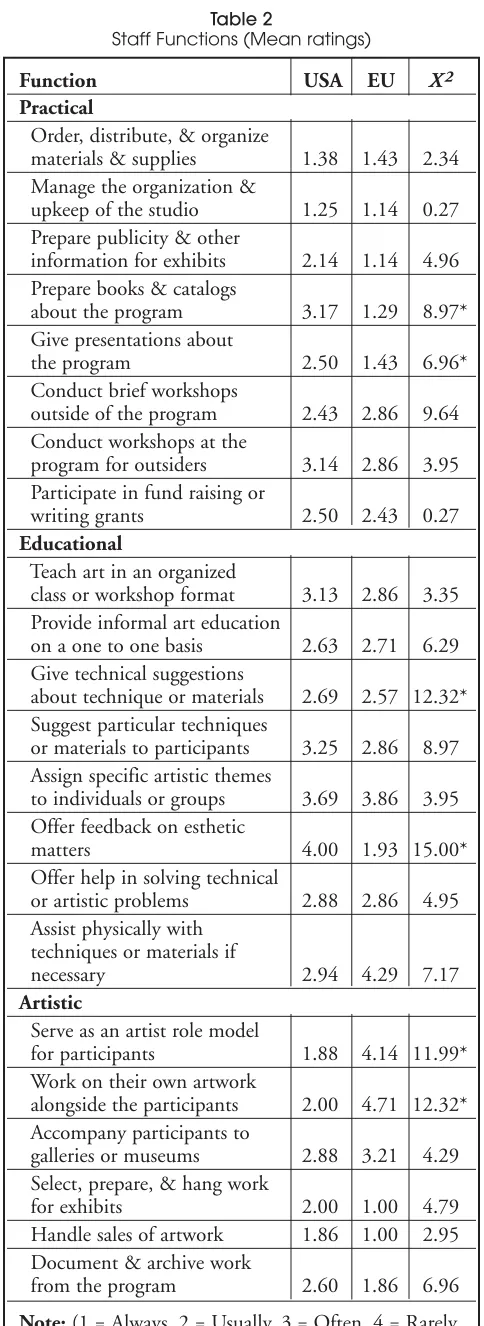
In Section 5, respondents were asked to rate the func-tions that staff members perform on a scale of 1 (always) to 5 (never). These functions can be loosely sorted into five categories: practical, educational, artistic, consultative, and interpersonal. Two items in the practical area (preparing publications and giving presentations about the program) were significantly more common among the Europeans. Two items in each of the educational areas (giving techni-cal and aesthetic feedback — a European practice) and artistic functions (serving as an artist role model and work-ing alongside the participants — a U.S. trend) were signifi-cant. The areas of consultative and interpersonal functions did not show significant differences (Table 2).
The final portion of the survey, Section 6, focused on the program mission statement. Although all responses do not appear to be formal organizational mission statements, the choice of language that characterizes each group is telling. The U.S. participants used phrasing that seemed to reflect social service (“personal growth,” “interpersonal understanding,” “profound stigmatization and isolation,” “creative expression,” “safe and supportive environment,” “self-care,” “judgment-free,” etc.) or sociological (“commu-nity involvement,” “marginalized,” “social change,” “sus-tainable,” “cultural, ethnic, gender, and spiritual diversity,” etc.) values. On the other hand, the Europeans used expres-sions that underscored the vocational aspects of their pro-grams (“opportunity and the financial security to live as
Function USA EU X2
Practical
Order, distribute, & organize
materials & supplies 1.38 1.43 2.34 Manage the organization &
upkeep of the studio 1.25 1.14 0.27 Prepare publicity & other
information for exhibits 2.14 1.14 4.96 Prepare books & catalogs
about the program 3.17 1.29 8.97* Give presentations about
the program 2.50 1.43 6.96* Conduct brief workshops
outside of the program 2.43 2.86 9.64 Conduct workshops at the
program for outsiders 3.14 2.86 3.95 Participate in fund raising or
writing grants 2.50 2.43 0.27
Educational
Teach art in an organized
class or workshop format 3.13 2.86 3.35 Provide informal art education
on a one to one basis 2.63 2.71 6.29 Give technical suggestions
about technique or materials 2.69 2.57 12.32* Suggest particular techniques
or materials to participants 3.25 2.86 8.97 Assign specific artistic themes
to individuals or groups 3.69 3.86 3.95 Offer feedback on esthetic
matters 4.00 1.93 15.00*
Offer help in solving technical
or artistic problems 2.88 2.86 4.95 Assist physically with
techniques or materials if
necessary 2.94 4.29 7.17
Artistic
Serve as an artist role model
for participants 1.88 4.14 11.99* Work on their own artwork
alongside the participants 2.00 4.71 12.32* Accompany participants to
galleries or museums 2.88 3.21 4.29 Select, prepare, & hang work
for exhibits 2.00 1.00 4.79 Handle sales of artwork 1.86 1.00 2.95 Document & archive work
from the program 2.60 1.86 6.96
[image:4.612.318.560.49.712.2]Note:(1 = Always, 2 = Usually, 3 = Often, 4 = Rarely, 5 = Never, 0 = Does not apply); *p≤.05
Table 2
professional artists,” “sell and rent out the work,” “recogni-tion,” “professional life,” etc.) with an emphasis on the artistic quality of the art products (“artistic development,” “high quality,” “real artists,” “intrinsic value of the paint-ings,” “talented disabled artists,” “art studio and gallery,” etc.). The phrase “the creative process” (or some related theme, such as “creative path,” “creative expression,” “Creative Source,” etc.) was used by all but one of the U.S. art therapists, whereas the term “creativity” in any form was used only once among the European sample. Another dimension of this narrative analysis was a strong theme shared by the two groups. Although all programs alluded to the special circumstances of the participants either directly (“people with disabilities”) or more indirectly (“people who are usually situated far outside society”), all avoided overt-ly clinical language such as “treatment,” “diagnosis,” “ther-apy,” or “assessment.” Even the term “therapeutic” appeared only once in the total sample and only in paren-thesis to suggest a broad understanding of the term.
Discussion
An analysis of the data from these two samples reveals interesting parallels and divergences. The apparent gap in the staff/participant ratio is a case in point. The U.S. pro-grams were more likely to have a number of different indi-viduals come through their doors for different program offerings during a given week, whereas the EU programs tended to operate a single program with the same partici-pants attending full-time. Considered from this perspective, the true ratio of staff to participants in the two samples is likely to be closer in any given hour than the data suggest. The EU programs showed a tendency to maintain a more specialized focus, a fact that is echoed in their serving fewer populations and their generally longer-term involve-ment with given individuals. Regarding the program nomenclature, the U.S. programs leaned toward human service terminology whereas the Europeans favored art-related language.
More similarities than differences were discovered when program services were compared. The Europeans showed a greater commitment to maintaining a permanent collection (a logical choice when artistic production is the main function) than the U.S. respondents. The reverse is true with respect to offering art therapy and art education services. Although the EU sample by design did not offer art therapy services, it is curious that only half of the U.S. programs with art therapists on staff claimed to provide art therapy. This suggests that these practitioners see them-selves as having moved away from the profession’s tradi-tional model. Surprising, too, was the fact that despite the value the Europeans placed on art quality, approximately half the sample did not teach art. This may relate to the art bruttradition (strongly held in Europe) that rejects cultur-al influences on art making.
In terms of funding, there is a large degree of scatter in the results. This is due in part to the confusion among respondents (some used percentages whereas others answered “yes” or “no”) but is also due to the fact that five
different national healthcare and arts funding systems influenced these results. Nearly all the programs in this study find it necessary to seek multiple funding sources to sustain their programs.
When asked to describe the self-governance within the programs, both groups appeared to be fairly egalitarian. The themes of motivation and talent were included in the survey because these terms seemed to come up continually in on-site discussions. The scores for motivation are close. However, in retrospect, the U.S. respondents may have interpreted the question of motivation as “motivation to get into treatment” and the Europeans may have thought of it as “motivation to pursue an art career.” The striking distinction is around the topic of talent. The difference is logical in light of the focus the European programs place on the production of quality art. This focus leads to the active recruitment of artistically gifted individuals into these programs. The historic value in art therapy of “process over product” can explain the low endorsement of talent among the U.S. respondents.
As with the range of responses in the service section of the survey, the similarities among staff functions in the two groups are more striking than the differences, and only three of the five subtopics areas (practical, educational, and artistic) showed any significant variations. The U.S. sample demonstrated a stronger trend toward staff working along-side the participants as artist role models. The Europeans, on the other hand, were more likely to work on books and presentations about the program, and to offer technical and aesthetic feedback to the artists. These trends seem to be in keeping with the therapy versus art orientations of the sample.
The narrative analysis of the mission statements in Section 6 revealed that neither group emphasized clinical language in the description of their programs. The state-ments from the U.S. group favored terminology with a social service tone, whereas the EU leaned toward profes-sional art world language.
Navratil, the founder of the famous Haus der Künstler, dis-cussed the early days of this program and his use of Machover’s Human Figure Drawing test (as cited in Maizels, 2001). A few sentences later he stated: “I did not use art therapy in the beginning, but only this test and these experiments on a diagnostic aspect” (p. 43). Although readers of this journal may grasp the distinction being made, this conflation of art therapy, drawing assess-ment, research, and diagnosis is fairly common when art therapy is mentioned in various “outsider art” publica-tions, and facilitators in atelier programs are more likely to read these sources than Art Therapy. A broader philosoph-ical position is well illustrated in the somewhat terse expla-nation offered at one Dutch program: “We do not do art therapy because these people are not sick.” Such a state-ment was true of the developstate-mentally delayed artists at that particular site; their condition was a life state rather than an illness. This position reflects the normalization principle (Wolfensberger & Thomas, 1983) where every effort is made to destigmatize individuals by facilitating age- and culturally-appropriate opportunities rather than grafting “therapy” onto the end of every activity. In this model, involving people in socially valued activities (e.g., art, work) rather than socially distancing ones (e.g. sick-ness, therapy) helps to strip away layers of “otherness.”
This fundamental distinction helps explain the differ-ences in the two samples. In many ways the programs are statistically indistinguishable, but they differ at this therapy/ art split. Although comparisons of the EU ateliers to tra-ditional U.S. art therapy programs would likely show greater differences, the U.S. studio-based programs in this sample still retain echoes of a clinical history despite hav-ing moved away from the therapy mainstream. Although by no means jargon-heavy, the U.S. descriptions still sug-gest a human service rather than a vocational or art world mission. The split is also demonstrated in the value placed on talent. Programs geared toward the development of artists must look for and nurture talent. As art therapists, we are acculturated from day one to reassure our clients that in terms of their art expression “it doesn’t matter what it looks like.” A professional art perspective requires gal-leries, exhibitions, and sales. To be viable, the art from such a program must appeal to the public — in short, it doesmatter what it looks like!
Can art therapists facilitate programs based on the European studio model? Certainly nothing in the American Art Therapy Association’s online “Definition of the Profession” (n.d.) seems to rule out such practice. To enter this arena requires art therapist to grapple with pro-fessional practice issues relating to confidentiality and dual relationships. The art therapy professional code of practice permits public presentation of client artwork as long as written, informed consent is obtained and such exhibitions are handled with respect and client welfare in mind (Art Therapy Credentials Board, n.d.). Yet the same document specifies, “the therapist shall ensure that appropriate steps are taken to protect client identity” (para. 4.1.2.3). Because placing the artist’s name alongside a work is normal gallery practice, it can be argued that disclosing the names of
artists (with permission) has a potential therapeutic bene-fit. Applying normalization and social role valorization principles, such a program could employ a vocational reha-bilitation model to help marginalized individuals find a valued place in society.
Although art therapists are urged to establish nonex-ploitive financial arrangements, the sale of work from art therapy contexts is not currently dealt with in the code of practice, yet it extends naturally from exhibiting artworks. The majority of EU and U.S. programs in this sample had sales. These ranged from occasional, in-house events to established program shops to ongoing relationships with professional (sometimes international) galleries. Art thera-pists are barred from “entering into therapeutic or non-professional relationships with current or former clients” (para. 4.1.3.1), yet helping to manage the “career” aspects in our practice (e.g., exhibition, sales) in this context would be understood as another professional role for the art therapist rather than a dual relationship.
In any treatment program there are clinical and prac-tical factors (e.g., age, diagnosis, sobriety, income level, insurance coverage, etc.) that influence access. In a studio program, artistic talent and motivation would need to be considered as essential admission features. It would not be unreasonable to have some form of portfolio review as part of the admission process for such a program.
The art therapist, too, would need to develop a certain art world savvy. One director of a well-known non-art ther-apy program put it this way: “Many people who start these kinds of programs come from social work or medical back-grounds…they’re so well intentioned, but they don’t really understand the philosophy of art making” (DeCarlo, 2006, p. 39). Imbedded in this philosophy are the skills of criti-cal aesthetic judgment and facility with the exhibition and marketing of work. Adopting such a position demands a strong shift away from the tradition of valuing all client art products, regardless of their artistic merit, and toward offering technical and aesthetic feedback to bring work to gallery standards that help keep the work and the program viable. As with other specialty art therapy applications, additional training, consultation, or supervision in the area of arts management is advised. Such a strategy would help art therapists gain new skills and recognize when the serv-ices of other professionals are needed.
Ultimately, the comparison of these two samples of programs calls into question some traditional art therapy values as well as current ethical and practice guidelines. Are we constrained by the very standards we have established for ourselves or will reevaluating certain “therapy” conven-tions from our practice free us to work more creatively? Do our standards restrict us to practice only in the traditional psychotherapy rubric or do they have the elasticity to adapt as our practices evolve?
Conclusion
create art? Can they be both? These “therapeutic” studios hold promise as legitimate sites for expanded art therapy practice, yet they are only part of a growing trend in the field toward community-based practice. Moving from a narrow medical model to services that address broader social, vocational, and rehabilitation dimensions demands a redefinition of the limits of the art therapy field.
Returning to the Magritte painting, what I find extraordinary is that it jars the viewer into thinking in a new way, to question what is seen and what is known. The painting is, of course, not a pipe. It is something much more — it is the image andthe idea of a pipe. It reminds us that images and the ideas behind them can prompt us to reconsider our realities.
References
Adamson, E. (1984). Art as healing.London: Coventure.
Allen, P. B. (1995). Coyote comes in from the cold: The evolu-tion of the open studio concept. Art Therapy: Journal of the American Art Therapy Association, 12(3), 161-166.
American Art Therapy Association. (n.d.). Definition of the pro-fession. Retrieved February 11, 2008, from http://www.art therapy.org/aamembership.html
Art Therapy Credentials Board. (n.d.). Code of professional prac-tice. Retrieved February 11, 2008, from http://atcb.org/code ofpractice
Block, D., Harris, T., & Laing, S. (2005). Open studio process as a model of social action: A program for at-risk youth. Art Therapy: Journal of the American Art Therapy Association, 22(1), 32-38.
DeCarlo, T. (2006). Creative growth. Raw Vision, 54,34-41.
Feilacher, J. (Ed.). (2004). Sovären das Haus der Künstler in Gugging. [Sovereign of the House of Artists of Gugging]. Heidelberg, Germany: Edition Braus im Wachter Verlag.
Franklin, M. (1996). A place to stand: Maori culture-tradition in a contemporary art studio. Art Therapy: Journal of the American Art Therapy Association, 13(2), 126-130.
Funk, R. (1987). Disability rights: From caste to class in the con-text of civil rights. In A. Gartner & T. Joe (Eds.), Image of the disabled, disabling images (pp. 7-30). New York: Praeger.
Gronert, F. (Ed.). (2002). Folly drawings: About in- and outsiders in art. Rotterdam, Netherlands: Galerie Atelier Herenplaats.
Höss, H. (1987). Persons with a mental handicap — Anthropological aspects and educational concepts. In A. D. Spellenberg (Ed.), Artists from Stetten: An exhibition by persons with a mental handicap. (pp. 15-19). Stuttgart, Germany: Konrad Wittwer.
Katz, E. (1994). Creativity, art and the disabled individual. International Journal of Arts Medicine, 3(2), 30-33.
Lemanczyk, I. (2004). Moment mal: Künstler aus Stetten. Stuttgart, Germany: Neuer Kunstverlag.
Maizels, J. (2001). John Maizels interviews Dr. Leo Navratil, founder of the Gugging House of Artists. Raw Vision, 34, 42-48.
McGraw, M. (1995). The art studio: A studio-based art therapy program. Art Therapy: Journal of the American Art Therapy Association, 12(3), 167-174.
Nirje, B. (1969). The normalization principle and its human management implications. In R. Kugel & W. Wolfensberger (Eds.), Changing patterns in residential services for the mentally retarded (pp. 179-195). Washington, DC: President’s Committee on Mental Retardation.
Spaniol, S. E. (1990). Organizing exhibitions of art by people with mental illness. Boston: Manual Center for Psychiatric Rehabilitation, Boston University.
Spaniol, S. E. (1994). Confidentiality reexamined: Negotiating use of art by clients. American Journal of Art Therapy, 32, 69-74.
Tillyer, M. D., & Accordino, M. P. (2002, Winter). Painting with a broad brush: Professional careers for artists with psychiatric disabilities. Psychiatric Rehabilitation Journal, 25(2), 265-272.
Timm-Bottos, J. (1995). Artstreet: Joining community through art. Art Therapy: Journal of the American Art Therapy Association, 12(3), 184-187.
Timmerman, M. (n.d.). Original power of expression. Ermelo, Netherlands: Art and Artability.
Ulman, E. (1961). Art therapy: Problems of definition. Bulletin of Art Therapy, 1,10-20.
Vick, R. M. (2000). Creative dialog: A shared will to create. Art Therapy: Journal of the American Art Therapy Association, 17(3), 216-219.
Wolfensberger, W. (2000). A brief overview of social role val-orization. Mental Retardation, 38(2), 105-123.