Published online 22 August 2006 in Wiley InterScience (www.interscience.wiley.com) DOI: 10.1002/mma.766 MOS subject classification: 05 A 15; 05 A 16; 05 A 17
Multinomial permutations on a circle
Yoram Zimmels
∗,†and Leonid G. Fel
Department of Civil and Environmental Engineering,Technion,Haifa 32000,Israel
Communicated by W. Spr¨oßig
SUMMARY
Multinomial permutations on a circle are considered in the framework of combinatorics. Different cases are presented and shown to agree with previously derived formula for the number of cyclic necklaces. Two applied examples are discussed with a view to illustrate the implications of derived formulas. Copyright q 2006 John Wiley & Sons, Ltd.
KEY WORDS: multinomial circular permutations; partition diagrams
1. INTRODUCTION
Elementary combinatorics gives the number of distinct permutations P(nm)=N!/(n1! · · ·nm!)in
a set M that is comprised of N elements divided between m distinct subsets, each consisting of identical elements, N=n1+ · · · +nm, wherenm denotes a tuple(n1, . . . ,nm). Sometimes it
is important to know the number of different permutations if the setM remains invariant under the action of additional operation. This situation occurs when the N elements are distributed uniformly on the circle in such a way that the angular distance between adjacent elements is 2/N. In this case, we set an additional requirement that two arrangements of the N elements are equivalent under the action of a cyclic groupCN, i.e. after rotating one of them by the angle
2r/N, r∈N, rN.
This question is related in pure mathematics to the Frobenius–Burnside counting problem and is known as a cyclic necklace enumeration problem. The main result here dates back to P´olya[1]who gave the generating functionZCN(xi)from which the number(CN,nm)of different
necklaces arises as a coefficient in ZCN(xi)[2–6]. The explicit formula for(CN,nm)is given in
Reference[7]and verified in Reference[8]
(CN,nm)=
1
N
d|
(d)P(km), whereP(km)=(k1+ · · · +m km)! j=1 kj! ,
kj=
nj
d (1)
∗Correspondence to: Yoram Zimmels, Department of Civil and Environmental Engineering, Technion, Haifa 32000, Israel.
wherekm and =gcdnm denote a tuple (k1, . . . ,km) and a great common divisor of the tuple nm, respectively.(d)denotes the Euler totient function,
(d)=d
r
j=1
(1−1/pj), where gcd(d,pj)>1 (2)
where pj are all the prime divisors ofd,r gives their number andd is any divisor of.
In this paper we derive(CN,nm)in several cases which are distinguished by different. We
verify Formula (1) by making use of straightforward calculation of (CN,nm) which is rather
combinatorial than group-theoretical. This method is much longer and sophisticated, however it presumes no need for knowledge in Frobenius–Burnside counting problem, P´olya enumeration theorem and all the group-theoretical methods behind them. This work addresses the wide audience of professionals in electrical, chemical, civil engineerings and computer science.
2. APPLICATION OF COMBINATORIAL METHOD
Letnm be given with gcd(n1, . . . ,nm} = where the prime factorization ofis defined by
=pa1
1 ·. . .· p
a
, al∈N∪ {0}, pl are primes, l=1, . . . , (3)
and stands for dimension of representation (3). Denote by b the tuple (b1, . . . ,b)such that bl∈N∪ {0} and 0blal. Next, define the integer D(b)=p1b1 ·. . .· pb, e.g. D(0)=1 and
D(a)=where0=(0, . . . ,0)anda=(a1, . . . ,a), respectively.
Let u and v be two tuples of the same dimension . Define a relation uv if for every 1la relation 0ulvl holds, i.e. D(v)is divisible by D(u).
Being a composite integer D(a)facilitates the construction of different cyclic permutations in the setM. In order to account for all of them correctly, it is convenient to represent the entire number P(nm)of distinct permutations (cyclic permutations included) in the form
P(nm)= 0ba
N D(b)C
nm D(b)
(4)
whereN/D(b)is an integer and the tuple
nm D(b)=
n1 D(b), . . . ,
nm
D(b)
(5)
corresponds to the set of N/D(b) elements of m distinct subsets, the kth subset consisting of nk/D(b) identical elements. The new entity C(nm/D(b)) stands for the number of cyclic
permutations of the units (comprised of set elements) of the length D(b). Formula (4) can be readily generalized to any intermediate tuplegu such that0ga,
P
nm D(g)
= gba
N D(b)C
nm D(b)
(6)
the tuplea
(CN,nm)= 0ba
C
nm D(b)
(7)
3. SPECIFIC CASES
Case0: Start with a trivial case where all ni do not have common divisors, gcd(n1, . . . ,nm} =1.
By (4) and (7) we have
(CN,nm)=
1
NP(n
m) (8)
Case1: In this case gcd(n1, . . . ,nm} =pwherepis a prime. Making use of (4) and (6) we have
P
nm
p
= N pC
nm
p
, P(nm)=N C(nm)+ N pC
nm
p
(9)
Combining both equalities in (9) we obtain
(CN,nm)=
1
N
P(nm)+(p−1)P
nm
p
(10)
In what follows, we draw a graphG(nm)associated with every prime factorization (3) and label its vertices by the integers D(bd)for all tuplesbd satisfying0dbdad. Here two vertices D(1bd)
and D(2bd)are connected with a bond if and only ifdj=1|1bj−2bj| =1.
Case 2: Consider a case where gcd(n1, . . . ,nm)=p2 with a corresponding graph shown
in Figure 1.
The conservation laws of permutations for the vertices p2,pand 1 read
P
nm
p2
= N p2C
nm
p2
, P
nm
p
= N p2C
nm
p2
+ N pC
nm
p
P(nm)= N p2C
nm
p2
+ N pC
nm
p
+N C(nm)
Combining the last equalities we get
(CN,nm)=
1
N
P(nm)+(p−1)P
nm
p
+p(p−1)P
nm
p2
(11)
Formula (11) paves the way to a more general case.
Case 3: Let nm be given and gcd(n1, . . . ,nm)=pa with a corresponding graph shown
Figure 1. Graph with gcd(nm)=p2.
[image:4.567.121.484.312.521.2]Figure 2. Graph with gcd(nm)=pa.
Figure 3. Graph with gcd(nm)=p1p2.
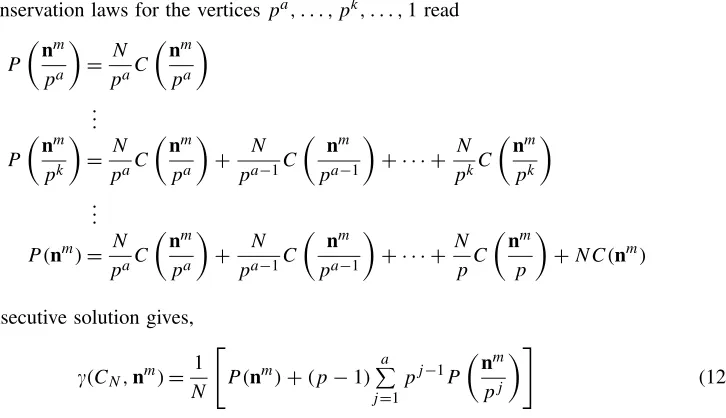
The conservation laws for the vertices pa, . . . ,pk, . . . ,1 read
P
nm
pa
= N paC
nm
pa
...
P
nm
pk
= N paC
nm
pa
+ N pa−1C
nm pa−1
+ · · · + N pkC
nm
pk
...
P(nm)= N paC
nm
pa
+ N pa−1C
nm pa−1
+ · · · + N pC
nm
p
+N C(nm)
Their consecutive solution gives,
(CN,nm)=
1
N
P(nm)+(p−1)
a j=1
pj−1P
nm
pj
(12)
It is easy to see that Formulas (8), (10), (11) and (12) satisfy (1). Now we move on to the cases where gcd(n1, . . . ,nm}is composed from several primes.
Case4: In this case gcd(nm)=p1p2and the corresponding graph is shown in Figure 3.
The conservation laws for the vertices p1p2,p1,p2 and 1 read
P
nm p1p2
= N p1p2
C
nm p1p2
P
nm
p1
= N p1p2
C
nm p1p2
+ N p1
C
nm
p1
Figure 4. Graph with gcd(nm)=p
1p2p3.
P nm p2 = N p1p2
C
nm p1p2
+ N p2 C nm p2
P(nm)= N p1p2
C
nm p1p2
+ N p1 C nm p1 + N p2 C nm p2
+N C(nm)
After simple algebra we obtain
(CN,nm)=
1
N
P(nm)+(p1−1)P
nm
p1
+(p2−1)P
nm
p2
+(p1−1)(p2−1)P
nm p1p2
(13)
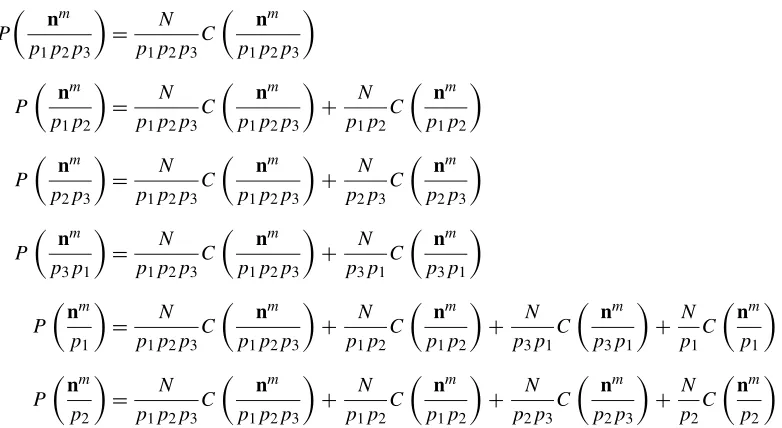
Case5: Consider the case where gcd(nm)=p1p2p3with corresponding graph shown in Figure 4.
Here the conservation laws for 8 vertices read
P
nm p1p2p3
= N p1p2p3
C
nm p1p2p3
P
nm p1p2
= N p1p2p3
C
nm p1p2p3
+ N p1p2
C
nm p1p2
P
nm p2p3
= N p1p2p3
C
nm p1p2p3
+ N p2p3
C
nm p2p3
P
nm p3p1
= N p1p2p3
C
nm p1p2p3
+ N p3p1
C
nm p3p1
P nm p1 = N p1p2p3
C
nm p1p2p3
+ N p1p2
C
nm p1p2
+ N p3p1
C
nm p3p1
+ N p1 C nm p1 P nm p2 = N p1p2p3
C
nm p1p2p3
+ N p1p2
C
nm p1p2
+ N p2p3
C
nm p2p3
Figure 5. Graph with gcd(nm)=p2 1p2.
P nm p3 = N p1p2p3
C
nm p1p2p3
+ N p1p3
C
nm p1p3
+ N p2p3
C
nm p2p3
+ N p3 C nm p3
P(nm)= N p1p2p3
C
nm p1p2p3
+ N p1p2
C
nm p1p2
+ N p1p2
C
nm p1p2
+ N p1p3
C
nm p1p3
+ N p1 C nm p1 + N p2 C nm p2 + N p3 C nm p3
+N C(nm)
After simple algebra we obtain,
(CN,nm)=
1
N
P(nm)+ 3
l=1
(pl−1)P
nm pl
+3
l>r
(pl−1)(pr−1)P
nm plpr
+(p1−1)(p2−1)(p3−1)P
nm p1p2p3
(14)
The extended case gcd(nm} =j=1pj which by Equation (1) gives
(CN,nm)=
1
N
P(nm)+ j=1
(pj−1)P
nm pj
+
j>k
(pj −1)(pk−1)P
nm pjpk
+ · · · +
j=1
(pj −1)P
nm p1·. . .·p
(15)
is more challenging. However, it is outside the scope of this work.
Case6: In this case gcd(nm)=p21p2 and corresponding graph is shown in Figure 5.
The conservation laws for 6 vertices read
P n
m
p12p2
= N p12p2
C n
m
p12p2
P
nm p1p2
= N p12p2
C n
m
p12p2
+ N p1p2
C
nm p1p2
P n
m
p12
= N p12p2
C n
m
p12p2
+ N p21C
nm p21
P nm p1 = N p12p2
C n
m
p12p2
+ N p1p2
C
nm p1p2
+ N p12C
nm p21
+ N p1 C nm p1 P nm p2 = N p12p2
C n
m
p12p2
+ N p1p2
C
nm p1p2
+ N p2 C nm p2
P(nm)= N p12p2
C n
m
p12p2
+ N p1p2
C
nm p1p2
+ N p12C
nm p21
+ N p1 C nm p1 + N p2 C nm p2
+N C(nm)
After simple algebra we obtain
(CN,nm)=
1
N
P(nm)+(p1−1)P
nm
p1
+(p2−1)P
nm
p2
+p1(p1−1)P nm
p21
+(p1−1)(p2−1)P
nm p1p2
+p1(p1−1)(p2−1)P nm p12p2
(16)
As in the previous cases, Examples 4–6 give the results which are satisfying the general Formula (1). The most general case of Formula (1) when gcd(n1, . . . ,nm} =p1a1·. . .·pa seems
to be excessively complex and presents a challenge in the context of combinatorial derivation. Note that the general Formula (1) can be extended so as to cover the case where the number of positions Nt on the circle exceeds the total number of elements N. In this case Formula (1) is
valid with the running index j=0, . . . ,N, andn0=Nt−N is added to the tuplenm, representing
dummy elements.
4. ENGINEERING APPLICATIONS
In the following we illustrate examples of engineering applications of multinomial permutations on a circle.
1. Synthesis of new organic materials.
In organic chemistry the number of structural isomers provides options for construction of different molecules using the same atoms. If the basic structure is cyclic, such as in the case of benzene rings, then this number can be calculated by Formula (1).
2. Transmission of different electric signals.
A set of N electric signals comprises k different subsets, the jth subset consists of nj
transmitted through theNwires of a coaxial cable and how many arrangements of the signals turn identical.
3. Generation of shift-register cycles.
A formula for multinomial permutations on a circle for the case of a set comprising only two different subsets is given in Reference[9]. This formula was used in an algorithm to construct binary sequences.
In what follows, the first two categories are discussed in further detail.
4.1. Cyclic organic materials
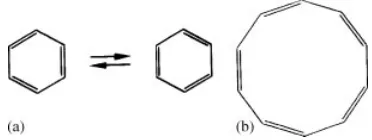
As shown in Figure 6(a), the benzene ring offers six identical positions that can be used to attach one or more of the functional groups specified in Reference[10]. A basic question is how many theoretical compounds can be synthesized from the benzene, its derivative and the available functional groups [10]. In general, if there are m functional groups of interest and n positions on an aromatic ring, then the number of different arrangements with up tonrepetitions of these groups on the ring (one group per position), disregarding cyclic equivalence, ism+nn−1.
For example, if H, OH and COOH are selected, thenm=3 and usingn=6 for the benzene ring and disregarding cyclic equivalence, the result is 28. Note that here repetition allows the choice of each of the groups up to 6 times. Suppose our choice changes to 2H, 2OH and 2COOH, and there is one functional group per single position, then the maximum number of different compounds obtainable with the benzene ring (using all 6 functional groups and excluding cyclic equivalence) is according to Formula (10), (6!/2!3+3!/1!3)/6=16. The same result would be obtained had we selected only 4 functional groups, say 2H and 2OH leaving two positions on the benzene ring empty. Here we denote empty positions by SFG (slack functional group) giving again a set of 6 groups 2H, 2OH and 2SFG. If 3H and 3OH, or 3H and 3SFG are selected, the result is 4. Thus increasing the number of a selected functional groups from 2 to 3 produced a 4 fold decrease in the number of different compounds that can be constructed using the benzene ring.
The all-cis-cyclodecapentaene has 10 positions around its ring, Figure 6(b). Using 5 different pairs, e.g. 2H, 2OH, 2COOH, 2NO2and 2SH, gives via Equation (10), 11 352 different permutations
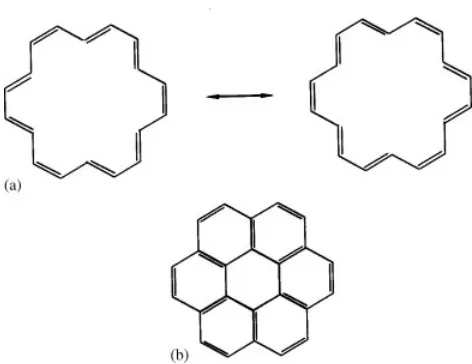
of compounds. Had we used 5H and 5OH (or 5SFG) the result is 26. The annulene, Figure 7(a), has 18 positions on its outer ring. However, the 6 fold symmetry persists so that our selection of functional groups must be in 6 sets, each consisting of 3 functional groups. If we are interested inl3 functional groups, then there are 3lways of selecting different groups (each comprising three functional groups). Consequently, there are3l3+6−16 ways to occupy the 18 outer positions of the annulene ring (with the set of3l triplets and disregarding their 3! internal permutations) while keeping its 6 fold symmetry.
[image:8.567.190.376.553.623.2]Figure 7. (a) The annulenering; and (b) the coronene ring.
Figure 8. (a) Division of an area enclosed by a circle into 10 identical sectors; and (b) schematic cross-section of a general coaxial cable.
Suppose we setl=4 then the result is 112. If we pick, out of 112, 6 sets comprised of three pairs (e.g.AA,BBandCC) where each pair consists of two identical units of 3 functional groups, then using Equation (10) and recalling that there are 3! internal permutations in each of the different units, we get 3·3!316=10 368, as the number of different arrangements on the annulene ring. In other two-dimensional structures that use the benzene ring as a building block (Figure 7(b)), the result inr·r!q(CN,nm)wherer is the number of functional groups in a unit,qis a number of
different pairs of these units, and(CN,nm)is the number of different multinomial permutations
of the 2q units on the outer ring of the structure.
Note thatq=(the number of positions on the outer ring)/2r. In the above example,r=3 and the number of positions is equal to 18, so thatq=18/6=3.
4.2. Transmission of signals and storage of data
Figure 8(a) shows division of the area enclosed by a circle inton identical sectors. The set ofn
[image:9.567.165.401.89.271.2] [image:9.567.165.400.308.424.2]in content, being different from one subset to the other. In theith subset there are ji different wires,
ports or storage sites that transmit or store different signals. An example of one such arrangement in a coaxial cable is shown in Figure 8(b).
In this case the number of different signals or storage options, S1, is given by
S1=
k i=1
ji!(CN,nk) (17)
Here, a combined signal from all sectors depends on their relative positions, so that cyclically equivalent positions are counted as being the same. Ifni of the tuple nk are allowed to vary in
the range[0,n]for alli, then Equation (17) is extended asS2=Alk S1, where Alkdenotes all
k+n−1 n
tuples nk that can be combined from thek pulses. For example, if ji=1 for all i, and
k=3,n=6, we get a sum of 28 terms
S2=(CN,{6,0,0})+(CN,{5,1,0})+ · · · +(CN,{0,1,5})+(CN,{0,0,6}) (18)
Ifkcan vary from 1 to a final valuekf, then Equation (17) is extended further as,S3=
kf k=1 S2.
The last expression forS3gives the total number of words that can be transmitted or stored in the
configuration of Figure 8(a).
REFERENCES
1. P´olya G. Kombinatorische anzahlbestimmungen f¨ur Gruppen, Graphen, und chemische Verbindungen. Acta Mathematica1937;68:145–154.
2. Harary F, Palmer EM.Graphical Enumeration. Academic Press: New York, 1973.
3. Rotman JJ.An Introduction to the Theory of Groups(Chapter 3). Allyn and Bacon: Boston, MA, 1984. 4. Polya G, Read RC. Combinatorial Enumeration of Groups, Graphs, and Chemical Compounds. Springer:
New York, 1987.
5. Harary F.Graph Theory. Addison-Wesley: Reading, MA, 1994.
6. Kerber A.Applied Finite Group Actions(Chapter 3, 2nd edn). Springer: Berlin, 1999.