DOI: 10.22099/jtls.2017.25896.2291
Interactional Complexity Development, Interactional Demonstrators and Interaction Density in
Collaborative and e-collaborative Writing Modalities
Zohre Mohamadi Assistant Professor
Islamic Azad University, KarajBranch
Abstract
This study aimed at investigating the potential of collaborative and e-collaborative writing modalities in developing interactional complexity, utilization of interactional demonstrators and density of interaction. To this end, 66 Iranian intermediate female English as foreign language learners (EFL) were selected to participate in this study according to their scores on Oxford Placement Test (OPT). Participant assignment into experimental group was done on the basis of computer literacy criterion. The conversation analysis of transcribed conversations in collaborative writing and log analysis of e-collaborative writing on e-writing forum indicated that collaborative writing led to more complex interaction than e-collaborative writing on the basis of interaction complexity measure. Significant differences were found in the frequency of interactional resources and demonstrators in two writing modalities using chi-square analysis. Informational demonstrators occurred more in e-collaborative writing, and interactional, attitude and empathic resources occurred more in collaborative writing. Interaction density measure was also in favor of collaborative writing. The results implied that implementation of collaborative tasks is potential technique for the development and assessment of interactional competence .
Keywords: interactional complexity, interactional resources, interactional
density, collaborative writing, e-collaborative writing
* English Translation Department, Karaj Branch, Islamic Azad University, Karaj Branch , Iran
With the introduction of communicative competence, second and foreign language acquisition/learning literature has thrived with research on how and what factors affect the development of communicative competence components including grammar, sociolinguistic and discourse and strategic ones (Hulstijn, 2011). While the other three competencies are owned individually, strategic competence is composed of a set of skills that help better accomplished the other three. Later added to the competency model, is interactional competence (Young & He, 1998). Interactional competence is defined as the knowledge and ability constructed as a result of "interactional processes during interactive tasks such as negotiation of meaning, feedback, and production of modified output" (Kim, 2009, p. 255). Interactional processes include corrective feedback, modification of input, uptake of forms, recast and meta-linguistic talk opportunities, confirmation checks and interaction management. Interactional competence is "co-constructed by all participants in a discursive practice; participants recognize and respond to expectations of what to say and how to say it by drawing on various identity, linguistic, and interactional resources that they bring to the interaction" (Morales & Lee, 2015, p. 34).
language deeply, reflecting on it and collaboratively solving linguistic problems (Elola & Oskoz, 2010; Li & Kim, 2016). There is much research evidence acknowledging the dialogic productive nature of collaborative writing which rests on the transformation from inter-subjectivity to intra-subjectivity (Platt & Brooks, 2002). There are plenty of studies on confirming decisive role of collaborative writing in influencing language complexity of learner language (Dobao, 2012; Elola & Oskoz, 2010; Jalili & Shahrokhi, 2017; McDonough & Fuentes, 2015; Yazdi-Amirkhiz, Ajideh, & Leitner, 2016) and cognitive task complexity on language complexity (Frear & Bitchener, 2015; Luna & Ortiz, 2013; Rahimpour & Mohamadi, 2012).
Literature Review Interactional Competence
Building on sociocultural research, the role of learner talk, negotiation of meaning and interaction in the classroom is acknowledged to promote language learning (Twiner, Littleton, Coffin, & Whitelock, 2014). In linguistically mediated social activities, qualified participants need something more than linguistic knowledge. Participants' diversity of linguistic and interactional resources indicates what a person knows and what a person does together with others in dialogic discourse practice (Morales & Lee, 2015). In dialogic interaction, the mind goes through meaning-making process that helps learners co-construct knowledge through establishing shared knowledge and moving from inter-subjectivity (learning by others what they cannot learn alone) to intra-subjectivity (self-regulated learning). It is proposed that if mind goes through this transformation, it should be seen in dialogic discourse (Mohamadi, 2017). In addition, interaction work requires participants go through repair negotiations as a result of communication breakdown and positively foster language development since repair negotiation creates comprehensible input through clarification requests, recast, prepositional adjustments, comprehension and confirmation checks which make learners have pushed output and in turn attend linguistic resources and reconstruct interlanguage development by the monitoring of external feedback (Kitajima, 2013).
and the crucial interplay between the peers and group members to manage and orchestrate discourse through interactional moves to accomplish the task objectives dialogically rather than authoritatively.
Various studies have explored the construct of interaction and how it unfolds in dialogic discourse from different perspectives. For example, Sato (2014) utilized competence based and performance-based measures on raters' perception and perception of participants on peer interaction. The results of regression analysis of elicited interaction specific features such as turn-taking highlighted the important role participants have. Besides, correlation analysis indicated that individual performance cannot be predicted regardless of context. Others explored how interaction is mediated by artifacts such as pedagogic tasks. For example, Kim's (2009) study of how task complexity affected the amount of attention and noticing learners give to the language supports the fact that the more complex the task is, the more focus on form occurs during an interaction. Other artifacts such as computers also received good attention recently. Research indicated that computers have dramatically changed interaction. Zhang, Liu, Chen, Wang and Huang's (2017) social network analysis, content analysis, and log sequential analysis indicated that in computer-assisted collaborative activities, interactions are less reciprocal and loosely connected. Kent, Laslo, and Rafaeli's (2016) study of interactivity in online discussion tools indicated that there is a significantly positive relation between interactivity and learning outcomes.
Interactional Complexity, Resources, and Density
complex interaction measured by counting the total number of turns performed by each speaker (number of turns) and a total number of words produced by a single speaker divided by the speakers' total number of turns.
As Arundale (2013) suggests, there are two types of conceptualization of interaction in communication. According to his specification, the first type is encoding decoding model which assumes interaction is the activity of one language operating system which operates irrespective of any other processing system. In this model, communication is a monolog alternated between individuals. This approach is summative and mostly conducted through omnipresent observation data collection procedure. The second type is interaction achievement conceptualization model which assumes that encoding decoding model masks non-summative interdependency of utterances. Here, interaction is an interplay between two or more individuals' cognitive autonomous behavior that makes an integral system. Accordingly, the research method is finding grounded viable evidence for interaction achievements. Whatever the approach is, there is the danger of the data being affected by the researcher perspective. Transcriptions of verbal and non-verbal activities reduce multimodal interaction into a monomial script. The transcripts may include the data perceived to be significant by the researcher (Twiner et al., 2014).
resources in L1 and FL (foreign language) and qualitative analysis identified linguistic and non-linguistic resources used by participants to achieve interactional meaning (Lindgren & Stevenson, 2013). The comparison between prosperous and less successful L1 and English argumentative writing of Chinese ESL university students indicated that successful argumentative writing differs from its counterpart as it includes more hedging interaction devices. Besides, it is stated that there is no significant difference in interpersonal devices such as boosters and attitude markers between the two. However, less authorial identity was found in L1 writing (Lee & Deakin, 2016).
seen a cognitive endeavored and only recently it is considered as a social one because ones' private speech in public shows that it is a shared problem to be solved and urge the other interlocutor to respond. Respectively, another interlocutor is seen as a fellow conversationalist rather than as an audience.
Interaction progress requires participants' orientation towards utilizing a variety of multi-modal phenomena including interaction organization activities, materials, body, and speech. This involves complex attentional and cognitive resources and adjustments to respond to dynamic fashion in interaction. It requires mutual orientation to pertinent features in the locus of attention to coordinate critical next moves and maintain interactional coherency (Bottema-Beutel & Smith, 2013). Among many interaction features, unique feature is density of interaction. The density of communication is measured according to Palonen, Hakkarainen, and Fishman (2013) measure. According to this measure, the more actors that have a connection with one another, the denser the interaction is. The number of observed ties is divided by the number of all possible tiles. The measure varies between 0 and 1. If the network is 0, the interaction is empty and has low density. If the value is 1, it indicates that others directly interacting with everyone else and the interaction is highly dense.
Since successful L2 writing partly depends on interaction features and qualities (Lee & Deakin, 2016), investigation how interaction modality moderates interaction features is worthy. Moderate interaction feature is worthy. However, little has been documented in this regard (Pardo-Ballester & Cabello, 2016). Therefore, this research is intended to investigate the potential of two writing modalities of collaborative and e-collaborative in fostering interactional complexity development, interaction demonstration, and intensity in Iranian EFL learners. The following research questions were set to attend the research objective.
2. Do collaborative and electronic collaborative writing differ regarding creating a medium for utilization of interactional demonstrators by writers?
3. Do collaborative and electronic collaborative writing differ concerning interactional density?
Method Participants
Student participants. Since equitable participation in the classroom environment is a crucial component of interactional competence and since how learners are positioned to enter classroom interaction affects their duties and responsibilities, and in turn development and demonstration affordances available across classroom interaction terrain (Pinnow & Chval, 2015), care was taken in homogeneity issues in participants selection. 66 Iranian adult intermediate female EFL learners with age range of 16-20 whose L1 was Persian were invited to participate in this study. The program was a free writing program participants voluntarily attended. From among 82 enrolled participants in the program, those whose scores on an Oxford Placement Test (2004 version) were 40-47 out of 60 representatives of intermediate level (Pollitt, 2009) were selected to take part in this study. The OPT interpretation rubric of Pollitt (2009) was used. Students were assigned to two groups of collaborative and e-collaborative writing. The experimental group assignment was based on computer literacy criterion; those who indicated they often used computers in program registration form were assigned into the e-collaborative group and the rest to the collaborative counterpart. 30 students were in each group. Students made three classes of 12 students. In each class, students made four groups of three students. The initial sampling was random sampling by proficiency level on OPT and computer literacy criterion. Within class, group assignment was done on the basis of convenient based sampling.
foreign language. They cooperated as duty paid teachers in this program with teaching writing experience of 5 -7 years. Besides instruction, they helped in data coding phase of the study. They were briefed and trained how to code the data using measurement rubrics of interactional complexity, interaction demonstrators, and density. The inter-rater reliability index for the three raters who rated the participants’ performance on the pretest of writing was .951 (p = .000). Had a single rater rated them three times, the intra-rater reliability would have been .867 (p = .000). The inter-rater reliability index for the three raters who rated the participants’ performance on the posttest of writing was .855 (p = .000). Had a single rater rated them three times, the intra-rater reliability would have been .663 (p = .000).
Instruments
Oxford placement test (2004 version). OPT is a standard test of language proficiency with a 6 rating scale; students whose score fell between 0-17 were considered as basic (A1), and students whose scores were 18-29 were identified as elementary students (A2). Those whose scores were between 30 and 39 were in the lower intermediate group (B1). The students with the scores of 40-47, were identified as upper intermediate (B2) and also students who obtained scores 48-54, and 54-60 were considered as advanced (C1) and very sophisticated (C2) levels respectively.
how to act as admins and use the potential and informative options provided by the website to monitor group work.
Collaboration instruction. The structure of collaboration adapted from Mulligan & Garofalo (2011) with some modifications was implemented in this study. The structure and organization of cooperation is as follow: 1) students choose their partners on the basis of their convenience; (2) they brainstorm about the topic which is selected considering topic familiarity issue; (3) they research and gather information using any source; (4) they provide the outline and give it back to the teacher and the teachers provides pertinent comments; (5) they then plan and write the first draft; (6) they check out the first selection according to the check list provided by the teacher in advance; (7) each student had editing individually with different highlight colors so that when handed together they could track each other's ideas and provide justification for the required revisions; (8) they handed in their writing to the teacher and the teachers comment on language, content and organization; (9) students received the teachers' comments and revised the paper together. Students in both experimental groups were briefed and instructed to follow the mentioned collaboration structure in doing their assignment in class and online through the website.
information perceived cohesively with the speaker/hearer and has psychological reality for the encoder) (Crookes, 1990). Each c-unit was coded and given specific type and category according to the functions they played. The elicited demonstrators, their types, and examples are provided in the related data analysis part. The density of interaction is measured according to Palonen et al.'s (2013) measure. The more actors that have the connection with one another, the denser the interaction is. The number of observed ties is divided by the number of all possible tiles. The measure varies between 0 and 1. If the network is 0, the interaction is empty and has low density. If the value is 1, it indicates that everyone is directly interacting with everyone else and the interaction is highly dense. The inter-rater reliability index between the teachers rating and coding the data according to measures of interactional complexity, demonstrators and density were taken as the reliability in decisions made in coding stage.
Procedure
After participant selection and required briefing session for students and teachers on their roles in each research context, the researcher conducted the study. The teachers provided instruction on the same topic and writing genres of argumentative, classification and division, comparison and contrast, description and definition through the same syllabus and lesson plan across two groups through PowerPoint presentation and teacher-directed instruction. Teachers gave explicit analytic feedback to student writing in each group. Students were asked to write their assignment following the procedure mentioned earlier in each group in the class period. The transcription of collaborative writing and log analysis of electronic collaborative writing were coded by the raters for measuring interactional complexity, demonstrators and density for later analysis according to the measurement rubrics.
Data Collection Procedure
writing program were taken as pretest and posttest in measuring interactional complexity development in each group. The purpose was to track changes in the interactional complexity development from pretest to post- test as a result of practicing in different writing modalities. Interactional resources and demonstrators were elicited through the transcription and log analysis of c-unit in collaborative and e-collaborative writings. The frequency count of the interactional resources and demonstrators through chi-square analysis indicated if two writing modalities are significantly different concerning interactional resources on ten writing sessions. Density analysis was also done by raters rating the density of interaction through transcription analysis of collaborative and log analysis of electronic collaborative writing on ten sessions of writing according to the density measurement rubric. The data were analyzed using independent-samples t-test to answer the first research question which investigates if writing modality affects the development of interactional complexity and analysis of chi-square to answer the second and third research questions which examine if two writing modalities have different potential in creating a medium for the occurrence of interactional demonstrators and degree of density.
Results
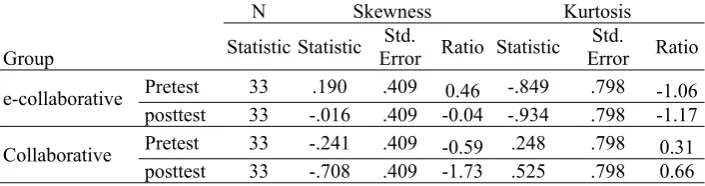
Before presenting the primary results, the assumptions of normality of the data and homogeneity of variances across the groups were checked. Based on the results displayed in Table 1, it can be concluded that the assumption of normality was met. The absolute values of the ratios of skewness and kurtosis over their standard errors were lower than 1.96.
Table 1.
Descriptive Statistics; Testing Normality Assumption
Group
N Skewness Kurtosis
Statistic Statistic Error Std. Ratio Statistic Error Std. Ratio
e-collaborative Pretest 33 .190 .409 0.46 -.849 .798 -1.06
posttest 33 -.016 .409 -0.04 -.934 .798 -1.17
Collaborative Pretest 33 -.241 .409 -0.59 .248 .798 0.31
An independent t-test was run to compare the collaborative and e-collaborative groups' means on the pretest of interactional complexity to prove that the two groups were homogenous regarding the index of interactional complexity of their performance before the main study. Based on the results displayed in Table 2, it can be claimed that the collaborative (M = 21.11, SD = 5.13) and the e-collaborative (M = 21.05, SD = 5.85) groups had relatively the same means on the pretest of interactional complexity.
Table 2.
Descriptive Statistics; Pretest of Interactional Complexity by Groups
group N Mean Std. Deviation Std. Error Mean
Pretest collaborative 33 21.11 5.134 .894
e-collaborative 33 21.05 5.852 1.019
Table 3.
Independent Samples T-Test; Pretest of Interactional Complexity by Groups
Levene's
Test t-test for Equality of Means
F Sig. t Df Sig. (tailed)2- Difference Mean Difference Std. Error
95% Confidence Interval of the
Difference
Lower Upper
Equal
varia
nces
assume
d
.801 .374 .042 64 .967 .057 1.355 -2.651 2.764
Equal
varia
nces
not
.042 62.93 .967 .057 1.355 -2.651 2.764
The Effect of Writing Modality on Interactional Complexity Development
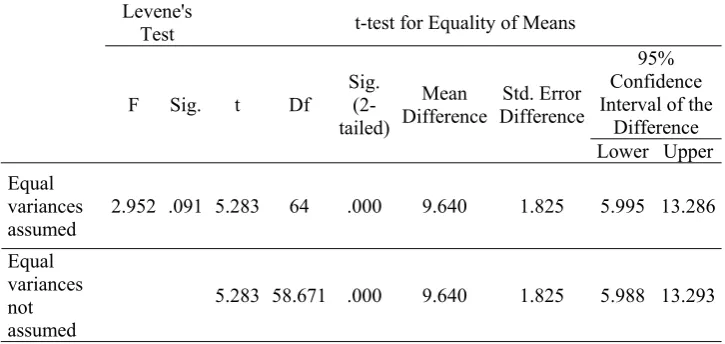
An independent t-test was run to compare the collaborative and e-collaborative groups' means on the posttest of interactional complexity. Based on the results displayed in Table 4 it can be claimed that the cooperative group (M = 37.15, SD = 8.45) had a higher mean than the e-collaborative (M = 27.51, SD = 6.19) on the posttest of interactional complexity.
Table 4.
Descriptive Statistics; Posttest of Interactional Complexity by Groups
group N Mean Std. Deviation Std. Error Mean
Posttest Collaborative 33 37.15 8.457 1.472
e-collaborative 33 27.51 6.196 1.079
Table 5.
Independent Samples t-test; Posttest of Interactional Complexity by Groups
Levene's
Test t-test for Equality of Means
F Sig. t Df Sig.
(2-tailed)
Mean Difference
Std. Error Difference
95% Confidence Interval of the
Difference Lower Upper Equal
variances
assumed 2.952 .091 5.283 64 .000 9.640 1.825 5.995 13.286
Equal variances not assumed
5.283 58.671 .000 9.640 1.825 5.988 13.293
It should be noted that the assumption of homogeneity of variances was met (Levene’s F = 2.95, p = .091). That is why the first row of Table 5, i.e., "Equal variances assumed" was reported.
The interactional Demonstrators in Collaborative and e-Collaborative Writing
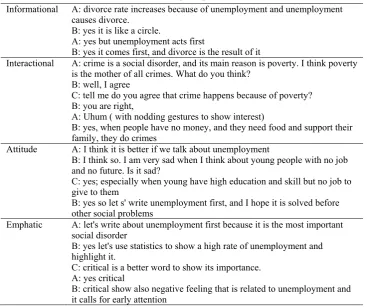
or unintentionally. Attitude demonstrators are the devices participants in conversation use to express their feeling either towards the content of the conversation of or the flow of conversation. The last type of demonstrator was strong one indicating value judgments, or emphasis participants give to the conversation segments. The following table provides episode examples of each kind of interactional demonstrators. The categories were based on Crookes's (1990) classification of interactional resources, but the episodes were taken from the real data of the present study.
Table 6.
Interactional demonstrators and sample episodes
Informational A: divorce rate increases because of unemployment and unemployment causes divorce.
B: yes it is like a circle.
A: yes but unemployment acts first
B: yes it comes first, and divorce is the result of it
Interactional A: crime is a social disorder, and its main reason is poverty. I think poverty is the mother of all crimes. What do you think?
B: well, I agree
C: tell me do you agree that crime happens because of poverty? B: you are right,
A: Uhum ( with nodding gestures to show interest)
B: yes, when people have no money, and they need food and support their family, they do crimes
Attitude A: I think it is better if we talk about unemployment
B: I think so. I am very sad when I think about young people with no job and no future. Is it sad?
C: yes; especially when young have high education and skill but no job to give to them
B: yes so let s' write unemployment first, and I hope it is solved before other social problems
Emphatic A: let's write about unemployment first because it is the most important social disorder
B: yes let's use statistics to show a high rate of unemployment and highlight it.
C: critical is a better word to show its importance. A: yes critical
B: critical show also negative feeling that is related to unemployment and it calls for early attention
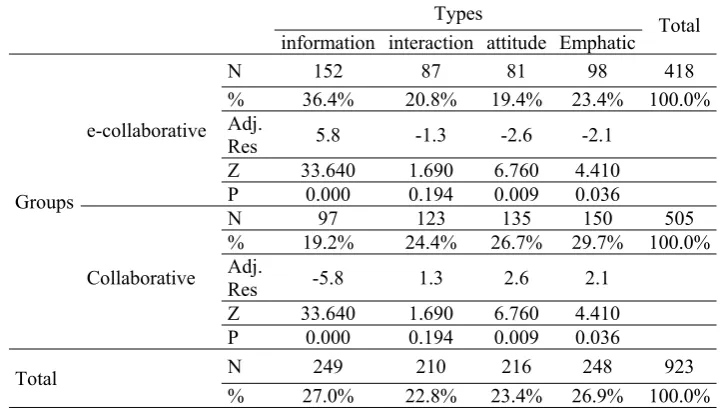
run to compare the collaborative and e-collaborative groups' use of four types of interactional demonstrators. Table 7 displays the frequency, percentages, adjusted standardized residuals, z-values, and p-values for the four types of interactional demonstrators. Before discussing the results, it should be mentioned that the p-values computed for each cell should be compared against the Bonferroni corrected p-value of .0062; i.e., .05 / 8 = .0062, in order not to commit type I error by using a single statistic eight times.
The results indicated that the e-collaboration group (Adj. Residual = 5.8 > 1.96, p = .000 < .0062) employed “information” interactional demonstrators significantly more than what was expected, while the collaborative group’s use was significantly less than expectation (Adj. Residual = -5.8 > -1.96, p = .000 <.0062).
Table 7.
Frequencies; Percentages and adjusted Std. Residuals of Interactional Demonstrators by Groups
Types Total
information interaction attitude Emphatic
Groups
e-collaborative
N 152 87 81 98 418
% 36.4% 20.8% 19.4% 23.4% 100.0%
Adj.
Res 5.8 -1.3 -2.6 -2.1
Z 33.640 1.690 6.760 4.410
P 0.000 0.194 0.009 0.036
Collaborative
N 97 123 135 150 505
% 19.2% 24.4% 26.7% 29.7% 100.0%
Adj.
Res -5.8 1.3 2.6 2.1
Z 33.640 1.690 6.760 4.410
P 0.000 0.194 0.009 0.036
Total N 249 210 216 248 923
% 27.0% 22.8% 23.4% 26.9% 100.0%
difference between the two groups was not a significant one. The collaboration group (Adj. Residual = 2.1 > 1.96, p = .036 > .0062) employed “empathic” interactional demonstrators more the e-collaborative group (Adj. Residual = -2.1 > -1.96, p = .036 >.0062); although the difference between the two groups was not a significant one. The two groups made almost the same use of “interaction” type (Adj. Residual < +/- 1.96).
The results of chi-square (χ2 (3) = 34.83, p = .000, r = .194
representing a weak effect size) (Table 8) indicated that there were significant differences between the two groups' use of interactional demonstrators. The results should be reported cautiously due to the weak effect size value of .194 and also since only one of the four types of interactional demonstrators; i.e. "information" showed a significant difference between the two groups.
Table 8
Chi-Square Tests; Interactional Demonstrators by Groups
Value Df Asymptotic Significance (2-sided)
Pearson Chi-Square 34.832a 3 .000
Likelihood Ratio 34.868 3 .000
Linear-by-Linear
Association 23.603 1 .000
N of Valid Cases 923
a. 0 cells (.0%) have expected count less than 5. The minimum expected number is 95.10.
Table 9.
Frequencies; Percentages and adjusted Std. Residuals of Interactional Density by Groups
Type Total
low High
Group
e-collaborative
N 30 100 130
% 23.1% 76.9% 100.0%
Adj. Res 2.6 -2.6
Z 6.76 6.76
P .009 .009
Collaborative
N 20 150 170
% 11.8% 88.2% 100.0%
Adj. Res -2.6 2.6
Z 6.76 6.76
P .009 .009
Total N % 16.7% 83.3% 100.0% 50 250 300
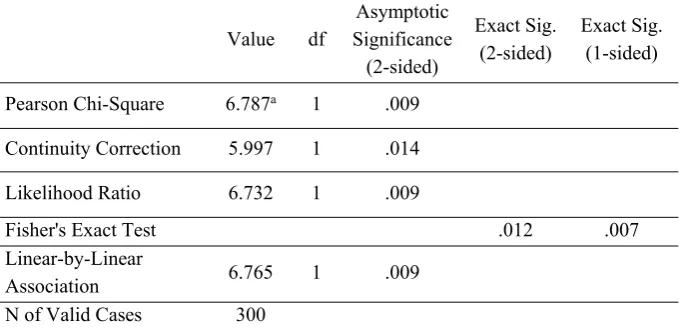
The results of chi-square (χ2 (1) = 5.99, p = .014, r = .141 representing
a weak effect size) (Table 10) indicated that there were significant but weak differences between the two groups' use of interactional density. The results should be reported cautiously due to the uncertain effect size value of .141.
Table 10.
Chi-Square Tests; Interactional Density by Groups
Value df
Asymptotic Significance (2-sided)
Exact Sig. (2-sided)
Exact Sig. (1-sided)
Pearson Chi-Square 6.787a 1 .009
Continuity Correction 5.997 1 .014
Likelihood Ratio 6.732 1 .009
Fisher's Exact Test .012 .007
Linear-by-Linear
Association 6.765 1 .009
Value df
Asymptotic Significance (2-sided)
Exact Sig. (2-sided)
Exact Sig. (1-sided)
a. 0 cells (.0%) have expected count less than 5. The minimum expected count is 21.67.
b. Computed only for a 2x2 table
Discussion
This study investigated the effect of writing modality including collaborative and e-collaborative writing on the development of interactional complexity, implementation of interactional demonstrators and density of interaction. The results indicated that both groups had improvement on interactional complexity from pretest to posttest. Also, collaborative writing has more potential in fostering the development of interactional complexity. The results also indicated that informational demonstrators were more in e-collaborative writing than a collaborative one. Attitude, emphatic and interactional demonstrators were quantitatively more in collaborative writing than in e-collaborative writing. The results also indicated that interaction in collaborative writing was denser than that in e-collaborative writing.
elicitation techniques were used either in classroom learning context or assessment and evaluation context (Morales & Lee, 2015). The results also are consistent with those of the study by Kitajima (2013). He confirmed that repair negotiation and interaction management are more when the productive task is convergent in nature which means learners need to come to a similar constructed outcome as in collaborative writing.
However, the results of this study do not support the previous research on e-collaborative writing. Choi's (2008) evaluation of e-collaborative writing on ESL writing through questionnaire and interview and reflective essay indicated a supportive role of e-collaborative writing which could not be approved in this study. This contrary to previous research (Goldberg, Russell, & Cook, 2003; Hayes & Ge, 2008; Lehtinen, Hakkarainen, Lipponen, Rahikainen, & Muukkonen, 1999) suggests that when it comes to technology, e-collaborative learning is not as successful as collaborative classroom writing. Several unanswered questions are left which masks other important issues than achievements based analysis.
Adams, and Newton (2012)' study of syntactic complexity in text chats as noticeable amount of ideas is expressed through emoticons and abbreviations
Conclusions and Implications
classes need to be compared with computer-assisted classes. Technology does not always mean better. The haphazard infrastructure services such as internet speed and quality may put some students at advantages of others (Rabiee, Nazarian, & Gharibshaeyan, 2013). Teacher and student perspective analysis can reveal what roles macro and micro factors play in quality judgments of interactions.
References
Alwi, N. A. N. M., Adams, R., & Newton, J. (2012). Writing to learn via text chat: Task implementation and focus on form. Journal of second
language writing, 21(1), 23-39 .
Arundale, R. B. (2013). Conceptualizing ‘interaction in interpersonal pragmatics :Implications for understanding and research. Journal of
pragmatics, 58, 12-26 .
Azadi, S. (2015). The role of classroom interaction on the improvement of speaking among Iranian learners. International Journal of Language
Learning and Applied Linguistics World, 8(1), 126-135 .
Bottema-Beutel, K., & Smith, N. (2013). The interactional construction of identity: An adolescent with autism in interaction with peers.
Linguistics and Education, 24(2), 197-214 .
Chalak, A., & Karimi, M. (2017). Analysis of turn-taking and repair strategies among male and female Iranian intermediate EFL learners.
Journal of Applied Linguistics and Language Research, 4(2), 1-9 .
Choi, J. W.-C. (2008). The role of online collaboration in promoting ESL writing. English LanguageTeaching, 1(1), 34-49 .
Collentine, J., & Freed, B. F. (2004). Learning context and its effects on second language acquisition: Introduction. Studies in second
Language acquisition, 26(2), 153-171 .
Crookes, G. (1990). The utterance, and other basic units for second language discourse analysis. Applied linguistics, 11(2), 183-199 .
Deci, E. L., & Ryan, R. M. (2000). The" what" and" why" of goal pursuits: Human needs and the self-determination of behavior. The
psychological inquiry, 11(4), 227-268 .
Dobao, A .F. (2012). Collaborative writing tasks in the L2 classroom: Comparing group, pair, and individual work. Journal of second
Ellis, R. (2003). Task-based language learning and teaching: Oxford
University Press.
Ellis, R., & Barkhuizen, G. P. (2005). Analysing learner language: Oxford
University Press, USA.
Ellis, R., Tanaka, Y., & Yamazaki, A. (1994). Classroom interaction, comprehension, and the acquisition of L2 word meanings. Language
learning, 44(3), 449-491 .
Elola, I & ,.Oskoz, A. (2010). Collaborative writing: Fostering foreign language and writing conventions development. Language Learning
& Technology, 14(3), 51-71 .
Elola, I., & Oskoz, A. (2017). Writing with 21st-century social tools in the L2 classroom: New literacies, genres, and writing practices. Journal
of Second Language Writing .
Frear, M. W., & Bitchener, J. (2015). The effects of cognitive task complexity on writing complexity. Journal of second language
writing, 30, 45-57 .
Fulcher, G. (2003). Testing second language speaking: Pearson Education.
Ghaith, G. (2003). Effects of the learning together model of cooperative learning in English as a foreign language reading achievement, academic self-esteem, and feelings of school alienation. Bilingual
Research Journal, 27(3), 451-474 .
Goldberg, A., Russell, M., & Cook, A. (2003). The effect of computers on student writing: A meta-analysis of studies from 1992 to 2002. The
Journal of Technology, Learning, and Assessment, 2(1), Available
from http://www.jtla.org.
Hall, J. K., & Smotrova, T. (2013). Teacher self-talk: an Interactional resource for managing instruction and eliciting empathy. Journal of
pragmatics, 47(1), 75-92 .
Hayes, T., & Ge, X. (2008). The effects of computer-supported
collaborative learning on students' writing performance. Paper
presented at the Proceedings of the 8th international conference on International conference for the learning sciences-Volume 1.
Hulstijn, J. H. (2011). Language proficiency in native and nonnative speakers: An agenda for research and suggestions for second-language assessment. Language Assessment Quarterly, 8(3),
229-249 .
Writing. Journal of Applied Linguistics and Language Research, 4(4), 13-28 .
Kent, C., Laslo, E., & Rafaeli, S. (2016). Interactivity in online discussions and learning outcomes. Computers & Education, 97, 116-128 .
Kim, Y. (2009). The effects of task complexity on learner-learner interaction. System, 37(2), 254-268 .
Kitajima, R. (2013). Interactional features of repair negotiation in NS– NNS interaction on two task types: Information gap and personal information exchange. Linguistics and Education, 24(2), 165-178 .
Lee, J. J., & Deakin, L. (2016). Interactions in L1 and L2 undergraduate student writing: Interactional metadiscourse in successful and less-successful argumentative essays. Journal of second language
writing, 33, 21-34 .
Lehtinen, E., Hakkarainen, K., Lipponen, L., Rahikainen, M., & Muukkonen, H. (1999). Computer supported collaborative learning: A review. The JHGI Giesbers reports on education, 10, 1999 .
Li, M., & Kim, D. (2016). One wiki, two groups: Dynamic interactions across ESL collaborative writing tasks. Journal of second language
writing, 31, 25-42 .
Lindgren, E., & Stevenson, M. (2013). Interactional resources in the letters of young writers in Swedish and English. Journal of second
language writing, 22(4), 390-405 .
Lucas, E. M., Oliveira, T. C., Farias, K., & Alencar, P. S. (2017). CollabRDL: A language to coordinate collaborative reuse. Journal
of Systems and Software. 131, 505-527.
Luna, A. M. R., & Ortiz, L. S. H. (2013). Collaborative writing to enhance academic writing development through project work. HOW Journal, 20(1), 130-148 .
McDonough, K., & Fuentes, C. s. G. a. (2015). The effect of writing task and task conditions on Colombian EFL learners’ language use. TESL
Canada Journal, 32(2), 67 .
Mohamadi, Z. (2017). Task engagement: a potential criterion for quality assessment of language learning tasks. Asian-Pacific Journal of
Second and Foreign Language Education, 2(1), 3 .
Palonen, T., Hakkarainen, K., & Fishman, B. (2013). Patterns of interaction in computer-supported learning: A social network
analysis. Paper presented at the Fourth International Conference of
the Learning Sciences.
Pardo-Ballester, C., & Cabello, A. C. (2016). L2 collaborative E-writing.
Procedia-Social and Behavioral Sciences, 228, 601-607 .
Pinnow, R. J., & Chval, K. B. (2015). “How much You wanna bet?”: Examining the role of positioning in the development of L2 learner interactional competencies in the content classroom. Linguistics and
Education, 30, 1-11 .
Platt, E., & Brooks, F. B. (2002). Task engagement: A turning point in foreign language development. Language learning, 52(2), 365-400 .
Pollitt, A. (2009). The oxford online placement test: The meaning of OPT scores: London: Oxford University Press. Available for download at: http//oxfordenglishtesting. com.
Prohorets, E., & Plekhanova, M. (2015). Interaction intensity levels in a blended learning environment .Procedia-Social and Behavioral
Sciences, 174, 3818-3823 .
Rabiee, A., Nazarian, Z., & Gharibshaeyan, R. (2013). An explanation for internet use obstacles concerning e-learning in Iran. The
International Review of Research in Open and Distributed Learning,
14(3), 361-376 .
Rahimpour, M., & Mohamadi, Z. (2012). Incidental and intentional instruction on discussion techniques: Assessing complexity issue.
ISRN Education, Article ID 853460 .
Ryshina-Pankova, M. (2011). Developmental changes in the use of interactional resources: Persuading the reader in FL book reviews.
Journal of second language writing, 20(4), 243-256 .
Samarbakhsh Tehrani, S., Iravani, H., Hessamy, G., & Hemmati, F. (2013). The effects of teachers' interactional moves on learners' uptake in EFL classrooms. Journal of Language and Translation, 3(3), 81-92 .
Sato, M. (2014). Exploring the construct of interactional oral fluency: Second Language Acquisition and Language Testing approaches.
System, 45, 79-91 .
Sharan, S. (1980). Cooperative learning in small groups: Recent methods and effects on achievement, attitudes, and ethnic relations. Review
Shively, R. L. (2015). Developing interactional competence during study abroad: Listener responses in L2 Spanish. System ,48, 86-98 .
Turner, C. (2012). Classroom assessment. Routledge handbook of
language testing, 61-74 .
Twiner, A., Littleton, K., Coffin, C., & Whitelock, D. (2014). Meaning making as an interactional accomplishment: A temporal analysis of intentionality and improvisation in classroom dialogue.
International Journal of Educational Research, 63, 94-106 .
Urdan, T., & Schoenfelder, E. (2006). Classroom effects on student motivation: Goal structures, social relationships, and competence beliefs. Journal of school psychology, 44(5), 331-349 .
Yazdi-Amirkhiz, S. Y., Ajideh, P., & Leitner, G. (2016). The influence of collaboration on individual writing quality: the case of Iranian vs. Malaysian college students. Journal of English Language Teaching
and Learning,17(8), 1-24
Young, R., & He, A. W. (1998). Talking and testing: Discourse
approaches to the assessment of oral proficiency (Vol. 14): John
Benjamins Publishing.
Zhang, S., Liu, Q., Chen, W., Wang, Q., & Huang, Z. (2017). Interactive networks and social knowledge construction behavioral patterns in primary school teachers' online collaborative learning activities.
Computers & Education, 104, 1-17 .
Zheng, B., & Warschauer, M. (2017). Epilogue: Second language writing in the age of computer-mediated communication. Journal of Second