Original Article
Journal of Advances in Medical Education & Professionalism
Students teaching students: A novel solution for teaching procedures
via instruction on the corpse
CARLOS E GARCIA RODRIGUEZ1*, RAJ J SHAH1, CODY SMITH1, CHRISTOPHER
J GAY1, JARED ALVARADO1, DOUGLAS RAPPAPORT2, WILLIAM J
ADAMAS-RAPPAPORT3, RICHARD AMINI4
1College of Medicine, University of Arizona, 1501 N Campbell Ave, Tucson, AZ 85724, USA; 2Department of Emergency Medicine, Mayo Clinic Hospital, Phoenix, AZ, USA; 3Department of Surgery, University of Arizona, Tucson, AZ, USA; 4Department of Emergency Medicine, University of Arizona, Tucson, AZ, USA
Introduction: Increased faculty and resident responsibilities have led to the decreased time available for teaching clinical skills to medical students. Numerous advances in education and simulation have attempted to obviate this problem; however, documented success is lacking. Our objective was to describe a novel fresh cadaver-based, student-driven procedural skills lab and to compare the educational effectiveness of student instructors to the senior instructor (SI). Methods: This was a prospective study performed at an academic medical center. A pilot program, “Students Teaching Students,” was introduced where four trained first-year medical students (TMS) instructed 41 other untrained first-year medical students in technical procedures. This study compared the teaching evaluations of the SI with the TMS teaching equivalent procedures. Paired t-test was used to determine statistically significant changes in procedural confidence between pre- and post-training. Utilizing a post-training questionnaire, average post-training confidence improvement values and objective post-training test scores of the participants were compared between TMS and SI, using a 2 sample t-test. Statistical significance was considered as a p<0.05. All statistical analyses were conducted in Stata 11 (StataCorp LP, College Station, TX, USA).
Results: Twenty-nine out of 39 (74%) students completed the questionnaire. Both groups demonstrated a statistically significant improvement in subjective confidence level in performing each procedure when pre- and post-training scores were compared, while there was no statistically significant difference found in cognitive knowledge between the groups (p=0.73). There was no statistically significant difference in the mean confidence improvement between the SI and TMS groups for chest tube insertion (2.06 versus 1.92 respectively, p=0.587), femoral line placement (2.00 versus 1.94 respectively, p=0.734) or student test score (88% versus 85% respectively).
Conclusion: Our results demonstrate that first-year medical students well-trained in technical skills, such as our TMS, may be a valuable additional teaching resource. The Students Teaching Students procedure lab employed in this study was effective at immediately increasing first-year medical students’ confidence and technical skill. First-year medical students well-trained in technical skills, such as our TMS, may be a valuable additional teaching resource.
*Corresponding author:
Carlos Garcia Rodriguez, University of Arizona College of Medicine, 2550 E River Rd. Apt #11206, Tucson, AZ 85718
Tel: +602-5165993
Email: garciarodriguez1@ email.arizona.edu
Please cite this paper as:
Rodriguez CEG, Shah RJ, Smith C, Gay CJ, Alvarado J, Rappaport D, Adamas-Rappaport WJ, Amini R. Students teaching students: A novel solution for teaching procedures via instruction on the corpse. J Adv Med Educ Prof. 2019;7(2):51-55. DOI: 10.30476/JAMP.2019.44708. Received: 12 April 2018 Accepted: 17 December 2018
Keywords: Students, Teaching, Medical students
A
bs
tr
ac
Introduction
A
basic foundation of technical skill competency is pivotal in medical student training prior to entering residency.Unfortunately, opportunities to perform or
practice medical procedures have declined over the last two decades (1-3). It is postulated that some of the contributing factors include time constraints on academic faculty, increased
financial pressures, and overarching concerns
with allowing novice practitioners opportunities to “practice” on clinical patients (1).This national trend has led to growing concern that medical students may not be exposed to procedures that they will be expected to competently perform
upon entering residency (2, 4,5).
Innovations in the field of simulation and
procedure models have increased the medical
students’ exposure to clinical procedures. Despite these advances, the integration of these models requires dedicated time and significant faculty involvement (1, 3, 6-9). Our objective
was to describe a novel cadaver-based, student-driven procedural skills lab and to compare the educational effectiveness of student instructors to the senior instructor (SI).
Methods
This was a prospective study performed at an academic medical center. The study participants
were 41 first-year medical students. Participation
in the study was voluntary. Our sample was from
a population of medical students with a mean age
of 26, of whom 51% were male. This investigation was reviewed by the Institutional Review Board and determined to be a quality improvement project that does not require IRB oversight. Data were collected from February 2015 to May 2015.
Trained medical students (Authors) received
approximately 15 hours of training from the SI (Author), a professor of surgery with over 35 years
of surgical experience. This training included both didactic and hands-on procedural training
utilizing a non-preserved cadaver. Each procedure
was graded using a validated checklist. All of the participants in the STS group completed the given procedure without instruction before they were
deemed ready to teach their first year colleagues.
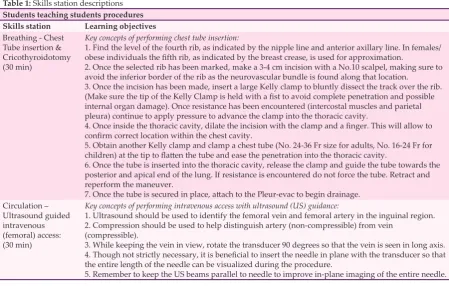
In addition, during the study this instruction between the STS group and the senior instructor was carried out regularly to insure expertise on the part of the former group (Table 1).
The authors instituted a two-hour hands-on technical procedures cadaver lab, called “Students Teaching Students,” which was
directed by four trained first-year medical students (TMS) and a SI. During each session, the TMS and SI groups used non-preserved cadavers to teach five distinct procedures: endotracheal
intubation, cricothyroidotomy, chest tube insertion, thoracentesis, and ultrasound-guided femoral line placement. Student participants were divided into three groups of three students, with novice student participants rotating through each
Table 1: Skills station descriptions
Students teaching students procedures
Skills station Learning objectives
Breathing - Chest Tube insertion & Cricothyroidotomy (30 min)
Key concepts of performing chest tube insertion:
1. Find the level of the fourth rib, as indicated by the nipple line and anterior axillary line. In females/ obese individuals the fifth rib, as indicated by the breast crease, is used for approximation.
2. Once the selected rib has been marked, make a 3-4 cm incision with a No.10 scalpel, making sure to avoid the inferior border of the rib as the neurovascular bundle is found along that location.
3. Once the incision has been made, insert a large Kelly clamp to bluntly dissect the track over the rib. (Make sure the tip of the Kelly Clamp is held with a fist to avoid complete penetration and possible internal organ damage). Once resistance has been encountered (intercostal muscles and parietal pleura) continue to apply pressure to advance the clamp into the thoracic cavity.
4. Once inside the thoracic cavity, dilate the incision with the clamp and a finger. This will allow to confirm correct location within the chest cavity.
5. Obtain another Kelly clamp and clamp a chest tube (No. 24-36 Fr size for adults, No. 16-24 Fr for children) at the tip to flatten the tube and ease the penetration into the thoracic cavity.
6. Once the tube is inserted into the thoracic cavity, release the clamp and guide the tube towards the posterior and apical end of the lung. If resistance is encountered do not force the tube. Retract and reperform the maneuver.
7. Once the tube is secured in place, attach to the Pleur-evac to begin drainage. Circulation –
Ultrasound guided intravenous (femoral) access: (30 min)
Key concepts of performing intravenous access with ultrasound (US) guidance:
1. Ultrasound should be used to identify the femoral vein and femoral artery in the inguinal region. 2. Compression should be used to help distinguish artery (non-compressible) from vein
(compressible).
3. While keeping the vein in view, rotate the transducer 90 degrees so that the vein is seen in long axis. 4. Though not strictly necessary, it is beneficial to insert the needle in plane with the transducer so that the entire length of the needle can be visualized during the procedure.
station. Two stations were taught by TMS and one
by the SI (Figure 1).
The cadaver lab was performed five times. Prior to each session, it was randomly determined
which procedural station would be taught by SI
and which one by TMS for the whole session. Each
station maintained an instructor to student ratio
of 1:2. Student participants were taught relevant pathophysiology and technical proficiency. Successful performance of the stations’ skill was required before rotating to the next station.
Assessment consisted of a post-training
questionnaire, made by the authors; it was
administered seven days after participation in the session.
The questionnaire included 12 objective questions used to assess the student’s knowledge in
performing the procedures independently, as well
as 13 questions regarding individual confidence
in performing the procedures via a 4-point Likert-scale (1=strongly disagree; 4=strongly agree). All students without prior experience were given an initial score of 1 (strongly disagree) regarding
confidence in performing the procedures taught. Participants with prior experience were excluded
from assessment.
After discussions with experts in the field of Emergency Medicine and General Surgery,
the decision was made to focus post-educational
assessment utilizing only 2 of the 3 procedures:
chest tube insertion (CTI) and ultrasound-guided
femoral line placement (FLP). These experts felt that CTI and FLP were most comparable regarding the level of difficulty and total number
of steps in performing the procedure.
Measurements of the 4-point Likert-scale
were used to compare the mean post training
confidence improvement (PCI), which was
defined as the difference between the students’ pre training confidence value and post training confidence value, via a paired t-test. Additionally,
average PCI values and objective post-training
test scores were compared between students
taught by TMS and students taught by SI using a 2-sample t test to determine any statistically
significant changes. All statistical analysis was conducted in Stata 11 (StataCorp LP, College Station, TX, USA). Data are presented as means and standard deviations (SD) and percentages with 95% confidence intervals (CI). A paired t-test was used for comparison of the paired samples. The
statistical level of significance was set at p < 0.05.
Results
A total of 41 students participated in the sessions, while 39 were given the post-training
questionnaire (two students were excluded from
the study due to previous experience).
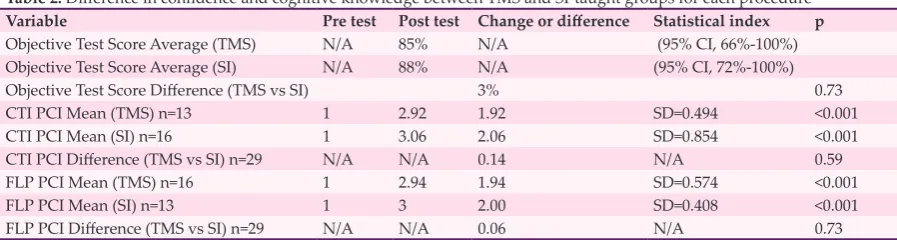
Seventy-four percent of the students (29/39) completed the post-training questionnaire. The objective test score average for all students was 86.3% (95% CI, 78%-94%). For students taught by TMS, cognitive test score average was 85% (95% CI, 66%-100 versus 88% for those taught by the SI (95% CI, 72%-100%) (p=0.73) (Table 2). The average student confidence improvement following instruction was 1.96 for FLP (p<0.001) and 2.0 for CTI (p<0.001) (Table 2). When comparing students taught by TMS vs. SI, we found no statistically significant differences in student procedural confidence (p=0.734) (Table 2).
Discussion
The importance of acquiring experience prior to clinical situations was recognized by
Kaplan et al.(1) and the American College of
Surgeons Residency Review Committee (10-11).
Surgical education has dramatically changed in response to numerous constraints placed on residency programs, but a substantial gap still exists between expectations and performance
(12). This gap is in part due to the declining
trend in teaching technical skills during medical school and has resulted in the necessity to look for
other avenues of skill training such as mannequin simulations and software-based training (2,
4). Technological advances have allowed for curriculums to create new, viable mechanisms of teaching modalities. Yet, limitations exist within
these avenues, such as the equipment cost and
the necessity to have full-time faculty present who is familiar with the software-based training. Furthermore, the realistic tissue handling, hepatic feedback and preserved tissue planes provided by non-preserved cadavers were unparalleled when compared to the inferior degree of realism
provided by mannequins (1, 2, 6-8, 13-19).
We implemented numerous fresh cadaver educational labs at our institution in the past. However, these training sessions did not address the constant strain on faculty time, nor did they evaluate the use of a peer-to-peer teaching method
(1, 3, 6-8, 16-19). The STS approach of
near-peer instructors sought to increase the teacher to student ratio, thus mitigating the issue of diminished faculty teaching time. There is some
evidence supporting the utilization of peer to peer
teaching, but its utility in teaching procedures is
unproven (12, 20). To the best of our knowledge, our study is unique in that it successfully
integrated medical students as educators for a clinical procedure lab. While some residency programs have created procedure labs, or “boot camps,” where incoming interns can learn and practice resident-level skills and procedures, there is no current practice in undergraduate
medical education (21).
Our results demonstrated no statistically
significant difference between TMS and SI instruction regarding the student participants’
subjective confidence level in performing the
procedure nor objective procedural cognitive knowledge. Our data suggest that properly trained
first-year medical students, such as our TMS,
can be a viable teaching resource in addition to clinical faculty. If this model proves successful in other studies, then the potential exists to improve the teacher to student ratio, allowing for increased hands-on instruction. In our study, our teacher to
student ratio was 1:2, which is lower than other
studies that have used small groups to teach
procedures (8). Smaller student to teacher ratios
increase practice opportunities, increasing the likelihood that a student will achieve competency in a given procedural skill. Repetition of procedures is pivotal to mastering skills in long
term as confirmed by other studies (21).
Within our institution, the Willed Body Program is a crucial component in training
students with non-preserved cadavers. However, the concept elicited by this paper can also be implemented as a viable option to increase the teacher to student ratios with other teaching modalities such as inexpensive phantom models. Further investigation is recomended to study the
efficacy of TMS in teaching hands-on technical
skills through methods other than non-preserved
cadavers, such as mannequin simulations or
software-based training.
Limitations
Our study had several limitations, including
small sample size. Although we tested the confidence of each student in performing each
skill set, further studies should evaluate and compare the performance of the technical
skill acquisition between student instructor groups and senior instructor groups. Moreover,
our investigation was vulnerable to self-selection bias, as students who volunteered had probably increased personal interest in
technical skill acquisition. Future investigations
are recommended to incorporate additional procedures to assess if other procedures could
Table 2: Difference in confidence and cognitive knowledge between TMS and SI-taught groups for each procedure
Variable Pre test Post test Change or difference Statistical index p
Objective Test Score Average (TMS) N/A 85% N/A (95% CI, 66%-100%)
Objective Test Score Average (SI) N/A 88% N/A (95% CI, 72%-100%)
Objective Test Score Difference (TMS vs SI) 3% 0.73
CTI PCI Mean (TMS) n=13 1 2.92 1.92 SD=0.494 <0.001
CTI PCI Mean (SI) n=16 1 3.06 2.06 SD=0.854 <0.001
CTI PCI Difference (TMS vs SI) n=29 N/A N/A 0.14 N/A 0.59
FLP PCI Mean (TMS) n=16 1 2.94 1.94 SD=0.574 <0.001
FLP PCI Mean (SI) n=13 1 3 2.00 SD=0.408 <0.001
FLP PCI Difference (TMS vs SI) n=29 N/A N/A 0.06 N/A 0.73
be taught in this manner. Future research should
also evaluate long-term benefits of procedural
competency prior to residency. Conclusion
The Students Teaching Students procedure lab employed in this study was effective in
immediately increasing first-year medical students’ confidence and technical skill.
First-year medical students well-trained in technical
skills, such as our TMS, might be a valuable
additional teaching resource. Acknowledgement
We would like to thank the Willed Body Program at the University of Arizona – College of Medicine for providing materials essential
for the study. This research did not receive any
specific financial grant from funding agencies in the public, commercial, or not-for-profit sectors.
Conflict of Interest: None declared. References
1. Kaplan SJ, Carroll JT, Nematollahi S, Chuu A, Adamas-Rappaport W, Ong E. Utilization of a non-preserved cadaver to address deficiencies in technical skills during the third year of medical school: A cadaver model for teaching technical skills. World J Surg. 2013;37(5):953-5.
2. DiMaggio PJ, Waer AL, Desmarais TJ, Sozanski J, Timmerman H, Lopez JA, et al. The use of a lightly preserved cadaver and full thickness pig skin to teach technical skills on the surgery clerkship-a response to the economic pressures facing academic medicine today. Am J Surg. 2017;200(1):162-6.
3. McCrary HC, Krate J, Savilo CE, Tran MH, Ho HT, Adamas-Rappaport WJ, et al. Development of a fresh cadaver model for instruction of ultrasound-guided breast biopsy during the surgery clerkship: pre-test and post-test results among third-year medical students. Am J Surg. 2016;212(5):1020-5.
4. Bridges M, Diamond DL. The financial impact of teaching surgical residents in the operating room. Am J Surg. 1999;177(1):28-32.
5. Qayumi K, Cheifetz RE, Forward D, Baird RM, Litherland HK, Koetting E. Teaching and evaluation of basic surgical techniques: the University of British Columbia experience. J Invest Surg. 1999;12(6):341-50. 6. Miller R, Ho H, Ng V, Tran M, Rappaport D, Rappaport WJ, et al. Introducing a Fresh Cadaver Model for Ultrasound-guided Central Venous Access Training in Undergraduate Medical Education. West J Emerg Med. 2016;17(3):362-6.
7. Nematollahi S, Kaplan SJ, Knapp CM, Tran M,
Rappaport D, Rappaport WJ, et al. Introduction of a fresh cadaver laboratory during the surgery clerkship improves emergency technical skills. Am J Surg. 2017;210(2):401-3.
8. Amini R, Stolz LA, Breshears E, Patanwala AE, Stea N, Hawbaker N, et al. Assessment of ultrasound-guided procedures in preclinical years. Internal and Emergency Medicine. 2017;12(7):1025-31.
9. Kay RD, Manoharan A, Nematollahi S, Nelson J, Cummings SH, Rappaport WJ, et al. A novel fresh cadaver model for education and assessment of joint aspiration. J Orthop. 2016;13(4):419-24.
10. Parent RJ, Plerhoples TA, Long EE, Zimmer DM, Teshome M, Mohr CJ, et al. Early, intermediate, and late effects of a surgical skills “boot camp” on an objective structured assessment of technical skills: a randomized controlled study. J Am Coll Surg. 2017; 210(6):984-9.
11. Chenot JF, Simmenroth-Nayda A, Koch A, Fischer T, Scherer M, Emmert B, et al. Can student tutors act as examiners in an objective structured clinical examination? Med Educ. 2007;41(11):1032-8. 12. Holland JP, Waugh L, Horgan A, Paleri V, Deehan DJ.
Cadaveric hands-on training for surgical specialties: Is this back to the future for surgical skills development? J Surg Educ. 2011;68(2):110-6.
13. Akaike M, Fukutomi M, Nagamune M, Fujimoto A, Tsuji A, Ishida K, et al. Simulation-based medical education in clinical skills laboratory. J Med Investig JMI. 2012;59(1-2):28-35.
14. Berman JR, Ben-Artzi A, Fisher MC, Bass AR, Pillinger MH. A comparison of arthrocentesis teaching tools: cadavers, synthetic joint models, and the relative utility of different educational modalities in improving trainees’ comfort with procedures. J Clin Rheumatol. 2012;18(4):175-9.
15. Sutherland LM, Middleton PF, Anthony A, Hamdorf J, Cregan P, Scott D, et al. Surgical simulation: a systematic review. Ann Surg. 2006;243(3):291-300. 16. Wong DT. What Is the Minimum Training Required
for Successful Cricothyroidotomy? Anesthesiology. 2003; 98(2):349-53.
17. Scott DJ, Dunnington GL. The New ACS/APDS Skills Curriculum: Moving the Learning Curve Out of the Operating Room. J Gastrointest Surg. 2008;12(2):213-21.
18. Varga S, Smith J, Minneti M, Carey J, Zakaluzny S, Noguchi T, et al. Central venous catheterization using a perfused human cadaveric model: Application to surgical education. J Surg Educ. 2015;72(1):28-32. 19. Soriano RP, Blatt B, Coplit L, CichoskiKelly E,
Kosowicz L, Newman L, et al. Teaching medical students how to teach: a national survey of students-as-teachers programs in U.S. medical schools. Acad Med. 2010;85(11):1725-31.
20. Kensinger CD, McMaster WG, Vella MA, Sexton KW, Snyder RA, Terhune KP. Residents as educators: A modern model. J Surg Educ. 2015;72(5):949-56. 21. Shea CH, Lai Q, Black C, Park JH. Spacing practice