(ISSN: 2582-158X)
Vol. 01, Issue 06, pp.276-282, September, 2019 Available online at http://www.journalijrar.com
RESEARCH ARTICLE
USE OF SCHOOL READINESS SCREENING TOOL FOR LEARNERS WITH SPECIAL NEEDS
*Dr. Zadock Obuchere Murundu
Tom Mboya University College, P.O. Box 199, Homa Bay, Kenya
ARTICLE INFO ABSTRACT
School Readiness Screening Test Tool is important because it is used by Educational Assessment and Research Centres, Professionals in the Educational Assessment Centres to determine school placement and intervention strategies for learners with Special Needs in Pre-schools. The tool has been in use in Educational Centres in Kenya since 1984 up to date and yet its efficacy is still in question. The purpose of this study was to find out the use of School Readiness Screening Tool for Learners with Special Needs in Kenya. The study adopted a descriptive survey design. The study involved 25 Educational Assessment professionals who were the coordinators of the Centres purposefully sampled from City, Urban, Rural and Semi-arid areas in Kenya. Data was collected by interview schedule, observation schedule and document analysis guide. The study revealed that; the School Readiness Screening Tool does not screen all kinds of disabilities. The study recommended that additional test content should be incorporated to the School Readiness Screening Tool to screen the contemporary Special Needs.
Key Words: Use, School Readiness, Screening Tool, Learners with Special Needs.
Copyright © 2019, Dr. Zadock Obuchere Murundu. This is an open access article distributed under the Creative Commons Attribution License, which permits unrestricted use, distribution, and reproduction in any medium, provided the original work is properly cited.
INTRODUCTION
Educational assessment in Kenya has been practiced since 1984. The process of screening using the School Readiness Screening Tool determines the category of special needs and disabilities that a learner may have and the placement options. In Kenya, Screening of School Readiness is done using a Screening tool at Educational assessment and Research Centres. The changing dimension in Special Needs Education is reflected in various reports, task force and educational reviews initiated by the government among them the Republic of Kenya (2008), which initiated the process of setting up facilities that could support parents and their children before admission to schools. The Kochung’ taskforce of 2003 established a big gap in the screening process and recommended that the services of Educational Assessment and Resource Services should be expanded to each District. The Koech Report (Republic of Kenya, 1999) emphasized the need of assessment personnel to support parents and their children in schools, Educational Assessment and Resource Centres and at home. These reviews specifically pointed out the need for assessment service and how they could be expanded to support parents and their children with special needs both at home and in school. The basis for establishment of Educational and Assessment Research Centres in Kenya in 1984 was for screening learners of pre-school age for early intervention, correct institution placement, identification of Special Needs and disabilities. The school readiness screening tools since introduction in 1984 screened the four traditional categories of learners with special needs that is metal handicaps, visually impaired and those speech and language difficulties. The diversities of children with special needs have since increased to include learners with autism, learners with specific learning disabilities, learners living under difficult circumstances,
learners with multiple handicaps and learners with emotional and behavioural problems. (Kochung’, 2003). Kochung’s (2003) taskforce established that, the first process of screening gives a picture of the presence of difficulties in children with diverse Special Needs. In response to these, the Ministry of Education, Science and Technology established diagnostic facilities to facilitate assessment (Republic of Kenya, 2004). This study investigated the possibility of new opportunities to screen contemporary categories of Special Needs and bridge the gap on the use of School Readiness Screening Tool by incorporating additional screening content to meet the individual needs of the contemporary learners with Special Needs. It also seeks to establish the difficulties faced in the use of School Readiness Screening Tool and to enable appropriate school placement and early intervention. The
Special Needs Education Policy (2009) in Kenya
acknowledges that learners with specific disabilities and Special Needs require specialized educational resources at individual and school levels. It is important to note that children with Special Needs in Kenya are generally grouped into four categories; those with physical disabilities, mental handicaps, visually impaired and speech and language difficulties. Currently, in all the Educational Assessment and Research Centres in Kenya, the assessment is carried out by use of School Readiness Screening Tool. The tool screens learners who; are blind, with autism, with specific learning difficulties and with mental retardation. After screening referral is done for intervention and placement, in addition, the tool cannot screen contemporary diversity of learners with Special Needs and Disabilities. Screening and Assessment of children with Special Needs is a multifaceted process that moves from general screening activities to a more specific and
narrow diagnosis. Educational Assessment determines
existence of a development delay, identifies strengths and needs, and develops strategies for intervention. Development Article History:
Received 24th June 2019,
Received in revised form 26th July 2019,
Accepted 20th August 2019,
Published online
30th September 2019.
perspectives and theories on child development are based on the development of screening procedures. First step in the screening process is to identify if the learner may have disabilities need further testing. According to the office of Special Education Programmes (OSEP), the screenings is used in connection with child activities it is not considered evaluation and is not subject prior to parental notice and consent requirements which apply to replacement evaluations. The process gives a rough picture of the presence of the problem. There are specially trained assessment teachers at the centres who screen children with special needs for the purpose of detecting difficulties and thereafter making educational decisions. The assessment teachers are supposed to work with other professionals as an interdisciplinary team. They include medical personnel like; physicians, dieticians, physiotherapists,
occupational therapists social workers, psychologists.
Professionals working in the centres have been trained in Special Needs Education and diagnostic assessment and delivery services. In the 1970s a few residential schools catered for those children with disabilities. This research has addressed the use of School Readiness Screening tool as independent variable. Before the School Readiness Screening
Tool is administered, the Educational Assessment
professionals record information on the medical and family history of the learner by interviewing the parent. The tool if used well from the finding of this research will generate means of giving new opportunities of screening contemporary categories of learners with Special Needs.
In America it is illegal for Educational Assessment to carry screening and assessment without parental consent and involvement. The law recognizes that parents play the principal role in the assessment process. At the assessment centre, a screening test is administered to the child in the presence of the parents. The screening tool detects any difficulties in the following areas: motor development, speech and language, social emotional development, cognitive development, and vision (Richard and Hornby, 2000). In the UK, Welffondale (2000)’s report, recognizes the status of children with disabilities and their families, and emphasizes the need for parents to be involved in the assessment of their children. The report is particular about the role of parents in education of their children with Special Needs. The report is based on decisions of evaluation of data that reflects all aspects of children’s development; cognitive, emotional, social, and physical. This involves professionals and parents in the assessment process so that children’s behaviours and abilities can be understood in various contexts and cooperative relationships among families and school staff are fostered. The report gave provision for training for early childhood teachers and administrators to understand and interpret standardized tests and other measures of learning and development. It emphasizes precautions specific to the assessment of young children. The enactment of an Act in 1981 legalized the roles of parents. The law emphasized the need for professionals and parents to work together to support children with special needs both in the school and at home. The law requires parental involvement in the training, participation and counselling of their children. In America Washington State has a long history of providing services for young children and their families, training early childhood professionals, and supporting development of community resources. The state’s commitment to its youngest citizens is reflected clearly in the delivery of federal programmes such as the Child Care Development Fund, Head Start, and Even Start, as well as the Individuals
with Disabilities Education Act (IDEA); Infant Toddler Early
Intervention; and 619 Preschool Special Education
programmes. Assessment has become a pivotal component of all programmes serving children from birth to eight years, and an essential practice for all early childhood educators Koech Report (Republic of Kenya, 1999). Community-based and neighbourhood early childhood programmes provide services to children who are developing typically, those who may have specific or transitory problems in development, and those at serious risk for school failure. Regular screenings for academic difficulties and formative assessments of student progress in research-based core curricula are considered as critical components of high-quality instruction during primary grades.
In Australia, tests of Basic Skills offer educators a resource to assist in their assessment of the literacy and numeracy of primary learners. The tests are designed to reflect curriculum development, and have been cross-referenced with English and Mathematics Curriculum. The profiles enable educators to report learner progress in terms of Profiles. There are three levels, A, B and C with two tests for each level. The Aspects of Literacy comprise reading, listening, proof reading, editing and writing tests. The aspects of numeracy include tests of number, measurement and space. This test is referred to as the
Australian Developmental Screening Test (ADST) which is a
relevant specialist qualifications or a graduate study that involves studies in testing. Statistics is required for one to administer this test. This may include professionals such as physiotherapists, occupational therapists, speech pathologist and special educators. This test is only a guide for assessing learners (Republic of Australia, 2005).
The ADST consists of 150 test items; arranged in 5 domains of development; personal-social, language, cognitive, fine motor and gross motor. The test kit consists of the Examiners’ Manual, set of stimulus cards, set of test materials (blocks, threading beads and cord, rattle, toy, pencil, cloth, pair of scissors, beanbag) and record forms. Each item in ADST is presented in a standardized format that specifies the materials
required for each administration, the standardized
administration protocol and the scoring criteria for each item (Republic of Australia, 2005). The Information for Educators booklet provides information about the baseline assessment in literacy and numeracy and supports the use of the Learner Record. The accompanying Compact Discs (CD) ROM provides an additional resource for educators to consider and assess other factors which impact upon learning. It also facilitates the electronic entry and analysis of the collected data (Republic of Australia, 2005).
Persons with Disabilities Act of 2003 in Kenya has helped both parents and the public to be sensitive to the needs of children with special needs and disabilities. The Disability Act (Republic of Kenya, 2003) basically addresses issues of disability to eliminate discrimination of all forms towards individuals with disability. This includes access to education and training, it provides for adaptation of infrastructural, socio-economic and environmental facilities to ensure conducive environment for persons with special needs. The Kenya Government expanded the number of schools to include special units, assessment services for children with Special Needs and personnel capacity building. This explains why the Educational Assessment and Research Centres (EARCs) are spread throughout the Sub-Counties in each of the forty-seven Counties of Kenya.
In the Republic of Kenya (2003), Special Needs Education has been expanding rapidly in the last two decades beginning from 1970s to 2000. In 1970s, a few residential schools catered for those children with disabilities. The report further emphasized that parents of children with special needs be involved in all decisions made concerning assessment, placement and intervention. The Kamunge Report of (1988) initiated the process of setting up facilities that could support parents and their children before admission to schools. The Koech Report (Republic of Kenya, 1999) emphasized the need of assessment personnel to support parents and their children in; schools, educational assessment research and resource centres and at home.
These reviews specifically pointed out the need for assessment services and how they could expand to support parents and their children with special needs both at home and in schools. Major Counties in Kenya have an Educational Assessment and Research Centre, where parents with Children with Special Needs take their children of ages 0 to 18 years or children of school-going age for educational assessment. These centres give guidance and counselling to the parents; do follow up programs in schools and in homes for children not of school-going age. Educational assessment teachers organize and conduct courses for all those involved in education of Children with Special Needs. The professionals work with the parents and assessment professionals in the production of appropriate low cost Aids that can be used by Children with Special Needs, to meet their individual disability needs. According to the Ministry of Education (Republic of Kenya, 2005), the main objectives of Educational Assessment and Resource Services are to:
Identify children with disabilities as early as possible,
Provide educational assessment services for children
with special needs,
Guide and counsel parents,
Refer learners with special needs to educational
facilities,
Provide peripatetic services for children in ordinary
schools, and
Help build small homes for the purpose of integration,
In the Educational Assessment Research and Resource Centres specially trained assessment teachers screen Children with Special Needs for the purpose of detecting difficulties and thereafter making educational decisions. Assessment teachers are supposed to work in collaboration with other professionals as an interdisciplinary team. These include medical personnel
such as physicians, dieticians, physiotherapists, occupational therapists social workers, and psychologists. Parents are informed of the role of any professional who is interacting with the child. All referrals are explained to the parents so that the parents are aware of what the professionals intend to undertake. If a parent is referred to a professional, the referral letter is supposed to explain why the child is to be further examined by the professional. Educational Assessment writes referral for intervention or for school placement. This referral does not give much details of strategies to be carried out or strengths and weakness of the learner/child.
Policy document from the Ministry of Education (Republic of Kenya, 2009) explains some of the initiatives addressed to streamline Special Needs Education (SNE). After assessment, assessors make referrals, prescribe placement activities and home based programs. Referral may be to various professionals like; psychologists, doctors, social workers ophthalmologists for further diagnostic tests. Referral can be for placement in educational facilities (special schools or inclusive schools), rehabilitation centres and small homes. The assumption here is that the professionals after screening discuss the results and referrals with the parents (Kochung,’ 2003).
As a matter of procedures, parents present their children at Educational Assessment and Research Centre on appointment. Many parents seeking information on development information and achievement age level milestones delay, which impact on School Readiness Screening. The process of screening using the School Readiness Screening Tool gives a chance to learners with disability or Special Needs to be identified. This gives an opportunity for early intervention to be done which prevents impairment becoming disabilities and disabilities becoming handicaps. Screening of School Readiness is done by Educational Assessment professionals at Regional Centres in Kenya. The efficacy of this tool in screening all categories of learners and children with Special Needs and Disabilities for placement and intervention strategies has not been established. This study therefore sought to examine the use of School Readiness Screening Tool for Learners with special needs.
Research Objectives
The study therefore aimed at exploring challenges in the use of School Readiness Screening Tool for Learners with special needs.
MATERIALS AND METHODS
Research Design
The study employed descriptive survey design. Gall (2014) describes descriptive design as collecting data in order to test hypothesis or answer questions concerning the current status of the subject study. Descriptive survey design was chosen because it is appropriate for educational fact finding as it yields a great deal of information, which is accurate (Orodho, 2009).
Methodology
setting, Rural setting, Urban, Semi-arid and Arid setting from the main nine regions of Kenya namely: Nairobi, Western, Central, Eastern, Coast, North Eastern, Nyanza and Rift Valley across the forty-seventy Counties of Kenya. Observation Guide was used to gather “live” data from “live” situations given that, in an observation, the researcher looks at what is happening (first hand data); to understand the context of programs, to be open-ended and inductive, to see things that might be otherwise be unconsciously missed, to discover things that participants might not freely talk about in interview situations, to move beyond perception-based data (e.g. opinions in interviews), and to access personal knowledge” (Cohen, Manion and Morrison, 2014). Focused Group Discussion Guide was to gain an elaborate picture of challenges in using the School Readiness Screening Tool. It was also used for validation of information gathered from Educational Assessment professionals’ questionnaire (Silverman, 2009). Interview Schedules were used to obtain information from the Educational Assessment professionals. The informants were
interviewed in their respective environments. All the formal
interviews were tape-recorded. To establish reliability of research instruments, a pilot study was conducted using test – retest method. The two tests were administered at an interval of 2 weeks. This was done so as to ensure consistency, dependability and adequacy of the instruments. Pearson’s r was used to determine correlation of instruments which were judged to be reliable at the value of magnitude of relationship of 0.7. Face validity of the instruments was confirmed by specialists in the area of study at Tom Mboya University College together with Directors of Quality Assurance and Standards in the Ministry of Education. Data was analyzed by use of descriptive statistics, organized, categorized under various emergent themes and presented in tables, graphs and narratives.
RESULTS AND DISCUSSION
Use of school readiness screening tool for learners with special needs
The study sought to find out challenges in the use of School Readiness Screening Tool for learners with Special Needs. The study findings were summarized in Table 1. It is clear from Table 1 that; co-operation from the parents and regular teachers is not forth coming. The screening process needs adequate time and preparation. The mode of communication to learners with Special Needs varied from mother tongue to Kiswahili, English and mixed depending on age of the learner and cultural background. There is need for appropriate adaptation of materials to meet the individual special needs for the blind, low vision, autistic and with speech and language difficulties in screening process. The major challenges in using the School Readiness Screening Tool from the study findings are:
a) Scope of School Readiness Screening Tool
b) Adaptation to Meet the Individual Needs
c) Challenges in Use of Language During the Screening
Process
d) Experience of the Assessors in Using the Tool
(a) Challenges in the Scope of School Readiness Screening
Tool: Educational Assessment and Resource professionals
stated that School Readiness Screening Tool does not screen areas especially of learners with autism. It does not screen
children with severe cerebral palsy, emotional and behavioural difficulties, speech and language difficulties, mentally handicapped and visual impairment. Respondents were to indicate the scope of the School Readiness Screening tool.
Results are shown in Table 2.Table 2 shows the findings of
the study in relation to Scope of School Readiness Screening Tool, in relationship to diversities of Special Needs and disabilities. Majority (56.0%) of the Education Assessment and Resource professionals stated that the School Readiness screening Tool does not screen all categories of contemporary Special Needs and Disabilities, the categories are namely learners; who are blind, with autism, with specific learning disabilities, with mental retardation, with speech and language difficulties, with severe cerebral palsy, with emotional and behavioural difficulties, with epilepsy and severe motor difficulties. And 28.0% of the Education Assessment professionals felt that the School Readiness Screening Tool content focuses only on children/ learner with no Special Needs and Disabilities. There is therefore need to bring all the stakeholders together with the professionals in the process of validation, development and legislation of the manual and the
materials used for screening.
(b) Challenges in Adaptation to Meet the Individual Needs
of the Learners: Regardless of the evidence of the importance
of early experiences, research suggests that many effects of early experiences are either transitory or reversible. When developing a screening instrument in a multicultural environment, special attention needs to be paid on the discriminating power of the screening instrument. Table 3 shows Challenges in adaptation to meet the individual needs of the learners. Table 3 shows the challenges that educational professional face in the screening process where the learner to screened is in the contemporary category of a lenders, the screening content is not able to cover, for example a learners who is blind. The professional may have to do adaptation of the material, for example use Braille material of large print. The study finding revealed that school readiness screening tools does not cover all test items for different diversities of children with special needs (88.0%), there is shortage of trained personnel (80.0%), and adaptation of items is based on professional training and requires adequate time and skills (4.0%). It was also noted that lack of enough time to go through all the questions in the questionnaire because of lack of enough staff (4.0%), not all professionals in the centre have been trained to use the screening tool (16.0%) and lack of enough trained professionals in assessment work and doctored results by parents or guardians. Due to lack of financial support, therefore most assessors just concentrate on the general assessment form.
(c) Challenges in Language and Communication in Using
School Readiness Screening Tool: From the related literature
review, the Report of Republic of Kenya (2012), following the eight goals of education goal number two on National unity
states that: The goal of education is to foster nationalism,
It is important that whenever possible learners are not confined in their local areas for the purpose of national integration. Table 4 shows Challenges in language and communication in the use of school readiness screening tool. Table 4 shows communication challenges faced by the professional during the
screening process due to the cultural background of the learner being screened; developmental stage and category of Special Needs or Disability status. These factors will influence communication during the screening process. Fifty six per cent of assessors said that translation was a problem for
Table 1. Challenges in Meeting Specific Individual Needs by the Education Assessment Professionals (n=25)
Challenges inMeeting Needs by the Education Assessment Professionals f %
To test a child who is blind, with low vision, need for tactile and embossed objects, use of sign language is necessary for learners with hearing difficulties.
5 20.0
Check list are missing in the screening tool. 2 4.0
Co-operation from the parents and regular teachers is necessary. 2 8.0
Fear of strangers or strange environment make some not to respond to test items totally as expected. 1 4.0
In some cases the number of children to be screened is overwhelming that one of service providers hence inability to meet individual needs, incompetence of the service providers.
1 4.0
Lack of reliable guardian or parents to give reliable background information. 2 8.0
One teacher delaying with several children with different specific individual needs. 1 4.0
Professionals do adaptation during the screening process. 2 8.0
Provision of specialized equipment by delivery services in placement and intervention programme. 1 4.0
Strategies under visual discrimination cannot be used in testing a child with Visually impaired, some of these try to discriminate, cannot be used to test Hearing Impaired.
1 4.0
The check list is missing in the screening tool. 1 4.0
The tool has no materials to screen all areas of disabilities. 1 4.0
Unique and heterogeneous nature of needs. 1 4.0
There is no one specific or common language to communicate with learners with specific learning difficulties. 4 16.0
Table 2. Challenges in the Scope of School Readiness Screening Tool (n = 25)
Response f %
All diversities of disabilities 3 12.0
Assume all children to be screened have no special needs 7 28.0
The screening tool does not all screen diversities of disability 14 56.0
None committal 1 04.0
Table 3. Challenges in Adaptation to Meet the Individual Needs of Learners (n=25)
Challenges in Adaptation to Meet the Individual Needs of Learners f %
Bridging cultural values. 18 72.0
Shortage of trained personnel. 20 80.0
School readiness screening tools does not cover all test items for different diversities of children with special needs. 22 88.0
Additional content for screening. 17 68.0
Other Challenges /Difficulties:
Not all professionals in the centre have been trained to use the screening tool. 4 16.0
Adaptation of items is based on professional training and requires adequate time and skills. 1 4.0
Communication with sign language to deaf learners and blind, professionals are not adequately trained to do the screening and do adaptation. 1 4.0
Lack of enough time to go through all the question in the questionnaire because of lack of enough staff, lack of enough trained professionals in assessment work, doctored results by parents or guardians.
1 4.0
Lack of financial support therefore most assessors just concentrate on the general assessment form, lack of induction on the new staff, lack of uniformity in the assessment procedures, low.
1 4.0
Table 4. Challenges in Language and Communication in Using School Readiness Screening Tool (n=25)
Challenges in Language and Communication in Using School Readiness Screening Tool f %
There was lack of proper interpretation of the language level to the learners. Some children lack expressive language abilities for example learners with autistic cases. Most parents and guardians are illiterate and use vernacular as the only language for communication. Only mother tongue language was used during screening. During screening mother tongue is used.
11 44.0
Translation was a problem for instance from vernacular to Kiswahili. Interpretation of English to Kiswahili or vernacular. Translation from vernacular to English. Use of mother tongue mixed with Kiswahili
14 56.0
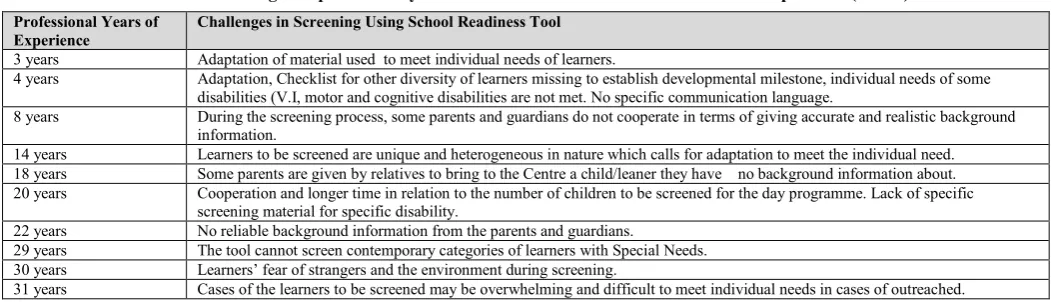
Table 5. Challenges Experienced By the Professionals of Various Years of Work Experience (n = 25)
Professional Years of Experience
Challenges in Screening Using School Readiness Tool
3 years Adaptation of material used to meet individual needs of learners.
4 years Adaptation, Checklist for other diversity of learners missing to establish developmental milestone, individual needs of some
disabilities (V.I, motor and cognitive disabilities are not met. No specific communication language.
8 years During the screening process, some parents and guardians do not cooperate in terms of giving accurate and realistic background
information.
14 years Learners to be screened are unique and heterogeneous in nature which calls for adaptation to meet the individual need.
18 years Some parents are given by relatives to bring to the Centre a child/leaner they have no background information about.
20 years Cooperation and longer time in relation to the number of children to be screened for the day programme. Lack of specific
screening material for specific disability.
22 years No reliable background information from the parents and guardians.
29 years The tool cannot screen contemporary categories of learners with Special Needs.
30 years Learners’ fear of strangers and the environment during screening.
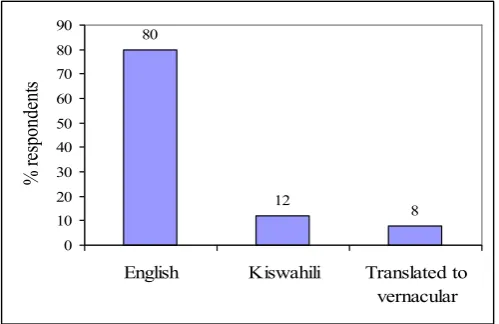
instance from vernacular to Kiswahili, interpretation of English to Kiswahili or vernacular. Forty four per cent of the assessors said there was lack of proper interpretation of the language level of the learners. Some children lack expressive language abilities for example learners with autistic cases. Most parents and guardians are illiterate and use vernacular as the only language for communication. Only mother tongue language was used during screening. During screening mother tongue is used. From the study finding, Government of Kenya has a mother tongue policy where children in preschool and lower primary are supposed to be taught in their mother tongue. This implied that assessment in centres in rural areas and arid areas should use a screening tool translated into mother tongue. In this study the School Readiness Screening Tool was established to be mainly in English language version. This implied that the education assessment professionals had to interpret the language during assessment.
Figure 1. Language Version of School Readiness Screening Tool
Figure 1 explains further the use of English, Kiswahili and Translated vernacular. Some of the language difficulties faced during the screening in use of School Readiness Screening
Tool were found to be; Problem of useof mother tongue mixed
with Kiswahili, Lackof proper interpretation of the language
level of the learners and Translation becomes a problem for instance from vernacular to Kiswahili. The educational
assessment professionals also had difficulties of useof mother
tongue and Kiswahili in communication and mixing of languages, for instance Kiswahili and mother tongue and the process of screening requires some time and preparation, and may bring about boredom from the client, hence some response can be arbitrary.
(d) Challenge in Experience of the Assessors in Using the
Tool: The study sought to establish challenges in Experience
of the Assessors in Using the Tool. Table 5 shows across tabulation of the challenges experienced by the professionals of various years of work experience. Table 5 shows Cross tabulation of the challenges experienced by the professionals of various years of work experience. The study established the relationship in the professionals work experience and the difficulties they experienced in using school readiness screening tool. Using across tabulation to establish the relationship in the professionals work experience and the difficulties they experienced in using school readiness screening tool, the result showed that there was no significant
relationship (χ2 = 230.00, P = 0.164). This implied that the
difficulties were experienced across the various years of work
experience of the professionals. The difficulties experienced in using the tool by long serving professionals were similarly experienced by the new professionals. The Educational professionals who have experience ranging from 3 years to 31years in using the tool will still face the challenges in, screening learners who are blind and with visual difficulties, parents giving false background information and learner/child brought to the centre by a relative who have no background information of the child.
Conclusion
Use of school readiness screening tool for learners with special needs
Study conclusions gave rise to the following challenges in the use of school readiness screening tool for Learners with Special Needs:
(a). Challenges in the scope of school readiness screening tool:
Study findings revealed thatscreening using school readiness
screening tool used by educational assessment and resource
professionals does not screen areas especially of learners in following categories:
Learners with autism, learners with severe cerebral palsy, emotional and behavioural difficulties, speech and language difficulties, mentally handicapped and visual impaired. The tool does not also screen special needs related to emotional and behavioural difficulties, epilepsy, physically handicapped, visually impaired and learners with specific learning difficulties and learners with severe motor difficulties, and learners with speech and language difficulties.
(b). Challenges in adaptation to meet the individual needs
of the learners: Findings also revealed that difficulties faced
in the adaptation meet the individual needs of the learners. School readiness screening tools does not cover all test items for different diversities of children with special needs, 88% of educational assessment professional confirmed this. In addition, 68% of the professionals noted the need to add content the school readiness screening tool to meet the contemporary individual needs of learners with special needs and disabilities. According to research finding it’s necessary to do adaption of screening tool, this can also be done by incorporation and bridging cultural values, which were pointed out by 72% of the professional. Research findings showed that there was shortage of trained personnel confirmed by 80% of the professionals working in the centres.
(c). Challenges in language and communication in using
school readiness screening tool: Some of the language
difficulties faced during screening in the use of school
readiness screening tool were found to be; problem of useof
mother tongue mixed with Kiswahili, lack of proper
interpretation of the language level of the learners and translation becomes a problem for instance from vernacular to Kiswahili. Educational assessment professionals also had
difficulties of use of mother tongue and Kiswahili in
communication and mixing of languages, for instance Kiswahili and mother tongue and the process of screening requires some time and preparation, and may bring about boredom from the client.
80
12
8 0
10 20 30 40 50 60 70 80 90
English Kiswahili Translated to
vernacular
%
r
es
pondent
(d). Challenge in experience of the assessors in using the
tool: Difficulties in experience of assessors in using the tool
were experienced across the various years of work experience of the professionals. Difficulties experienced in using the tool by long serving professionals were similarly experienced by new professionals.
Recommendation
Based on the research findings and conclusions of the study, the following recommendations were made:
Since the school readiness screening tools materials
cannot adequately screen the contemporary categories of learners with special needs and disabilities, additional content and communication strategy should be devised. There should be the use of Braille materials, laminated coloured pictures, large print for
low vision, cognitive developmental checklist.
Additional content in the referral form for more details of intervention and placement strategies and sustainable multidisciplinary approach in the screening process.
There is urgent need for Kenya Institute of Curriculum
Development to establish panel for multidisciplinary specialist in educational assessment and development, do the adaption of screening material used in school readiness screening tool to meet the individual needs for contemporary categories for learners with special needs and disabilities. Assessors should not be left to use their own coping strategies to adapt the screening material to meet the individual needs for example, in handling a learner who is blind with autism and with speech and language difficulties.
The Ministry of Education through Quality Assurance
Standards, Kenya Institute of Curriculum Development
should involve all stakeholders, parents,
multidisciplinary professionals working in educational centres and the educational assessment professionals in validation of the screening tools.
REFERENCES
Braun, M.K and Kanjee, A. H. 2006. Improving Education Through Assessment Innovation And Evaluation. New York: American Academy Of Arts and Sciences Publication.
Cohen, L., Manion L., And Morrison. K. 2014. Research Methods in Education 7th Edition. New York: Routledge.
Gall, M.M.D. 2014. Applying Educational Research: How to Read, Do, and Use Research to Solve Problems of Practice. (6th Edition). London: Pearson Publication.
Kochung’, E., J. 2003. The Role of Higher Education in Promoting Inclusive Education: Kenyan Perspective: Journal of Emerging Trends In Education. Vol. 2 Number 3. Available online on 23th August 2019 at 02.00 PM at; Jesteraps.Scholarlinkresearch.Org/Articles/Role.of.Higher.Edu
cationin.Promoting.Inclusive Education.Pdf.
Orodho, A.J. 2009. Techniques of Writing Research Proposals and Reports in Education and Social Sciences. 2nd Ed.Nairobi: Kanezja Enterprises.
Republic of Kenya, 2012. Ministry of Education Task Force on The Re-Alignment of The Education Sector To The Constitution of Kenya Towards A Globally Competitive Quality Education For Sustainable Development Report of The Task Force. Nairobi: Government Printers.
_____________ 1999. Koech Report on: The Commission of Inquiry into the Education Systems of Kenya. Totally Integrated Quality and Training. Nairobi: Government Printers.
_____________ 2001. Children’s Act Kenya. Nairobi: Government Printers.
_____________ 2003. A Report of The Taskforce on Special Needs Education. Nairobi: Government Printer.
_____________ 2004. Ministry of Education: A Report of The Task Force on Special Needs Education Appraisal
Exercise.(Kochung’ Report). Nairobi: Government
Printers.
_____________ 2005) Kenya Education Sector Support Programme 2005-2010; Delivering Quality Education and Training to All Kenyans. Nairobi: Government Printers. _____________ 2008. Special Needs Education Draft Policy.
Nairobi: Government Printers.
_____________ 2009. The National Special Needs Education Policy Framework. Nairobi: Government Printers.
Republic of Australia 2005. The State of South Australia, Department of Education And Children’s Services Produced. Hindmarsh. Port Road: Decs Publishers.
Richard, S. and Hornby, G. 2000. Meeting Special Needs in Mainstream Schools. A Practical Guide for Teachers. (2nd Edition). Fulton: Taylor and Francis Publishers.
Silverman, D. 2009. Interpreting Qualitative Data (3rd Ed.). London: Sage Printers.
Welfondale, S. 2000. Empowering Parents and Teachers: Working For Children. London: Cassel.