IJIRMPS1802001
Website :
www.ijirmps.org
Email : [email protected]
1
A Novel Approach to Enhance Teaching and
Learning Through Mining and Learning Analytics
1Ms. Payal Bhatt, 2Prof. Akansha Chauhan
1Research Scholar, 2Assistant Professor
Indus University
ABSTRACT: Material and message skills brought-in utensils and methods in the field of learning that familiarized new notions of instruction and education. Learning supervision Scheme is one of the key tackles used in educational institutes to simplify e-learning. There is extraordinary digital divide between town and pastoral zones. Use of e-learning programs has been intensifying, with high demand for education, particularly in developing countries. The research addresses the problem of learning service quality in higher education environment. So it is more important to evaluate the superiority of e-learning contributions, as it is serious to the package accomplishment and endurance. In universal the detached is to have a cost operative education atmosphere fortified with the modern skills to afford apprentices an occasion to get understanding hooked on new material and message skills and e-learning atmosphere.
Keywords: e-learning, service superiority, fulfilment, learning gratified
1. INTRODUCTION
Due to drastic improvement in information and communications technology (ICT) the E-learning has obtained a remarkable position. E-Learning differs extensively from traditional classroom education by its synchronous and asynchronous behavior.
This education examines the effect of scholar arrogances on the getting of E-Learning. The data withdrawal knowledge is smeared to foresee the behavior of E-Leaning Excellence of students calculation based on the individual norms and discernments. It also recognizes key variables that can be unhurried and investigated to sustenance an experimental calculation of the consequence of the variables on the purpose to assume E-Learning.
The Research work is organized as follows. The segment one defines about overview. Section 2 contracts about contextual study and its linked mechanism. The organization of the investigation work is clarified in section three. In section four representations the Research results. Lastly the paper is determined in last piece.
2. BACKGROUND AND RELATED WORKS
2.1 Literature Review
In this paper, diversified approach using various data mining techniques are collected to analyse and predict the e-learning quality of student’s at various levels. The study related to data mining for extracting and predicting the e-learning rate prediction in various models and the comprehensive literature review of various researchers’ works are stated below:
Mazen Qteishat, Jafar Alqatawna and Mohammad Al-Maaitah examined the influences causative to insolences near E-Learning in higher schooling between scholars in Jordan. The investigation industrialized a ERM-EL (Expertise Reception Model for E-learning) for forecasting the purpose to adopt E-Learning by the concepts of the Knowledge Reception Prototypical [9].
A.S. Arunachalam, and T.Velmurugan absorbed on gathering dissimilar models and inquiries from dissimilar colleges who uses E Learning tackles and pre course the composed greatest for the best explanations to appreciate the behavioral decorations of the scholars. Their training gave a clear knowledge of numerous landscapes removed for studying the behavioral decoration of a scholar with E Learning implement. They also painted new expansions counting investigation of data from enormous open operational sequences (MOOCs).
3. METHODOLOGY
E Learning analytics delivers cultured exploratory capability to progress the knowledge and schooling. It magnets after other grounds of study counting occupational acumen, web analytics, theoretical analytics, enlightening data withdrawal, and exploit analytics [11].
The education and learning purposes are:
IJIRMPS1802001
Website :
www.ijirmps.org
Email : [email protected]
2
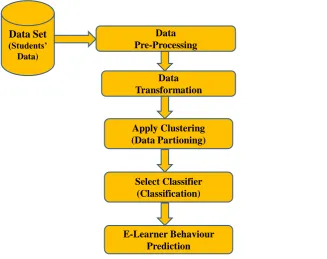
The submissions of numerous data mining techniques which is adopted as a methodology to analyse and predict the E-Learning ability of the students. The most predictive data models applied are artificial neural networks, Naïve Bayes, K-Nearest Neighbour (KNN), Support Vector Machine, logistic regression, classification trees, classification and regression trees and discriminant analysis. The following section describes the popular models which are used to analyse the learning behaviour and characteristics of Students’. The steps involved in for analyzing the learning behaviour of Student’s is explained in Figure 1.Data Transformation Data Set
(Students’ Data)
Apply Clustering (Data Partioning)
Data Pre-Processing
E-Learner Behaviour Prediction Select Classifier
(Classification)
Figure 1: Steps involved in Predicting the Behaviour of E-Learner
4. EXPERIMENT RESULTS
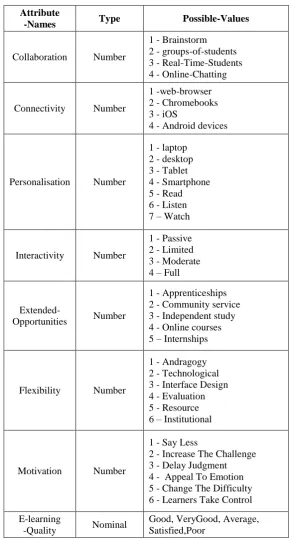
The data set is collected from various College students’ who are studying at Sivagangai district. At the outset a sample of 300 data is taken for analysis with different attributes. The description of Attributes is explained in Table 1.
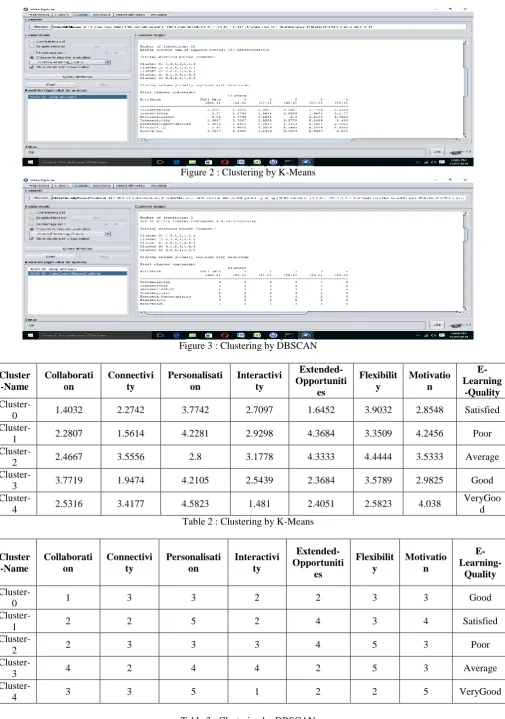
The data set has been pre-processed; The K-Means and DBSCAN algorithms are applied over the data to partioning the data into (K = 5) different clusters. The Random initialization method and the ten as the initial seed value are used to form the clusters. In K-Means, the Euclidean Distance and in DBSCAN, the Manhattan Distance metrics are used to measure distance between of an observation and the initial cluster centroids.
IJIRMPS1802001
Website :
www.ijirmps.org
Email : [email protected]
3
Attribute-Names Type Possible-Values
Collaboration Number
1 - Brainstorm 2 - groups-of-students 3 - Real-Time-Students 4 - Online-Chatting
Connectivity Number
1 -web-browser 2 - Chromebooks 3 - iOS
4 - Android devices
Personalisation Number
1 - laptop 2 - desktop 3 - Tablet 4 - Smartphone 5 - Read 6 - Listen 7 – Watch
Interactivity Number
1 - Passive 2 - Limited 3 - Moderate 4 – Full
Extended-Opportunities Number
1 - Apprenticeships 2 - Community service 3 - Independent study 4 - Online courses 5 – Internships
Flexibility Number
1 - Andragogy 2 - Technological 3 - Interface Design 4 - Evaluation 5 - Resource 6 – Institutional
Motivation Number
1 - Say Less
2 - Increase The Challenge 3 - Delay Judgment 4 - Appeal To Emotion 5 - Change The Difficulty 6 - Learners Take Control
E-learning
-Quality Nominal
Good, VeryGood, Average, Satisfied,Poor
IJIRMPS1802001
Website :
www.ijirmps.org
Email : [email protected]
4
Figure 2 : Clustering by K-MeansFigure 3 : Clustering by DBSCAN
Cluster -Name Collaborati on Connectivi ty Personalisati on Interactivi ty Extended-Opportuniti es Flexibilit y Motivatio n E-Learning -Quality
Cluster-0 1.4032 2.2742 3.7742 2.7097 1.6452 3.9032 2.8548 Satisfied
Cluster-1 2.2807 1.5614 4.2281 2.9298 4.3684 3.3509 4.2456 Poor
Cluster-2 2.4667 3.5556 2.8 3.1778 4.3333 4.4444 3.5333 Average
Cluster-3 3.7719 1.9474 4.2105 2.5439 2.3684 3.5789 2.9825 Good
Cluster-4 2.5316 3.4177 4.5823 1.481 2.4051 2.5823 4.038
VeryGoo d Table 2 : Clustering by K-Means
Cluster -Name Collaborati on Connectivi ty Personalisati on Interactivi ty Extended-Opportuniti es Flexibilit y Motivatio n E- Learning-Quality
Cluster-0 1 3 3 2 2 3 3 Good
Cluster-1 2 2 5 2 4 3 4 Satisfied
Cluster-2 2 3 3 3 4 5 3 Poor
Cluster-3 4 2 4 4 2 5 3 Average
Cluster-4 3 3 5 1 2 2 5 VeryGood
IJIRMPS1802001
Website :
www.ijirmps.org
Email : [email protected]
5
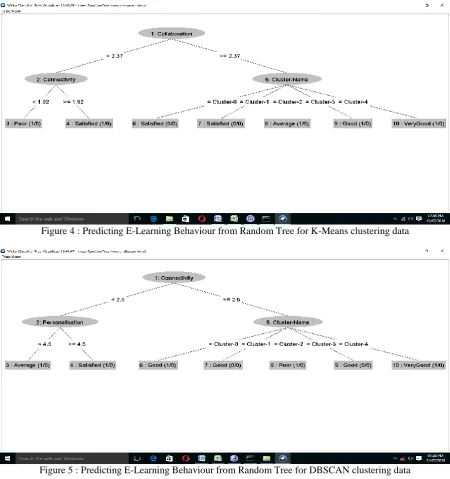
Figure 4 : Predicting E-Learning Behaviour from Random Tree for K-Means clustering dataFigure 5 : Predicting E-Learning Behaviour from Random Tree for DBSCAN clustering data
Classification
for- Cluster data MAE RMSE
Random-Tree
(K-Means) 0 0
Random-Tree
(DBSCAN) 0 0
IJIRMPS1802001
Website :
www.ijirmps.org
Email : [email protected]
6
Figure 6: Error-Accuracy by Classification for Cluster data5. CONCLUSION
E-learning is a new dimension of education system. The traditional approach in education is monotonous as well as predefined. In this paper the attributes of e-learning are analyzed Through the K-means and DBSCAN algorithms for grouping of similar data.The Random Tree classification algorithm is applied over the clustered data for predicting E-Learning quality of the students. The “E-Learning Quality” attribute is considered as the class label for the classification. The outcome of the classification algorithm generated the tree for the clustered data. From the tree generated for K-means data the e-learning qualities are classified as satisfied, poor, Average, good and Very good. Similarly for DBSCAN the e-learning qualities are predicted as Good, Satified, poor, Average and VeryGood. The error accuracy is analyed by Random Tree for different measure metrics MAE and RMSE which produced no errors. It substantiate that the essential care and importance should be given to the e-learning students in accordance with their categories.
REFERENCES
1. Marie Bienkowski, Mingyu Feng and Barbara Means, “Enhancing Teaching and Learning Through Educational Data Mining
and Learning Analytics: An Issue Brief”, U.S. Department of Education, October 2012.
2. Mazen Qteishat, Haitham Alshibly, Ja'far Alqatawna and Mohammad Al-Ma’aitah,” Factors Influencing the Adoption of
E-Learning in Jordan: an Extended TAM Model”, European Journal of Business and Management, ISSN 2222-1905 (Paper) ISSN 2222-2839 (Online) Vol.5, No.18, 2013.
3. Rahul B. Diwate , Amit Sahu,” Data Mining Techniques in Association Rule : A Review”, (IJCSIT) International Journal of
Computer Science and Information Technologies, Vol. 5 (1) , 2014, 227 -229.
4. Syeda Farha Shazmeen, Mirza Mustafa Ali Baig, and M.Reena Pawar,” Performance Evaluation of Different Data Mining
Classification Algorithm and Predictive Analysis”, IOSR Journal of Computer Engineering (IOSR-JCE) e-ISSN: 2278-0661, p- ISSN: 2278-8727Volume 10, Issue 6 (May. - Jun. 2013), PP 01-06.
5. Sahil P. Karkhanis, Shweta S. Dumbre,” A Study of Application of Data Mining and Analytics in Education Domain”,
International Journal of Computer Applications (0975 – 8887) Volume 120 – No.22, June 2015.
6. Dr. N. Venkatesan,” Role Of Data Mining Techniques In Educational And E-Learning System”, Apjr international journal
,Volume: II, Issue: VII ,August 2013.
7. Sachin R. Barahate,” Educational Data Mining as a Trend of Data Mining in Educational System”, International Conference &
Workshop on Recent Trends in Technology, Proceedings published in International Journal of Computer,(TCET) 2012.
8. Shimaa Abd Elkader Abd Elaal,”ELearning Using Data Mining”, ChineseEgyptian Research Journal, Vol. 5 (1) , 2014, 227
-229.
9. Sujeet Kumar Sharma, Jyoti Kumar Chandel,” Technology acceptance model for the use of learning through websites among
students in Oman”, International Arab Journal of Information Technology · January 2013.
10.Davoud Masoumi, Berner Lindström,” Quality in e-learning: A framework for promoting and assuring quality in virtual
institutions”, Journal of Computer Assisted Learning · February 2012.
11.L.Calvet Liñán, and A. Juan Pérez, “Educational Data Mining and Learning Analytics: differences, similarities, and time
evolution” RUSC. Universities and Knowledge Society Journal, (2015). 12(3). pp. 98-112.
12.Nahid shirani bidabadi, Ahmmadreza nasr isfahani, Amir rouhollahi,and Roya khalili,”Effective Teaching Methods in Higher
Education: Requirements and Barriers”,J Adv Med Educ Prof. 2016 Oct; 4(4): 170–178.
13.Birendra Kumar Sahu,” K-Means Clustering Algorithm - Case Study “,CTO & Vice President – Technology, Published on May
18, 2018.
14.K.Vanitha, G.Roch Libia Rani,” Analysis of Classification and Clustering Algorithms using Weka For Banking Data”,
International Journal of Advanced Research in Computer Science, 1 (4), Nov. –Dec, 2010, 104-107.
E
rr
ors
-in
-Per
ce
nt
age
Evaluation-Metrics
Random-Tree (K-Means)
IJIRMPS1802001
Website :
www.ijirmps.org
Email : [email protected]
7
15.Dr.R.Geetha Ramani ,G. Sivagami and Shomona Gracia Jacob,” Feature Relevance Analysis and Classification of
ParkinsonDisease Tele-Monitoring Data Through Data MiningTechniques”, International Journal of Advanced Research in
Computer Science and Software Engineering, Volume 2, Issue 3, March 2012ISSN: 2277 128X.
16.N. Menaga, Dr. B. Umadevi,” A Perspective Review on E-Learning Promotions and Development”, International Journal of
Computer Science and Mobile Applications, Vol.6 Issue. 6, June- 2018, pg. 16-22.
17.Dr. B. Umadevi, and R. Dhanalakshmi, “A Comprehensive Survey of Students Performance Using Various Data Mining